belt TOYOTA HIGHLANDER 2020 (in English) Repair Manual
[x] Cancel search | Manufacturer: TOYOTA, Model Year: 2020, Model line: HIGHLANDER, Model: TOYOTA HIGHLANDER 2020Pages: 560, PDF Size: 14.42 MB
Page 443 of 560
4437-1. Essential information
HIGHLANDER_U
7
When trouble arises
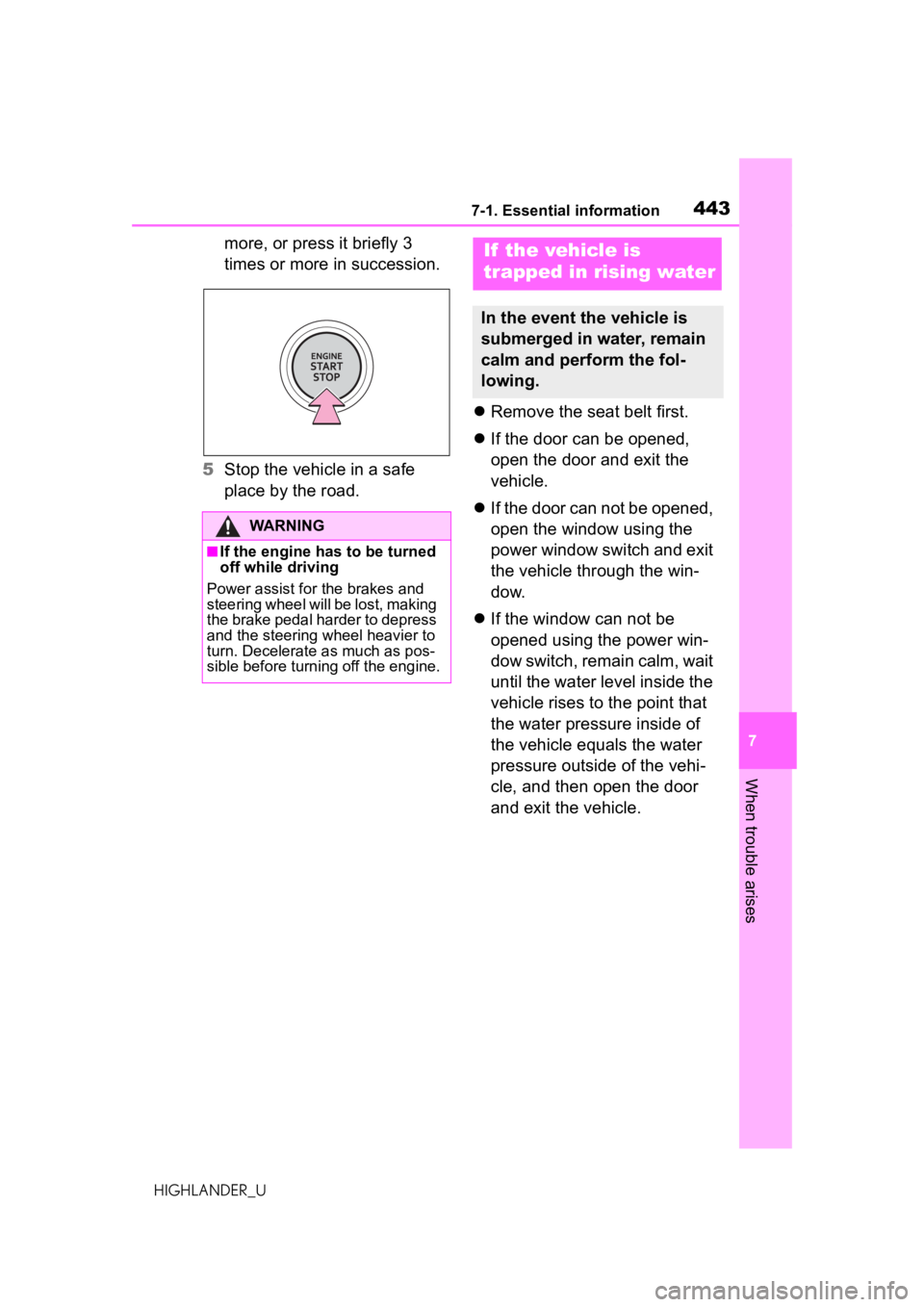
more, or press it briefly 3
times or more in succession.
5 Stop the vehicle in a safe
place by the road.
Remove the seat belt first.
If the door can be opened,
open the door and exit the
vehicle.
If the door can not be opened,
open the window using the
power window switch and exit
the vehicle through the win-
dow.
If the window can not be
opened using the power win-
dow switch, remain calm, wait
until the water level inside the
vehicle rises to the point that
the water pressure inside of
the vehicle equals the water
pressure outside of the vehi-
cle, and then open the door
and exit the vehicle.
WARNING
■If the engine has to be turned
off while driving
Power assist for the brakes and
steering wheel will be lost, making
the brake pedal harder to depress
and the steering wheel heavier to
turn. Decelerate as much as pos-
sible before turning off the engine.
If the vehicle is
trapped in rising water
In the event the vehicle is
submerged in water, remain
calm and perform the fol-
lowing.
Page 451 of 560
4517-2. Steps to take in an emergency
HIGHLANDER_U
7
When trouble arises
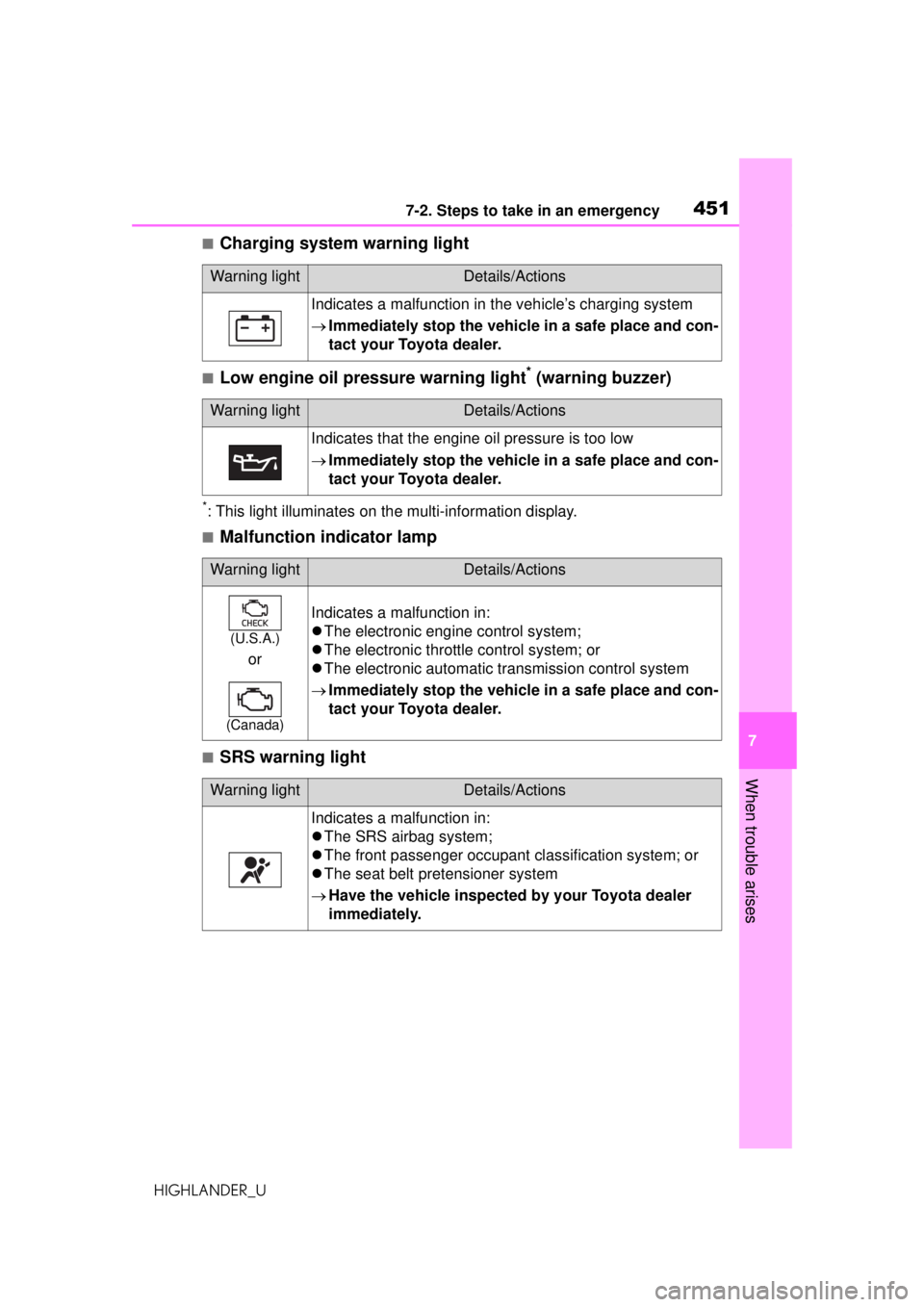
■Charging system warning light
■Low engine oil pressure warning light* (warning buzzer)
*: This light illuminates on th e multi-information display.
■Malfunction indicator lamp
■SRS warning light
Warning lightDetails/Actions
Indicates a malfunction in the vehicle’s charging system
Immediately stop the vehicle in a safe place and con-
tact your Toyota dealer.
Warning lightDetails/Actions
Indicates that the engine oil pressure is too low
Immediately stop the vehicle in a safe place and con-
tact your Toyota dealer.
Warning lightDetails/Actions
(U.S.A.)
or
(Canada)
Indicates a malfunction in:
The electronic engine control system;
The electronic throttle control system; or
The electronic automatic transmission control system
Immediately stop the vehicle in a safe place and con-
tact your Toyota dealer.
Warning lightDetails/Actions
Indicates a malfunction in:
The SRS airbag system;
The front passenger occupant classification system; or
The seat belt pretensioner system
Have the vehicle inspected by your Toyota dealer
immediately.
Page 453 of 560
4537-2. Steps to take in an emergency
HIGHLANDER_U
7
When trouble arises
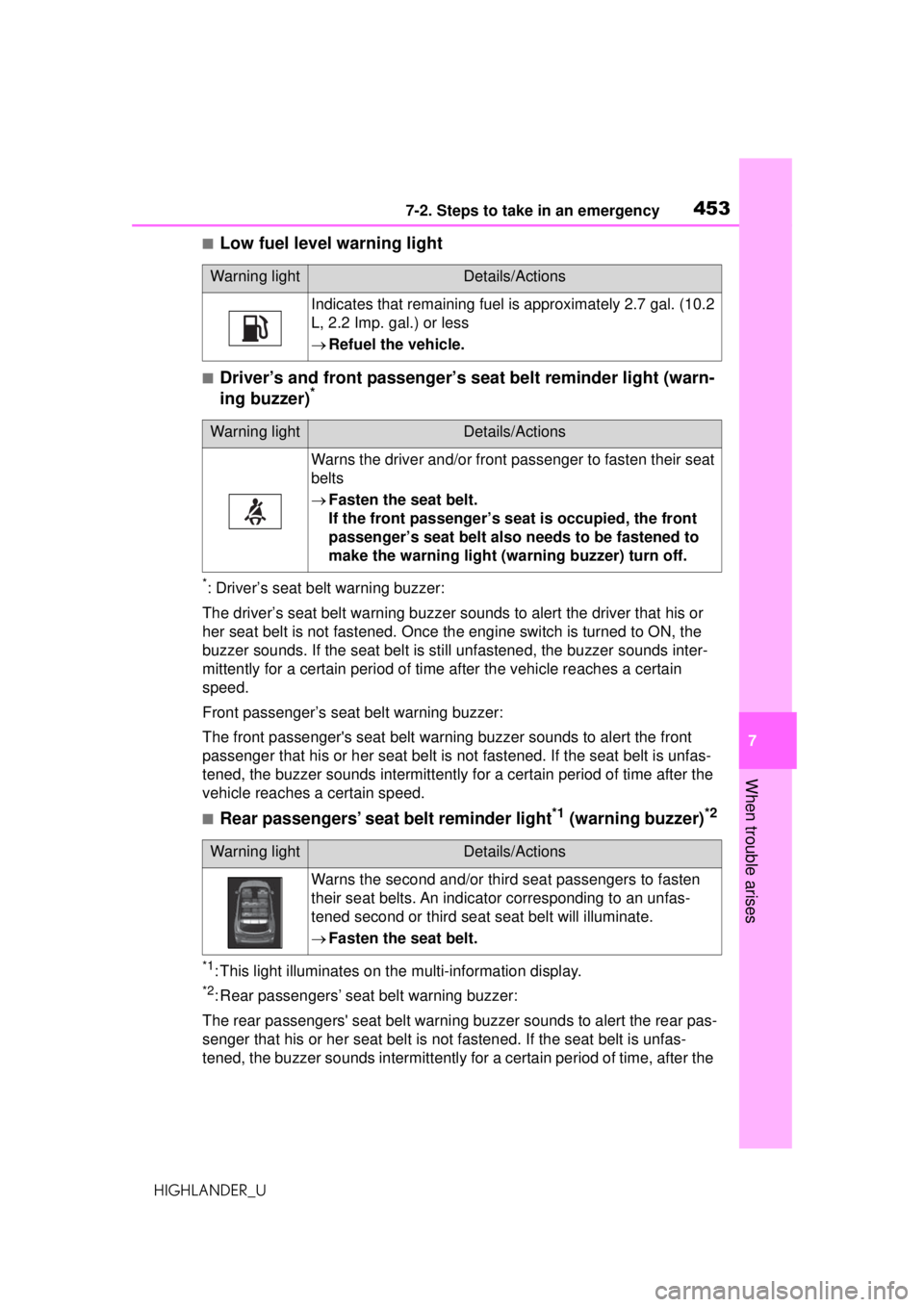
■Low fuel level warning light
■Driver’s and front passenger’s seat belt reminder light (warn-
ing buzzer)*
*: Driver’s seat belt warning buzzer:
The driver’s seat belt wa rning buzzer sounds to alert the driver that his or
her seat belt is not fastened. Once the engine switch is turned to ON, the
buzzer sounds. If the seat belt is st ill unfastened, the buzzer sounds inter-
mittently for a certain period of time after the vehicle reaches a certain
speed.
Front passenger’s seat belt warning buzzer:
The front passenger's seat belt warning buzzer sounds to alert the front
passenger that his or her seat belt is not fastened. If the seat belt is unfas-
tened, the buzzer sounds intermittently for a certain period of time after the
vehicle reaches a certain speed.
■Rear passengers’ seat belt reminder light*1 (warning buzzer)*2
*1: This light illuminates on the multi-information display.
*2: Rear passengers’ seat belt warning buzzer:
The rear passengers' seat belt warning buzzer sounds to alert the rear pas-
senger that his or her seat belt is not fastened. If the seat belt is unfas-
tened, the buzzer sounds intermittently for a certain period of time, after the
Warning lightDetails/Actions
Indicates that remaining fuel is approximately 2.7 gal. (10.2
L, 2.2 Imp. gal.) or less
Refuel the vehicle.
Warning lightDetails/Actions
Warns the driver and/or front pa ssenger to fasten their seat
belts
Fasten the seat belt.
If the front passenger’s seat is occupied, the front
passenger’s seat belt also needs to be fastened to
make the warning light (warning buzzer) turn off.
Warning lightDetails/Actions
Warns the second and/or third seat passengers to fasten
their seat belts. An indicator corresponding to an unfas-
tened second or th ird seat seat belt will illuminate.
Fasten the seat belt.
Page 454 of 560
4547-2. Steps to take in an emergency
HIGHLANDER_Useat belt is fastened and unfastened and the vehicle reaches a certain
speed.
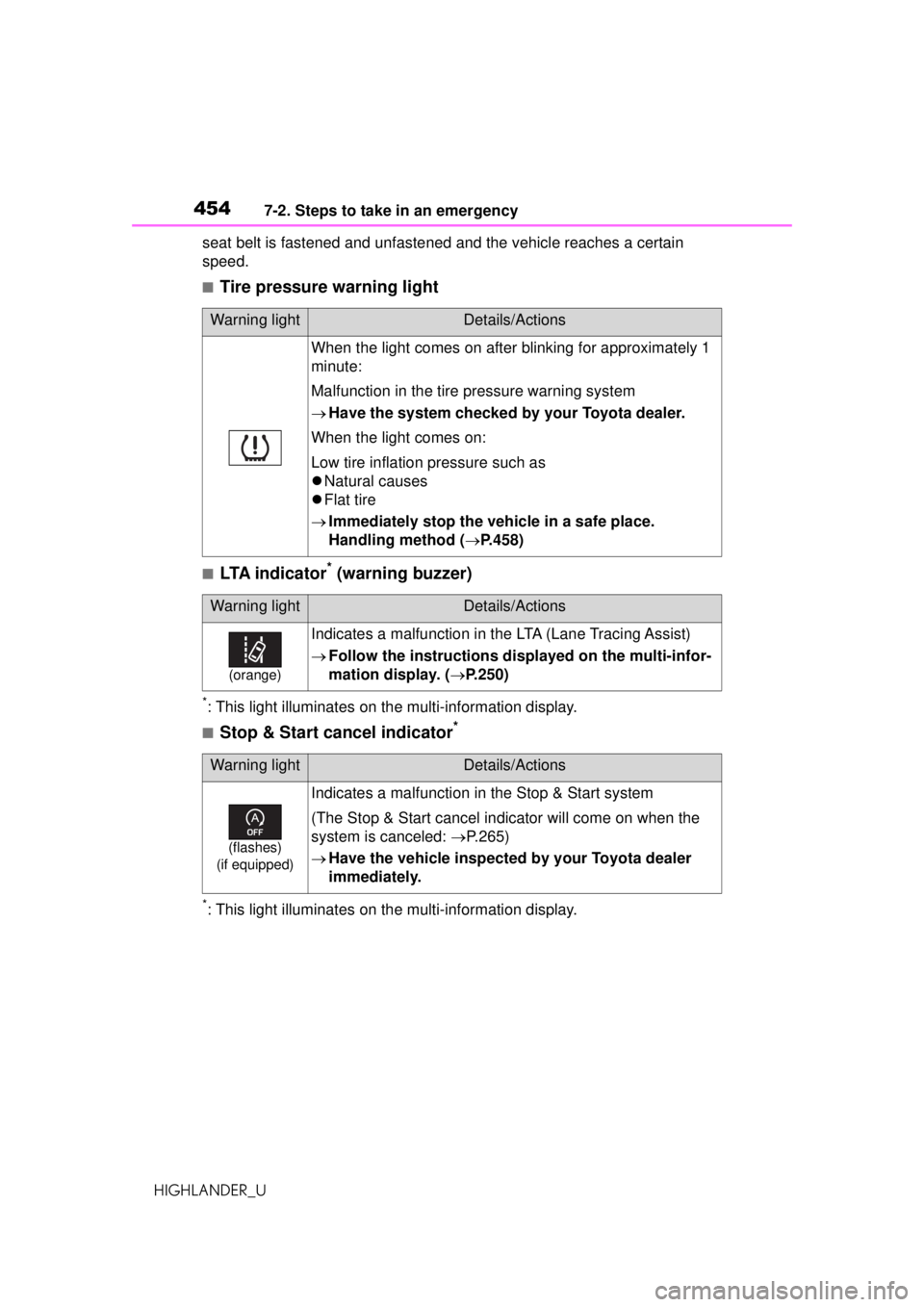
■Tire pressure warning light
■LTA indicator* (warning buzzer)
*: This light illuminates on th
e multi-information display.
■Stop & Start cancel indicator*
*: This light illuminates on the multi-information display.
Warning lightDetails/Actions
When the light comes on after blinking for approximately 1
minute:
Malfunction in the tire pressure warning system
Have the system checked by your Toyota dealer.
When the light comes on:
Low tire inflation pressure such as
Natural causes
Flat tire
Immediately stop the ve hicle in a safe place.
Handling method ( P.458)
Warning lightDetails/Actions
(orange)
Indicates a malfunction in the LTA (Lane Tracing Assist)
Follow the instructions di splayed on the multi-infor-
mation display. ( P.250)
Warning lightDetails/Actions
(flashes)
(if equipped)
Indicates a malfunction in the Stop & Start system
(The Stop & Start cancel in dicator will come on when the
system is canceled: P.265)
Have the vehicle inspected by your Toyota dealer
immediately.
Page 457 of 560
4577-2. Steps to take in an emergency
HIGHLANDER_U
7
When trouble arises
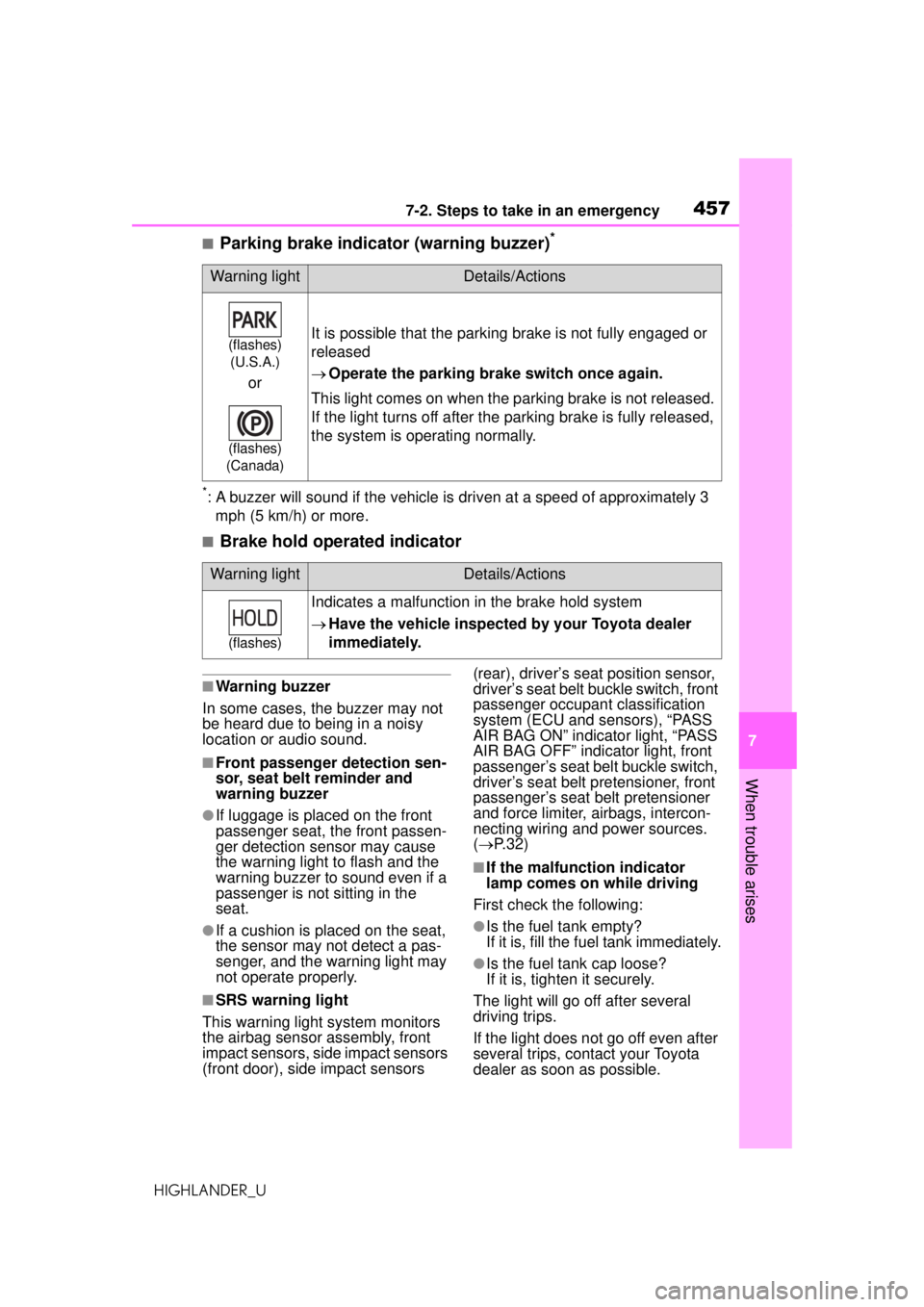
■Parking brake indicator (warning buzzer)*
*: A buzzer will sound if the vehicle is driven at a speed of approximately 3
mph (5 km/h) or more.
■Brake hold operated indicator
■Warning buzzer
In some cases, the buzzer may not
be heard due to being in a noisy
location or audio sound.
■Front passenger detection sen-
sor, seat belt reminder and
warning buzzer
●If luggage is placed on the front
passenger seat, the front passen-
ger detection sensor may cause
the warning light to flash and the
warning buzzer to sound even if a
passenger is not sitting in the
seat.
●If a cushion is placed on the seat,
the sensor may not detect a pas-
senger, and the warning light may
not operate properly.
■SRS warning light
This warning light system monitors
the airbag sensor assembly, front
impact sensors, si de impact sensors
(front door), side impact sensors (rear), driver’s seat position sensor,
driver’s seat belt buckle switch, front
passenger occupant classification
system (ECU and sensors), “PASS
AIR BAG ON” indicator light, “PASS
AIR BAG OFF” indicator light, front
passenger’s seat belt buckle switch,
driver’s seat belt pretensioner, front
passenger’s seat belt pretensioner
and force limiter, airbags, intercon-
necting wiring and power sources.
(
P. 3 2 )
■If the malfunction indicator
lamp comes on while driving
First check the following:
●Is the fuel tank empty?
If it is, fill the fuel tank immediately.
●Is the fuel tank cap loose?
If it is, tighten it securely.
The light will go off after several
driving trips.
If the light does not go off even after
several trips, cont act your Toyota
dealer as soon as possible.
Warning lightDetails/Actions
(flashes)
(U.S.A.)
or
(flashes)
(Canada)
It is possible that the parking brake is not fully engaged or
released
Operate the parking brake switch once again.
This light comes on when the parking brake is not released.
If the light turns off after the parking brake is fully released,
the system is operating normally.
Warning lightDetails/Actions
(flashes)
Indicates a malfunction in the brake hold system
Have the vehicle inspected by your Toyota dealer
immediately.
Page 486 of 560
4867-2. Steps to take in an emergency
HIGHLANDER_Ulent (65Ah) or greater, and perfor-
mance rating (CCA) is equivalent
(603A) or greater.
• If the sizes differ, the battery can-
not be properly secured.
• If the 20 hour rate capacity is low,
even if the time period where the
vehicle is not used is a short time,
the battery may discharge and the
engine may not be able to start.
For details, consult your Toyota
dealer.
WARNING
■When removing the battery
terminals
Always remove the negative (-)
terminal first. If the positive (+) ter-
minal contacts any metal in the
surrounding area when the posi-
tive (+) terminal is removed, a
spark may occur, le ading to a fire
in addition to electrical shocks
and death or serious injury.
■Avoiding battery fires or
explosions
Observe the following precautions
to prevent accidentally igniting the
flammable gas that may be emit-
ted from the battery:
●Make sure each jumper cable is
connected to the correct termi-
nal and that it is not unintention-
ally in contact with any other
than the intended terminal.
●Do not allow the other end of
the jumper cable connected to
the “+” terminal to come into
contact with any other parts or
metal surfaces in the area, such
as brackets or unpainted metal.
●Do not allow the + and - clamps
of the jumper cables to come
into contact with each other.
●Do not smoke, use matches,
cigarette lighters or allow open
flame near the battery.
■Battery precautions
The battery contains poisonous
and corrosive acidic electrolyte,
while related parts contain lead
and lead compounds. Observe
the following precautions when
handling the battery:
●When working with the battery,
always wear safety glasses and
take care not to allow any bat-
tery fluids (acid) to come into
contact with skin, clothing or the
vehicle body.
●Do not lean over the battery.
●In the event that battery fluid
comes into contact with the skin
or eyes, immediately wash the
affected area with water and
seek medical attention. Place a
wet sponge or cloth over the
affected area until medical
attention can be received.
●Always wash your hands after
handling the battery support,
terminals, and other bat-
tery-related parts.
●Do not allow children near the
battery.
■When replacing the battery
●When the vent plug and indica-
tor are close to the hold down
clamp, the battery fluid (sulfuric
acid) may leak.
●For information regarding bat-
tery replacement, contact your
Toyota dealer.
NOTICE
■When handling jumper cables
When connecting the jumper
cables, ensure that they do not
become entangled in the cooling
fan or engine drive belt.
Page 488 of 560
4887-2. Steps to take in an emergency
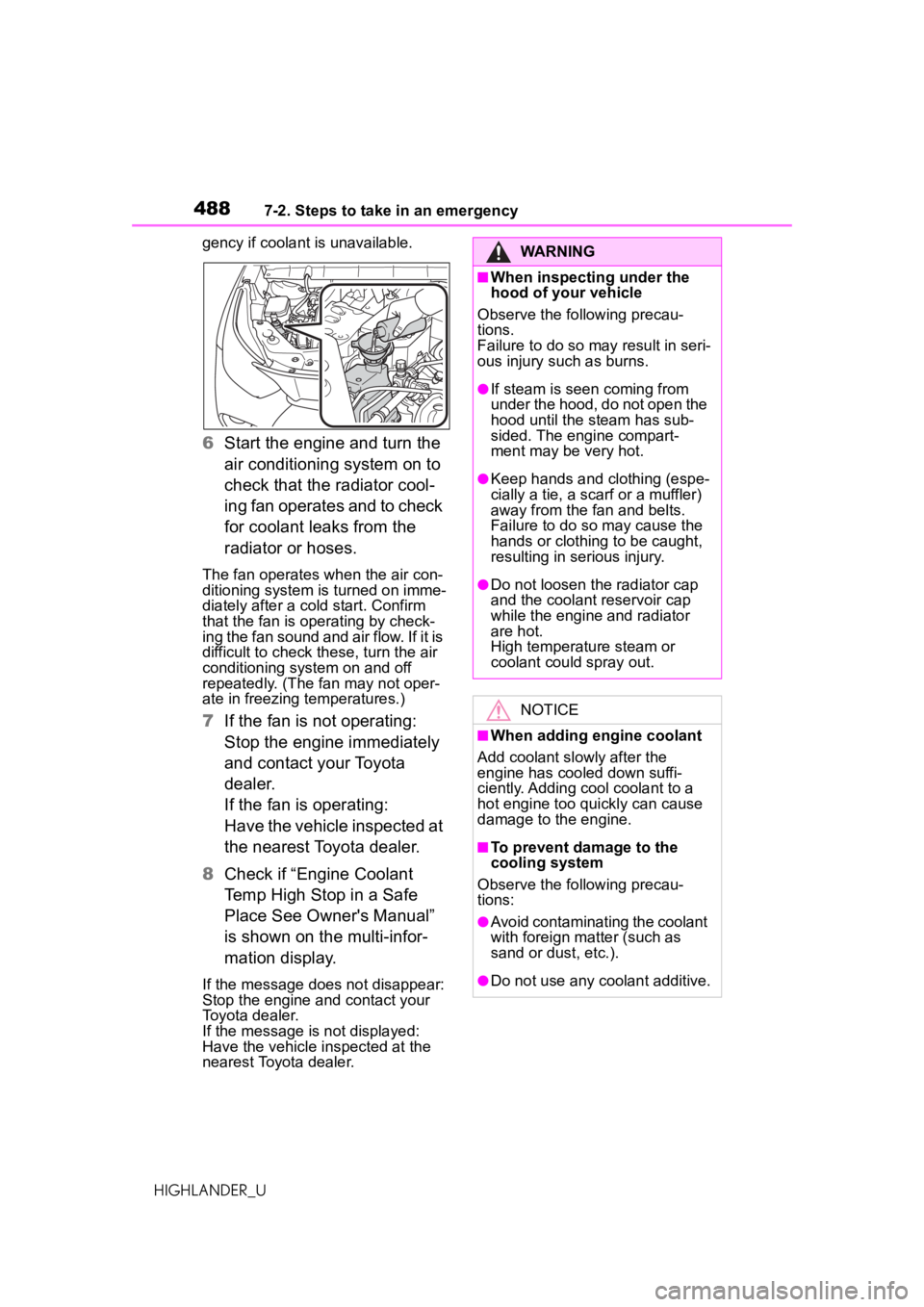
HIGHLANDER_Ugency if coolant is unavailable.
6
Start the engine and turn the
air conditioning system on to
check that the radiator cool-
ing fan operates and to check
for coolant leaks from the
radiator or hoses.
The fan operates when the air con-
ditioning system is turned on imme-
diately after a cold start. Confirm
that the fan is operating by check-
ing the fan sound and air flow. If it is
difficult to check these, turn the air
conditioning system on and off
repeatedly. (The fan may not oper-
ate in freezing temperatures.)
7If the fan is not operating:
Stop the engine immediately
and contact your Toyota
dealer.
If the fan is operating:
Have the vehicle inspected at
the nearest Toyota dealer.
8 Check if “Engine Coolant
Temp High Stop in a Safe
Place See Owner's Manual”
is shown on the multi-infor-
mation display.
If the message does not disappear:
Stop the engine and contact your
Toyota dealer.
If the message is not displayed:
Have the vehicle inspected at the
nearest Toyota dealer.
WARNING
■When inspecting under the
hood of your vehicle
Observe the following precau-
tions.
Failure to do so may result in seri-
ous injury such as burns.
●If steam is seen coming from
under the hood, do not open the
hood until the steam has sub-
sided. The engine compart-
ment may be very hot.
●Keep hands and clothing (espe-
cially a tie, a scarf or a muffler)
away from the fan and belts.
Failure to do so may cause the
hands or clothing to be caught,
resulting in serious injury.
●Do not loosen the radiator cap
and the coolant reservoir cap
while the engine and radiator
are hot.
High temperature steam or
coolant could spray out.
NOTICE
■When adding engine coolant
Add coolant slowly after the
engine has cooled down suffi-
ciently. Adding cool coolant to a
hot engine too quickly can cause
damage to the engine.
■To prevent damage to the
cooling system
Observe the following precau-
tions:
●Avoid contaminating the coolant
with foreign matter (such as
sand or dust, etc.).
●Do not use any coolant additive.
Page 495 of 560
4958-1. Specifications
HIGHLANDER_U
8
Vehicle specifications
■Oil capacity (Drain and
refill reference
*)
*: The engine oil capacity is a refer-
ence quantity to be used when changing the engine oil. Warm up
and turn off the engine, wait more
than 5 minutes, and check the oil
level on the dipstick.
■Engine oil selection
“Toyota Genuine Motor Oil” is
used in your Toyota vehicle. Use
Toyota approved “Toyota Genu-
ine Motor Oil” or equivalent to
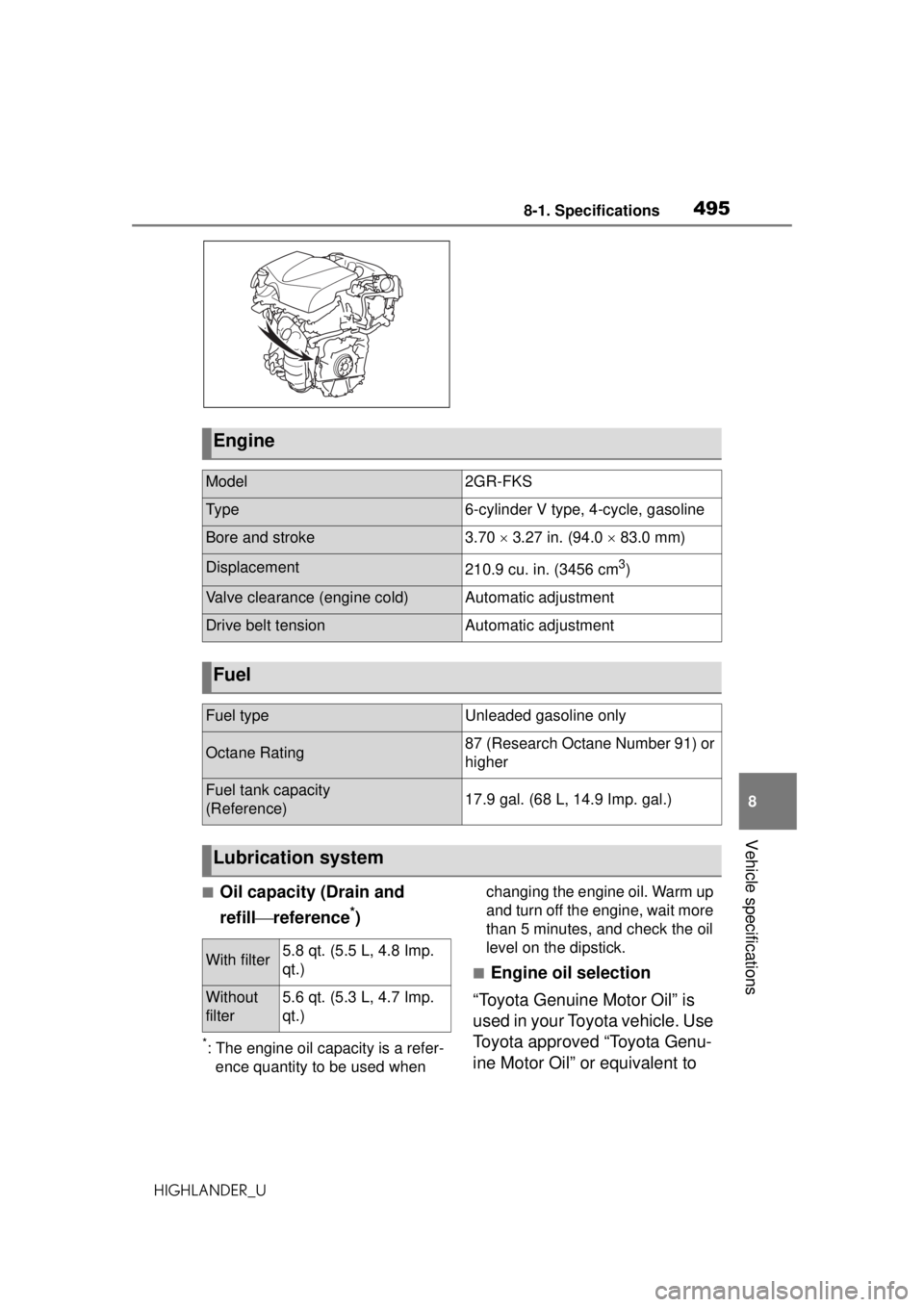
Engine
Model2GR-FKS
Ty p e6-cylinder V type, 4-cycle, gasoline
Bore and stroke3.70 3.27 in. (94.0 83.0 mm)
Displacement210.9 cu. in. (3456 cm3)
Valve clearance (engine cold)Automatic adjustment
Drive belt tensionAutomatic adjustment
Fuel
Fuel typeUnleaded gasoline only
Octane Rating87 (Research Octane Number 91) or
higher
Fuel tank capacity
(Reference)17.9 gal. (68 L, 14.9 Imp. gal.)
Lubrication system
With filter5.8 qt. (5.5 L, 4.8 Imp.
qt.)
Without
filter5.6 qt. (5.3 L, 4.7 Imp.
qt.)
Page 507 of 560
5078-1. Specifications
HIGHLANDER_U
8
Vehicle specifications
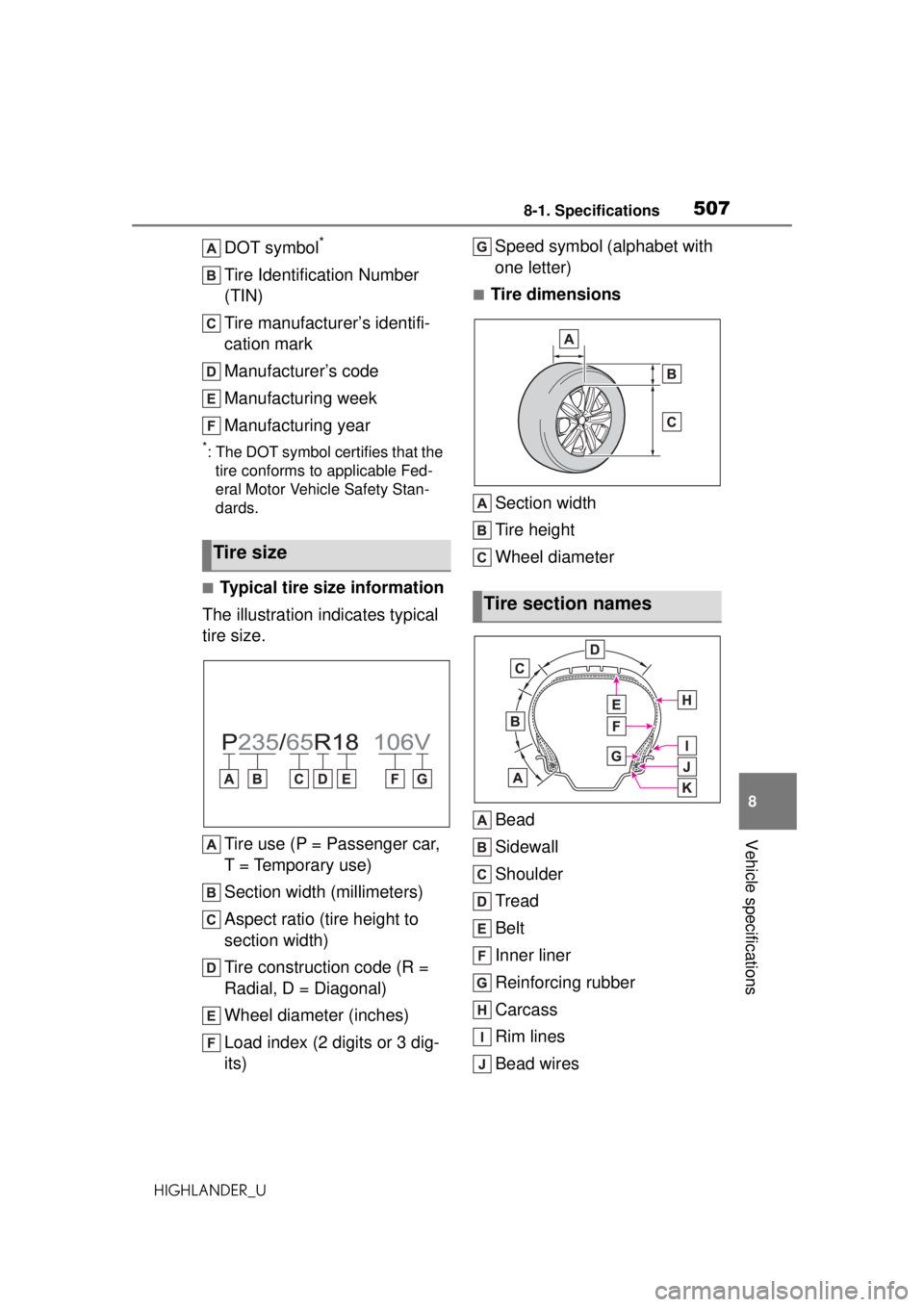
DOT symbol*
Tire Identification Number
(TIN)
Tire manufacturer’s identifi-
cation mark
Manufacturer’s code
Manufacturing week
Manufacturing year
*: The DOT symbol certifies that the tire conforms to applicable Fed-
eral Motor Vehicle Safety Stan-
dards.
■Typical tire size information
The illustration indicates typical
tire size.
Tire use (P = Passenger car,
T = Temporary use)
Section width (millimeters)
Aspect ratio (tire height to
section width)
Tire construction code (R =
Radial, D = Diagonal)
Wheel diameter (inches)
Load index (2 digits or 3 dig-
its) Speed symbol (alphabet with
one letter)
■Tire dimensions
Section width
Tire height
Wheel diameter
Bead
Sidewall
Shoulder
Tread
Belt
Inner liner
Reinforcing rubber
Carcass
Rim lines
Bead wires
Tire size
Tire section names
Page 529 of 560
529
HIGHLANDER_U
9
9
For owners
For owners
.9-1. For ownersReporting safety defects for U.S. owners............... 530
Seat belt instructions for Canadian owners (in
French) ...................... 530
SRS airbag instructions for Canadian owners (in
French) ...................... 532
Headlight aim instructions for Canadian owners (in
French) ...................... 539