automatic transmission TOYOTA HIGHLANDER 2020 Owners Manual (in English)
[x] Cancel search | Manufacturer: TOYOTA, Model Year: 2020, Model line: HIGHLANDER, Model: TOYOTA HIGHLANDER 2020Pages: 560, PDF Size: 14.42 MB
Page 2 of 560
2
HIGHLANDER_UTABLE OF CONTENTS
For your information ........................
5
Reading this manual ........................ 9
How to search ................................ 10
Pictorial index ................................ 11
1-1. For safe use Before driving ........................ 22
For safe driving ..................... 23
Seat belts .............................. 25
SRS airbags .......................... 32
Front passenger occupant clas- sification system.................. 41
Exhaust gas precautions....... 46
1-2. Child safety Riding with children ............... 47
Child restraint systems .......... 48
1-3. Emergency assistance Safety Connect ..................... 63
1-4. Theft deterrent system Engine immobilizer system ... 69
Alarm ..................................... 71
2-1. Instrument cluster Warning lights and indicators............................................ 74
Gauges and meters .............. 79
Multi-information display (4.2-inch display)................. 82
Multi-information display (7-inch display)................................ 91
Head-up display ................. 101
Fuel consumption information ......................................... 1063-1. Key information
Keys ................................... 112
3-2.
Opening, closing and locking
th
e doors
Side doors .......................... 115
Back door ........................... 119
Smart key system .............. 131
3-3. Adjusting the seats Front seats ......................... 138
Rear seats.......................... 139
Driving position memory .... 144
Head restraints................... 147
3-4. Adjust
ing the steering wheel
and mirrors
Ste
ering wheel ...................150
Inside rear view mirror ....... 151
Digital Rearview Mirror....... 152
Outside rear view mirrors ... 162
3-5. Opening, closing the win- dows and moon roof
Power windows .................. 164
Moon roof ........................... 167
Panoramic moon roof......... 170
4-1. Before driving Driving the vehicle.............. 177
Cargo and luggage ............ 184
Vehicle load limits .............. 187
Trailer towing...................... 188
Dinghy towing .................... 199
4-2. Driving procedures Engine
(ignition) switch ...... 200
Automatic transmission ...... 204
Turn signal lever................. 208
Parking brake ..................... 209
1For safety and security
2Vehicle status information
and indicators
3Before driving
4Driving
Page 175 of 560
175
HIGHLANDER_U
4
4
Driving
Driving
.4-1. Before drivingDriving the vehicle....... 177
Cargo and luggage ..... 184
Vehicle load limits ....... 187
Trailer towing............... 188
Dinghy towing ............. 199
4-2. Driving procedures Engine (ignition) switch.................................. 200
Automatic transmission .................................. 204
Turn signal lever.......... 208
Parking brake .............. 209
Brake Hold .................. 212
4-3. Operating the lights and wipers
Headlight switch .......... 214
Automatic High Beam . 217
Fog light switch ........... 220
Windshield wipers and washer....................... 220
Rear windshield wiper and washer....................... 223
4-4. Refueling Opening the fuel tank cap.................................. 225
4-5. Using the driving support systems
Toyota Safety Sense 2.0 .................................. 227PCS (Pre-Collision System)
.................................. 233
LTA (Lane Tracing Assist) .................................. 241
RSA (Road Sign Assist) .................................. 251
Dynamic radar cruise con- trol with full-speed range.................................. 254
Stop & Start system .... 264
BSM (Blind Spot Monitor) .................................. 270
Intuitive parking assist . 276
RCTA (Rear cross traffic alert) function............. 284
PKSB (Parking Support Brake) ........................ 289
Parking Support Brake func- tion (static objects) .... 296
Parking Support Brake func- tion (rear-crossing vehi-
cles) ........................... 302
Driving mode select switch .................................. 306
Multi-terrain Select ...... 307
Snow mode switch ...... 310
Downhill assist control sys- tem ............................ 311
Driving assist systems .................................. 313
4-6. Driving tips Winter driving tips........ 319
Page 204 of 560
2044-2. Driving procedures
HIGHLANDER_U
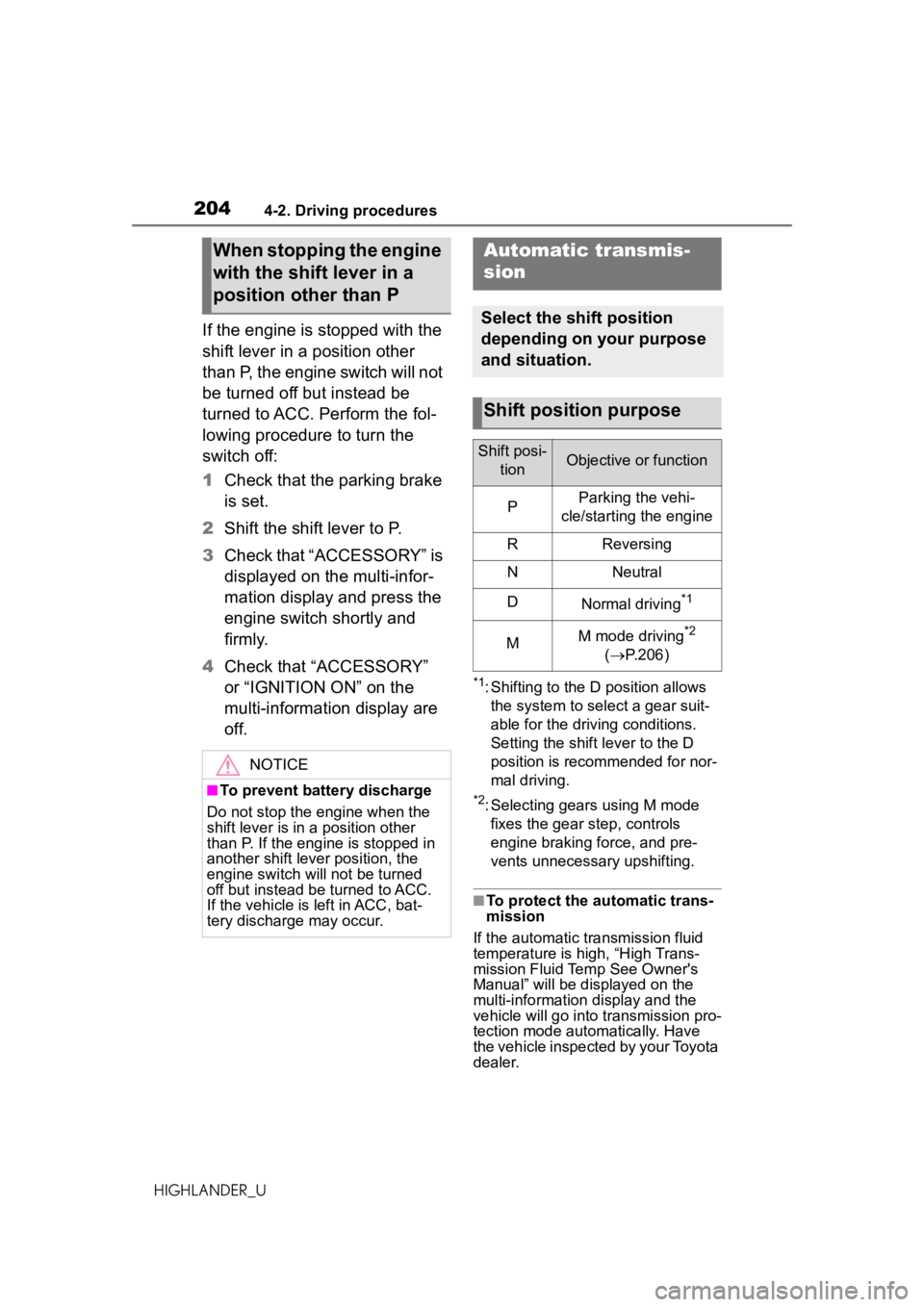
If the engine is stopped with the
shift lever in a position other
than P, the engine switch will not
be turned off but instead be
turned to ACC. Perform the fol-
lowing procedure to turn the
switch off:
1Check that the parking brake
is set.
2 Shift the shift lever to P.
3 Check that “ACCESSORY” is
displayed on the multi-infor-
mation display and press the
engine switch shortly and
firmly.
4 Check that “ACCESSORY”
or “IGNITION ON” on the
multi-information display are
off.
*1: Shifting to the D position allows
the system to select a gear suit-
able for the driv ing conditions.
Setting the shift lever to the D
position is recommended for nor-
mal driving.
*2: Selecting gears using M mode fixes the gear step, controls
engine braking force, and pre-
vents unnecessary upshifting.
■To protect the automatic trans-
mission
If the automatic transmission fluid
temperature is high, “High Trans-
mission Fluid Temp See Owner's
Manual” will be displayed on the
multi-information display and the
vehicle will go into transmission pro-
tection mode automatically. Have
the vehicle inspect ed by your Toyota
dealer.
When stopping the engine
with the shift lever in a
position other than P
NOTICE
■To prevent battery discharge
Do not stop the engine when the
shift lever is in a position other
than P. If the engine is stopped in
another shift lever position, the
engine switch will not be turned
off but instead be turned to ACC.
If the vehicle is left in ACC, bat-
tery discharge may occur.
Automatic transmis-
sion
Select the shift position
depending on your purpose
and situation.
Shift position purpose
Shift posi- tionObjective or function
PParking the vehi-
cle/starting the engine
RReversing
NNeutral
DNormal driving*1
MM mode driving*2
( P.206)
Page 267 of 560

2674-5. Using the driving support systems
HIGHLANDER_U
4
Driving
jam.
• When the engine coolant tem- perature or transmission fluid tem-
perature is extremely low or high.
• When the vehicle is stopped on a steep incline.
• When the steering wheel is being operated.
• When the vehicle is being driven
in a high altitude area.
• When the battery fluid tempera- ture is extremely low or high.
• For a while after the battery termi-
nals have been disconnected and
reconnected.
●When the engine is stopped by
the Stop & Start system, the
engine will be restarted automati-
cally if any of the following condi-
tions are met: (To enable the
engine to be stopped by the Stop
& Start system again, drive the
vehicle.)
• The air conditioning system is turned on. (vehicles without a
manual air conditioning system)
• The windshield defogger is turned on. (vehicles without a manual air
conditioning system)
• The shift lever is shifted from D or
P.
• The shift lever is shifted from P.
(When the engine is stopped by
the Stop & Start system when the
shift lever is in P.)
• The driver’s seat belt is unfas-
tened.
• The driver’s door is opened.
• The driving mode is changed from
NORMAL or ECO mode to
another mode.
• The driving mode is changed to SNOW mode.
• The Stop & Start cancel switch is
pressed.
• The steering wheel is operated.
• The accelerator pedal is depressed.
• The vehicle starts to roll on an incline.
●When the engine is stopped by
the Stop & Start system, the
engine may restart automatically in the following situations: (To
enable the engine to be stopped
by the Stop & Start system again,
drive the vehicle.)
• When the brake pedal is pumped or strongly depressed.
• When the air conditioning system is being used.
• When a switch of the air condition-
ing system is operated (windshield
defogger switch, etc.).
• If the battery charge becomes low.
■When the hood is opened
●If the hood is opened while the
engine is stopped by the Stop &
Start system, the engine will stall
and will not be able to be restarted
by the automatic engine start
function. In this case, restart the
engine using the normal engine
starting procedure. ( P.200)
●If the hood is closed after the
engine is started with the hood
open, the Stop & Start system will
not operate. Close the hood, turn
the engine switch off, wait 30 sec-
onds or more, and then start the
engine.
■Air conditioning system opera-
tion while the engine is stopped
by the Stop & Start system
Vehicles with an automatic air con-
ditioning system: When the air con-
ditioning is in automatic mode and
the engine is stopped by the Stop &
Start system, the fan may operate at
a low speed in order to prevent the
temperature in the cabin from
increasing or decreasing or may be
stopped.
To prioritize air conditioning system
performance when the vehicle is
stopped, disable the Stop & Start
system by pressing the Stop & Start
cancel switch.
●If the windshield is fogged up
Turn the windshield defogger on.
( P.333)
If the windshield fogs up frequently,
press the Stop & Start cancel switch
Page 324 of 560
3244-6. Driving tips
HIGHLANDER_U
NOTICE
■To prevent water damage
Take all necessary safety mea-
sures to ensure that water dam-
age to the engine or other
components does not occur.
●Water entering the engine air
intake will cause severe engine
damage.
●Water entering the automatic
transmission will cause deterio-
ration in shift quality, locking up
of your transm ission accompa-
nied by vibration, and ultimately
damage.
●Water can wash the grease
from wheel bearings, causing
rusting and premature failure,
and may also enter the differen-
tial, transmission and transfer
case, reducing t he gear oil’s
lubricating qualities.
■When you drive through
water
If driving through water, such as
when crossing shallow streams,
first check the depth of the water
and the bottom of the riverbed for
firmness. Drive slowly and avoid
deep water.
■Inspection after off-road driv-
ing
●Sand and mud that has accu-
mulated in brake drums and
around brake discs may affect
braking efficiency and may
damage brake system compo-
nents.
●Always perform a maintenance
inspection after each day of
off-road driving that has taken
you through rough terrain, sand,
mud, or water. For scheduled
maintenance info rmation, refer
to the “Warranty and Services
Guide”.
Page 396 of 560
3966-2. Maintenance
HIGHLANDER_U
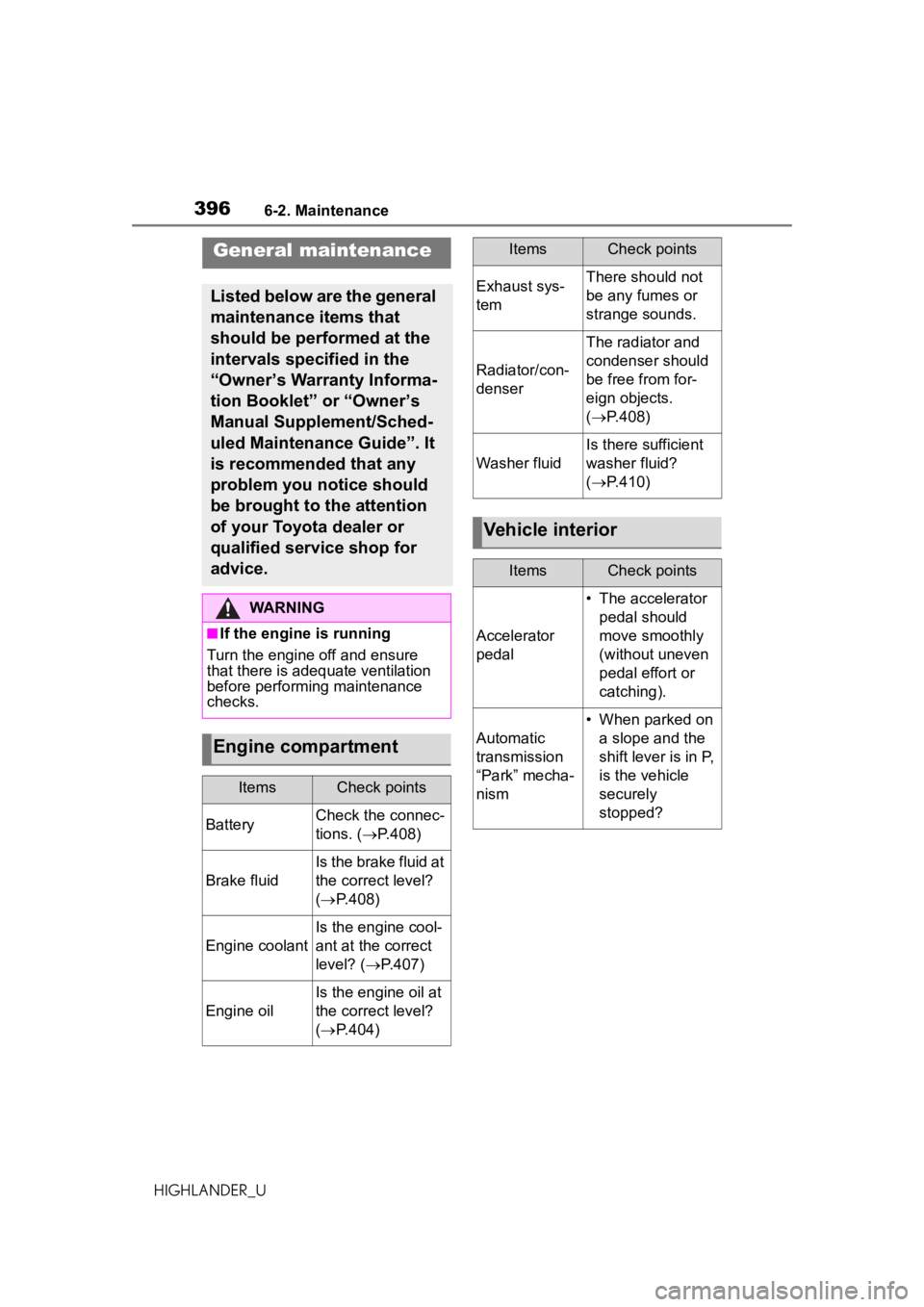
General maintenance
Listed below are the general
maintenance items that
should be performed at the
intervals specified in the
“Owner’s Warranty Informa-
tion Booklet” or “Owner’s
Manual Supplement/Sched-
uled Maintenance Guide”. It
is recommended that any
problem you notice should
be brought to the attention
of your Toyota dealer or
qualified service shop for
advice.
WARNING
■If the engine is running
Turn the engine off and ensure
that there is adequate ventilation
before performing maintenance
checks.
Engine compartment
ItemsCheck points
BatteryCheck the connec-
tions. ( P.408)
Brake fluid
Is the brake fluid at
the correct level?
( P.408)
Engine coolant
Is the engine cool-
ant at the correct
level? ( P.407)
Engine oil
Is the engine oil at
the correct level?
( P.404)
Exhaust sys-
temThere should not
be any fumes or
strange sounds.
Radiator/con-
denser
The radiator and
condenser should
be free from for-
eign objects.
( P.408)
Washer fluid
Is there sufficient
washer fluid?
( P.410)
Vehicle interior
ItemsCheck points
Accelerator
pedal
• The accelerator
pedal should
move smoothly
(without uneven
pedal effort or
catching).
Automatic
transmission
“Park” mecha-
nism
• When parked on a slope and the
shift lever is in P,
is the vehicle
securely
stopped?
ItemsCheck points
Page 451 of 560
4517-2. Steps to take in an emergency
HIGHLANDER_U
7
When trouble arises
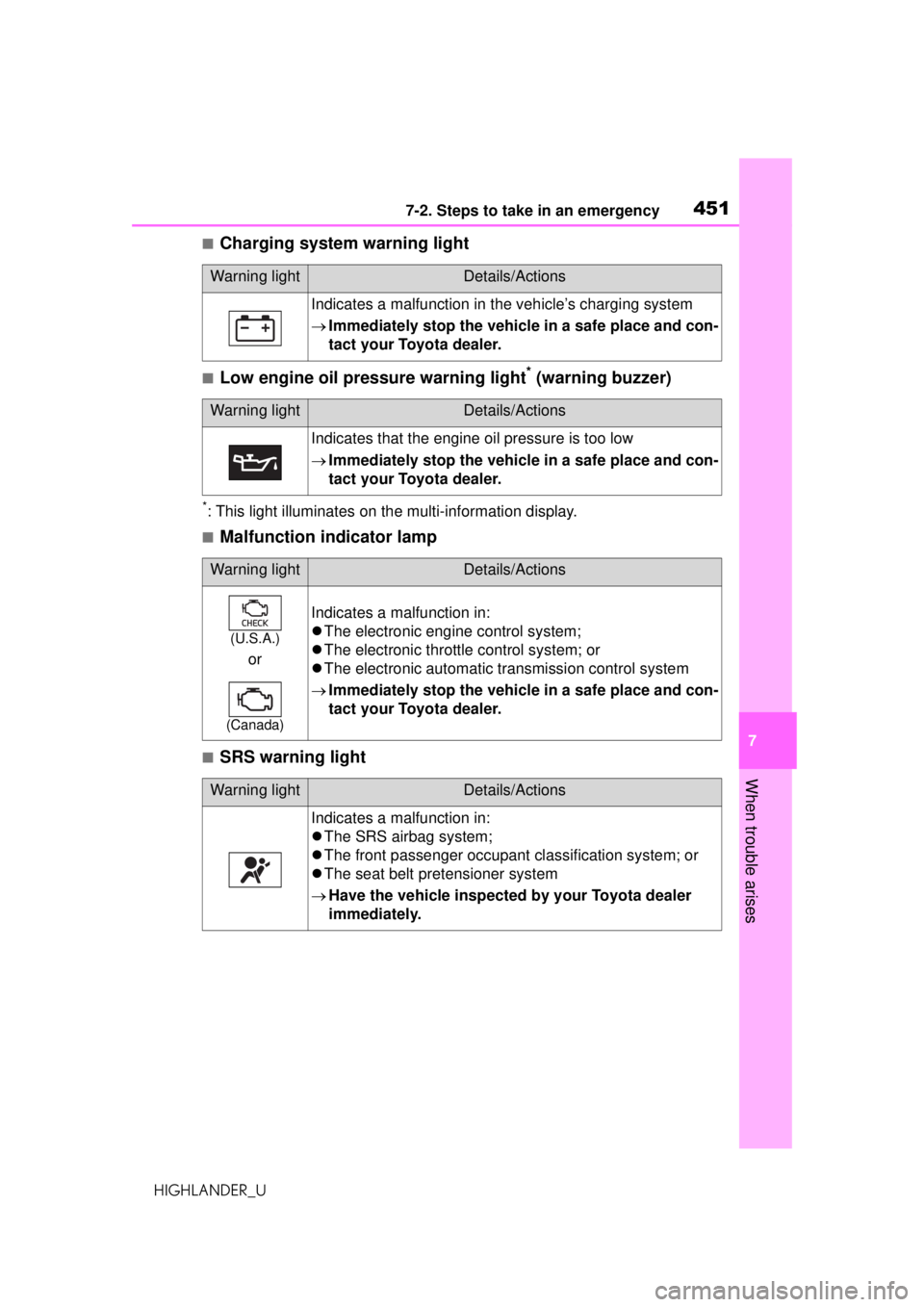
■Charging system warning light
■Low engine oil pressure warning light* (warning buzzer)
*: This light illuminates on th e multi-information display.
■Malfunction indicator lamp
■SRS warning light
Warning lightDetails/Actions
Indicates a malfunction in the vehicle’s charging system
Immediately stop the vehicle in a safe place and con-
tact your Toyota dealer.
Warning lightDetails/Actions
Indicates that the engine oil pressure is too low
Immediately stop the vehicle in a safe place and con-
tact your Toyota dealer.
Warning lightDetails/Actions
(U.S.A.)
or
(Canada)
Indicates a malfunction in:
The electronic engine control system;
The electronic throttle control system; or
The electronic automatic transmission control system
Immediately stop the vehicle in a safe place and con-
tact your Toyota dealer.
Warning lightDetails/Actions
Indicates a malfunction in:
The SRS airbag system;
The front passenger occupant classification system; or
The seat belt pretensioner system
Have the vehicle inspected by your Toyota dealer
immediately.
Page 497 of 560
4978-1. Specifications
HIGHLANDER_U
8
Vehicle specifications
*: The fluid capacity is a reference quantity.
If replacement is necessary, contact your Toyota dealer.
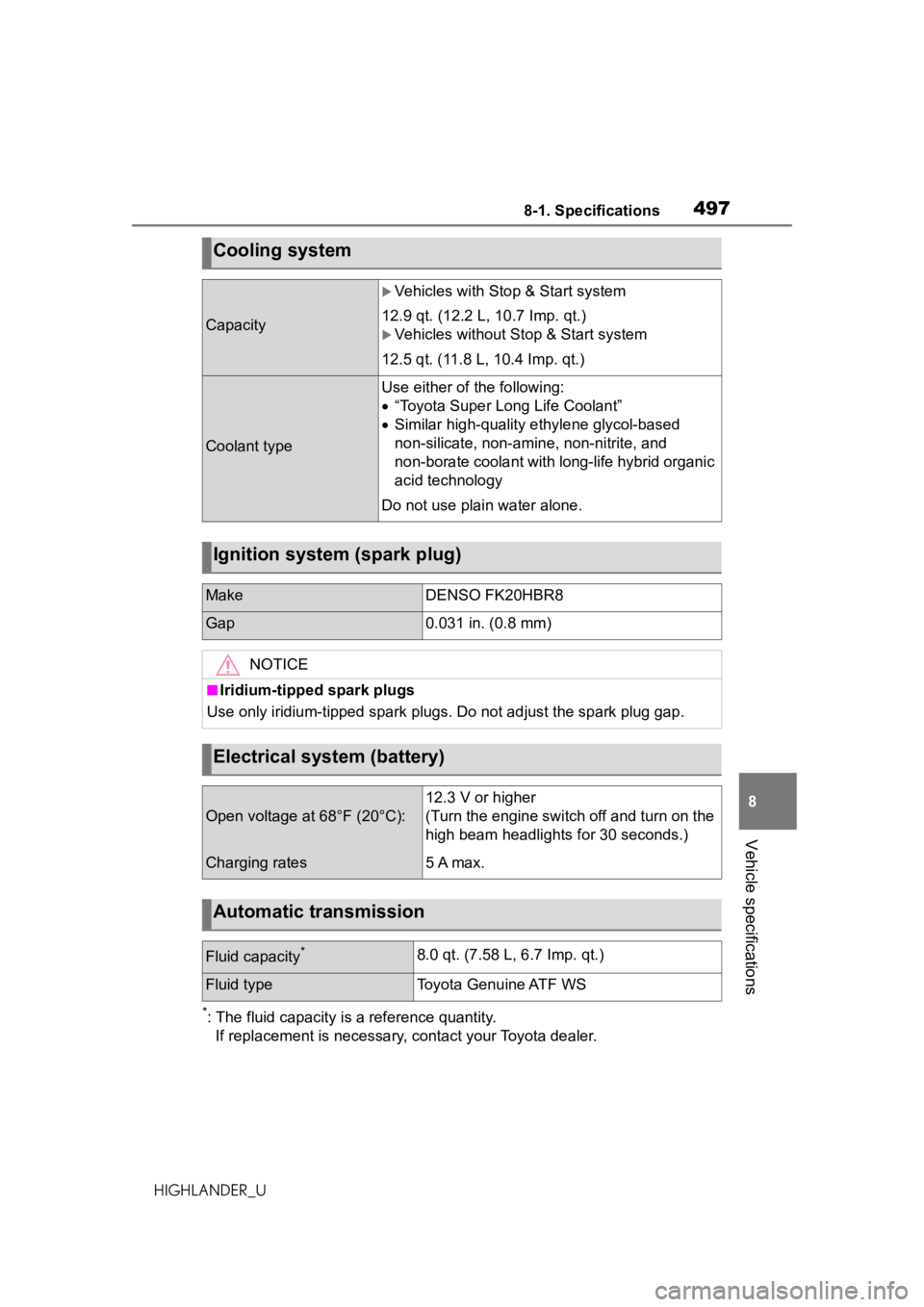
Cooling system
Capacity
Vehicles with Stop & Start system
12.9 qt. (12.2 L, 10.7 Imp. qt.)
Vehicles without Stop & Start system
12.5 qt. (11.8 L, 10.4 Imp. qt.)
Coolant type
Use either of the following:
“Toyota Super Long Life Coolant”
Similar high-quality ethylene glycol-based
non-silicate, non-amine, non-nitrite, and
non-borate coolant with long-life hybrid organic
acid technology
Do not use plain water alone.
Ignition system (spark plug)
MakeDENSO FK20HBR8
Gap0.031 in. (0.8 mm)
NOTICE
■Iridium-tipped spark plugs
Use only iridium-tipped spark plugs. Do not adjust the spark plug gap.
Electrical system (battery)
Open voltage at 68°F (20°C):
12.3 V or higher
(Turn the engine switch off and turn on the
high beam headlights for 30 seconds.)
Charging rates5 A max.
Automatic transmission
Fluid capacity*8.0 qt. (7.58 L, 6.7 Imp. qt.)
Fluid typeToyota Genuine ATF WS
Page 509 of 560
5098-1. Specifications
HIGHLANDER_U
8
Vehicle specifications
Grade C corresponds to a level of
performance which all passenger
car tires must meet under the Fed-
eral Motor Vehicle Safety Standard
No. 109.
Grades B and A represent higher
levels of performance on the labo-
ratory test wheel than the minimum
required by law. Warning: The temperature grades
of a tire assume that it is properly
inflated and not overloaded.
Excessive speed, underinflation, or
excessive loading, either sepa-
rately or in combination, can cause
heat buildup and possible tire fail-
ure.
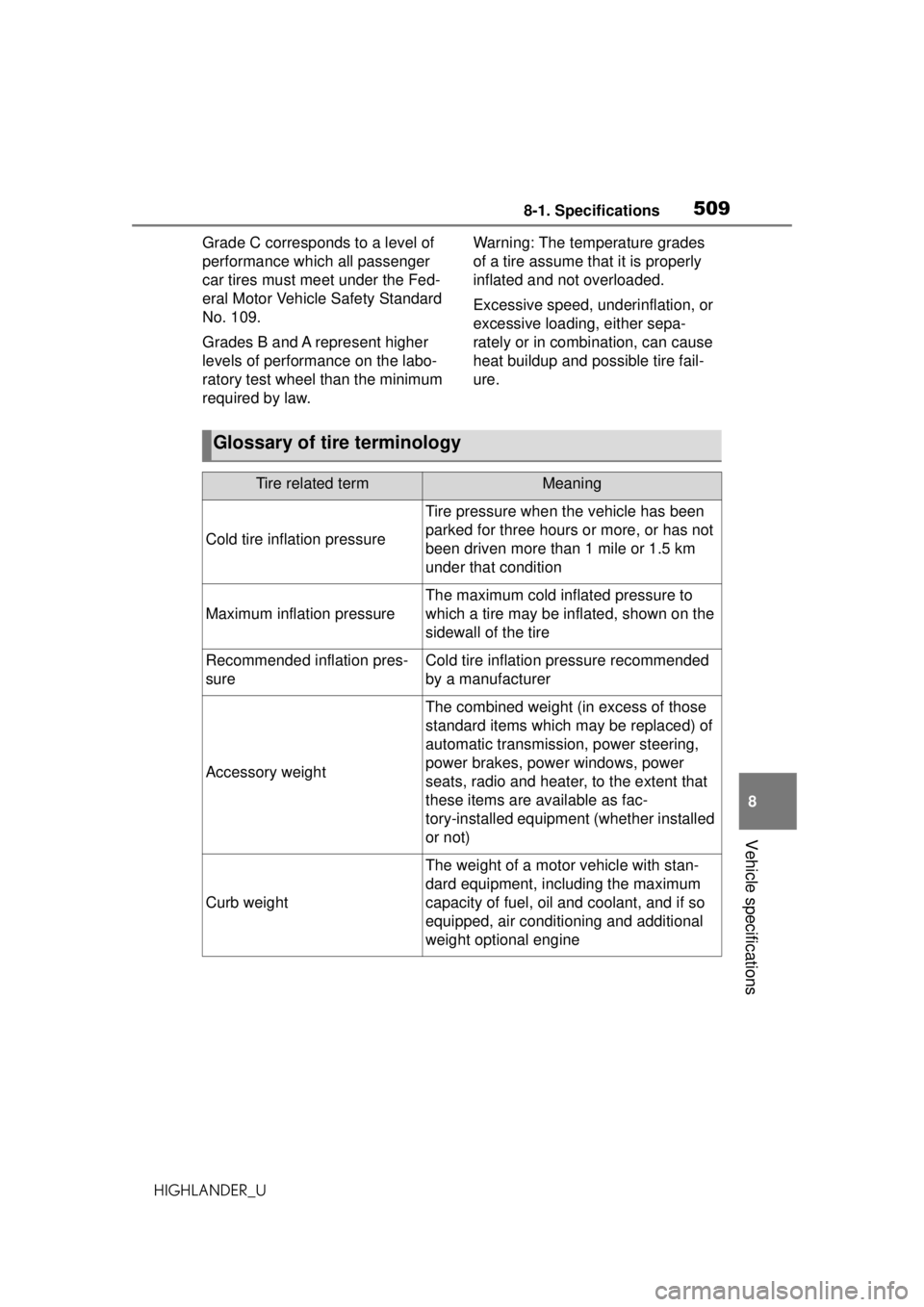
Glossary of tire terminology
Tire related termMeaning
Cold tire infl
ation pressure
Tire pressure when the vehicle has been
parked for three hours or more, or has not
been driven more than 1 mile or 1.5 km
under that condition
Maximum inflation pressure
The maximum cold inflated pressure to
which a tire may be inflated, shown on the
sidewall of the tire
Recommended inflation pres-
sureCold tire inflation pressure recommended
by a manufacturer
Accessory weight
The combined weight (in excess of those
standard items which may be replaced) of
automatic transmission, power steering,
power brakes, power windows, power
seats, radio and heater, to the extent that
these items are available as fac-
tory-installed equipment (whether installed
or not)
Curb weight
The weight of a motor vehicle with stan-
dard equipment, including the maximum
capacity of fuel, oil and coolant, and if so
equipped, air conditioning and additional
weight optional engine
Page 546 of 560

546Alphabetical Index
HIGHLANDER_U
Automatic light control system ............................................... 215
Automatic transmission ........ 204 If the shift lever cannot be shifted from P................................. 206
M mode ................................ 206
Auxiliary boxes ............... 361, 366
Average fuel economy ....... 84, 92
Average vehicle speed....... 86, 95
AWD Control ....................... 87, 95
B
Back door ................................ 119
Back-up lights Replacing light bulbs ............ 432
Battery Battery checking................... 408
If the battery is discharged ... 483
Preparing and checking before winter.................................. 319
Replacing ............................. 485
Warning light ........................ 451
Blind Spot Monitor (BSM) ...... 270
Brake Brake hold ............................ 212
Fluid ............................. 408, 499
Parking brake ....................... 209
Warning light ........................ 450
Brake assist ............................ 313
Break-in tips ........................... 178
Brightness control Instrument panel light control . 81
BSM (Blind Spot Monitor) ...... 270
Buzzer Hands off steering wheel warn-ing (LTA) ............................. 249
C
Care Exterior ................................. 388
Interior .................................. 391 Seat belts .............................391
Wheels and wheel ornaments
...........................................388
Cargo capacity ........................187
Cargo net hooks .....................363
Chains......................................320
Child restraint system Fixed with a LATCH system ...58
Fixed with a seat belt..............53
Front passenger occupant clas-sification system ...................41
Points to remember ................48
Riding with children ................47
Types of child restraint system installation method ...............50
Using an anchor bracket ........60
Child safety Airbag precautions .................37
Back door precautions.......... 119
Battery precautions ......409, 486
Child restraint system .............50
Heated steering wheel and seat heater precautions..............352
How your child should wear the seat belt ................................26
Moon roof precautions..........168
Panoramic moon roof precau- tions ....................................172
Power window lo ck switch ....166
Power window precautions...165
Rear door child-protectors .... 118
Removed electronic key battery precautions .........................429
Seat belt extender precautions .............................................27
Seat belt precautions..............47
Child-protectors...................... 118
Cleaning Exterior .................................388
Interior ..................................391
Radar sensor ........................228
Seat belts .............................391