Interior TOYOTA HIGHLANDER 2022 Owners Manual
[x] Cancel search | Manufacturer: TOYOTA, Model Year: 2022, Model line: HIGHLANDER, Model: TOYOTA HIGHLANDER 2022Pages: 568, PDF Size: 13.73 MB
Page 1 of 568

1
2
3
4
5
6
7
8
9
9
HIGHLANDER_U
Pictorial indexSearch by illustration
For safety
and securityMake sure to read through them
(Main topics: Child seat, theft deterrent system)
Vehicle status
information and
indicatorsReading driving-related information
(Main topics: Meters, multi-information display)
Before driving
Opening and closing the doors and windows,
adjustment before driving
(Main topics: Keys, doors, seats)
Driving
Operations and advice which are necessary for
driving
(Main topics: Starting engine, refueling)
Interior featuresUsage of the interior features
(Main topics: Air conditioner, storage features)
Maintenance
and careCaring for your vehicle and maintenance
procedures
(Main topics: Interior and exterior, light bulbs)
When trouble
arisesWhat to do in case of malfunction and emergency
(Main topics: Battery discharge, flat tire)
Vehicle
specificationsVehicle specifications, customizable features
(Main topics: Fuel, oil, tire inflation pressure)
For ownersReporting safety defects for U.S. owners, and seat
belt, SRS airbag and headlight aim instructions for
Canadian owners
IndexSearch by symptom
Search alphabetically
Page 3 of 568
3TABLE OF CONTENTS
1
2
3
4
5
6
7
8
9
10
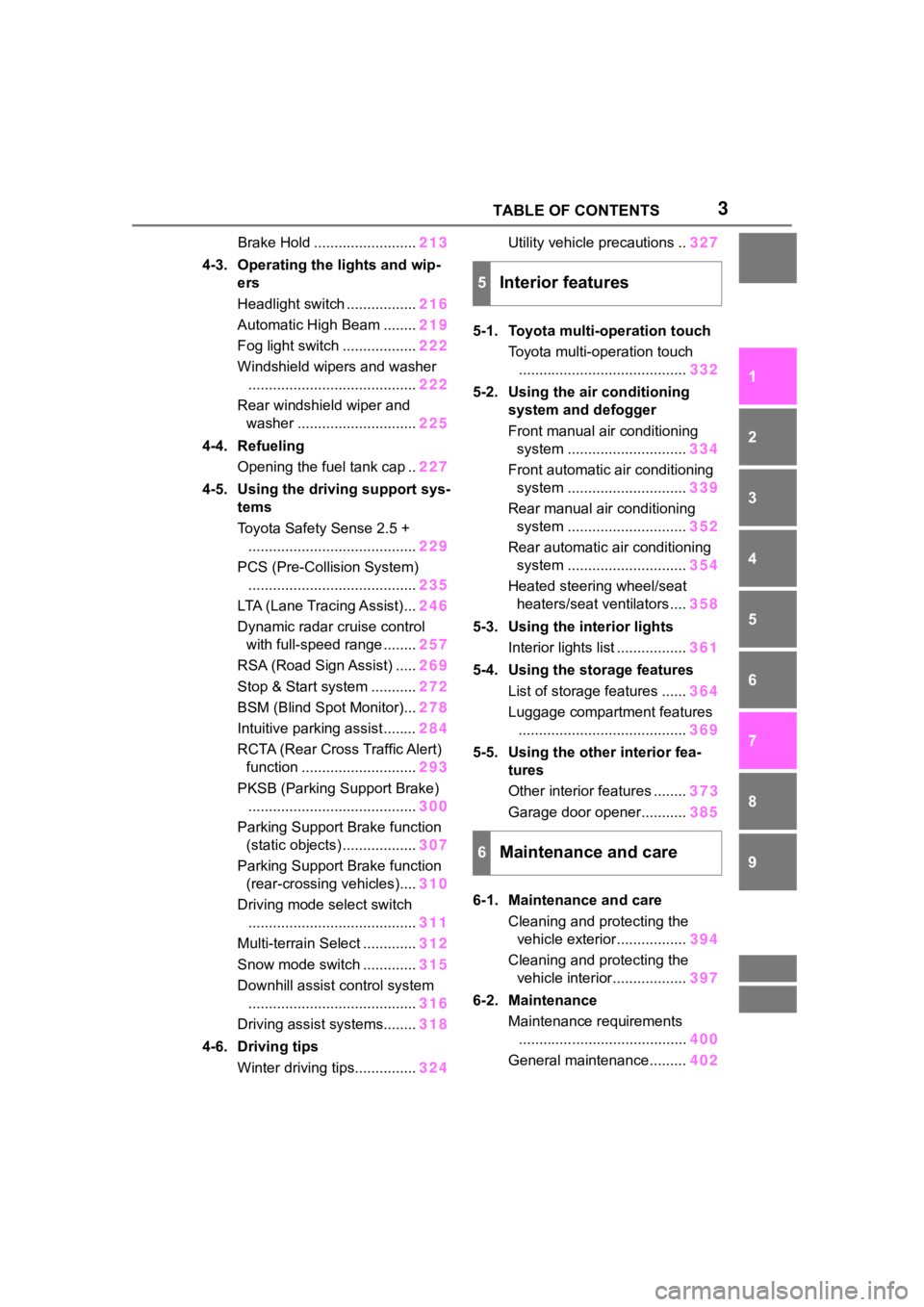
Brake Hold .........................213
4-3. Operating the lights and wip- ers
Headlight switch ................. 216
Automatic High Beam ........ 219
Fog light switch .................. 222
Windshield wipers and washer ......................................... 222
Rear windshield wiper and washer ............................. 225
4-4. Refueling Opening the fuel tank cap .. 227
4-5. Using the driving support sys- tems
Toyota Safety Sense 2.5 +......................................... 229
PCS (Pre-Collision System) ......................................... 235
LTA (Lane Tracing Assist)... 246
Dynamic radar cruise control with full-speed range ........ 257
RSA (Road Sign Assist) ..... 269
Stop & Start system ........... 272
BSM (Blind Spot Monitor)... 278
Intuitive parking assist ........ 284
RCTA (Rear Cross Traffic Alert) function ............................ 293
PKSB (Parking Support Brake) ......................................... 300
Parking Support Brake function (static objects) .................. 307
Parking Support Brake function (rear-crossing vehicles).... 310
Driving mode select switch ......................................... 311
Multi-terrain Select ............. 312
Snow mode switch ............. 315
Downhill assist control system ......................................... 316
Driving assist systems........ 318
4-6. Driving tips Winter driving tips............... 324Utility vehicle precautions ..
327
5-1. Toyota multi-operation touch Toyota multi-operation touch......................................... 332
5-2. Using the air conditioning system and defogger
Front manual air conditioning system ............................. 334
Front automatic air conditioning system ............................. 339
Rear manual air conditioning system ............................. 352
Rear automatic air conditioning system ............................. 354
Heated steering wheel/seat heaters/seat ventilators.... 358
5-3. Using the interior lights Interior lights list ................. 361
5-4. Using the storage features List of storage features ...... 364
Luggage compartment features ......................................... 369
5-5. Using the other interior fea- tures
Other interior features ........ 37
3
Garage do or opener
...........385
6-1. Maintenance and care Cleaning and protecting the vehicle exterior................. 394
Cleaning and protecting the vehicle interior.................. 397
6-2. Maintenance Maintenance requirements......................................... 400
General maintenance......... 402
5Interior features
6Maintenance and care
Page 21 of 568

21Pictorial index
■Interior
SRS airbags .................................................... ...................... P.34
Floor mats..................................................... ........................ P.24
Front seats .................................................... ...................... P.141
Rear seats ..................................................... ...................... P.142
Head restraints ................................................ ................... P.150
Seat belts ..................................................... ......................... P.27
Console box ....................................................................... P.365
Inside lock buttons ............................................ ................ P.120
Cup holders .................................................... .................... P.366
Assist grips ................................................... ..................... P.381
Rear seat entertainment system
*1, 2
*1
: If equipped
*2: Refer to “NAVIGATI ON AND MULTIMEDIA SYSTEM OWNER’S MAN-
UAL”.
Page 22 of 568

22Pictorial index
■Ceiling
Auxiliary box .................................................. .................... P.367
Conversation mirror .......................................................... P.384
Interior light
*1............................................................... ...... P.362
Personal lights
*1............................................................... .. P.362
Moon roof switches
*2......................................................... P.170
Panoramic moon roof switches
*2..................................... P.173
Vanity mirrors ................................................. .................... P.383
Sun visors..................................................... ...................... P.383
“SOS” button
*2............................................................... ...... P.65
Inside rear view mirror
*2.................................................... P.154
Digital Rearview Mirror
*2................................................... P.155
Garage door opener switches
*2........................................ P.385
*1: The illustration shows the fron t, but they are also equipped i n the rear.
*2: If equipped
Page 29 of 568

291-1. For safe use
1
For safety and security
1To fasten the seat belt, push
the plate into the buckle until
a click sound is heard.
2 To release the seat belt,
press the release button .
■When not using the rear seat
belts
Pass the outer seat belts through
the seat belt hangers and secure
the seat belt plat es to prevent the
shoulder belts from being damaged.
Second seat belts
Third seat belts
WARNING
■Using a seat belt extender
Observe the following precautions
to reduce the risk of injury in the
event of sudden braking, sudden
swerving or an accident. Failure
to do so may cause death or seri-
ous injury.
●Do not wear the seat belt
extender if you can fasten the
seat belt without the extender.
●Do not use the seat belt
extender when installing a child
restraint system because the
belt will not securely hold the
child restraint system, increas-
ing the risk of death or serious
injury in the event of an acci-
dent.
●The personalized extender may
not be safe on another vehicle,
when used by another person,
or at a different seating position
other than the one originally
intended.
NOTICE
■When using a seat belt
extender
When releasing the seat belt,
press on the buckle release but-
ton on the extender, not on the
seat belt. This helps prevent dam-
age to the vehicle interior and the
extender itself.
Fastening and releasing
the seat belt (except for
the third center seat)
Page 34 of 568

341-1. For safe use
■Location of the SRS airbags
SRS front airbagsSRS driver airbag/front passenger airbag
Can help protect the head and chest of the driver and front passenger from
impact with interior components
SRS knee airbag
Can help provide dr iver protection
SRS seat cushion airbag
Can help restrain the front passenger
SRS side and curtain shield airbags
SRS front side airbags
Can help protect the torso of the front seat occupants
SRS airbags
The SRS airbags inflate when the vehicle is subjected to cer-
tain types of severe impacts that may cause significant injury
to the occupants. They work together with the seat belts to
help reduce the risk of death or serious injury.
SRS airbag system
Page 36 of 568

361-1. For safe use
Airbag sensor assembly
Your vehicle is equipped with ADVANCED AIRBAGS designed
based on the US motor vehicle safety standards (FMVSS208). The
airbag sensor assembly (ECU) cont rols airbag deployment based on
information obtained from the sensors etc. shown in the system
components diagram above. This in formation includes crash sever-
ity and occupant information. As the airbags deploy, a chemical
reaction in the inflators quickly fills the airbags with non-toxic gas to
help restrain the motion of the occupants.
■If the SRS airbags deploy
(inflate)
●Slight abrasions, burns, bruising
etc., may be sustained from SRS
airbags, due to the extremely high
speed deployment (inflation) by
hot gases.
●A loud noise and white powder will
be emitted.
●Parts of the airbag module (steer-
ing wheel hub, airbag cover and
inflator) as well as the front seats,
parts of the front and rear pillars,
and roof side rails, may be hot for
several minutes. T he airbag itself
may also be hot.
●The windshield may crack.
●All of the doors will be unlocked.
( P.118)
●The brakes and st op lights will be
controlled automatically. ( P.319)
●The interior lights will turn on auto-
matically. ( P.363)
●The emergency flashers will turn
on automatically. ( P.448)
●Fuel supply to the engine will be
stopped. (P.455)
●For Safety Connect subscribers, if
any of the followin g situations
occur, the system is designed to
send an emergency call to the
response center, notifying them of
the vehicle’s location (without
needing to push the “SOS” button)
and an agent will attempt to speak
with the occupants to ascertain the level of emergency and assis-
tance required. If the occupants
are unable to communicate, the
agent automatically treats the call
as an emergency and helps to dis-
patch the necessary emergency
services. (
P. 6 5 )
• An SRS airbag is deployed.
• A seat belt pretensioner is acti-
vated.
• The vehicle is involved in a severe
rear-end collision.
■SRS airbag deployment condi-
tions (SRS front airbags)
●The SRS front airbags will deploy
in the event of an impact that
exceeds the set threshold level
(the level of forc e corresponding
to an approximately 12 - 18 mph
[20 - 30 km/h] frontal collision with
a fixed wall that does not move or
deform).
However, this threshold velocity will
be considerably higher in the follow-
ing situations:
• If the vehicle strikes an object, such as a parked vehicle or sign
pole, which can move or deform
on impact
• If the vehicle is involved in an underride collision, such as a colli-
sion in which the front of the vehi-
cle “underrides”, or goes under,
the bed of a truck
●Depending on the type of collision,
it is possible that only the seat belt
pretensioners and SRS seat cush-
ion airbag will activate.
Page 48 of 568
481-1. For safe use
Exhaust gas precau-
tions
Harmful substance to the
human body is included in
exhaust gases if inhaled.
WARNING
Exhaust gases include harmful
carbon monoxide (CO), which is
colorless and odorless. Observe
the following precautions.
Failure to do so may cause
exhaust gases enter the vehicle
and may lead to an accident
caused by light-headedness, or
may lead to death or a serious
health hazard.
■Important points while driving
●Keep the back door closed.
●If you smell exhaust gases in
the vehicle even when the back
door is closed, open the win-
dows and have the vehicle
inspected at your Toyota dealer
as soon as possible.
■When parking
●If the vehicle is in a poorly venti-
lated area or a closed area,
such as a garage, stop the
engine.
●Do not leave the vehicle with
the engine running for a long
time.
If such a situation cannot be
avoided, park the vehicle in an
open space and ensure that
exhaust fumes do not enter the
vehicle interior.
●Do not leave the engine running
in an area with snow build-up,
or where it is snowing. If snow-
banks build up around the vehi-
cle while the engine is running,
exhaust gases may collect and
enter the vehicle.
■Exhaust pipe
The exhaust system needs to be
checked periodically. If there is a
hole or crack caused by corro-
sion, damage to a joint or abnor-
mal exhaust noise, be sure to
have the vehicle inspected and
repaired by your Toyota dealer.
Page 51 of 568

511-2. Child safety
1
For safety and security
WARNING
●Toyota strongly urges the use of
a proper child restraint system
that conforms to the weight and
size of the child, installed on the
second seat. According to acci-
dent statistics, the child is safer
when properly restrained in the
second seat than in the front
seat.
●Holding a child in your or some-
one else’s arms is not a substi-
tute for a child restraint system.
In an accident, the child can be
crushed against the windshield
or between the holder and the
interior of the vehicle.
■Handling the child restraint
system
If the child restraint system is not
properly fixed in place, the child or
other passengers may be seri-
ously injured or even killed in the
event of sudden braking, sudden
swerving, or an accident.
●If the vehicle were to receive a
strong impact from an accident,
etc., it is possib le that the child
restraint system has damage
that is not readily visible. In
such cases, do not reuse the
restraint system.
●Make sure you have complied
with all installation instructions
provided with the child restraint
system manufacturer and that
the system is properly secured.
●Keep the child restraint system
properly secured on the seat
even if it is not in use. Do not
store the child restraint system
unsecured in the passenger
compartment.
●If it is necessary to detach the
child restraint system, remove it
from the vehicle or store it
securely in the luggage com-
partment.
Page 82 of 568
822-1. Instrument cluster
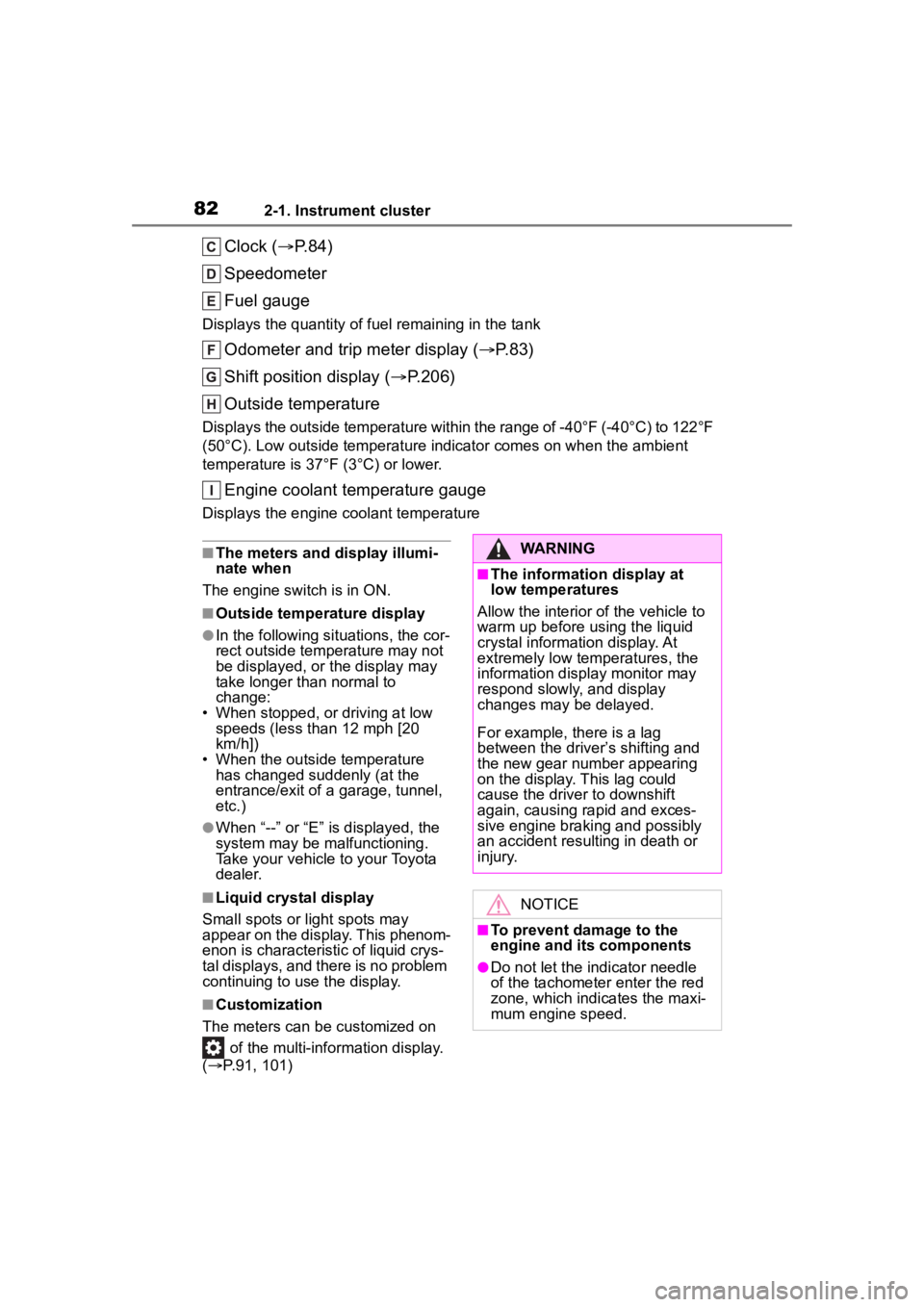
Clock (P.84)
Speedometer
Fuel gauge
Displays the quantity of fu el remaining in the tank
Odometer and trip meter display ( P.83)
Shift position display ( P.206)
Outside temperature
Displays the outside temperature within the range of -40°F (-40°C) to 122°F
(50°C). Low outside temperature indicator comes on when the ambient
temperature is 37°F (3°C) or lower.
Engine coolant temperature gauge
Displays the engine c oolant temperature
■The meters and display illumi-
nate when
The engine switch is in ON.
■Outside temperature display
●In the following si tuations, the cor-
rect outside tempe rature may not
be displayed, or the display may
take longer than normal to
change:
• When stopped, or driving at low
speeds (less than 12 mph [20
km/h])
• When the outside temperature
has changed suddenly (at the
entrance/exit of a garage, tunnel,
etc.)
●When “--” or “E” is displayed, the
system may be malfunctioning.
Take your vehicle to your Toyota
dealer.
■Liquid crystal display
Small spots or light spots may
appear on the display. This phenom-
enon is characteristi c of liquid crys-
tal displays, and there is no problem
continuing to use the display.
■Customization
The meters can be customized on of the multi-information display.
( P.91, 101)
WARNING
■The information display at
low temperatures
Allow the interior of the vehicle to
warm up before using the liquid
crystal information display. At
extremely low temperatures, the
information disp lay monitor may
respond slowly, and display
changes may be delayed.
For example, there is a lag
between the driver’s shifting and
the new gear number appearing
on the display. This lag could
cause the driver to downshift
again, causing rapid and exces-
sive engine braking and possibly
an accident resulting in death or
injury.
NOTICE
■To prevent damage to the
engine and its components
●Do not let the indicator needle
of the tachometer enter the red
zone, which indicates the maxi-
mum engine speed.