coolant temperature TOYOTA HIGHLANDER 2023 User Guide
[x] Cancel search | Manufacturer: TOYOTA, Model Year: 2023, Model line: HIGHLANDER, Model: TOYOTA HIGHLANDER 2023Pages: 552, PDF Size: 13.36 MB
Page 386 of 552
3866-3. Do-it-yourself maintenance
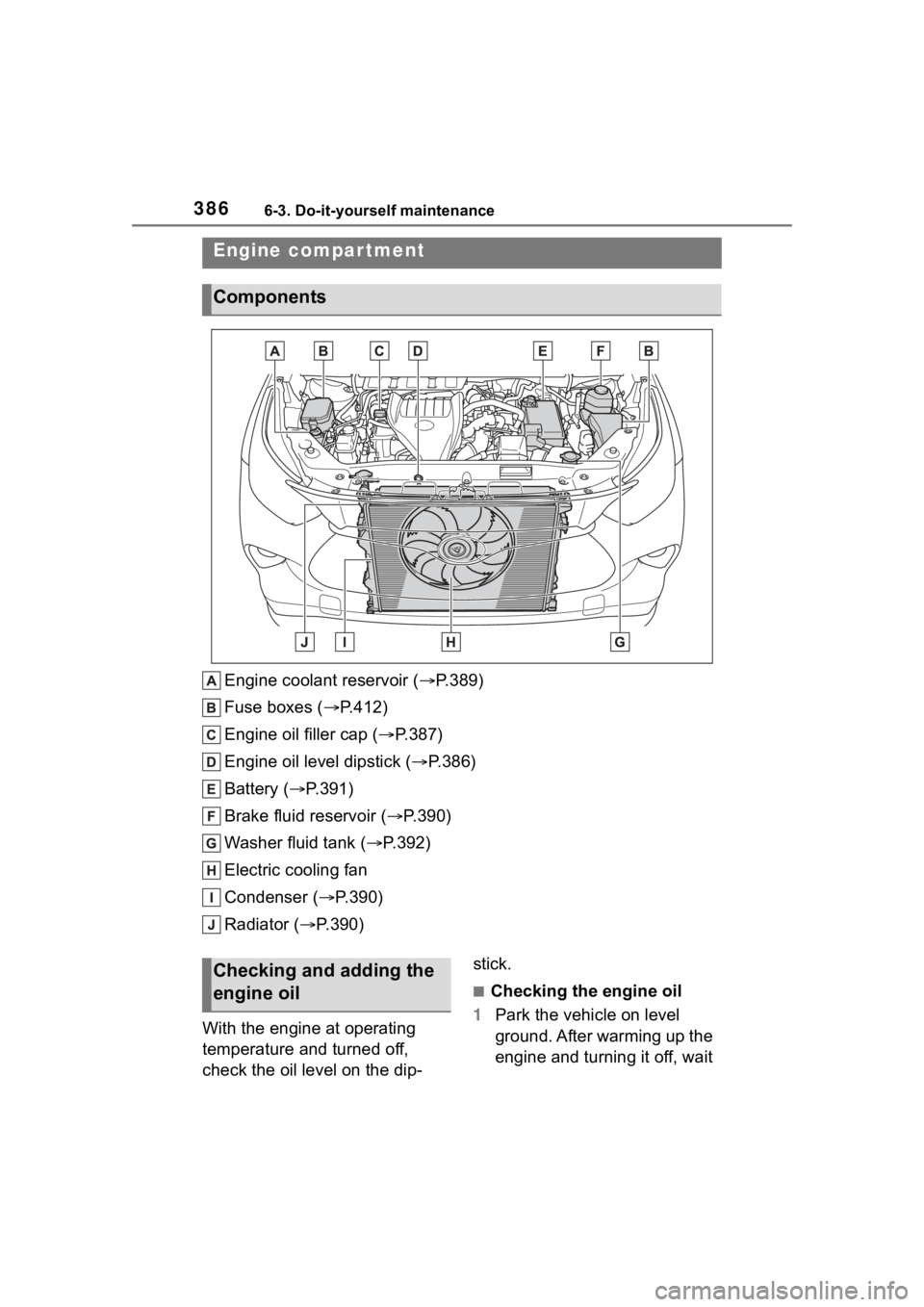
Engine coolant reservoir ( P.389)
Fuse boxes ( P.412)
Engine oil filler cap ( P.387)
Engine oil level dipstick ( P.386)
Battery ( P.391)
Brake fluid reservoir ( P.390)
Washer fluid tank ( P.392)
Electric cooling fan
Condenser ( P.390)
Radiator ( P.390)
With the engine at operating
temperature and turned off,
check the oil level on the dip- stick.
■Checking the engine oil
1 Park the vehicle on level
ground. After warming up the
engine and turning it off, wait
Engine compar tment
Components
Checking and adding the
engine oil
Page 390 of 552

3906-3. Do-it-yourself maintenance
Check the radiator and con-
denser and clear away any for-
eign objects. If either of the
above parts is extremely dirty or
you are not sure of their condi-
tion, have your vehicle
inspected by your Toyota dealer.
■Checking fluid level
The brake fluid level should be
between the “MAX” and “MIN”
lines on the tank.
■Adding fluid
Make sure to check the fluid
type and prepare the necessary
item.
Fluid type
SAE J1703 or FMVSS No.116 DOT
3 brake fluid
SAE J1704 or FMVSS No.116 DOT
4 brake fluid
Item
Clean funnel
■Brake fluid can absorb moisture
from the air
Excess moisture in the brake fluid
can cause a dangerous loss of brak-
ing efficiency. Use only newly
opened brake fluid.
NOTICE
■When adding coolant
Coolant is neither plain water nor
straight antifreeze. The correct
mixture of water and antifreeze
must be used to provide proper
lubrication, corrosion protection
and cooling. Be sure to read the
antifreeze or coolant label.
■If you spill coolant
Be sure to wash it off with water to
prevent it from d amaging parts or
paint.
Checking the radiator and
condenser
WARNING
■When the engine is hot
Do not touch the r adiator or con-
denser as they may be hot and
cause serious injuries, such as
burns.
■When the electric cooling fan
are operating
Do not touch the engine compart-
ment. With the engine switch in
ON, the electric cooling fan may
automatically start to run if the air
conditioning is on and/or the cool-
ant temperature is high. Be sure
the engine switch is OFF when
working near the electric cooling
fan or radiator grille.
Checking and adding the
brake fluid
Page 429 of 552
4297-2. Steps to take in an emergency
7
When trouble arises
truck for the tire strapping
method.
In order to suppress vehicle
movement during transporta-
tion, set the parking brake and
turn the engine switch off.
Fluid leaks under the vehicle
(Water dripping from the air
conditioning after use is nor-
mal.)
Flat-looking tires or uneven
tire wear
Engine coolant temperature
gauge needle continually
points higher than normal
Changes in exhaust sound
Excessive tire squeal when
cornering
Strange noises related to the
suspension system
Pinging or other noises
related to the engine
Engine missing, stumbling or
running roughly
Appreciable loss of power
Vehicle pulls heavily to one
NOTICE
■To prevent damage to the
vehicle during emergency
towing
Do not secure cables or chains to
the suspension components.
If you think something
is wrong
If you notice any of the fol-
lowing symptoms, your
vehicle probably needs
adjustment or repair. Con-
tact your Toyota dealer as
soon as possible.
Visible symptoms
Audible symptoms
Operational symptoms
Page 431 of 552

4317-2. Steps to take in an emergency
7
When trouble arises
■Brake system warning light
■Brake system warning light
■High coolant temperature warning light* (warning buzzer)
*: This light illuminat es on the multi-information display.
If a war ning light tur ns on or a war ning buzzer
sounds
Calmly perform the following actions if any of the warning
lights comes on or flashes. If a light comes on or flashes, but
then goes off, this does not necessarily indicate a malfunction
in the system. However, if this continues to occur, have the
vehicle inspected by your Toyota dealer.
Actions to the warning lights or warning buzzers
Warning lightDetails/Actions
(U.S.A.)
or
(red)
(Canada)
Indicates that:
The brake fluid level is low; or
The brake system is malfunctioning
Immediately stop the vehicle in a safe place and con-
tact your Toyota dealer. Continuing to drive the vehi-
cle may be dangerous.
Warning lightDetails/Actions
(yellow)
Indicates a malfunction in the electric parking brake
Have the vehicle inspected by your Toyota dealer
immediately.
Warning lightDetails/Actions
Indicates that the engine coolant temperature is too high
Immediately stop the vehicle in a safe place.
Handling method ( P.469)
Page 444 of 552

4447-2. Steps to take in an emergency
■If “Engine Stopped Steering
Power Low” is displayed
This message is displayed if the
engine is stopped while driving.
When steering wheel operations are
heavier than usual, grip the steering
wheel firmly and operate it using
more force th an usual.
■If “Power reduced to lower
engine temp” is displayed
This message may be displayed
when the engine coolant tempera-
ture is high.
At that time, the engine power out-
put is reduced until the temperature
decreases to the specified level. It is
still possible to con tinue driving nor-
mally, meanwhile the acceleration
performance or vehicle speed may
be lowered. After driving for a while
and the engine coolant temperature
is dropped, this m essage will disap-
pear and engine po wer output will
resume once the engine coolant
temperature has decreased to nor-
mal.
If after driving fo r a while the mes-
sage does not disappear or it comes
on and off frequently, contact your
Toyota dealer.
■If “Shift to P when Parked” is
displayed
This message is displayed when the
driver’s door is opened without turn-
ing the engine switch off with the
shift lever in any position other than
P. Change the shift lever to P.
■If “Auto Power OFF to Conserve
Battery” is displayed
Power was cut off due to the auto-
matic power off function. Next time
when starting the engine, increase
the engine speed slightly and main-
tain that level for approximately 5
minutes to recha rge the battery.
■If “Headlight System Malfunc-
tion Visit Your Dealer” is dis-
played
The following systems may be mal- functioning. Hav
e the vehicle
inspected by your Toyota dealer
immediately.
●The LED headlight system (if AFS
[Adaptive Front-lighting System]
equipped)
●AFS (Adaptive Front-lighting Sys-
tem) (if equipped)
●The automatic headlight leveling
system (if equipped)
●Automatic High Beam
■If “Radar Cruise Control
Unavailable See Owner's Man-
ual” is shown
The dynamic radar cruise control
with full-speed range system is sus-
pended temporarily or until the prob-
lem shown in the message is
resolved. (causes and coping meth-
ods: P.226)
■If “Radar Cruise Control
Unavailable” is shown
The dynamic radar cruise control
with full-speed range system cannot
be used temporarily. Use the system
when it becomes available again.
■If a message that indicates the
malfunction of front camera is
displayed
The following systems may be sus-
pended until the problem shown in
the message is resolved. (P.226,
437)
●PCS (Pre-Collision system)
●LTA (Lane Tracing Assist)
●Automatic High Beam
●RSA (Road Sign Assist) (if
equipped)
●Dynamic radar cruise control with
full-speed range
■If a message that indicates the
malfunction of radar sensor is
displayed
The following systems may be sus-
pended until the problem shown in
the message is resolved. (P.226,
437)
Page 469 of 552
4697-2. Steps to take in an emergency
7
When trouble arises1Stop the vehicle in a safe
place and turn off the air con-
ditioning system, and then
stop the engine.
2 If you see steam:
Carefully lift the hood after
the steam subsides.
If you do not see steam:
Carefully lift the hood.
3 After the engine has cooled
down sufficiently, inspect the
NOTICE
■When handling jumper cables
When connecting the jumper
cables, ensure that they do not
become entangled in the cooling
fan or engine drive belt.
If your vehicle over-
heats
The following may indicate
that your vehicle is over-
heating.
The needle of the engine
coolant temperature gauge
( P.79) enters the red zone
or a loss of engine power is
experienced. (For example,
the vehicle speed does not
increase.)
“Engine Coolant Temp High
Stop in a Safe Place See
Owner’s Manual” is shown
on the multi-information dis-
p l a y.
Steam comes out from
under the hood.
Correction procedures
Page 470 of 552

4707-2. Steps to take in an emergency
hoses and radiator core (radi-
ator) for any leaks.
Radiator
Cooling fan
If a large amount of coolant leaks,
immediately contact your Toyota
dealer.
4 The coolant level is satisfac-
tory if it is between the
“FULL” and “LOW” lines on
the reservoir.
Reservoir
“FULL” line
“LOW” line
Radiator cap
5 Add coolant if necessary.
Water can be used in an emer- gency if coolant is unavailable.
6
Start the engine and turn the
air conditioning system on to
check that the radiator cool-
ing fan operates and to check
for coolant leaks from the
radiator or hoses.
The fan operates when the air con-
ditioning system is turned on imme-
diately after a cold start. Confirm
that the fan is operating by check-
ing the fan sound and air flow. If it is
difficult to check these, turn the air
conditioning system on and off
repeatedly. (The fan may not oper-
ate in freezing temperatures.)
7If the fan is not operating:
Stop the engine immediately
and contact your Toyota
dealer.
If the fan is operating:
Have the vehicle inspected at
the nearest Toyota dealer.
8 Check if “Engine Coolant
Temp High Stop in a Safe
Place See Owner's Manual”
is shown on the multi-infor-
mation display.
If the message does not disappear:
Stop the engine and contact your
Toyota dealer.
If the message is not displayed:
Have the vehicle inspected at the
nearest Toyota dealer.
Page 471 of 552
4717-2. Steps to take in an emergency
7
When trouble arises
1Stop the engine. Shift the
shift lever to P and set the
parking brake.
2 Remove the mud, snow or
sand from around the front
wheels.
3 Place wood, stones or some
other material under the front
wheels to help provide trac-
tion.
4 Restart the engine.
5 Shift the shift lever to D or R
and release the parking
brake. Then, while exercising
caution, depress the acceler-
ator pedal.
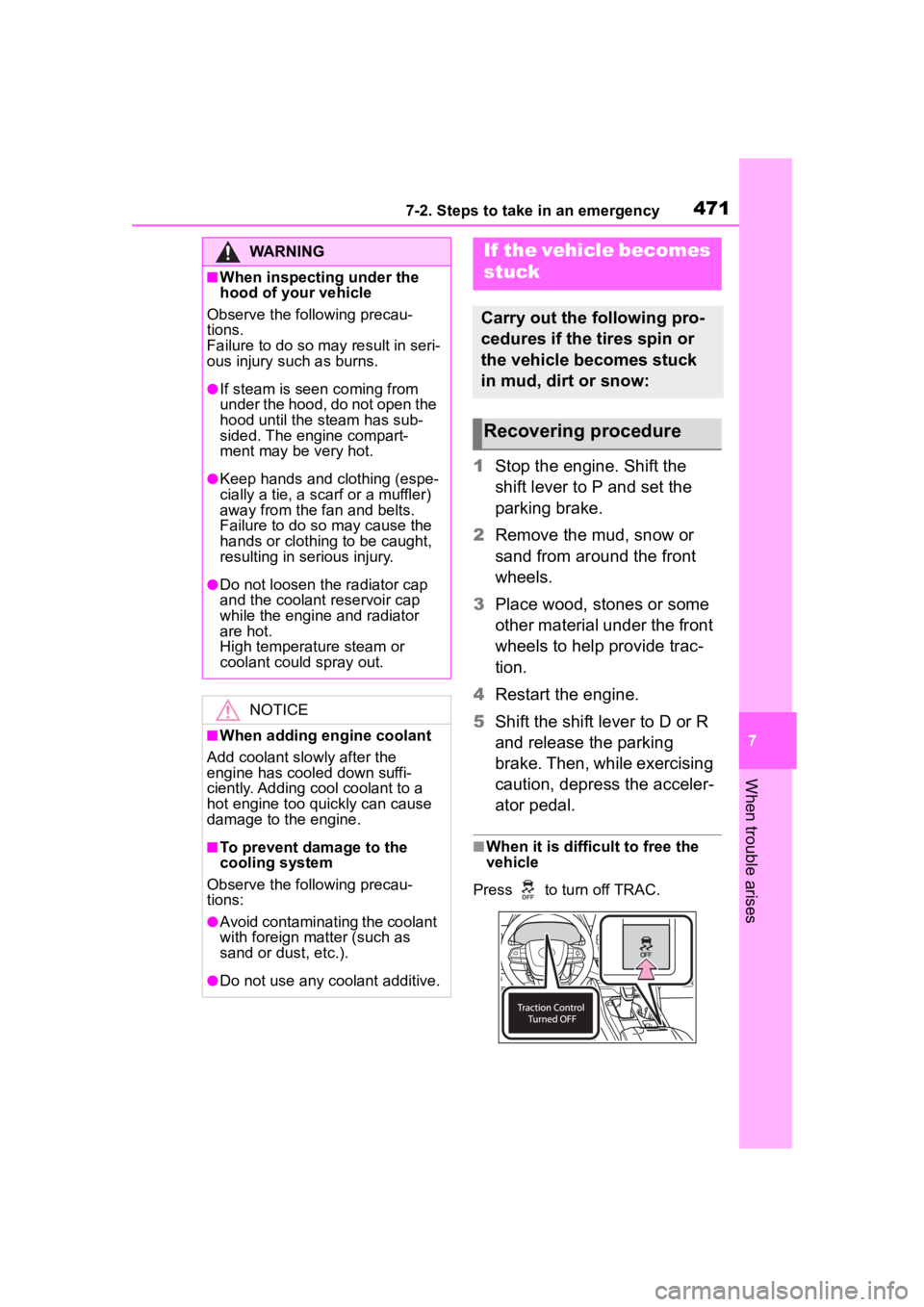
■When it is difficult to free the
vehicle
Press to turn off TRAC.
WARNING
■When inspecting under the
hood of your vehicle
Observe the following precau-
tions.
Failure to do so may result in seri-
ous injury such as burns.
●If steam is seen coming from
under the hood, do not open the
hood until the steam has sub-
sided. The engine compart-
ment may be very hot.
●Keep hands and clothing (espe-
cially a tie, a scarf or a muffler)
away from the fan and belts.
Failure to do so m ay cause the
hands or clothing to be caught,
resulting in serious injury.
●Do not loosen the radiator cap
and the coolant reservoir cap
while the engin e and radiator
are hot.
High temperature steam or
coolant could spray out.
NOTICE
■When adding engine coolant
Add coolant slowly after the
engine has cooled down suffi-
ciently. Adding cool coolant to a
hot engine too quickly can cause
damage to the engine.
■To prevent damage to the
cooling system
Observe the following precau-
tions:
●Avoid contaminating the coolant
with foreign matter (such as
sand or dust, etc.).
●Do not use any coolant additive.
If the vehicle becomes
stuck
Carry out the following pro-
cedures if the tires spin or
the vehicle becomes stuck
in mud, dirt or snow:
Recovering procedure
Page 488 of 552
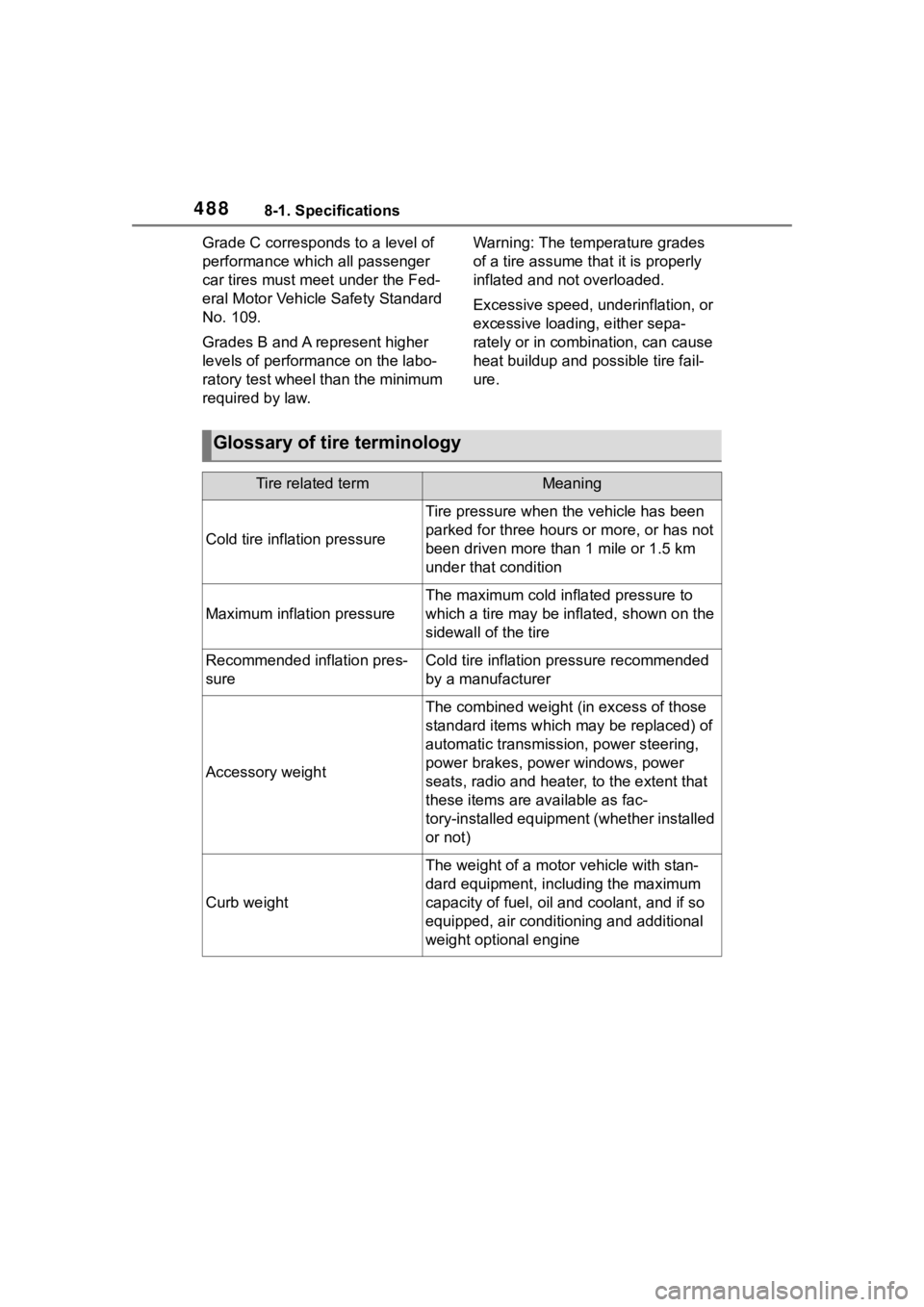
4888-1. Specifications
Grade C corresponds to a level of
performance which all passenger
car tires must meet under the Fed-
eral Motor Vehicle Safety Standard
No. 109.
Grades B and A represent higher
levels of performance on the labo-
ratory test wheel than the minimum
required by law. Warning: The temperature grades
of a tire assume tha
t it is properly
inflated and not overloaded.
Excessive speed, underinflation, or
excessive loading, either sepa-
rately or in combination, can cause
heat buildup and possible tire fail-
ure.
Glossary of tire terminology
Tire related termMeaning
Cold tire infl ation pressure
Tire pressure when the vehicle has been
parked for three hours or more, or has not
been driven more than 1 mile or 1.5 km
under that condition
Maximum inflation pressure
The maximum cold inf lated pressure to
which a tire may be inflated, shown on the
sidewall of the tire
Recommended inflation pres-
sureCold tire inflation pressure recommended
by a manufacturer
Accessory weight
The combined weight (in excess of those
standard items which may be replaced) of
automatic transmission, power steering,
power brakes, power windows, power
seats, radio and heater, to the extent that
these items are available as fac-
tory-installed equipment (whether installed
or not)
Curb weight
The weight of a motor vehicle with stan-
dard equipment, including the maximum
capacity of fuel, oil and coolant, and if so
equipped, air conditioning and additional
weight optional engine
Page 528 of 552
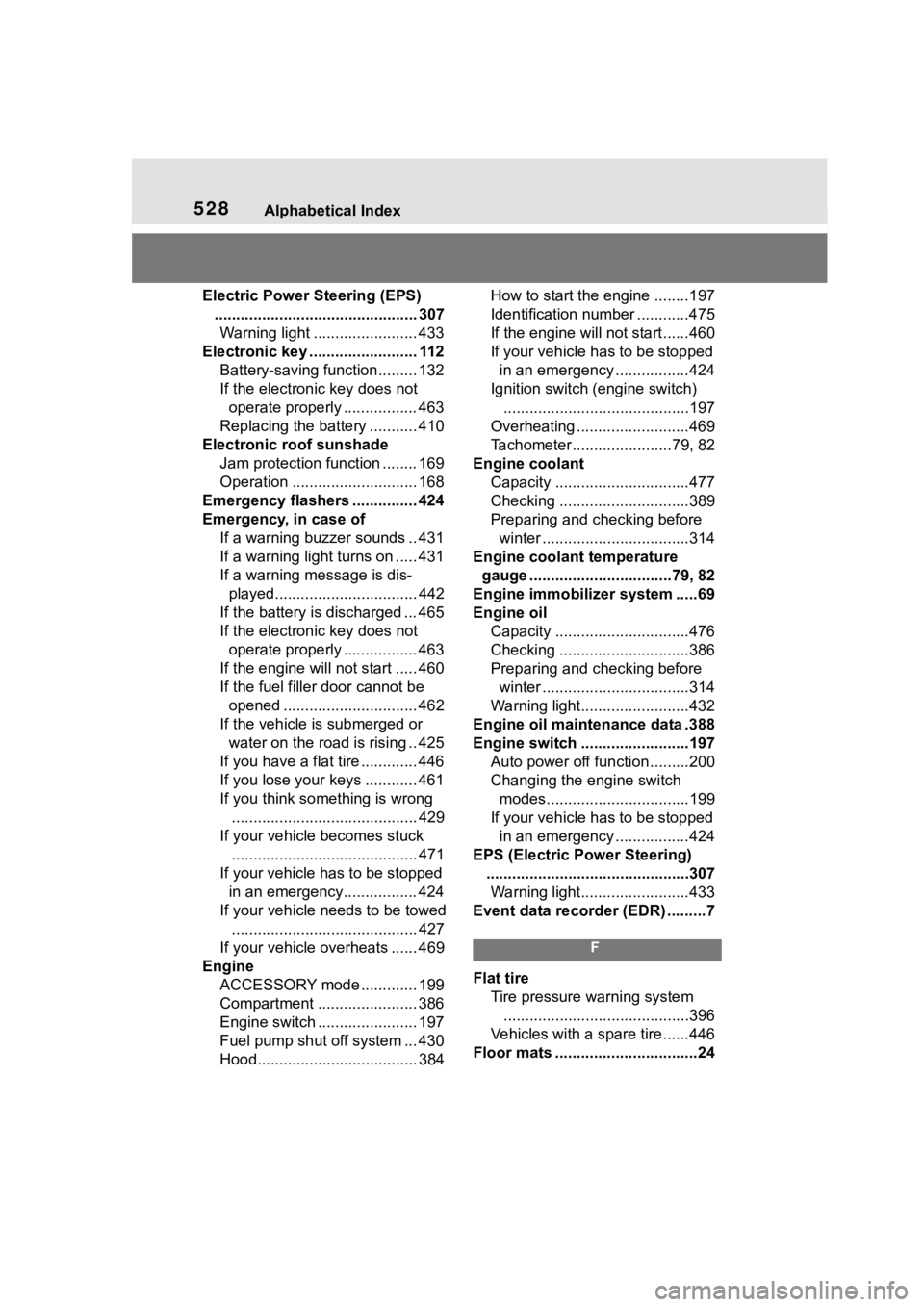
528Alphabetical Index
Electric Power Steering (EPS)............................................... 307Warning light ........................ 433
Electronic key ......................... 112 Battery-saving function......... 132
If the electronic key does not operate properly ................. 463
Replacing the battery ........... 410
Electronic roof sunshade Jam protection function ........ 169
Operation ............................. 168
Emergency flashers ............... 424
Emergency, in case of If a warning buzzer sounds .. 431
If a warning light turns on ..... 431
If a warning message is dis-played................................. 442
If the battery is discharged ... 465
If the electronic key does not operate properly ................. 463
If the engin e will not start ..... 460
If the fuel filler door cannot be opened ............................... 462
If the vehicle is submerged or water on the road is rising .. 425
If you have a flat tire ............. 446
If you lose your keys ............ 461
If you think something is wrong ........................................... 429
If your vehicle becomes stuck ........................................... 471
If your vehicle has to be stopped in an emergency................. 424
If your vehicle needs to be towed ........................................... 427
If your vehicle overheats ...... 469
Engine ACCESSORY mode ............. 199
Compartment ....................... 386
Engine switch ....................... 197
Fuel pump shut off system ... 430
Hood..................................... 384 How to start the engine ........197
Identification number ............475
If the engine will not start......460
If your vehicle has to be stopped
in an emergency .................424
Ignition switch (engine switch) ...........................................197
Overheating ..........................469
Tachometer.......................79, 82
Engine coolant Capacity ...............................477
Checking ..............................389
Preparing and checking before winter ..................................314
Engine coolant temperature gauge .................................79, 82
Engine immobilizer system .....69
Engine oil Capacity ...............................476
Checking ..............................386
Preparing and checking before winter ..................................314
Warning light.........................432
Engine oil maintenance data .388
Engine switch .........................197 Auto power off fun ction .........200
Changing the engine switch modes.................................199
If your vehicle has to be stopped in an emergency .................424
EPS (Electric Po wer Steering)
...............................................307 Warning light.........................433
Event data recorder (EDR) .........7
F
Flat tire Tire pressure w arning system
...........................................396
Vehicles with a spare tire......446
Floor mats .................................24