towing capacity TOYOTA HIGHLANDER 2023 Owners Manual
[x] Cancel search | Manufacturer: TOYOTA, Model Year: 2023, Model line: HIGHLANDER, Model: TOYOTA HIGHLANDER 2023Pages: 552, PDF Size: 13.36 MB
Page 181 of 552
1814-1. Before driving
4
Driving
Cargo capacity depends on the
total weight of the occupants.
(Cargo capacity) = (Total load
capacity) — (Total weight of
occupants)
Steps for Determining Correct
Load Limit —
(1) Locate the statement “The
combined weight of occupants
and cargo should never exceed
XXX kg or XXX lbs.” on your
vehicle’s placard.
(2) Determine the combined
weight of the driver and passen-
gers that will be riding in your
vehicle.
(3) Subtract the combined
weight of the driver and passen-
gers from XXX kg or XXX lbs.
(4) The resulting figure equals
the available amount of cargo
and luggage load capacity.
For example, if the “XXX”
amount equals 1400 lbs. and
there will be five 150 lb passen-
gers in your vehicle, the amount
of available cargo and luggage
load capacity is 650 lbs. (1400 − 750 (5
150) = 650 lbs.)
(5) Determine the combined
weight of luggage and cargo
being loaded on the vehicle.
That weight may not safely
exceed the available cargo and
luggage load capacity calcu-
lated in Step 4.
(6) If your vehicle will be towing
a trailer, load from your trailer
will be transferred to your vehi-
cle. Consult this manual to
determine how this reduces the
available cargo and luggage
load capacity of your vehicle.
( P.184)
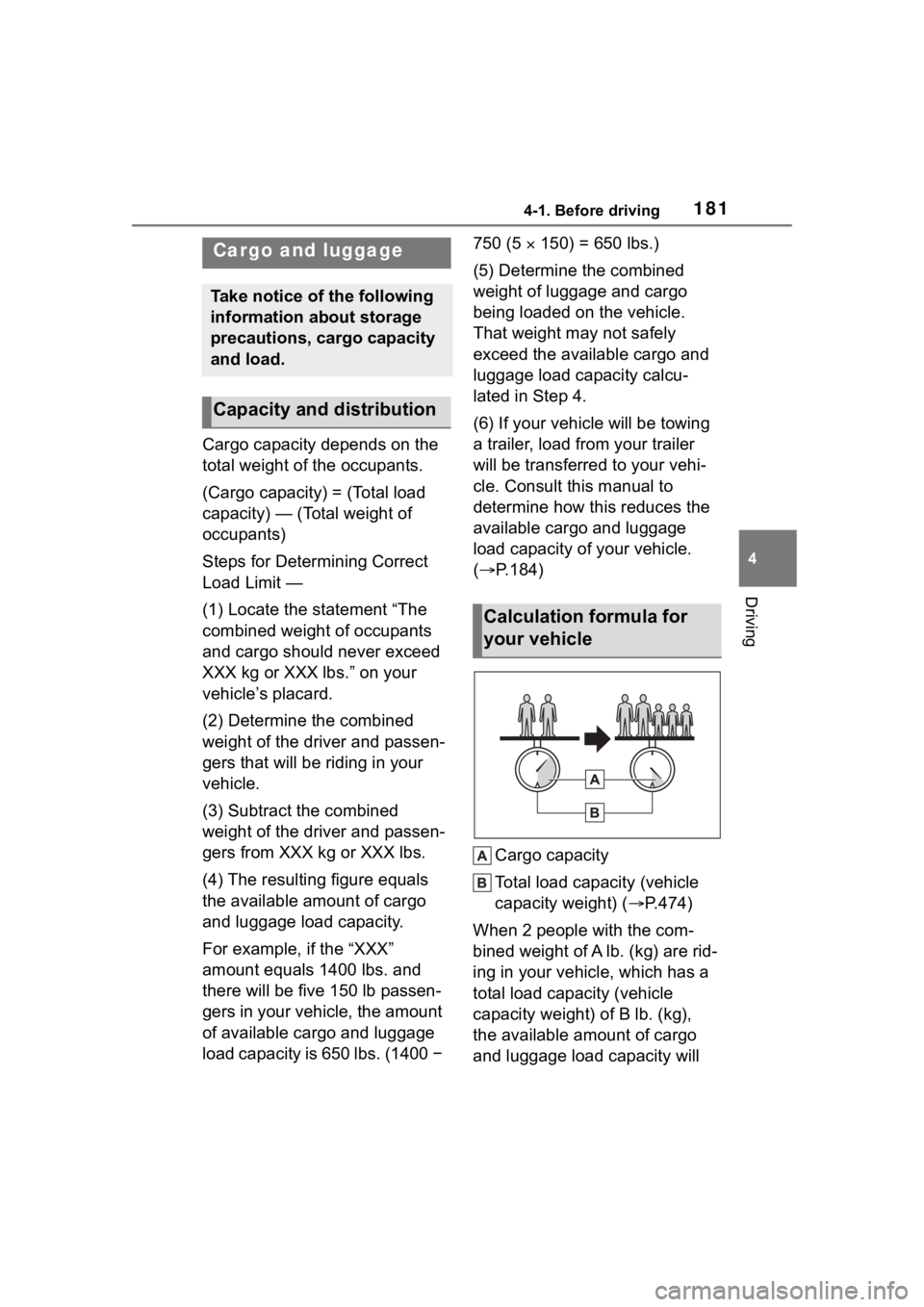
Cargo capacity
Total load capacity (vehicle
capacity weight) ( P.474)
When 2 people with the com-
bined weight of A lb. (kg) are rid-
ing in your vehicle, which has a
total load capacity (vehicle
capacity weight) of B lb. (kg),
the available amount of cargo
and luggage load capacity will
Cargo and luggage
Take notice of the following
information about storage
precautions, cargo capacity
and load.
Capacity and distribution
Calculation formula for
your vehicle
Page 187 of 552
1874-1. Before driving
4
Driving
WARNING
■Trailer towing precautions
To tow a trailer safely, use
extreme care and drive the vehi-
cle in accordance with the trailer’s
characteristics and operating con-
ditions. Failure to do so could
cause an accident resulting in
death or serious injury. Vehicle
stability and braking performance
are affected by trailer stability,
brake setting and performance,
and the hitch. Your vehicle will
handle different ly when towing a
trailer.
■To avoid accident or injury
●Do not exceed the TWR,
unbraked TWR, GCWR, GVWR
or GAWR.
●If the gross trailer weight is over
2000 lb. (900 kg), a sway con-
trol device with sufficient capac-
ity is required.
●If the gross trailer weight is over
5000 lb. (2200 kg), a weight dis-
tributing hitch with sufficient
capacity is required.
●Adjust the tongue weight within
the appropriate range. Place
heavier loads as close to the
trailer axle as possible.
●Do not exceed 65 mph (104
km/h), the posted towing speed
limit or the speed limit for your
trailer as set fort h in your trailer
owner’s manual, whichever is
lowest. Slow down sufficiently
before making a turn, in cross
winds, on wet or slippery sur-
face, etc. to help avoid an acci-
dent. If you experience a
vehicle-trailer instability from
reducing a certain speed, slow
down and make sure you keep
your vehicle speed under the
speed of which you experience
the instability.
●Do not make jerky, abrupt or
sharp turns.
●Do not apply the brakes sud-
denly as you may skid, resulting
in jackknifing and loss of vehicle
control. This is especially true
on wet or slippery surfaces.
●Do not exceed the trailer hitch
assembly weight, gross vehicle
weight, gross axle weight and
trailer tongue w eight capacities.
●Do not use the following sys-
tems when trailer towing.
• Dynamic radar cruise control with full-speed range
• LTA (Lane Tracing Assist)
• PCS (Pre-Collision System)
• BSM (Blind Spot Monitor) (if equipped)
• PKSB (Parking Support Brake) (if equipped)
• RCTA (Rear Cross Traffic Alert) function (if equipped)
• Intuitive parking assist (if equipped)
●Slow down and downshift
before descending steep or long
downhill grades. Do not make
sudden downshifts while
descending steep or long down-
hill grades.
●Vehicle-trailer instability is more
likely on steep long downhills.
Before descending steep or
long downhill grades, slow
down and downshift. Do not
make sudden downshifts when
descending steep or long down-
hill grades. Avoid holding the
brake pedal down too long or
applying the brakes too fre-
quently. This could cause the
brakes to overheat and result in
reduced braking efficiency.
Page 190 of 552
1904-1. Before driving
The gross trailer weight must
never exceed 5000 lb. (2200
kg).
The gross combination weight
must never exceed the follow-
ing:
• 2WD models: 10600 lb. (4805 kg)
• AWD models: 10600 lb. (4805 kg)
The gross vehicle weight
must never exceed the
GVWR indicated on the Certi-
fication Label. ( P.474)
The gross axle weight on
each axle must never exceed
the GAWR indicated on the
Certification Label. ( P.474)
If the gross trailer weight is
over the unbraked TWR,
trailer service brakes are
required.
If the gross trailer weight is
over 2000 lb. (900 kg), a sway
control device with sufficient
capacity is required.
If the gross trailer weight is
over 5000 lb. (2200 kg), a
weight distributing hitch with
sufficient capacity is required.
Confirm that the gross trailer
weight, gross combination
weight, gross vehicle weight,
gross axle weight and tongue weight are all within the limits.
■GCWR*
2WD models: 10600 lb. (4805
kg)
AWD models: 10600 lb. (4805
kg)
■TWR*
5000 lb. (2200 kg)
■Unbraked TWR*
1000 lb. (450 kg)
*: These models meet the tow-vehi-
cle trailering requirement of SAE
International per SAE J2807.
A recommended tongue
weight varies in accordance
with the types of trailers or
towing as described below.
To ensure the recommended
values shown below, the
trailer must be loaded by
referring to the following
instructions.
• Tongue Weight
The gross trailer weight should be
distributed so that the tongue
weight is 9% to 11%.
(Tongue weight/Gross trailer weight
x 100 = 9% to 11%)
Weight limits
GCWR, TWR and
Unbraked TWR
Trailer Tongue Weight
Page 536 of 552
536Alphabetical Index
Checking .............................. 393
If you have a flat tire ............. 446
Inflation pressure.................. 405
Information ........................... 484
Replacing ............................. 446
Rotating tires ........................ 396
Size ...................................... 479
Snow tires ............................ 314
Spare tire.............................. 446
Tire inflation pressure display function............................... 396
Tire pressure warning system ........................................... 396
Warning light ........................ 435
Tools ........................................ 447
Top tether strap ........................ 62
Total load capacity ................. 474
To w i n g Dinghy towing....................... 196
Emergency towing................ 427
Trailer towing ........................ 185
Toyota Safety Sense 2.5 + Automatic High Beam .......... 213
Dynamic radar cruise control with full-speed range .......... 249
LTA (Lane Tracing Assist) ..... 239
PCS (Pre-Collision System) . 228
RSA (Road Sign Assist) ....... 261
TRAC (Traction Control) ........ 307
Traction Control (TRAC) ........ 307
Trailer Sway Control .............. 307
Trailer towing .......................... 185
Transmission Automatic transmission ........ 201
Driving mode select switch... 300
If the shift lever cannot be shifted from P................................. 202
M mode ................................ 203
Trip meters .......................... 80, 85
Turn signal lights Replacing light bulbs ............ 415
Turn signal lever ................... 204U
USB charging ports ................349
V
Vanity lights ............................359
Vanity mirrors .........................359
Vehicle data recording ...............6
Vehicle identification number474
Vehicle information display .....91
Vehicle Stability Control (VSC)...............................................307
Ventilators (seat ventilators) .335
VSC (Vehicle Stability Control) ...............................................307
W
Warning buzzers ABS ......................................433
Airbags .................................432
Approach warning ................256
Brake hold ............................438
Brake Override System ........433
Brake system ........................431
Charging system ..................432
Downshifting .........................203
Drive-Start Control ................433
Electric power steering .........433
Engine ..................................432
Hands off steering wheel warn- ing (LTA) .............................248
High coolant temperature .....431
Intuitive parking assist .280, 282, 436
Low engine oil pressure .......432
LTA (Lane Tracing Assist) ...239, 243, 436
Open door .................... 116, 118
PKSB (Parking Support Brake) ...........................................437
Pre-collision braking .............230