fuel TOYOTA HIGHLANDER HYBRID 2023 Repair Manual
[x] Cancel search | Manufacturer: TOYOTA, Model Year: 2023, Model line: HIGHLANDER HYBRID, Model: TOYOTA HIGHLANDER HYBRID 2023Pages: 572, PDF Size: 14.07 MB
Page 476 of 572

4767-2. Steps to take in an emergency
If the fuel filler door opener
switch cannot be operated,
remove the cover inside the
luggage compartment and
pull the lever to open the fuel
filler door.
If the fuel filler door
cannot be opened
If the fuel filler door opener
switch cannot be operated,
contact your Toyota dealer
to service the vehicle. In
case where refueling is
urgently necessary, the fol-
lowing procedure can be
used to open the fuel filler
door.
Opening the fuel filler
door
NOTICE
■When opening the fuel filler
door manually
●Do not open the fuel filler door
manually except in an emer-
gency. Fuel may overflow.
●Using the lever to open the fuel
filler door may not allow for an
adequate reduction in fuel tank
pressure before refueling. To
prevent fuel from spilling out,
turn the cap slowly when remov-
ing it.
●During refueling, fuel may spill
out from the filler opening due to
air being discharged from inside
the fuel tank. The refore, fill the
fuel tank carefully and slowly.
Page 489 of 572

489
8
8
Vehicle specifications
Vehicle specifications
.8-1. SpecificationsMaintenance data (fuel, oil level, etc.) .................. 490
Fuel information .......... 498
Tire information ........... 500
8-2. Customization Customizable features.................................. 510
8-3. Initialization Items to initialize ......... 523
Page 490 of 572

4908-1. Specifications
8-1.Specifications
*1: Unladen vehicle
*2: For 7-seat models
*3: For 8-seat models
*4: For AXUH70L-ARXGHA, AXUH78L-ARXMHA models*6
*5
: For AXUH70L-ARXNHA, AXUH70L-ARXMHA, AXUH78L-ARXNHA models
*6
*6
: The model code is indicated o n the Certification Label. (P.490)
■Vehicle identification num-
ber
The vehicle identification num-
ber (VIN) is the legal identifier for your vehicle. This is the pri-
mary identification number for
your Toyota. It is used in regis-
tering the ownership of your
Maintenance data (fuel, oil level, etc.)
Dimensions and weight
Overall length194.9 in. (4950 mm)
Overall width76 in. (1930 mm)
Overall height*168.1 in. (1730 mm)
Wheelbase112.2 in. (2850 mm)
TreadFront65.3 in. (1659 mm)
Rear65.4 in. (1662 mm)
Vehicle capacity weight
(Occupants + luggage)1225 lb. (555 kg)*2
1330 lb. (605 kg)*3,4
1390 lb. (630 kg)*3,5
Trailer Weight Rating
(Trailer weight + cargo weight)3500 lb. (1590 kg)
Seating capacity
Seating capacity7-seat models8-seat models
7 (Front 2, Rear 5)8 (Front 2, Rear 6)
Vehicle identification
Page 491 of 572

4918-1. Specifications
8
Vehicle specifications
vehicle.
Top left of the instrument
panel
The vehicle identification number is
stamped.
Left-hand side center pillar
This number is also on the Certifi-
cation Label.
■Engine number
The engine number is stamped
on the engine block as shown.
Engine
ModelA25A-FXS
Ty p e4-cylinder in line , 4-cycle, gasoline
Bore and stroke3.44 4.07 in. (87.5 103.48 mm)
Displacement151.8 cu. in. (2487 cm3)
Valve clearance (engine cold)Automatic adjustment
Fuel
Fuel typeUnleaded gasoline only
Octane Rating87 (Research Octane Number 91) or
higher
Fuel tank capacity
(Reference)17.1 gal. (65 L, 14.2 Imp. gal.)
Page 493 of 572

4938-1. Specifications
8
Vehicle specifications
Outside temperature
SAE 0W-16 is the best choice
for good fuel economy and good
starting in cold weather.
If SAE 0W-16 is not available,
SAE 0W-20 oil may be used.
However, it must be replaced
with SAE 0W-16 at the next oil
change.
Oil viscosity (0W-16 is explained
here as an example):
• The 0W in 0W-16 indicates the characteristic of the oil
which allows cold startability.
Oils with a lower value before the W allow for easier starting
of the engine in cold weather.
• The 16 in 0W-16 indicates the viscosity characteristic of the
oil when the oil is at high tem-
perature. An oil with a higher
viscosity (one with a higher
value) may be better suited if
the vehicle is operated at high
speeds, or under extreme
load conditions.
How to read oil container label:
API registered mark is added to
some oil containers to help you
select the oil you should use.
Cooling system
Capacity
Gasoline
engine10.5 qt. (9.9 L , 8.7 Imp. qt.)
Power con-
trol unit2.0 qt. (1.9 L, 1.7 Imp. qt.)
Coolant type
Use either of the following:
“Toyota Super Long Life Coolant”
Similar high-quality et hylene glycol-based
non-silicate, non -amine, non-nitrite, and
non-borate coolant with long-life hybrid organic
acid technology
Do not use pla in water alone.
Page 498 of 572

4988-1. Specifications
■Gasoline quality
In very few cases, driveability prob-
lems may be caused by the brand of
gasoline you are using. If driveability
problems persist, try changing the
brand of gasoline. If this does not
correct the problem, consult your
Toyota dealer.
■Recommendation of the use of
gasoline containing detergent
additives
●Toyota recomme nds the use of
gasoline that contains detergent
additives to avoid the build-up of
engine deposits.
●All gasoline sold in the U.S.A. con-
tains minimum detergent additives
to clean and/or keep clean intake
systems, per EPA’s lowest addi-
tives concentration program.
●Toyota strongly recommends the
use of Top Tier Detergent Gaso-
line. For more information on Top
Tier Detergent Gasoline and a list
of marketers, please go to the offi-
cial website www.toptiergas.com.
■Recommendation of the use of
low emissions gasoline
Gasolines containing oxygenates
such as ethers and ethanol, as well
as reformulated gasolines, are avail-
able in some cities. These fuels are
typically acceptable for use, provid-
ing they meet other fuel require-
ments.
Toyota recommends these fuels,
since the formulations allow for
reduced vehicle emissions.
■Non-recommendation of the
use of blended gasoline
●Use only gasoline containing up to
15% ethanol.
DO NOT use any flex-fuel or gas-
oline that could contain more than
15% ethanol, including from any
pump labeled E30 (30% ethanol
[ ]), E50 (50% ethanol [ ]), E85
(85% ethanol [ ]) (which are only
some examples of f uel containing
more than 15% ethanol).
●If you use gasohol in your vehicle,
be sure that it has an octane rat-
ing no lower than 87.
●Toyota does not recommend the
use of gasoline containing metha-
nol.
■Non-recommendation of the
use of gasoline containing MMT
Some gasoline contains an octane
enhancing additive called MMT
(Methylcyclopentadienyl Manga-
nese Tricarbonyl).
Toyota does not re commend the use
of gasoline that contains MMT. If
fuel containing MMT is used, your
emission control system may be
Fuel infor mation
You must only use unleaded
gasoline.
Select octane rating 87
(Research Octane Number
91) or higher. Use of
unleaded gasoline with an
octane rating lower than 87
may result in engine knock-
ing. Persistent knocking
can lead to engine damage.
At minimum, the gasoline you
use should meet the specifica-
tions of ASTM D4814 in the
U.S.A.
Page 499 of 572

4998-1. Specifications
8
Vehicle specifications
adversely affected.
The malfunction indicator lamp on
the instrument cluster may come on.
If this happens, contact your Toyota
dealer for service.
■If your engine knocks
●Consult your Toyota dealer.
●You may occasionally notice light
knocking for a short time while
accelerating or driving uphill. This
is normal and there is no need for
concern.
NOTICE
■Notice on fuel quality
●Do not use impro per fuels. If
improper fuels are used, the
engine will be damaged.
●Do not use leaded gasoline.
Leaded gasoline can cause
damage to your vehicle’s
three-way catalytic converters
causing the emission control
system to malfunction.
●Do not use gasohol other than
the type previously stated.
Other gasohol may cause fuel
system damage or vehicle per-
formance problems.
●Using unleaded gasoline with
an octane number or rating
lower than the l evel previously
stated may cause persistent
heavy knocking.
At worst, this may lead to
engine damage.
■When refueling with gasohol
Take care not to spill gasohol. It
can damage your vehicle’s paint.
■Fuel-related poor driveability
If poor driveability (poor hot start-
ing, vaporization, engine knock-
ing, etc.) is encountered after
using a different type of fuel, dis-
continue the use of that type of
fuel.
Page 504 of 572
5048-1. Specifications
Grade C corresponds to a level of
performance which all passenger
car tires must meet under the Fed-
eral Motor Vehicle Safety Standard
No. 109.
Grades B and A represent higher
levels of performance on the labo-
ratory test wheel than the minimum
required by law. Warning: The temperature grades
of a tire assume tha
t it is properly
inflated and not overloaded.
Excessive speed, underinflation, or
excessive loading, either sepa-
rately or in combination, can cause
heat buildup and possible tire fail-
ure.
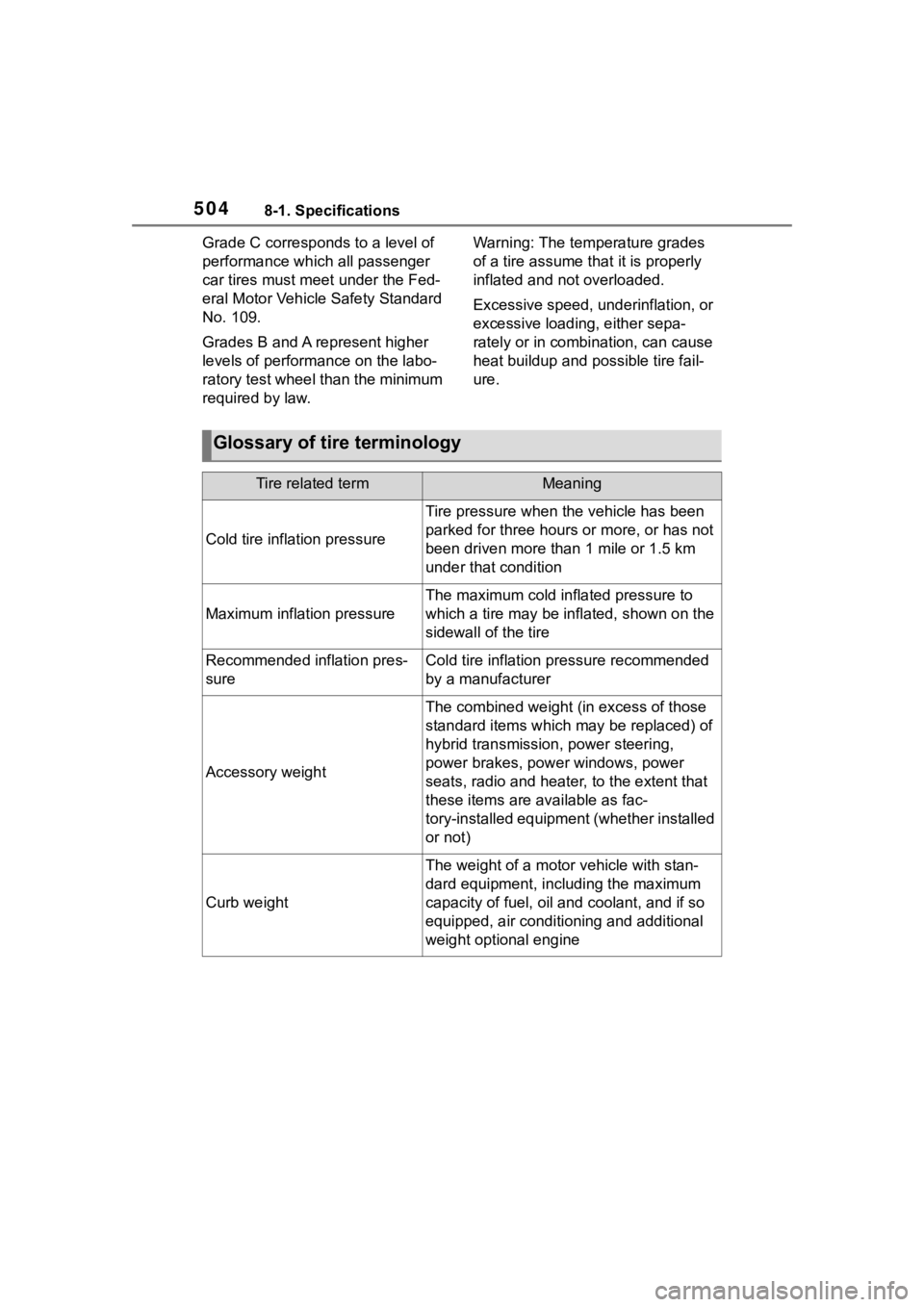
Glossary of tire terminology
Tire related termMeaning
Cold tire infl ation pressure
Tire pressure when the vehicle has been
parked for three hours or more, or has not
been driven more than 1 mile or 1.5 km
under that condition
Maximum inflation pressure
The maximum cold inf lated pressure to
which a tire may be inflated, shown on the
sidewall of the tire
Recommended inflation pres-
sureCold tire inflation pressure recommended
by a manufacturer
Accessory weight
The combined weight (in excess of those
standard items which may be replaced) of
hybrid transmission, power steering,
power brakes, power windows, power
seats, radio and heater, to the extent that
these items are available as fac-
tory-installed equipment (whether installed
or not)
Curb weight
The weight of a motor vehicle with stan-
dard equipment, including the maximum
capacity of fuel, oil and coolant, and if so
equipped, air conditioning and additional
weight optional engine
Page 512 of 572

5128-2. Customization
Units*2miles (MPG)
km (km/L)
OO—km (L/100 km)
miles (MPG Impe-rial)
Meter Type*32-dial1-dial—O—non-dial
Meter Style*3Smart
Casual
—O—Tough
Sporty
Dial Type*7SpeedometerHybrid System Indi- cator—O—
EV indicatorOnOff—O—
Eco Accelerator Guid-
ance
*3OnOff—O—
Drive information items
(First item)
*3Distance
Average vehicle speed
—O—
Elapsed time
Drive information items
(Second item)
*3Elapsed time
Average vehicle speed
—O—
Distance
Speedometer display*4OnOff—O—
Gadget content*4Off
Average vehicle speed
—O—Distance
Elapsed time
Fuel economy type*4Trip (after start)Total (after reset)*5
—O—
Tank (after refuel)*6
Fuel economy*3
Total average (Average fuel consumption [after reset])Trip average (Aver- age fuel consump- tion [after start])
—O—
Function*1Default settingCustomized setting
Page 541 of 572

541Alphabetical Index
Alphabetical Index
A
A/C ........................................... 328Air conditioning filter ............. 418
Automatic air conditioning sys-tem ..................................... 328
Eco air conditioning mode .... 332
Front seat concentrated airflow mode (S-FLOW) ................. 334
Rear automatic air conditioning system ................................ 337
ABS (Anti-lock Brake System) ............................................... 311Warning light ........................ 447
ACA (Active Cornering Assist) ............................................... 311
Active Cornering Assist (ACA) ............................................... 311
Adaptive Front-lighting System (AFS)...................................... 225
AFS (Adaptive Front-lighting System) ................................. 225
AHB (Automatic High Beam) . 226
Air conditioning filter ............. 418
Air conditioning system ........ 328 Air conditioning filter ............. 418
Automatic air conditioning sys-tem ..................................... 328
Eco air conditioning mode .... 332
Front seat concentrated airflow mode (S-FLOW) ................. 334
Rear automatic air conditioning system ................................ 337
Airbags Airbag operating conditions.... 36
Airbag precautions for your child............................................. 39
Correct driving posture ........... 25
Curtain shield airbag operating conditions ............................. 37
Curtain shield airbag precautions ............................................. 39 Front passenger occupant clas-
sification system ...................43
General airbag precautions ....39
Locations of airbags ...............34
Modification and disposal of air- bags......................................42
Side airbag operating conditions .............................................37
Side airbag precautions..........39
Side and curtain shield airbags operating conditions .............37
Side and curtain shield airbags precautions ...........................39
SRS airbags ...........................34
SRS warning light .................447
Alarm .........................................78 Warning buzzer ....................445
Anchor brackets ... ..............52, 62
Antennas (smart key system)142
Anti-lock Brake System (ABS) ............................................... 311Warning light.........................447
Approach warning ..................270
Armrest ......... ......................... ..362
Assist grips .............................363
Audio system-linked display101, 111
Automatic air conditioning sys- tem .........................................328Eco air conditioning mode ....332
Automatic headlight leveling system ...................................224
Automatic High Beam ............226
Automatic light control system ...............................................224
Auxiliary boxes ...............349, 354
Average fuel economy .....97, 109
Average vehicle speed ...........101
AWD Control ...........................101
B
Back door ................................131