Indicator TOYOTA HILUX 2019 User Guide
[x] Cancel search | Manufacturer: TOYOTA, Model Year: 2019, Model line: HILUX, Model: TOYOTA HILUX 2019Pages: 708, PDF Size: 95.31 MB
Page 63 of 708
631-2. Child safety
1
HILUX_OM_OM0K375E_(EE)
For safety and security
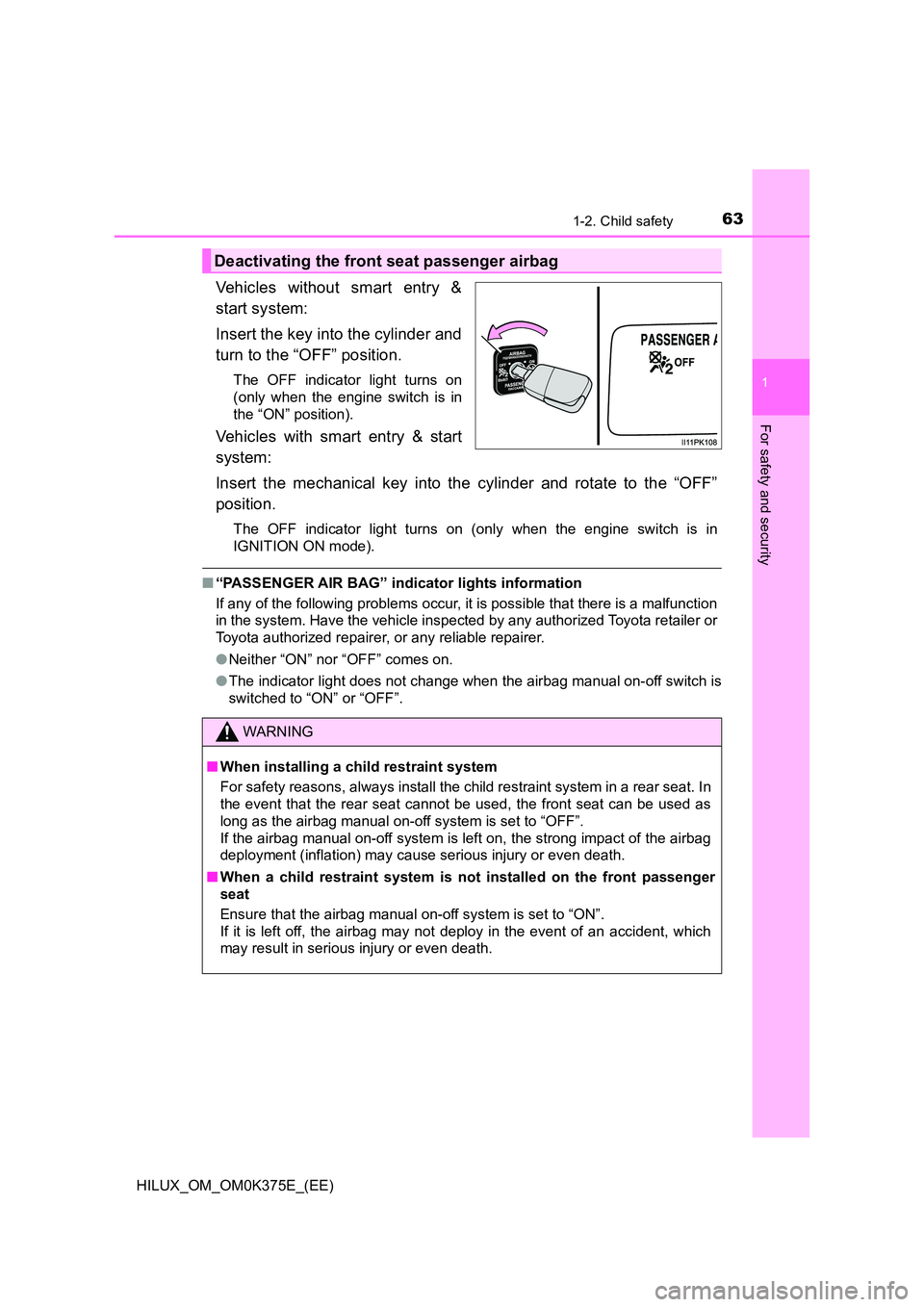
Vehicles without smart entry &
start system:
Insert the key into the cylinder and
turn to the “OFF” position.
The OFF indicator light turns on
(only when the engine switch is in
the “ON” position).
Vehicles with smart entry & start
system:
Insert the mechanical key into the cylinder and rotate to the “OFF”
position.
The OFF indicator light turns on (only when the engine switch is in
IGNITION ON mode).
■ “PASSENGER AIR BAG” indicator lights information
If any of the following problems occur, it is possible that there is a malfunction
in the system. Have the vehicle inspected by any authorized Toyota retailer or
Toyota authorized repairer, or any reliable repairer.
● Neither “ON” nor “OFF” comes on.
● The indicator light does not change when the airbag manual on-off switch is
switched to “ON” or “OFF”.
Deactivating the front seat passenger airbag
WARNING
■ When installing a child restraint system
For safety reasons, always install the child restraint system in a rear seat. In
the event that the rear seat cannot be used, the front seat can be used as
long as the airbag manual on-off system is set to “OFF”.
If the airbag manual on-off system is left on, the strong impact of the airbag
deployment (inflation) may cause serious injury or even death.
■ When a child restraint system is not installed on the front passenger
seat
Ensure that the airbag manual on-off system is set to “ON”.
If it is left off, the airbag may not deploy in the event of an accident, which
may result in serious injury or even death.
Page 71 of 708
711-2. Child safety
1
HILUX_OM_OM0K375E_(EE)
For safety and security
When using a child restraint system
WARNING
■When using a child restraint system
Observe the following precautions.
Failure to do so may result in death or serious injury.
● Vehicles with front passenger occupant classification system: Never use a
rear-facing child restraint system on the front passenger seat when “ON”
of the “PASSENGER AIR BAG” indicator is illuminated. ( P. 57)
The force of the rapid inflation of the front passenger airbag can cause
death or serious injury to children in the event of an accident.
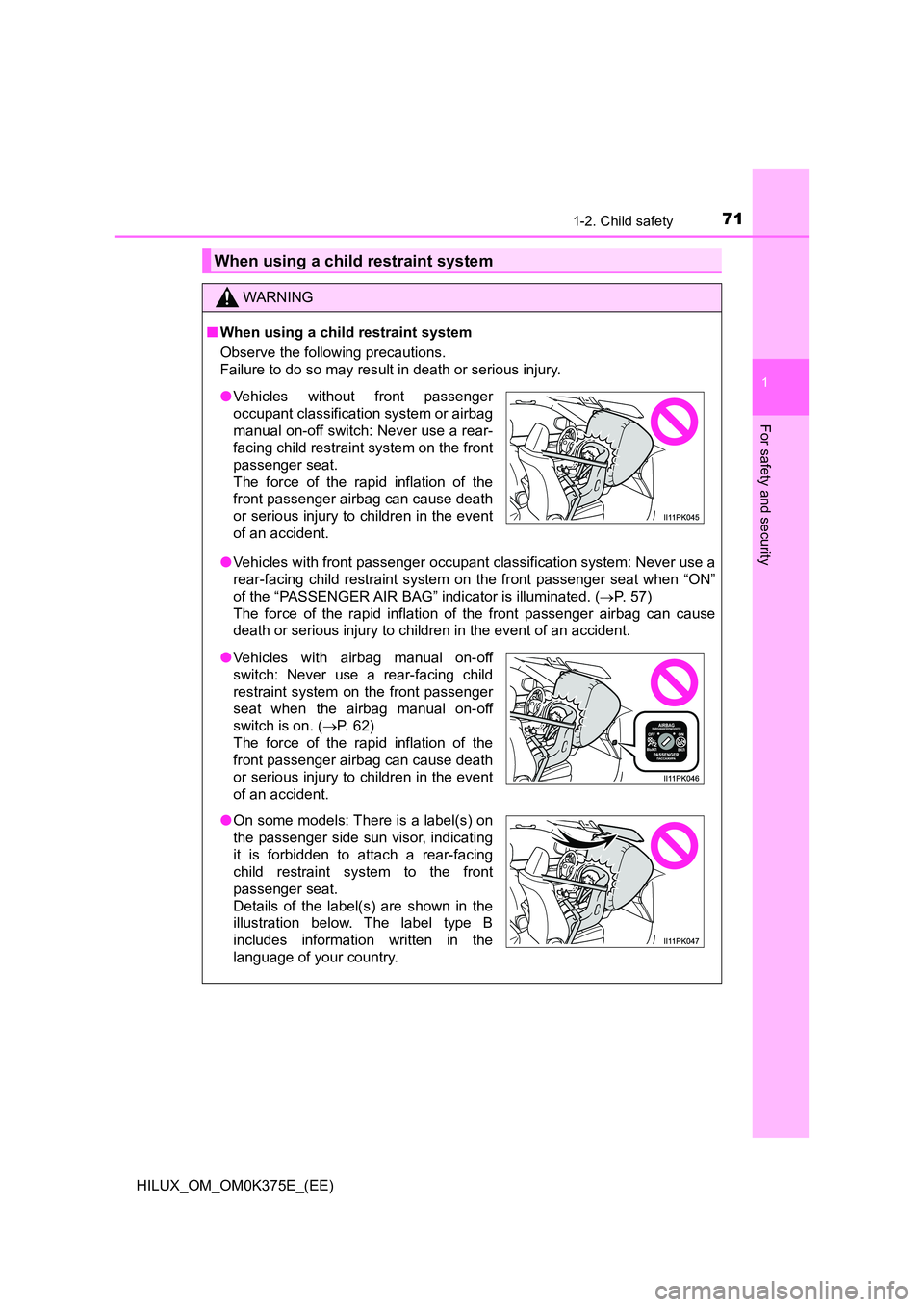
● Vehicles without front passenger
occupant classification system or airbag
manual on-off switch: Never use a rear-
facing child restraint system on the front
passenger seat.
The force of the rapid inflation of the
front passenger airbag can cause death
or serious injury to children in the event
of an accident.
● Vehicles with airbag manual on-off
switch: Never use a rear-facing child
restraint system on the front passenger
seat when the airbag manual on-off
switch is on. ( P. 62)
The force of the rapid inflation of the
front passenger airbag can cause death
or serious injury to children in the event
of an accident.
● On some models: There is a label(s) on
the passenger side sun visor, indicating
it is forbidden to attach a rear-facing
child restraint system to the front
passenger seat.
Details of the label(s) are shown in the
illustration below. The label type B
includes information written in the
language of your country.
Page 75 of 708
751-2. Child safety
1
HILUX_OM_OM0K375E_(EE)
For safety and security
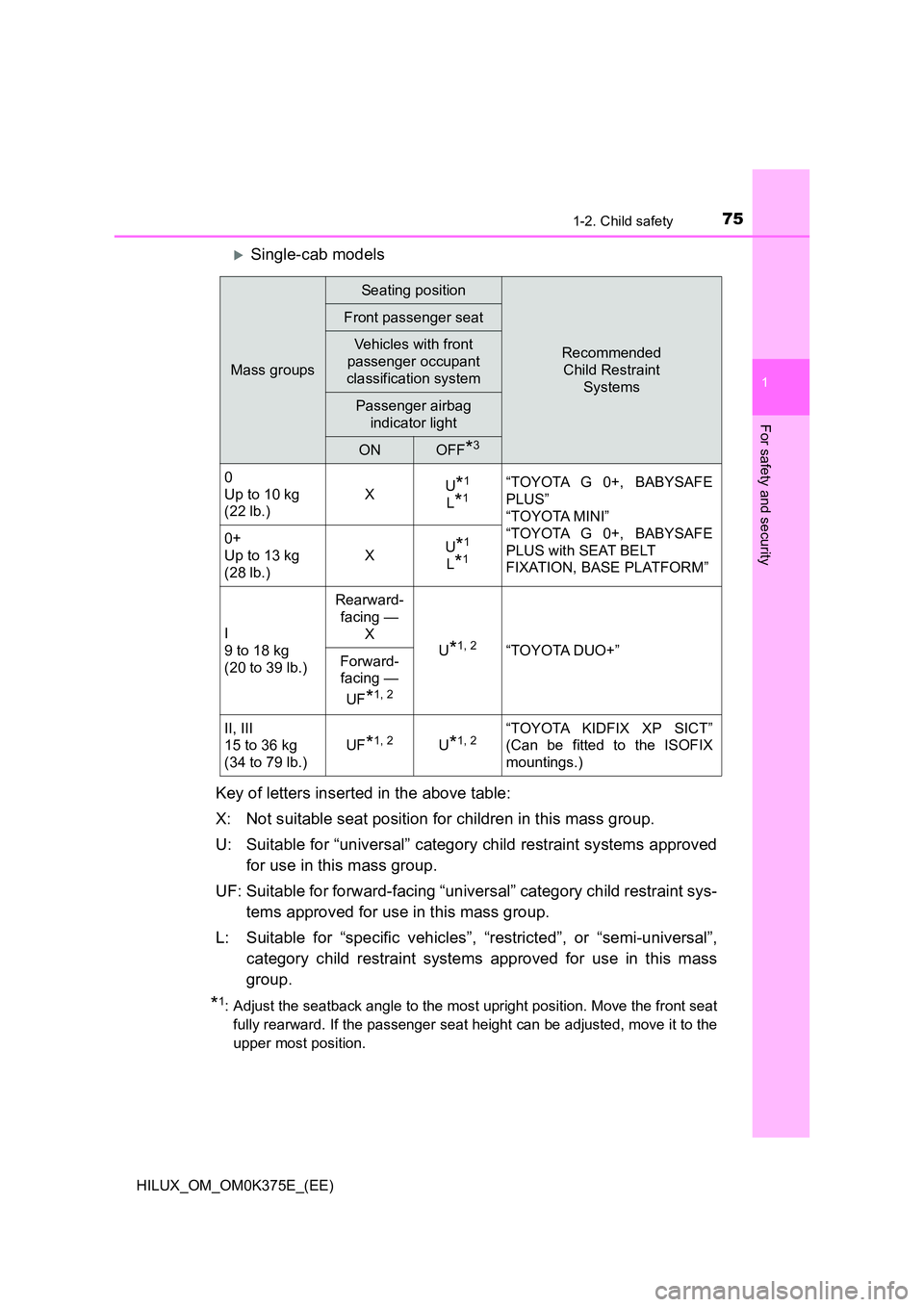
Single-cab models
Key of letters inserted in the above table:
X: Not suitable seat position for children in this mass group.
U: Suitable for “universal” category child restraint systems approved
for use in this mass group.
UF: Suitable for forward-facing “universal” category child restraint sys-
tems approved for use in this mass group.
L: Suitable for “specific vehicles”, “restricted”, or “semi-universal”,
category child restraint systems approved for use in this mass
group.
*1: Adjust the seatback angle to the most upright position. Move the front seat
fully rearward. If the passenger seat height can be adjusted, move it to the
upper most position.
Mass groups
Seating position
Recommended
Child Restraint
Systems
Front passenger seat
Vehicles with front
passenger occupant
classification system
Passenger airbag
indicator light
ONOFF*3
0
Up to 10 kg
(22 lb.)
X U*1
L*1“TOYOTA G 0+, BABYSAFE
PLUS”
“TOYOTA MINI”
“TOYOTA G 0+, BABYSAFE
PLUS with SEAT BELT
FIXATION, BASE PLATFORM”
0+
Up to 13 kg
(28 lb.)
X U*1
L*1
I
9 to 18 kg
(20 to 39 lb.)
Rearward-
facing —
X
U*1, 2“TOYOTA DUO+” Forward-
facing —
UF*1, 2
II, III
15 to 36 kg
(34 to 79 lb.)
UF*1, 2U*1, 2“TOYOTA KIDFIX XP SICT”
(Can be fitted to the ISOFIX
mountings.)
Page 76 of 708
761-2. Child safety
HILUX_OM_OM0K375E_(EE)
*2: If the head restraint interferes with your child restraint system, and the
head restraint can be removed, remove the head restraint. Otherwise, put
the head restraint in the upper most position.
*3: When it is unavoidable to install a rear-facing child restraint system on the
front passenger seat, a child restraint system can be installed if the PAS-
SENGER AIRBAG OFF indicator lamp is lit.
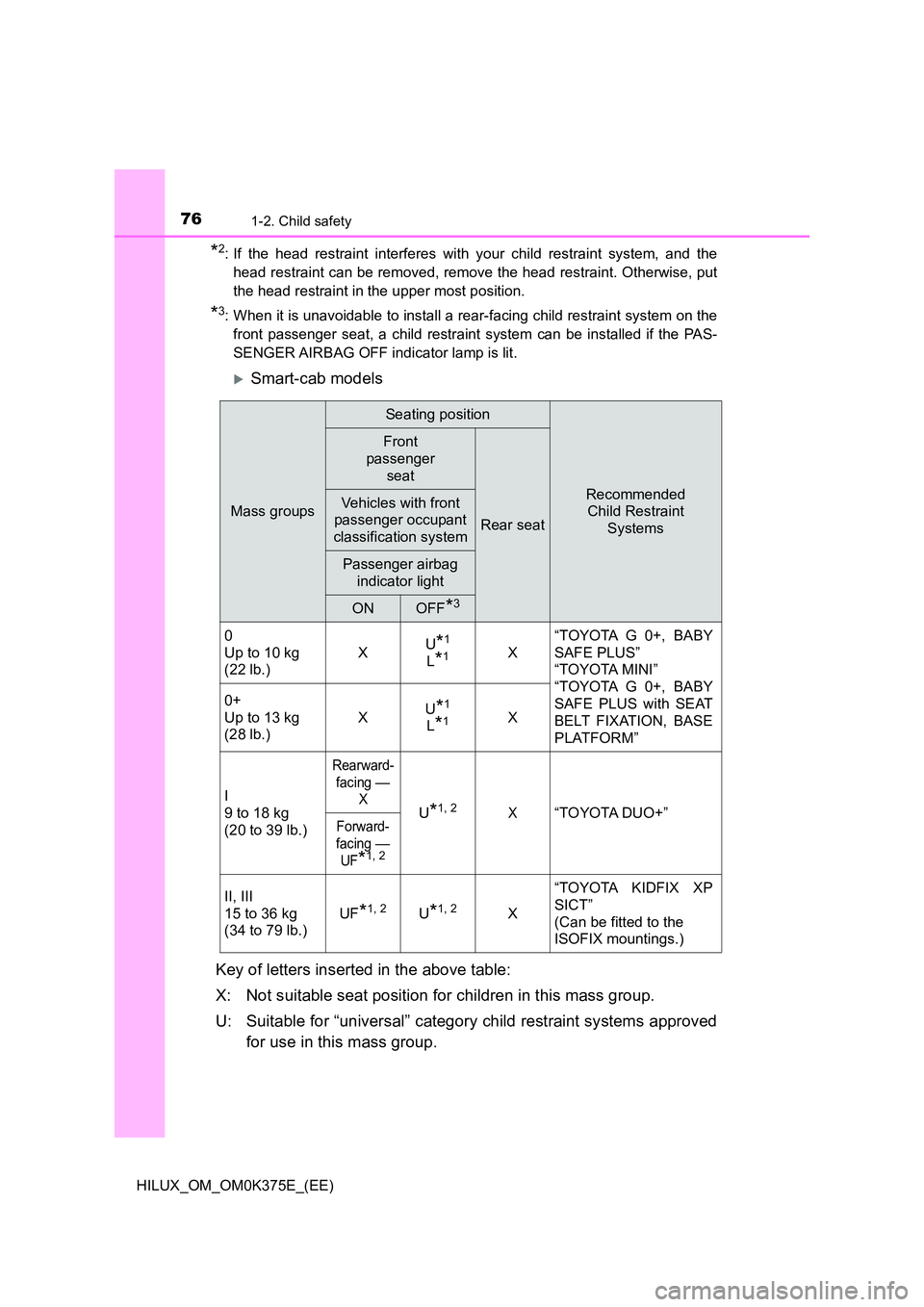
Smart-cab models
Key of letters inserted in the above table:
X: Not suitable seat position for children in this mass group.
U: Suitable for “universal” category child restraint systems approved
for use in this mass group.
Mass groups
Seating position
Recommended
Child Restraint
Systems
Front
passenger
seat
Rear seat
Vehicles with front
passenger occupant
classification system
Passenger airbag
indicator light
ONOFF*3
0
Up to 10 kg
(22 lb.)
X U*1
L*1X
“TOYOTA G 0+, BABY
SAFE PLUS”
“TOYOTA MINI”
“TOYOTA G 0+, BABY
SAFE PLUS with SEAT
BELT FIXATION, BASE
PLATFORM”
0+
Up to 13 kg
(28 lb.)
X U*1
L*1X
I
9 to 18 kg
(20 to 39 lb.)
Rearward-
facing —
XU*1, 2X“TOYOTA DUO+”Forward-
facing —
UF*1, 2
II, III
15 to 36 kg
(34 to 79 lb.)
UF*1, 2U*1, 2X
“TOYOTA KIDFIX XP
SICT”
(Can be fitted to the
ISOFIX mountings.)
Page 77 of 708
771-2. Child safety
1
HILUX_OM_OM0K375E_(EE)
For safety and security
UF: Suitable for forward-facing “universal” category child restraint sys-
tems approved for use in this mass group.
L: Suitable for “specific vehicles”, “restricted”, or “semi-universal”,
category child restraint systems approved for use in this mass
group.
*1: Adjust the seatback angle to the most upright position. Move the front seat
fully rearward. If the passenger seat height can be adjusted, move it to the
upper most position.
*2: If the head restraint interferes with your child restraint system, and the
head restraint can be removed, remove the head restraint. Otherwise, put
the head restraint in the upper most position.
*3: When it is unavoidable to install a rear-facing child restraint system on the
front passenger seat, a child restraint system can be installed if the PAS-
SENGER AIRBAG OFF indicator lamp is lit.
Page 78 of 708
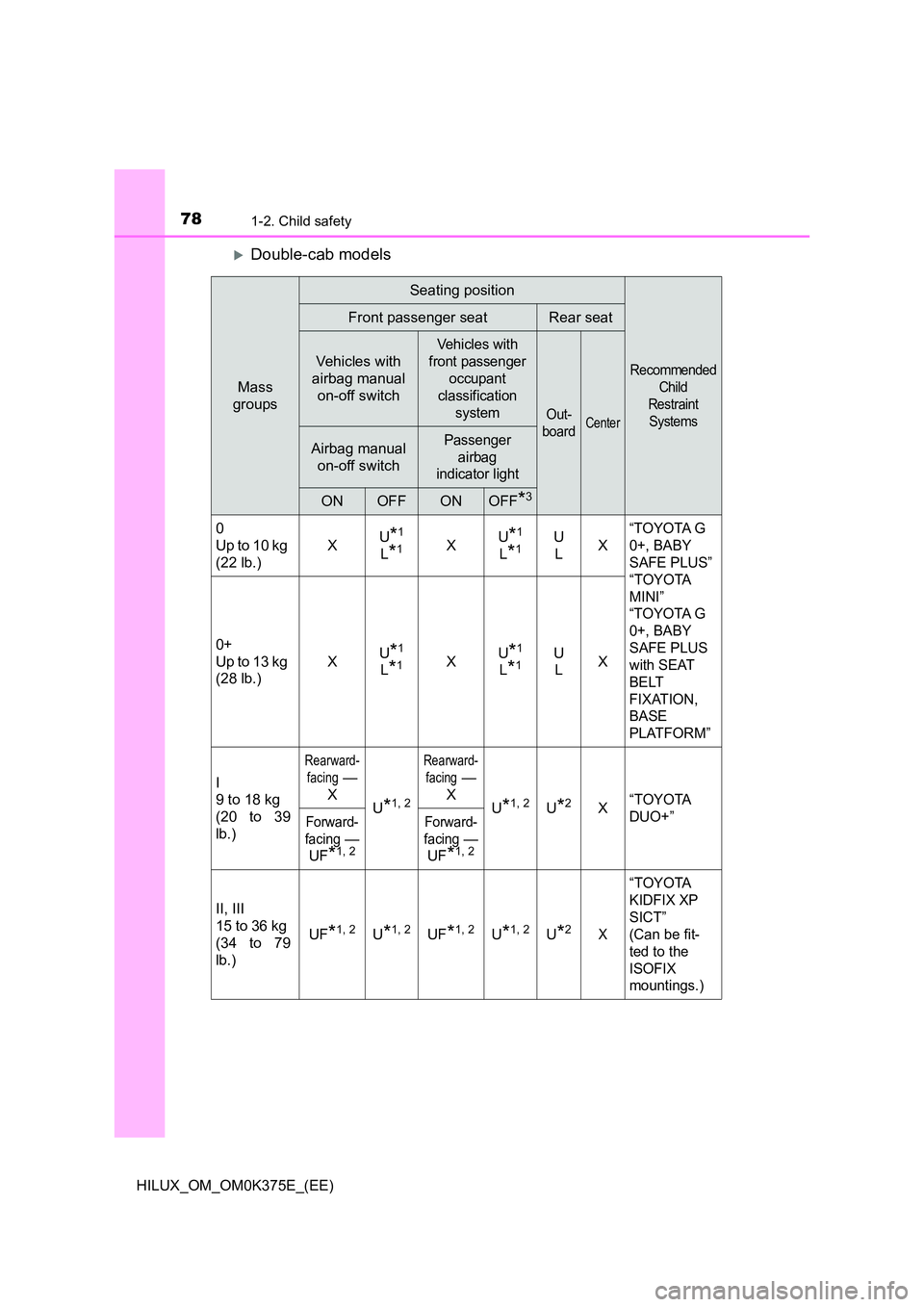
781-2. Child safety
HILUX_OM_OM0K375E_(EE)
Double-cab models
Mass
groups
Seating position
Recommended
Child
Restraint
Systems
Front passenger seatRear seat
Vehicles with
airbag manual
on-off switch
Vehicles with
front passenger
occupant
classification
systemOut-
boardCenter
Airbag manual
on-off switch
Passenger
airbag
indicator light
ONOFFONOFF*3
0
U p t o 1 0 k g
(22 lb.)
X U*1
L*1XU*1
L*1U
L X
“TOYOTA G
0+, BABY
SAFE PLUS”
“TOYOTA
MINI”
“TOYOTA G
0+, BABY
SAFE PLUS
with SEAT
BELT
FIXATION,
BASE
PLATFORM”
0+
U p t o 1 3 k g
(28 lb.)
X U*1
L*1XU*1
L*1U
L X
I
9 to 18 kg
(20 to 39
lb.)
Rearward-
facing —
X U*1, 2
Rearward-
facing —
X U*1, 2U*2X“TOYOTA
DUO+”Forward-
facing —
UF*1, 2
Forward-
facing —
UF*1, 2
II, III
15 to 36 kg
(34 to 79
lb.)
UF*1, 2U*1, 2UF*1, 2U*1, 2U*2X
“TOYOTA
KIDFIX XP
SICT”
(Can be fit-
ted to the
ISOFIX
mountings.)
Page 79 of 708
791-2. Child safety
1
HILUX_OM_OM0K375E_(EE)
For safety and security
Key of letters inserted in the above table:
X: Not suitable seat position for children in this mass group.
U: Suitable for “universal” category child restraint systems approved
for use in this mass group.
UF: Suitable for forward-facing “universal” category child restraint sys-
tems approved for use in this mass group.
L: Suitable for “specific vehicles”, “restricted”, or “semi-universal”,
category child restraint systems approved for use in this mass
group.
*1: Adjust the seatback angle to the most upright position. Move the front seat
fully rearward. If the passenger seat height can be adjusted, move it to the
upper most position.
*2: If the head restraint interferes with your child restraint system, and the
head restraint can be removed, remove the head restraint. Otherwise, put
the head restraint in the upper most position.
*3: When it is unavoidable to install a rear-facing child restraint system on the
front passenger seat, a child restraint system can be installed if the PAS-
SENGER AIRBAG OFF indicator lamp is lit.
Double-cab models: When securing some types of child restraint sys-
tems in rear seat, it may not be possible to properly use the seat belts
in positions next to the child restraint without interfering with it or
affecting seat belt effectiveness. Be sure your seat belt fits snugly
across your shoulder and low on your hips. If it does not, or if it inter-
feres with the child restraint, move to a different position. Failure to do
so may result in death or serious injury.
Page 81 of 708
811-2. Child safety
1
HILUX_OM_OM0K375E_(EE)
For safety and security
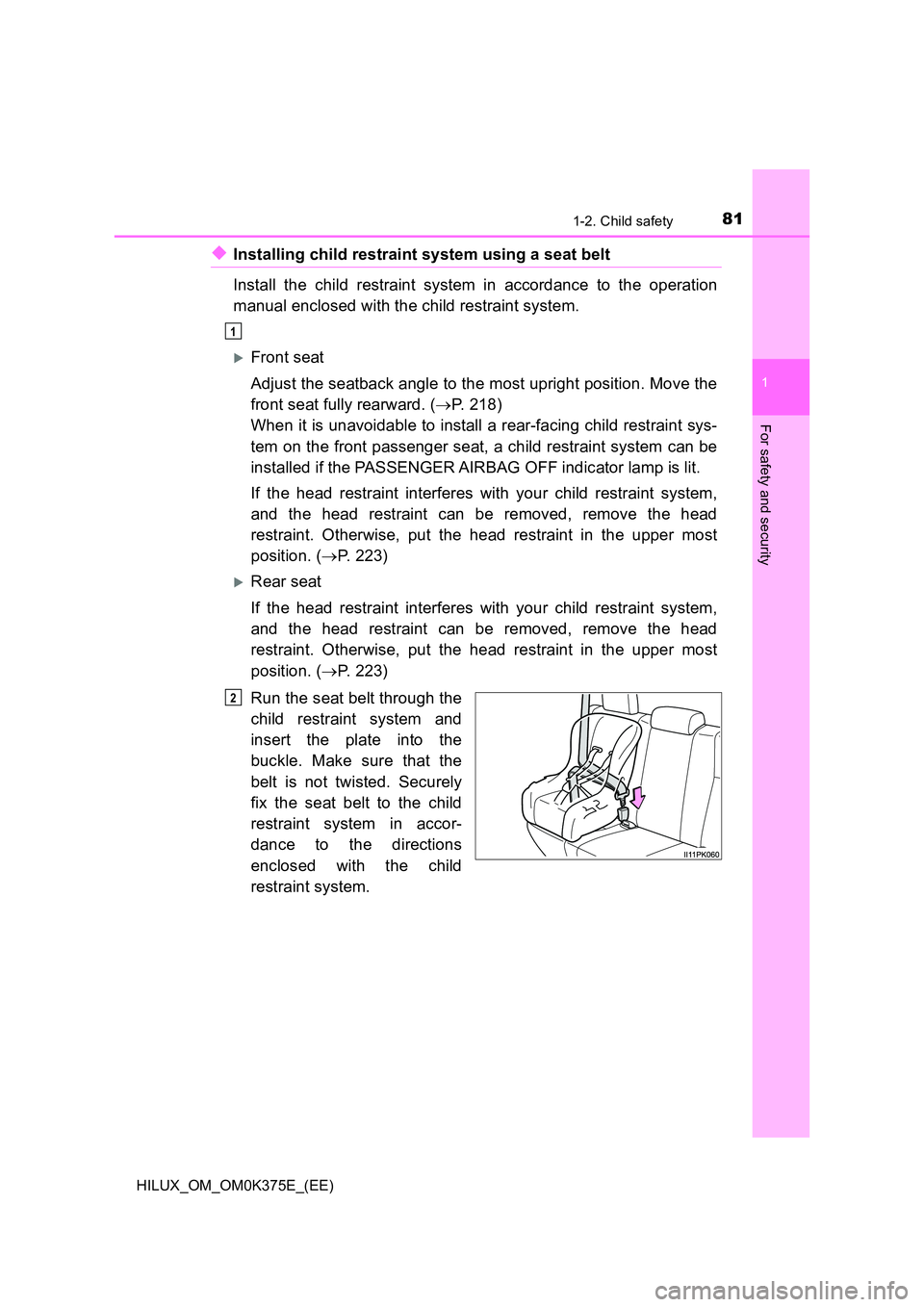
◆Installing child restraint system using a seat belt
Install the child restraint system in accordance to the operation
manual enclosed with the child restraint system.
Front seat
Adjust the seatback angle to the most upright position. Move the
front seat fully rearward. ( P. 218)
When it is unavoidable to install a rear-facing child restraint sys-
tem on the front passenger seat, a child restraint system can be
installed if the PASSENGER AIRBAG OFF indicator lamp is lit.
If the head restraint interferes with your child restraint system,
and the head restraint can be removed, remove the head
restraint. Otherwise, put the head restraint in the upper most
position. ( P. 223)
Rear seat
If the head restraint interferes with your child restraint system,
and the head restraint can be removed, remove the head
restraint. Otherwise, put the head restraint in the upper most
position. ( P. 223)
Run the seat belt through the
child restraint system and
insert the plate into the
buckle. Make sure that the
belt is not twisted. Securely
fix the seat belt to the child
restraint system in accor-
dance to the directions
enclosed with the child
restraint system.
1
2
Page 95 of 708
95
1
1-3. Theft deterrent system
HILUX_OM_OM0K375E_(EE)
For safety and security
Engine immobilizer system
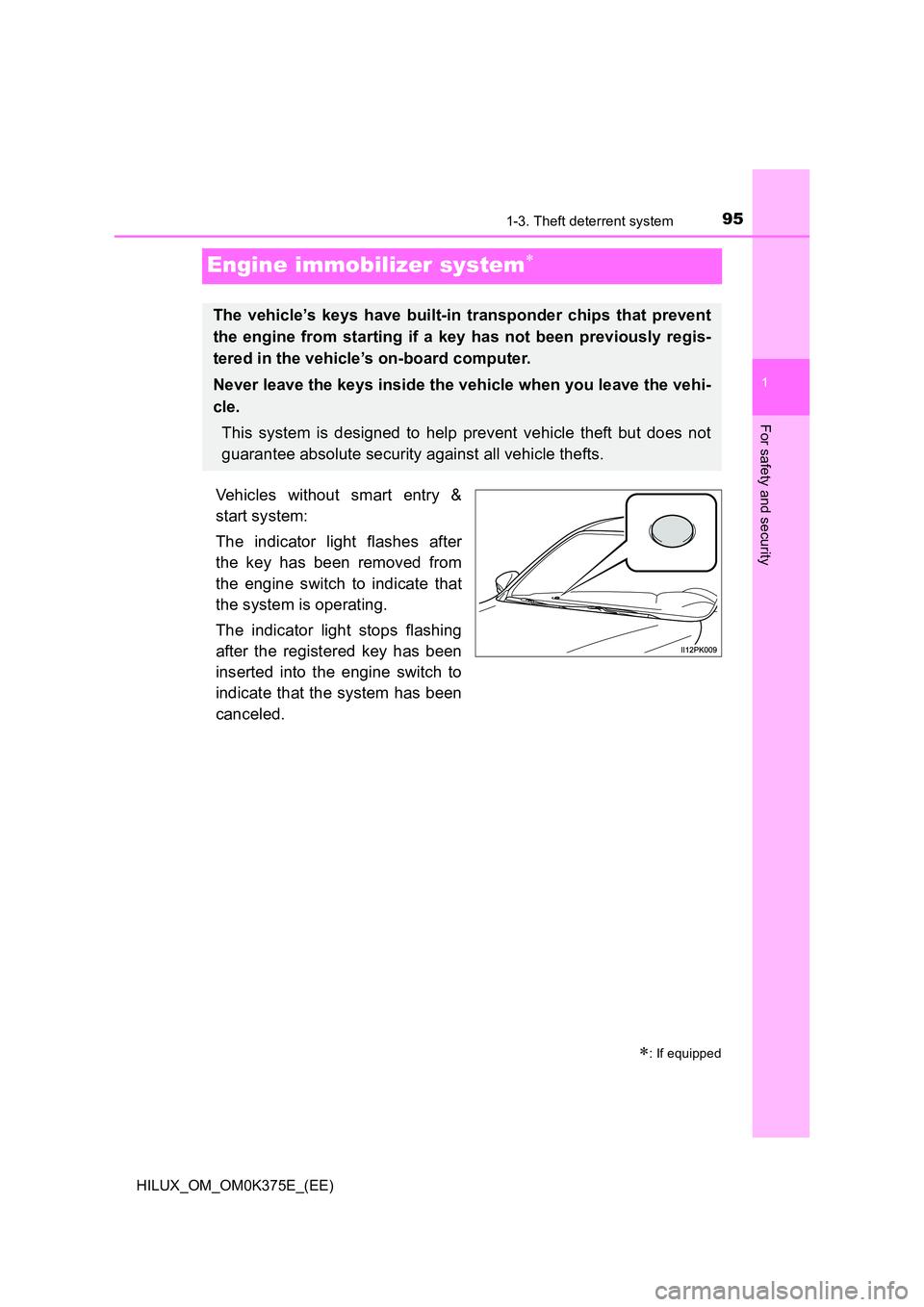
Vehicles without smart entry &
start system:
The indicator light flashes after
the key has been removed from
the engine switch to indicate that
the system is operating.
The indicator light stops flashing
after the registered key has been
inserted into the engine switch to
indicate that the system has been
canceled.
: If equipped
The vehicle’s keys have built-in transponder chips that prevent
the engine from starting if a key has not been previously regis-
tered in the vehicle’s on-board computer.
Never leave the keys inside the vehicle when you leave the vehi-
cle.
This system is designed to help prevent vehicle theft but does not
guarantee absolute security against all vehicle thefts.
Page 96 of 708
961-3. Theft deterrent system
HILUX_OM_OM0K375E_(EE)
Vehicles with smart entry & start system:
The indicator light flashes after the engine switch has been turned off
to indicate that the system is operating.
The indicator light stops flashing after the engine switch has been
turned to ACCESSORY or IGNITION ON mode to indicate that the
system has been canceled.
■ System maintenance
The vehicle has a maintenance-free type engine immobilizer system.
■ Conditions that may cause the system to malfunction
● If the grip portion of the key is in contact with a metallic object
● If the key is in close proximity to or touching a key to the security system
(key with a built-in transponder chip) of another vehicle