differential TOYOTA HILUX 2023 User Guide
[x] Cancel search | Manufacturer: TOYOTA, Model Year: 2023, Model line: HILUX, Model: TOYOTA HILUX 2023Pages: 810, PDF Size: 131.54 MB
Page 344 of 810
3424-5. Using the driving support systems
HILUX_OM_OM0K789E_(EE)
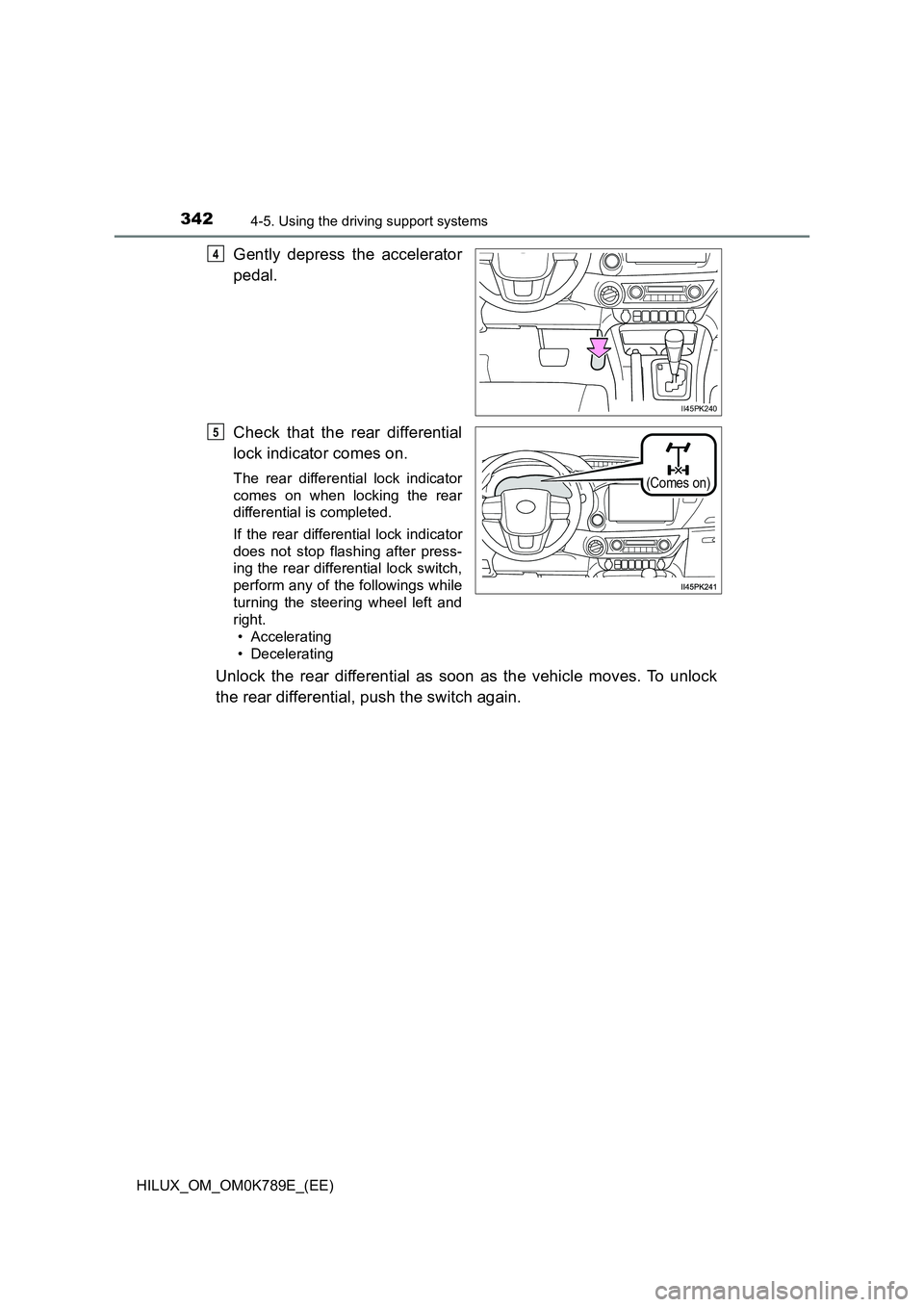
Gently depress the accelerator
pedal.
Check that the rear differential
lock indicator comes on.
The rear differential lock indicator
comes on when locking the rear
differential is completed.
If the rear differential lock indicator
does not stop flashing after press-
ing the rear differential lock switch,
perform any of the followings while
turning the steering wheel left and
right.
• Accelerating
• Decelerating
Unlock the rear differential as soon as the vehicle moves. To unlock
the rear differential, push the switch again.
II45PK240
4
(Comes on)
5
Page 345 of 810
3434-5. Using the driving support systems
4
Driving
HILUX_OM_OM0K789E_(EE)
■Locking the rear differential
The following systems do not operate w hen the rear differential is locked.
It is normal operation for the ABS warning light, VSC OFF indicator (if
equipped) and “TRC OFF” indicator (if equipped) to be on or for “TRC turned
off” to be displayed on the multi-information display (if equipped) at this time.
•ABS
• Brake assist (if equipped)
• VSC (if equipped)
• TRC/A-TRC (if equipped)
• Trailer Sway Control (if equipped)
• Hill-start assist control (if equipped)
• Downhill assist control (if equipped)
■ Unlocking the rear differential
If the rear differential lock indicator still flashes even after unlocking the rear
differential, check the safety of the surrounding area and slightly turn the
steering wheel in either direction while the vehicle is in motion.
■ Automatic system cancelation of the rear differential lock system
The rear differential lock is also unlocked in any of the following situations:
● The front-wheel drive control switch is turned to H2 or H4 (4WD models)
● The engine switch is turned to the “ACC” or “LOCK” position (vehicles with-
out smart entry & start system) or A CCESSORY or off (vehicles with smart
entry & start system)
■ After unlocking the rear differential
Check that the indicator goes off.
WARNING
■ To avoid an accident
Failure to observe the following precautions may result in an accident.
● Do not use the rear differential lock system except when wheel spinning
occurs in a ditch or on a slippery or rugged surface. Large steering effort
and careful cornering control will be required.
● Do not lock the rear differential until the wheels have stopped spinning.
Otherwise, the vehicle may move in an unexpected direction when the dif-
ferential lock is engaged, resulting in an accident. This may also lead to
possible damage to rear differential lock component parts.
● Do not drive over 8 km/h (5 mph) when the differential is locked.
● Do not keep driving with the rear differential lock switch on.
Page 349 of 810
3474-5. Using the driving support systems
4
Driving
HILUX_OM_OM0K789E_(EE)
■ Operating conditions
● The Stop & Start system is operational when all of the following conditions
are met:
• The vehicle has been driven a certain amount of time.
• The brake pedal is being depressed firmly. (vehicles with automatic trans-
mission)
• The clutch pedal is not depressed. (vehicles with manual transmission)
• The D shift position is selected. (v ehicles with automatic transmission)
• The shift lever is in N. (vehicles with manual transmission)
• The driver’s seat belt is fastened.
• The driver’s door is closed.
• The selected driving mode is normal or Eco drive mode. (if equipped)
• The rear differential is not locked. (if equipped)
• is off. (vehicles without manual air conditioning system)
• The accelerator pedal is not being depressed. (vehicles with automatic
transmission)
• The engine is adequately warmed up.
• The outside temperature is -5°C (23°F) or higher.
• The hood is closed. ( P. 348)
● In the following situations, the engine may not be stopped by the Stop &
Start system. This is not a malfunction of the Stop & Start system.
• When the air conditioning system is being used.
• When the power heater is being used.
• When the battery is undergoing a periodic recharge.
• When the battery is not sufficiently charged, such as if the vehicle has
been parked for a long time and the battery charge has decreased, the
electric load is large, the battery fluid temperature is excessively low or
the battery has deteriorated.
• When the brake booster vacuum is low.
• When the elapsed time since the engine was restarted is short.
• When the vehicle is stopped frequently, such as when in a traffic jam.
• When the engine coolant temperature or transmission fluid temperature
is extremely low or high.
• When the vehicle is stopped on a steep incline. (vehicles with automatic
transmission)
• When the steering wheel is being operated.
• When the vehicle is being driven in a high altitude area.
• When the battery fluid temperature is extremely low or high.
• For a while after the battery terminals have been disconnected and
reconnected.
Page 350 of 810
3484-5. Using the driving support systems
HILUX_OM_OM0K789E_(EE)
● When the engine is stopped by the Stop & Start system, the engine will be
restarted automatically if any of the following conditions are met:
(To enable the engine to be stopped by the Stop & Start system again, drive
the vehicle.)
• The air conditioning system is turned on.
• is turned on.
• The power heater is turned on.
• The shift lever is shifted from D or P. (vehicles with automatic transmis-
sion)
• The shift lever is shifted from P. (When the engine is stopped by the Stop
& Start system when the shift lever is in P.) (vehicles with automatic trans-
mission)
• The driver’s seat belt is unfastened.
• The driver’s door is opened.
• The driving mode is changed from normal or Eco drive mode to another
mode. (if equipped)
• The rear differential is locked. (if equipped)
• The Stop & Start cancel switch is pressed.
• The steering wheel is operated.
• The accelerator pedal is depressed. (vehicles with automatic transmis-
sion)
• The vehicle starts to roll on an incline.
● When the engine is stopped by the Stop & Start system, the engine may
restart automatically in the following situations:
(To enable the engine to be stopped by the Stop & Start system again, drive
the vehicle.)
• When the brake pedal is pumped or strongly depressed.
• When the air conditioning system is being used.
• When a switch of the air conditioning system is operated ( , etc.).
• If the battery charge becomes low.
■ When the hood is opened
● If the hood is opened while the engine is stopped by the Stop & Start sys-
tem, the engine will stall and will not be able to be restarted by the automatic
engine start function. In this case, restart the engine using the normal
engine starting procedure. ( P. 219, 222)
● If the hood is closed after the engine is started with the hood open, the Stop
& Start system will not operate. Close the hood, turn the engine switch to the
“LOCK” position*1 or off*2, wait 30 seconds or more, and then start the
engine.
*1: Vehicles without smart entry & start system
*2: Vehicles with smart entry & start system
Page 366 of 810
3644-5. Using the driving support systems
HILUX_OM_OM0K789E_(EE)
■Operating tips (vehicles with automatic transmission)
The system will operate when the shift lever is in a position other than P, how-
ever to make effective use of the system it is recommended to select a lower
shift range.
■ The system will not operate when
● The transfer mode is in H2.
● The rear differential is locked. (if equipped)
■ If the downhill assist control system indicator flashes
● In the following situations, the indicator flashes and the system will not oper-
ate:
• The transfer mode is not in L4 or H4.
• The rear differential is locked. (if equipped)
• The shift lever is in P. (vehicles with automatic transmission)
• The accelerator or brake pedal is depressed.
• The vehicle speed exceeds approximately 30 km/h (18 mph).
• The brake system overheats.
● In the following situations, the indicator flashes to alert the driver, but the
system will operate:
• The shift lever is in N. (vehicles with automatic transmission)
• The clutch pedal is depressed. (vehicles with manual transmission)
• The “DAC” switch is turned off while the system is operating.
The system will gradually ceases operat ion. The indicator will flash during
operation, and then go off when the system is fully off.
■ When the downhill assist control system is operated continuously
This may cause the brake actuator to overheat. In this case, the downhill
assist control system will stop operating, a buzzer will sound and the downhill
assist control system indicator will start flashing, and “TRC turned off” will be
shown on the multi-information display. Refrain from using the system until
the downhill assist control system indicator stays on and the message goes
off. (The vehicle can be driven normally during this time.)
■ Sounds and vibrations caused by the downhill assist control system
● A sound may be heard from the engine compartment when the engine is
started or just after the vehicle begins to move. This sound does not indicate
that a malfunction has occurred in downhill assist control system.
● Either of the following conditions may occur when the downhill assist control
system is operating. None of these are indicators that a malfunction has
occurred.
• Vibrations may be felt through the vehicle body and steering.
• A motor sound may be heard after the vehicle comes to a stop.
Page 570 of 810
5688-2. Steps to take in an emergency
HILUX_OM_OM0K789E_(EE)
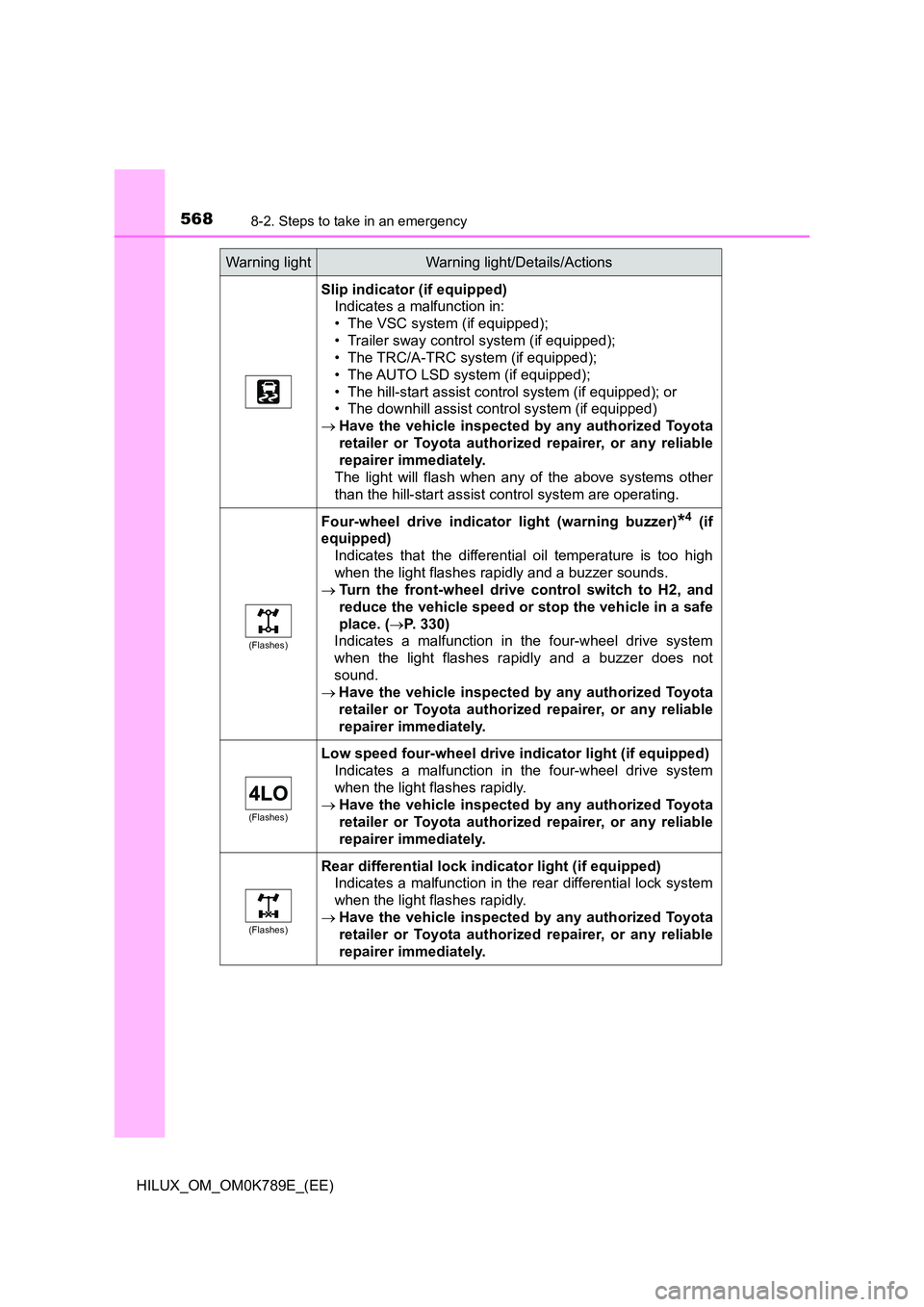
Slip indicator (if equipped)
Indicates a malfunction in:
• The VSC system (if equipped);
• Trailer sway control system (if equipped);
• The TRC/A-TRC system (if equipped);
• The AUTO LSD system (if equipped);
• The hill-start assist control system (if equipped); or
• The downhill assist control system (if equipped)
Have the vehicle inspected by any authorized Toyota
retailer or Toyota authorized repairer, or any reliable
repairer immediately.
The light will flash when any of the above systems other
than the hill-start assist control system are operating.
(Flashes)
Four-wheel drive indicator light (warning buzzer)*4 (if
equipped)
Indicates that the differential oil temperature is too high
when the light flashes rapidly and a buzzer sounds.
Turn the front-wheel drive control switch to H2, and
reduce the vehicle speed or stop the vehicle in a safe
place. ( P. 330)
Indicates a malfunction in the four-wheel drive system
when the light flashes rapidly and a buzzer does not
sound.
Have the vehicle inspected by any authorized Toyota
retailer or Toyota authorized repairer, or any reliable
repairer immediately.
(Flashes)
Low speed four-wheel drive indicator light (if equipped)
Indicates a malfunction in the four-wheel drive system
when the light flashes rapidly.
Have the vehicle inspected by any authorized Toyota
retailer or Toyota authorized repairer, or any reliable
repairer immediately.
(Flashes)
Rear differential lock indicator light (if equipped)
Indicates a malfunction in the rear differential lock system
when the light flashes rapidly.
Have the vehicle inspected by any authorized Toyota
retailer or Toyota authorized repairer, or any reliable
repairer immediately.
Warning lightWarning light/Details/Actions
Page 574 of 810
5728-2. Steps to take in an emergency
HILUX_OM_OM0K789E_(EE)
*1: Vehicles with multi-information display: a indicator is displayed on the
multi-information display.
*2: The buzzer sounds if the vehicle reaches a speed of 5 km/h (3 mph).
*3: Slow down until the lamp goes off.
*4: The buzzer sounds when the differential oil temperature is too high and
turning the front-wheel drive control switch to H2 is required.
*5: The buzzer will sound at the same time the warning light flashes.
*6: The light turns to yellow.
*7: The open door warning buzzer sounds if the vehicle reaches or exceeds a
speed of 5 km/h (3 mph).
*8: The driver’s and front passenger’s seat belt warning buzzer sounds to alert
the driver and front passenger that his or her seat belt is not fastened. If
the seat belt is unfastened, the buzzer sounds intermittently for a certain
period of time after the vehicle reaches a certain speed.
*9: Models made in South Africa*10, and models made in Thailand*10 with
rear seat heaters:
The rear passengers’ seat belt warning buzzer sounds to alert the rear
passenger that his or her seat belt is not fastened. If the seat belt is unfas-
tened, the buzzer sounds intermittently for a certain period of time after the
vehicle reaches a certain speed.
Models made in Thailand*10 without rear seat heaters:
The rear passengers’ seat belt warning buzzer sounds to alert the rear
passenger that his or her seat belt is not fastened. If the seat belt is unfas-
tened, the buzzer sounds intermittently for a certain period of time, after
the seat belt is fastened and unfastened and the vehicle reaches a certain
speed.
*10: See “Checking your vehicle’s model” if you are not sure of which model
your vehicle is. ( P. 1 2 )
*11: The parking brake engaged warning buzzer sounds if the vehicle reaches a
speed of approximately 5 km/h (3 mph) or more.
Page 580 of 810
5788-2. Steps to take in an emergency
HILUX_OM_OM0K789E_(EE)
■ If “Oil maintenance required soon” is shown
The engine oil is scheduled to be changed.
Check the engine oil, and change if necessary. After changing the engine oil,
the oil change system should be reset. ( P. 491)
For Russia, Armenia, Ukraine, Byelarus, Moldova, Bosnia Herzegovina, Mon-
tenegro, Serbia and Macedonia: You have forgotten to reset the oil change
system. Change the engine oil in accordance with the maintenance schedule.
■ If “Oil maintenance required” is shown
The engine oil is scheduled to be changed.
Check and change the engine oil, and oil filter by any authorized Toyota
retailer or Toyota authorized repairer, or any reliable repairer. After changing
the engine oil, the oil change system should be reset. ( P. 491)
For Russia, Armenia, Ukraine, Byelarus, Moldova, Bosnia Herzegovina, Mon-
tenegro, Serbia and Macedonia: You have forgotten to reset the oil change
system. Change the engine oil in accordance with the maintenance schedule.
■ If “Differential oil temp high Shift to 2WD mode Cooling time required” or
“Differential oil temp high Co oling time required” is shown
The differential oil temperature is too high.
Turn the front-wheel drive control switch to H2, and reduce the vehicle speed
or stop the vehicle in a safe place. ( P. 330)
■ If “Engine oil level low Add or replace” is shown
The engine oil level is low. (This warning message may be displayed if the
vehicle is stopped on a slope. Move the vehicle to a level surface and check
to see if the message goes off.)
Check the level of the engine oil and add or replace oil if necessary.
( P. 479)
■ If “Power turned off to save battery” is shown
Power was turned off due to the automatic power off function.
Next time when starting the engine, increase the engine speed slightly and
maintain that level for approximately 5 minutes to recharge the battery.
■ If “DPF full Manual regeneration required See owner’s manual” is shown
The deposit collected in the filter needs to be regenerated. ( P. 370)
■ If “DPF regeneration in progress” is shown
Regeneration is being automatically carried out by the DPF system.
( P. 369)
Page 617 of 810
6158-2. Steps to take in an emergency
HILUX_OM_OM0K789E_(EE)
8
When trouble arises
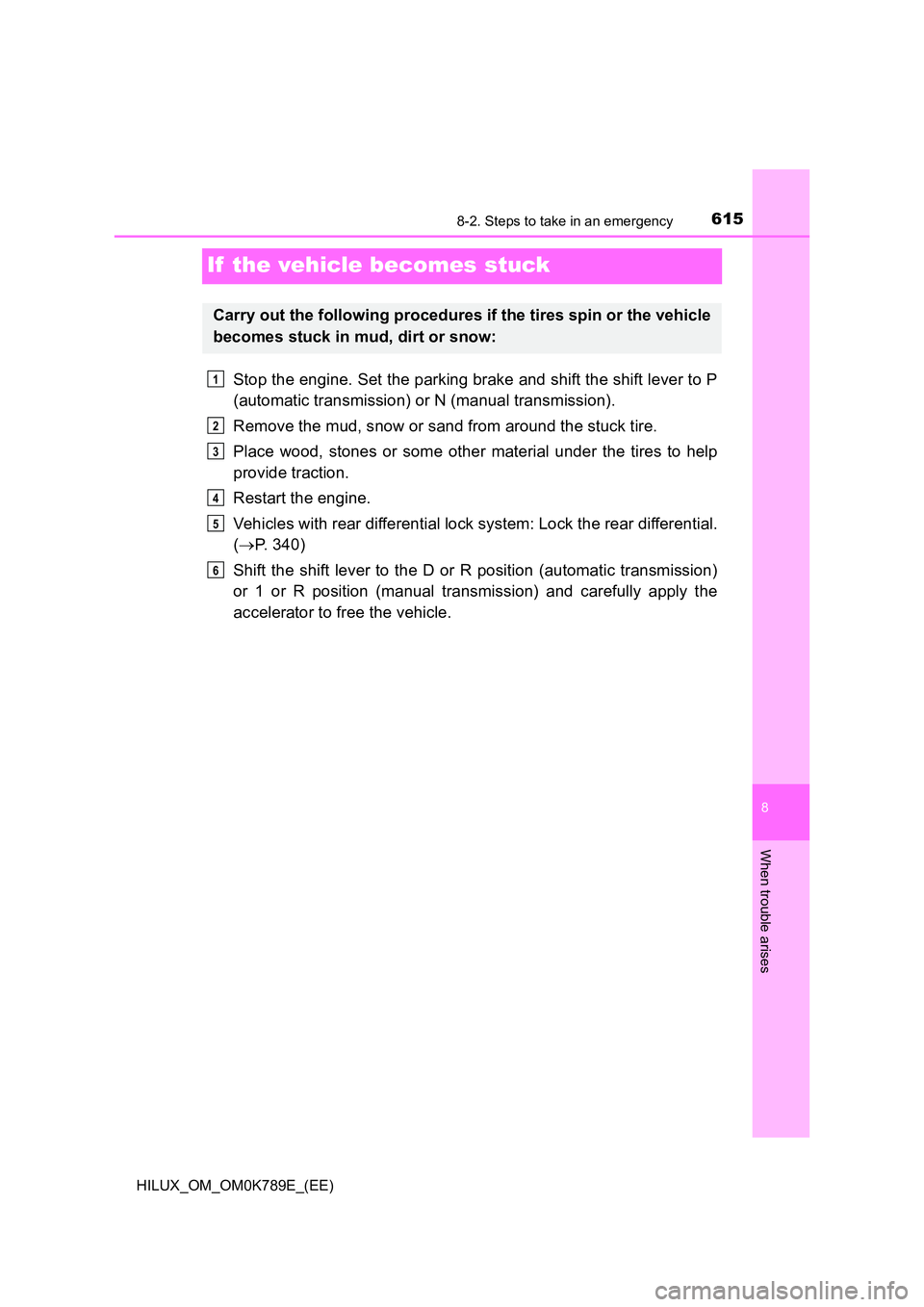
If the vehicle becomes stuck
Stop the engine. Set the parking brake and shift the shift lever to P
(automatic transmission) or N (manual transmission).
Remove the mud, snow or sand from around the stuck tire.
Place wood, stones or some other material under the tires to help
provide traction.
Restart the engine.
Vehicles with rear differential lock system: Lock the rear differential.
( P. 340)
Shift the shift lever to the D or R position (automatic transmission)
or 1 or R position (manual transmission) and carefully apply the
accelerator to free the vehicle.
Carry out the following procedures if the tires spin or the vehicle
becomes stuck in mud, dirt or snow:
1
2
3
4
5
6
Page 639 of 810
637
9
9-1. Specifications
Vehicle specifications
HILUX_OM_OM0K789E_(EE)
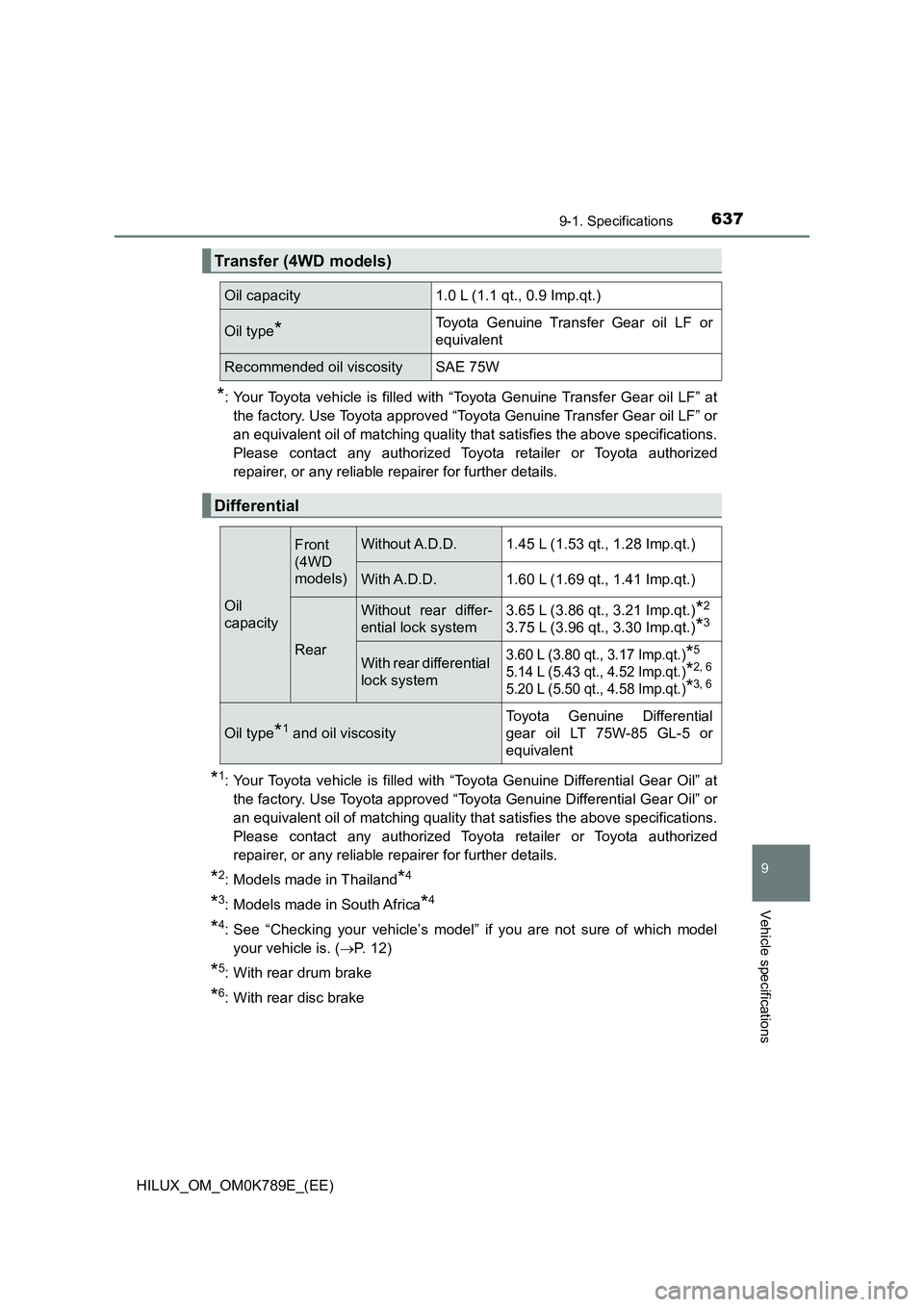
*: Your Toyota vehicle is filled with “Toyota Genuine Transfer Gear oil LF” at
the factory. Use Toyota approved “Toyota Genuine Transfer Gear oil LF” or
an equivalent oil of matching quality that satisfies the above specifications.
Please contact any authorized Toyota retailer or Toyota authorized
repairer, or any reliable repairer for further details.
*1: Your Toyota vehicle is filled with “Toyota Genuine Differential Gear Oil” at
the factory. Use Toyota approved “Toyota Genuine Differential Gear Oil” or
an equivalent oil of matching quality that satisfies the above specifications.
Please contact any authorized Toyota retailer or Toyota authorized
repairer, or any reliable repairer for further details.
*2: Models made in Thailand*4
*3: Models made in South Africa*4
*4: See “Checking your vehicle’s model” if you are not sure of which model
your vehicle is. ( P. 1 2 )
*5: With rear drum brake
*6: With rear disc brake
Transfer (4WD models)
Oil capacity1.0 L (1.1 qt., 0.9 Imp.qt.)
Oil type*Toyota Genuine Transfer Gear oil LF or
equivalent
Recommended oil viscositySAE 75W
Differential
Oil
capacity
Front
(4WD
models)
Without A.D.D.1.45 L (1.53 qt., 1.28 Imp.qt.)
With A.D.D.1.60 L (1.69 qt., 1.41 Imp.qt.)
Rear
Without rear differ-
ential lock system
3.65 L (3.86 qt., 3.21 Imp.qt.)*2
3.75 L (3.96 qt., 3.30 Imp.qt.)*3
With rear differential
lock system
3.60 L (3.80 qt., 3.17 Imp.qt.)*5
5.14 L (5.43 qt., 4.52 Imp.qt.)*2, 6
5.20 L (5.50 qt., 4.58 Imp.qt.)*3, 6
Oil type*1 and oil viscosity
Toyota Genuine Differential
gear oil LT 75W-85 GL-5 or
equivalent