towing TOYOTA HILUX 2023 Owner's Manual
[x] Cancel search | Manufacturer: TOYOTA, Model Year: 2023, Model line: HILUX, Model: TOYOTA HILUX 2023Pages: 810, PDF Size: 131.54 MB
Page 286 of 810
2844-5. Using the driving support systems
HILUX_OM_OM0K789E_(EE)
WARNING
■Situations unsuitable for LDA system
In the following situations, use the LDA switch to turn the system off. Failure
to do so may lead to an accident, resulting in death or serious injury.
● Vehicle is driven on a road surface which is slippery due to rainy weather,
fallen snow, freezing, etc.
● Vehicle is driven on a snow-covered road.
● White (yellow) lines are difficult to see due to rain, snow, fog, dust, etc.
● A spare tire, tire chains, etc. are equipped.
● When the tires have been excessively worn, or when the tire inflation pres-
sure is low.
● When your vehicle is towing a trailer (with towing hitch) or during emer-
gency towing.
■ Preventing LDA system malfunctions and operations performed by
mistake
● Do not modify the headlights or place stickers, etc. on the surface of the
lights.
● Do not modify the suspension etc. If the suspension etc. needs to be
replaced, contact any authorized Toyota retailer or Toyota authorized
repairer, or any reliable repairer.
● Do not install or place anything on the hood or grille. Also, do not install a
grille guard (bull bars, kangaroo bar, etc.).
● If your windshield needs repairs, contact any authorized Toyota retailer or
Toyota authorized repairer, or any reliable repairer.
Page 305 of 810

3034-5. Using the driving support systems
4
Driving
HILUX_OM_OM0K789E_(EE)
WARNING
■Situations unsuitable for dynamic radar cruise control
Do not use dynamic radar cruise control in any of the following situations.
Doing so may result in inappropriate speed control and could cause an acci-
dent resulting in death or serious injury.
● Roads where there are pedestrians, cyclists, etc.
● In heavy traffic
● On roads with sharp bends
● On winding roads
● On slippery roads, such as those covered with rain, ice or snow
● On steep downhills, or where there are sudden changes between sharp up
and down gradients
Vehicle speed may exceed the set speed when driving down a steep hill.
● At entrances to freeways and highways
● When weather conditions are bad enough that they may prevent the sen-
sors from detecting correctly (fog, snow, sandstorm, heavy rain, etc.)
● When there is rain, snow, etc. on the front surface of the radar or front
camera
● In traffic conditions that require frequent repeated acceleration and decel-
eration
● When your vehicle is towing a trailer (with towing hitch) or during emer-
gency towing
● When an approach warning buzzer is heard often
Page 321 of 810

3194-5. Using the driving support systems
4
Driving
HILUX_OM_OM0K789E_(EE)
WARNING
■To avoid operating the cruise control by mistake
Switch the cruise control off using the “ON-OFF” button when not in use.
■ Situations unsuitable for cruise control
Do not use cruise control in any of the following situations.
Doing so may result in loss of control and could cause an accident resulting
in death or serious injury.
● In heavy traffic
● On roads with sharp bends
● On winding roads
● On slippery roads, such as those covered with rain, ice or snow
● On steep hills
Vehicle speed may exceed the set speed when driving down a steep hill.
● When your vehicle is towing a trailer (with towing hitch) or during emer-
gency towing
Page 327 of 810
3254-5. Using the driving support systems
4
Driving
HILUX_OM_OM0K789E_(EE)
● The sensor is frozen. (Thawing the area will resolve this problem.)
In especially cold weather, if a sensor is frozen, the screen may show an
abnormal display, or objects may not be detected.
● The sensor is covered in any way.
● On an extremely bumpy road, on an incline, on gravel, or on grass
● When vehicle horns, vehicle detectors, motorcycle engines, air brakes of
large vehicles, the clearance sonar of ot her vehicles or other devices which
produce ultrasonic waves are near the vehicle.
● A sensor is coated with a sheet of spray or heavy rain.
● If objects draw too close to the sensor.
● When a pedestrian is wearing clothing that does not reflect ultrasonic waves
(ex. skirts with gathers or frills).
● When objects that are not perpendicular to the ground, not perpendicular to
the vehicle traveling direction, uneven, or waving are in the detection range.
● Strong wind is blowing.
● When driving in inclement weather such as fog, snow or a sandstorm.
● When an object that cannot be detected is between the vehicle and a
detected object.
● If an object such as a vehicle, motorcycle, bicycle or pedestrian cuts in front
of the vehicle or runs out from the side of the vehicle.
● If the orientation of a sensor has been changed due to a collision or other
impact.
● When equipment that may obstruct a sensor is installed, such as a towing
eyelet, bumper protector (an additional trim strip, etc.), bicycle carrier, or
snow plow.
● If the front of the vehicle is raised or lowered due to the carried load.
● If the vehicle cannot be driven in a stable manner, such as when the vehicle
has been in an accident or is malfunctioning.
● When tire chains, a compact spare tire or an emergency tire puncture repair
kit are used.
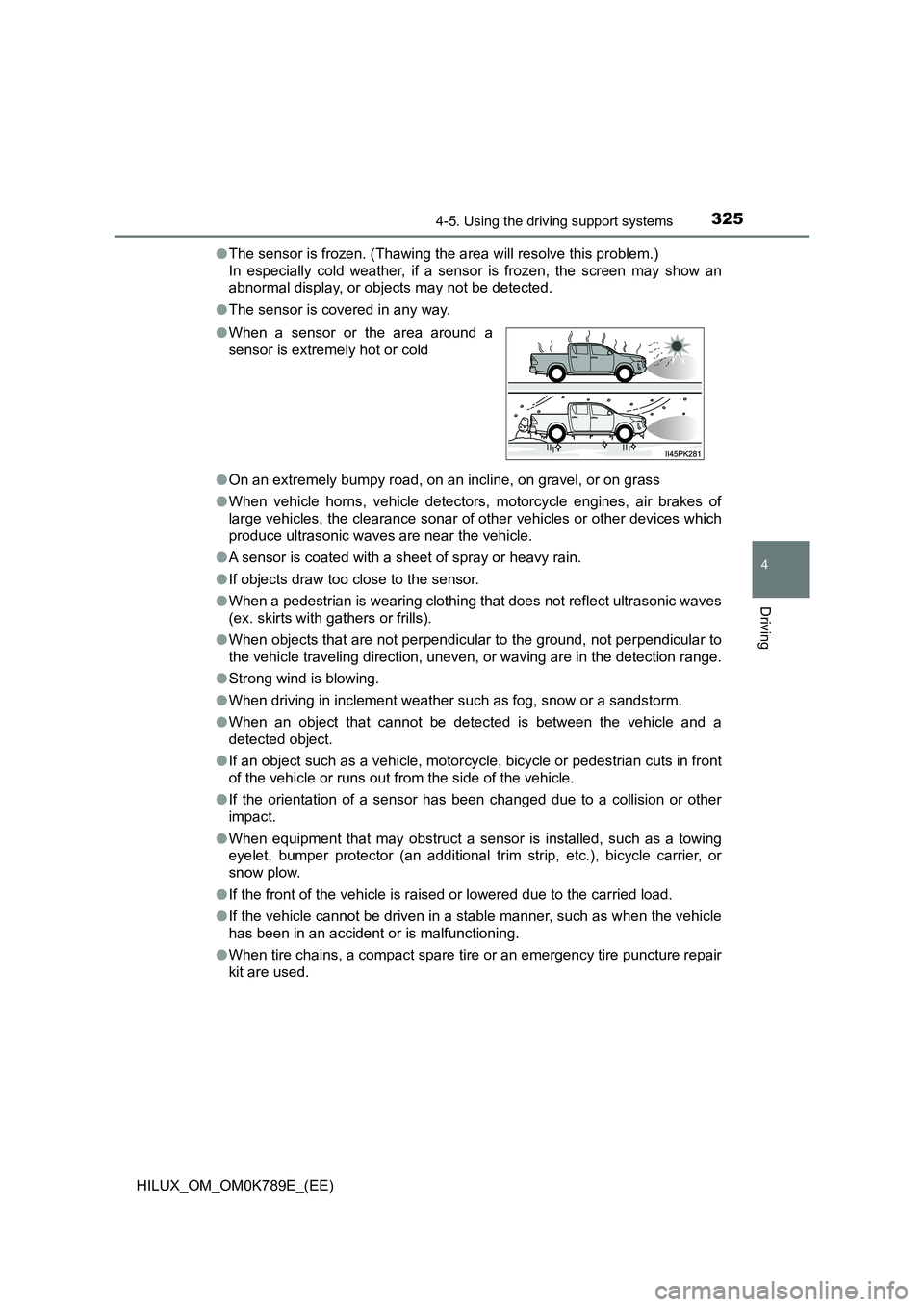
● When a sensor or the area around a
sensor is extremely hot or cold
Page 492 of 810
4907-3. Do-it-yourself maintenance
HILUX_OM_OM0K789E_(EE)
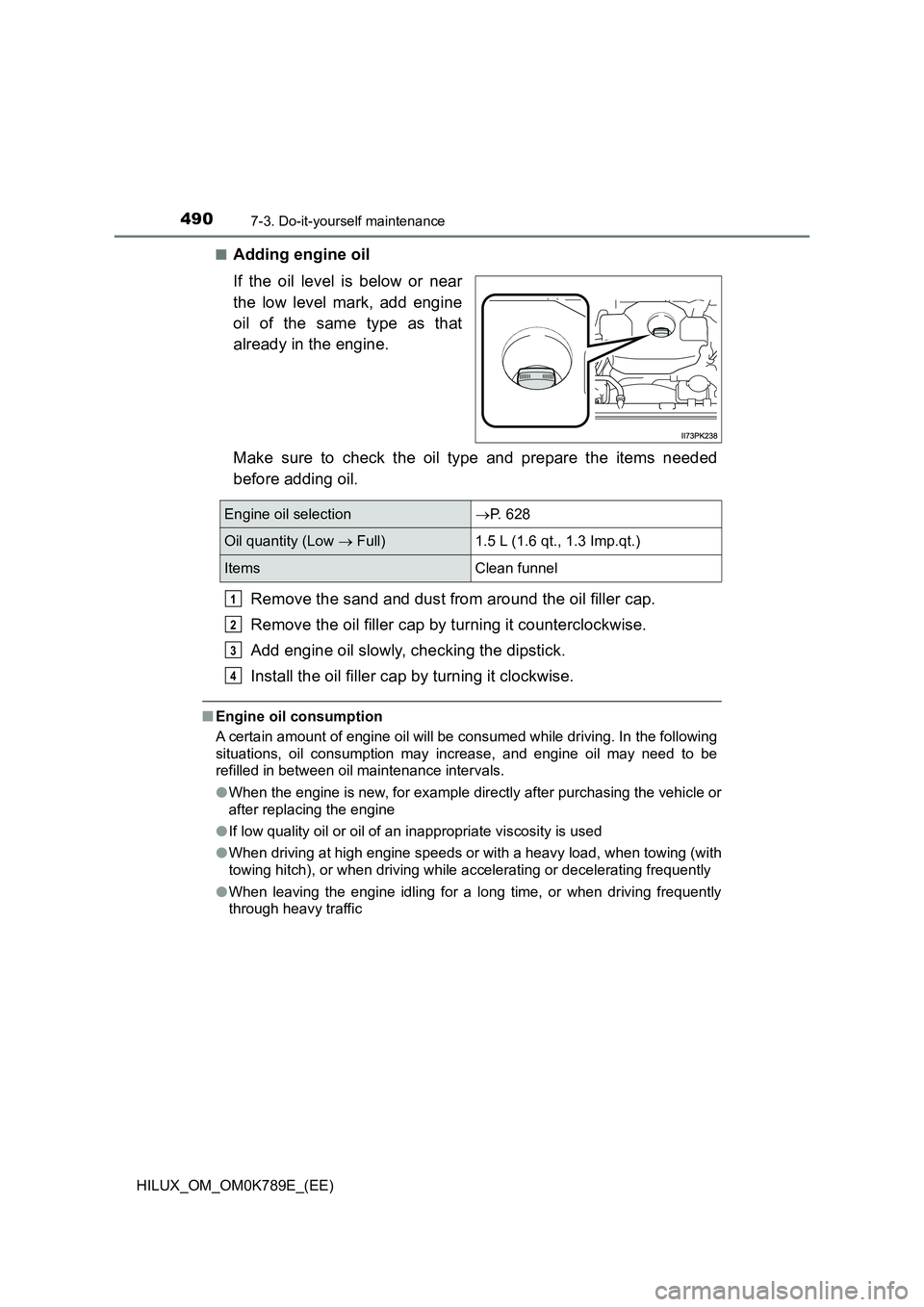
■Adding engine oil
If the oil level is below or near
the low level mark, add engine
oil of the same type as that
already in the engine.
Make sure to check the oil type and prepare the items needed
before adding oil.
Remove the sand and dust from around the oil filler cap.
Remove the oil filler cap by turning it counterclockwise.
Add engine oil slowly, checking the dipstick.
Install the oil filler cap by turning it clockwise.
■ Engine oil consumption
A certain amount of engine oil will be consumed while driving. In the following
situations, oil consumption may increase, and engine oil may need to be
refilled in between oil maintenance intervals.
● When the engine is new, for example directly after purchasing the vehicle or
after replacing the engine
● If low quality oil or oil of an inappropriate viscosity is used
● When driving at high engine speeds or with a heavy load, when towing (with
towing hitch), or when driving while accelerating or decelerating frequently
● When leaving the engine idling for a long time, or when driving frequently
through heavy traffic
Engine oil selection P. 628
Oil quantity (Low Full) 1.5 L (1.6 qt., 1.3 Imp.qt.)
Items Clean funnel
1
2
3
4
Page 502 of 810

5007-3. Do-it-yourself maintenance
HILUX_OM_OM0K789E_(EE)
AdBlue™ is used to reduce the amount of nitrogen oxides in exhaust
gas. Make sure to observe the following precautions regarding
AdBlue™.
● AdBlue™ is consumed in the process of driving.
● When AdBlue™ is depleted, the engine cannot be restarted.
● When AdBlue™ needs to be refilled, have it refilled at any autho-
rized Toyota retailer or Toyota authorized repairer, or any reliable
repairer.
It may be a criminal offence to use a vehicle that does not consume
any reagent if it is required for the reduction of emissions.
■Possible driving range
The amount of AdBlue™ that is consumed while driving differs
according to the driving conditions and driving environment. When
the amount of AdBlue™ that is consumed increases, the possible
driving range until it is necessary to refill AdBlue™ decreases.
*1: When the vehicle is used at high elevations and in low temperatures, the
amount of AdBlue™ that is consumed increases.
*2: During normal driving, 1.0 L (1.1 qt., 0.9 Imp.qt.) of AdBlue™ is con-
sumed approximately every 600 km (373 miles). Also, after a full refill, the
vehicle can be driven for approximately 10000 km (6214 miles) before all
AdBlue™ is depleted.
AdBlue™ (if equipped)
Possible driving range
Short*1Long
[High-load driving][Normal driving]*2[Low-load driving]
• When your vehicle is
towing a trailer (with
towing hitch)
• When firmly depress-
ing the accelerator
pedal
• When driving on long
uphill slopes
• When the DPF sys-
tem is operating
• When driving short
distances
• When in traffic con-
gestion
Page 561 of 810

5598-2. Steps to take in an emergency
HILUX_OM_OM0K789E_(EE)
8
When trouble arises
If your vehicle needs to be towed
The following may indicate a problem with your transmission. Contact
any authorized Toyota retailer or Toyota authorized repairer, or any
reliable repairer or commercial towing service before towing.
● The engine is running but the vehicle does not move.
● The vehicle makes an abnormal sound.
Do not tow with a sling-type truck
to prevent body damage.
If towing is necessary, we recommend having your vehicle
towed by any authorized Toyota retailer or Toyota authorized
repairer, or any reliable repairer or commercial towing service,
using a wheel-lift type truck or flatbed truck.
Use a safety chain system for all towing, and abide by all state/
provincial and local laws.
Situations when it is necessary to contact dealers before towing
Towing with a sling-type truck
Page 562 of 810

5608-2. Steps to take in an emergency
HILUX_OM_OM0K789E_(EE)
When using a flatbed truck to transport the vehicle, use tire strapping
belts. Refer to the owner’s manual of the flatbed truck for the tire
strapping method.
In order to suppress vehicle movement during transportation, set the
parking brake and turn the engine switch to the “LOCK” position (vehi-
cles without smart entry & start system) or off (vehicles with smart
entry & start system).
Towing with a wheel-lift type truck
From the frontFrom the rear
Use a towing dolly under the rear
wheels.
Use a towing dolly under the
front wheels.
Using a flatbed truck
Page 563 of 810

5618-2. Steps to take in an emergency
HILUX_OM_OM0K789E_(EE)
8
When trouble arises
If a tow truck is not available in an emergency, your vehicle may be
temporarily towed using cables or chains secured to the emergency
towing hooks. This should only be attempted on hard surfaced roads
for at most 80 km (50 miles) at under 30 km/h (18 mph).
A driver must be in the vehicle to steer and operate the brakes. The
vehicle’s wheels, drive train, axles, steering and brakes must be in
good condition.
Securely attach cables or
chains to the towing hooks.
Take care not to damage the vehi-
cle body.
Enter the vehicle being towed and start the engine.
If the engine does not start, turn the engine switch to the “ON” position
(vehicles without smart entry & start system) or IGNITION ON mode (vehi-
cles with smart entry & start system).
Vehicles with Stop & Start system:
Before towing the vehicle, turn the engine switch to the “LOCK” position
(vehicles without smart entry & start system) or off (vehicles with smart
entry & start system) once, and then start the engine.
4WD models: Turn the front-wheel drive control switch to H2.
( P. 330)
Shift the shift lever to N and release the parking brake.
When the shift lever cannot be shifted (automatic transmission):
P. 2 3 6
Emergency towing
Emergency towing procedure
1
2
3
4
Page 564 of 810

5628-2. Steps to take in an emergency
HILUX_OM_OM0K789E_(EE)
■While towing
If the engine is not running, the power assist for the brakes and steering will
not function, making steering and braking more difficult.
WARNING
Observe the following precautions.
Failure to do so may result in death or serious injury.
■ When towing the vehicle
■ While towing
● When towing using cables or chains, avoid sudden starts, etc. which place
excessive stress on the towing hooks, cables or chains. The towing hooks,
cables or chains may become damaged, broken debris may hit people,
and cause serious damage.
● Vehicles without smart entry & start system or vehicles with manual trans-
mission: Do not turn the engine swit ch to the “LOCK” position (vehicles
without smart entry & start system) or off (vehicles with smart entry & start
system).
There is a possibility that the steering wheel is locked and cannot be oper-
ated.
Pre Runner (2WD models): Be sure to
transport the vehicle with all four wheels
raised off the ground. If the vehicle is
towed with the tires contacting the
ground, the drivetrain and related parts
may be damaged or an accident may
occur due to a change in direction of the
vehicle.
4WD models: Be sure to transport the
vehicle with all four wheels raised off the
ground. If the vehicle is towed with the
tires contacting the ground, the drivetrain
and related parts may be damaged, and
the vehicle may fly off the truck.