stop start TOYOTA IQ 2012 Owner's Manual
[x] Cancel search | Manufacturer: TOYOTA, Model Year: 2012, Model line: IQ, Model: TOYOTA IQ 2012Pages: 476, PDF Size: 23.52 MB
Page 168 of 476
168 2-1. Driving procedures
iQ_WE_74014E
CAUTION
When starting the vehicle (vehicles with a Multidrive)
Always keep your foot on the brake pedal while stopped with the engine run-
ning. This prevents the vehicle from creeping.
When driving the vehicle
Do not drive if you are unfamiliar with the location of the clutch, brake and
accelerator pedals to avoid depressing the wrong pedal.
• Accidentally depressing the accelerator pedal instead of the brake
pedal will result in sudden acceleration that may lead to an accident
that could result in death or serious injury.
• When backing up, you may twist your body around, leading to a diffi-
culty in operating the pedals. Make sure to operate the pedals properly.
• Make sure to keep a correct driving posture even when moving the
vehicle only slightly, allowing you to depress the brake and accelerator
pedals properly.
• Depress the brake pedal using your right foot. Depressing the brake
pedal using your left foot may delay response in an emergency, result-
ing in an accident.
Do not drive the vehicle over or stop the vehicle near flammable materials.
The exhaust system and exhaust gases can be extremely hot. This may
cause a fire if there is any flammable material nearby.
Do not let the vehicle roll backward while the shift lever is in a driving posi-
tion, or roll forward while the shift lever is in R.
Doing so may cause the engine to stall or lead to poor brake and steering
performance, resulting in an accident or damage to the vehicle.
If the smell of exhaust is noticed inside the vehicle, open the windows and
check that the back door is closed. Large amounts of exhaust in the
vehicle can cause driver drowsiness and an accident, resulting in death or
a serious health hazard. Have the vehicle inspected by any authorized
Toyota dealer or repairer, or another duly qualified and equipped
professional immediately.
On vehicles with a Multidrive, do not shift the shift lever to P while the vehi-
cle is moving.
Doing so can damage the transmission and may result in a loss of vehicle
control.
Page 173 of 476
173 2-1. Driving procedures
2
When driving
iQ_WE_74014E
NOTICE
When driving the vehicle
Vehicles with a Multidrive
Do not depress the accelerator and brake pedals at the same time during
driving, as this may restrain driving torque.
Do not use the accelerator pedal or depress accelerator and brake pedals
together to hold the vehicle on a hill.
Vehicles with a manual transmission
Do not depress the accelerator and brake pedals at the same time during
driving, as this may restrain driving torque.
Do not shift gears unless the clutch pedal is fully depressed. After shifting,
do not release the clutch pedal abruptly. Doing so may damage the clutch,
transmission and gears.
Observe the following to prevent the clutch from being damaged.
• Do not rest your foot on the clutch pedal while driving.
Doing so may cause clutch trouble.
• Do not use any gears other than the 1st gear when starting off and
moving forward.
Doing so may damage the clutch.
• Do not use the clutch to hold the vehicle when stopping on an uphill
grade.
Doing so may damage the clutch.
Do not shift the shift lever to R when the vehicle is still moving. Doing so
may damage the clutch, transmission and gears.
When parking the vehicle (vehicles with a Multidrive)
Always put the shift lever in P.
Failure to do so may cause the vehicle to move or the vehicle may acceler-
ate suddenly if the accelerator pedal is accidentally depressed.
Avoiding damage to vehicle parts
Do not turn the steering wheel fully in either direction and hold it there for a
long time.
Doing so may damage the power steering motor.
When driving over bumps in the road, drive as slowly as possible to avoid
damaging the wheels, underside of the vehicle, etc.
Page 179 of 476
179
2-1. Driving procedures
2
When driving
iQ_WE_74014E
Engine (ignition) switch (vehicles with smart entr y & start system)
Performing the following operations when carrying the electronic
key on your person starts the engine or changes “ENGINE START
STOP” switch modes.
Starting the engine
Multidrive
Check that the parking brake is set.
Check that the shift lever is set in P.
Sit in the driver’s seat and firmly depress the brake pedal.
The “ENGINE START STOP” switch indicator turns green. If the
indicator does not turn green, the engine cannot be started.
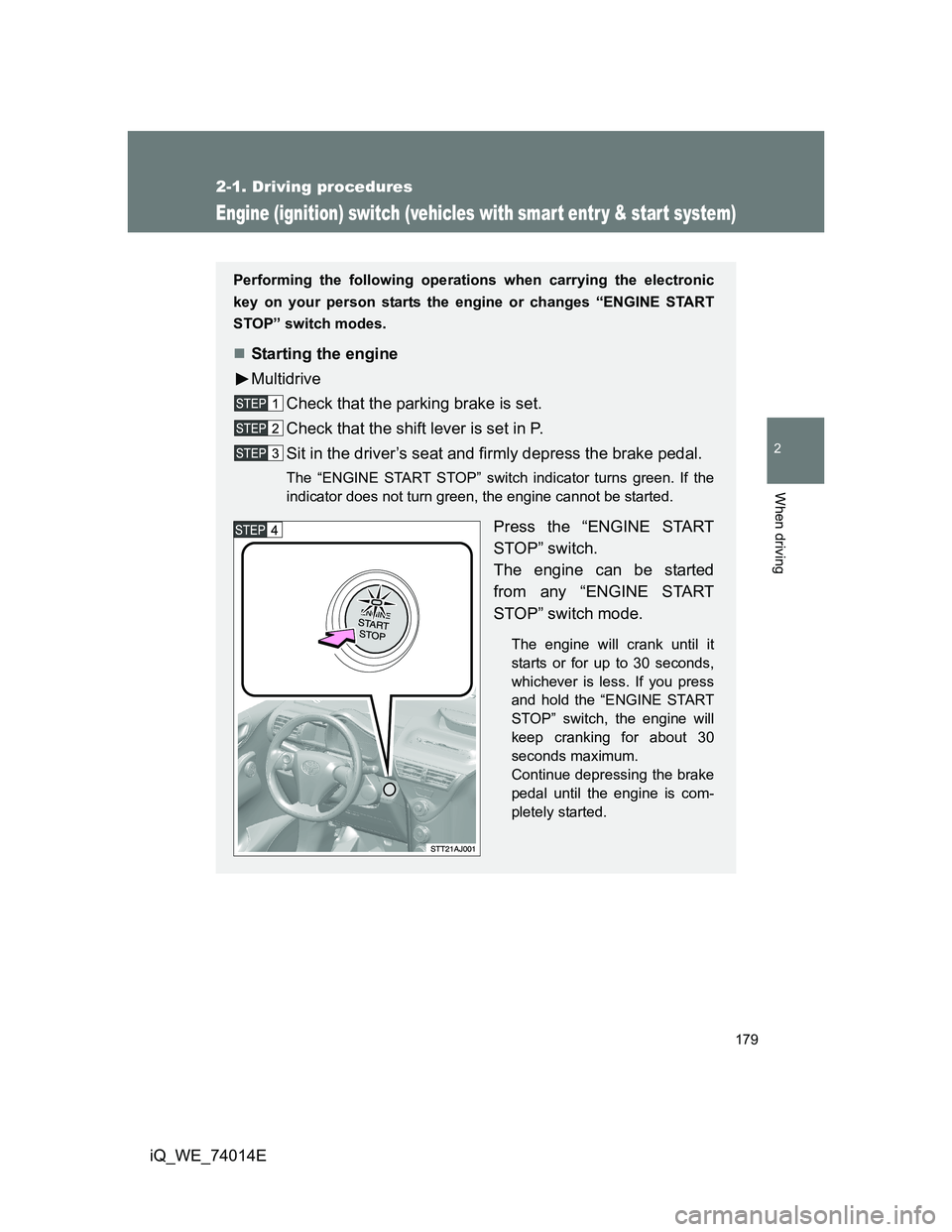
Press the “ENGINE START
STOP” switch.
The engine can be started
from any “ENGINE START
STOP” switch mode.
The engine will crank until it
starts or for up to 30 seconds,
whichever is less. If you press
and hold the “ENGINE START
STOP” switch, the engine will
keep cranking for about 30
seconds maximum.
Continue depressing the brake
pedal until the engine is com-
pletely started.
Page 180 of 476
180 2-1. Driving procedures
iQ_WE_74014E
Manual transmission
Check that the parking brake is set.
Check that the shift lever is set in N.
Sit in the driver’s seat and firmly depress the clutch pedal.
The “ENGINE START STOP” switch indicator turns green. If the
indicator does not turn green, the engine cannot be started.
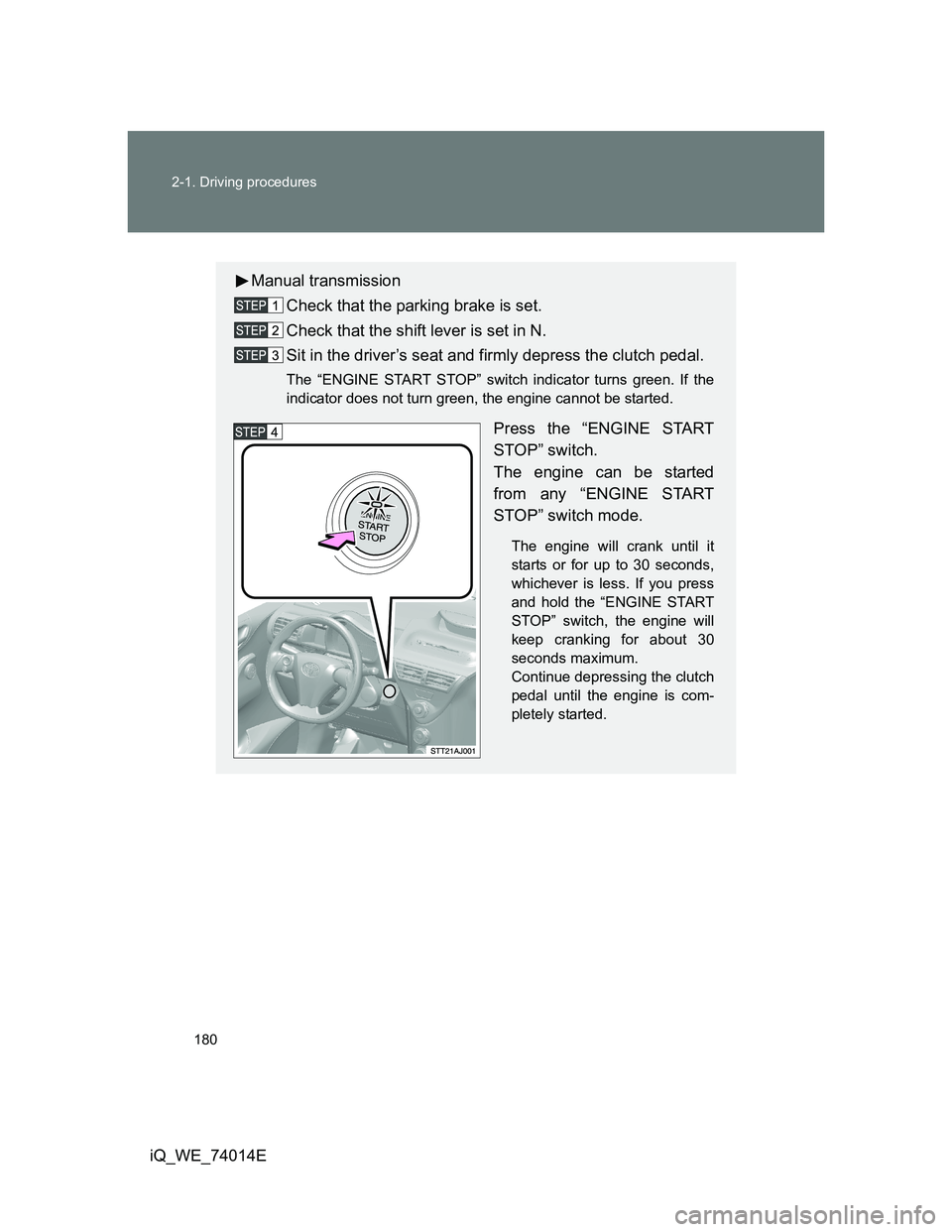
Press the “ENGINE START
STOP” switch.
The engine can be started
from any “ENGINE START
STOP” switch mode.
The engine will crank until it
starts or for up to 30 seconds,
whichever is less. If you press
and hold the “ENGINE START
STOP” switch, the engine will
keep cranking for about 30
seconds maximum.
Continue depressing the clutch
pedal until the engine is com-
pletely started.
Page 181 of 476
181 2-1. Driving procedures
2
When driving
iQ_WE_74014E
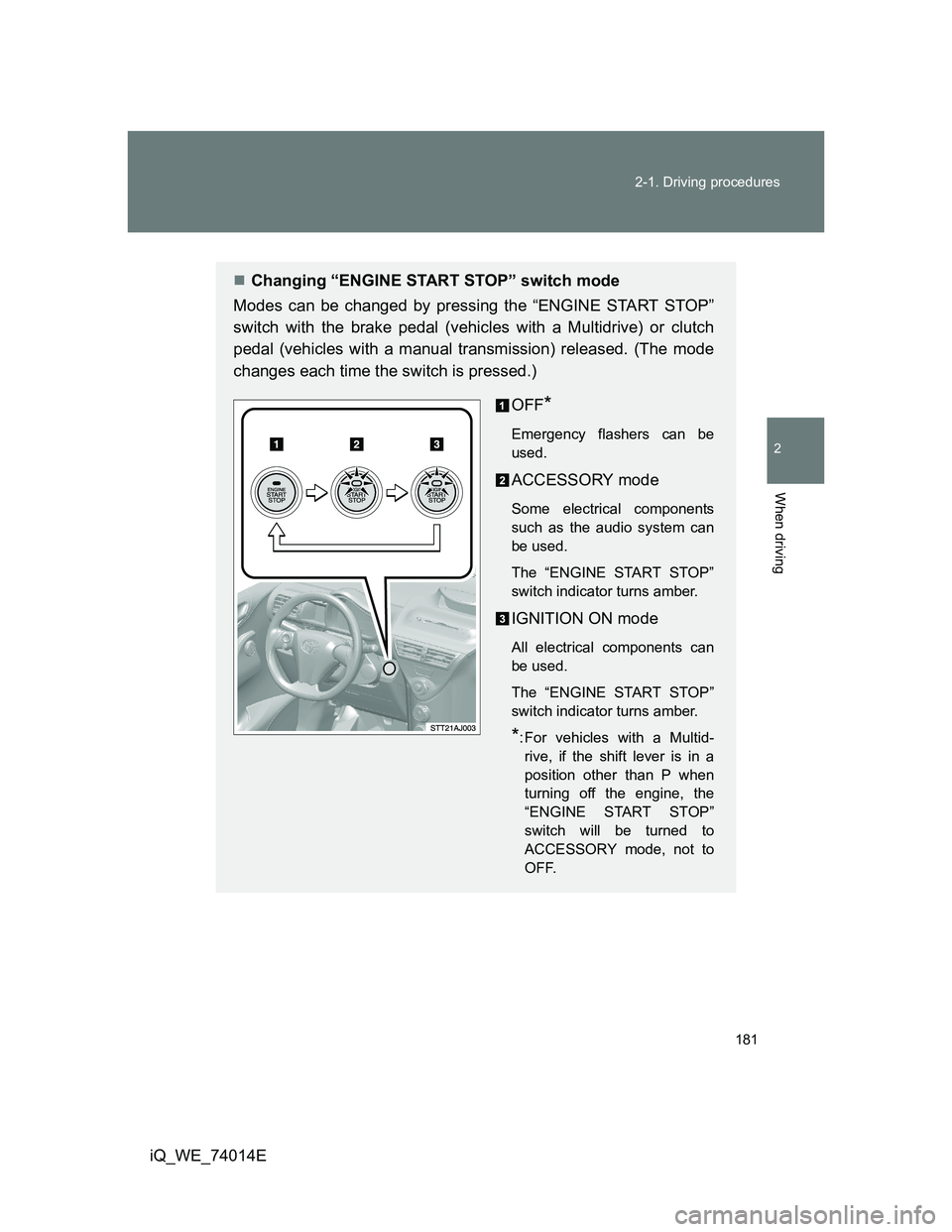
Changing “ENGINE START STOP” switch mode
Modes can be changed by pressing the “ENGINE START STOP”
switch with the brake pedal (vehicles with a Multidrive) or clutch
pedal (vehicles with a manual transmission) released. (The mode
changes each time the switch is pressed.)
OFF
*
Emergency flashers can be
used.
ACCESSORY mode
Some electrical components
such as the audio system can
be used.
The “ENGINE START STOP”
switch indicator turns amber.
IGNITION ON mode
All electrical components can
be used.
The “ENGINE START STOP”
switch indicator turns amber.
*: For vehicles with a Multid-
rive, if the shift lever is in a
position other than P when
turning off the engine, the
“ENGINE START STOP”
switch will be turned to
ACCESSORY mode, not to
OFF.
Page 182 of 476
182 2-1. Driving procedures
iQ_WE_74014E
Steering lock
When the “ENGINE START STOP” switch is turned off and then a door is
opened and closed, the steering lock function locks the steering wheel in its
current position. The steering lock is disabled when the “ENGINE START
STOP” switch is operated again.
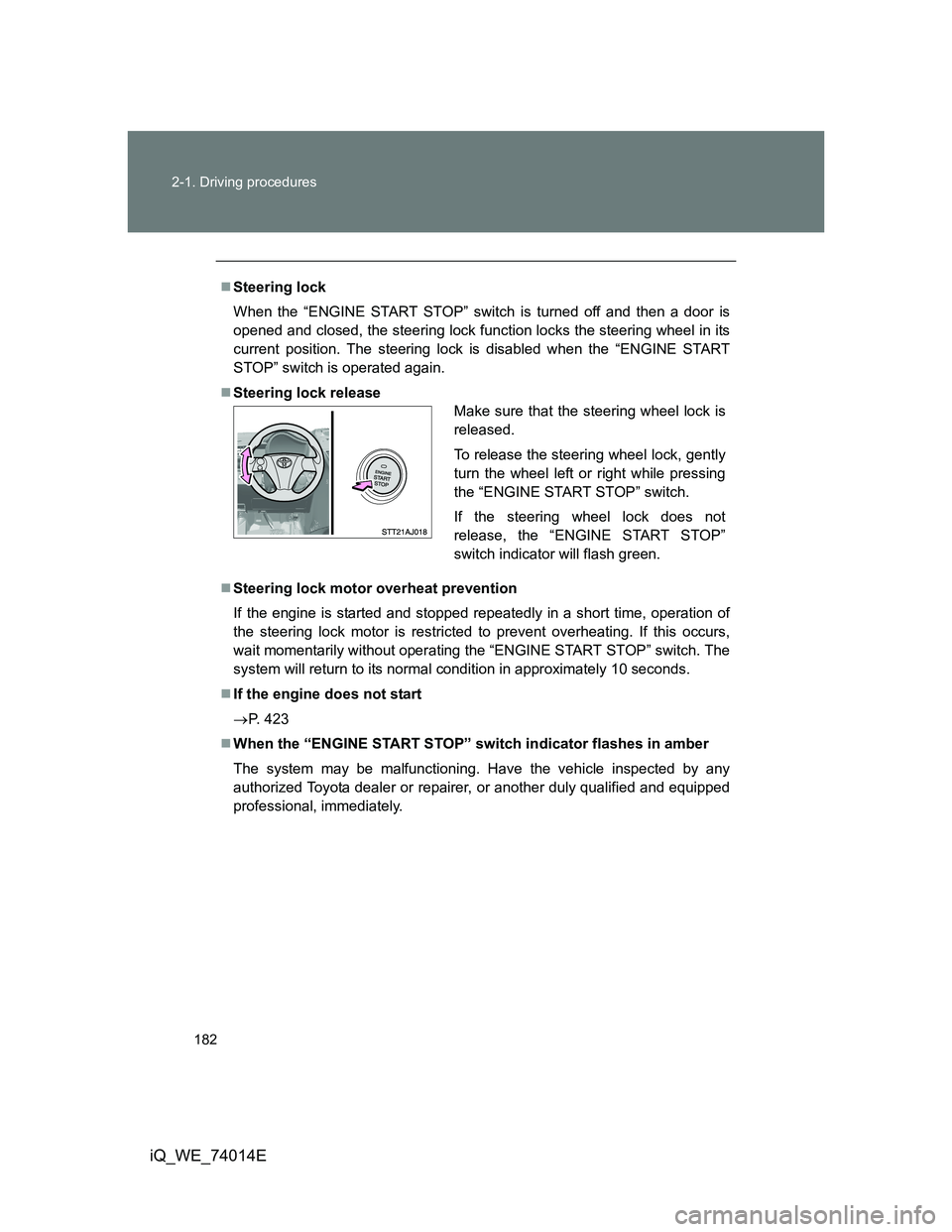
Steering lock release
Steering lock motor overheat prevention
If the engine is started and stopped repeatedly in a short time, operation of
the steering lock motor is restricted to prevent overheating. If this occurs,
wait momentarily without operating the “ENGINE START STOP” switch. The
system will return to its normal condition in approximately 10 seconds.
If the engine does not start
P. 423
When the “ENGINE START STOP” switch indicator flashes in amber
The system may be malfunctioning. Have the vehicle inspected by any
authorized Toyota dealer or repairer, or another duly qualified and equipped
professional, immediately.
Make sure that the steering wheel lock is
released.
To release the steering wheel lock, gently
turn the wheel left or right while pressing
the “ENGINE START STOP” switch.
If the steering wheel lock does not
release, the “ENGINE START STOP”
switch indicator will flash green.
Page 183 of 476
183 2-1. Driving procedures
2
When driving
iQ_WE_74014E
Auto power OFF function
Multidrive
If the vehicle is left in ACCESSORY mode for more than 20 minutes or
IGNITION ON mode (the engine is not running) for more than an hour
with the shift lever in P, the “ENGINE START STOP” switch will automati-
cally turn off. However, this function cannot entirely prevent battery dis-
charge. Do not leave the vehicle with the “ENGINE START STOP” switch
in ACCESSORY or IGNITION ON mode for long periods of time when the
engine is not running.
Manual transmission
If the vehicle is left in ACCESSORY mode for more than 20 minutes or
IGNITION ON mode (the engine is not running) for more than an hour, the
“ENGINE START STOP” switch will automatically turn off. However, this
function cannot entirely prevent battery discharge. Do not leave the
vehicle with the “ENGINE START STOP” switch in ACCESSORY or
IGNITION ON mode for long periods of time when the engine is not
running.
“ENGINE START STOP” switch operation
When operating the “ENGINE START STOP” switch, push it quickly and
firmly. If the switch is not pushed firmly, the mode may not change or the
engine may not start. Furthermore, if the switch is pushed quickly and firmly,
there is no need to hold it down.
If the electronic key does not operate properly
P. 427
Electronic key battery depletion
P. 4 3
When the electronic key battery is fully depleted
P. 357
Conditions affecting operation
P. 6 1
Note for the entry function
P. 4 4
Page 184 of 476
184 2-1. Driving procedures
iQ_WE_74014E
CAUTION
When starting the engine
Always start the engine while sitting in the driver’s seat. Do not depress the
accelerator pedal while starting the engine under any circumstances.
Doing so may cause an accident resulting in death or serious injury.
Caution while driving
If the vehicle is coasting without engine power, for example if the engine
stalls, do not open a door or operate the locks until the vehicle is completely
stopped in a safe condition. Driving with the steering locked may cause an
accident, resulting in death or serious injury.
Stopping the engine in an emergency
If you want to stop the engine in an emergency while driving the vehicle,
press and hold the “ENGINE START STOP” switch for more than 2 seconds,
or press it briefly 3 times or more in succession.
However, do not touch the “ENGINE START STOP” switch while driving
except in an emergency. Turning the engine off while driving will not cause
loss of steering or braking control, but the power assist to these systems will
be lost. This will make it more difficult to steer and brake, so you should pull
over and stop the vehicle as soon as it is safe to do so.
NOTICE
To prevent battery discharge
Do not leave the “ENGINE START STOP” switch in ACCESSORY or IGNI-
TION ON mode for long periods without the engine running.
When starting the engine
Do not race a cold engine.
If the engine becomes difficult to start or stalls frequently, have the engine
checked immediately.
“ENGINE START STOP” switch operation
If you feel something catching or sense irregular resistance when operating
the “ENGINE START STOP” switch, then there may be a malfunction. Imme-
diately contact any authorized Toyota dealer or repairer, or another duly
qualified and equipped professional.
Page 185 of 476
185
2-1. Driving procedures
2
When driving
iQ_WE_74014E
Multidrive
: If equipped
Select a shift position appropriate for the driving conditions.
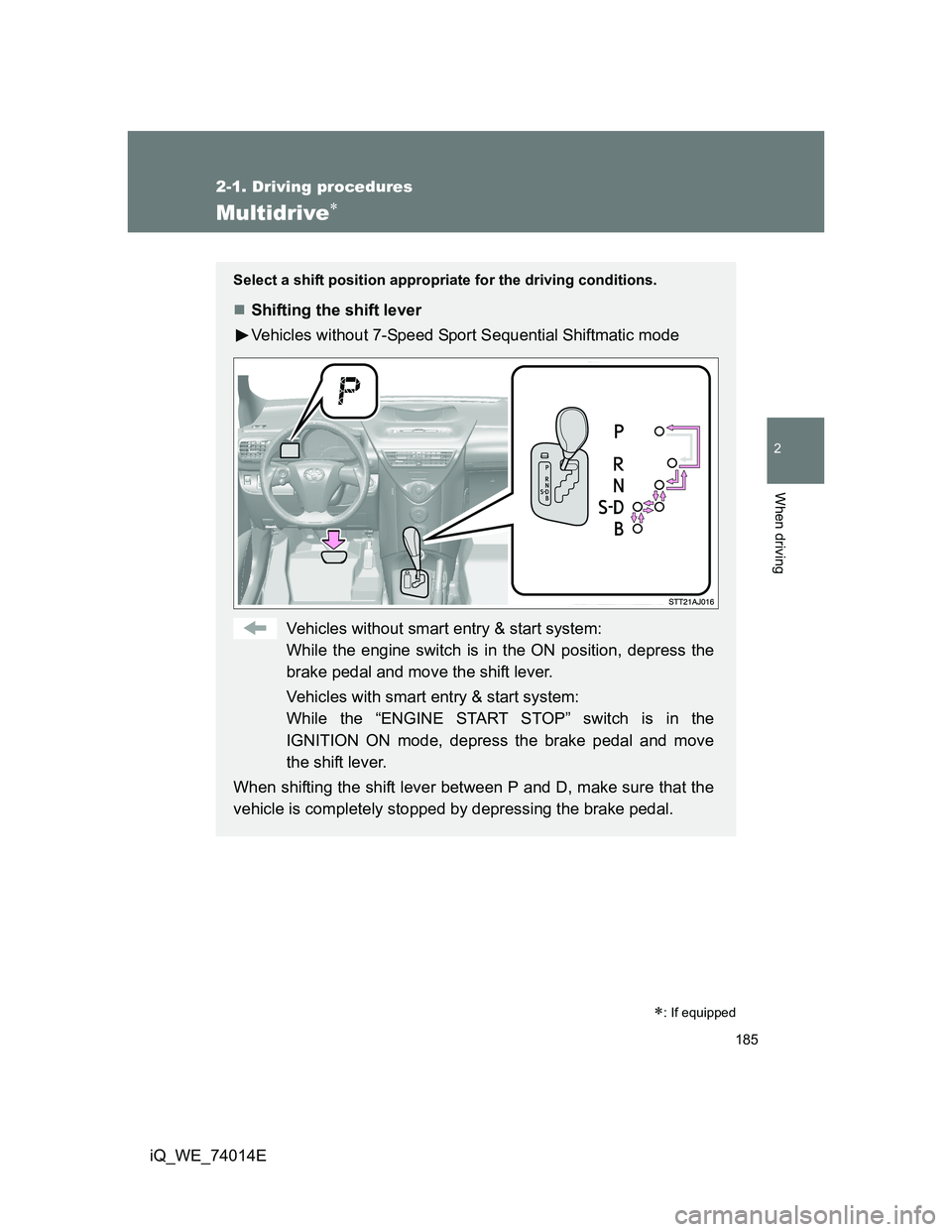
Shifting the shift lever
Vehicles without 7-Speed Sport Sequential Shiftmatic mode
Vehicles without smart entry & start system:
While the engine switch is in the ON position, depress the
brake pedal and move the shift lever.
Vehicles with smart entry & start system:
While the “ENGINE START STOP” switch is in the
IGNITION ON mode, depress the brake pedal and move
the shift lever.
When shifting the shift lever between P and D, make sure that the
vehicle is completely stopped by depressing the brake pedal.
Page 186 of 476
186 2-1. Driving procedures
iQ_WE_74014E
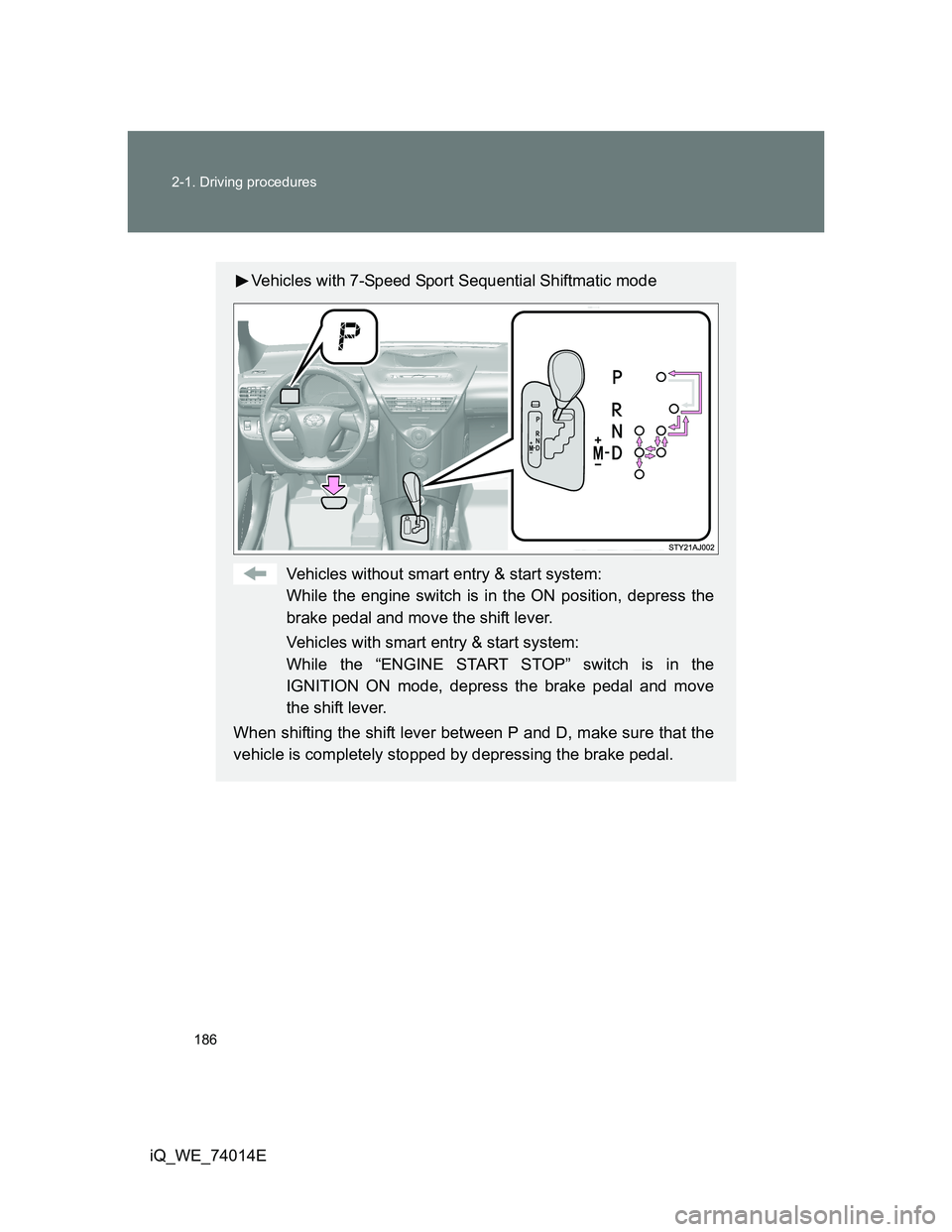
Vehicles with 7-Speed Sport Sequential Shiftmatic mode
Vehicles without smart entry & start system:
While the engine switch is in the ON position, depress the
brake pedal and move the shift lever.
Vehicles with smart entry & start system:
While the “ENGINE START STOP” switch is in the
IGNITION ON mode, depress the brake pedal and move
the shift lever.
When shifting the shift lever between P and D, make sure that the
vehicle is completely stopped by depressing the brake pedal.