belt TOYOTA IQ 2012 Owner's Guide
[x] Cancel search | Manufacturer: TOYOTA, Model Year: 2012, Model line: IQ, Model: TOYOTA IQ 2012Pages: 476, PDF Size: 23.52 MB
Page 152 of 476
152 1-7. Safety information
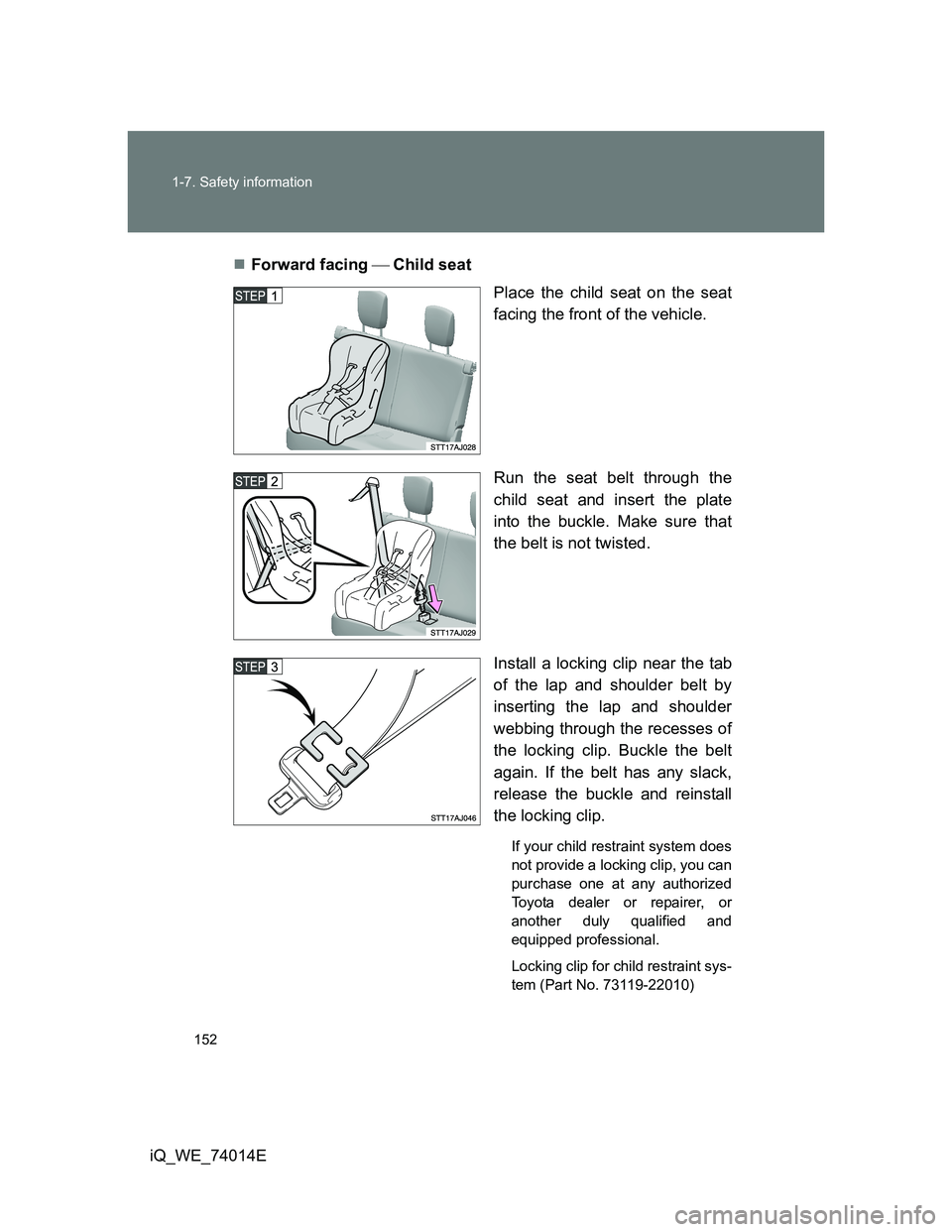
iQ_WE_74014EForward facing Child seat
Place the child seat on the seat
facing the front of the vehicle.
Run the seat belt through the
child seat and insert the plate
into the buckle. Make sure that
the belt is not twisted.
Install a locking clip near the tab
of the lap and shoulder belt by
inserting the lap and shoulder
webbing through the recesses of
the locking clip. Buckle the belt
again. If the belt has any slack,
release the buckle and reinstall
the locking clip.
If your child restraint system does
not provide a locking clip, you can
purchase one at any authorized
Toyota dealer or repairer, or
another duly qualified and
equipped professional.
Locking clip for child restraint sys-
tem (Part No. 73119-22010)
Page 153 of 476
153 1-7. Safety information
1
Before driving
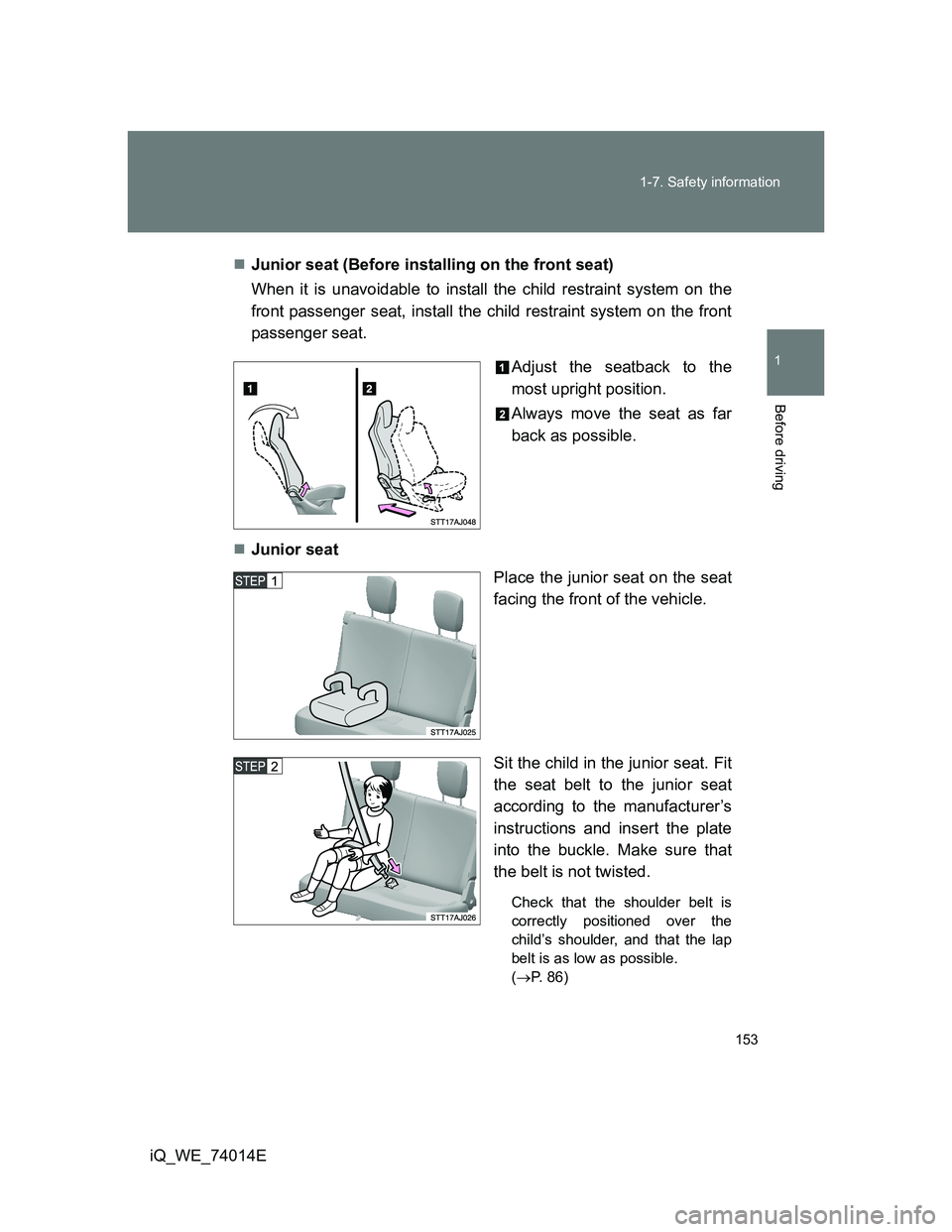
iQ_WE_74014EJunior seat (Before installing on the front seat)
When it is unavoidable to install the child restraint system on the
front passenger seat, install the child restraint system on the front
passenger seat.
Adjust the seatback to the
most upright position.
Always move the seat as far
back as possible.
Junior seat
Place the junior seat on the seat
facing the front of the vehicle.
Sit the child in the junior seat. Fit
the seat belt to the junior seat
according to the manufacturer’s
instructions and insert the plate
into the buckle. Make sure that
the belt is not twisted.
Check that the shoulder belt is
correctly positioned over the
child’s shoulder, and that the lap
belt is as low as possible.
(P. 86)
Page 154 of 476
154 1-7. Safety information
iQ_WE_74014E
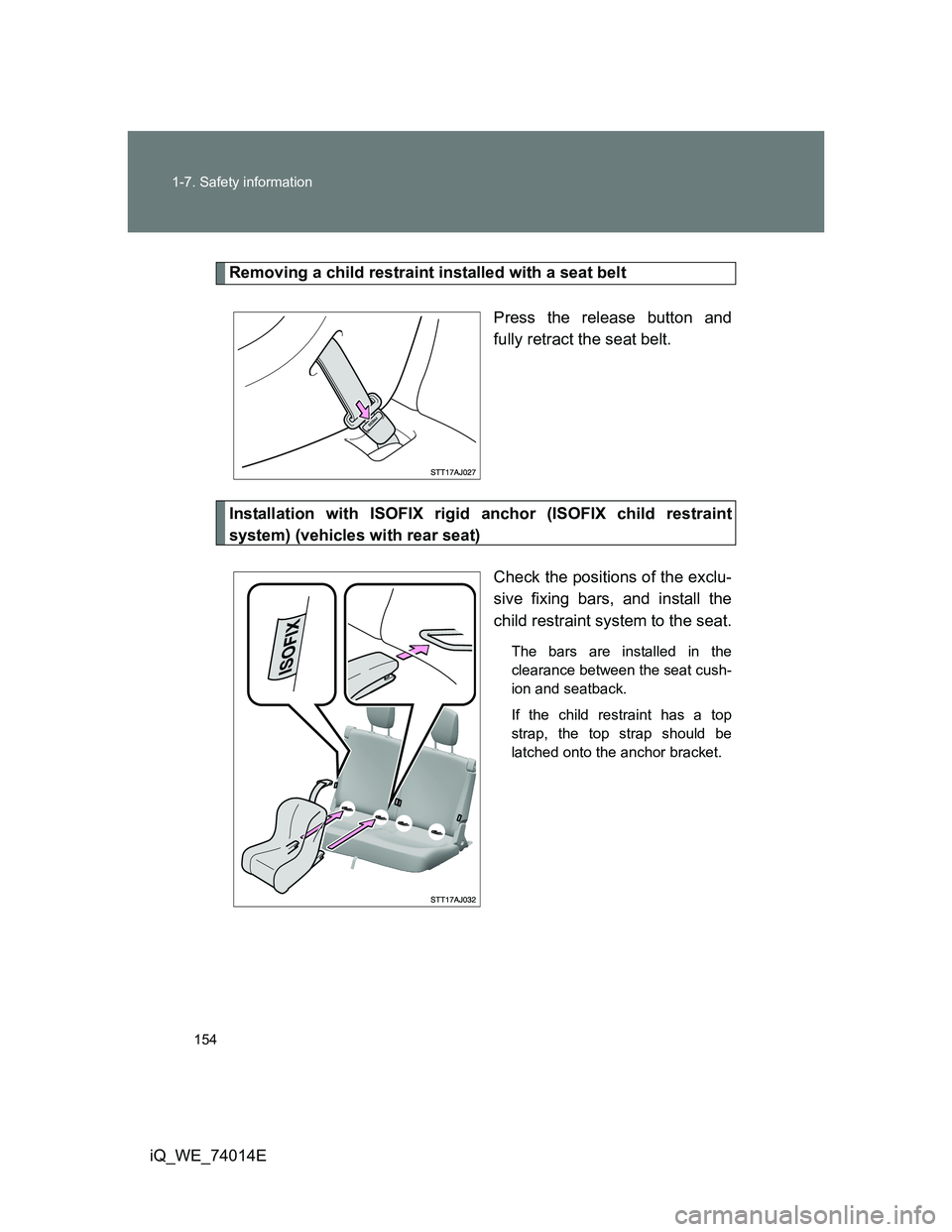
Removing a child restraint installed with a seat belt
Press the release button and
fully retract the seat belt.
Installation with ISOFIX rigid anchor (ISOFIX child restraint
system) (vehicles with rear seat)
Check the positions of the exclu-
sive fixing bars, and install the
child restraint system to the seat.
The bars are installed in the
clearance between the seat cush-
ion and seatback.
If the child restraint has a top
strap, the top strap should be
latched onto the anchor bracket.
Page 155 of 476
155 1-7. Safety information
1
Before driving
iQ_WE_74014E
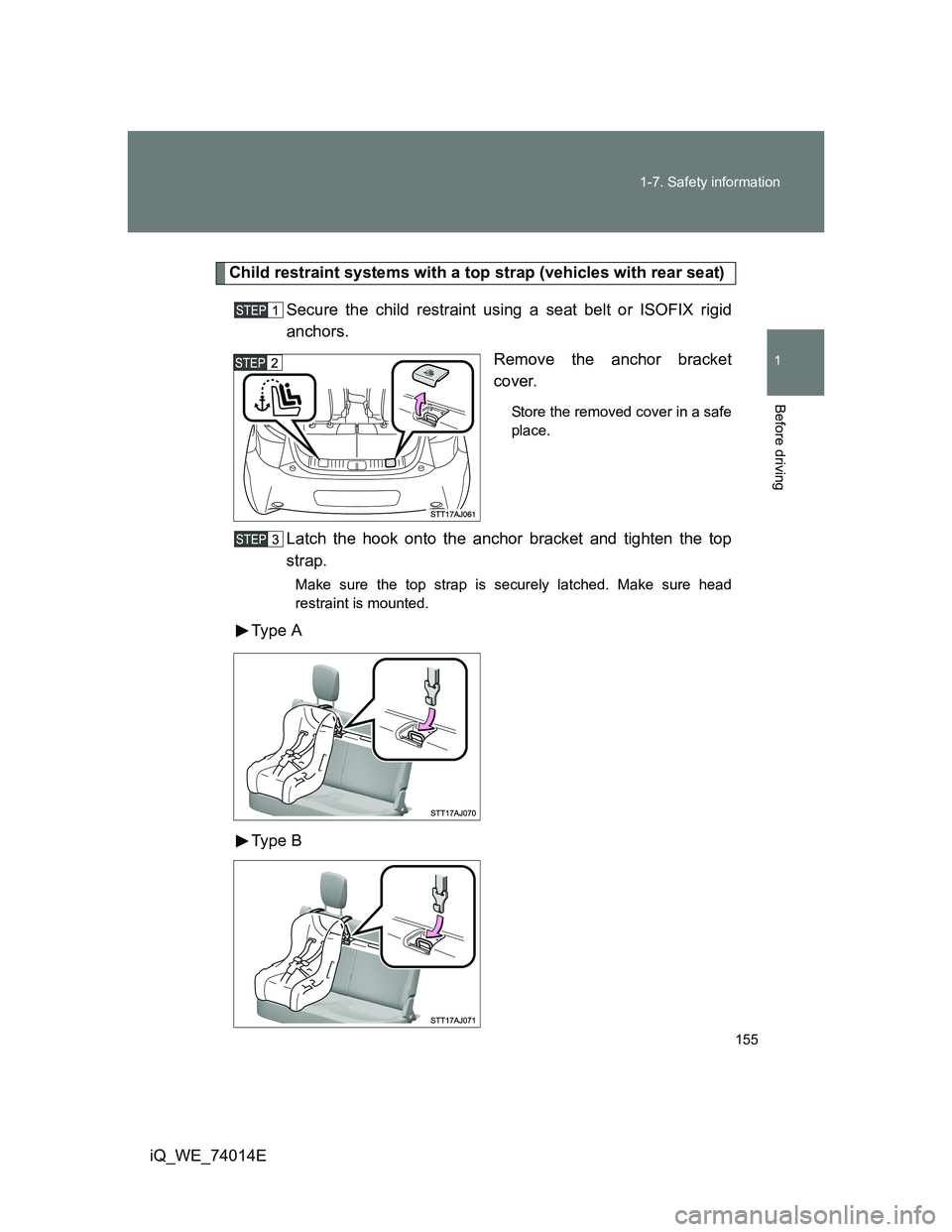
Child restraint systems with a top strap (vehicles with rear seat)
Secure the child restraint using a seat belt or ISOFIX rigid
anchors.
Remove the anchor bracket
cover.
Store the removed cover in a safe
place.
Latch the hook onto the anchor bracket and tighten the top
strap.
Make sure the top strap is securely latched. Make sure head
restraint is mounted.
Type A
Type B
Page 158 of 476
158 1-7. Safety information
iQ_WE_74014E
CAUTION
When installing a child restraint system
When a junior seat is installed, always ensure that the shoulder belt is
positioned across the center of the child’s shoulder. The belt should be
kept away from the child’s neck, but not so that it could fall off the child’s
shoulder. Failing to do so may result in death or serious injury in the event
of sudden braking, sudden swerving or an accident.
Ensure that the belt and tab are securely locked and the seat belt is not
twisted.
Push and pull the child seat in different directions to be sure it is secure.
Follow all installation instructions provided by the child restraint system
manufacturer.
Always remove the locking clip when the child restraint system is not
installed.
To correctly attach a child restraint system to the ISOFIX rigid anchors
When using the ISOFIX rigid anchors, be sure that there are no foreign
objects around the ISOFIX rigid anchors and that the seat belt is not caught
behind the child restraint. Make sure the child restraint system is securely
attached, or it may cause death or serious injury to the child or other passen-
gers in the event of a sudden stop, sudden swerve or an accident.
Page 230 of 476
230 2-5. Driving information
iQ_WE_74014E
CAUTION
Storage precautions
Never allow anyone to ride in the luggage compartment. It is not designed
for passengers. They should ride in their seats with their seat belts prop-
erly fastened. Otherwise, they are much more likely to suffer death or seri-
ous bodily injury, in the event of sudden braking, sudden swerving or an
accident.
Secure all items in the occupant compartment, as they may shift and injure
someone during sudden braking, sudden swerving or an accident.
Page 311 of 476
311 4-1. Maintenance and care
4
Maintenance and care
iQ_WE_74014E
Caring for leather areas
Toyota recommends cleaning the interior of the vehicle at least twice a year
to maintain the quality of the vehicle’s interior.
Shampooing the carpets
There are several commercial foaming-type cleaners available. Use a
sponge or brush to apply the foam. Rub in overlapping circles. Do not apply
water. Excellent results are obtained when keeping the carpet as dry as pos-
sible.
Seat belts
Clean with mild soap and lukewarm water using a cloth or sponge. Also
check the belts periodically for excessive wear, fraying or cuts.
CAUTION
Water in the vehicle
Do not splash or spill liquid in the vehicle. Doing so may cause the electri-
cal components etc. to malfunction or catch fire.
Do not get any of the SRS components or wiring in the vehicle interior wet.
(P. 125)
Electrical malfunction may cause the airbags to deploy or not function
properly, resulting in death or severe injury.
Cleaning the interior (especially instrument panel)
Do not use polish wax or polish cleaner. The instrument panel may reflect off
the windshield, obstructing the driver’s view and leading to an accident,
resulting in death or serious injury.
Page 317 of 476
317 4-3. Do-it-yourself maintenance
4
Maintenance and care
iQ_WE_74014E
CAUTION
The engine compartment contains many mechanisms and fluids that may
move suddenly, become hot, or become electrically energized. To avoid death
or serious injury, observe the following precautions.
When working on the engine compartment
Keep hands, clothing, and tools away from the moving fan and engine
drive belt.
Be careful not to touch the engine, radiator, exhaust manifold, etc. right
after driving as they may be hot. Oil and other fluids may also be hot.
Do not leave anything that may burn easily, such as paper or rags, in the
engine compartment.
Do not smoke, cause sparks or expose an open flame to fuel or the bat-
tery. Fuel and battery fumes are flammable.
Be extremely cautious when working on the battery. It contains poisonous
and corrosive sulfuric acid.
Take care because brake fluid can harm your hands or eyes and damage
painted surfaces.
If fluid gets on your hands or in your eyes, flush the affected area with
clean water immediately.
If you still experience discomfort, see a doctor.
When working near the electric cooling fan or radiator grille
Vehicles without smart entry & start system:
Be sure the engine switch is in the LOCK position.
With the engine switch in the ON position, the electric cooling fan may
automatically start to run if the air conditioning system is on and/or the
coolant temperature is high. (P. 342)
Vehicles with smart entry & start system:
Be sure the “ENGINE START STOP” switch is in the OFF.
With the “ENGINE START STOP” switch in the IGNITION ON mode, the
electric cooling fan may automatically start to run if the air conditioning
system is on and/or the coolant temperature is high. (P. 342)
Safety glasses
Wear safety glasses to prevent flying or falling material, fluid spray, etc. from
getting in the eyes.
Page 348 of 476
348 4-3. Do-it-yourself maintenance
iQ_WE_74014E
When to replace your vehicle’s tires
Tires should be replaced if:
You have tire damage such as cuts, splits, cracks deep enough to
expose the fabric or bulges indicating internal damage
A tire goes flat repeatedly or cannot be properly repaired due to the size
or location of a cut or other damage
If you are not sure, consult with any authorized Toyota dealer or repairer, or
another duly qualified and equipped professional.
Tire life
Any tires over 6 years old must be checked by a qualified technician even if
they have seldom or never been used or damage is not obvious.
If the tread depth wears down to 4 mm (0.16 in.) or more on snow tires
The effectiveness of snow tires is lost.
CAUTION
When inspecting or replacing tires
Observe the following precautions to prevent accidents.
Failure to do so may cause damage to parts of the drive train, as well as
dangerous handling characteristics, which may lead to an accident resulting
in death or serious injury.
Do not mix tires of different makes, models or tread patterns.
Also, do not mix tires of remarkably different treadwear.
Do not use tire sizes other than those recommended by Toyota.
Do not mix differently constructed tires (radial, bias-belted or bias-ply
tires).
Do not mix summer, all season and winter tires.
Do not use tires that have been used on another vehicle.
Do not use tires if you do not know how they were used previously.
Page 370 of 476
370 4-3. Do-it-yourself maintenance
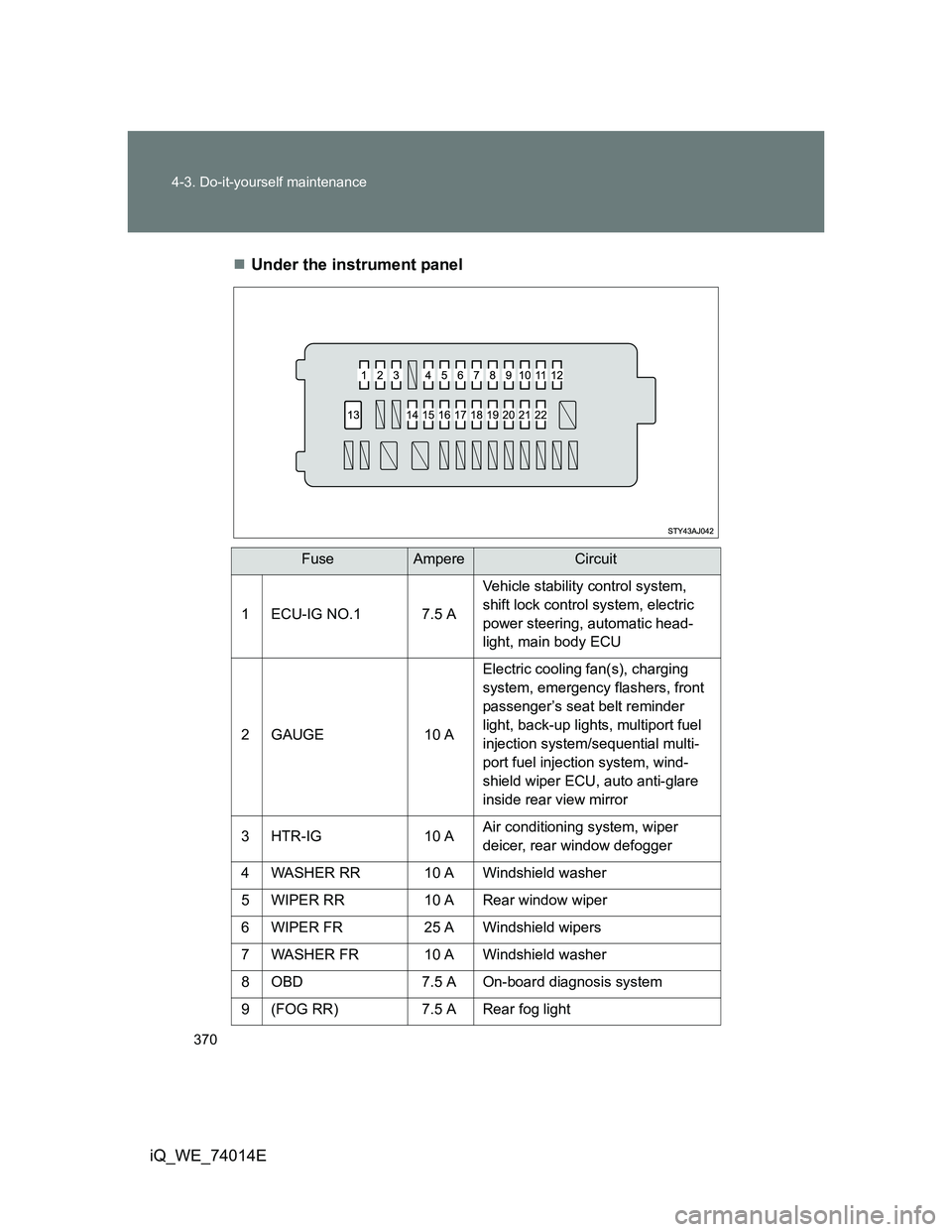
iQ_WE_74014EUnder the instrument panel
FuseAmpereCircuit
1 ECU-IG NO.1 7.5 AVehicle stability control system,
shift lock control system, electric
power steering, automatic head-
light, main body ECU
2 GAUGE 10 AElectric cooling fan(s), charging
system, emergency flashers, front
passenger’s seat belt reminder
light, back-up lights, multiport fuel
injection system/sequential multi-
port fuel injection system, wind-
shield wiper ECU, auto anti-glare
inside rear view mirror
3 HTR-IG 10 AAir conditioning system, wiper
deicer, rear window defogger
4 WASHER RR 10 A Windshield washer
5 WIPER RR 10 A Rear window wiper
6 WIPER FR 25 A Windshield wipers
7 WASHER FR 10 A Windshield washer
8 OBD 7.5 A On-board diagnosis system
9 (FOG RR) 7.5 A Rear fog light