belt TOYOTA IQ 2012 User Guide
[x] Cancel search | Manufacturer: TOYOTA, Model Year: 2012, Model line: IQ, Model: TOYOTA IQ 2012Pages: 476, PDF Size: 23.52 MB
Page 86 of 476
86
1-3. Adjustable components (seats, mirrors, steering wheel)
iQ_WE_74014E
Seat belts
Make sure that all occupants are wearing their seat belts before driv-
ing the vehicle.
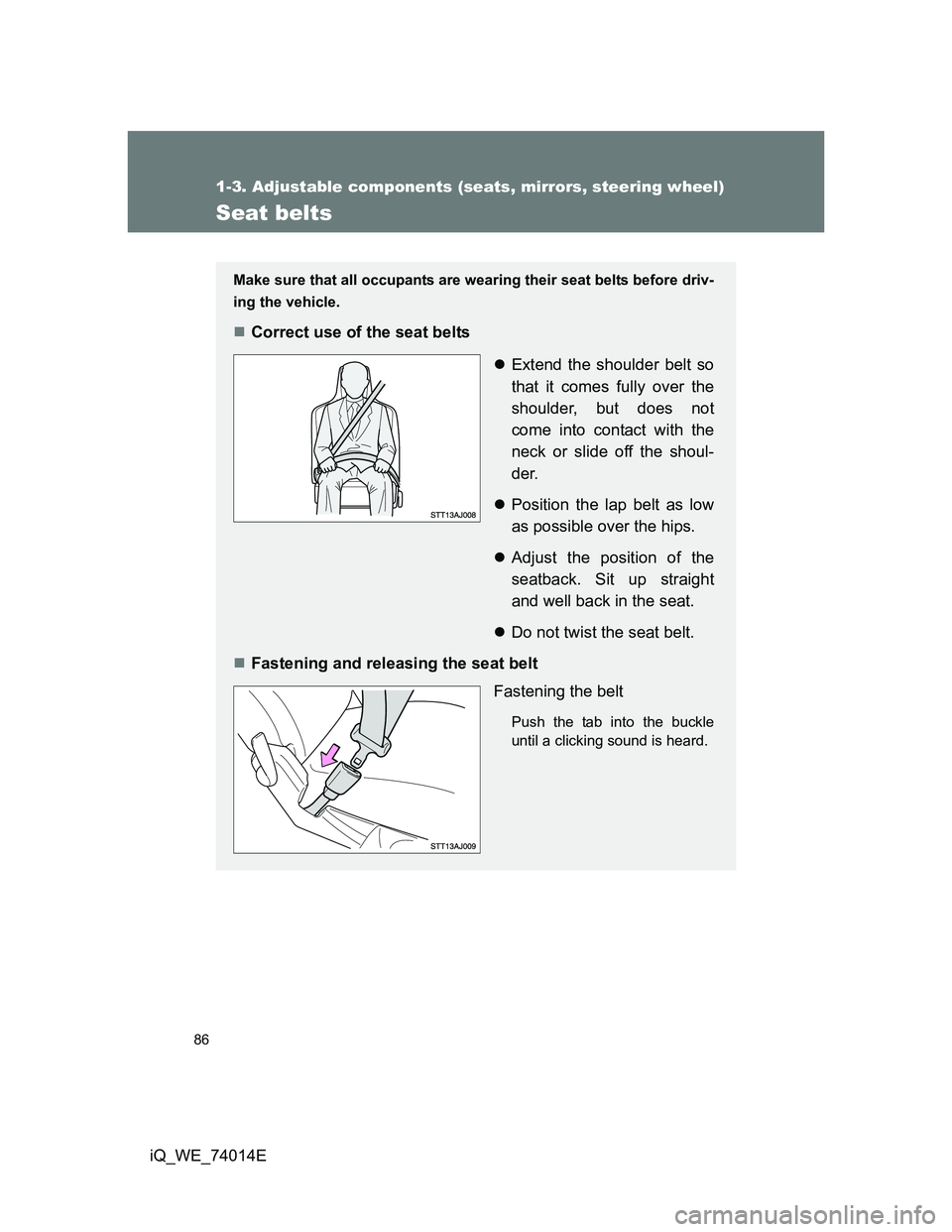
Correct use of the seat belts
Extend the shoulder belt so
that it comes fully over the
shoulder, but does not
come into contact with the
neck or slide off the shoul-
der.
Position the lap belt as low
as possible over the hips.
Adjust the position of the
seatback. Sit up straight
and well back in the seat.
Do not twist the seat belt.
Fastening and releasing the seat belt
Fastening the belt
Push the tab into the buckle
until a clicking sound is heard.
Page 87 of 476
87 1-3. Adjustable components (seats, mirrors, steering wheel)
1
Before driving
iQ_WE_74014E
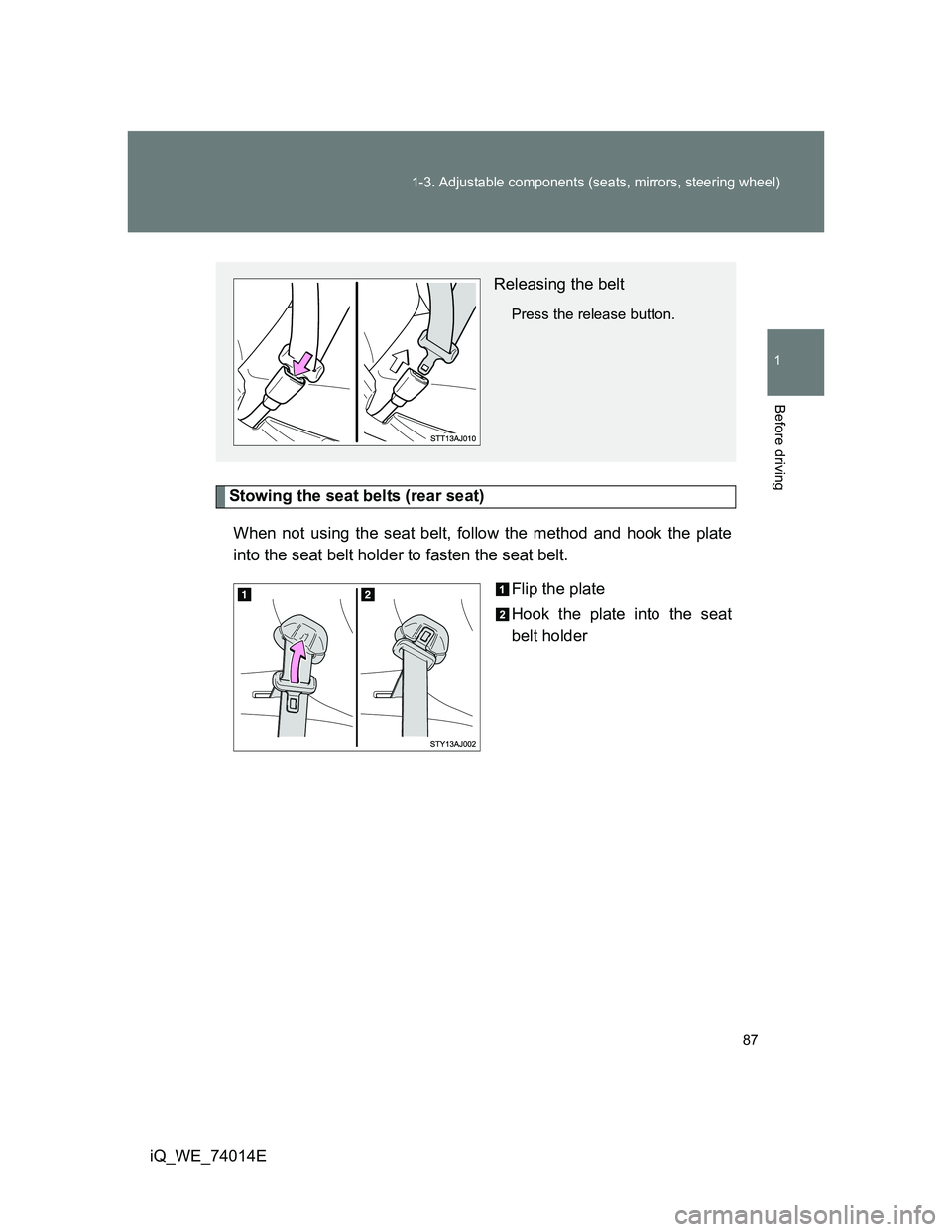
Stowing the seat belts (rear seat)
When not using the seat belt, follow the method and hook the plate
into the seat belt holder to fasten the seat belt.
Flip the plate
Hook the plate into the seat
belt holder
Releasing the belt
Press the release button.
Page 88 of 476
88 1-3. Adjustable components (seats, mirrors, steering wheel)
iQ_WE_74014E
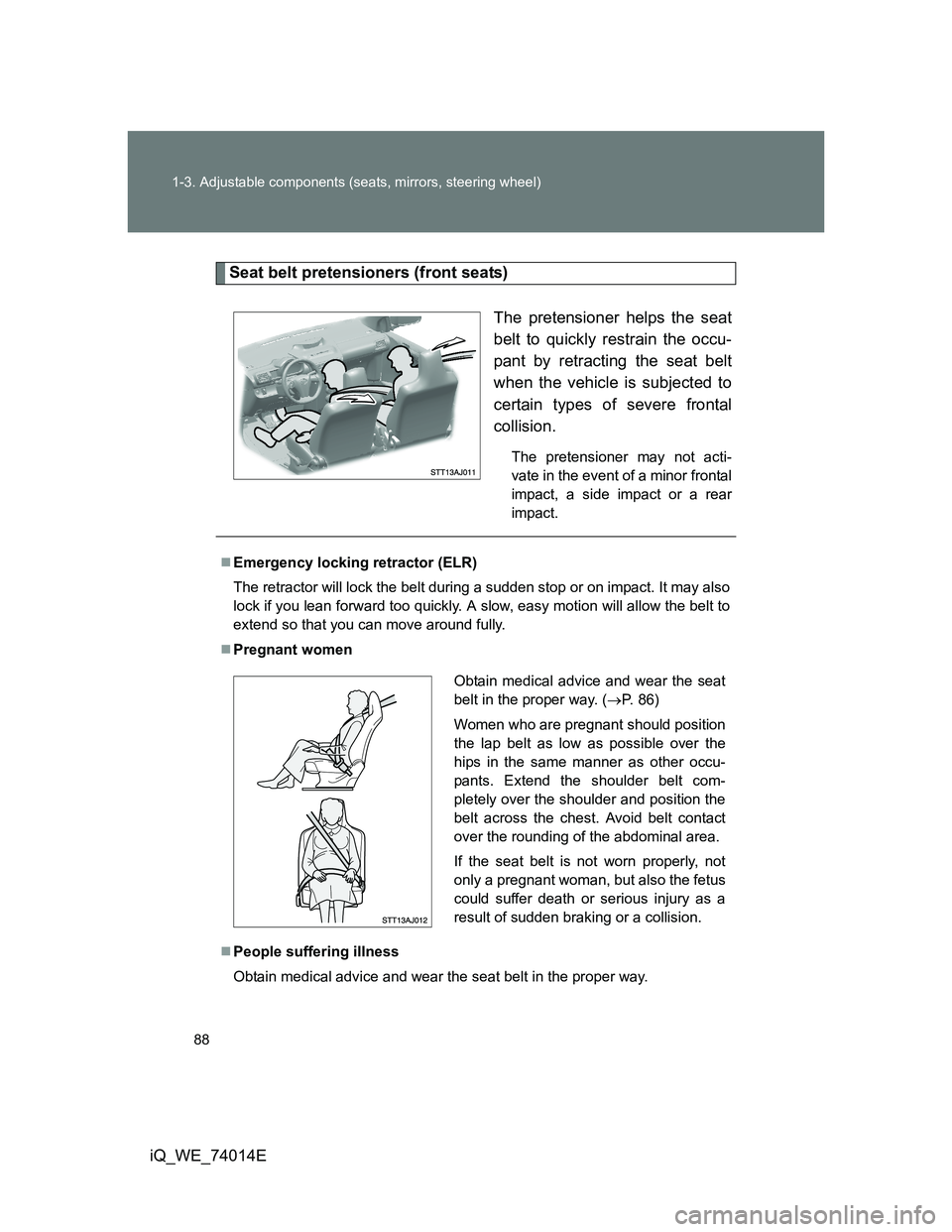
Seat belt pretensioners (front seats)
The pretensioner helps the seat
belt to quickly restrain the occu-
pant by retracting the seat belt
when the vehicle is subjected to
certain types of severe frontal
collision.
The pretensioner may not acti-
vate in the event of a minor frontal
impact, a side impact or a rear
impact.
Emergency locking retractor (ELR)
The retractor will lock the belt during a sudden stop or on impact. It may also
lock if you lean forward too quickly. A slow, easy motion will allow the belt to
extend so that you can move around fully.
Pregnant women
People suffering illness
Obtain medical advice and wear the seat belt in the proper way.
Obtain medical advice and wear the seat
belt in the proper way. (P. 86)
Women who are pregnant should position
the lap belt as low as possible over the
hips in the same manner as other occu-
pants. Extend the shoulder belt com-
pletely over the shoulder and position the
belt across the chest. Avoid belt contact
over the rounding of the abdominal area.
If the seat belt is not worn properly, not
only a pregnant woman, but also the fetus
could suffer death or serious injury as a
result of sudden braking or a collision.
Page 89 of 476
89 1-3. Adjustable components (seats, mirrors, steering wheel)
1
Before driving
iQ_WE_74014E
Child seat belt usage
The seat belts of your vehicle were principally designed for persons of adult
size.
Use a child restraint system appropriate for the child, until the child
becomes large enough to properly wear the vehicle’s seat belt. (P. 137)
When the child becomes large enough to properly wear the vehicle’s
seat belt, follow the instructions on P. 86 regarding seat belt usage.
Replacing the belt after the pretensioner has been activated
If the vehicle is involved in multiple collisions, the pretensioner will activate
for the first collision, but will not activate for the second or subsequent colli-
sions.
Seat belt regulations
If seat belt regulations exist in the country where you reside, please contact
any authorized Toyota dealer or repairer, or another duly qualified and
equipped professional, for seat belt replacement or installation.
CAUTION
Observe the following precautions to reduce the risk of injury in the event of
sudden braking, sudden swerving or an accident.
Failing to do so may cause death or severe injury.
Wearing a seat belt
Ensure that all passengers wear a seat belt.
Always wear a seat belt properly.
Each seat belt should be used by one person only. Do not use a seat belt
for more than one person at once, including children.
Toyota recommends that children be seated in the rear seat and always
use a seat belt and/or an appropriate child restraint system.
Do not recline the seat any more than necessary to achieve a proper seat-
ing position. The seat belt is most effective when the occupants are sitting
up straight and well back in the seats.
Do not wear the shoulder belt under your arm.
Always wear your seat belt low and snug across your hips.
Page 90 of 476
90 1-3. Adjustable components (seats, mirrors, steering wheel)
iQ_WE_74014E
CAUTION
When children are in the vehicle
Do not allow children to play with the seat belt. If the seat belt becomes
twisted around a child’s neck, it may lead to choking or other serious injuries
that could result in death.
If this occurs and the buckle cannot be unfastened, scissors should be used
to cut the belt.
Seat belt pretensioners
If the pretensioner has activated, the SRS warning light will come on. In that
case, the seat belt cannot be used again and must be replaced at any autho-
rized Toyota dealer or repairer, or another duly qualified and equipped pro-
fessional.
Seat belt damage and wear
Do not damage the seat belts by allowing the belt, plate, or buckle to be
jammed in the door.
Inspect the seat belt system periodically. Check for cuts, fraying, and loose
parts. Do not use a damaged seat belt until it is replaced. Damaged seat
belt cannot protect an occupant from death or serious injury.
Ensure that the belt and tab are locked and the belt is not twisted.
If the seat belt does not function correctly, immediately contact any autho-
rized Toyota dealer or repairer, or another duly qualified and equipped pro-
fessional.
Replace the seat assembly, including the belts, if your vehicle has been
involved in a serious accident, even if there is no obvious damage.
Do not attempt to install, remove, modify, disassemble or dispose of the
seat belts. Have any necessary repairs carried out by any authorized
Toyota dealer or repairer, or another duly qualified and equipped profes-
sional. Inappropriate handling of the pretensioner may prevent it from
operating properly resulting in death or serious injury.
Page 122 of 476
122
iQ_WE_74014E
1-7. Safety information
Correct driving posture
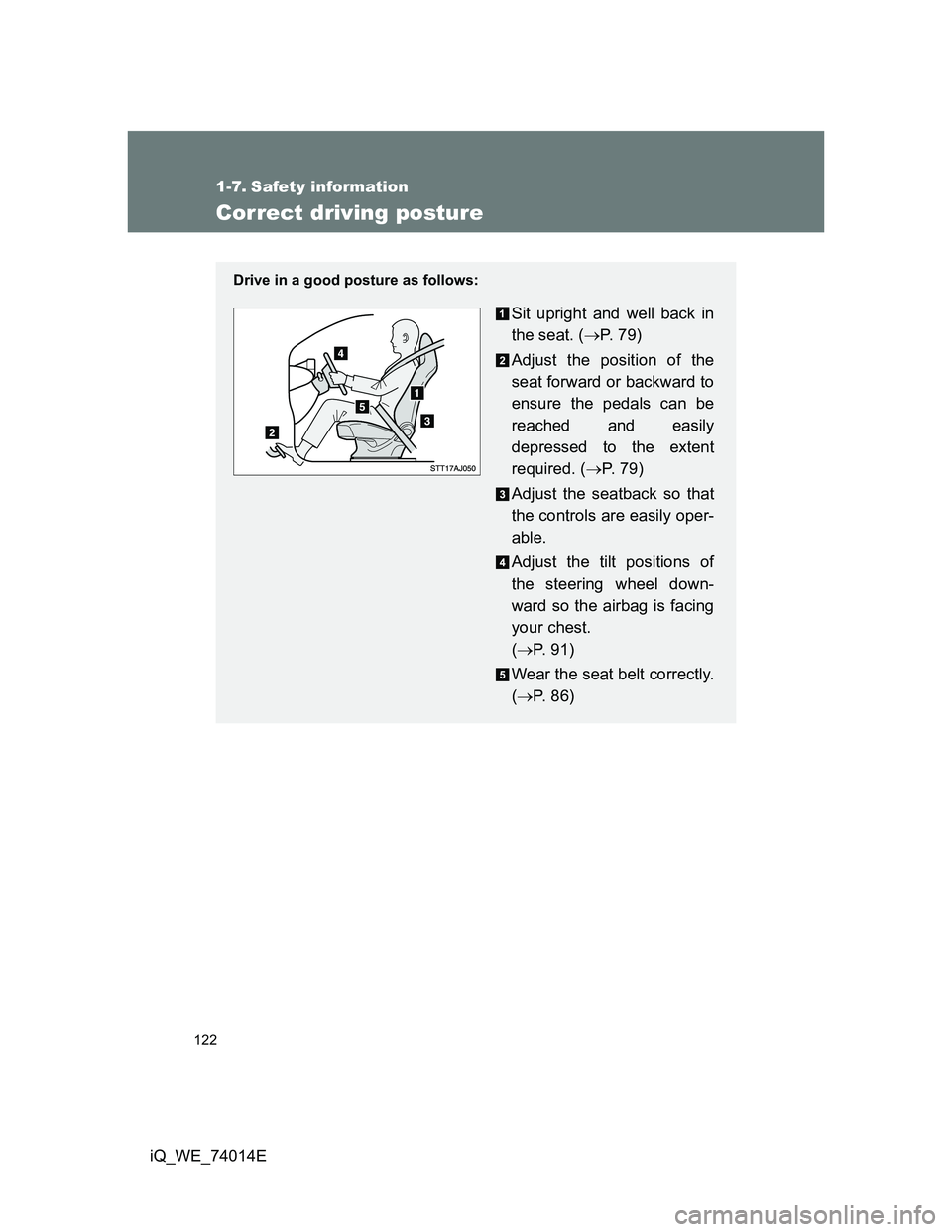
Drive in a good posture as follows:
Sit upright and well back in
the seat. (P. 7 9 )
Adjust the position of the
seat forward or backward to
ensure the pedals can be
reached and easily
depressed to the extent
required. (P. 79)
Adjust the seatback so that
the controls are easily oper-
able.
Adjust the tilt positions of
the steering wheel down-
ward so the airbag is facing
your chest.
(P. 91)
Wear the seat belt correctly.
(P. 86)
Page 123 of 476
123 1-7. Safety information
1
Before driving
iQ_WE_74014E
CAUTION
While driving
Do not adjust the position of the driver’s seat while driving.
Doing so could cause the driver to lose control of the vehicle.
Do not place a cushion between the driver or passenger and the seatback.
A cushion may prevent correct posture from being achieved, and reduce
the effectiveness of the seat belt and head restraint, increasing the risk of
death or serious injury to the driver or passenger.
Do not place anything under the front seats.
Objects placed under the front seats may become jammed in the seat
tracks and stop the seat from locking in place. This may lead to an acci-
dent. The adjustment mechanism may also be damaged.
Adjusting the seat position
Take care when adjusting the seat position to ensure that other passen-
gers are not injured by the moving seat.
Do not put your hands under the seat or near the moving parts to avoid
injury.
Fingers or hands may become jammed in the seat mechanism.
Page 124 of 476
124
1-7. Safety information
iQ_WE_74014E
SRS airbags
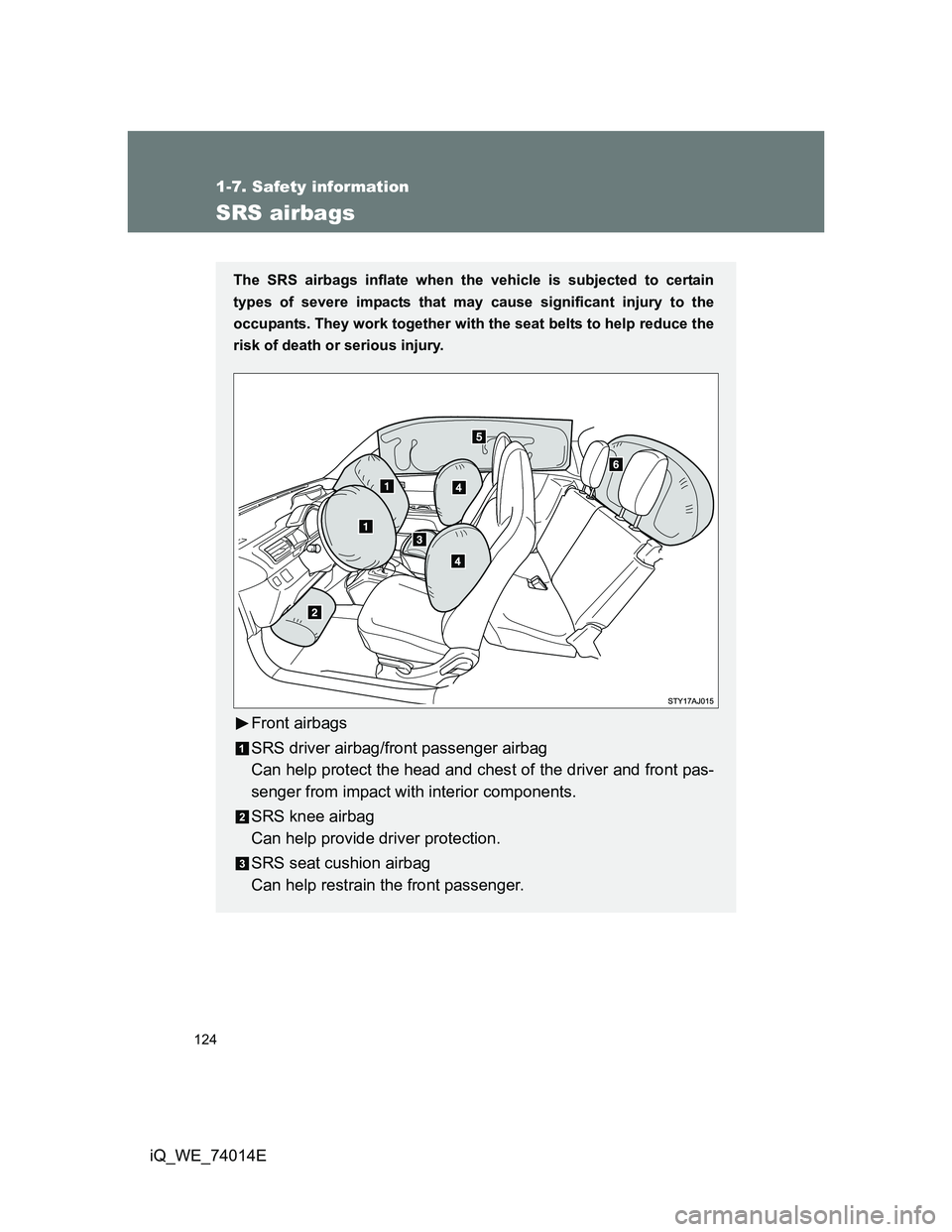
The SRS airbags inflate when the vehicle is subjected to certain
types of severe impacts that may cause significant injury to the
occupants. They work together with the seat belts to help reduce the
risk of death or serious injury.
Front airbags
SRS driver airbag/front passenger airbag
Can help protect the head and chest of the driver and front pas-
senger from impact with interior components.
SRS knee airbag
Can help provide driver protection.
SRS seat cushion airbag
Can help restrain the front passenger.
Page 126 of 476
126 1-7. Safety information
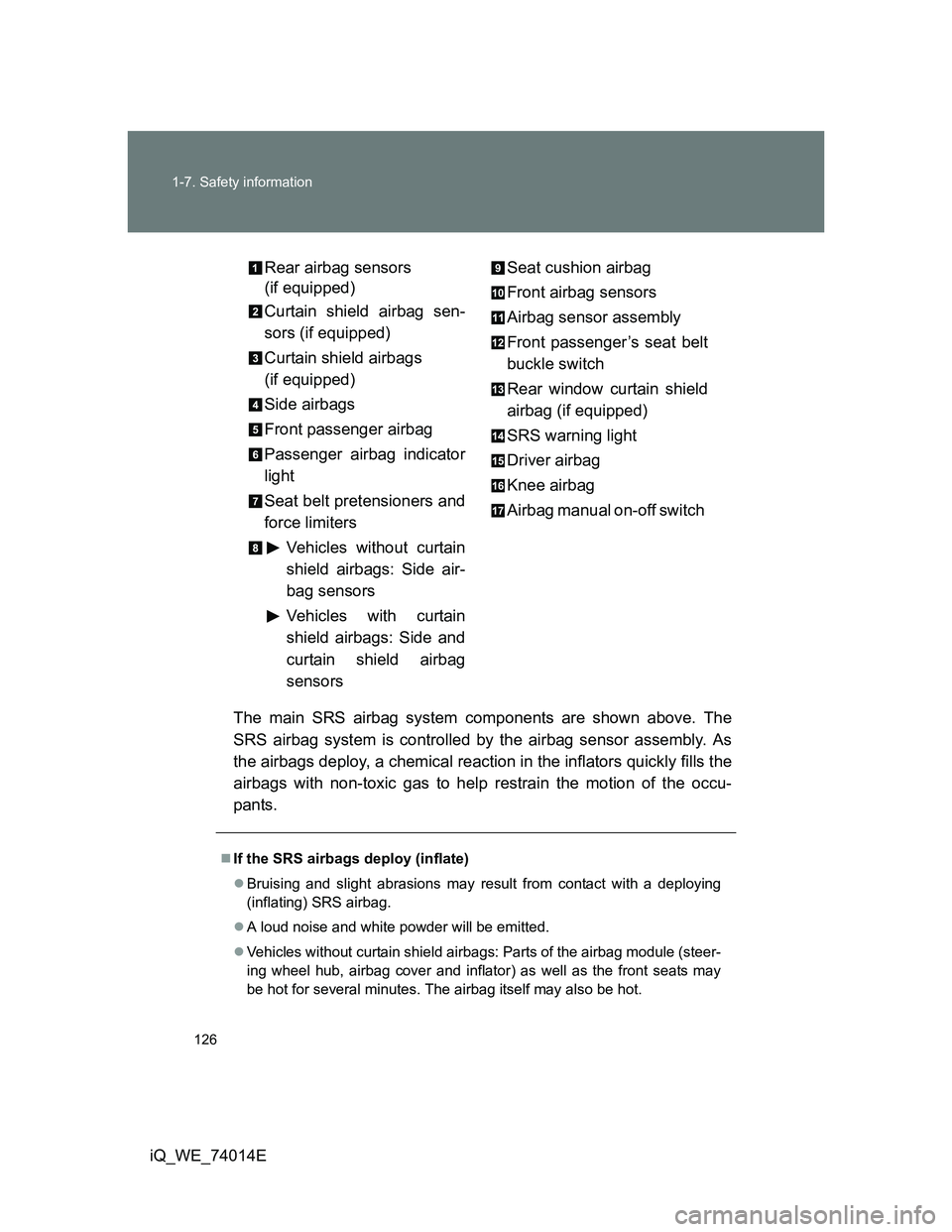
iQ_WE_74014EThe main SRS airbag system components are shown above. The
SRS airbag system is controlled by the airbag sensor assembly. As
the airbags deploy, a chemical reaction in the inflators quickly fills the
airbags with non-toxic gas to help restrain the motion of the occu-
pants.
Rear airbag sensors
(if equipped)
Curtain shield airbag sen-
sors (if equipped)
Curtain shield airbags
(if equipped)
Side airbags
Front passenger airbag
Passenger airbag indicator
light
Seat belt pretensioners and
force limiters
Vehicles without curtain
shield airbags: Side air-
bag sensors
Vehicles with curtain
shield airbags: Side and
curtain shield airbag
sensorsSeat cushion airbag
Front airbag sensors
Airbag sensor assembly
Front passenger’s seat belt
buckle switch
Rear window curtain shield
airbag (if equipped)
SRS warning light
Driver airbag
Knee airbag
Airbag manual on-off switch
If the SRS airbags deploy (inflate)
Bruising and slight abrasions may result from contact with a deploying
(inflating) SRS airbag.
A loud noise and white powder will be emitted.
Vehicles without curtain shield airbags: Parts of the airbag module (steer-
ing wheel hub, airbag cover and inflator) as well as the front seats may
be hot for several minutes. The airbag itself may also be hot.
Page 127 of 476
127 1-7. Safety information
1
Before driving
iQ_WE_74014E
Vehicles with curtain shield airbags: Parts of the airbag module (steering
wheel hub, airbag cover and inflator) as well as the front seats, and parts
of the front and rear pillars, roof side rail and rear roof headlining may be
hot for several minutes. The airbag itself may also be hot.
The front windshield may crack.
Operating conditions (front airbags)
The SRS front airbags will deploy in the event of an impact that exceeds
the set threshold level (the level of force corresponding to an approxi-
mately 20-30 km/h [12-18 mph] frontal collision with a fixed wall that does
not move or deform).
However, this threshold velocity will be considerably higher if the vehicle
strikes an object, such as a parked vehicle or sign pole, which can move or
deform on impact, or if the vehicle is involved in an underride collision (e.g.
a collision in which the front of the vehicle “underrides”, or goes under, the
bed of a truck, etc.).
Depending on the type of collision, it is possible that only the seat belt
pretensioners will activate.
The SRS seat cushion airbag on the front passenger’s seat will not oper-
ate if the occupant is not wearing a seat belt.
Operating conditions (side airbags & curtain shield airbags [if
equipped])
The SRS side airbags & SRS curtain shield airbags will deploy in the event
of an impact that exceeds the set threshold level (the level of force corre-
sponding to the impact force produced by an approximately 1500 kg [3300
lb.] vehicle colliding with the vehicle cabin from a direction perpendicular to
the vehicle orientation at an approximate speed of 20-30 km/h [12-18 mph]).
Operating conditions (rear window curtain shield airbag [if equipped])
The SRS rear window curtain shield airbag is designed to inflate when the
passenger compartment is subjected to a severe impact from the rear or
side.