wiring TOYOTA LAND CRUISER 2000 Owners Manual
[x] Cancel search | Manufacturer: TOYOTA, Model Year: 2000, Model line: LAND CRUISER, Model: TOYOTA LAND CRUISER 2000Pages: 235, PDF Size: 5.13 MB
Page 30 of 235
L/C 100_U
52 2000 L/C 100 (OM60866U)
This indicator comes on when the igni-
tion key is turned to the ”ACC” or
”ON” position. It goes off after about
6 seconds. This means the front seat
belt pretensioners are operating proper-
ly.
This warning light system monitors the
airbag sensor assembly, front airbag sen-
sors, seat belt pretensioner assemblies,
warning light, interconnecting wiring and
power sources. (For details, see ”Service
reminder indicators and warning buzzers”
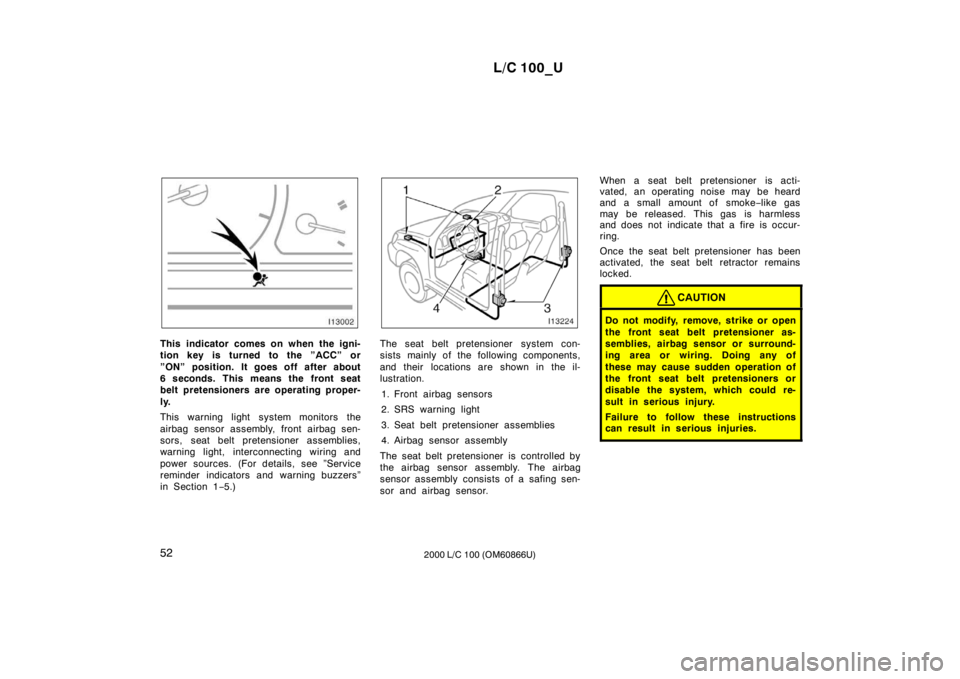
in Section 1−5.)The seat belt pretensioner system con-
sists mainly of the following components,
and their locations are shown in the il-
lustration.
1. Front airbag sensors
2. SRS warning light
3. Seat belt pretensioner assemblies
4. Airbag sensor assembly
The seat belt pretensioner is controlled by
the airbag sensor assembly. The airbag
sensor assembly consists of a safing sen-
sor and airbag sensor. When a seat belt pretensioner is acti-
vated, an operating noise may be heard
and a small amount of smoke
−like gas
may be released. This gas is harmless
and does not indicate that a fire is occur-
ring.
Once the seat belt pretensioner has been
activated, the seat belt retractor remains
locked.
CAUTION
Do not modify, remove, strike or open
the front seat belt pretensioner as-
semblies, airbag sensor or surround-
ing area or wiring. Doing any of
these may cause sudden operation of
the front seat belt pretensioners or
disable the system, which could re-
sult in serious injury.
Failure to follow these instructions
can result in serious injuries.
Page 32 of 235
L/C 100_U
54 2000 L/C 100 (OM60866U)
The SRS (Supplemental Restraint Sys-
tem) airbags are designed to provide
further protection for the driver and
front passenger in addition to the pri-
mary safety protection provided by the
seat belts.
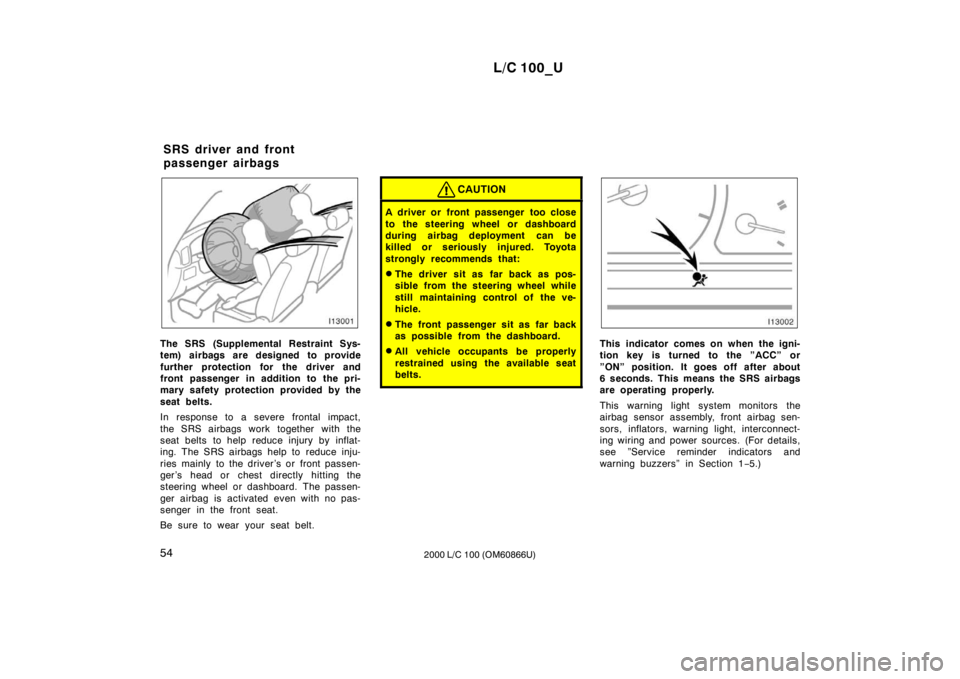
In response to a severe frontal impact,
the SRS airbags work together with the
seat belts to help reduce injury by inflat-
ing. The SRS airbags help to reduce inju-
ries mainly to the driver’s or front passen-
ger ’s head or chest directly hitting the
steering wheel or dashboard. The passen-
ger airbag is activated even with no pas-
senger in the front seat.
Be sure to wear your seat belt.
CAUTION
A driver or front passenger too close
to the steering wheel or dashboard
during airbag deployment can be
killed or seriously injured. Toyota
strongly recommends that: The driver sit as far back as pos-
sible from the steering wheel while
still maintaining control of the ve-
hicle.
The front passenger sit as far back
as possible from the dashboard.
All vehicle occupants be properly
restrained using the available seat
belts.
This indicator comes on when the igni-
tion key is turned to the ”ACC” or
”ON” position. It goes off after about
6 seconds. This means the SRS airbags
are operating properly.
This warning light system monitors the
airbag sensor assembly, front airbag sen-
sors, inflators, warning light, interconnect-
ing wiring and power sources. (For details,
see ”Service reminder indicators and
warning buzzers” in Section 1 −5.)
SRS driver and front
passenger airbags
Page 159 of 235
L/C 100_U195
2000 L/C 100 (OM60866U)
(b) Starting a flooded engine
If the engine will not start, your engine
may be flooded because of repeated
cranking.
If this happens, turn the key to ”START”
with the accelerator pedal held down.
Keep the key and accelerator pedal so for
15 seconds and release them. Then try
starting the engine with your foot off the
accelerator pedal.
If the engine does not start after 15 se-
conds of cranking, release the key, wait
a few minutes and try again.
If the engine still will not start, it needs
adjustment or repair. Call a Toyota dealer
or qualified repair shop for assistance.
NOTICE
Do not crank for more than 30 se-
conds at a time. This may overheat
the starter and wiring systems.
(c) Jump starting
To avoid serious personal injury and
damage to your vehicle which might re-
sult from battery explosion, acid burns,
electrical burns, or damaged electronic
components, these instructions must be
followed precisely.
If you are unsure about how to follow this
procedure, we strongly recommend that
you seek the help of a competent me-
chanic or towing service.
CAUTION
Batteries contain sulfuric acid
which is poisonous and corrosive.
Wear protective safety glasses when
jump starting, and avoid spilling
acid on your skin, clothing, or ve-
hicle.
If you should accidentally get acid
on yourself or in your eyes, remove
any contaminated clothing and flush
the affected area with water im-
mediately. Then get immediate medi-
cal attention. If possible, continue
to apply water with a sponge or
cloth while en route to the medical
office.
The gas normally produced by a
battery will explode if a flame or
spark is brought near. Use only
standardized jumper cables and do
not smoke or light a match while
jump starting.
NOTICE
The battery used for boosting must
be 12 V. Do not jump start unless you
are sure that the booster battery is
correct.