child restraint TOYOTA LAND CRUISER 2012 Owners Manual
[x] Cancel search | Manufacturer: TOYOTA, Model Year: 2012, Model line: LAND CRUISER, Model: TOYOTA LAND CRUISER 2012Pages: 692, PDF Size: 29.3 MB
Page 2 of 692
TABLE OF CONTENTSIndex
2
L/C200_EE (OM60G38E)
1-1. Key information
Keys ...................................... 38
1-2. Opening, closing and locking
the doors
Smart entry &
start system ........................ 40
Wireless remote control ........ 55
Side doors............................. 60
Back door.............................. 63
1-3. Adjustable components
(seats, mirrors, steering
wheel)
Front seats ............................ 75
Rear seats ............................ 78
Driving position memory
system ................................ 86
Head restraints ..................... 91
Seat belts .............................. 95
Steering wheel .................... 101
Anti-glare inside
rear view mirror................. 104
Outside
rear view mirrors ............... 1061-4. Opening and closing
the windows and moon roof
Power windows .................. 109
Moon roof ........................... 113
1-5. Refueling
Opening
the fuel tank cap............... 116
1-6. Theft deterrent system
Engine immobilizer
system.............................. 120
Double locking system ....... 125
Alarm .................................. 127
1-7. Safety information
Correct driving posture ....... 135
SRS airbags ....................... 137
Child restraint systems ....... 151
Installing child restraints ..... 160
Airbag manual
on-off system ................... 174
1Before driving
For vehicles with a navigation system, refer to the “Navigation System Owner’s
Manual” for information regarding the equipment listed below.
• Navigation system
• Air conditioning
• Windshield wiper de-icer• Audio/video system
• Toyota parking assist monitor
Page 37 of 692
1Before driving
37
L/C200_EE (OM60G38E)
1-1. Key information
Keys.................................... 38
1-2. Opening, closing and locking
the doors
Smart entry &
start system ...................... 40
Wireless remote control ...... 55
Side doors .......................... 60
Back door ........................... 63
1-3. Adjustable components
(seats, mirrors, steering
wheel)
Front seats.......................... 75
Rear seats .......................... 78
Driving position memory
system .............................. 86
Head restraints ................... 91
Seat belts............................ 95
Steering wheel .................. 101
Anti-glare inside
rear view mirror............... 104
Outside
rear view mirrors ............. 1061-4. Opening and closing
the windows and moon roof
Power windows ................. 109
Moon roof.......................... 113
1-5. Refueling
Opening
the fuel tank cap ............. 116
1-6. Theft deterrent system
Engine immobilizer
system ............................ 120
Double locking system ...... 125
Alarm ................................ 127
1-7. Safety information
Correct driving posture ..... 135
SRS airbags...................... 137
Child restraint systems ..... 151
Installing
child restraints ................ 160
Airbag manual
on-off system .................. 174
Page 98 of 692
98 1-3. Adjustable components (seats, mirrors, steering wheel)
L/C200_EE (OM60G38E)
People suffering illness
Obtain medical advice and wear the seat belt in the proper way.
Child seat belt usage
The seat belts of your vehicle were principally designed for persons of adult
size.
Use a child restraint system appropriate for the child, until the child
becomes large enough to properly wear the vehicle’s seat belt. (P. 151)
When the child becomes large enough to properly wear the vehicle’s
seat belt, follow the instructions on P. 95 regarding seat belt usage.
Replacing the belt after the pretensioner has been activated
If the vehicle is involved in multiple collisions, the pretensioner will activate
for the first collision, but will not activate for the second or subsequent colli-
sions.
Seat belt regulations
If seat belt regulations exist in the country where you reside, please contact
any authorized Toyota dealer or repairer, or another duly qualified and
equipped professional, for seat belt replacement or installation.
Page 99 of 692
99 1-3. Adjustable components (seats, mirrors, steering wheel)
1
Before driving
L/C200_EE (OM60G38E)
CAUTION
Observe the following precautions to reduce the risk of injury in the event of
sudden braking, sudden swerving or an accident.
Failing to do so may cause death or serious injury.
Wearing a seat belt
Ensure that all passengers wear a seat belt.
Always wear a seat belt properly.
Each seat belt should be used by one person only. Do not use a seat belt
for more than one person at once, including children.
Toyota recommends that children be seated in the rear seat and always
use a seat belt and/or an appropriate child restraint system.
Do not recline the seat any more than necessary to achieve a proper seat-
ing position. The seat belt is most effective when the occupants are sitting
up straight and well back in the seats.
Do not wear the shoulder belt under your arm.
Always wear your seat belt low and snug across your hips.
When children are in the vehicle
Do not allow children to play with the seat belt. If the seat belt becomes
twisted around a child’s neck, it may lead to choking or other serious injuries
that could result in death.
If this occurs and the buckle cannot be unfastened, scissors should be used
to cut the belt.
Seat belt pretensioners
Do not place anything, such as a cushion, on the front passenger’s seat.
Doing so will disperse the passenger’s weight, which prevents the sensor
from detecting the passenger’s weight properly. As a result, the seat belt
pretensioner for the front passenger’s seat may not activate in the event of
a collision.
If the pretensioner has activated, the SRS warning light will come on. In
that case, the seat belt cannot be used again and must be replaced at any
authorized Toyota dealer or repairer, or another duly qualified and
equipped professional.
Page 146 of 692
146 1-7. Safety information
L/C200_EE (OM60G38E)
CAUTION
SRS airbag precautions
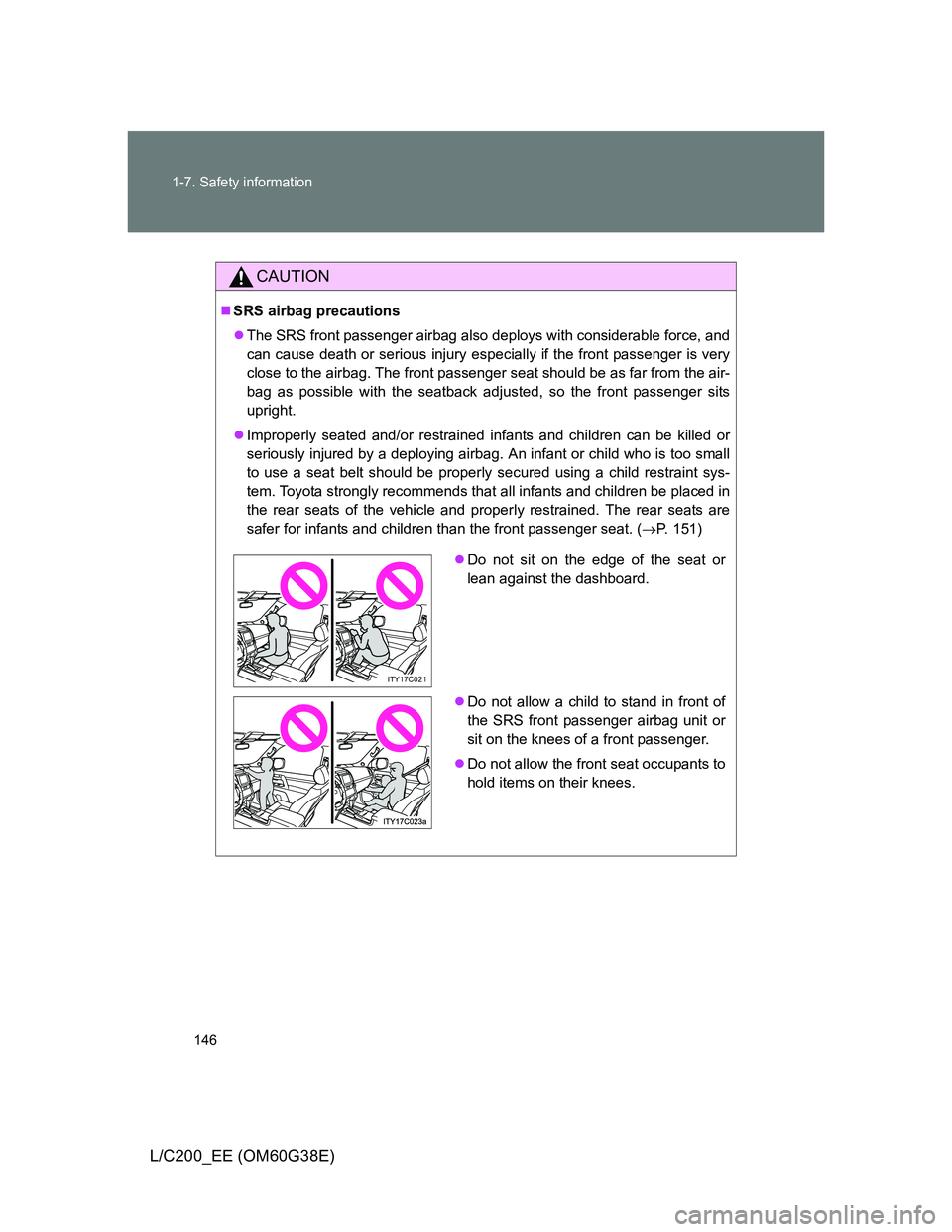
The SRS front passenger airbag also deploys with considerable force, and
can cause death or serious injury especially if the front passenger is very
close to the airbag. The front passenger seat should be as far from the air-
bag as possible with the seatback adjusted, so the front passenger sits
upright.
Improperly seated and/or restrained infants and children can be killed or
seriously injured by a deploying airbag. An infant or child who is too small
to use a seat belt should be properly secured using a child restraint sys-
tem. Toyota strongly recommends that all infants and children be placed in
the rear seats of the vehicle and properly restrained. The rear seats are
safer for infants and children than the front passenger seat. (P. 151)
Do not sit on the edge of the seat or
lean against the dashboard.
Do not allow a child to stand in front of
the SRS front passenger airbag unit or
sit on the knees of a front passenger.
Do not allow the front seat occupants to
hold items on their knees.
ITY17C021
Page 151 of 692
151
1
1-7. Safety information
Before driving
L/C200_EE (OM60G38E)
Child restraint systems
Points to remember
Studies have shown that installing a child restraint on a rear seat is
much safer than installing one to the front passenger seat.
Choose a child restraint system appropriate to the age and size of
the child.
For installation details, follow the instructions provided with the
child restraint system.
General installation instructions are provided in this manual.
(P. 160)
Toyota recommends that you use a child restraint system which
conforms to the regulation “ECE No.44”.
Types of child restraints
Child restraint systems are classified into the following 5 groups
according to the regulation “ECE No.44”.
Group 0: Up to 10 kg (22 lb.) (0 - 9 months)
Group 0
+: Up to 13 kg (28 lb.) (0 - 2 years)
Group I: 9 to 18 kg (20 to 39 lb.) (9 months - 4 years)
Group II: 15 to 25 kg (34 to 55 lb.) (4 years - 7 years)
Group III: 22 to 36 kg (49 to 79 lb.) (6 years - 12 years)
In this owner’s manual, the following popular 3 types of child restraint
systems that can be secured with the seat belts are explained.
Toyota strongly urges the use of child restraint systems.
Page 153 of 692
153 1-7. Safety information
1
Before driving
L/C200_EE (OM60G38E)
Child restraint system suitability for various seating positions
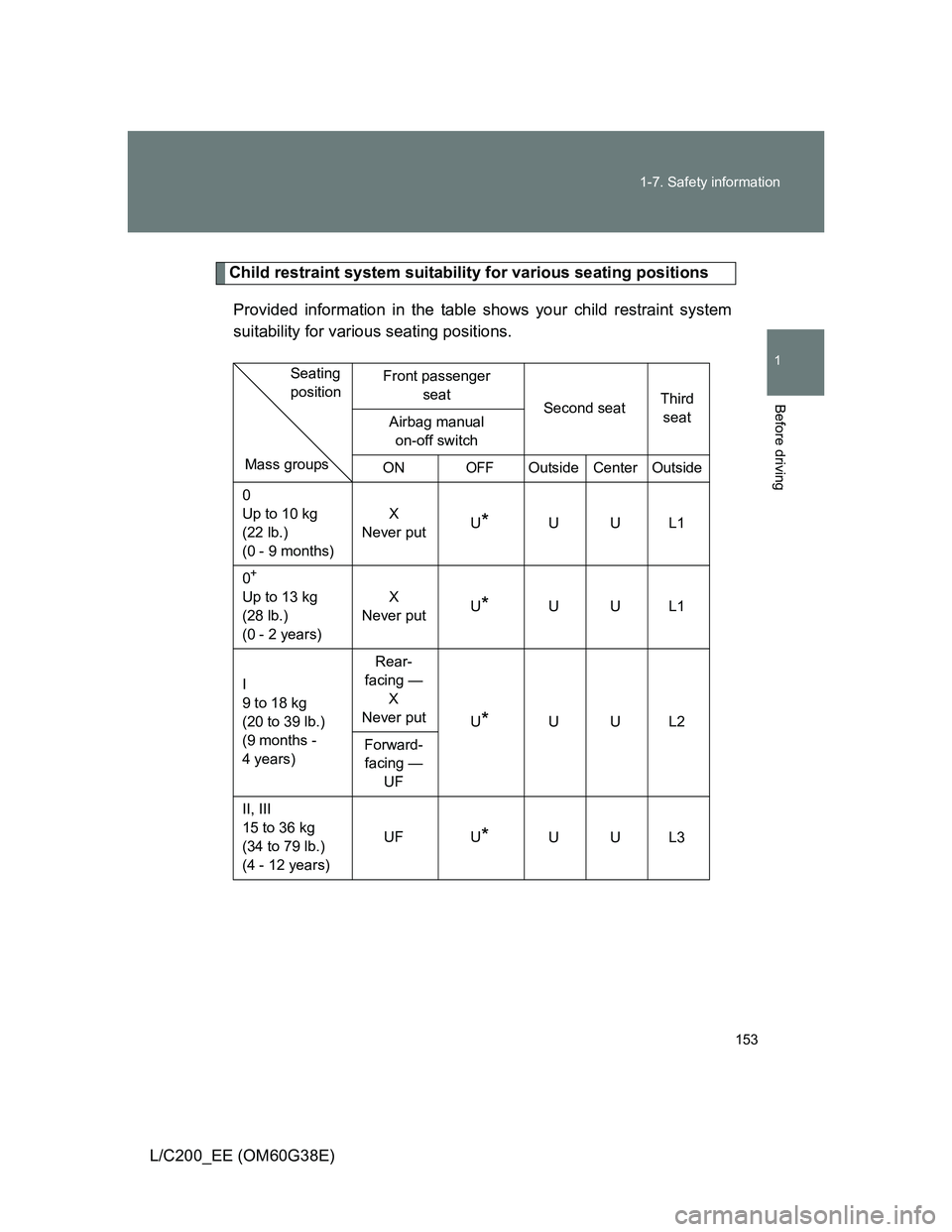
Provided information in the table shows your child restraint system
suitability for various seating positions.
Front passenger
seat
Second seatThird
seat
Airbag manual
on-off switch
ON
OFFOutside Center Outside
0
Up to 10 kg
(22 lb.)
(0 - 9 months)X
Never putU
*UUL1
0
+
Up to 13 kg
(28 lb.)
(0 - 2 years)X
Never putU*UUL1
I
9 to 18 kg
(20 to 39 lb.)
(9 months -
4 years)Rear-
facing —
X
Never put
U
*UUL2
Forward-
facing —
UF
II, III
15 to 36 kg
(34 to 79 lb.)
(4 - 12 years)UF U
*UUL3
Mass groupsSeating
position
Page 154 of 692
154 1-7. Safety information
L/C200_EE (OM60G38E)Key of letters inserted in the above table:
U: Suitable for “universal” category child restraint system approved
for the use in this mass group.
UF: Suitable for forward-facing “universal” category child restraint
system approved for the use in this mass group.
L1: Suitable for “TOYOTA BABY SAFE (0 to 13 kg [0 to 28 lb.])”
approved for the use in this mass group
L2: Suitable for “TOYOTA DUO (9 to 18 kg [20 to 39 lb.])” approved
for the use in this mass group
L3: Suitable for “TOYOTA KID (15 to 36 kg [34 to 79 lb.])” approved
for the use in this mass group
X: Not suitable seat position for children in this mass group.
NOTE:
*: When you use child restraint system on the passenger seat, you
must adjust the seat cushion to the uppermost position.
Other child restraint systems different from the systems mentioned in
the table can be used, but the suitability of the systems must be care-
fully checked with the child restraint system manufacturer and
retailer.
Page 155 of 692
155 1-7. Safety information
1
Before driving
L/C200_EE (OM60G38E)
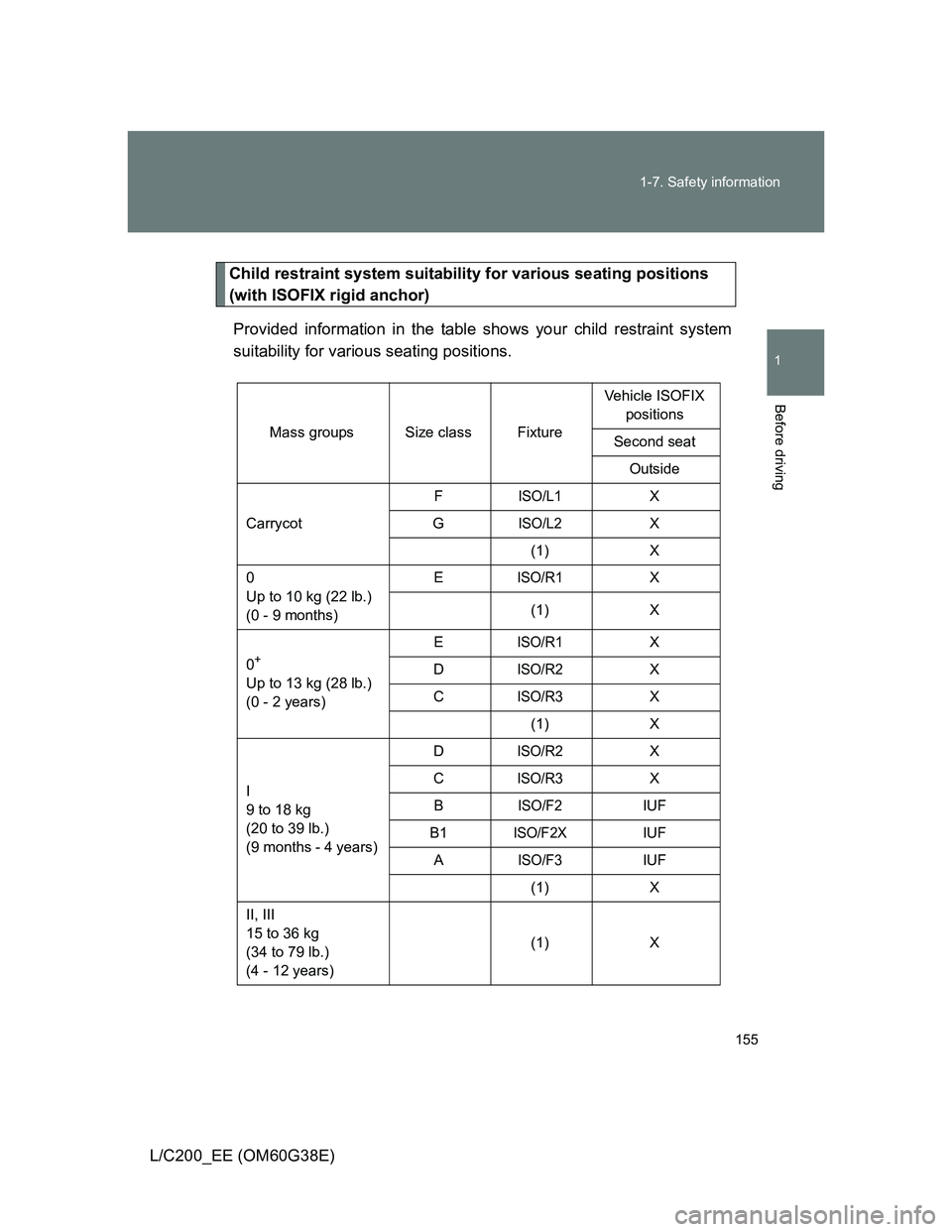
Child restraint system suitability for various seating positions
(with ISOFIX rigid anchor)
Provided information in the table shows your child restraint system
suitability for various seating positions.
Mass groups Size class FixtureVehicle ISOFIX
positions
Second seat
Outside
CarrycotF
ISO/L1X
G
ISO/L2X
(1) X
0
Up to 10 kg (22 lb.)
(0 - 9 months)E
ISO/R1X
(1) X
0
+
Up to 13 kg (28 lb.)
(0 - 2 years)E
ISO/R1X
D
ISO/R2X
C
ISO/R3X
(1) X
I
9 to 18 kg
(20 to 39 lb.)
(9 months - 4 years)D
ISO/R2X
C
ISO/R3X
B
ISO/F2IUF
B1
ISO/F2XIUF
A
ISO/F3IUF
(1) X
II, III
15 to 36 kg
(34 to 79 lb.)
(4 - 12 years)(1) X
Page 156 of 692
156 1-7. Safety information
L/C200_EE (OM60G38E)(1) For the child restraint system which do not carry the ISO/XX size
class identification (A to G), for the applicable mass group, the
car manufacturer shall indicate the vehicle specific ISOFIX child
restraint system(s) recommended for each position
Key of letters inserted in the above table:
IUF: Suitable for ISOFIX forward-facing child restraint systems of uni-
versal category approved for use in this mass group
X: ISOFIX position not suitable for ISOFIX child restraint systems in
this mass group and/or this size class.
Other child restraint systems different from the systems mentioned in
the table can be used, but the suitability of the systems must be care-
fully checked with the child restraint system manufacturer and
retailer.