tow TOYOTA MATRIX 2009 E140 / 2.G User Guide
[x] Cancel search | Manufacturer: TOYOTA, Model Year: 2009, Model line: MATRIX, Model: TOYOTA MATRIX 2009 E140 / 2.GPages: 440, PDF Size: 9.39 MB
Page 126 of 440
126 2-3. Operating the lights and wipers
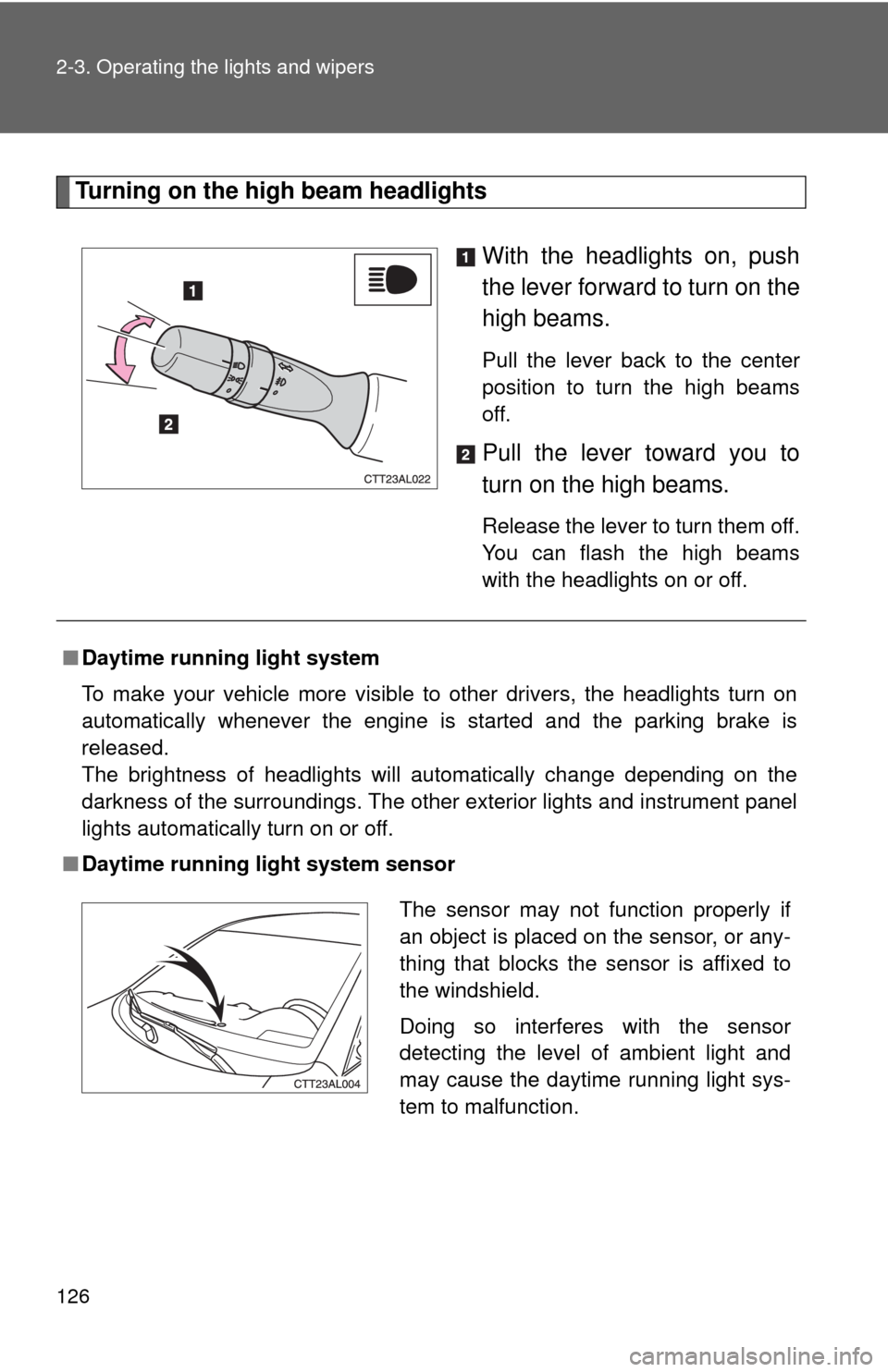
Turning on the high beam headlights
With the headlights on, push
the lever forward to turn on the
high beams.
Pull the lever back to the center
position to turn the high beams
off.
Pull the lever toward you to
turn on the high beams.
Release the lever to turn them off.
You can flash the high beams
with the headlights on or off.
■Daytime running light system
To make your vehicle more visible to other drivers, the headlights turn on
automatically whenever the engine is started and the parking brake is
released.
The brightness of headlights will automatically change depending on the
darkness of the surroundings. The other exterior lights and instrument panel
lights automatically turn on or off.
■Daytime running light system sensor
The sensor may not function properly if
an object is placed on the sensor, or any-
thing that blocks the sensor is affixed to
the windshield.
Doing so interferes with the sensor
detecting the level of ambient light and
may cause the daytime running light sys-
tem to malfunction.
Page 130 of 440
130 2-3. Operating the lights and wipers
■The windshield wipers and washers can be operated when
The engine switch is in the “ON” position.
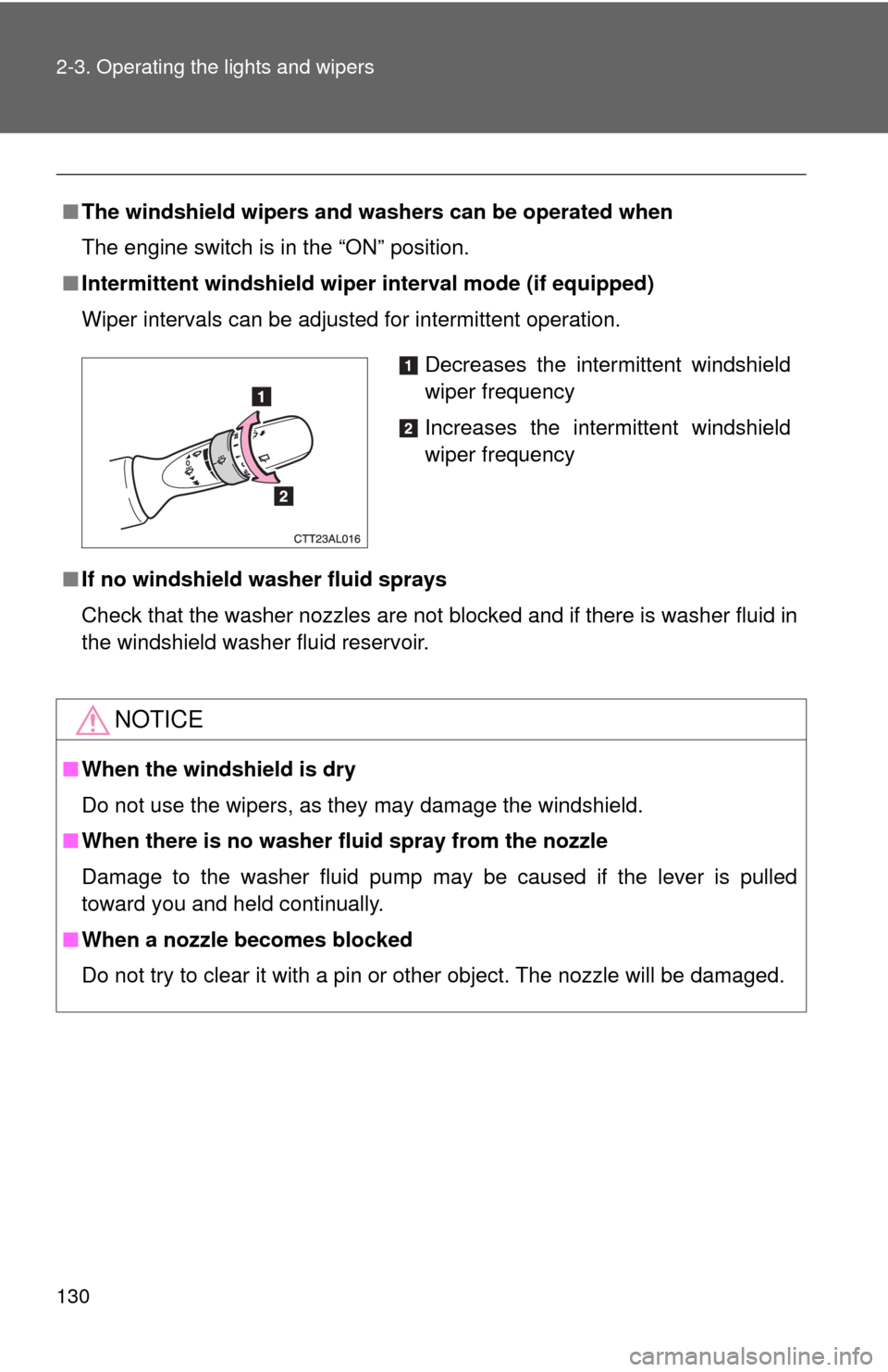
■Intermittent windshield wiper interval mode (if equipped)
Wiper intervals can be adjusted for intermittent operation.
■If no windshield washer fluid sprays
Check that the washer nozzles are not blocked and if there is washer fluid in
the windshield washer fluid reservoir.
NOTICE
■When the windshield is dry
Do not use the wipers, as they may damage the windshield.
■When there is no washer fluid spray from the nozzle
Damage to the washer fluid pump may be caused if the lever is pulled
toward you and held continually.
■When a nozzle becomes blocked
Do not try to clear it with a pin or other object. The nozzle will be damaged.
Decreases the intermittent windshield
wiper frequency
Increases the intermittent windshield
wiper frequency
Page 131 of 440
131
2-3. Operating the lights and wipers
2
When driving
Rear window wiper and washer (if equipped)
■The rear window wiper and washer can be operated when
The engine switch is in “ON”.
NOTICE
■When the rear window is dry
Do not use the wipers, as they may damage the rear window.
■When there is no washer fluid spray from the nozzle
Damage to the washer fluid pump may be caused if the lever is pulled
toward you and held continually.
■When a nozzle becomes blocked
Do not try to clear it with a pin or other object. The nozzle will be damaged.
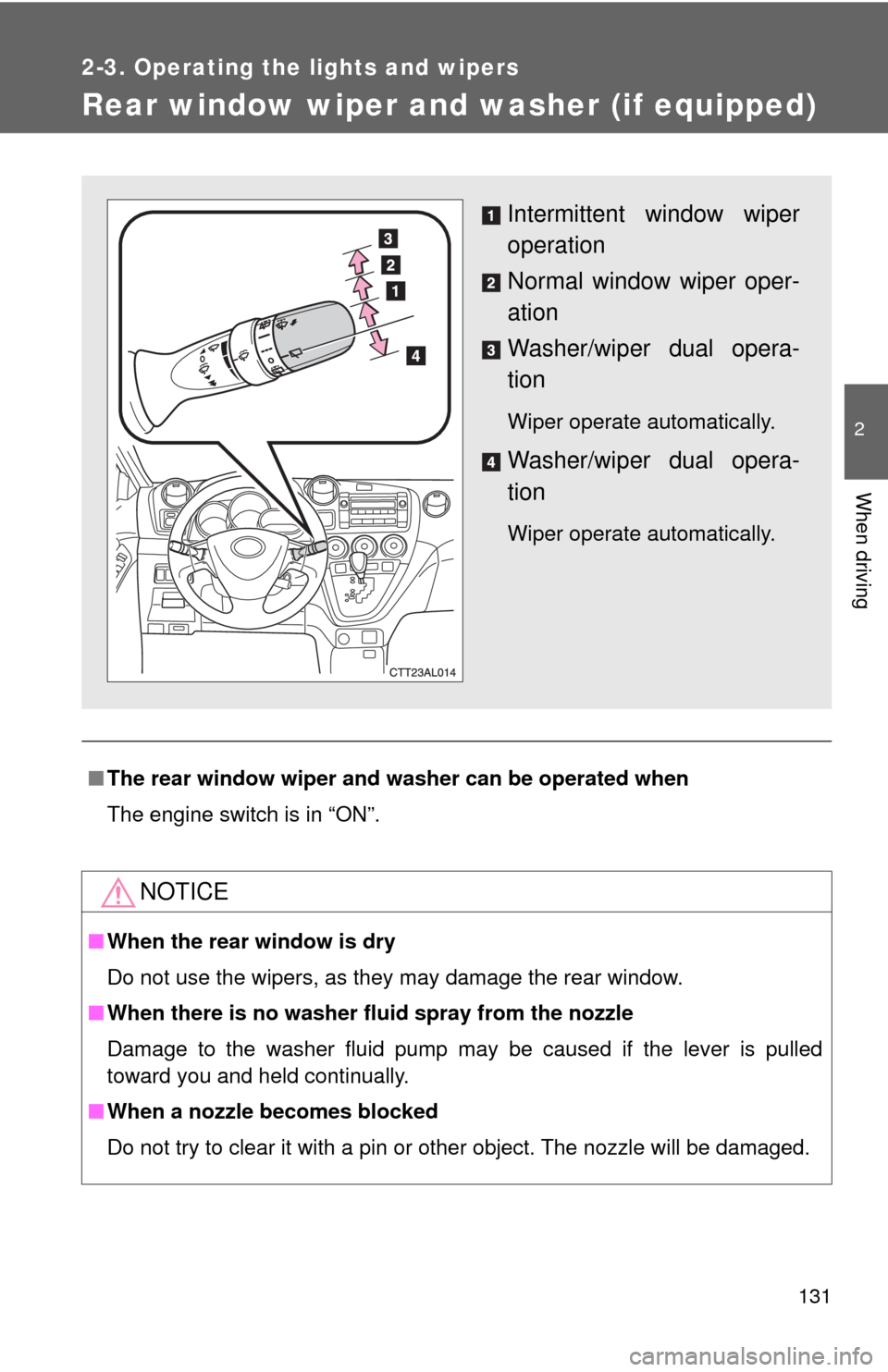
Intermittent window wiper
operation
Normal window wiper oper-
ation
Washer/wiper dual opera-
tion
Wiper operate automatically.
Washer/wiper dual opera-
tion
Wiper operate automatically.
Page 133 of 440
133 2-4. Using other driving systems
2
When driving
■Cruise control can be set when
●Automatic transmission:
The shift lever is in D or 3 (standard type), or in D, 4 or 5 range of S
(multi-mode type).
●Vehicle speed is above 25 mph (40 km/h).
■Accelerating
The vehicle can be accelerated normally.
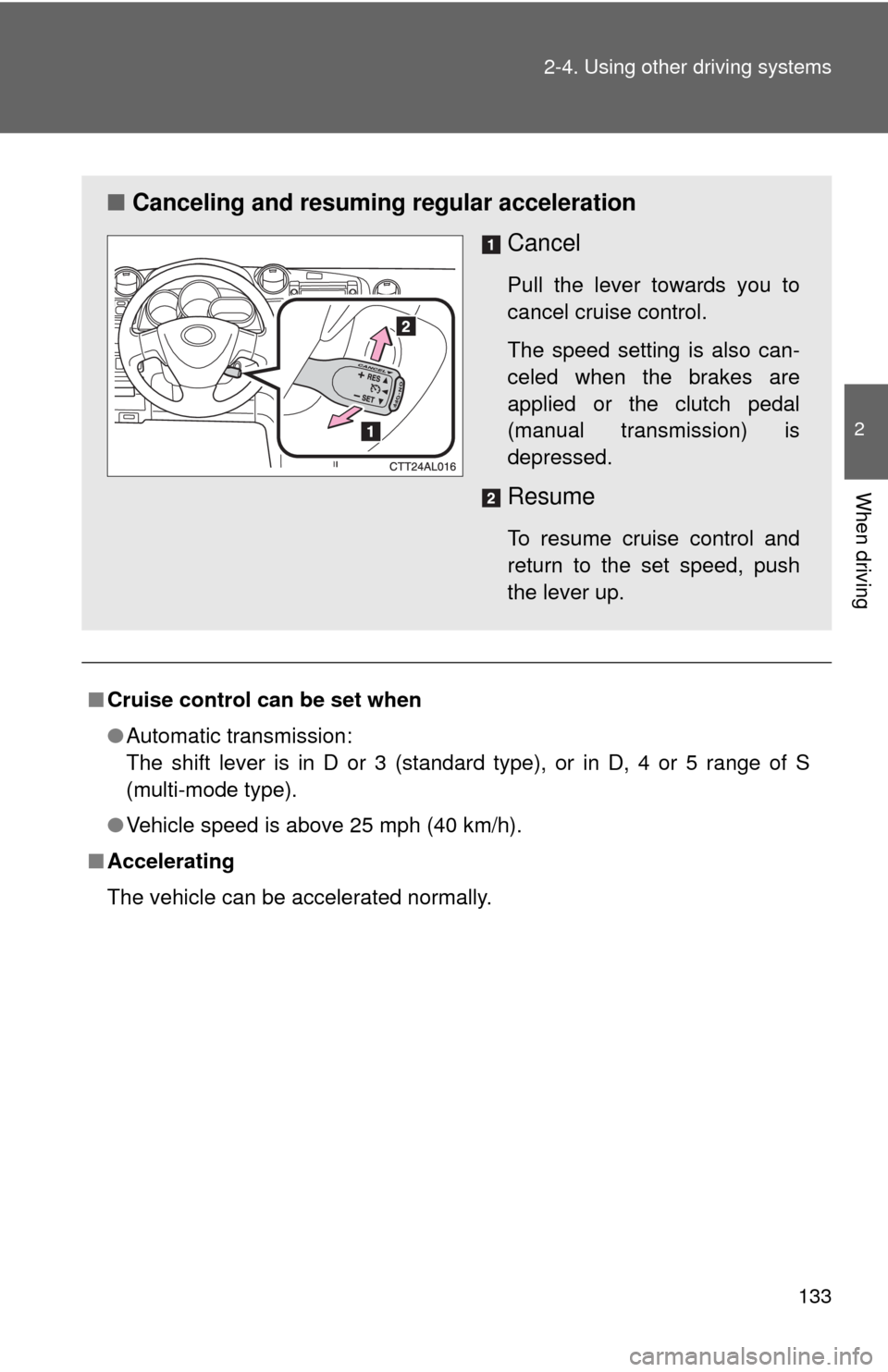
■Canceling and resuming regular acceleration
Cancel
Pull the lever towards you to
cancel cruise control.
The speed setting is also can-
celed when the brakes are
applied or the clutch pedal
(manual transmission) is
depressed.
Resume
To resume cruise control and
return to the set speed, push
the lever up.
Page 140 of 440

140
2-5. Driving information
Cargo and luggage
Capacity and distribution
Cargo capacity depends on the total weight of the occupants.
(Cargo capacity) = (Total load capacity) - (Total weight of occupants)
Steps for Determining Correct Load Limit ⎯
(1) Locate the statement “The combined weight of occupants and
cargo should never exceed XXX kg or XXX lbs.” on your vehi-
cle’s placard.
(2) Determine the combined weight of the driver and passengers
that will be riding in your vehicle.
(3) Subtract the combined weight of the driver and passengers from
XXX kg or XXX lbs.
(4) The resulting figure equals the available amount of cargo and
luggage load capacity.
For example, if the “XXX” amount equals 1400 lbs. and there will
be five 150 lb passengers in your vehicle, the amount of avail-
able cargo and luggage load capacity is 650 lbs. (1400 - 750 (5 ×
150) = 650 lbs.)
(5) Determine the combined weight of luggage and cargo being
loaded on the vehicle. That weight may not safely exceed the
available cargo and luggage load capacity calculated in Step 4.
Take notice of the following information about storage precau-
tions, cargo capacity and load.
●Stow cargo and luggage in the luggage compartment whenever
possible. Be sure all items are secured in place.
●Be careful to keep the vehicle level. Placing the weight as far for-
ward as possible helps maintain vehicle balance.
●For better fuel economy, do not carry unnecessary weight.
Page 141 of 440
141 2-5. Driving information
2
When driving
(6) If your vehicle will be towing a trailer, load from your trailer will be
transferred to your vehicle. Consult this manual to determine how
this reduces the available cargo and luggage load capacity of
your vehicle. (→P. 148)
Example on your vehicle
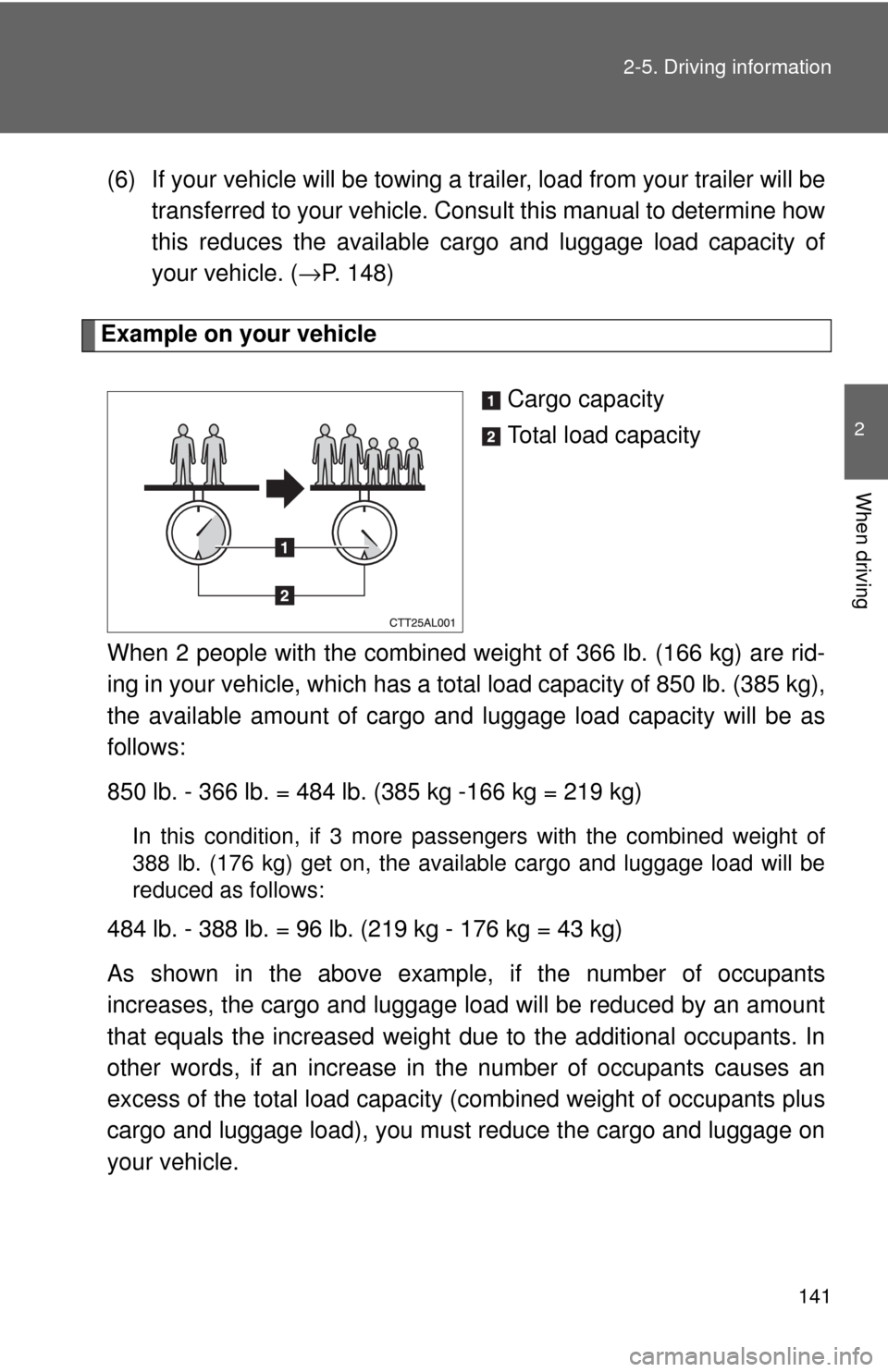
Cargo capacity
Total load capacity
When 2 people with the combined weight of 366 lb. (166 kg) are rid-
ing in your vehicle, which has a total load capacity of 850 lb. (385 kg),
the available amount of cargo and luggage load capacity will be as
follows:
850 lb. - 366 lb. = 484 lb. (385 kg -166 kg = 219 kg)
In this condition, if 3 more passengers with the combined weight of
388 lb. (176 kg) get on, the available cargo and luggage load will be
reduced as follows:
484 lb. - 388 lb. = 96 lb. (219 kg - 176 kg = 43 kg)
As shown in the above example, if the number of occupants
increases, the cargo and luggage load will be reduced by an amount
that equals the increased weight due to the additional occupants. In
other words, if an increase in the number of occupants causes an
excess of the total load capacity (combined weight of occupants plus
cargo and luggage load), you must reduce the cargo and luggage on
your vehicle.
Page 143 of 440
143
2-5. Driving information
2
When driving
Vehicle load limits
■Total load capacity and seating capacity
These details are also described on the tire and loading information
label. (→P. 312)
CAUTION
■Overloading the vehicle
Do not overload the vehicle.
It may not only cause damage to the tires, but also degrade steering and
braking ability, resulting in an accident.
Vehicle load limits include total load capacity, seating capacity,
towing capacity and cargo capacity.
■Total load capacity: 850 lb. (385 kg)
Total load capacity means the combined weight of occupants, cargo
and luggage.
■Seating capacity: 5 occupants (Front 2, Rear 3)
Seating capacity means the maximum number of occupants whose
estimated average weight is 150 lb. (68 kg) per person.
■Towing capacity: 1500 lb. (680 kg)
■Cargo capacity
Cargo capacity may increase or decrease depending on the weight
and the number of occupants.
Page 148 of 440
148
2-5. Driving information
Trailer towing
Your vehicle is designed primarily as a passenger-carrying vehicle.
Towing a trailer will have an adverse effect on handling, perfor-
mance, braking, durability, and fuel consumption. For your safety
and the safety of others, do not overload the vehicle or trailer.
Toyota warranties do not apply to damage or malfunction caused by
towing a trailer for commercial purposes.
■Weight limits
Confirm that the total trailer weight, gross vehicle weight, gross
axle weight and trailer tongue load are all within the limits.
■Gross vehicle weight
The gross vehicle weight must not exceed the Gross Vehicle
Weight Rating (GVWR) indicated on the Certification Label. The
gross vehicle weight is the sum weight of the unloaded vehicle,
driver, passengers, luggage, hitch and trailer tongue load. Also
included is the weight of any special equipment installed on your
vehicle.
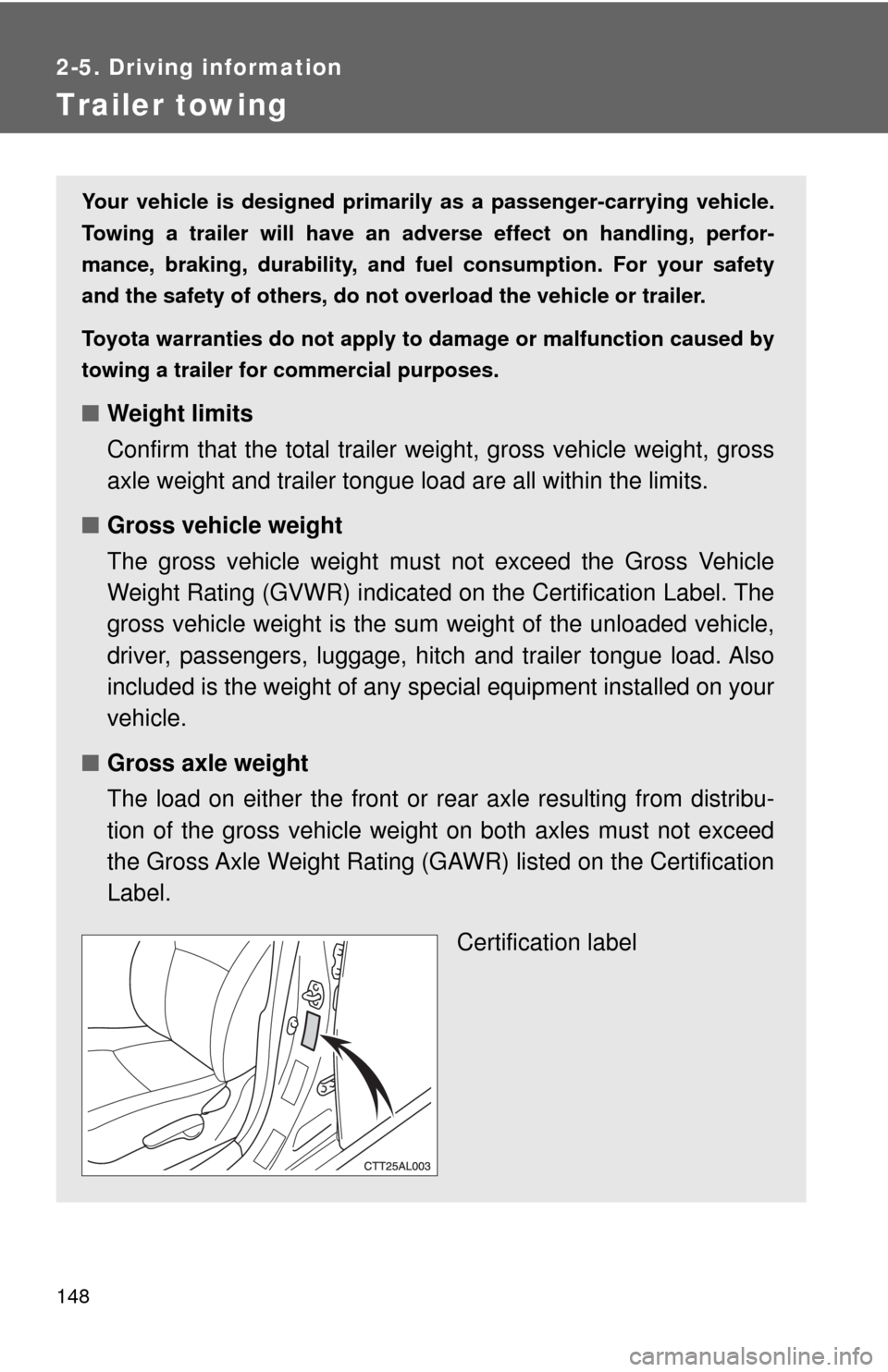
■Gross axle weight
The load on either the front or rear axle resulting from distribu-
tion of the gross vehicle weight on both axles must not exceed
the Gross Axle Weight Rating (GAWR) listed on the Certification
Label.
Certification label
Page 149 of 440
149 2-5. Driving information
2
When driving
Towing a trailer
Contact your Toyota dealer for further information about additional
requirements such as a towing kit, etc.
Hitch
Trailer hitch assemblies have different weight capacities established
by the hitch manufacturer. Even though the vehicle may be rated for
towing a higher weight, the operator must never exceed the maxi-
mum weight rating specified for the trailer hitch.
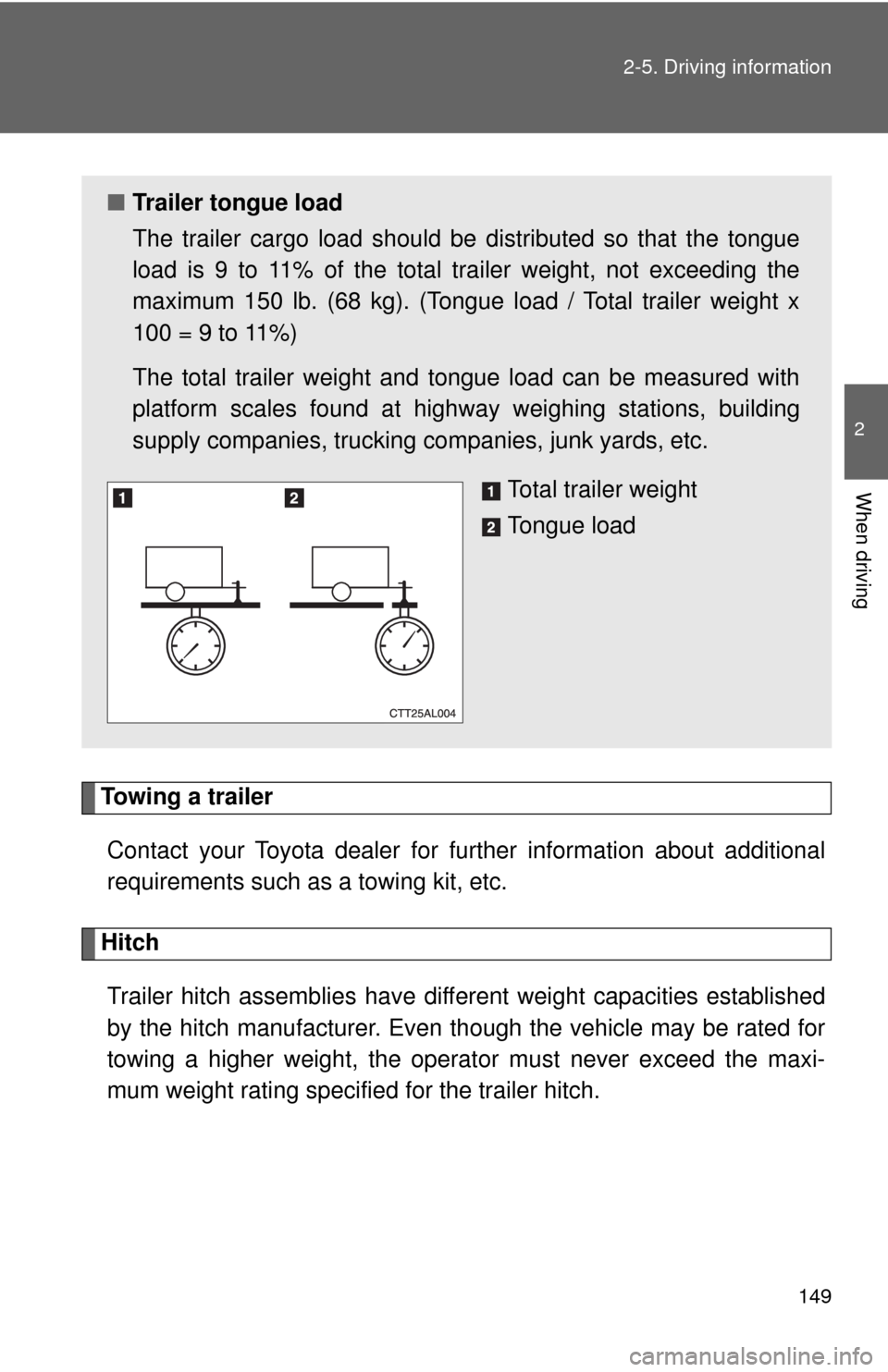
■Trailer tongue load
The trailer cargo load should be distributed so that the tongue
load is 9 to 11% of the total trailer weight, not exceeding the
maximum 150 lb. (68 kg). (Tongue load / Total trailer weight x
100 = 9 to 11%)
The total trailer weight and tongue load can be measured with
platform scales found at highway weighing stations, building
supply companies, trucking companies, junk yards, etc.
Total trailer weight
Tongue load
Page 150 of 440

150 2-5. Driving information
■Before towing
●Ensure that your vehicle’s tires are properly inflated. (→P. 312)
●Trailer tires should be inflated according to the trailer manufacturer's rec-
ommendation.
●All trailer lights must work in order to be legal.
●Confirm all lights work each time you connect them.
●Check that your vehicle remains level when a loaded or unloaded trailer
is hitched. Do not drive if the vehicle is not level, and check for improper
tongue load, overloading, worn suspension, or other possible causes.
●Make sure the trailer cargo is securely loaded.
●Check that your rear view mirrors conform to any federal, state/provincial
or local regulations. If they do not, install rear view mirrors appropriate for
towing purposes.
■Break-in schedule
Toyota recommends that you do not use a new vehicle or a vehicle with any
new power train components (engine, transmission, differential, wheel bear-
ings, etc.) to tow a trailer for the first 500 miles (800 km) of driving.
■Maintenance
●If you tow a trailer, your vehicle will require more frequent maintenance
due to the additional load. (See “Scheduled Maintenance Guide” or
“Owner's Manual Supplement”.)
●Retighten the fixing bolts of the towing ball and bracket after approxi-
mately 600 miles (1000 km) of trailer towing.