belt TOYOTA MATRIX 2011 E140 / 2.G Workshop Manual
[x] Cancel search | Manufacturer: TOYOTA, Model Year: 2011, Model line: MATRIX, Model: TOYOTA MATRIX 2011 E140 / 2.GPages: 501, PDF Size: 11.47 MB
Page 407 of 501

406 5-2. Steps to take in an emergency
buzzer sounds intermittently for 10 seconds after the vehicle has reached a
speed of 12 mph (20 km/h). Then, if the seat belt is still unfastened, the
buzzer will sound at a different tone for 20 more seconds.
*
3: Maintenance required reminder light:
Refer to the seperate “Scheduled Maintenace Guide” or “Owner’s Manual
Supplement” for the maintenance interval applicable to your vehicle.
■SRS warning light
This warning light system monitors the airbag sensor assembly, front airbag
sensors, side and curtain shield airbag sensors, curtain shield airbag sen-
sors, driver's seat position sensor, driver's seat belt buckle switch, front pas-
senger occupant classification system, “AIR BAG ON” indicator light, “AIR
BAG OFF” indicator light, front passenger's seat belt buckle switch, seat belt
pretensioner assemblies, inflators, interconnecting wiring and power
sources. (P. 7 1 )
■Front passenger detection sensor and passenger seat belt reminder
●If luggage is placed on the front passenger seat, the front passenger
detection sensor may cause the warning light to flash, even if a passen-
ger is not sitting in the seat.
●If a cushion is placed on the seat, the sensor may not detect a passen-
ger, and the warning light may not operate properly.
■
When the tire pressure warning light comes on
Check the tire inflation pressure and adjust to the appropriate level.
Pushing the tire pressure warning reset switch does not turn off the tire
pressure warning light.
■The tire pressure warning light may turn on due to natural causes
The tire pressure warning light may turn on due to natural causes such
as natural air leaks or tire inflation pressure changes caused by temper-
ature. In this case, adjusting the tire inflation pressure will turn off the
warning light (after a few minutes).
Page 409 of 501
408 5-2. Steps to take in an emergency
■If the tire pressure warning light comes on after blinking for 1
minute frequently
If the tire pressure warning light comes on after blinking for 1 minute fre-
quently when the engine switch is turned to the “ON” position, have it
checked by your Toyota dealer.
■Customization that can be configured at Toyota dealer
The vehicle speed linked seat belt reminder buzzer can be disabled.
(Customizable features P. 472) However, Toyota recommends that the
seat belt reminder buzzer be operational to alert the driver and front passen-
ger that the seat belts are not fastened.
CAUTION
■If the tire pressure warning light comes on
Be sure to observe the following precautions. Failure to do so could
cause loss of vehicle control and result in death or serious injury.
●Stop your vehicle in a safe place as soon as possible. Adjust the tire
inflation pressure immediately.
●If the tire pressure warning light comes on even after tire inflation pres-
sure adjustment, it is probable that you have a flat tire. Check the tires.
If the tire is flat, change to the spare tire and have the flat tire repaired
by the nearest Toyota dealer.
●Avoid abrupt maneuvering and braking. If the vehicle tires deteriorate,
you could lose control of the steering wheel or the brakes.
■If a blowout or sudden air leakage should occur
The tire pressure warning system may not activate immediately.
Page 420 of 501
5
When trouble arises
419 5-2. Steps to take in an emergency
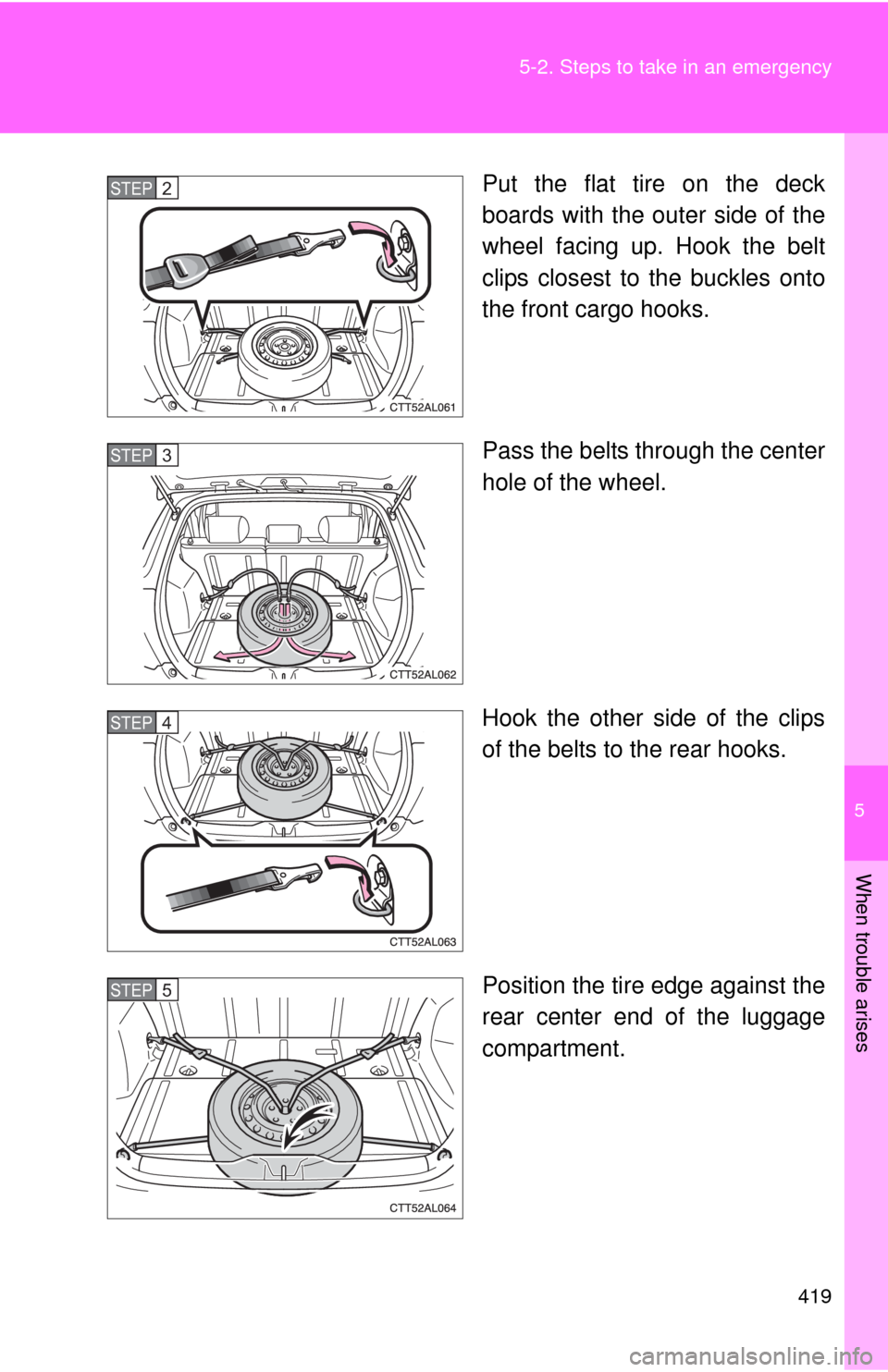
Put the flat tire on the deck
boards with the outer side of the
wheel facing up. Hook the belt
clips closest to the buckles onto
the front cargo hooks.
Pass the belts through the center
hole of the wheel.
Hook the other side of the clips
of the belts to the rear hooks.
Position the tire edge against the
rear center end of the luggage
compartment.STEP2
STEP3
STEP4
STEP5
Page 421 of 501
420 5-2. Steps to take in an emergency
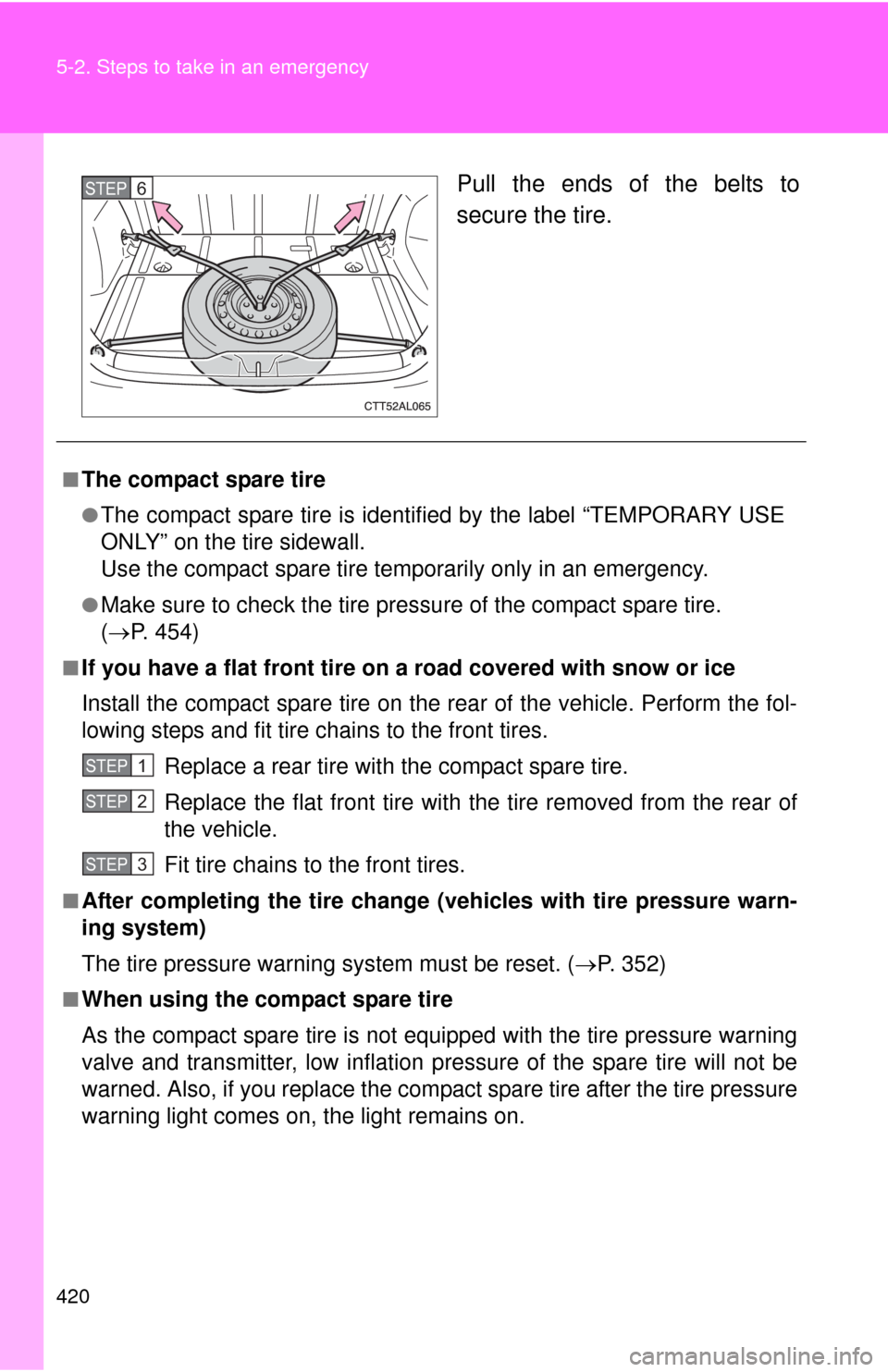
Pull the ends of the belts to
secure the tire.STEP6
■The compact spare tire
●The compact spare tire is identified by the label “TEMPORARY USE
ONLY” on the tire sidewall.
Use the compact spare tire temporarily only in an emergency.
●Make sure to check the tire pressure of the compact spare tire.
(P. 454)
■If you have a flat front tire on a road covered with snow or ice
Install the compact spare tire on the rear of the vehicle. Perform the fol-
lowing steps and fit tire chains to the front tires.
Replace a rear tire with the compact spare tire.
Replace the flat front tire with the tire removed from the rear of
the vehicle.
Fit tire chains to the front tires.
■After completing the tire change (vehicles with tire pressure warn-
ing system)
The tire pressure warning system must be reset. (P. 352)
■When using the compact spare tire
As the compact spare tire is not equipped with the tire pressure warning
valve and transmitter, low inflation pressure of the spare tire will not be
warned. Also, if you replace the compact spare tire after the tire pressure
warning light comes on, the light remains on.
STEP1
STEP2
STEP3
Page 424 of 501
5
When trouble arises
423 5-2. Steps to take in an emergency
CAUTION
■When the spare tire is attached
The vehicle speed may not be correctly detected, and the following sys-
tems may not operate correctly:
●ABS & Brake assist
●VSC
●TRAC
Also, not only can the following system not be utilized fully, it may actu-
ally negatively effect the drive-train components:
●Active Torque Control 4WD system (if equipped)
■When stowing the flat tire
●
Make sure the rear seats are in their original position.
●Secure it using a tire tie-down belt. Otherwise, the flat tire may fly out
in case of the sudden braking or an accident, resulting in death or seri-
ous injury.
NOTICE
■Do not drive the vehicle with a flat tire
Do not continue driving with a flat tire.
Driving even a short distance with a flat tire can damage the tire and the
wheel beyond repair.
■Be careful when driving over bumps with the compact spare tire
installed on the vehicle
The vehicle becomes lower when driving with the compact spare tire
compared to when driving with standard tires. Be careful when driving
over uneven road surfaces.
■Driving with tire chains and the compact spare tire
Do not fit tire chains to the compact spare tire.
Tire chains may damage the vehicle body and adversely affect driving
performance.
Page 433 of 501

432 5-2. Steps to take in an emergency
NOTICE
■To prevent damage to the vehicle
Do not pull- or push-start the vehicle, because the catalytic converter may
overheat and become a fire hazard.
■When handling jumper cables
Be careful that the jumper cables do not become tangled in the cooling fans
or any of the belts when connecting or disconnecting them.
■When attaching the engine cover (1.8 L 4-cylinder [2ZR-FE] engine)
Ensure that the rubber grommets remain attached to the engine cover. If the
grommet is attached to the bolts, transfer grommets to the engine cover.
Page 435 of 501
434 5-2. Steps to take in an emergency
■Overheating
If you observe the following, your vehicle may be overheating.
●The engine coolant temperature gauge enters the red zone or a loss of
power is experienced.
●Steam is coming from under the hood.
CAUTION
■To prevent an accident or injury when inspecting under the hood of
your vehicle
●If steam is seen coming from under the hood, do not open the hood until
the steam has subsided. The engine compartment may be very hot, caus-
ing serious injury such as burns.
●Keep hands and clothing away from the fan and other belts while the
engine is running.
●Do not loosen the coolant reservoir cap while the engine and radiator are
hot.
Serious injury, such as burns, may result from hot coolant and steam
released under pressure.
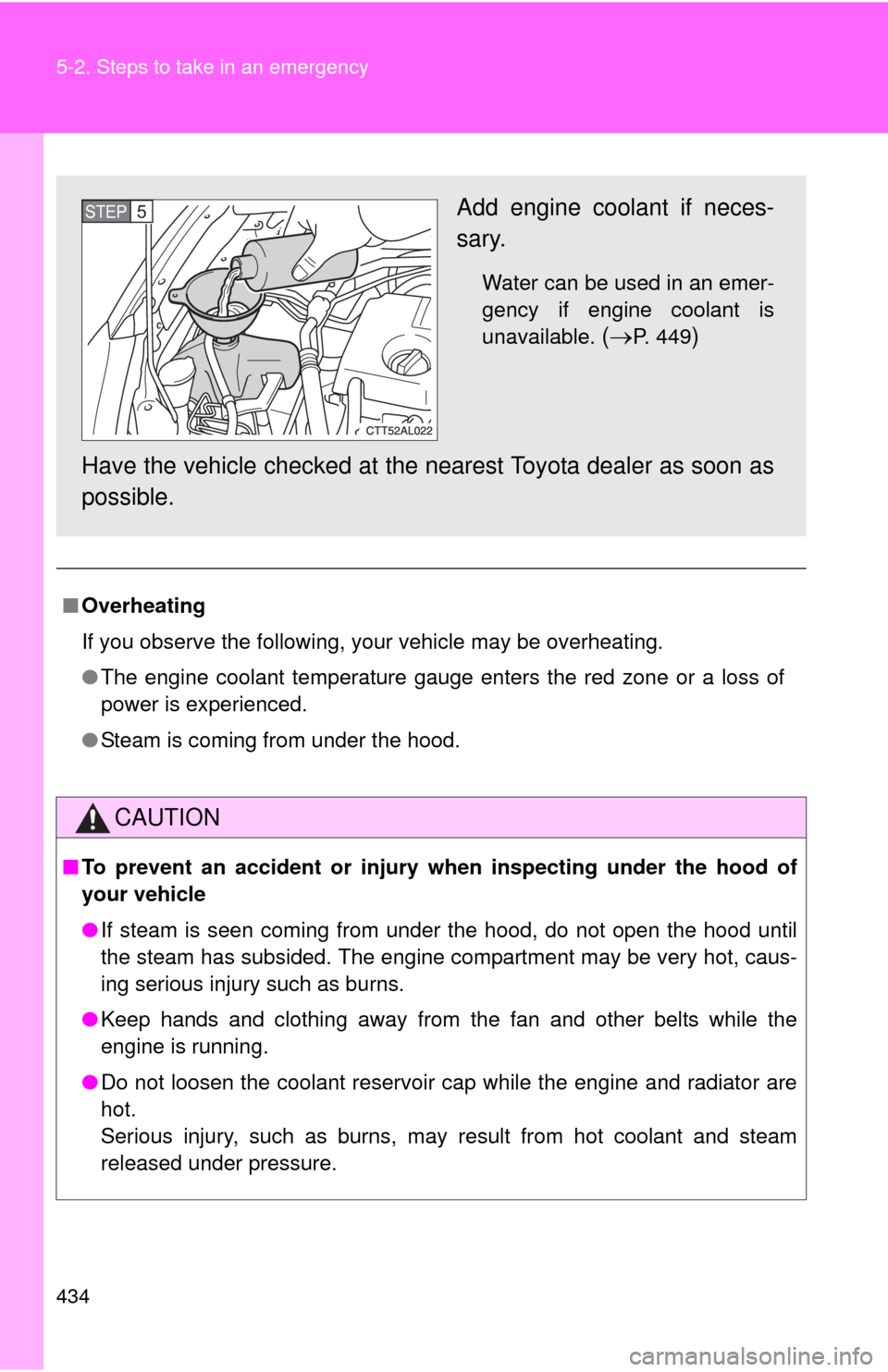
Add engine coolant if neces-
sary.
Water can be used in an emer-
gency if engine coolant is
unavailable.
(P. 449)
Have the vehicle checked at the nearest Toyota dealer as soon as
possible.
STEP5
Page 446 of 501
445 6-1. Specifications
6
Vehicle specifications
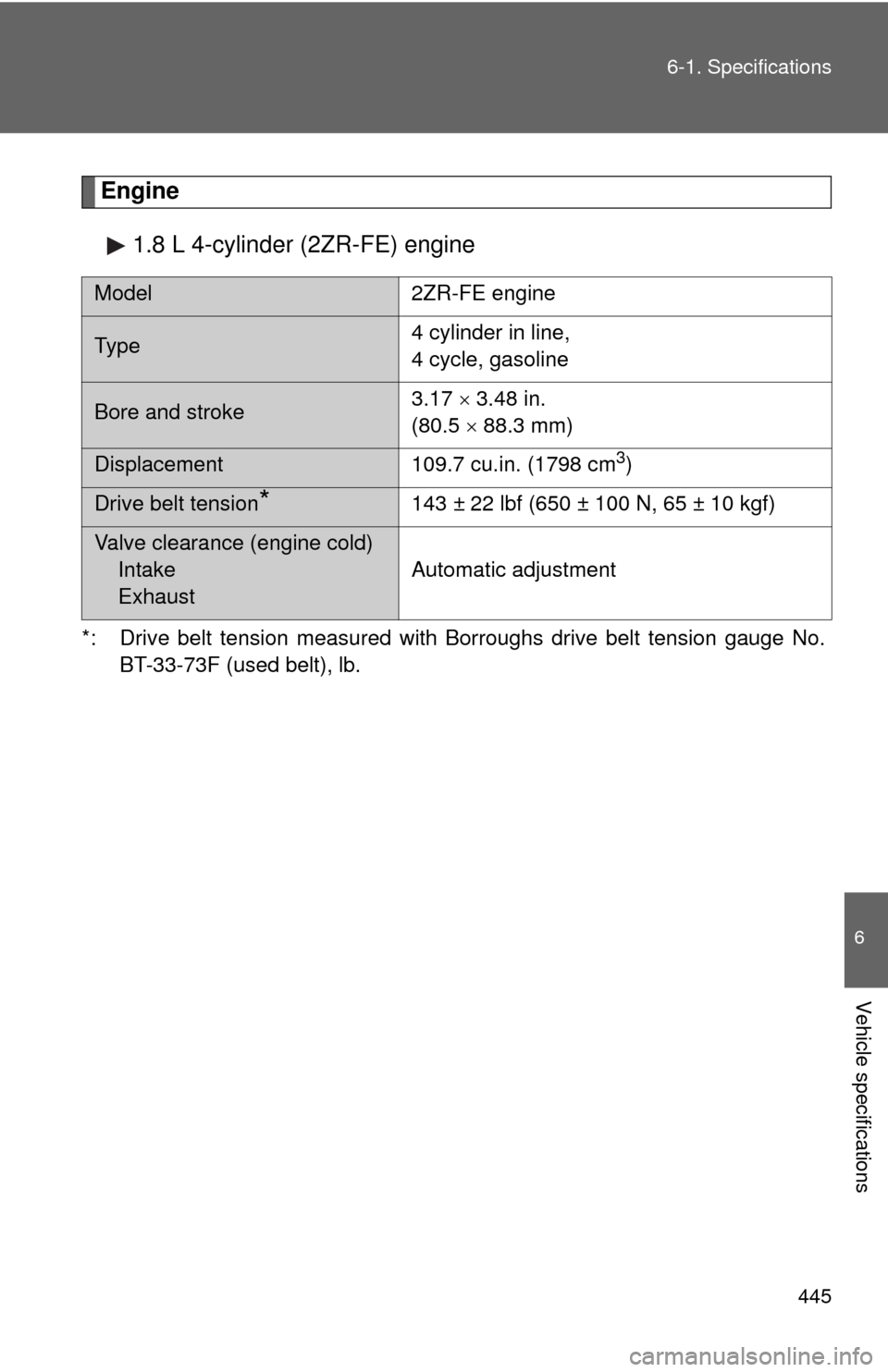
Engine
1.8 L 4-cylinder (2ZR-FE) engine
*: Drive belt tension measured with Borroughs drive belt tension gauge No.
BT-33-73F (used belt), lb.
Model 2ZR-FE engine
Ty p e4 cylinder in line,
4 cycle, gasoline
Bore and stroke3.17 3.48 in.
(80.5 88.3 mm)
Displacement 109.7 cu.in. (1798 cm3)
Drive belt tension*143 ± 22 lbf (650 ± 100 N, 65 ± 10 kgf)
Valve clearance (engine cold)
Intake
ExhaustAutomatic adjustment
Page 447 of 501
446 6-1. Specifications
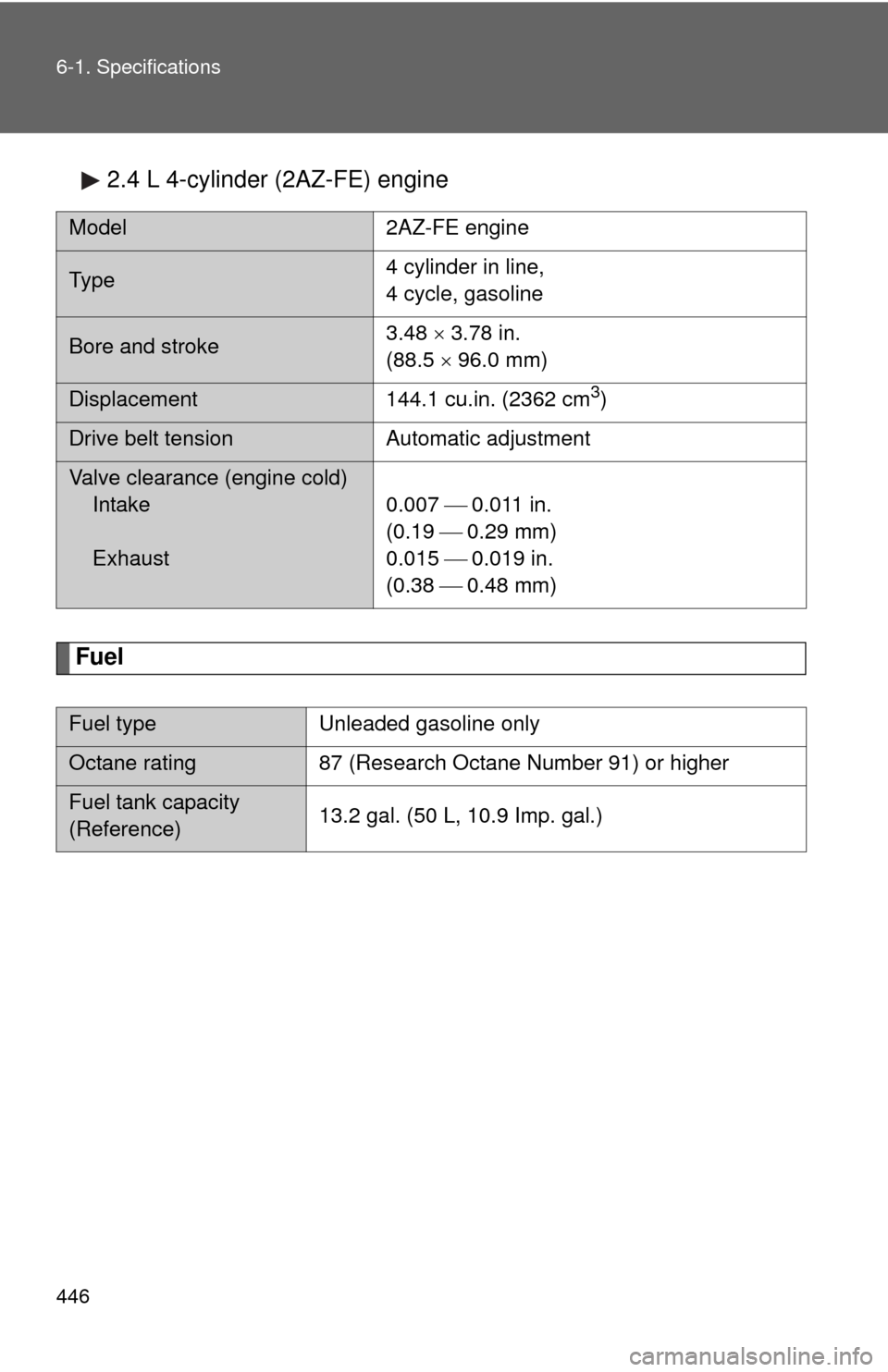
2.4 L 4-cylinder (2AZ-FE) engine
Fuel
Model 2AZ-FE engine
Ty pe4 cylinder in line,
4 cycle, gasoline
Bore and stroke3.48 3.78 in.
(88.5 96.0 mm)
Displacement 144.1 cu.in. (2362 cm3)
Drive belt tension Automatic adjustment
Valve clearance (engine cold)
Intake
Exhaust0.007 0.011 in.
(0.19 0.29 mm)
0.015 0.019 in.
(0.38 0.48 mm)
Fuel type Unleaded gasoline only
Octane rating 87 (Research Octane Number 91) or higher
Fuel tank capacity
(Reference)13.2 gal. (50 L, 10.9 Imp. gal.)
Page 465 of 501
464 6-1. Specifications
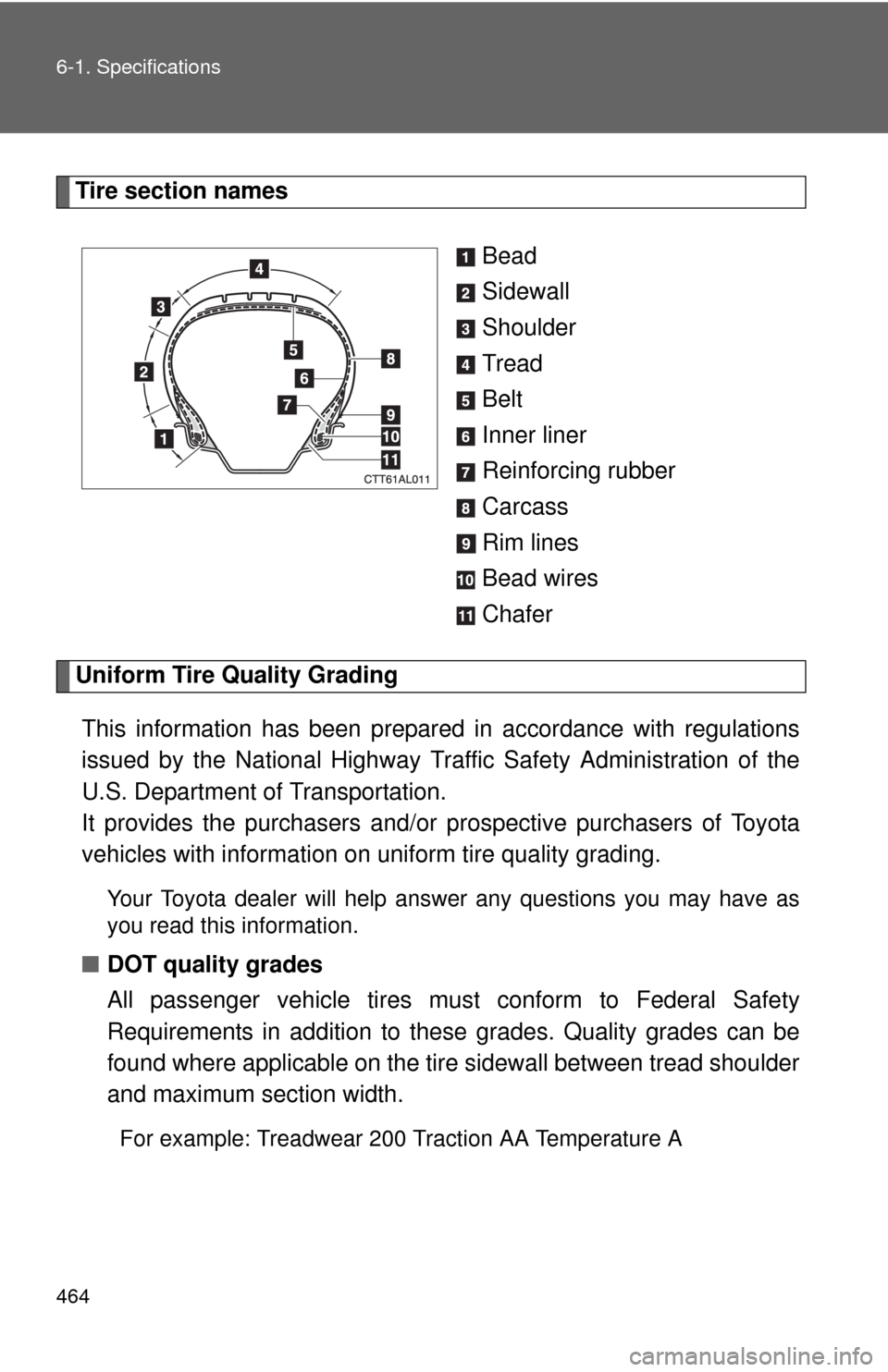
Tire section names
Bead
Sidewall
Shoulder
Tread
Belt
Inner liner
Reinforcing rubber
Carcass
Rim lines
Bead wires
Chafer
Uniform Tire Quality Grading
This information has been prepared in accordance with regulations
issued by the National Highway Traffic Safety Administration of the
U.S. Department of Transportation.
It provides the purchasers and/or prospective purchasers of Toyota
vehicles with information on uniform tire quality grading.
Your Toyota dealer will help answer any questions you may have as
you read this information.
■DOT quality grades
All passenger vehicle tires must conform to Federal Safety
Requirements in addition to these grades. Quality grades can be
found where applicable on the tire sidewall between tread shoulder
and maximum section width.
For example: Treadwear 200 Traction AA Temperature A