wheel size TOYOTA MATRIX 2012 E140 / 2.G User Guide
[x] Cancel search | Manufacturer: TOYOTA, Model Year: 2012, Model line: MATRIX, Model: TOYOTA MATRIX 2012 E140 / 2.GPages: 516, PDF Size: 7.02 MB
Page 421 of 516
5
When trouble arises
421
5-2. Steps to take in an emergency
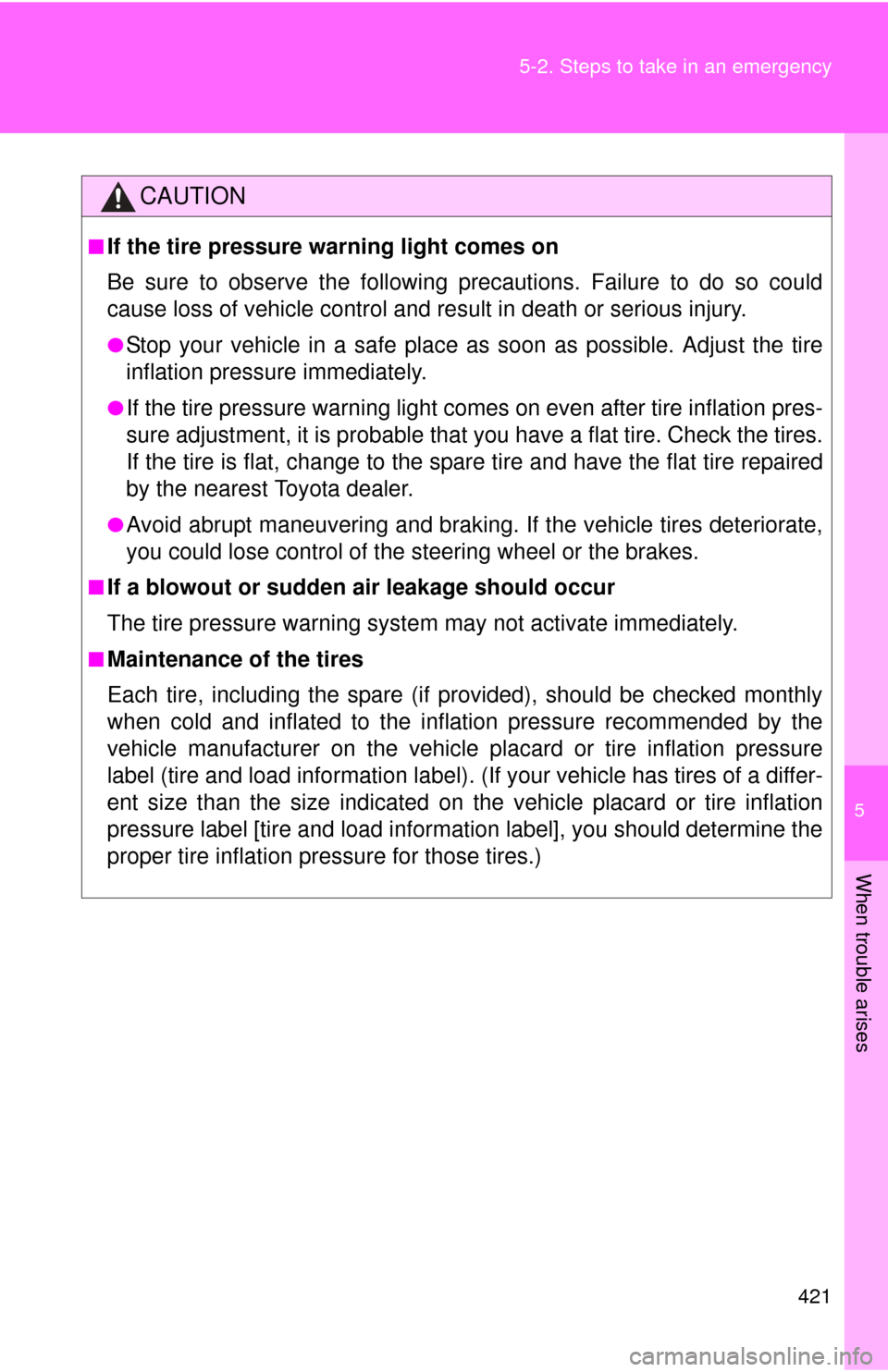
CAUTION
■If the tire pressure warning light comes on
Be sure to observe the following precautions. Failure to do so could
cause loss of vehicle control and result in death or serious injury.
●Stop your vehicle in a safe place as
soon as possible. Adjust the tire
inflation pressure immediately.
●If the tire pressure warning light comes on even after tire inflation pres-
sure adjustment, it is pr obable that you have a flat tire. Check the tires.
If the tire is flat, change to the spare tire and have the flat tire repaired
by the nearest Toyota dealer.
●Avoid abrupt maneuvering and braking. If the vehicle tires deteriorate,
you could lose control of the steering wheel or the brakes.
■If a blowout or sudden air leakage should occur
The tire pressure warning syste m may not activate immediately.
■Maintenance of the tires
Each tire, including the spare (if provided), should be checked monthly
when cold and inflated to the inflation pressure recommended by the
vehicle manufacturer on the vehicle placard or tire inflation pressure
label (tire and load information label). (If your vehicle has tires of a differ-
ent size than the size indicated on the vehicle placard or tire inflation
pressure label [tire and load information label], you should determine the
proper tire inflation pr essure for those tires.)
Page 467 of 516
467
6-1. Specifications
6
Vehicle specifications
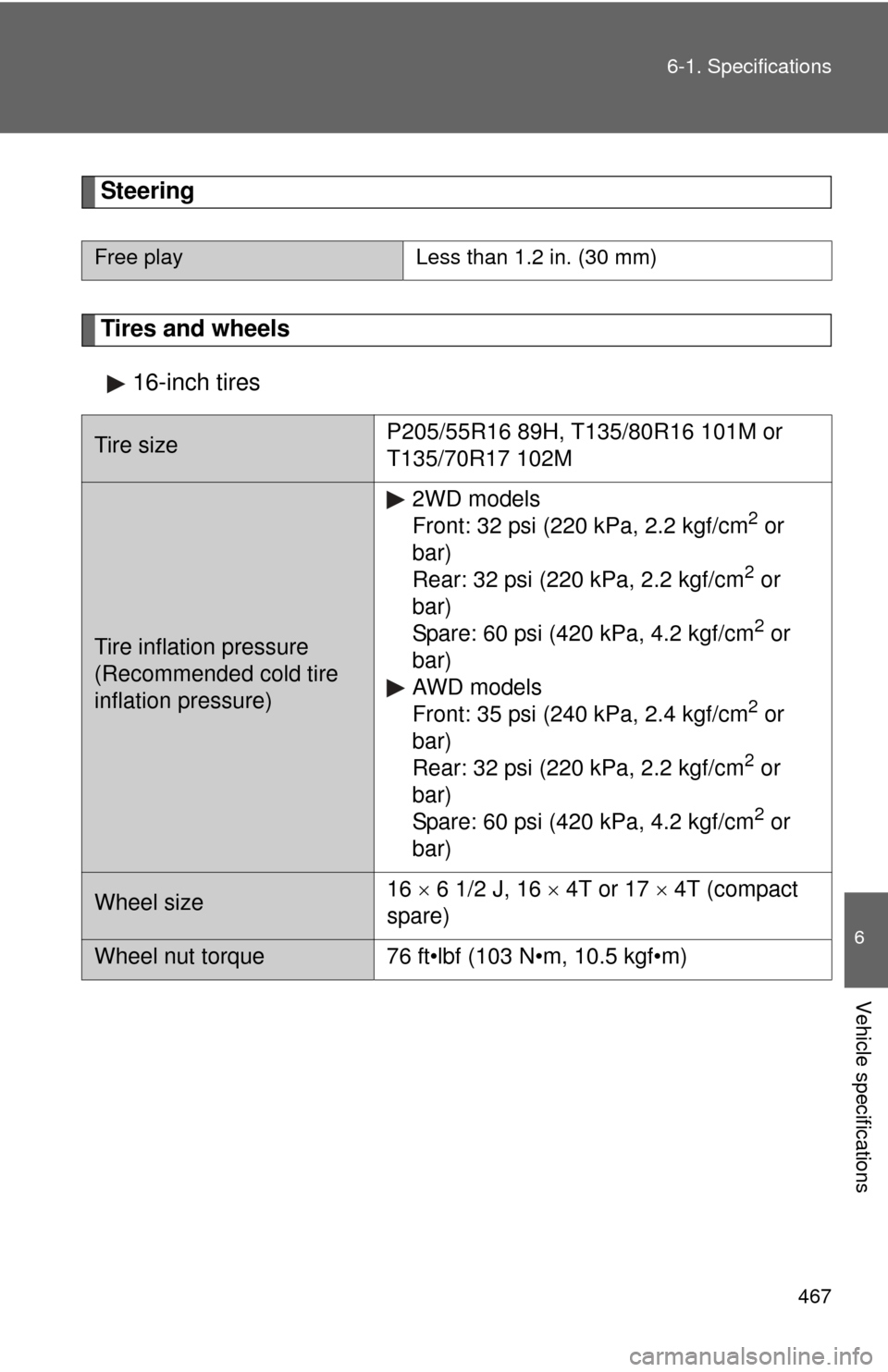
Steering
Tires and wheels
16-inch tires
Free play Less than 1.2 in. (30 mm)
Tire sizeP205/55R16 89H, T135/80R16 101M or
T135/70R17 102M
Tire inflation pressure
(Recommended cold tire
inflation pressure) 2WD models
Front: 32 psi (220 kPa, 2.2 kgf/cm
2 or
bar)
Rear: 32 psi (220 kPa, 2.2 kgf/cm
2 or
bar)
Spare: 60 psi (420 kPa, 4.2 kgf/cm
2 or
bar)
AWD models
Front: 35 psi (240 kPa, 2.4 kgf/cm
2 or
bar)
Rear: 32 psi (220 kPa, 2.2 kgf/cm
2 or
bar)
Spare: 60 psi (420 kPa, 4.2 kgf/cm
2 or
bar)
Wheel size 16
6 1/2 J, 16 4T or 17 4T (compact
spare)
Wheel nut torque 76 ft•lbf (103 N•m, 10.5 kgf•m)
Page 468 of 516
468 6-1. Specifications
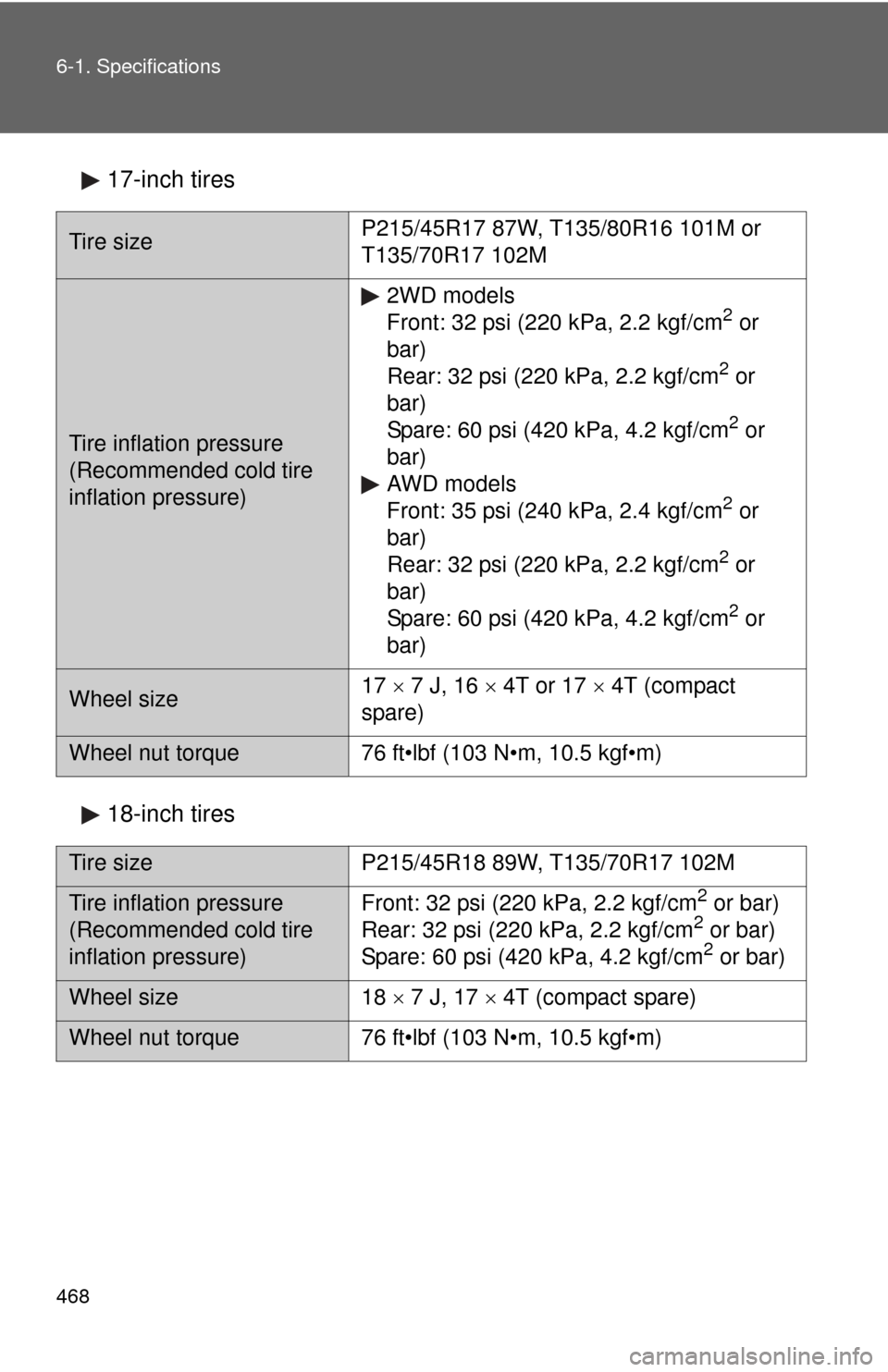
17-inch tires
18-inch tires
Tire sizeP215/45R17 87W, T135/80R16 101M or
T135/70R17 102M
Tire inflation pressure
(Recommended cold tire
inflation pressure) 2WD models
Front: 32 psi (220 kPa, 2.2 kgf/cm
2 or
bar)
Rear: 32 psi (220 kPa, 2.2 kgf/cm
2 or
bar)
Spare: 60 psi (420 kPa, 4.2 kgf/cm
2 or
bar)
AWD models
Front: 35 psi (240 kPa, 2.4 kgf/cm
2 or
bar)
Rear: 32 psi (220 kPa, 2.2 kgf/cm
2 or
bar)
Spare: 60 psi (420 kPa, 4.2 kgf/cm
2 or
bar)
Wheel size 17
7 J, 16 4T or 17 4T (compact
spare)
Wheel nut torque 76 ft•lbf (103 N•m, 10.5 kgf•m)
Tire size P215/45R18 89W, T135/70R17 102M
Tire inflation pressure
(Recommended cold tire
inflation pressure)Front: 32 psi (220 kPa, 2.2 kgf/cm2 or bar)
Rear: 32 psi (220 kPa, 2.2 kgf/cm2 or bar)
Spare: 60 psi (420 kPa, 4.2 kgf/cm2 or bar)
Wheel size 18 7 J, 17 4T (compact spare)
Wheel nut torque 76 ft•lbf (103 N•m, 10.5 kgf•m)
Page 476 of 516
476 6-1. Specifications
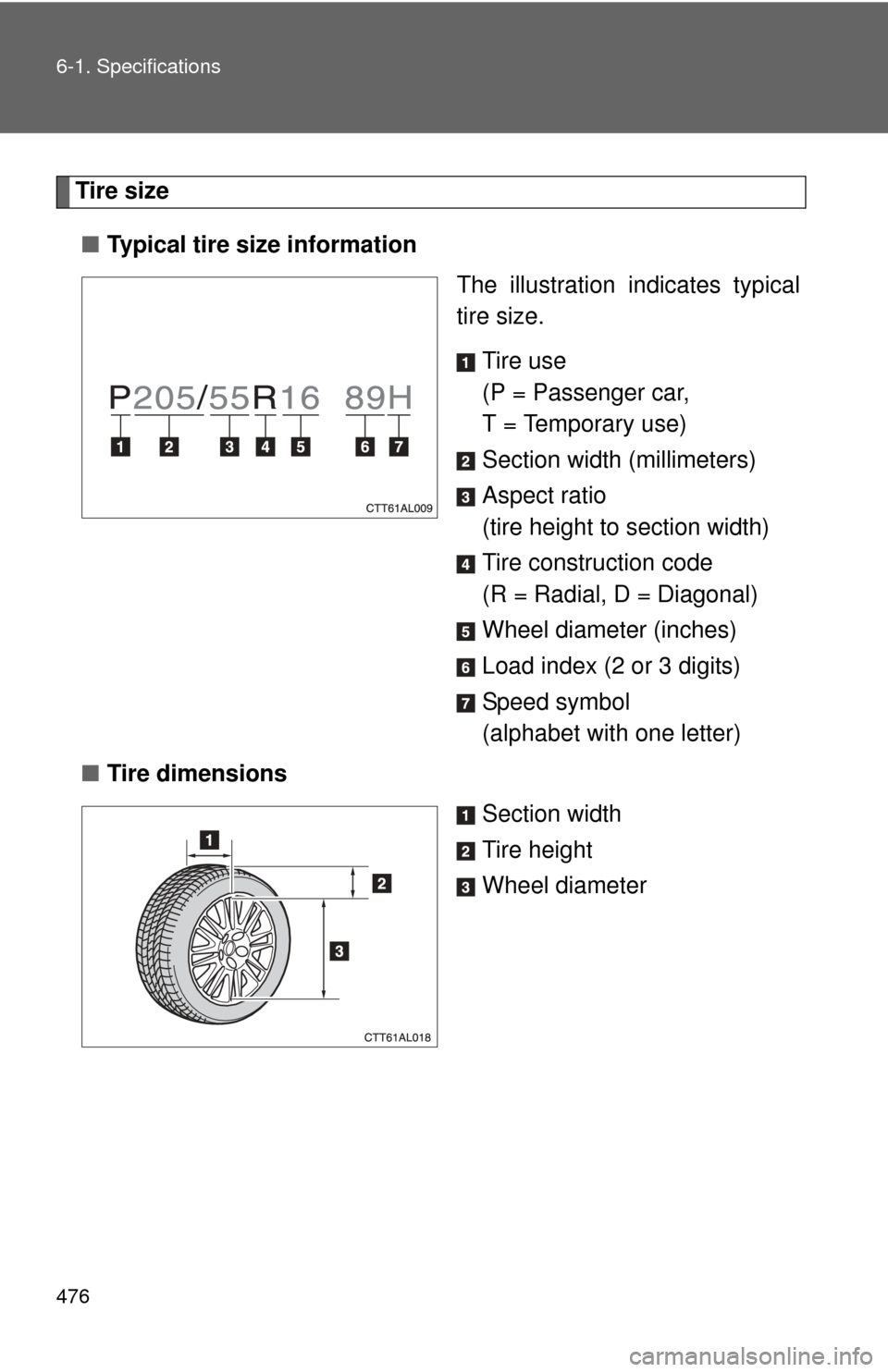
Tire size■ Typical tire size information
The illustration indicates typical
tire size.
Tire use
(P = Passenger car,
T = Temporary use)
Section width (millimeters)
Aspect ratio
(tire height to section width)
Tire construction code
(R = Radial, D = Diagonal)
Wheel diameter (inches)
Load index (2 or 3 digits)
Speed symbol
(alphabet with one letter)
■ Tire dimensions
Section width
Tire height
Wheel diameter
Page 480 of 516
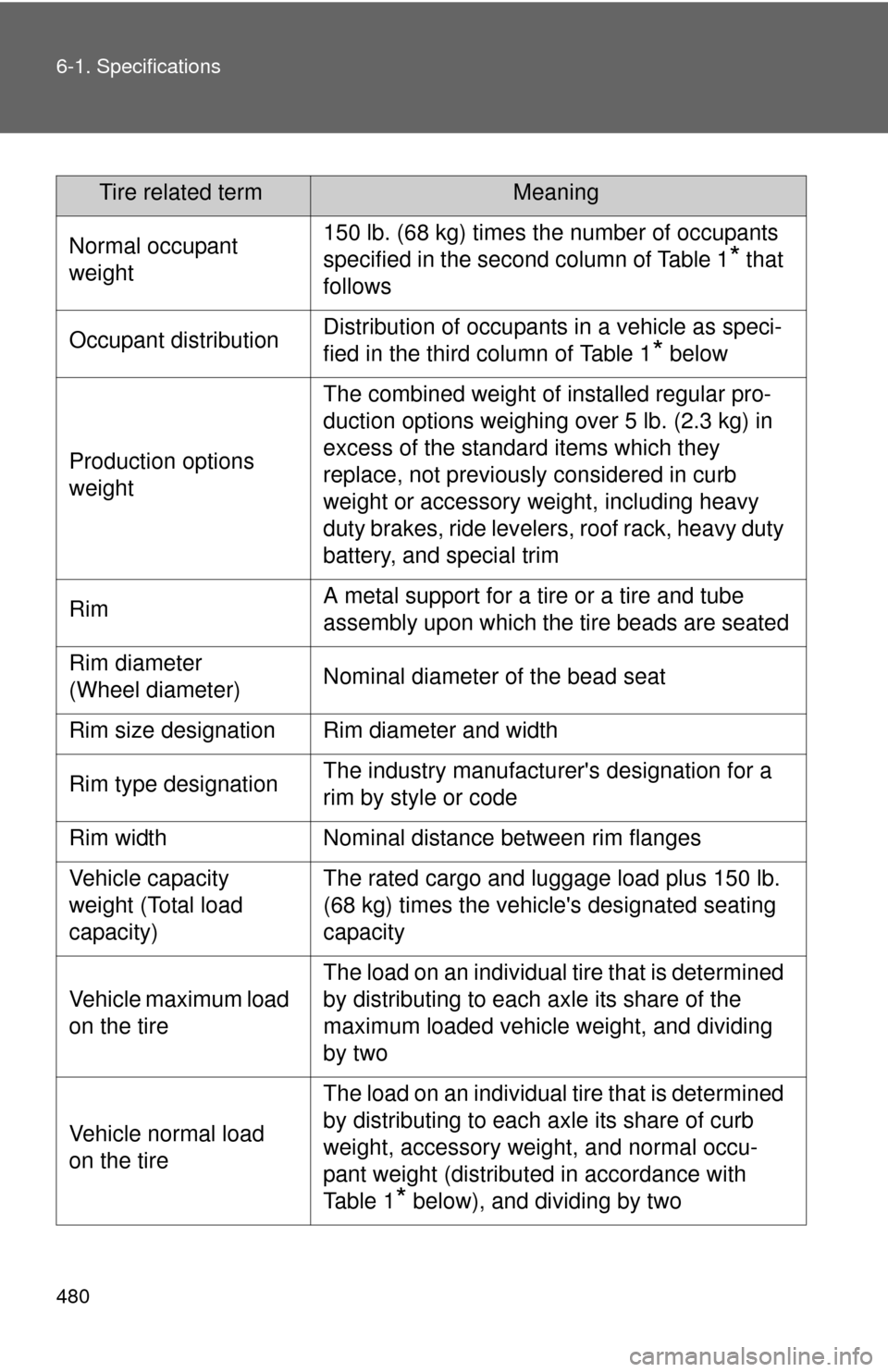
480 6-1. Specifications
Tire related termMeaning
Normal occupant
weight 150 lb. (68 kg) times the number of occupants
specified in the second column of Table 1
* that
follows
Occupant distribution Distribution of occupants in a vehicle as speci-
fied in the third column of Table 1
* below
Production options
weight The combined weight of installed regular pro-
duction options weighing over 5 lb. (2.3 kg) in
excess of the standard items which they
replace, not previously considered in curb
weight or accessory weight, including heavy
duty brakes, ride levelers, roof rack, heavy duty
battery, and special trim
Rim A metal support for a tire or a tire and tube
assembly upon which the tire beads are seated
Rim diameter
(Wheel diameter) Nominal diameter of the bead seat
Rim size designation Rim diameter and width
Rim type designation The industry manufacturer's designation for a
rim by style or code
Rim width Nominal distance between rim flanges
Vehicle capacity
weight (Total load
capacity) The rated cargo and luggage load plus 150 lb.
(68 kg) times the vehicl
e's designated seating
capacity
Vehicle maximum load
on the tire The load on an individual tire that is determined
by distributing to each axle its share of the
maximum loaded vehicle weight, and dividing
by two
Vehicle normal load
on the tire The load on an individual tire that is determined
by distributing to each axle its share of curb
weight, accessory weight, and normal occu-
pant weight (distributed in accordance with
Ta b l e 1
* below), and dividing by two