VIN TOYOTA MIRAI 2019 (in English) User Guide
[x] Cancel search | Manufacturer: TOYOTA, Model Year: 2019, Model line: MIRAI, Model: TOYOTA MIRAI 2019Pages: 528, PDF Size: 11.84 MB
Page 26 of 528
261-1. For safe use
MIRAI_OM_USA_OM62054U(18MY)_O
M62048U(19MY)
Before driving
Use only floor mats designed specifically for vehicles of the same
model and model year as your vehicle. Fix them securely in plac e
onto the carpet.
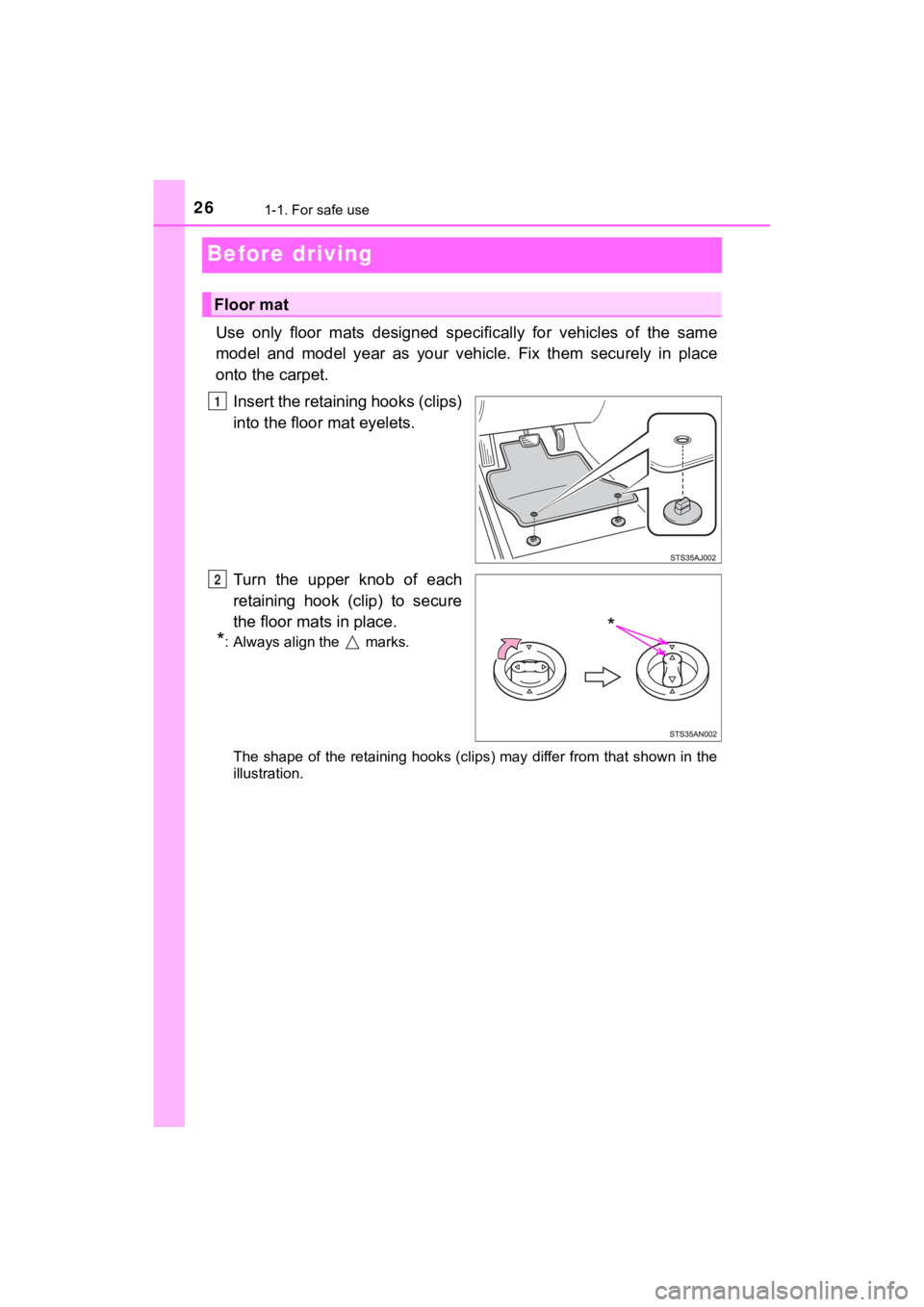
Insert the retaining hooks (clips)
into the floor mat eyelets.
Turn the upper knob of each
retaining hook (clip) to secure
the floor mats in place.
*: Always align the marks. The shape of the retaining hooks (clips) may differ from that s hown in the
illustration.
Floor mat
1
*
O
Page 27 of 528
271-1. For safe use
1
For safety and security
MIRAI_OM_USA_OM62054U(18MY)_O
M62048U(19MY)
WARNING
Observe the following precautions.
Failure to do so may cause the driver’s floor mat to slip, possibly interfering
with the pedals while driving. An unexpectedly high speed may result or it may
become difficult to stop the vehicle. This could lead to an acc ident, resulting in
death or serious injury.
■ When installing the driver’s floor mat
● Do not use floor mats designed for other models or different mo del year
vehicles, even if they are Toyota Genuine floor mats.
● Only use floor mats designed for the driver’s seat.
● Always install the floor mat securely using the retaining hooks (clips) pro-
vided.
● Do not use two or more floor mats on top of each other.
● Do not place the floor mat bottom-side up or upside-down.
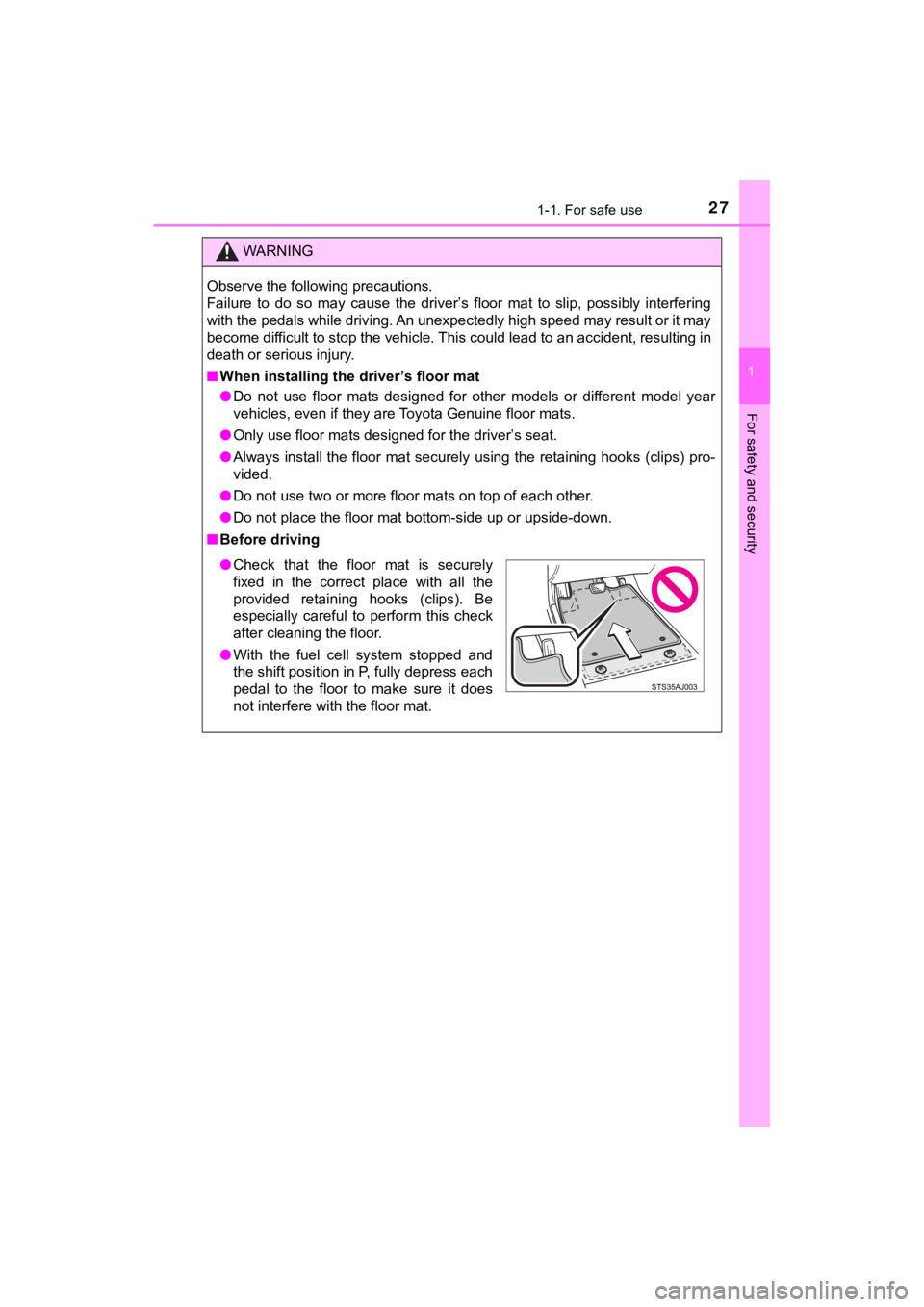
■ Before driving
● Check that the floor mat is securely
fixed in the correct place with all the
provided retaining hooks (clips). Be
especially careful to perform this check
after cleaning the floor.
● With the fuel cell system stopped and
the shift position in P, fully depress each
pedal to the floor to make sure it does
not interfere with the floor mat.
Page 28 of 528
281-1. For safe use
MIRAI_OM_USA_OM62054U(18MY)_O
M62048U(19MY)
For safe driving
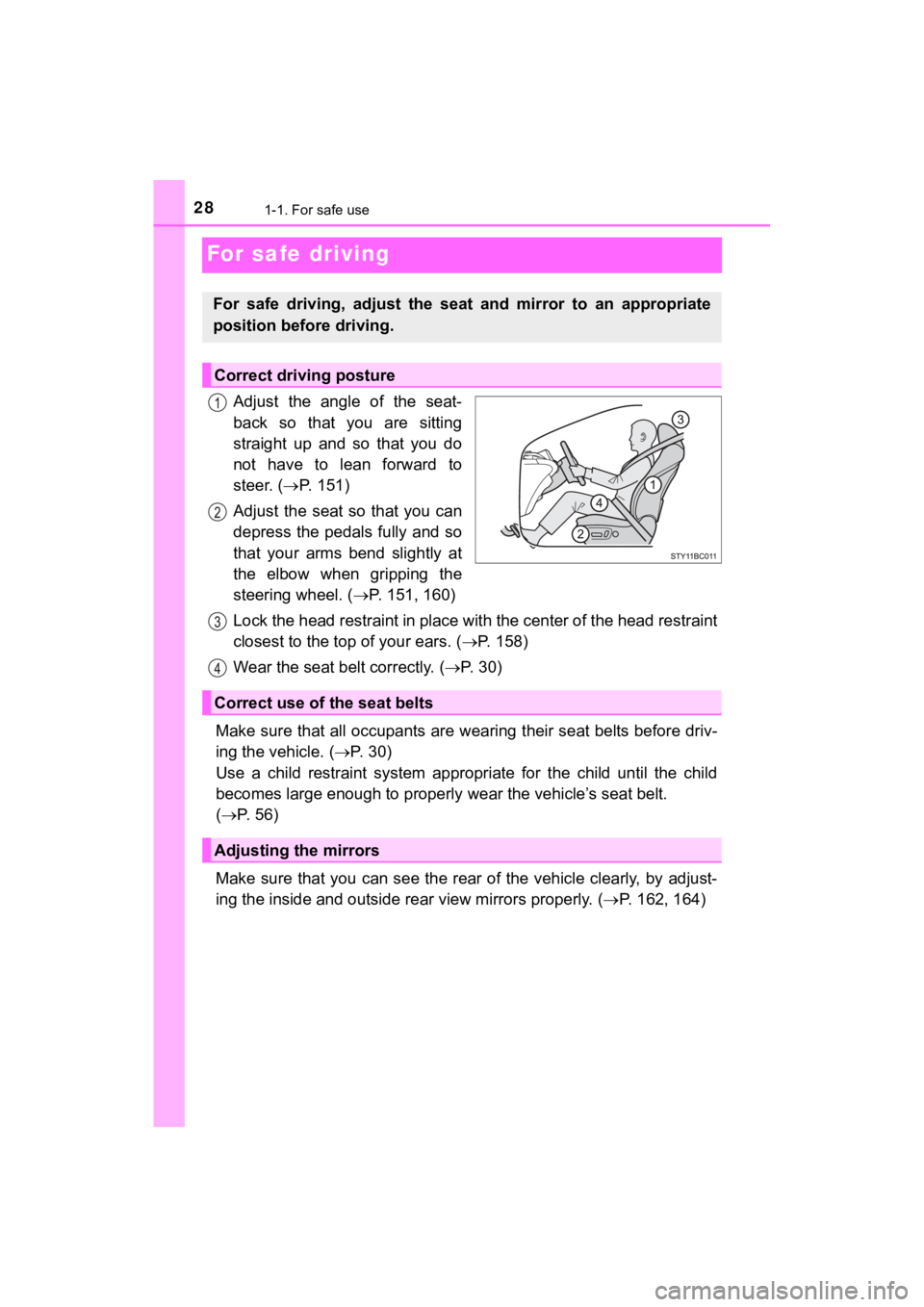
Adjust the angle of the seat-
back so that you are sitting
straight up and so that you do
not have to lean forward to
steer. (P. 1 5 1 )
Adjust the seat so that you can
depress the pedals fully and so
that your arms bend slightly at
the elbow when gripping the
steering wheel. ( P. 151, 160)
Lock the head restraint in place with the center of the head restraint
closest to the top of your ears. ( P. 1 5 8 )
Wear the seat belt correctly. ( P. 3 0 )
Make sure that all occupants are wearing their seat belts before driv-
ing the vehicle. ( P. 3 0 )
Use a child restraint system appropriate for the child until th e child
becomes large enough to properly wear the vehicle’s seat belt.
( P. 56)
Make sure that you can see the rear of the vehicle clearly, by adjust-
ing the inside and outside rear view mirrors properly. ( P. 162, 164)
For safe driving, adjust the seat and mirror to an appropriate
position before driving.
Correct driving posture
Correct use of the seat belts
Adjusting the mirrors
Page 29 of 528
291-1. For safe use
1
For safety and security
MIRAI_OM_USA_OM62054U(18MY)_O
M62048U(19MY)
WARNING
Observe the following precautions.
Failure to do so may result in death or serious injury.
●Do not adjust the position of the driver’s seat while driving.
Doing so could cause the driver to lose control of the vehicle.
● Do not place a cushion between the driver or passenger and the seatback.
A cushion may prevent correct posture from being achieved, and reduce
the effectiveness of the seat belt and head restraint.
● Do not place anything under the front seats.
Objects placed under the front seats may become jammed in the s eat
tracks and stop the seat from locking in place. This may lead t o an acci-
dent and the adjustment mechanism may also be damaged.
● Always observe the legal speed limit when driving on public roads.
● When driving over long distances, take regular breaks before yo u start to
feel tired.
Also, if you feel tired or sleepy while driving, do not force y ourself to con-
tinue driving and take a break immediately.
Page 30 of 528
301-1. For safe use
MIRAI_OM_USA_OM62054U(18MY)_O
M62048U(19MY)
Seat belts
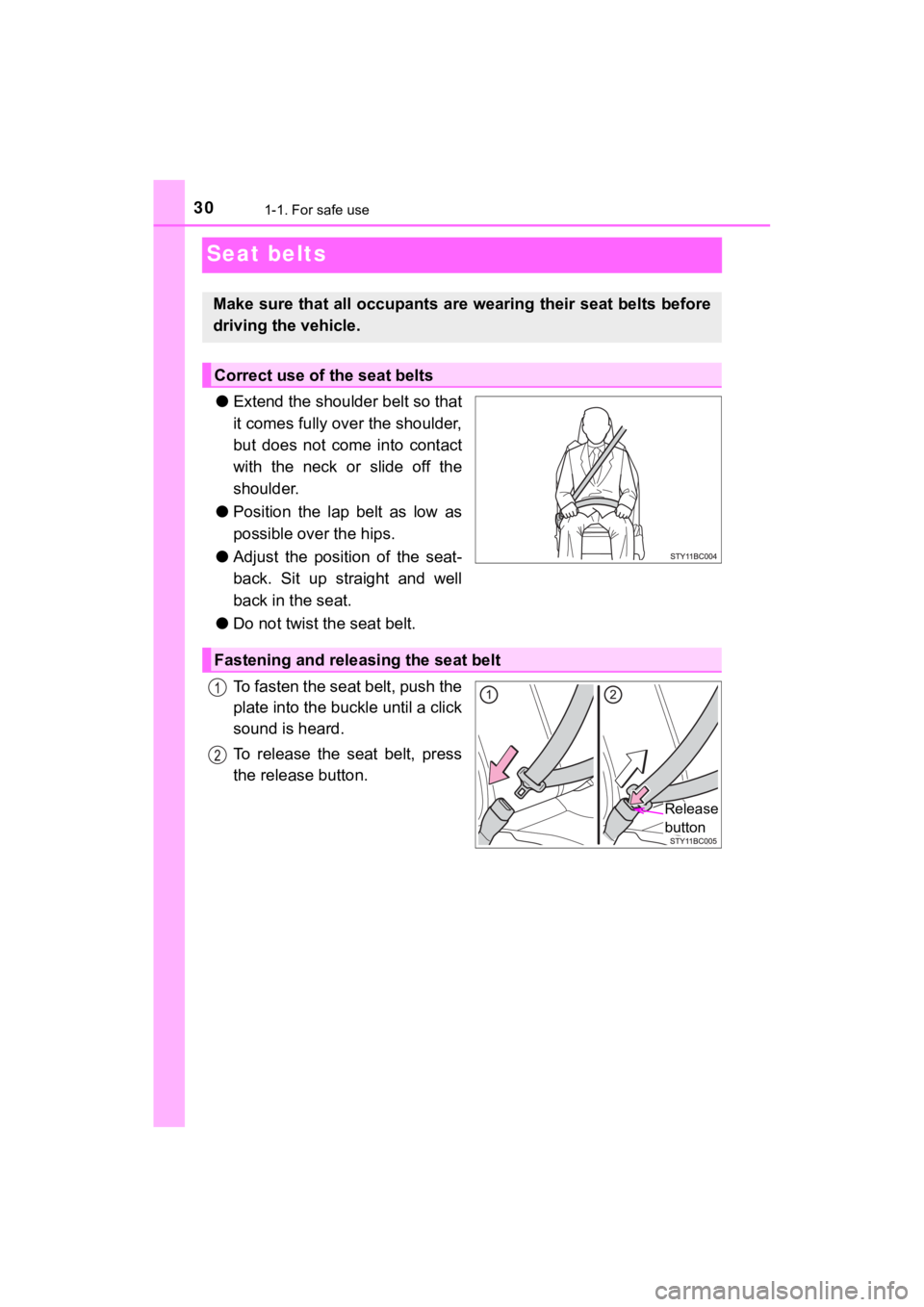
●Extend the shoulder belt so that
it comes fully over the shoulder,
but does not come into contact
with the neck or slide off the
shoulder.
● Position the lap belt as low as
possible over the hips.
● Adjust the position of the seat-
back. Sit up straight and well
back in the seat.
● Do not twist the seat belt.
To fasten the seat belt, push the
plate into the buckle until a click
sound is heard.
To release the seat belt, press
the release button.
Make sure that all occupants are wearing their seat belts before
driving the vehicle.
Correct use of the seat belts
Fastening and releasing the seat belt
Release
button
Page 33 of 528
331-1. For safe use
1
For safety and security
MIRAI_OM_USA_OM62054U(18MY)_O
M62048U(19MY)
WARNING
Observe the following precautions to reduce the risk of injury in the event of
sudden braking, sudden swerving or an accident.
Failure to do so may cause death or serious injury.
■ Wearing a seat belt
● Ensure that all passengers wear a seat belt.
● Always wear a seat belt properly.
● Each seat belt should be used by one person only. Do not use a seat belt
for more than one person at once, including children.
● Toyota recommends that children be seated in the rear seat and always
use a seat belt and/or an appropriate child restraint system.
● To achieve a proper seating position, do not recline the seat m ore than
necessary. The seat belt is most effective when the occupants a re sitting
up straight and well back in the seats.
● Do not wear the shoulder belt under your arm.
● Always wear your seat belt low and snug across your hips.
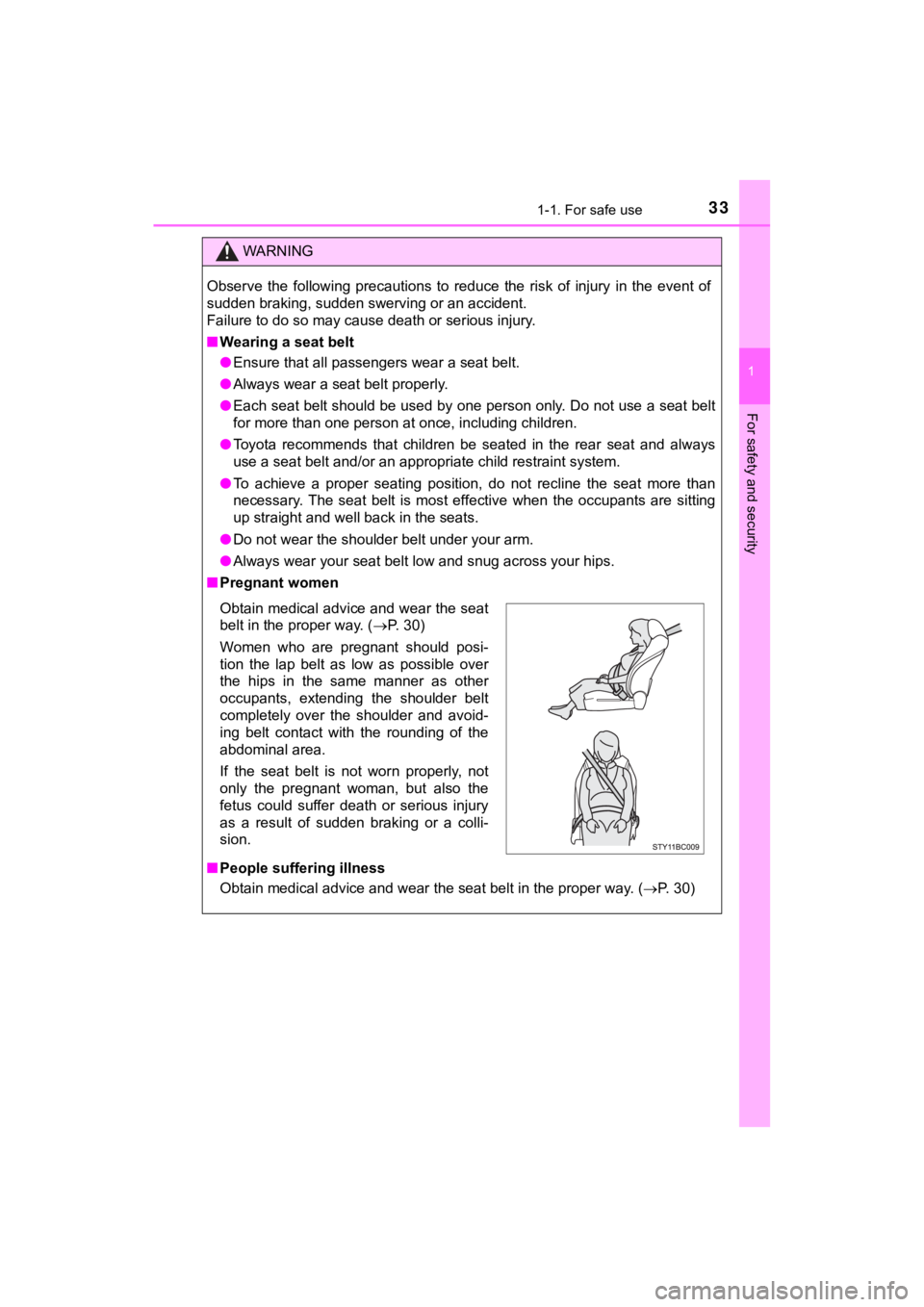
■ Pregnant women
■ People suffering illness
Obtain medical advice and wear the seat belt in the proper way. (P. 30)
Obtain medical advice and wear the seat
belt in the proper way. ( P. 30)
Women who are pregnant should posi-
tion the lap belt as low as possible over
the hips in the same manner as other
occupants, extending the shoulder belt
completely over the shoulder and avoid-
ing belt contact with the rounding of the
abdominal area.
If the seat belt is not worn properly, not
only the pregnant woman, but also the
fetus could suffer death or serious injury
as a result of sudden braking or a colli-
sion.
Page 39 of 528
391-1. For safe use
1
For safety and security
MIRAI_OM_USA_OM62054U(18MY)_O
M62048U(19MY)
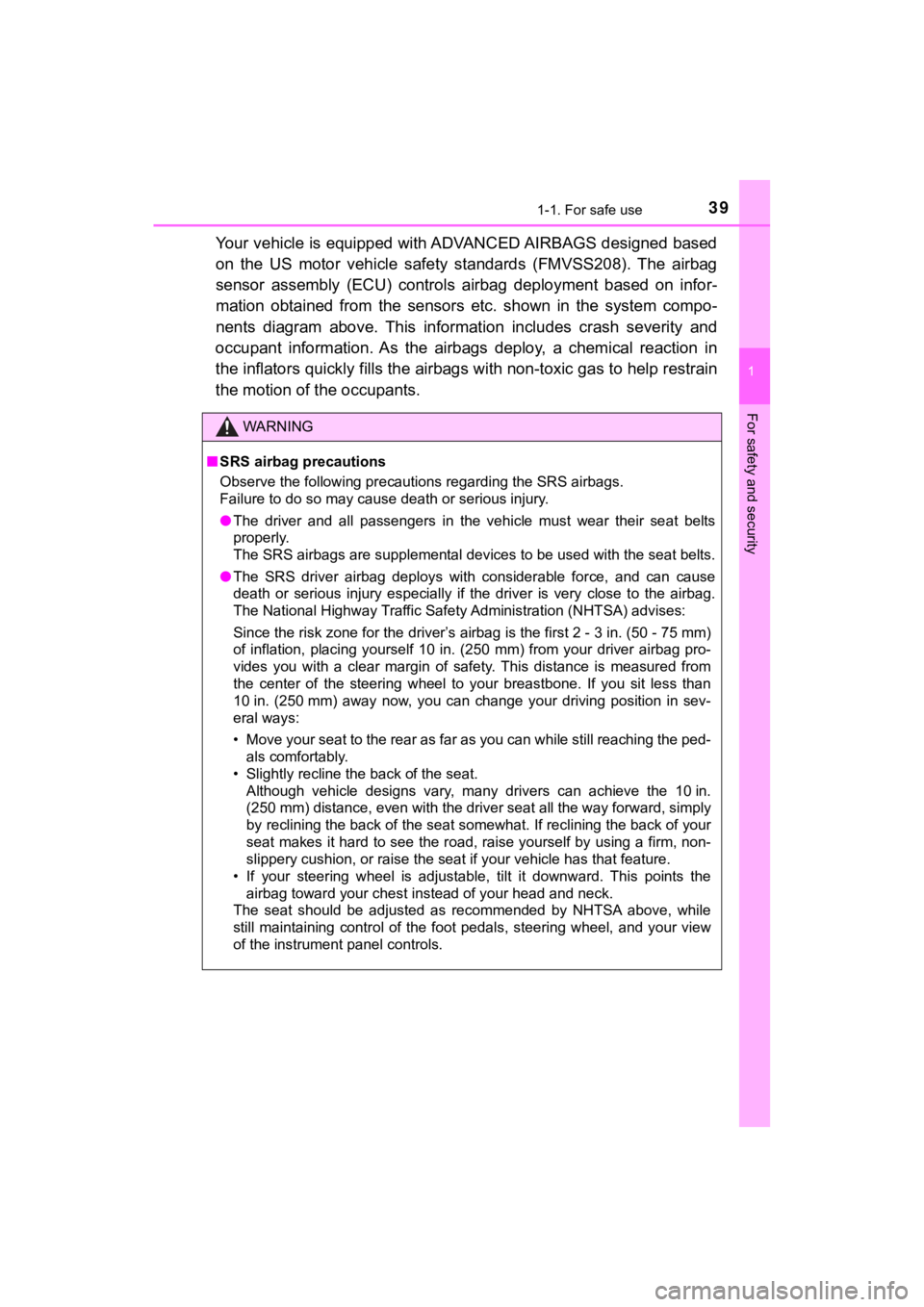
Your vehicle is equipped with ADVANCED AIRBAGS designed based
on the US motor vehicle safety standards (FMVSS208). The airbag
sensor assembly (ECU) controls airbag deployment based on infor-
mation obtained from the sensors etc. shown in the system compo -
nents diagram above. This informat ion includes crash severity and
occupant information. As the airbags deploy, a chemical reactio n in
the inflators quickly fills the airbags with non-toxic gas to h elp restrain
the motion of t he occupants.
WARNING
■SRS airbag precautions
Observe the following precautions regarding the SRS airbags.
Failure to do so may cause death or serious injury.
● The driver and all passengers in the vehicle must wear their se at belts
properly.
The SRS airbags are supplemental devices to be used with the se at belts.
● The SRS driver airbag deploys with considerable force, and can cause
death or serious injury especially if the driver is very close to the airbag.
The National Highway Traffic Safety Administration (NHTSA) advi ses:
Since the risk zone for the driver’s airbag is the first 2 - 3 in. (50 - 75 mm)
of inflation, placing yourself 10 in. (250 mm) from your driver airbag pro-
vides you with a clear margin of safety. This distance is measured from
the center of the steering wheel to your breastbone. If you sit less than
10 in. (250 mm) away now, you can change your driving position in sev-
eral ways:
• Move your seat to the rear as far as you can while still reach ing the ped-
als comfortably.
• Slightly recline the back of the seat.
Although vehicle designs vary, many drivers can achieve the 10 in.
(250 mm) distance, even with the driver seat all the way forward , simply
by reclining the back of the seat somewhat. If reclining the ba ck of your
seat makes it hard to see the road, raise yourself by using a f irm, non-
slippery cushion, or raise the seat if your vehicle has that feature.
• If your steering wheel is adjustable, tilt it downward. This p oints the
airbag toward your chest instead of your head and neck.
The seat should be adjusted as recommended by NHTSA above, whil e
still maintaining control of the foot pedals, steering wheel, and your view
of the instrument panel controls.
Page 42 of 528
421-1. For safe use
MIRAI_OM_USA_OM62054U(18MY)_O
M62048U(19MY)
WARNING
■SRS airbag precautions
● Do not hang coat hangers or other hard objects on the coat hook s. All of
these items could become projectiles and may cause death or ser ious
injury, should the SRS curtain shield airbags deploy.
● If a vinyl cover is put on the area where the SRS knee airbag w ill deploy,
be sure to remove it.
● Do not use seat accessories which cover the parts where the SRS side
airbags and SRS seat cushion airbag inflate as they may interfe re with
inflation of the SRS airbags. Such accessories may prevent the side
airbags and SRS seat cushion airbag from activating correctly, disable the
system or cause the side airbags and SRS seat cushion airbag to inflate
accidentally, resulting in death or serious injury.
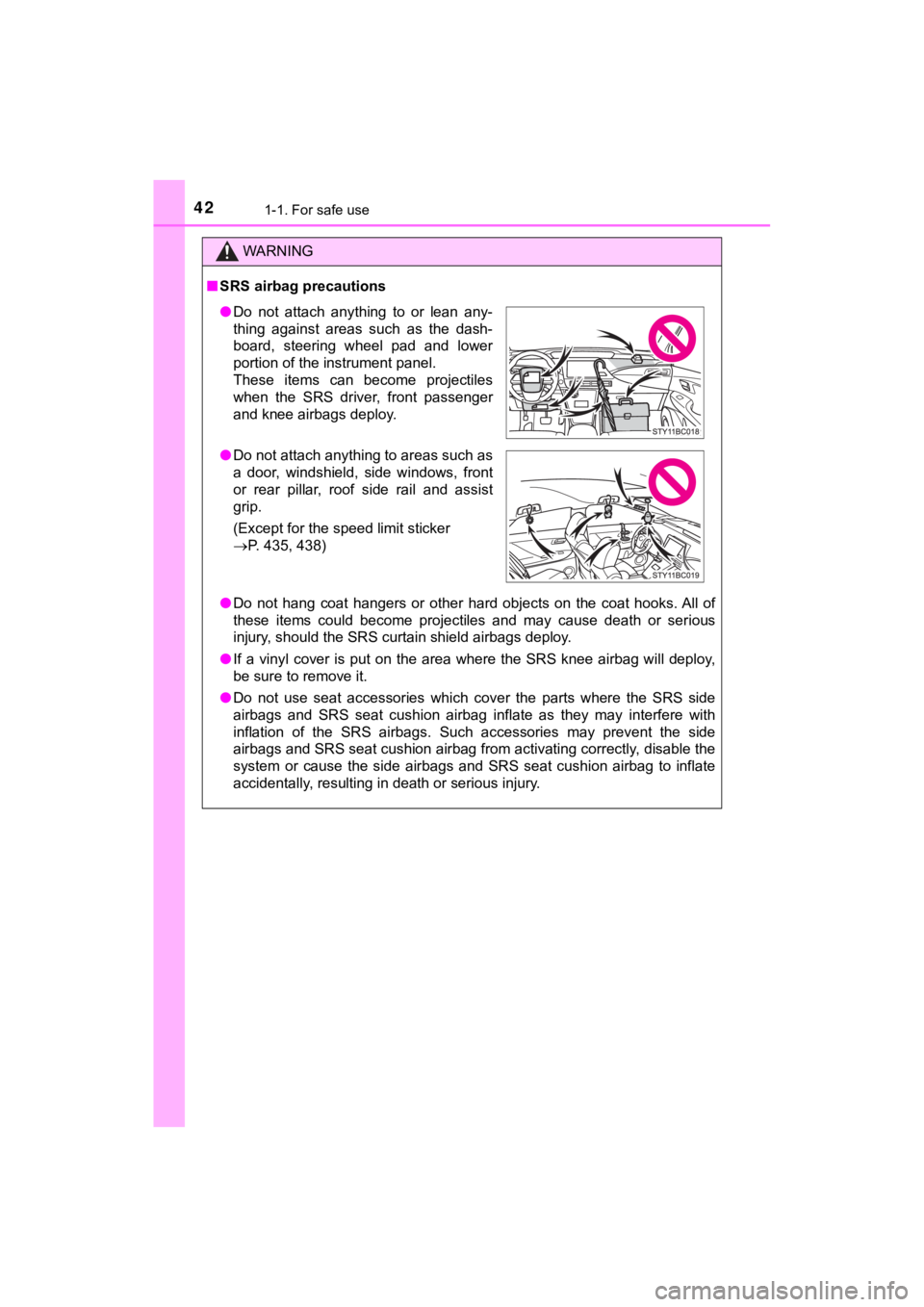
● Do not attach anything to or lean any-
thing against areas such as the dash-
board, steering wheel pad and lower
portion of the instrument panel.
These items can become projectiles
when the SRS driver, front passenger
and knee airbags deploy.
● Do not attach anything to areas such as
a door, windshield, side windows, front
or rear pillar, roof side rail and assist
grip.
(Except for the speed limit sticker
P. 435, 438)
Page 54 of 528

541-1. For safe use
MIRAI_OM_USA_OM62054U(18MY)_O
M62048U(19MY)
WARNING
■Front passenger occupant classification system precautions
● Do not recline the front passenger seatback so far that it touc hes a rear
seat. This may cause the “AIR BAG OFF” indicator light to be il luminated,
which indicates that the SRS airbags for the front passenger wi ll not acti-
vate in the event of a severe accident. If the seatback touches the rear
seat, return the seatback to a position where it does not touch the rear
seat. Keep the front passenger seatback as upright as possible when the
vehicle is moving. Reclining the seatback excessively may lesse n the
effectiveness of the seat belt system.
● If an adult sits in the front passenger seat, the “AIR BAG ON” indicator
light is illuminated. If the “AIR BAG OFF” indicator is illuminated, ask the
passenger to sit up straight, well back in the seat, feet on the floor, and
with the seat belt worn correctly. If the “AIR BAG OFF” indicat or still
remains illuminated, either ask the passenger to move to the re ar seat, or
if that is not possible, move the front passenger seat fully re arward.
● When it is unavoidable to install a forward-facing child restra int system on
the front passenger seat, install the child restraint system on the front pas-
senger seat in the proper order. ( P. 59)
● Do not modify or remove the front seats.
● Do not kick the front passenger seat or subject it to severe im pact. Other-
wise, the SRS warning light may come on to indicate a malfuncti on of the
front passenger occupant classification system. In this case, contact your
Toyota dealer immediately.
● Child restraint systems installed on the rear seat should not c ontact the
front seatbacks.
● Do not use a seat accessory, such as a cushion and seat cover, that cov-
ers the seat cushion surface.
● Do not modify or replace the upholstery of the front seat.
Page 55 of 528
551-1. For safe use
1
For safety and security
MIRAI_OM_USA_OM62054U(18MY)_O
M62048U(19MY)
Safety information for children
●It is recommended that children sit in the rear seats to avoid acci-
dental contact with the shift lever, wiper switch, etc.
● Use the rear door child-protector lock or the window lock switc h to
avoid children opening the door while driving or operating the
power window accidentally. ( P. 135, 167)
● Do not let small children operate equipment which may catch or
pinch body parts, such as the power window, hood, trunk, seats,
etc.
Observe the following precautions when children are in the vehi -
cle.
Use a child restraint system app ropriate for the child, until the
child becomes large enough to properly wear the vehicle’s seat
belt.
WARNING
Never leave children unattended in the vehicle, and never allow children to
have or use the key.
Children may be able to start the vehicle or shift the vehicle into neutral.
There is also a danger that children may injure themselves by p laying with
the windows or other features of the vehicle. In addition, heat build-up or
extremely cold temperatures inside the vehicle can be fatal to children.