VIN TOYOTA MIRAI 2019 (in English) Owner's Manual
[x] Cancel search | Manufacturer: TOYOTA, Model Year: 2019, Model line: MIRAI, Model: TOYOTA MIRAI 2019Pages: 528, PDF Size: 11.84 MB
Page 57 of 528
571-1. For safe use
1
For safety and security
MIRAI_OM_USA_OM62054U(18MY)_O
M62048U(19MY)
WARNING
■When a child is riding
Observe the following precautions.
Failure to do so may result in death or serious injury.
● For effective protection in automobile accidents and sudden sto ps, a child
must be properly restrained, using a seat belt or child restrai nt system
depending on the age and size of the child.
● Toyota strongly urges the use of a proper child restraint syste m that con-
forms to the size of the child, installed on the rear seat. According to acci-
dent statistics, the child is safer when properly restrained in the rear seat
than in the front seat.
● Holding a child in your or someone else’s arms is not a substit ute for a
child restraint system. In an accident, the child can be crushed against the
windshield or between the holder and the interior of the vehicle.
● Place one child to a child restraint system and then secure the child with
the harness of the child restraint system.
■ Handling the child restraint system
If the child restraint system is not properly fixed in place, t he child or other
passengers may be seriously injured or even killed in the event of sudden
braking, sudden swerving, or an accident.
● If the vehicle were to receive a strong impact from an accident, etc., it is
possible that the child restraint system has damage that is not readily visi-
ble. In such cases, do not reuse the restraint system.
● Make sure you have complied with all installation instructions provided
with the child restraint system manufacturer and that the syste m is prop-
erly secured.
● Keep the child restraint system properly secured on the seat ev en if it is
not in use. Do not store the child restraint system unsecured in the pas-
senger compartment.
● If it is necessary to detach the child restraint system, remove it from the
vehicle or store it securely in the trunk.
Page 65 of 528
651-1. For safe use
1
For safety and security
MIRAI_OM_USA_OM62054U(18MY)_O
M62048U(19MY)
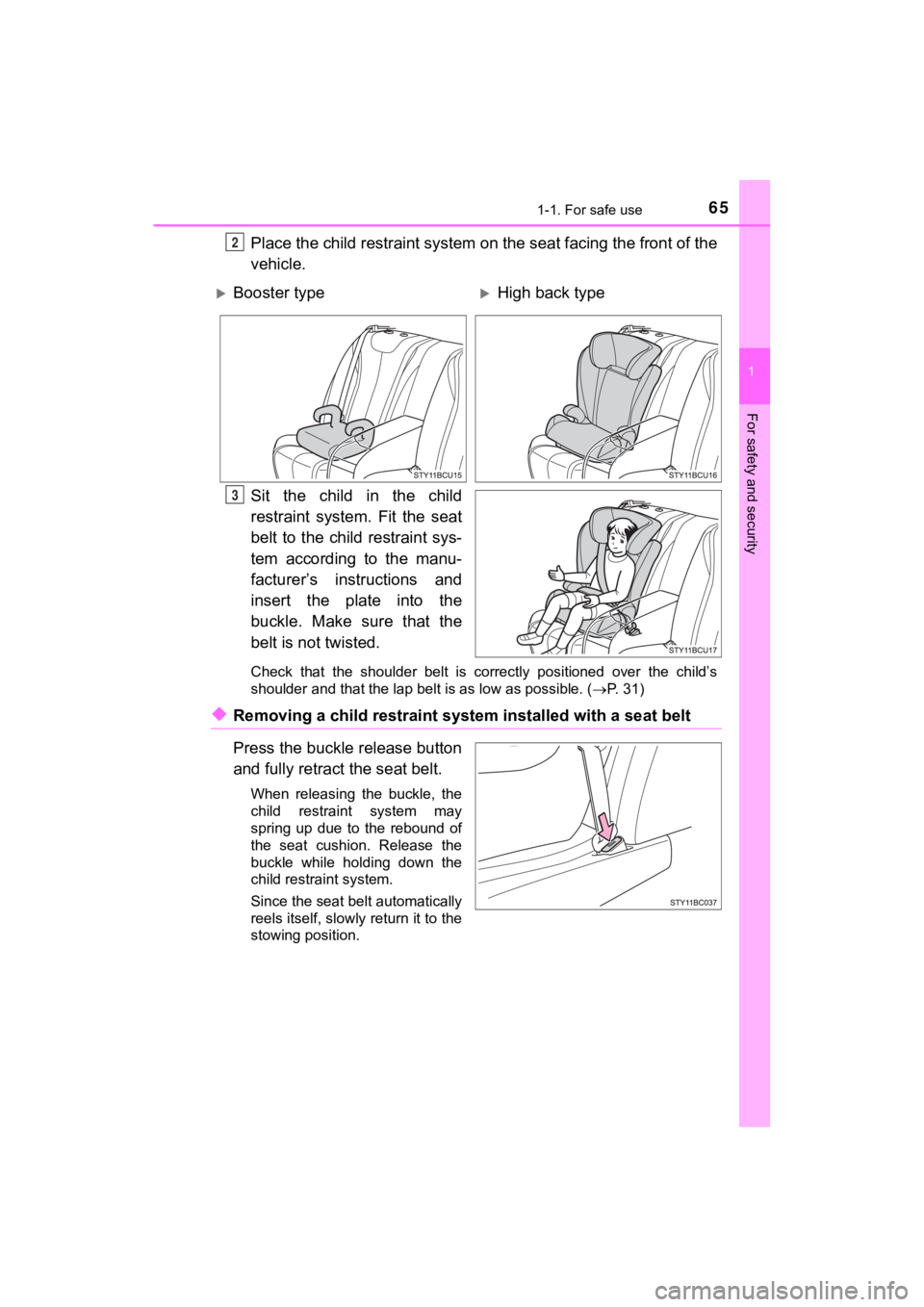
Place the child restraint system on the seat facing the front of the
vehicle.
Sit the child in the child
restraint system. Fit the seat
belt to the child restraint sys-
tem according to the manu-
facturer’s instructions and
insert the plate into the
buckle. Make sure that the
belt is not twisted.
Check that the shoulder belt is correctly positioned over the c hild’s
shoulder and that the lap belt is as low as possible. ( P. 31)
◆Removing a child restraint system installed with a seat belt
Press the buckle release button
and fully retract the seat belt.
When releasing the buckle, the
child restraint system may
spring up due to the rebound of
the seat cushion. Release the
buckle while holding down the
child restraint system.
Since the seat belt automatically
reels itself, slowly return it to the
stowing position.
2
Booster typeHigh back type
3
Page 66 of 528
661-1. For safe use
MIRAI_OM_USA_OM62054U(18MY)_O
M62048U(19MY)
WARNING
■When installing a child restraint system
Observe the following precautions.
Failure to do so may result in death or serious injury.
● Do not allow children to play with the seat belt. If the seat b elt becomes
twisted around a child’s neck, it may lead to choking or other serious inju-
ries that could result in death.
If this occurs and the buckle cannot be unfastened, scissors sh ould be
used to cut the belt.
● Ensure that the belt and plate are securely locked and the seat belt is not
twisted.
● Shake the child restraint system left and right, and forward and backward
to ensure that it has been securely installed.
● After securing a child restraint system, never adjust the seat.
● When a booster seat is installed, always ensure that the should er belt is
positioned across the center of the child’s shoulder. The belt should be
kept away from the child’s neck, but not so that it could fall off the child’s
shoulder.
● Follow all installation instructions provided by the child rest raint system
manufacturer.
■ When installing a booster seat
To prevent the belt from going into ALR lock mode, do not fully extend the
shoulder belt. ALR mode causes the belt to tighten only. This c ould cause
injury or discomfort to the child. ( P. 32)
■ Do not use a seat belt extender
If a seat belt extender is used when installing a child restraint system, the
seat belt will not securely hold the child restraint system, which could cause
death or serious injury to the child or other passengers in the event of sud-
den braking, sudden swerving or an accident.
Page 73 of 528

731-2. Emergency assistance
1
For safety and security
MIRAI_OM_USA_OM62054U(18MY)_O
M62048U(19MY)■
Services
Subscribers have the following Safety Connect services availabl
e:
● Automatic Collision Notification
*
Helps drivers receive necessary response from emergency ser-
vice providers. ( P. 7 5 )
*: U.S. Patent No. 7,508,298 B2
● Stolen Vehicle Location
Helps drivers in the eve nt of vehicle theft. (P. 75)
● Emergency Assistance Button (SOS)
Connects drivers to response-center support. ( P. 7 5 )
● Enhanced Roadside Assistance
Provides drivers various on-road assistance. (P. 7 6 )
■Subscription
After you have signed the Telemati cs Subscription Service Agree-
ment and are enrolled, you c an begin receiving services.
A variety of subscription terms are available for purchase. Con tact
your Toyota dealer, call the following appropriate Safety Conne ct
response center or push the “SOS ” button in your vehicle for further
subscription details. • The United States 1-855-405-6500
• Canada 1-888-869-6828
• Puerto Rico 1-877-855-8377
Page 85 of 528
85
Fuel cell system2
MIRAI_OM_USA_OM62054U(18MY)_O
M62048U(19MY)2. Fuel cell vehicle
Fuel cell vehicle characteristics ................... 86
Fuel cell vehicle precautions ....................... 90
Advice for driving fuel cell vehicles ........................... 102
Page 87 of 528
872. Fuel cell vehicle
2
Fuel cell system
MIRAI_OM_USA_OM62054U(18MY)_O
M62048U(19MY)
The electric motor (traction motor) allows smooth, powerful takeoff
and acceleration. This vehicle dr ives similarly to a gasoline vehicle
without any special actions by the driver. ( P. 172) As there are no
engine sounds and the vehicle is q uiet, operation noises unique to
fuel cell vehicle com ponents may be heard. ( P. 8 8 )
The system may behave differently on cold days. It is performin g a
special cold-start process to im prove start-up performance. (P. 189)
Operation noises ( P. 88), purge process ( P. 189), etc., differ from
usual. However, this is not a malfunction.
Compressed hydrogen gas fuel can be filled at hydrogen stations .
Opening the fuel door (P. 213)
Driving the vehicle
Fuel cell system
Fuel filling
Page 88 of 528
882. Fuel cell vehicle
MIRAI_OM_USA_OM62054U(18MY)_O
M62048U(19MY)
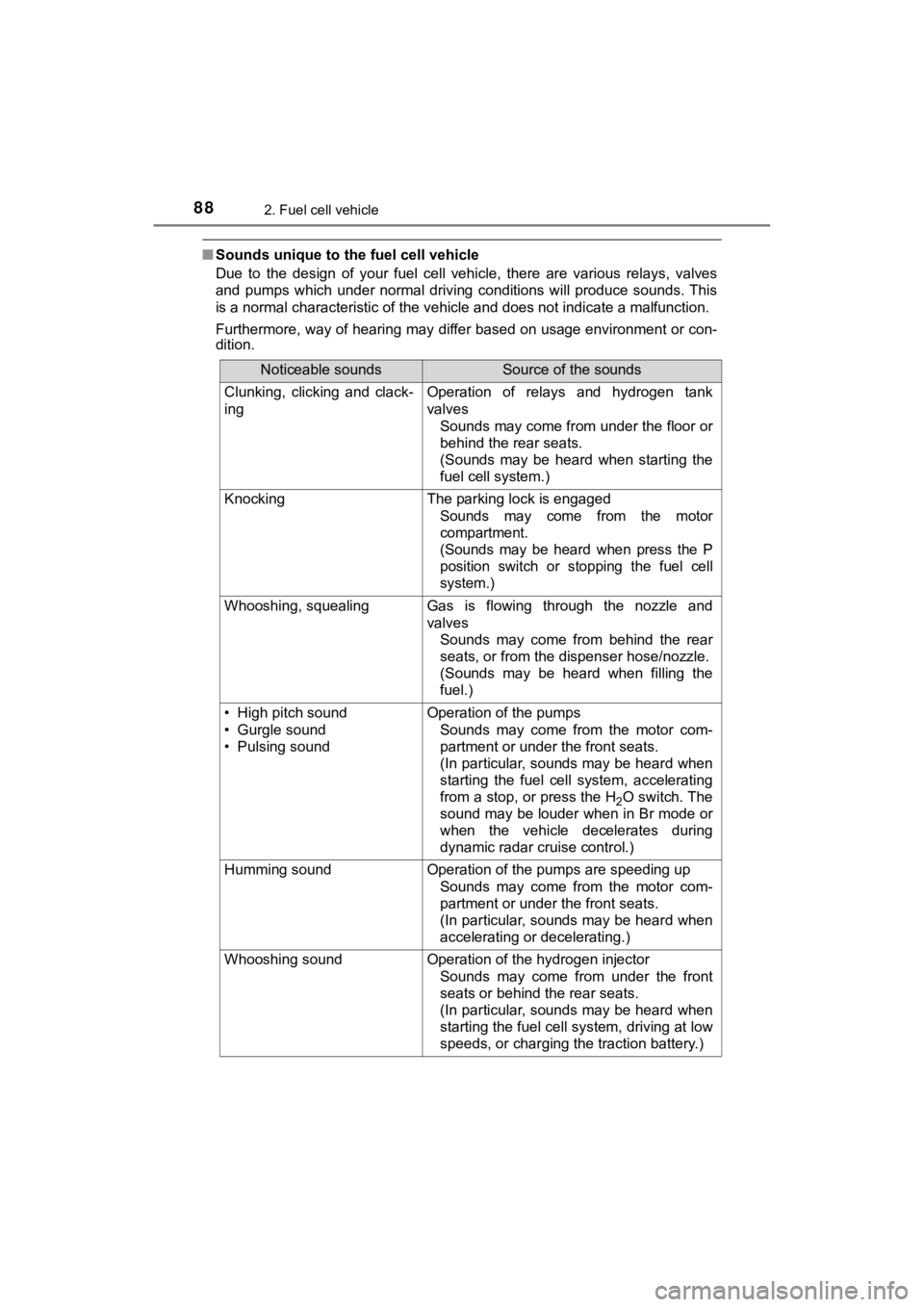
■Sounds unique to the fuel cell vehicle
Due to the design of your fuel cell vehicle, there are various relays, valves
and pumps which under normal driving conditions will produce so unds. This
is a normal characteristic of the vehicle and does not indicate a malfunction.
Furthermore, way of hearing may differ based on usage environme nt or con-
dition.
Noticeable soundsSource of the sounds
Clunking, clicking and clack-
ingOperation of relays and hydrogen tank
valves
Sounds may come from under the floor or
behind the rear seats.
(Sounds may be heard when starting the
fuel cell system.)
KnockingThe parking lock is engaged
Sounds may come from the motor
compartment.
(Sounds may be heard when press the P
position switch or stopping the fuel cell
system.)
Whooshing, squealingGas is flowing through the nozzle and
valvesSounds may come from behind the rear
seats, or from the dispenser hose/nozzle.
(Sounds may be heard when filling the
fuel.)
• High pitch sound
• Gurgle sound
• Pulsing soundOperation of the pumpsSounds may come from the motor com-
partment or under the front seats.
(In particular, sounds may be heard when
starting the fuel cell system, accelerating
from a stop, or press the H
2O switch. The
sound may be louder when in Br mode or
when the vehicle decelerates during
dynamic radar cruise control.)
Humming soundOperation of the pumps are speeding up
Sounds may come from the motor com-
partment or under the front seats.
(In particular, sounds may be heard when
accelerating or decelerating.)
Whooshing sound Operation of the hydrogen injectorSounds may come from under the front
seats or behind the rear seats.
(In particular, sounds may be heard when
starting the fuel cell system, driving at low
speeds, or charging the traction battery.)
Page 89 of 528
892. Fuel cell vehicle
2
Fuel cell system
MIRAI_OM_USA_OM62054U(18MY)_O
M62048U(19MY)■
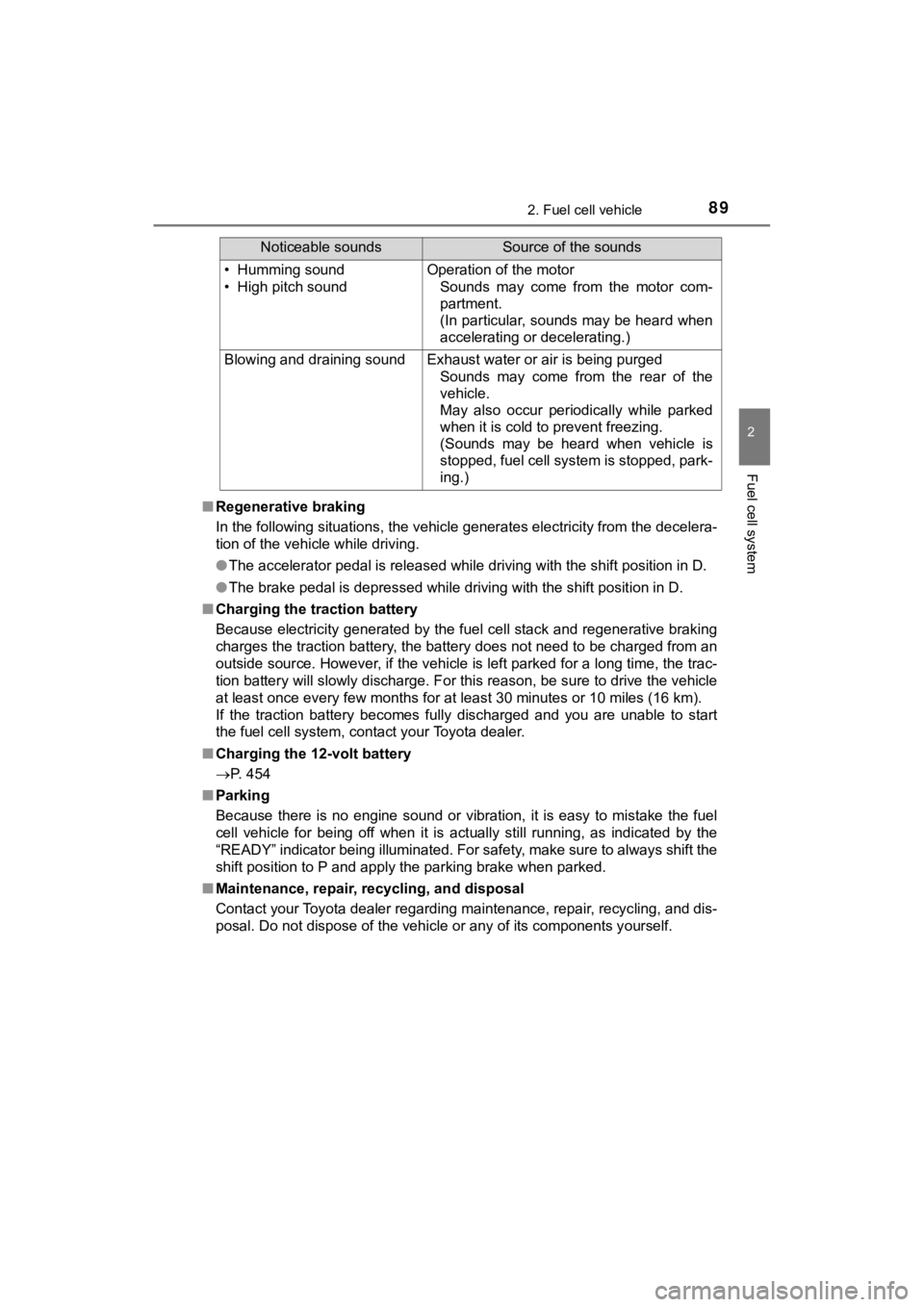
Regenerative braking
In the following situations, the vehicle generates electricity from the decelera-
tion of the vehicle while driving.
● The accelerator pedal is released while driving with the shift position in D.
● The brake pedal is depressed while driving with the shift posit ion in D.
■ Charging the traction battery
Because electricity generated by the fuel cell stack and regene rative braking
charges the traction battery, the battery does not need to be c harged from an
outside source. However, if the vehicle is left parked for a lo ng time, the trac-
tion battery will slowly discharge. For this reason, be sure to drive the vehicle
at least once every few months for at least 30 minutes or 10 mi les (16 km).
If the traction battery becomes fully discharged and you are unable to start
the fuel cell system, contact your Toyota dealer.
■ Charging the 12-volt battery
P. 454
■ Parking
Because there is no engine sound or vibration, it is easy to mistake the fuel
cell vehicle for being off when it is actually still running, as indicated by the
“READY” indicator being illuminated. For safety, make sure to a lways shift the
shift position to P and apply the parking brake when parked.
■ Maintenance, repair, recycling, and disposal
Contact your Toyota dealer regarding maintenance, repair, recyc ling, and dis-
posal. Do not dispose of the vehicle or any of its components y ourself.
• Humming sound
• High pitch soundOperation of the motor
Sounds may come from the motor com-
partment.
(In particular, sounds may be heard when
accelerating or decelerating.)
Blowing and draining soundExhaust water or air is being purgedSounds may come from the rear of the
vehicle.
May also occur periodically while parked
when it is cold to prevent freezing.
(Sounds may be heard when vehicle is
stopped, fuel cell system is stopped, park-
ing.)
Noticeable soundsSource of the sounds
Page 94 of 528
942. Fuel cell vehicle
MIRAI_OM_USA_OM62054U(18MY)_O
M62048U(19MY)■
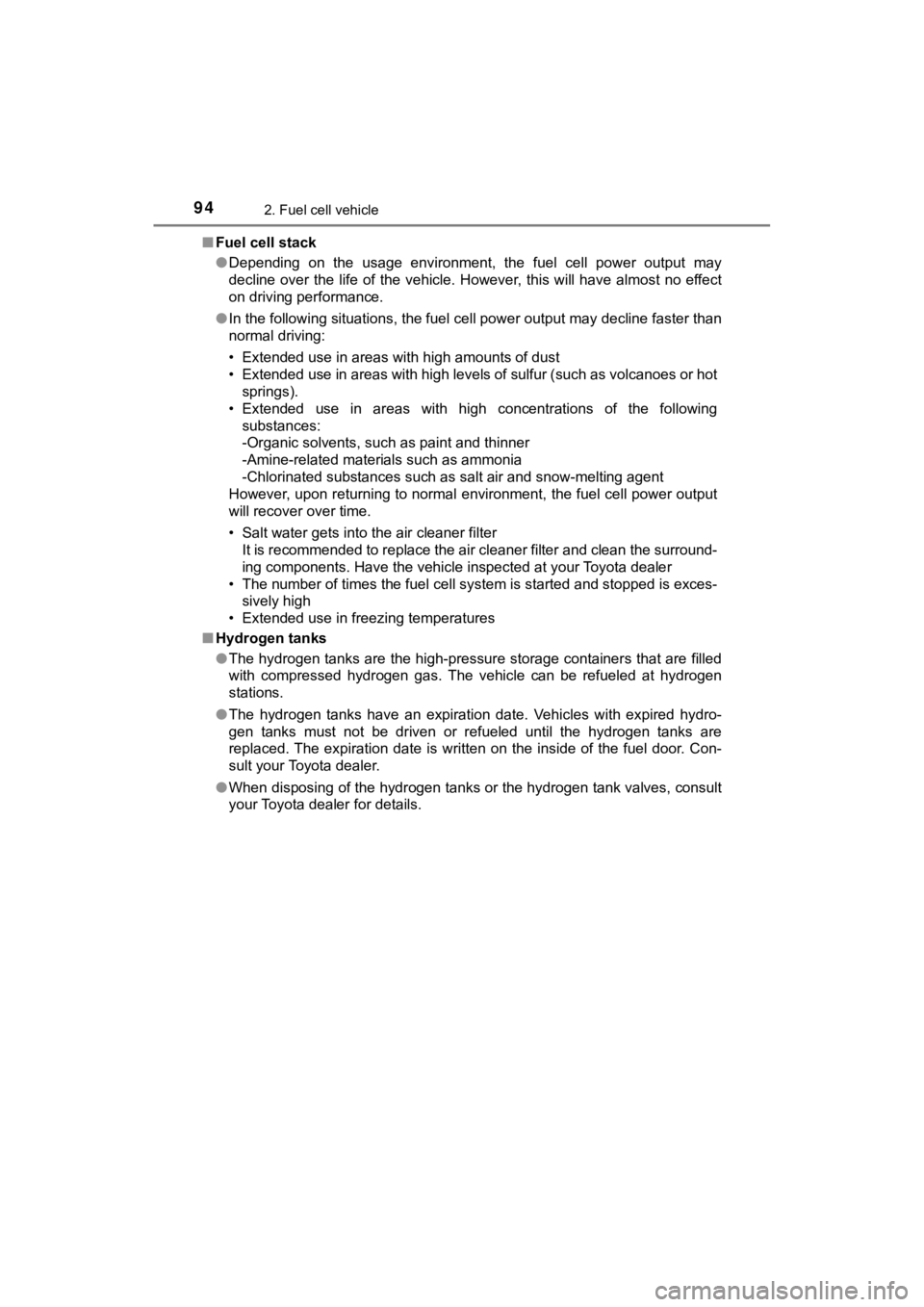
Fuel cell stack
●Depending on the usage environment, the fuel cell power output may
decline over the life of the vehicle. However, this will have almost no effect
on driving performance.
● In the following situations, the fuel cell power output may dec line faster than
normal driving:
• Extended use in areas with high amounts of dust
• Extended use in areas with high levels of sulfur (such as volc anoes or hot
springs).
• Extended use in areas with high concentrations of the following substances:
-Organic solvents, such as paint and thinner
-Amine-related materials such as ammonia
-Chlorinated substances such as salt air and snow-melting agent
However, upon returning to normal environment, the fuel cell po wer output
will recover over time.
• Salt water gets into the air cleaner filter It is recommended to replace the air cleaner filter and clean t he surround-
ing components. Have the vehicle inspected at your Toyota deale r
• The number of times the fuel cell system is started and stoppe d is exces-
sively high
• Extended use in freezing temperatures
■ Hydrogen tanks
●The hydrogen tanks are the high-pressure storage containers that are filled
with compressed hydrogen gas. The vehicle can be refueled at hy drogen
stations.
● The hydrogen tanks have an expiration date. Vehicles with expir ed hydro-
gen tanks must not be driven or refueled until the hydrogen tanks are
replaced. The expiration date is written on the inside of the fuel door. Con-
sult your Toyota dealer.
● When disposing of the hydrogen tanks or the hydrogen tank valve s, consult
your Toyota dealer for details.
Page 95 of 528
952. Fuel cell vehicle
2
Fuel cell system
MIRAI_OM_USA_OM62054U(18MY)_O
M62048U(19MY)■
Fuel cell stack coolant
●Fuel cell stack coolant uses a specifically-designed fluid with high electrical
insulation properties, in order to safely cool the high-voltage fuel cell stack.
● Never add water or other coolants to the fuel cell stack coolin g system, as
they will cause permanent damage.
● Consult your Toyota dealer for replenishing or changing the fue l cell stack
coolant.
■ Ion filter
●An ion filter is installed in the coolant lines for the fuel ce ll stack, in order to
maintain the normal insulation properties of the coolant.
● It is necessary to periodically change the ion filter. ( P. 428) Contact your
Toyota dealer for this periodic maintenance.
■ Tailpipe
●When the power switch is turned off and the fuel cell system is stopped
( P. 187) after driving, exhaust water is discharged. Be careful w hen stand-
ing behind the vehicle to avoid dripping or spraying.
● It is possible to manually purge the exhaust. This may be desirable, for
instance, before parking in a garage. This is done by pressing the H
2O
switch. ( P. 187)
● On cold days, water vapor in the exhaust may appear as a white mist emit-
ted from the tailpipe. This is not a malfunction.
● If the tailpipe is blocked, the fuel cell system will stop.
■ Hydrogen detectors
When the power switch is turned to ON mode, the hydrogen detect ors are
activated.