fuel pressure TOYOTA MIRAI 2019 Owners Manual (in English)
[x] Cancel search | Manufacturer: TOYOTA, Model Year: 2019, Model line: MIRAI, Model: TOYOTA MIRAI 2019Pages: 528, PDF Size: 11.84 MB
Page 15 of 528
15Pictorial index
MIRAI_OM_USA_OM62054U(18MY)_O
M62048U(19MY)Windshield wipers . . . . . . . . . . . . . . . . . . . . . . . . . . . . . . . . . P. 210
Precautions against winter season . . . . . . . . . . . . . . . . . . . . . P. 301
To prevent freezing (windshield wiper de-icer). . . . . . . . . . . . . P. 309
Precautions against car wash . . . . . . . . . . . . . . . . . . . . . . . . . P. 354
Fuel door . . . . . . . . . . . . . . . . . . . . . . . . . . . . . . . . . . . . . . . . P. 213
Refueling method . . . . . . . . . . . . . . . . . . . . . . . . . . . . . . . . . . . P. 213
Fuel type/hydrogen tanks’ fuel capacity . . . . . . . . . . . . . . . . . . P. 468
Tires . . . . . . . . . . . . . . . . . . . . . . . . . . . . .
. . . . . . . . . . . . . P. 378
Tire size/inflation pressure . . . . . . . . . . . . . . . . . . . . . . . . . P. 471
Winter tires/tire chains . . . . . . . . . . . . . . . . . . . . . . . . . . . . P. 301
Checking/rotation/tire pressur e warning system . . . . . . . . .P. 378
Coping with flat tires . . . . . . . . . . . . . . . . . . . . . . . . . . . . . . P. 432
Hood . . . . . . . . . . . . . . . . . . . . . . . . . . . . . . . . . . . . . . . . . . . . P. 366
Opening . . . . . . . . . . . . . . . . . . . . . . . . . . . . . . . . . . . . . . . . . . P. 366
Coping with overheat . . . . . . . . . . . . . . . . . . . . . . . . . . . . . . . . P. 457
Headlights . . . . . . . . . . . . . . . . . . . . . . . . . . . . . . . . . . . . . . . P. 201
Parking lights/daytime running lights . . . . . . . . . . . . . . . . . P. 201
Turn signal lights . . . . . . . . . . . . . . . . . . . . . . . . . . . . . . . . . . P. 199
Tail lights . . . . . . . . . . . . . . . . . . . . . . . . . . . . . . . . . . . . . . . . P. 201
License plate lights . . . . . . . . . . . . . . . . . . . . . . . . . . . . . . . . P. 201
Back-up lights
Shifting the shift position to R . . . . . . . . . . . . . . . . . . . . . . . . . P. 193
Side marker lights . . . . . . . . . . . . . . . . . . . . . . . . . . . . . . . . . P. 201
Light bulbs of the exterior lights for driving
(Replacing method: P. 405)
Page 94 of 528

942. Fuel cell vehicle
MIRAI_OM_USA_OM62054U(18MY)_O
M62048U(19MY)■
Fuel cell stack
●Depending on the usage environment, the fuel cell power output may
decline over the life of the vehicle. However, this will have almost no effect
on driving performance.
● In the following situations, the fuel cell power output may dec line faster than
normal driving:
• Extended use in areas with high amounts of dust
• Extended use in areas with high levels of sulfur (such as volc anoes or hot
springs).
• Extended use in areas with high concentrations of the following substances:
-Organic solvents, such as paint and thinner
-Amine-related materials such as ammonia
-Chlorinated substances such as salt air and snow-melting agent
However, upon returning to normal environment, the fuel cell po wer output
will recover over time.
• Salt water gets into the air cleaner filter It is recommended to replace the air cleaner filter and clean t he surround-
ing components. Have the vehicle inspected at your Toyota deale r
• The number of times the fuel cell system is started and stoppe d is exces-
sively high
• Extended use in freezing temperatures
■ Hydrogen tanks
●The hydrogen tanks are the high-pressure storage containers that are filled
with compressed hydrogen gas. The vehicle can be refueled at hy drogen
stations.
● The hydrogen tanks have an expiration date. Vehicles with expir ed hydro-
gen tanks must not be driven or refueled until the hydrogen tanks are
replaced. The expiration date is written on the inside of the fuel door. Con-
sult your Toyota dealer.
● When disposing of the hydrogen tanks or the hydrogen tank valve s, consult
your Toyota dealer for details.
Page 103 of 528
1032. Fuel cell vehicle
2
Fuel cell system
MIRAI_OM_USA_OM62054U(18MY)_O
M62048U(19MY)
◆Using Eco drive mode
Using Eco drive mode (P. 195) makes torque generation less
aggressive than normal when stepping on the accelerator pedal,
leading to improvement in fuel economy.
Also, is displayed on the air conditioning screen, indicating
the switch to ECO HEAT/COOL mode ( P. 3 0 8 ) .
◆Air conditioning system on/off
● Turn off the air conditioning system operation switch except
when necessary to help curb fuel consumption.
In summer: When the ambient temperature is high, use the recircu -
lated air mode. This decreases the load on the air con-
ditioning system.
In winter: Avoid excess heating. Use the seat heater to minimize the need for cabin heating ( P. 316).
● By pushing , ECO HEAT/COOL mode is turned on. This
helps curb fuel consumption even with the air conditioning syst em
turned on.
◆Checking tire inflation pressure
Make sure to check the tire inflation pressure frequently. Impr oper
tire inflation pressure can cause poor fuel economy.
Additionally, snow tires have mo re rolling friction and their use on
dry roads lead to poor fuel economy. Use tires that are appropr iate
for the season.
◆Luggage
Avoid carrying unnecessary luggage and unload excess weight in
order avoid poor fuel economy. Installing a large roof rack wil l also
reduce fuel economy.
Page 108 of 528
1083. Instrument cluster
MIRAI_OM_USA_OM62054U(18MY)_O
M62048U(19MY)
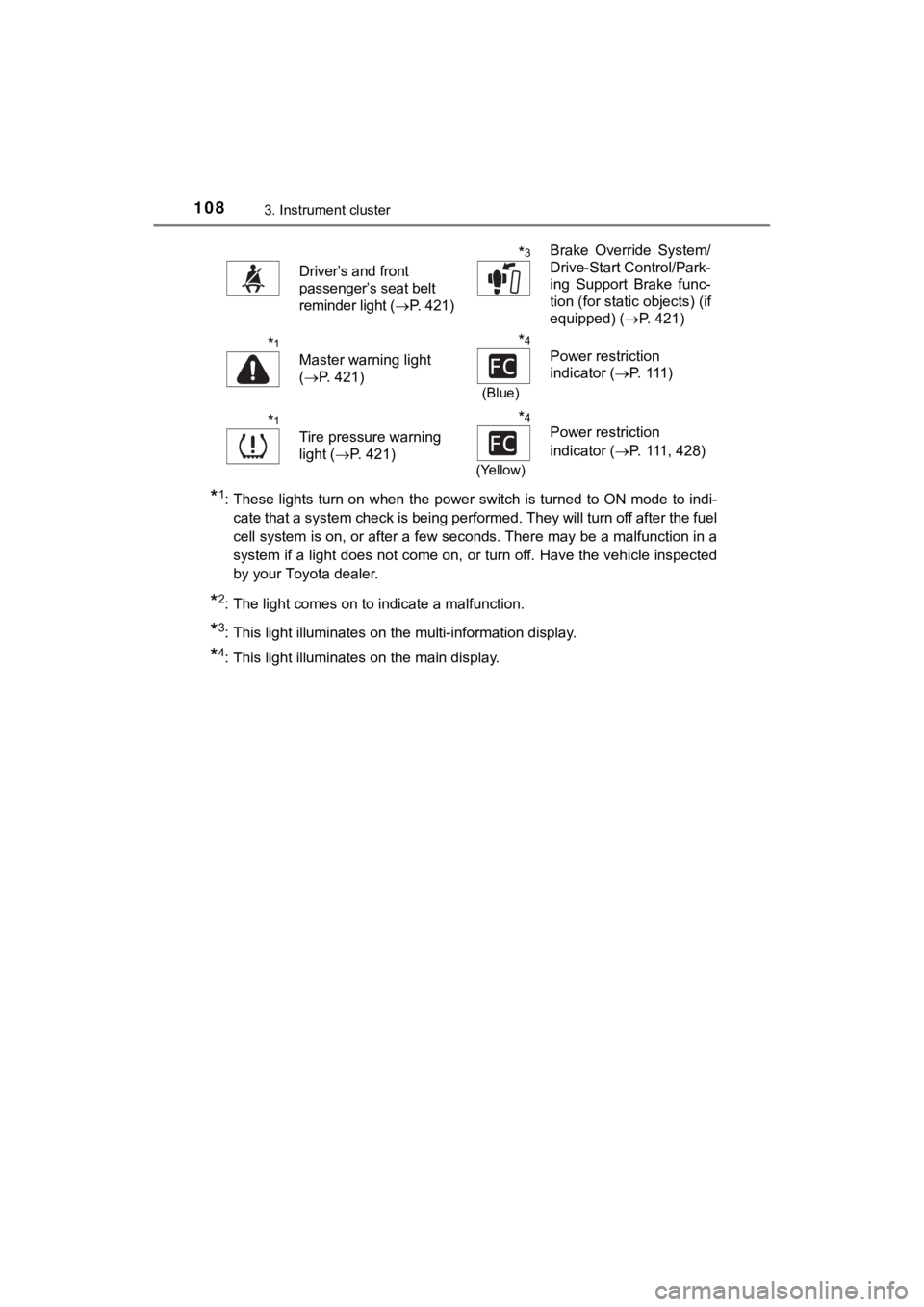
*1: These lights turn on when the power switch is turned to ON mode to indi-
cate that a system check is being performed. They will turn off after the fuel
cell system is on, or after a few seconds. There may be a malfu nction in a
system if a light does not come on, or turn off. Have the vehic le inspected
by your Toyota dealer.
*2: The light comes on to indicate a malfunction.
*3: This light illuminates on the multi-information display.
*4: This light illuminates on the main display.
Driver’s and front
passenger’s seat belt
reminder light ( P. 421)
*3Brake Override System/
Drive-Start Control/Park-
ing Support Brake func-
tion (for static objects) (if
equipped) ( P. 421)
*1
Master warning light
(P. 421)
*4
(Blue)
Power restriction
indicator ( P. 111 )
*1
Tire pressure warning
light ( P. 421)
*4
(Yellow)
Power restriction
indicator ( P. 111, 428)
Page 213 of 528
2135-4. Refueling
5
Driving
MIRAI_OM_USA_OM62054U(18MY)_O
M62048U(19MY)
Opening the fuel door
●Close the all the doors and windows.
● Set the parking brake.
● Shift the shift position to P.
● Turn the power switch off.
● Turn off the headlights.
■Fuel Type
Compressed hydrogen gas
■ Notes on fueling
●Fueling will not be possible if the pressure inside the vehicle ’s hydrogen tanks
is higher than the supply pressure of the hydrogen station. If the hydrogen
tanks are more than half full, the vehicle will be unable to fu el at a H35 dis-
penser.
A hydrogen station with a H70 dispenser (supply pressure of 101 50 psi
[70 MPa, 714 kgf/cm
2, 700 bar] is necessary to completely fill hydrogen tanks.
● If the fueling cannot be completed due to trouble with the station equipment,
call the number indicated on the equipment.
● Fuel with compressed hydrogen g as only at hydrogen stations.
● Fuel at hydrogen stations confor ming with the Society of Automo-
tive Engineers (SAE) J2601 fueling protocol or laws that may
supersede such SAE protocols.
●
Refer to the Mirai Station Finder Application in Entune,
www.toyota.com
(for U.S. owners) or www.toyota.ca (for
Canadian owners), or call 1-800-331-4331 (for U.S. owners)
or 1-888-869-6828 (for Canadian owners).
● Observe any notic es or instructions show n at hydrogen stations.
● The filling time and amount of fuel may depend on outside tem-
perature and the equipment at that hydrogen station.
● Vehicles with expired hydrogen tanks must not be used. ( P. 94)
Consult your Toyota dealer.
Before filling
Page 237 of 528
2375-5. Using the driving support systems
5
Driving
MIRAI_OM_USA_OM62054U(18MY)_O
M62048U(19MY)• When driving through steam or smoke
• When the surrounding area is dim, such as at dawn or dusk, or
while at
night or in a tunnel, making a detectable object appear to be n early the
same color as its surroundings
• When driving in a place where the surrounding brightness changes sud- denly, such as at the entrance or exit of a tunnel
• After the fuel cell system has started the vehicle has not bee n driven for a
certain amount of time
• While making a left/right turn and for a few seconds after mak ing a left/
right turn
• While driving on a curve and for a few seconds after driving o n a curve
• If your vehicle is skidding
• If the wheels are misaligned
• If a wiper blade is blocking the front camera
• The vehicle is being driven at extremely high speeds
• When driving on a hill
• If the radar sensor or front camera is misaligned
● In some situations such as the following, sufficient braking fo rce may not be
obtained, preventing the system from performing properly:
• If the braking functions cannot operate to their full extent, such as when
the brake parts are extremely cold, extremely hot, or wet
• If the vehicle is not properly maintained (brakes or tires are excessively
worn, improper tire inflation pressure, etc.)
• When the vehicle is being driven on a gravel road or other sli ppery sur-
face
■ If VSC is disabled
●If VSC is disabled ( P. 297), the pre-collision brake assist and pre-collision
braking functions are also disabled.
● The PCS warning light will turn on and “VSC Turned Off Pre-Coll ision Brake
System Unavailable” will be displayed on the multi-information display.
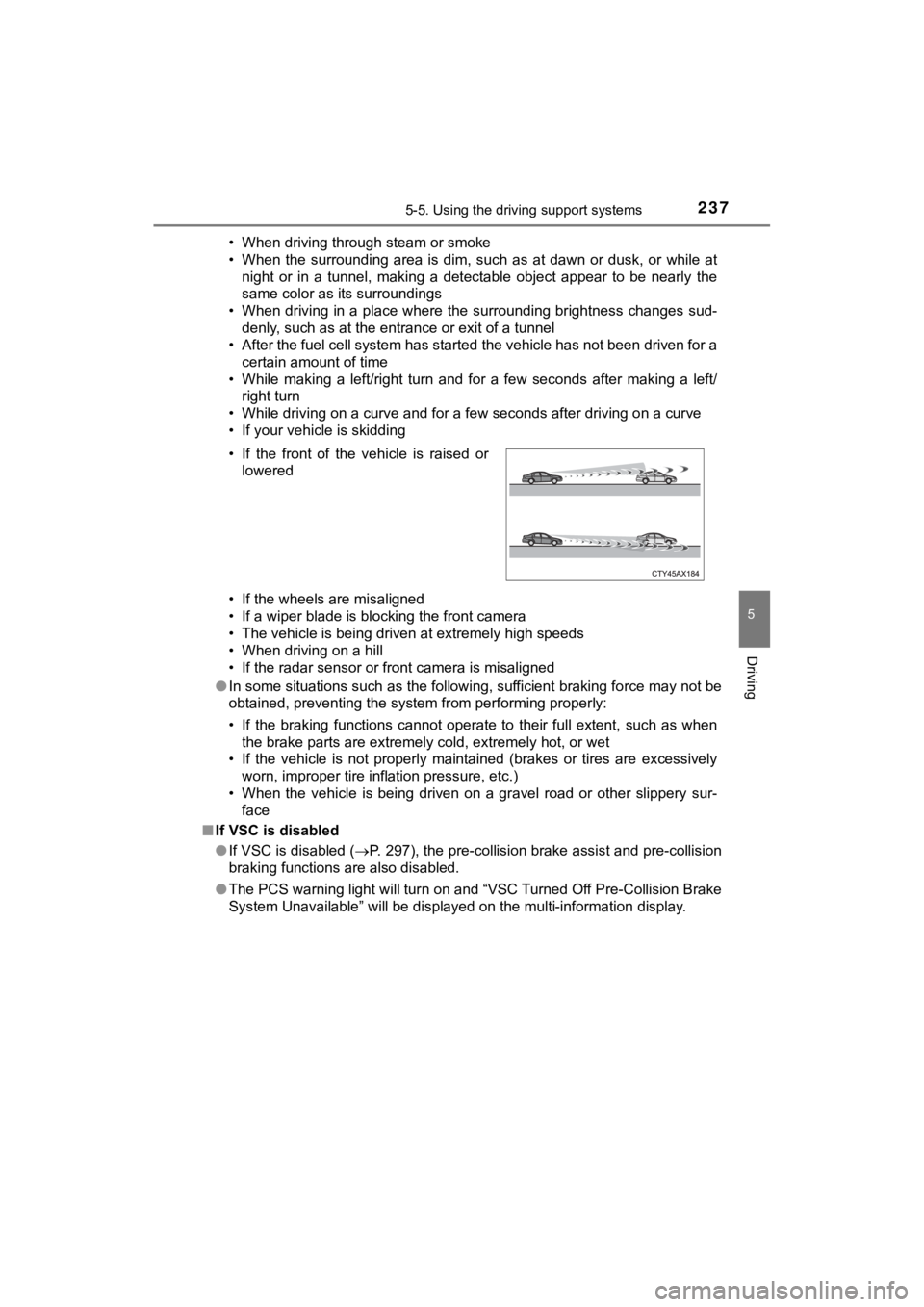
• If the front of the vehicle is raised or
lowered
Page 355 of 528
3557-1. Maintenance and care
MIRAI_OM_USA_OM62054U(18MY)_O
M62048U(19MY)
7
Maintenance and care
NOTICE
■Cleaning the exterior lights
● Wash carefully. Do not use organic substances or scrub with a h ard brush.
This may damage the surfaces of the lights.
● Do not apply wax to the surfaces of the lights.
Wax may cause damage to the lenses.
■ When washing the car
Do not remove the vehicle receptacle cap and directly pour wate r over the
vehicle receptacle. If water enters the vehicle receptacle, dam age may
occur.
■ When using an automatic car wash
Set the wiper switch to the off position. ( P. 210)
If the wiper switch is in “AUTO” the wipers may operate and the wiper
blades may be damaged.
■ When using a high pressure car wash
● When washing the vehicle, do not let water of the high pressure washer hit
directly or the vicinity of the camera. Due to the shock from t he high pres-
sure water, it is possible the device may not operate as normal .
● Do not bring the nozzle tip close to boots (rubber or resin man ufactured
cover), connectors or the following parts. The parts may be dam aged if
they come into contact with high-pressure water.
• Fuel cell stack
• Traction related parts
• Steering parts
• Suspension parts
• Brake parts
● Keep the cleaning nozzle at least 11.9 in. (30 cm) away from th e vehicle
body. Otherwise resin section, such as moldings and bumpers, ma y be
deformed and damaged. Also, do not continuously hold the nozzle in the
same place.
● Do not spray the lower part of the windshield continuously. If water enters
the air conditioning system intake located near the lower part of the wind-
shield, the air conditioning system may not operate correctly.
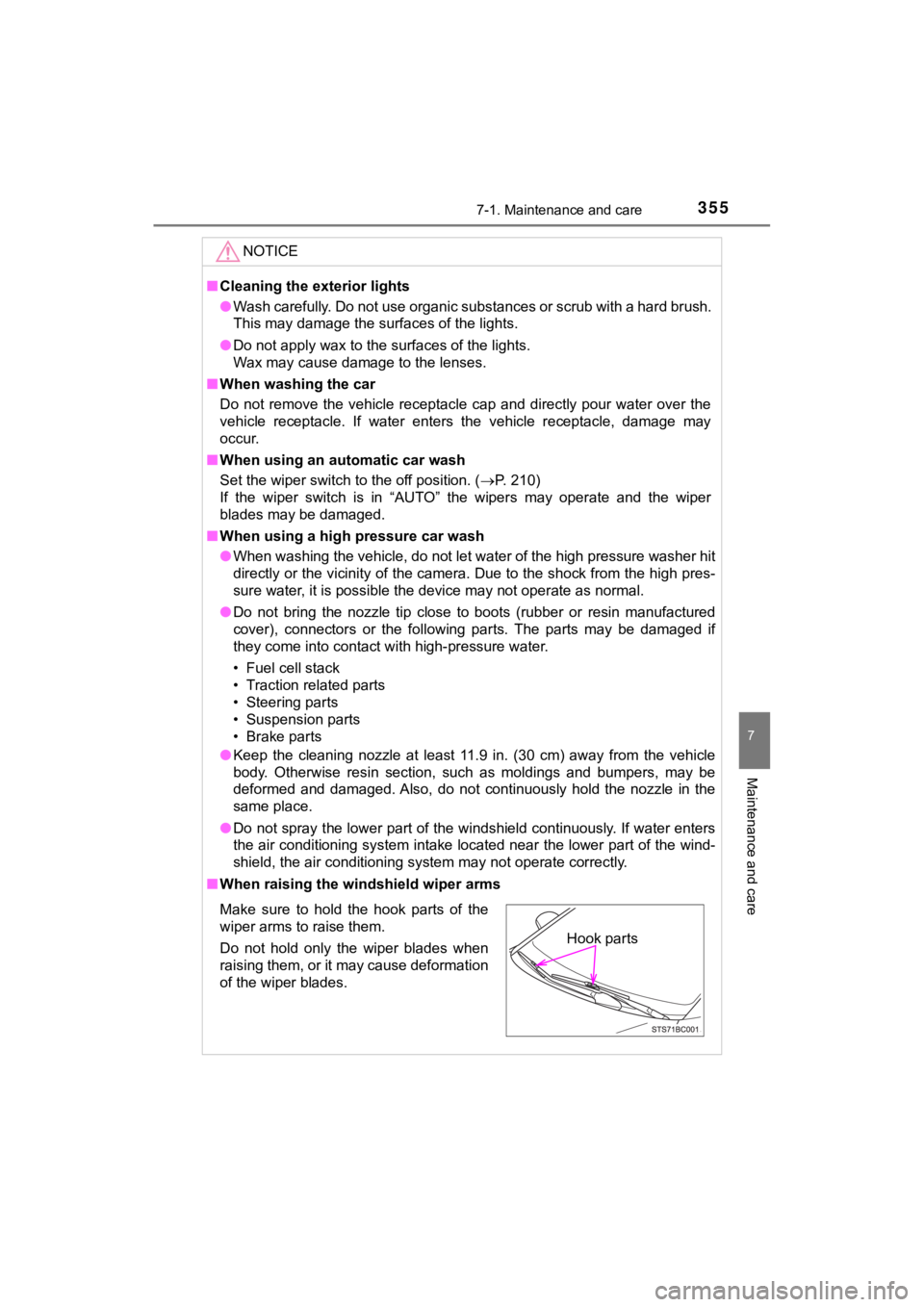
■ When raising the windshield wiper arms
Make sure to hold the hook parts of the
wiper arms to raise them.
Do not hold only the wiper blades when
raising them, or it may cause deformation
of the wiper blades.
Hook parts
Page 371 of 528
3717-3. Do-it-yourself maintenance
MIRAI_OM_USA_OM62054U(18MY)_O
M62048U(19MY)
7
Maintenance and care
■If the inverter coolant level drops within a short time of repl enishing
Visually check the radiators, hoses, inverter coolant reservoir cap, drain cock
and water pump.
If you cannot find a leak, have your Toyota dealer test the cap and check for
leaks in the cooling system.
Check the radiator and condenser and clear away any foreign objects.
If either of the above parts is extremely dirty or you are not sure of
their condition, have your vehic le inspected by your Toyota dea ler.
WARNING
■When the fuel cell system is hot
Do not remove the coolant reservoir caps.
The cooling system may be under pressure and may spray hot coolant if the
cap is removed, causing serious injuries, such as burns.
NOTICE
■When adding coolant
Coolant is neither plain water nor straight antifreeze. The cor rect mixture of
water and antifreeze must be used to provide proper lubrication , corrosion
protection and cooling. Be sure to read the antifreeze or coolant label.
■ If you spill coolant
Be sure to wash it off with water to prevent it from damaging p arts or paint.
Radiator and condenser
WARNING
■When the fuel cell system is hot
Do not touch the radiator or condenser as they may be hot and c ause seri-
ous injuries, such as burns.
Page 394 of 528
3947-3. Do-it-yourself maintenance
MIRAI_OM_USA_OM62054U(18MY)_O
M62048U(19MY)
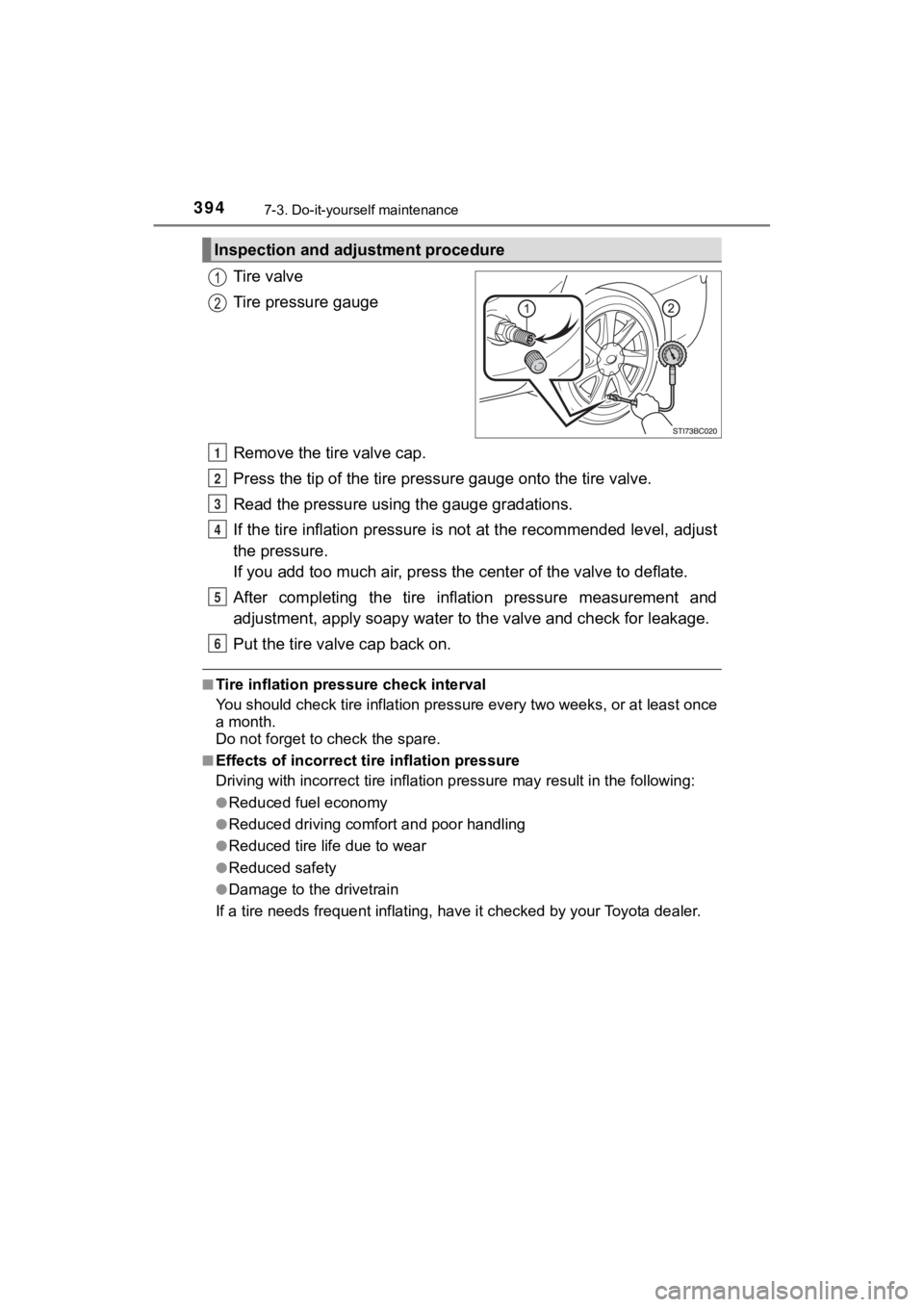
Tire valve
Tire pressure gauge
Remove the tire valve cap.
Press the tip of the tire pressure gauge onto the tire valve.
Read the pressure using the gauge gradations.
If the tire inflation pressure is not at the recommended level, adjust
the pressure.
If you add too much air, press the center of the valve to defla te.
After completing the tire inflation pressure measurement and
adjustment, apply soapy water to the valve and check for leakage.
Put the tire valve cap back on.
■Tire inflation pressure check interval
You should check tire inflation p ressure every two weeks, or at least once
a month.
Do not forget to check the spare.
■Effects of incorrect tire inflation pressure
Driving with incorrec t tire inflation pressure may result in th e following:
●Reduced fuel economy
●Reduced driving comfort and poor handling
●Reduced tire life due to wear
●Reduced safety
●Damage to the drivetrain
If a tire needs frequent inflating , have it checked by your Toyota dealer.
Inspection and adjustment procedure
1
2
3
4
5
6
Page 425 of 528

4258-2. Steps to take in an emergency
MIRAI_OM_USA_OM62054U(18MY)_O
M62048U(19MY)
8
When trouble arises
WARNING
■Maintenance of the tires
Each tire, including the spare (if provided), should be checked monthly
when cold and inflated to the inflation pressure recommended by the
vehicle manufacturer on the vehicle placard or tire inflation p ressure
label (tire and load information label). (If your vehicle has t ires of a dif-
ferent size than the size indica ted on the vehicle placard or tire inflation
pressure label [tire and load information label], you should de termine
the proper tire inflation p ressure for those tires.)
As an added safety feature, your vehicle has been equipped with a tire
pressure monitoring system (TPMS -tire pressure warning system) that
illuminates a low tire pressure telltale (tire pressure warning light) when
one or more of your tires is significantly under-inflated. Acco rdingly,
when the low tire pressure telltale (tire pressure warning ligh t) illumi-
nates, you should stop and check your tires as soon as possible , and
inflate them to the proper pressure. Driving on a significantly under-
inflated tire causes the tire to overheat and can lead to tire failure.
Under-inflation also reduces fuel efficiency and tire tread lif e, and may
affect the vehicle’s handl ing and stopping ability.
Please note that the TPMS (tire pressure warning system) is not a sub-
stitute for proper tire maintena nce, and it is the driver’s responsibility to
maintain correct tire pressure, even if under-inflation has not reached
the level to trigger illumination of the TPMS low tire pressure telltale (tire
pressure warning light).
Your vehicle has also been equipped with a TPMS (tire pressure warn-
ing system) malfunction indicato r to indicate when the system is not
operating properly. The TPMS (tire pressure warning system) mal func-
tion indicator is combined with the low tire pressure telltale (tire pressure
warning light). When the system detects a malfunction, the tell tale will
flash for approximately one mi nute and then remain continuously illumi-
nated. This sequence will continue upon subsequent vehicle star t-ups
as long as the malfunction exists . When the malfunction indicator is illu-
minated, the system may not be able to detect or signal low tir e pres-
sure as intended.
TPMS (tire pressure warning system) malfunctions may occur for a vari-
ety of reasons, including the installation of replacement or al ternate tires
or wheels on the vehicle that prevent the TPMS (tire pressure w arning
system) from functioning properly. Always check the TPMS (tire pres-
sure warning system) malfunction telltale after replacing one or more
tires or wheels on your vehicle to ensure that the replacement or alter-
nate tires and wheels allow the TPMS (tire pressure warning sys tem) to
continue to function properly.