suspension TOYOTA MIRAI 2020 Owners Manual (in English)
[x] Cancel search | Manufacturer: TOYOTA, Model Year: 2020, Model line: MIRAI, Model: TOYOTA MIRAI 2020Pages: 528, PDF Size: 11.98 MB
Page 43 of 528

431-1. For safe use
1
For safety and security
MIRAI_OM_USA_OM62073U
WARNING
■SRS airbag precautions
● Do not strike or apply significant levels of force to the area of the SRS
airbag components.
Doing so can cause the SRS airbags to malfunction.
● Do not touch any of the component parts immediately after the SRS
airbags have deployed (inflated) as they may be hot.
● If breathing becomes difficult after the SRS airbags have deplo yed, open a
door or window to allow fresh air in, or leave the vehicle if i t is safe to do
so. Wash off any residue as soon as possible to prevent skin ir ritation.
● If the areas where the SRS airbags are stored, such as the steering wheel
pad and front and rear pillars garnishes, are damaged or cracke d, have
them replaced by your Toyota dealer.
● Do not place anything, such as a cushion, on the front passenger’s seat.
Doing so will disperse the passenger’s weight, which prevents t he sensor
from detecting the passenger’s weight properly. As a result, th e SRS front
airbags for the front passenger may not deploy in the event of a collision.
■ Modification and disposal of SRS airbag system components
Do not dispose of your vehicle or perform any of the following modifications
without consulting your Toyota dealer. The SRS airbags may malfunction or
deploy (inflate) accidentally, causing death or serious injury.
● Installation, removal, disassembly and repair of the SRS airbag s
● Repairs, modifications, removal or replacement of the steering wheel,
instrument panel, dashboard, seats or seat upholstery, front, s ide and rear
pillars or roof side rails
● Repairs or modifications of the front fender, front bumper, or side of the
occupant compartment
● Installation of a grille guard (bull bars, kangaroo bar, etc.), snow plows,
winches, or roof luggage carrier
● Modifications to the vehicle’s suspension system
● Installation of electronic devices such as mobile two-way radio s and CD
players
● Modifications to your vehicle for a person with a physical disa bility
Page 179 of 528

1795-1. Before driving
5
Driving
MIRAI_OM_USA_OM62073U
NOTICE
■Avoiding damage to vehicle parts
● Do not turn the steering wheel fully in either direction and ho ld it there for
an extended period of time.
Doing so may damage the power steering motor.
● When driving over bumps in the road, drive as slowly as possibl e to avoid
damaging the wheels, underside of the vehicle, etc.
■ If you get a flat tire while driving
A flat or damaged tire may cause the following situations. Hold the steering
wheel firmly and gradually depress the brake pedal to slow down the vehi-
cle.
● It may be difficult to control your vehicle.
● The vehicle will make abnormal sounds or vibrations.
● The vehicle will lean abnormally.
Information on what to do in case of a flat tire ( P. 432)
■ When encountering flooded roads
Do not drive on a road that has flooded after heavy rain, etc. Doing so may
cause the following serious damage to the vehicle:
● Fuel cell system stalling
● Short in electrical components
● Fuel cell system damage caused by water immersion
In the event that you drive on a flooded road and the vehicle i s flooded, be
sure to have your Toyota dealer check the following:
● Fuel cell system
● Brake function
● Changes in quantity and quality of transmission fluid, etc.
● Lubricant condition for the bearings and suspension joints (whe re possi-
ble), and the function of all joints, bearings, etc.
If the shift control system is damaged by flooding, it may not be possible to
shift the shift position to P, or from P to other positions. Wh en the shift posi-
tion cannot be changed from P to any other position, the front wheels will
lock, and you will be unable to tow the vehicle with the front wheels on the
ground, as the front wheels may be locked. In this case, transp ort the vehi-
cle with both front wheels or all four wheels lifted.
■ If the vehicle will not shift out of the P position
There is a possibility that the 12-volt battery is discharged. Check the
12-volt battery in this situation.
Page 239 of 528
2395-5. Using the driving support systems
5
Driving
MIRAI_OM_USA_OM62073U
WARNING
●When the tires have been excessively worn, or when the tire inf lation pres-
sure is low.
● When tires of a size other than specified are installed.
● Vehicle is driven in traffic lanes other than that highways and freeways.
● During emergency towing
■ Preventing LDA system malfunctio ns and operations performed by
mistake
● Do not modify the headlights or place stickers, etc. on the sur face of the
lights.
● Do not modify the suspension etc. If the suspension etc. needs to be
replaced, contact your Toyota dealer.
● Do not install or place anything on the hood or grille. Also, d o not install a
grille guard (bull bars, kangaroo bar, etc.).
● If your windshield needs repairs, contact your Toyota dealer.
■ Conditions in which functions may not operate properly
In the following situations, the functions may not operate prop erly and the
vehicle may depart from its lane. Drive safely by always paying careful
attention to your surroundings and operate the steering wheel t o correct the
path of the vehicle without relying solely on the functions.
● Vehicle is being driven around a sharp curve.
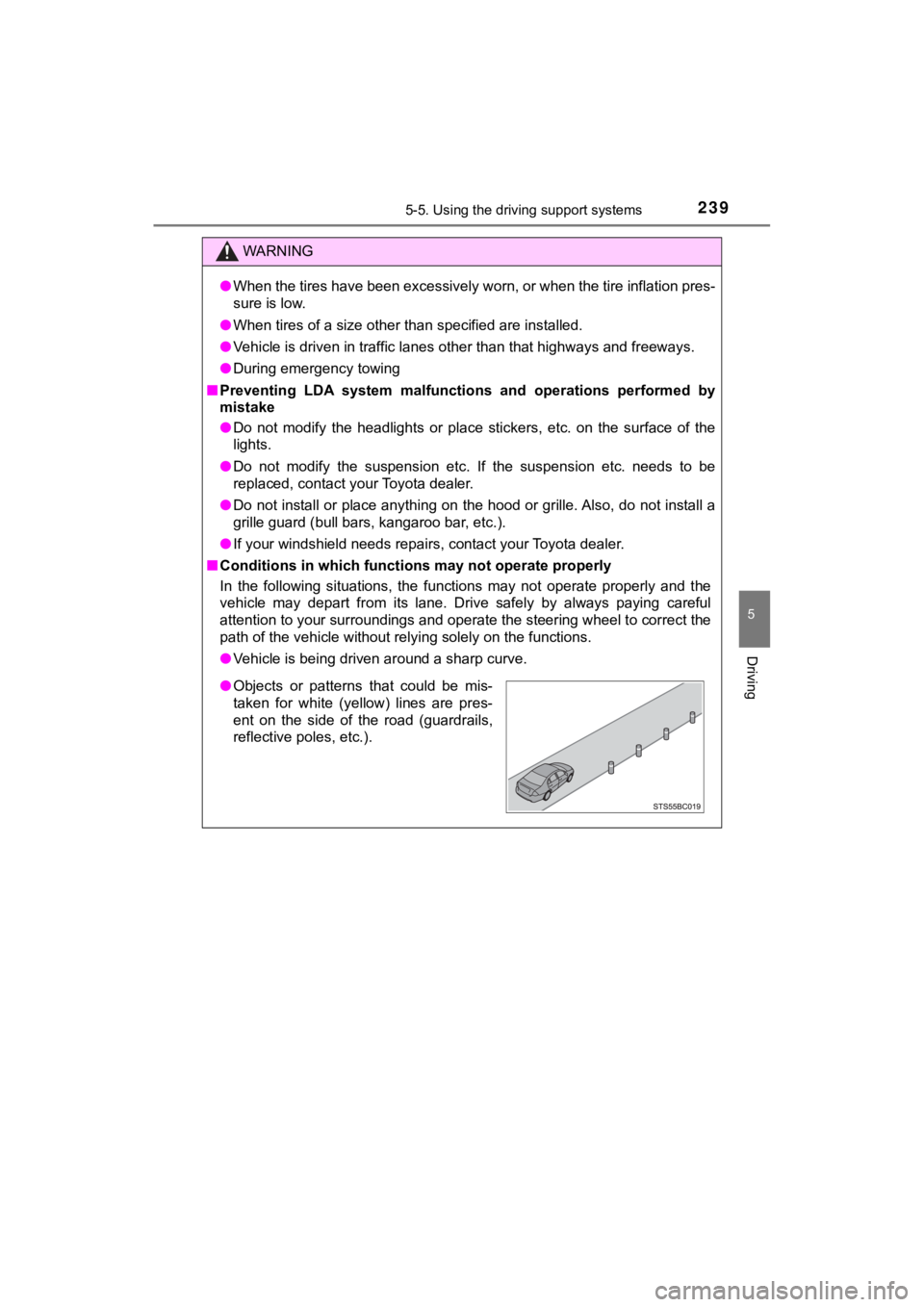
●Objects or patterns that could be mis-
taken for white (yellow) lines are pres-
ent on the side of the road (guardrails,
reflective poles, etc.).
Page 270 of 528

2705-5. Using the driving support systems
MIRAI_OM_USA_OM62073U■
Sensor detection information
●The sensor’s detection areas are limited to the areas around th e vehicle’s
bumper.
● Certain vehicle conditions and the surrounding environment may affect the
ability of a sensor to correctly detect an obstacle. Particular instances where
this may occur are listed below.
• There is dirt, snow or ice on the sensor. (Wiping the sensors will resolve
this problem.)
• The sensor is frozen. (Thawing the area will resolve this problem.)
In especially cold weather, if a sensor is frozen the screen ma y show an
abnormal display, or obstacles may not be detected.
• The sensor is covered in any way.
• The vehicle is leaning considerably to one side.
• On an extremely bumpy road, on an incline, on gravel, or on grass.
• The vicinity of the vehicle is noisy due to vehicle horns, motorcycle
engines, air brakes of large vehicles, or other loud noises pro ducing ultra-
sonic waves.
• There is another vehicle equipped with parking assist sensors in the
vicinity.
• The sensor is coated with a sheet of spray or heavy rain.
• The vehicle is equipped with a fender pole or wireless antenna .
• Towing eyelets are installed.
• The bumper or sensor receives a strong impact.
• A backlit license plate, license plate holder, etc., are insta lled.
• The vehicle is approaching a tall or curved curb.
• In harsh sunlight or intense cold weather.
• The area directly under the bumpers is not detected.
• If obstacles draw too close to the sensor.
• A non-genuine Toyota suspension (lowered suspension etc.) is i nstalled.
• People may not be detected if they are wearing certain types o f clothing.
In addition to the examples above, there are instances in which, because of
their shape, signs and other objects may be judged by a sensor to be closer
than they are.
● The shape of the obstacle may prevent a sensor from detecting i t. Pay par-
ticular attention to the following obstacles:
• Wires, fences, ropes, etc.
• Cotton, snow and other materials that absorb sound waves
• Sharply-angled objects
• Low obstacles
• Tall obstacles with upper sections projecting outwards in the direction of your vehicle
Page 284 of 528

2845-5. Using the driving support systems
MIRAI_OM_USA_OM62073U
WARNING
■For safe use
Do not rely solely upon the system. Relying solely upon the sys tem may
lead to an unexpected accident.
● Driving safely is the sole responsibility of the driver. Pay ca reful attention
to the surrounding conditions in order to ensure safe driving. The Parking
Support Brake function (for static objects) can provide support to lessen
the severity of collisions. However, it may not operate dependi ng on the
situation.
● The Parking Support Brake function (for static objects) is not a system
designed to completely stop the vehicle. Furthermore, even if t he brake
control is able to stop the vehicle, brake control is canceled after approxi-
mately 2 seconds, so depress the brake pedal immediately.
■ In order for the system to operate properly
Make sure to observe the following precautions regarding the se nsors
( P. 265). Failure to observe these precautions may cause the sen sors
not to operate properly, and may result in an unexpected accide nt.
● Do not perform work such as modification, disassembly or painti ng
● Only perform replacements using genuine parts
● Do not subject the area around the sensors to any impacts
● Do not damage the sensors, and always keep them clean
■ Handling the suspension
Do not modify the suspension, as changes to the height or incli ne of the
vehicle may prevent the sensors from correctly detecting obstac les, may
cause the system not operate, or may cause the system to operate unnec-
essarily.
Page 285 of 528

2855-5. Using the driving support systems
5
Driving
MIRAI_OM_USA_OM62073U
NOTICE
■Preventing sensor malfunctions
● If the area around a sensor is subjected to an impact, equipment may not
operate properly due to a sensor malfunction. Have the vehicle inspected
at your Toyota dealer.
● When using a high-pressure washer to wash the vehicle, do not s pray
water directly on the sensors. The sensors may not function pro perly if
subjected to an impact from strong water pressure.
● When using steam to wash the vehicle, do not direct steam too c lose to
the sensors. The sensors may not function properly if subjected to steam.
■ Preventing unnecessary operation
In the following situations, turn the Parking Support Brake fun ction (for static
objects) off. The system may operate even though there is no po ssibility of
a collision.
● A chassis roller, chassis dynamo, free roller or similar equipm ent is being
used for an inspection, etc.
● The vehicle is being loaded onto a ship, truck or other transpo rt vessel
● The suspension has been lowered or tires that have a different size than
the genuine tires are equipped
● The height of the vehicle has drastically changed due to the ca rried load
(the nose tilts up or down).
● A towing eyelet is installed
● When using an automatic car wash
Page 300 of 528

3005-5. Using the driving support systems
MIRAI_OM_USA_OM62073U
WARNING
■Replacing tires
Make sure that all tires are of the specified size, brand, trea d pattern and
total load capacity. In addition, make sure that the tires are inflated to the
recommended tire inflation pressure level.
The ABS, TRAC and VSC systems will not function correctly if di fferent tires
are installed on the vehicle.
Contact your Toyota dealer for further information when replaci ng tires or
wheels.
■ Handling of tires and the suspension
Using tires with any kind of problem or modifying the suspensio n will affect
the driving assist systems, and may cause a system to malfuncti on.
Page 335 of 528
3356-4. Other interior features
6
Interior features
MIRAI_OM_USA_OM62073U■
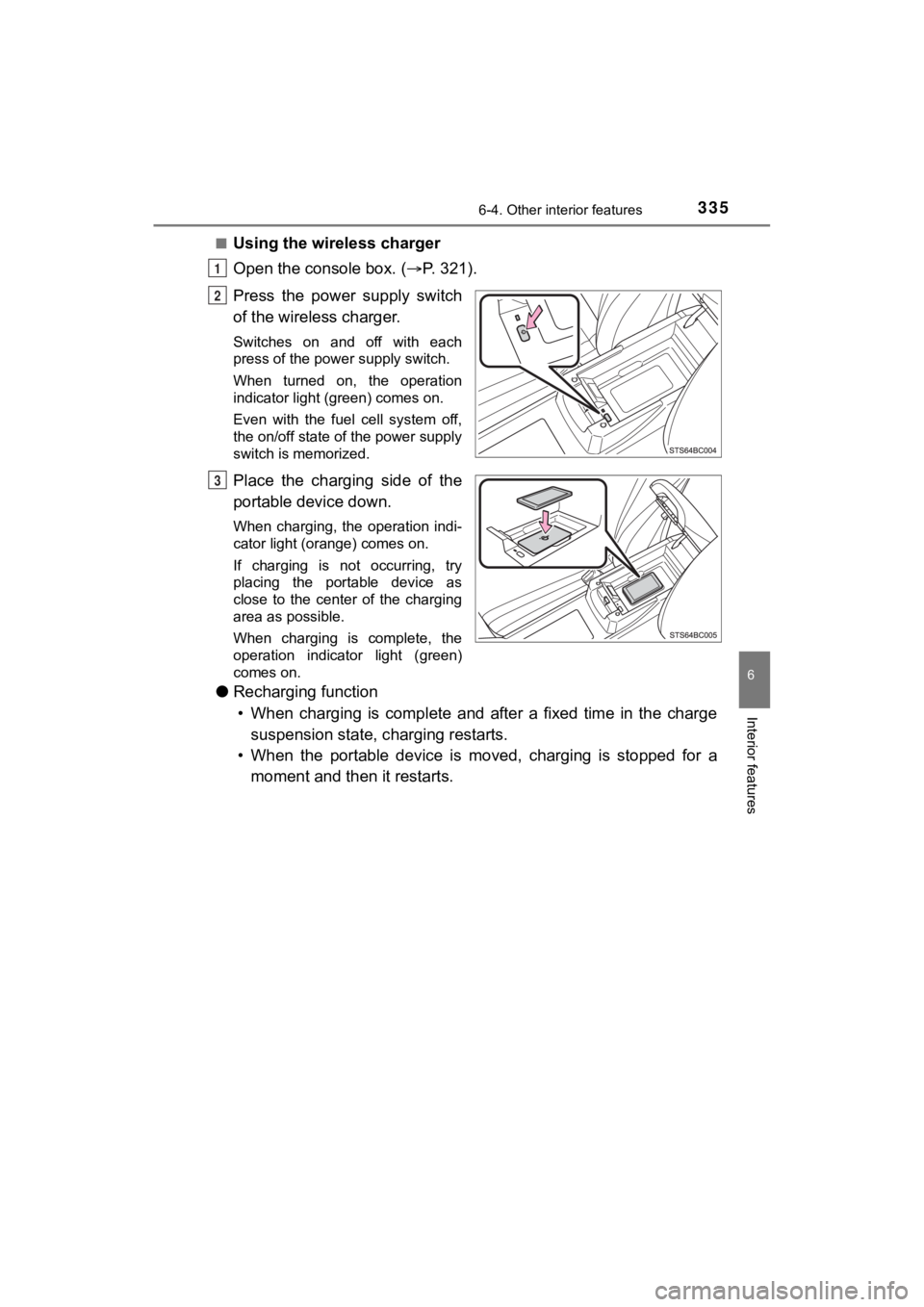
Using the wireless charger
Open the console box. (
P. 3 2 1 ) .
Press the power supply switch
of the wireless charger.
Switches on and off with each
press of the power supply switch.
When turned on, the operation
indicator light (green) comes on.
Even with the fuel cell system off,
the on/off state of the power supply
switch is memorized.
Place the charging side of the
portable device down.
When charging, the operation indi-
cator light (orange) comes on.
If charging is not occurring, try
placing the portable device as
close to the center of the charging
area as possible.
When charging is complete, the
operation indicator light (green)
comes on.
● Recharging function
• When charging is complete and after a fixed time in the charge suspension state, c harging restarts.
• When the portable device is moved, charging is stopped for a moment and then it restarts.
1
2
3
Page 355 of 528
3557-1. Maintenance and care
MIRAI_OM_USA_OM62073U
7
Maintenance and care
NOTICE
■Cleaning the exterior lights
● Wash carefully. Do not use organic substances or scrub with a h ard brush.
This may damage the surfaces of the lights.
● Do not apply wax to the surfaces of the lights.
Wax may cause damage to the lenses.
■ When washing the car
Do not remove the vehicle receptacle cap and directly pour wate r over the
vehicle receptacle. If water enters the vehicle receptacle, dam age may
occur.
■ When using an automatic car wash
Set the wiper switch to the off position. ( P. 210)
If the wiper switch is in “AUTO” the wipers may operate and the wiper
blades may be damaged.
■ When using a high pressure car wash
● When washing the vehicle, do not let water of the high pressure washer hit
directly or the vicinity of the camera. Due to the shock from t he high pres-
sure water, it is possible the device may not operate as normal .
● Do not bring the nozzle tip close to boots (rubber or resin man ufactured
cover), connectors or the following parts. The parts may be dam aged if
they come into contact with high-pressure water.
• Fuel cell stack
• Traction related parts
• Steering parts
• Suspension parts
• Brake parts
● Keep the cleaning nozzle at least 11.9 in. (30 cm) away from th e vehicle
body. Otherwise resin section, such as moldings and bumpers, ma y be
deformed and damaged. Also, do not continuously hold the nozzle in the
same place.
● Do not spray the lower part of the windshield continuously. If water enters
the air conditioning system intake located near the lower part of the wind-
shield, the air conditioning system may not operate correctly.
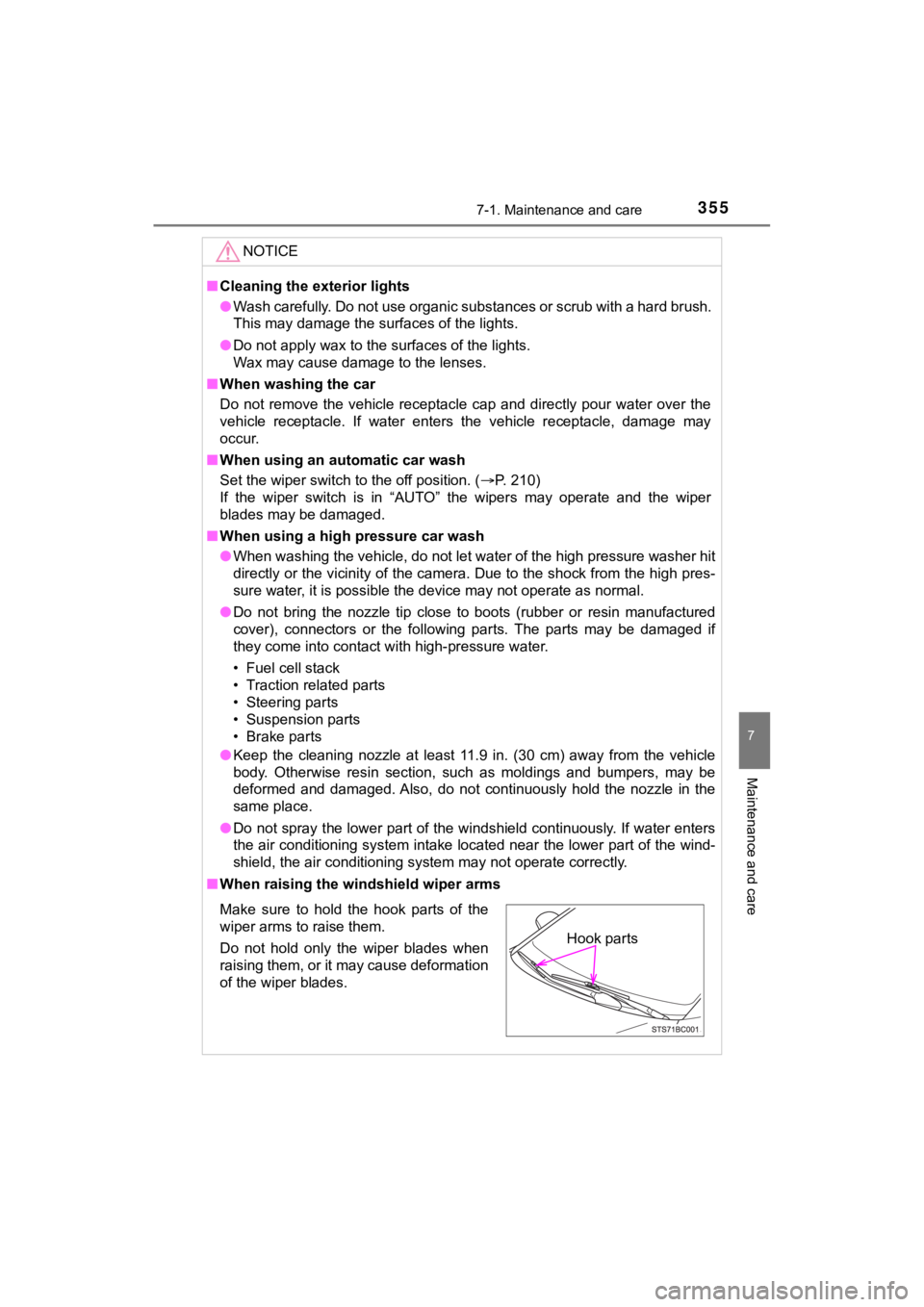
■ When raising the windshield wiper arms
Make sure to hold the hook parts of the
wiper arms to raise them.
Do not hold only the wiper blades when
raising them, or it may cause deformation
of the wiper blades.
Hook parts
Page 368 of 528
3687-3. Do-it-yourself maintenance
MIRAI_OM_USA_OM62073U
WARNING
■When raising your vehicle
Make sure to observe the following precautions to reduce the po ssibility of
death or serious injury:
● Make sure to set the floor jack properly at the jack point.
Raising the vehicle with an improperly positioned floor jack wi ll damage
the vehicle and may cause the vehicle to fall off the floor jac k.
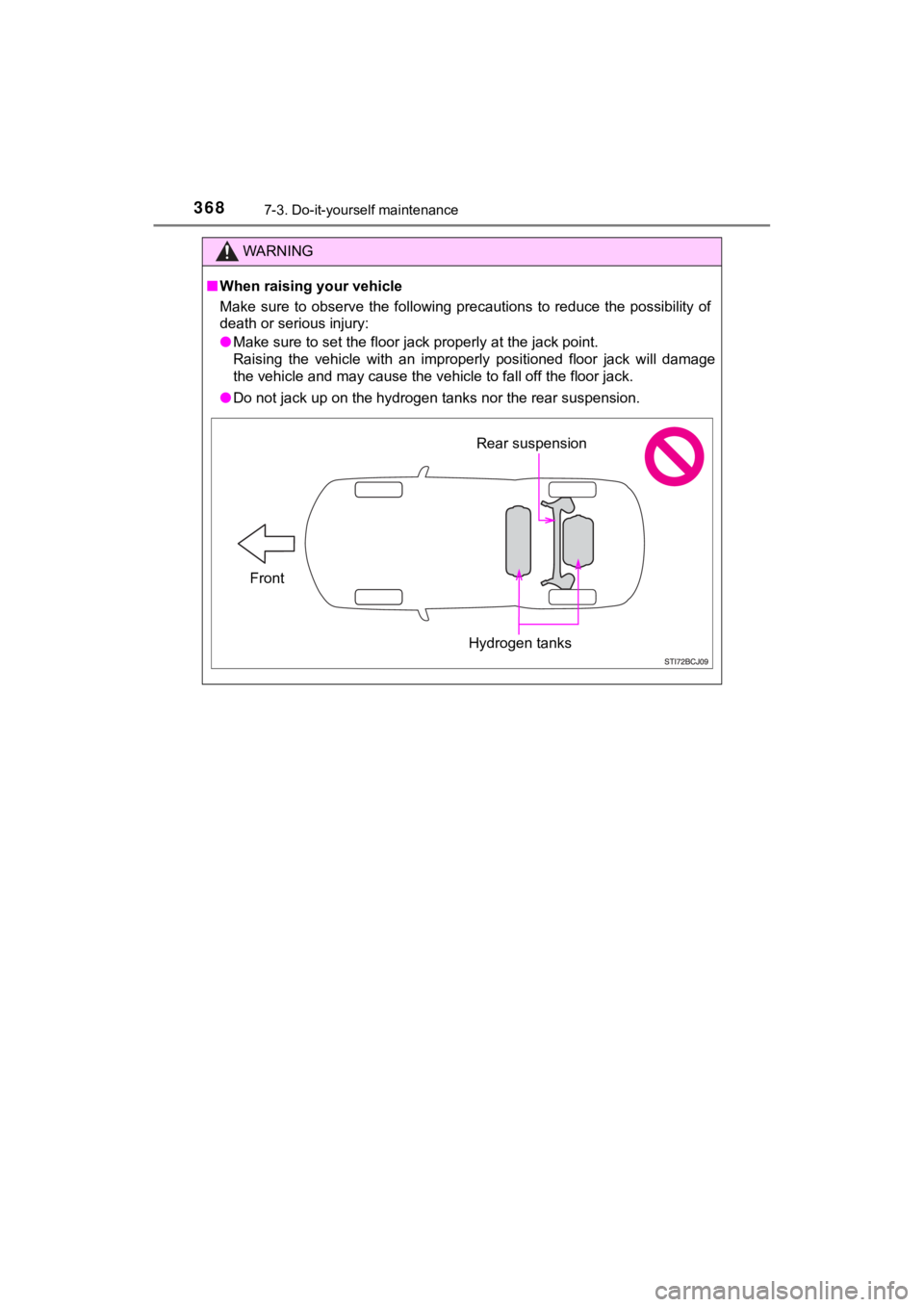
● Do not jack up on the hydrogen tanks nor the rear suspension.
Rear suspension
Hydrogen tanks
Front