brake TOYOTA MIRAI 2023 Owners Manual
[x] Cancel search | Manufacturer: TOYOTA, Model Year: 2023, Model line: MIRAI, Model: TOYOTA MIRAI 2023Pages: 572, PDF Size: 17.71 MB
Page 3 of 572
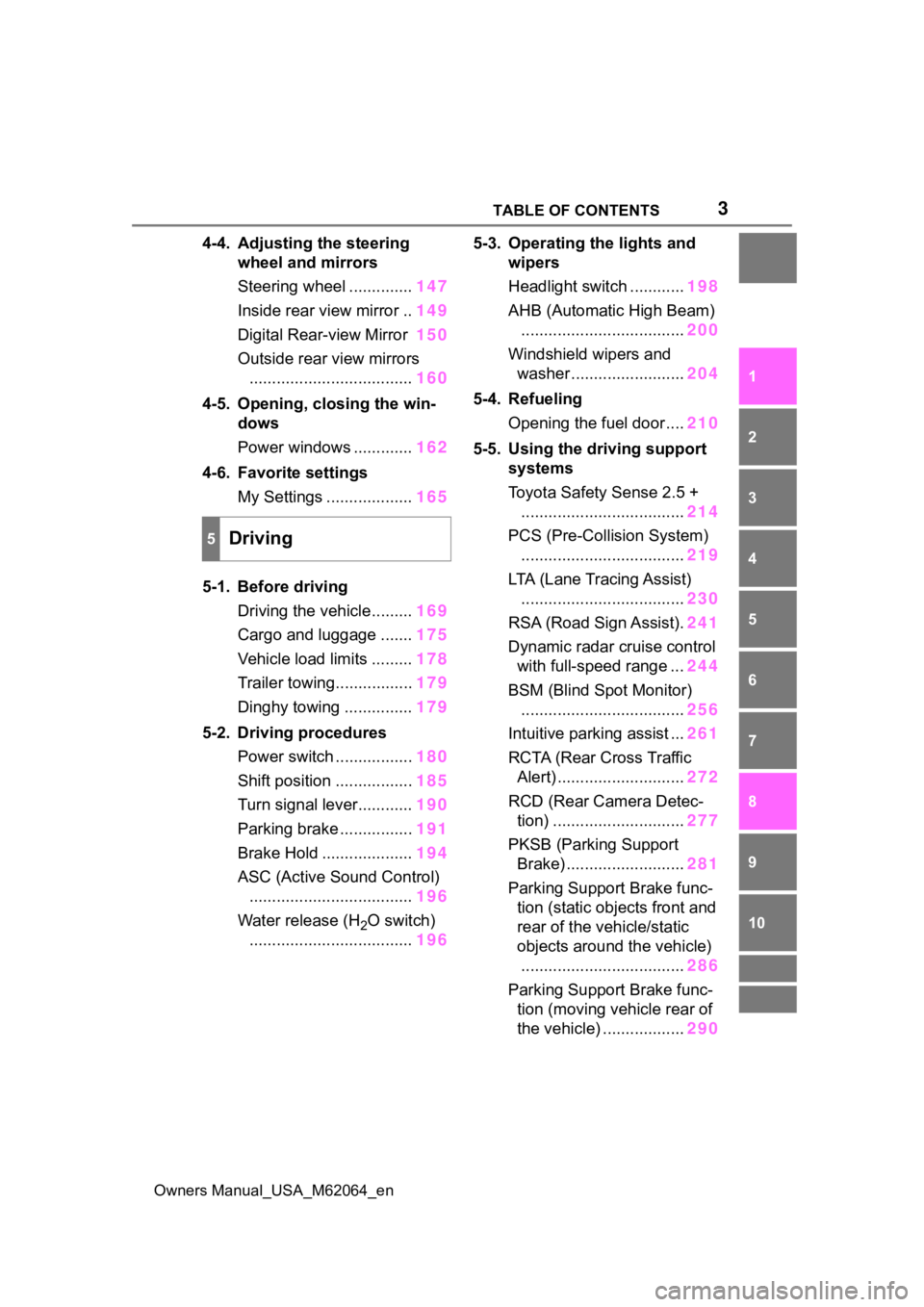
3TABLE OF CONTENTS
Owners Manual_USA_M62064_en
1
2
3
4
5
6
8 7
9
10
4-4. Adjusting the steering wheel and mirrors
Steering wheel .............. 147
Inside rear view mirror .. 149
Digital Rear-view Mirror 150
Outside rear view mirrors .................................... 160
4-5. Opening, closing the win- dows
Power windows ............. 162
4-6. Favorite settings My Settings ................... 165
5-1. Before driving Driving the vehicle......... 169
Cargo and luggage ....... 175
Vehicle load limits ......... 178
Trailer towing................. 179
Dinghy towing ............... 179
5-2. Driving procedures Power switch ................. 180
Shift position ................. 185
Turn signal lever............ 190
Parking brake ................ 191
Brake Hold .................... 194
ASC (Active Sound Control) .................................... 196
Water release (H
2O switch)
.................................... 1965-3. Operating the lights and
wipers
Headlight switch ............ 198
AHB (Automatic High Beam) .................................... 200
Windshield wipers and washer ......................... 204
5-4. Refueling Opening the fuel door .... 210
5-5. Using the driving support systems
Toyota Safety Sense 2.5 +
.................................... 214
PCS (Pre-Collision System) .................................... 219
LTA (Lane Tracing Assist) .................................... 230
RSA (Road Sign Assist). 241
Dynamic radar cruise control with full-speed range ... 244
BSM (Blind Spot Monitor) .................................... 256
Intuitive parking assist ... 261
RCTA (Rear Cross Traffic Alert) ............................ 272
RCD (Rear Camera Detec- tion) ............................. 277
PKSB (Parking Support Brake) .......................... 281
Parking Support Brake func- tion (static obj ects front and
rear of the vehicle/static
objects around the vehicle) .................................... 286
Parking Support Brake func- tion (moving vehicle rear of
the vehicle) .................. 290
5Driving
Page 4 of 572
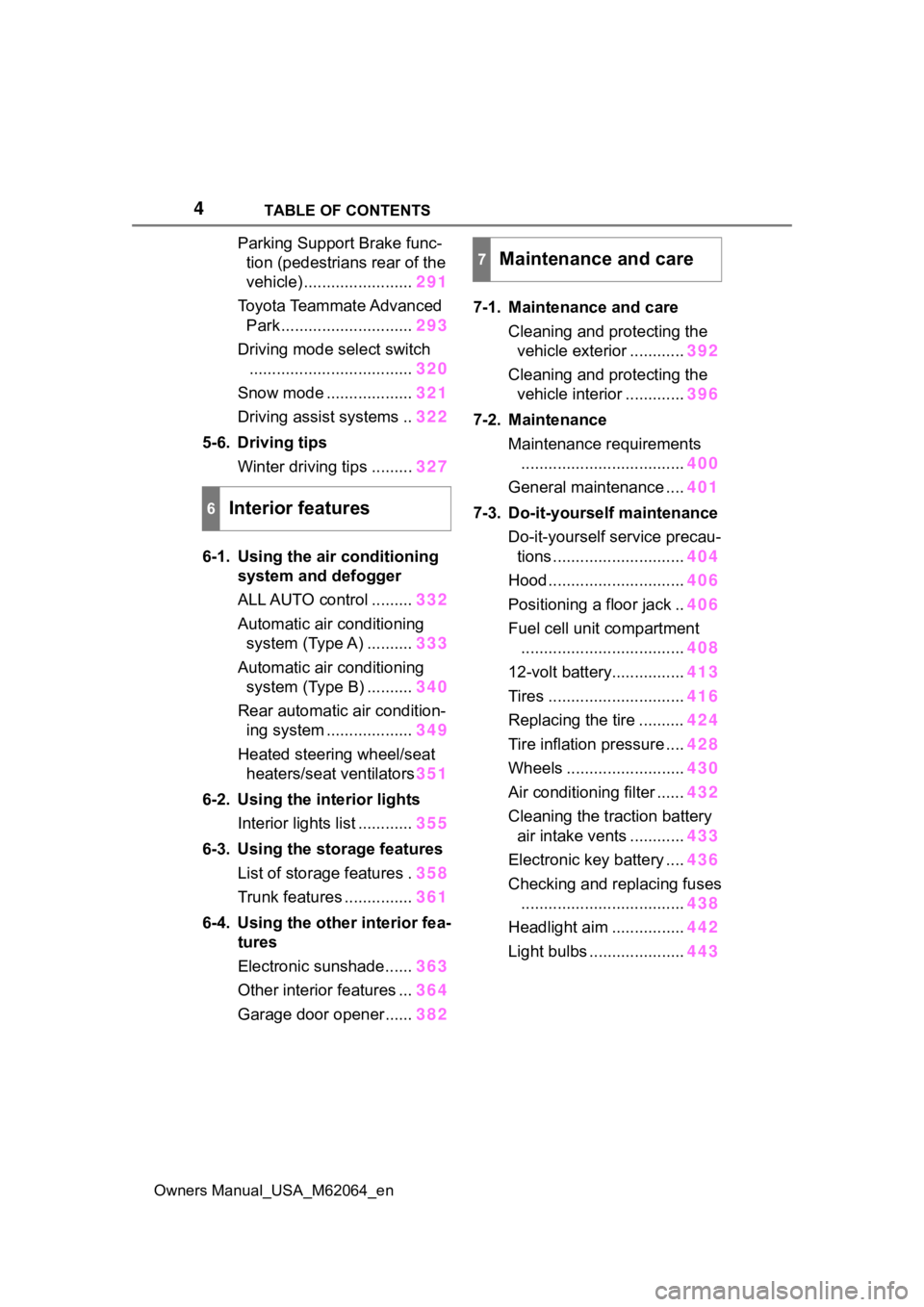
4TABLE OF CONTENTS
Owners Manual_USA_M62064_en
Parking Support Brake func-tion (pedestrians rear of the
vehicle) ........................ 291
Toyota Teammate Advanced Park ............................. 293
Driving mode select switch .................................... 320
Snow mode ................... 321
Driving assist systems .. 322
5-6. Driving tips Winter driving tips ......... 327
6-1. Using the air conditioning
system and defogger
ALL AUTO control ......... 332
Automatic air conditioning system (Type A) .......... 333
Automatic air conditioning system (Type B) .......... 340
Rear automatic air condition- ing system ................... 349
Heated steering wheel/seat heaters/seat ventilators 351
6-2. Using the interior lights Interior lights list ............ 355
6-3. Using the storage features List of storage features . 358
Trunk features ............... 361
6-4. Using the other interior fea- tures
Electronic sunshade...... 363
Other interior features ... 364
Garage door opener...... 3827-1. Maintenance and care
Cleaning and protecting the vehicle exterior ............ 392
Cleaning and protecting the vehicle interior ............. 396
7-2. Maintenance Maintenance requirements.................................... 400
General maintenance .... 401
7-3. Do-it-yourself maintenance Do-it-yourself service precau-tions ............................. 404
Hood .............................. 406
Positioning a floor jack .. 406
Fuel cell unit compartment .................................... 408
12-volt battery................ 413
Tires .............................. 416
Replacing the tire .......... 424
Tire inflation pressure .... 428
Wheels .......................... 430
Air conditioning filter ...... 432
Cleaning the traction battery air intake vents ............ 433
Electronic key battery .... 436
Checking and replacing fuses .................................... 438
Headlight aim ................ 442
Light bulbs ..................... 443
6Interior features
7Maintenance and care
Page 7 of 572

7
Owners Manual_USA_M62064_en
by installing non-genuine Toyota
products.
The installation of a mobile two-
way radio system in your vehicle
could affect electronic systems
such as:
Fuel cell system
Advanced Drive
Toyota Safety Sense 2.5 +
with Teammate
Toyota Safety Sense 2.5 +
Anti-lock brake system
Vehicle dynamics integrated
management
SRS airbag system
Seat belt pretensioner system
Be sure to check with your Toy-
ota dealer for precautionary
measures or special instructions
regarding installation of a mobile
two-way radio system.
High voltage parts and cables
on the fuel cell electric vehicles
emit approximately the same
amount of electromagnetic
waves as the conventional gas-
oline powered vehicles or home
electronic appliances despite of
their electromagnetic shielding.
Unwanted noise may occur in
the reception of the mobile two-
way radio. The vehicle is equipped with
sophisticated computers that will
record certain data, such as:
• Engine speed / Electric motor
speed (traction motor speed)
• Accelerator status
• Brake status
• Vehicle speed
• Operation status of the driving assist systems
• Images from the cameras
Your vehicle is equipped with cam-
eras. Contact your Toyota dealer for
the location of re cording cameras.
The recorded data varies
according to the vehicle grade
level and options with which it is
equipped.
These computers do not record
conversations or sounds, and
only record images outside of
the vehicle in certain situations.
Data Transmission
Your vehicle may transmit the data
recorded in these computers to
Toyota without notification to you.
Data usage
Toyota may use the data recorded
in this computer to diagnose mal-
functions, conduct research and
development, and improve quality.
Toyota will not disclose the
recorded data to a third party
except:
• With the consen t of the vehicle
owner or with the consent of the
lessee if the vehicle is leased
Installation of a mobile
two-way radio system
Vehicle data recording
Page 8 of 572
8
Owners Manual_USA_M62064_en• In response to an official request
by the police, a court of law or a
government agency
• For use by Toyota in a lawsuit
• For research purposes where the data is not tied to a specific vehi-
cle or vehicle owner
Recorded image information
can be erased by your Toyota
dealer.
The image recording function can
be disabled. However, if the func-
tion is disabled, data from when the
system operates will not be avail-
able.
To learn more about the vehi-
cle data collected, used and
shared by Toyota, please visit
www.toyota.com/privacyvts/
.
If your Toyota has Safety Con-
nect and if you have subscribed
to those services, please refer to
the Safety Connect Telematics
Subscription Service Agreement
for information on data collected
and its usage.
To learn more about the vehi-
cle data collected, used and
shared by Toyota, please visit
www.toyota.com/privacyvts/
.
When using Advanced Drive, refer to the subscription service
contract or “Toyota Teammate
Advanced Drive OWNER’S
MANUAL” for details about
recorded data and its use.
This vehicle is equipped with an
event data recorder (EDR). The
main purpose of an EDR is to
record, in certain crash or near
crash-like situations, such as an
air bag deployment or hitting a
road obstacle, data that will
assist in understanding how a
vehicle’s systems performed.
The EDR is designed to record
data related to vehicle dynamics
and safety systems for a short
period of time, typically 30 sec-
onds or less.
The EDR in this vehicle is
designed to record such data
as:
• How various systems in your
vehicle were operating;
• Whether or not the driver and passenger safety belts were
buckled/fastened;
• How far (if at all) the driver was depressing the accelera-
tor and/or brake pedal; and,
• How fast the vehicle was trav- eling.
These data can help provide a
better understanding of the cir-
cumstances in which crashes
and injuries occur.
Usage of data collected
through Safety Connect
(U.S.mainland only)
Advanced Drive data han-
dling
Event data recorder
Page 20 of 572
20Pictorial index
Owners Manual_USA_M62064_en
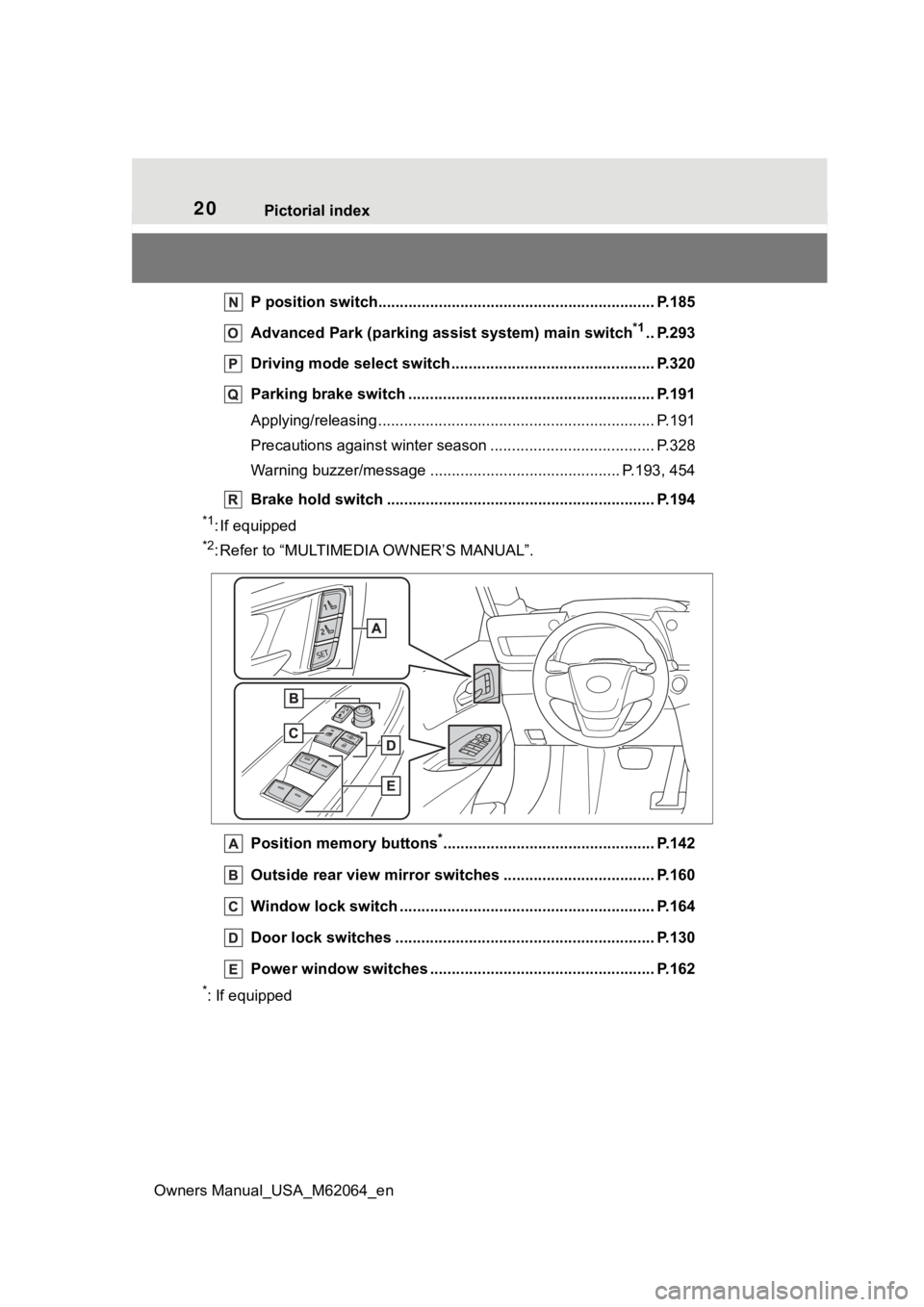
P position switch.............................................. .................. P.185
Advanced Park (parking assist system) main switch
*1.. P.293
Driving mode select switch ..................................... .......... P.320
Parking brake switch ........................................... .............. P.191
Applying/releasing............................................. ................... P.191
Precautions against winter season .............................. ........ P.328
Warning buzzer/me ssage ......................................... ... P.193, 454
Brake hold switch .............................................. ................ P.194
*1: If equipped
*2: Refer to “MULTIMEDIA OWNER’S MANUAL”.
Position memory buttons
*................................................. P.142
Outside rear view mirror swi tches ................................... P.160
Window lock switch ............................................. .............. P.164
Door lock switches ............................................................ P.130
Power window switches ....... ............................................. P.162
*: If equipped
Page 36 of 572

361-1. For safe use
Owners Manual_USA_M62064_en
Front passenger’s seat belt buckle switch
Front passenger occupant classification system (ECU and sen-
sors)
“AIRBAG ON” and “AIRBAG OFF” indicator lights
Your vehicle is equipped with ADVANCED AIRBAGS designed
based on the US motor vehicle safety standards (FMVSS208). The
airbag sensor assembly (ECU) cont rols airbag deployment based on
information obtained from the sensors etc. shown in the system
components diagram above. This in formation includes crash sever-
ity and occupant information. As the airbags deploy, a chemical
reaction in the inflators quickly fills the airbags with non-toxic gas to
help restrain the motion of the occupants.
■If the SRS airbags deploy
(inflate)
●Slight abrasions, burns, bruising,
etc., may be sustained from SRS
airbags, due to the extremely high
speed deployment (inflation) by
hot gases.
●A loud noise and white powder will
be emitted.
●Parts of the airbag module (steer-
ing wheel hub, airbag cover and
inflator) as well as the front seats,
parts of the front and rear pillars,
and roof side rails, may be hot for
several minutes. T he airbag itself
may also be hot.
●The windshield may crack.
●The fuel cell system will be
stopped and hydr ogen supply will
be stopped fro m the hydrogen
tank valves. ( P. 8 9 )
●All of the doors will be unlocked.
( P.128)
●The brakes and st op lights will be
controlled automatically. ( P.323)
●The interior lights will turn on auto-
matically. ( P.357)
●The emergency flashers will turn
on automatically. ( P.446)
●For Safety Connect subscribers, if any of the following situations
occur, the system is designed to
send an emergency call to the
response center, notifying them of
the vehicle’s location (without
needing to push the “SOS” button)
and an agent will attempt to speak
with the occupants to ascertain
the level of emergency and assis-
tance required. If the occupants
are unable to communicate, the
agent automatically treats the call
as an emergency and helps to dis-
patch the necessary emergency
services. (
P. 6 5 )
• An SRS airbag is deployed.
• A seat belt pretensioner is acti- vated.
• The vehicle is involved in a severe rear-end collision.
■SRS airbag deployment condi-
tions (SRS front airbags)
●The SRS front airbags will deploy
in the event of an impact that
exceeds the set threshold level
(the level of forc e corresponding
to an approximately 12 - 18 mph
[20 - 30 km/h] frontal collision with
a fixed wall that does not move or
deform).
However, this threshold velocity will
be considerably higher in the follow-
ing situations:
Page 78 of 572
782-1. Fuel cell electric vehicle
Owners Manual_USA_M62064_en
■Maintenance, repair, recycling,
and disposal
Contact your Toyota dealer regard-
ing maintenance, repair, recycling,
and disposal. Do not dispose of the
vehicle or any of its components
yourself.
The electric motor (traction
motor) allows smooth, powerful
takeoff and acceleration. This
vehicle drives similarly to a gas-
oline vehicle without any special
actions by the driver. ( P.169)
As there are no engine sounds
and the vehicle is quiet, opera-
tion noises unique to fuel cell
electric vehicle components
may be heard. ( P.77)
■Regenerative braking
In the following si tuations, the vehi-
cle generates electricity from the
deceleration of the vehicle while
driving.
●The accelerator pedal is released
while driving with the shift position
in D.
●The brake pedal is depressed
while driving with the shift position
in D.
■Charging the traction battery
Because electricity generated by the
fuel cell stack and regenerative
braking charges the traction battery,
the battery does not need to be
charged from an outside source.
However, if the vehicle is left parked
for a long time, the traction battery
will slowly discharge. For this rea-
son, be sure to drive the vehicle at
least once every few months for at
least 30 minutes or 10 miles (16
km). If the traction ba
ttery becomes fully
discharged and yo u are unable to
start the fuel cell system, contact
your Toyota dealer.
■Charging the 12-volt battery
P.487
■Sounds and vibrations specific
to a fuel cell e lectric vehicle
Because there is no engine sound
or vibration, it is easy to mistake the
fuel cell electric vehicle for being off
when it is actually still running, as
indicated by the “READY” indicator
being illumina ted. For safety, make
sure to always shift the shift position
to P and apply the parking brake
when parked.
The system may behave differ-
ently on cold days as it may be
performing a special cold-start
process to improve the start up
performance. ( P.180)
Operation noises ( P.77),
purge process ( P.182), etc.,
may differ from usual. However,
this is not a malfunction.
Compressed hydrogen gas fuel
can be filled at hydrogen sta-
tions.
More information about hydrogen
fuel and fueling can be found in the
“Opening the fuel door” section of
this manual. ( P.210)
Driving the vehicle
Fuel cell system
Fuel filling
Page 88 of 572
882-1. Fuel cell electric vehicle
Owners Manual_USA_M62064_en
WARNING
■Road accident cautions
In the event of an accident,
observe the following precautions.
Failure to do so c an cause fire or
electric shocks, resulting in death
or serious injury.
●Stop the vehicle i n a safe place
to prevent subsequent acci-
dents. Shift the shift position to
P and apply the parking brake.
●Check for hydrogen gas leak-
age.
Hydrogen leaks will cause a
warning message to be shown
on the multi-information dis-
play. Larger leaks may also be
audible.
●If a large amount of hydrogen
gas leaking is noticed, turn off
the power switch, exit the vehi-
cle, and stay far away from it.
Display warning signs and keep
sources of fire away from the
vehicle. If possible, get assis-
tance. When the above is done,
immediately contact your Toyota
dealer.
●Do not touch the high-voltage
parts, cables (orange), or con-
nectors.
●If electric wires are exposed
inside or outside your vehicle,
an electric shock may occur.
Never touch exposed electric
wires.
●If a fluid leak occurs, do not
touch the fluid as it may be the
carbonate ester-based organic
electrolyte from t he traction bat-
tery. If it comes into contact with
your skin or eyes, wash it off
immediately with a large
amount of water, and seek
immediate medical attention.
●In case of a vehicle fire, the
hydrogen gas in the hydrogen
tanks is released angled down-
ward on both the right side of
the vehicle as well as the rear of
the vehicle, in order to reduce
damage to the hydrogen tanks.
Keep away from the vehicle and
do not stand on either the right
side or the rear of the vehicle.
●If a vehicle fire occurs, it can be
extinguished with a Class A, B,
or C fire extinguisher. If using
water, apply a large amount
from a hydrant.
●If your vehicle needs to be
towed, do so with the rear
wheels lifted. If the wheels are
touching the ground, the electric
motor (traction motor) may con-
tinue to generate electricity.
This may cause a fire.
■Traction battery
●Never resell, trans fer, or modify
the traction batte ry. To prevent
accidents, traction batteries that
have been removed from dis-
posed vehicle are collected
through Toyota dealers. Do not
dispose of the traction battery
yourself.
If the traction battery is not
properly collected, the following
may occur, resulting in death or
serious injury:
• The traction battery may be ille- gally disposed or dumped, and
it is hazardous to the environ-
ment. Additionally, someone
may touch a high-voltage part,
resulting in an electric shock.
Page 91 of 572
912-1. Fuel cell electric vehicle
Owners Manual_USA_M62064_en
2
Fuel cell systemMaintaining the Fuel cell System
Indicator to Eco area on the
multi-information display can
extend your driving range.
( P.103, 108)
Drive your vehicle smoothly.
Avoid abrupt acceleration and
deceleration.
Mild acceleration and decelera-
tion can help curb wasteful fuel
consumption.
If the brakes are operated gently
and in a timely manner, a
greater amount of electrical
energy can be regenerated
when slowing down.
Repeated acceleration and
deceleration, as well as long
waits at traffic lights, will lead to decreased fuel economy. Check
traffic reports before leaving and
avoid delays as much as possi-
ble. When driving in a con-
gested traffic situations, gently
release the brake pedal to allow
the vehicle to move forward
slightly while avoiding overuse
of the accelerator pedal. Doing
so can help control excessive
fuel consumption.
Similar to an electric vehicle, a
fuel cell electric vehicle uses the
most fuel in high output driving
such as driving on a steep uphill
or at high speeds. Moderate the
vehicle speed and maintain a
steady speed.
When using Eco drive mode, the
torque corresponding to the
accelerator pedal depression
amount can be generated more
smoothly than it is in normal
conditions. In addition, the oper-
ation of the air conditioning sys-
tem (heating/cooling) will be
minimized, improving the fuel
economy. (
P.320)
Use the air conditioning only
when necessary. Doing so
Fuel cell electric vehi-
cle driving tips
To maximize fuel economy
and range, pay attention to
the following:
Use of Fuel cell System
Indicator
Accelerator pedal/brake
pedal operation
When braking
Delays
Driving with high power
output
Using Eco drive mode
Air conditioning
Page 95 of 572
953-1. Instrument cluster
Owners Manual_USA_M62064_en
3
Vehicle status information and indicators
The units used on the meters and some indicators may differ dep ending on
the target region.
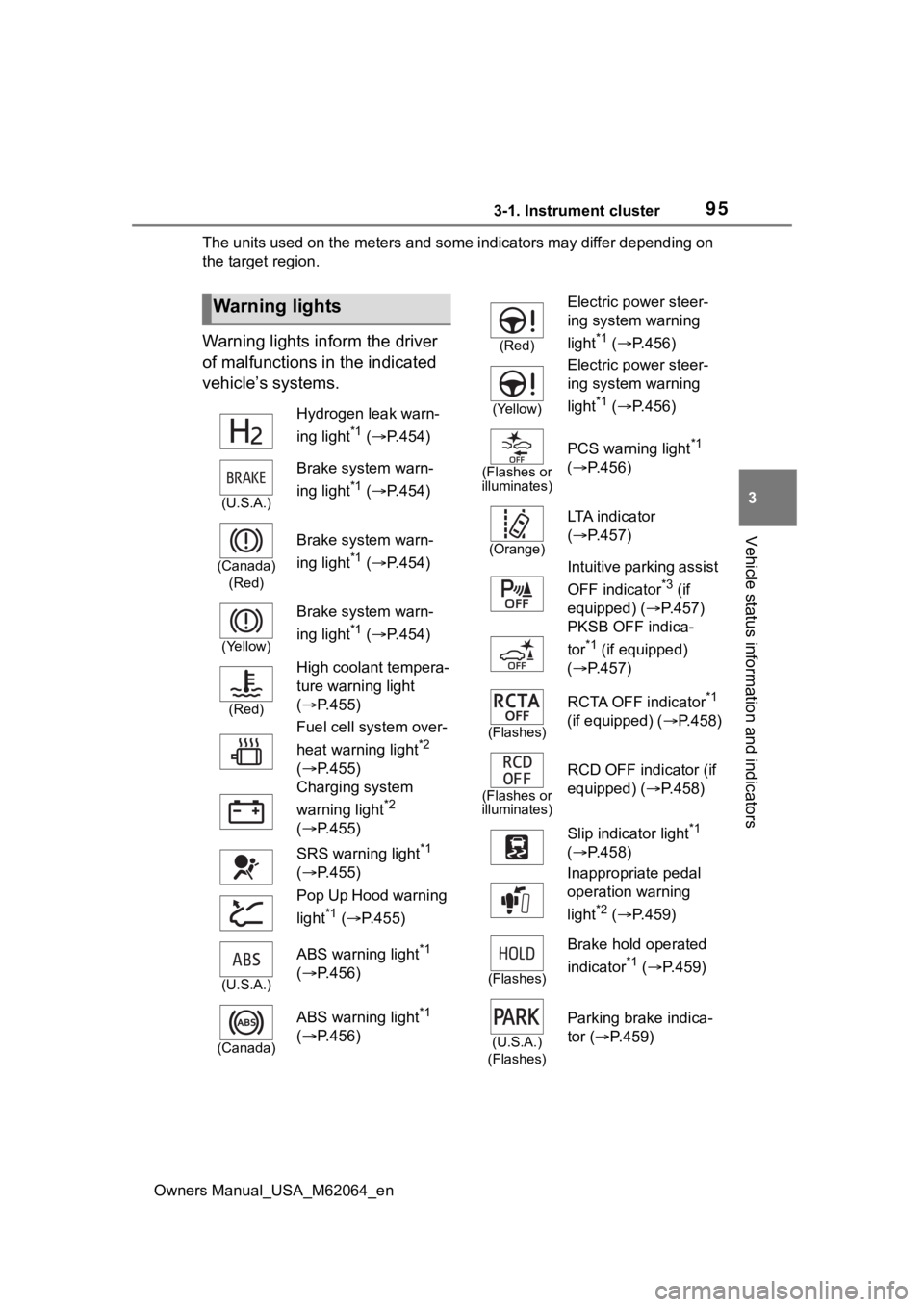
Warning lights inform the driver
of malfunctions in the indicated
vehicle’s systems.
Warning lights
Hydrogen leak warn-
ing light
*1 ( P.454)
(U.S.A.)
Brake system warn-
ing light
*1 ( P.454)
(Canada)
(Red)
Brake system warn-
ing light
*1 ( P.454)
(Yellow)
Brake system warn-
ing light
*1 ( P.454)
(Red)
High coolant tempera-
ture warning light
( P.455)
Fuel cell system over-
heat warning light
*2
( P.455)
Charging system
warning light
*2
( P.455)
SRS warning light
*1
( P.455)
Pop Up Hood warning
light
*1 ( P.455)
(U.S.A.)
ABS warning light*1
( P.456)
(Canada)
ABS warning light*1
( P.456)
(Red)
Electric power steer-
ing system warning
light
*1 ( P.456)
(Yellow)
Electric power steer-
ing system warning
light
*1 ( P.456)
(Flashes or
illuminates)
PCS warning light*1
( P.456)
(Orange)
LTA i n d i c a t o r
( P.457)
Intuitive parking assist
OFF indicator
*3 (if
equipped) ( P.457)
PKSB OFF indica-
tor
*1 (if equipped)
( P.457)
(Flashes)
RCTA OFF indicator*1
(if equipped) ( P.458)
(Flashes or
illuminates)
RCD OFF indicator (if
equipped) ( P.458)
Slip indicator light
*1
( P.458)
Inappropriate pedal
operation warning
light
*2 ( P.459)
(Flashes)
Brake hold operated
indicator
*1 ( P.459)
(U.S.A.)
(Flashes)
Parking brake indica-
tor ( P.459)