fuse TOYOTA MIRAI 2023 Owners Manual
[x] Cancel search | Manufacturer: TOYOTA, Model Year: 2023, Model line: MIRAI, Model: TOYOTA MIRAI 2023Pages: 572, PDF Size: 17.71 MB
Page 4 of 572
4TABLE OF CONTENTS
Owners Manual_USA_M62064_en
Parking Support Brake func-tion (pedestrians rear of the
vehicle) ........................ 291
Toyota Teammate Advanced Park ............................. 293
Driving mode select switch .................................... 320
Snow mode ................... 321
Driving assist systems .. 322
5-6. Driving tips Winter driving tips ......... 327
6-1. Using the air conditioning
system and defogger
ALL AUTO control ......... 332
Automatic air conditioning system (Type A) .......... 333
Automatic air conditioning system (Type B) .......... 340
Rear automatic air condition- ing system ................... 349
Heated steering wheel/seat heaters/seat ventilators 351
6-2. Using the interior lights Interior lights list ............ 355
6-3. Using the storage features List of storage features . 358
Trunk features ............... 361
6-4. Using the other interior fea- tures
Electronic sunshade...... 363
Other interior features ... 364
Garage door opener...... 3827-1. Maintenance and care
Cleaning and protecting the vehicle exterior ............ 392
Cleaning and protecting the vehicle interior ............. 396
7-2. Maintenance Maintenance requirements.................................... 400
General maintenance .... 401
7-3. Do-it-yourself maintenance Do-it-yourself service precau-tions ............................. 404
Hood .............................. 406
Positioning a floor jack .. 406
Fuel cell unit compartment .................................... 408
12-volt battery................ 413
Tires .............................. 416
Replacing the tire .......... 424
Tire inflation pressure .... 428
Wheels .......................... 430
Air conditioning filter ...... 432
Cleaning the traction battery air intake vents ............ 433
Electronic key battery .... 436
Checking and replacing fuses .................................... 438
Headlight aim ................ 442
Light bulbs ..................... 443
6Interior features
7Maintenance and care
Page 372 of 572
3726-4. Using the other interior features
Owners Manual_USA_M62064_en
The power outlet can be used
for 12 V accessories that run on
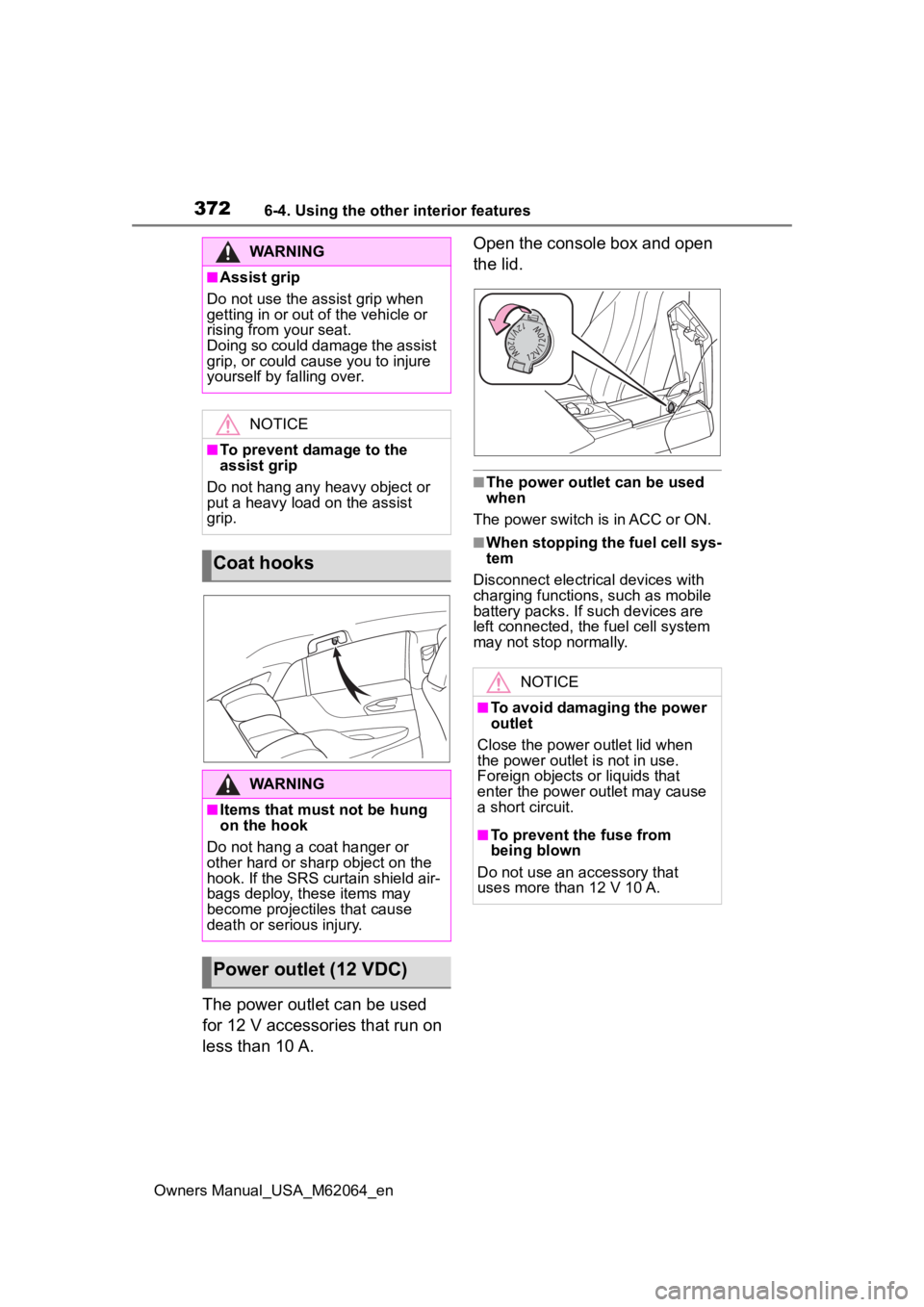
less than 10 A.Open the console box and open
the lid.
■The power outlet can be used
when
The power switch is in ACC or ON.
■When stopping the fuel cell sys-
tem
Disconnect electrical devices with
charging functions, such as mobile
battery packs. If such devices are
left connected, the fuel cell system
may not stop normally.
WARNING
■Assist grip
Do not use the assist grip when
getting in or out o f the vehicle or
rising from your seat.
Doing so could damage the assist
grip, or could cause you to injure
yourself by falling over.
NOTICE
■To prevent damage to the
assist grip
Do not hang any heavy object or
put a heavy load on the assist
grip.
Coat hooks
WARNING
■Items that must not be hung
on the hook
Do not hang a coat hanger or
other hard or sharp object on the
hook. If the SRS curtain shield air-
bags deploy, these items may
become projectiles that cause
death or serious injury.
Power outlet (12 VDC)
NOTICE
■To avoid damaging the power
outlet
Close the power outlet lid when
the power outlet is not in use.
Foreign objects or liquids that
enter the power outlet may cause
a short circuit.
■To prevent the fuse from
being blown
Do not use an accessory that
uses more than 12 V 10 A.
Page 373 of 572
3736-4. Using the other interior features
Owners Manual_USA_M62064_en
6
Interior features
The power outlet can be used
for 120 V accessories that run
on less than 100 W.
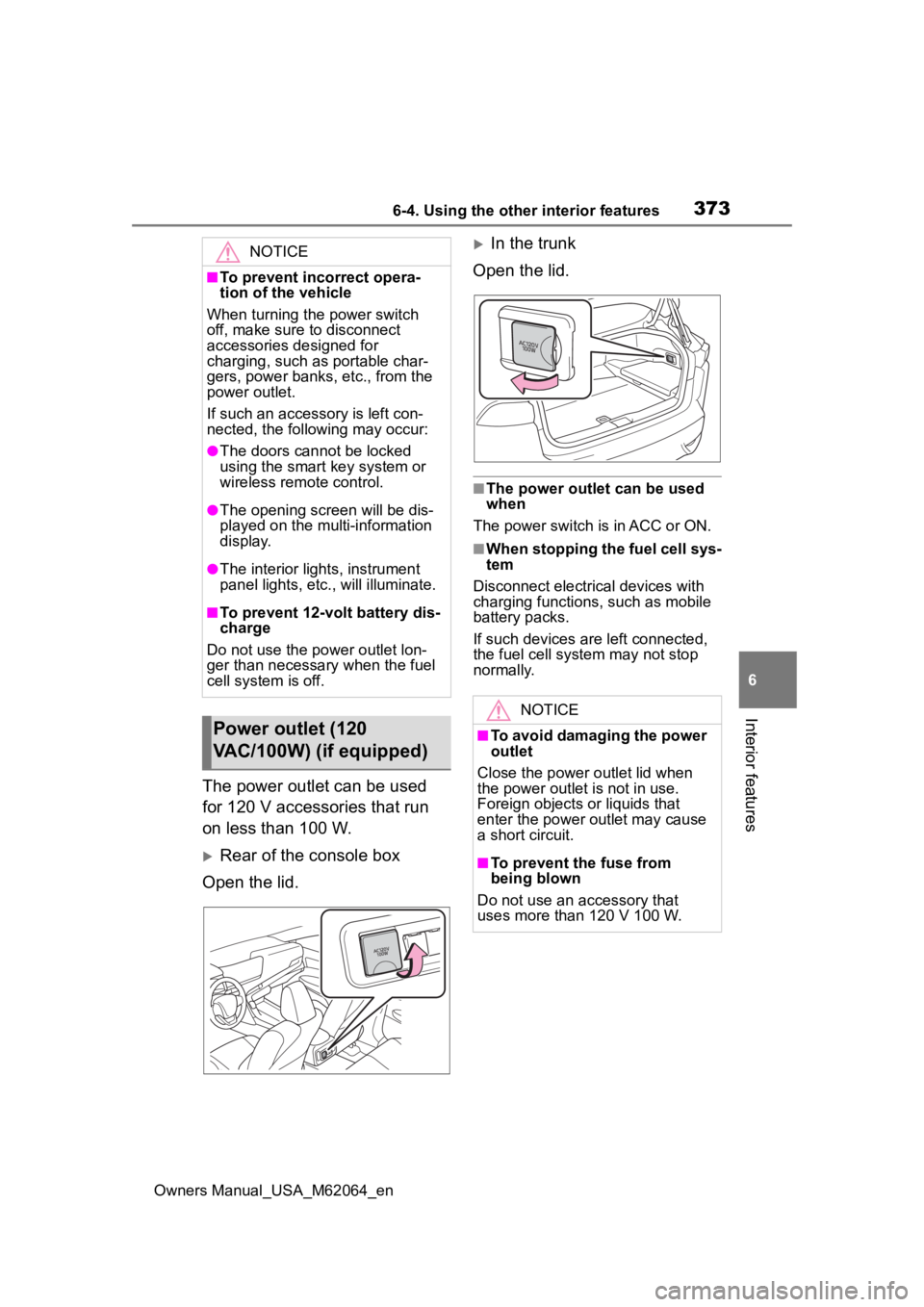
Rear of the console box
Open the lid.
In the trunk
Open the lid.
■The power outlet can be used
when
The power switch is in ACC or ON.
■When stopping the fuel cell sys-
tem
Disconnect electrical devices with
charging functions, such as mobile
battery packs.
If such devices are left connected,
the fuel cell system may not stop
normally.
NOTICE
■To prevent incorrect opera-
tion of the vehicle
When turning the power switch
off, make sure to disconnect
accessories designed for
charging, such as portable char-
gers, power banks , etc., from the
power outlet.
If such an accessory is left con-
nected, the following may occur:
●The doors cannot be locked
using the smart key system or
wireless remote control.
●The opening scr een will be dis-
played on the multi-information
display.
●The interior lights, instrument
panel lights, etc., will illuminate.
■To prevent 12-volt battery dis-
charge
Do not use the power outlet lon-
ger than necessary when the fuel
cell system is off.
Power outlet (120
VAC/100W) (if equipped)
NOTICE
■To avoid damaging the power
outlet
Close the power outlet lid when
the power outlet is not in use.
Foreign objects or liquids that
enter the power outlet may cause
a short circuit.
■To prevent the fuse from
being blown
Do not use an accessory that
uses more than 120 V 100 W.
Page 391 of 572
391
Owners Manual_USA_M62064_en
7
7
Maintenance and care
Maintenance and care
7-1. Maintenance and careCleaning and protecting the vehicle exterior .......... 392
Cleaning and protecting the vehicle interior ........... 396
7-2. Maintenance Maintenance requirements.................................. 400
General maintenance.. 4017-3. Do-it-yourself mainte-
nance
Do-it-yourself service pre- cautions ..................... 404
Hood............................ 406
Positioning a floor jack 406
Fuel cell unit compartment .................................. 408
12-volt battery ............. 413
Tires ............................ 416
Replacing the tire ........ 424
Tire inflation pressure .. 428
Wheels ........................ 430
Air conditioning filter .... 432
Cleaning the traction battery air intake vents .......... 433
Electronic key battery .. 436
Checking and replacing fuses .......................... 438
Headlight aim .............. 442
Light bulbs ................... 443
Page 404 of 572
4047-3. Do-it-yourself maintenance
Owners Manual_USA_M62064_en
7-3.Do-it-yourself maintenance
Do-it-yourself ser vice
precautions
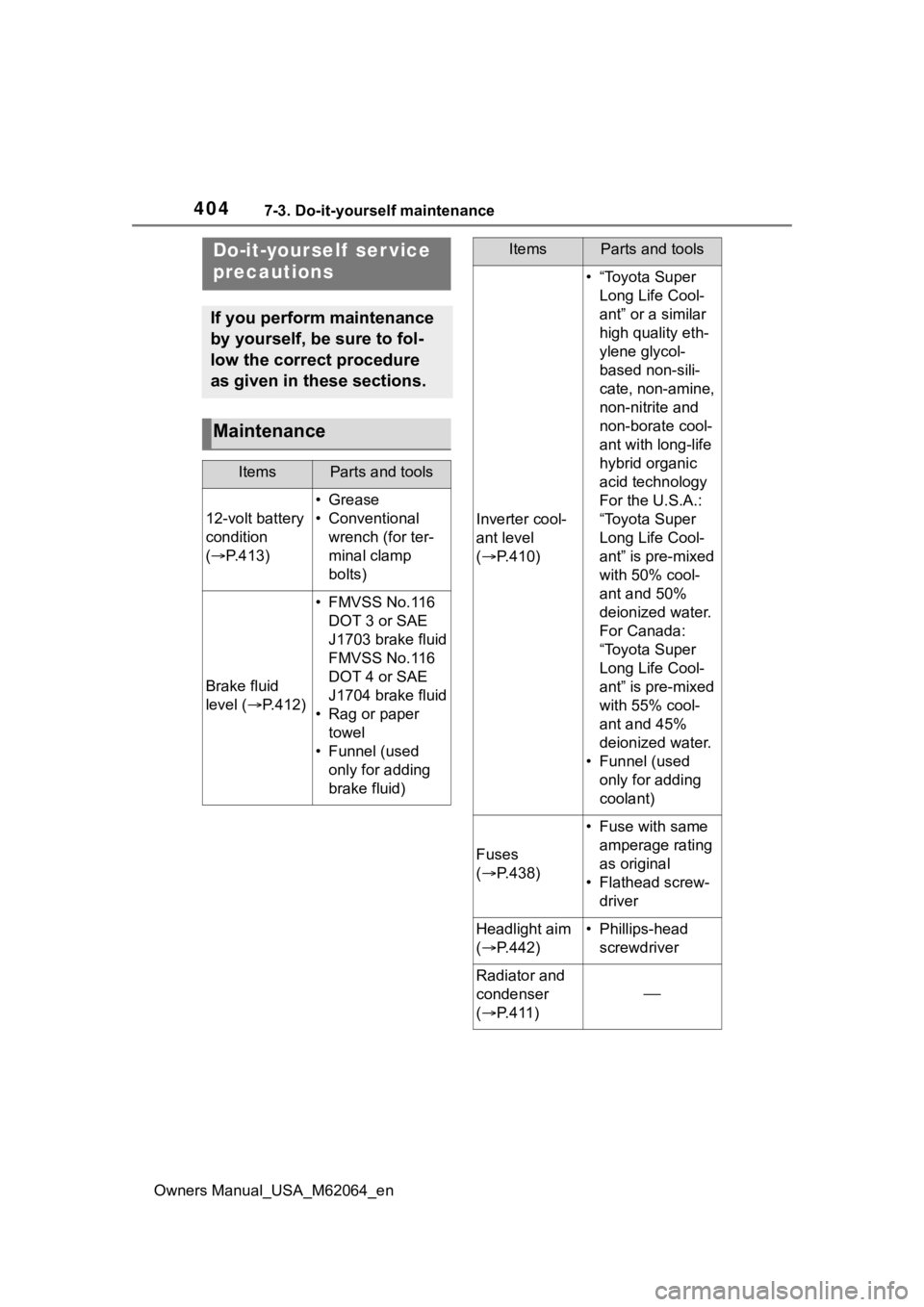
If you perform maintenance
by yourself, be sure to fol-
low the correct procedure
as given in these sections.
Maintenance
ItemsParts and tools
12-volt battery
condition
( P.413)
•Grease
• Conventional
wrench (for ter-
minal clamp
bolts)
Brake fluid
level ( P.412)
• FMVSS No.116
DOT 3 or SAE
J1703 brake fluid
FMVSS No.116
DOT 4 or SAE
J1704 brake fluid
• Rag or paper towel
• Funnel (used only for adding
brake fluid)
Inverter cool-
ant level
( P.410)
• “Toyota Super
Long Life Cool-
ant” or a similar
high quality eth-
ylene glycol-
based non-sili-
cate, non-amine,
non-nitrite and
non-borate cool-
ant with long-life
hybrid organic
acid technology
For the U.S.A.:
“Toyota Super
Long Life Cool-
ant” is pre-mixed
with 50% cool-
ant and 50%
deionized water.
For Canada:
“Toyota Super
Long Life Cool-
ant” is pre-mixed
with 55% cool-
ant and 45%
deionized water.
• Funnel (used only for adding
coolant)
Fuses
( P.438)
• Fuse with same
amperage rating
as original
• Flathead screw- driver
Headlight aim
( P.442)• Phillips-head
screwdriver
Radiator and
condenser
( P.411)
ItemsParts and tools
Page 408 of 572
4087-3. Do-it-yourself maintenance
Owners Manual_USA_M62064_en
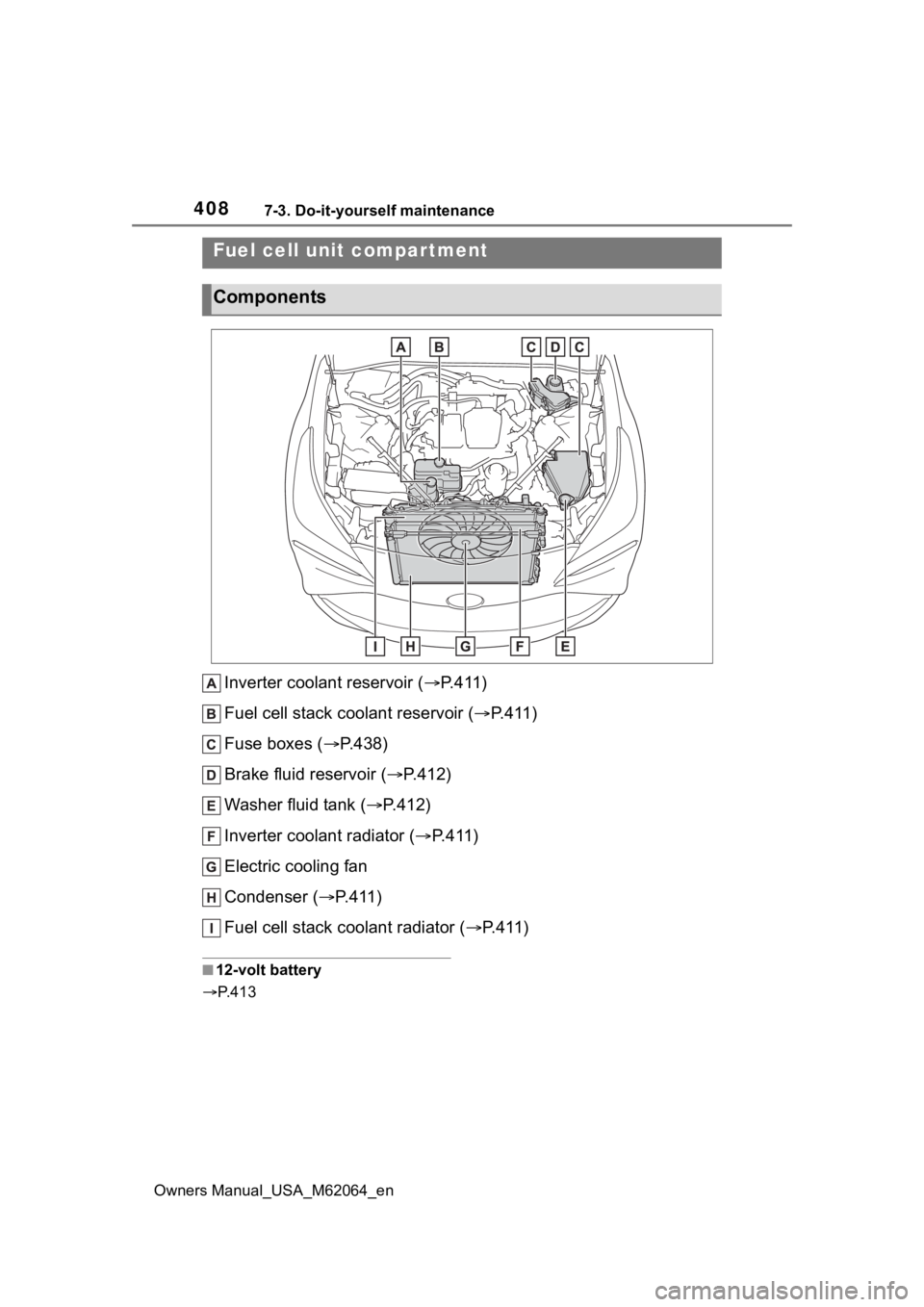
Inverter coolant reservoir ( P.411)
Fuel cell stack coolant reservoir ( P.411)
Fuse boxes ( P.438)
Brake fluid reservoir ( P.412)
Washer fluid tank ( P.412)
Inverter coolant radiator ( P.411)
Electric cooling fan
Condenser ( P.411)
Fuel cell stack coolant radiator ( P. 4 1 1 )
■12-volt battery
P. 4 1 3
Fuel cell unit compartment
Components
Page 438 of 572
4387-3. Do-it-yourself maintenance
Owners Manual_USA_M62064_en
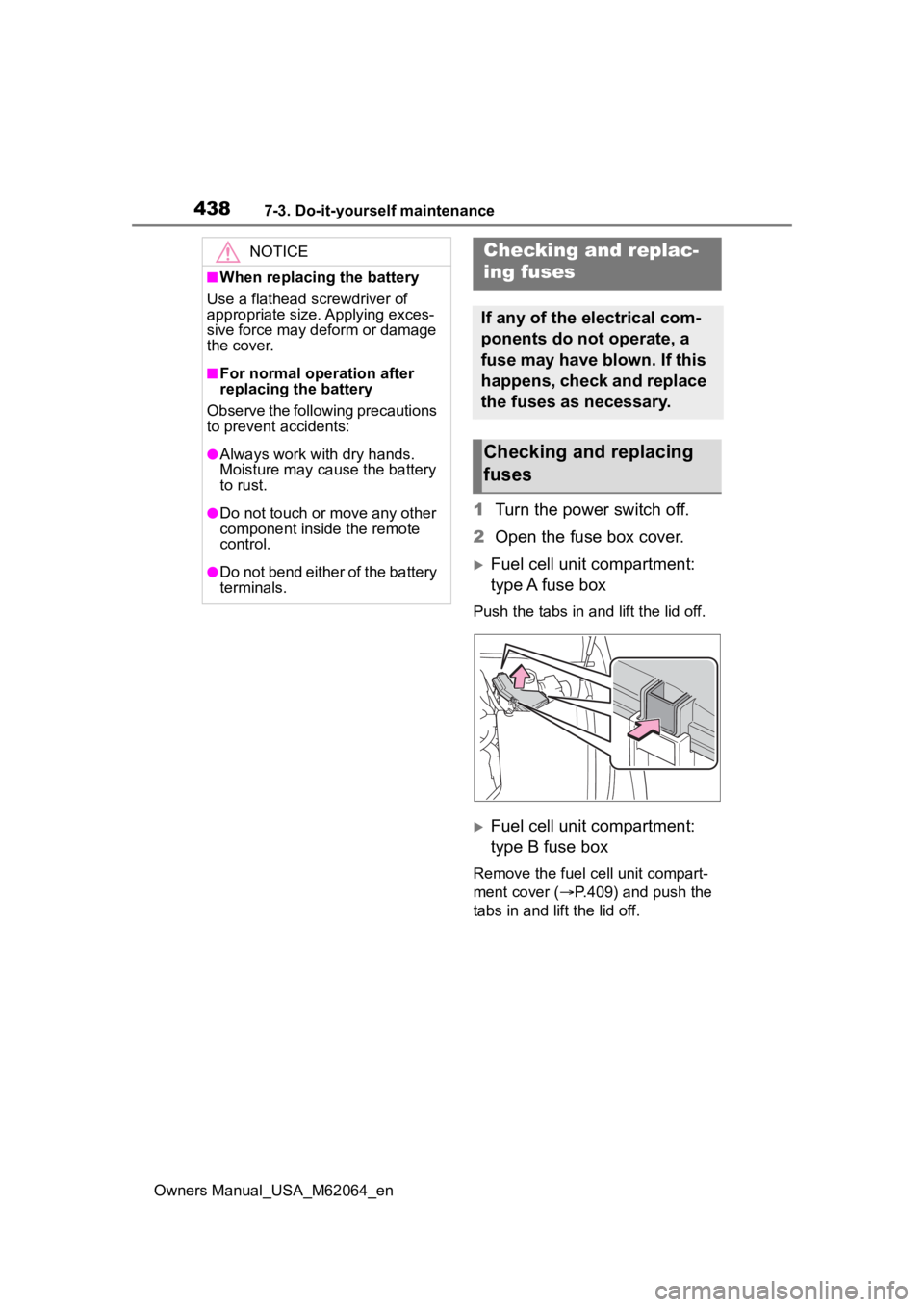
1Turn the power switch off.
2 Open the fuse box cover.
Fuel cell unit compartment:
type A fuse box
Push the tabs in and lift the lid off.
Fuel cell unit compartment:
type B fuse box
Remove the fuel cell unit compart-
ment cover ( P.409) and push the
tabs in and lift the lid off.
NOTICE
■When replacing the battery
Use a flathead screwdriver of
appropriate size. Applying exces-
sive force may deform or damage
the cover.
■For normal operation after
replacing the battery
Observe the following precautions
to prevent accidents:
●Always work with dry hands.
Moisture may cau se the battery
to rust.
●Do not touch or move any other
component inside the remote
control.
●Do not bend either of the battery
terminals.
Checking a nd replac-
ing fuses
If any of the electrical com-
ponents do not operate, a
fuse may have blown. If this
happens, check and replace
the fuses as necessary.
Checking and replacing
fuses
Page 440 of 572
4407-3. Do-it-yourself maintenance
Owners Manual_USA_M62064_en
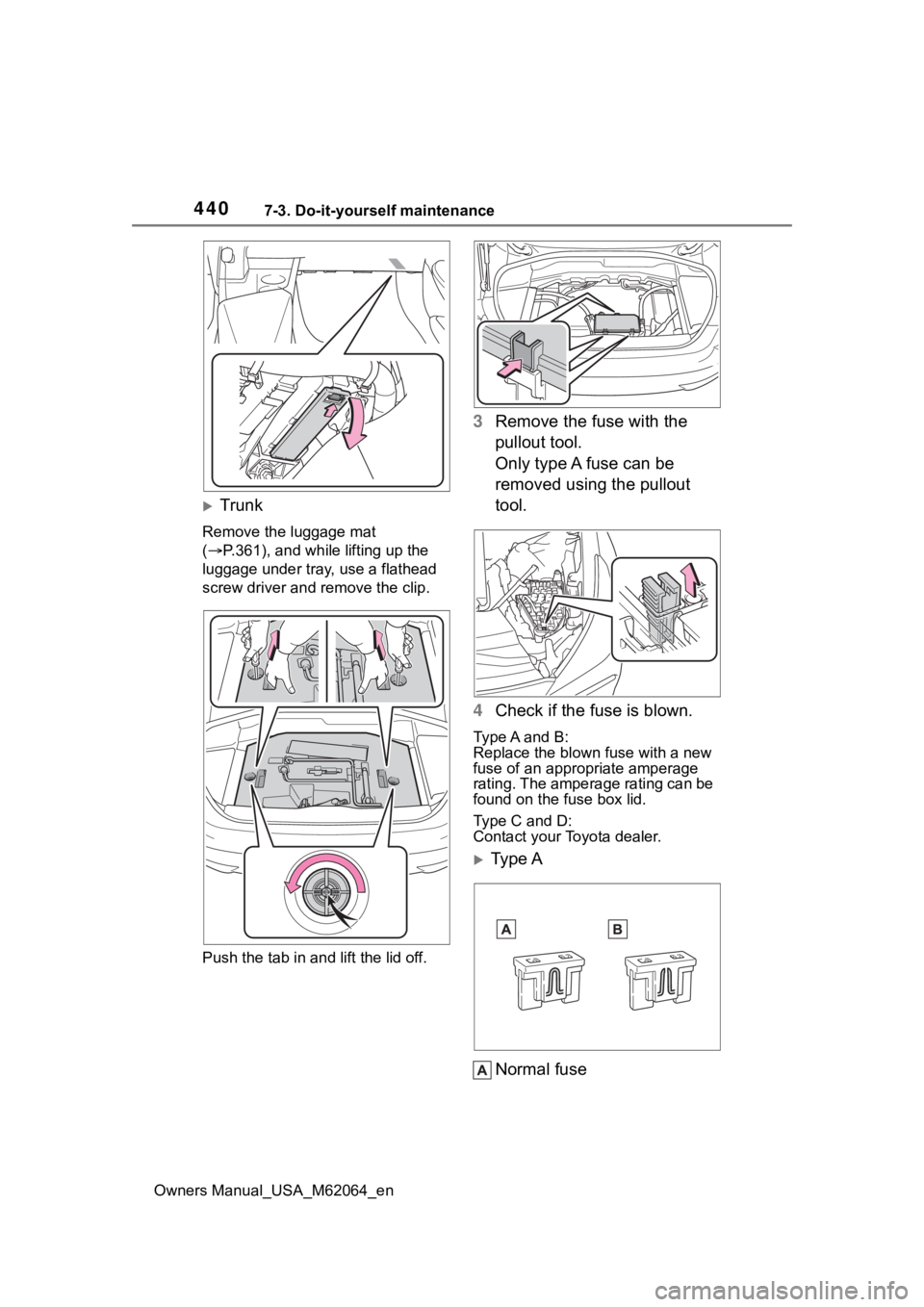
Trunk
Remove the luggage mat
( P.361), and while lifting up the
luggage under tray, use a flathead
screw driver and r emove the clip.
Push the tab in and lift the lid off.
3 Remove the fuse with the
pullout tool.
Only type A fuse can be
removed using the pullout
tool.
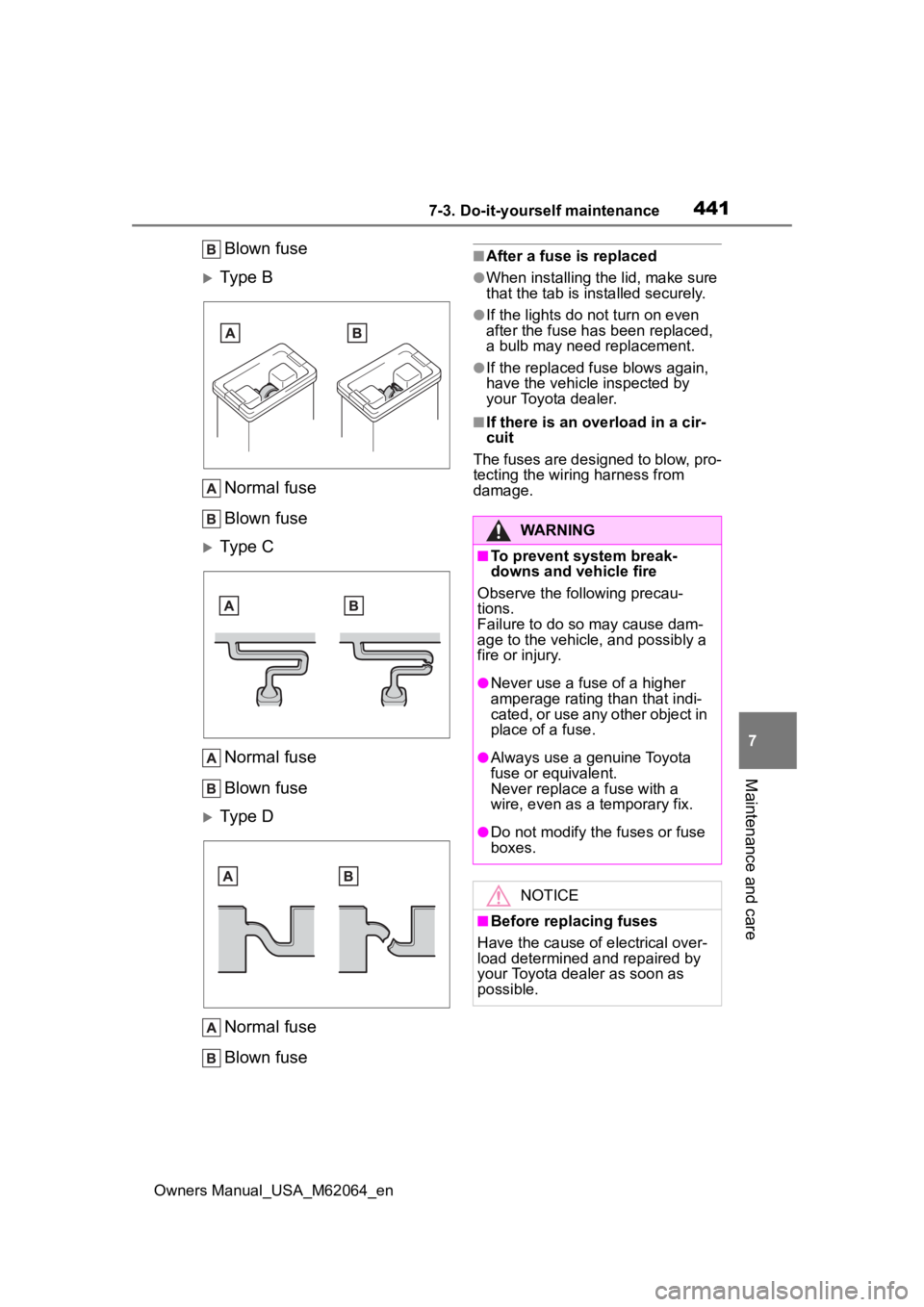
4 Check if the fuse is blown.
Type A and B:
Replace the blown fuse with a new
fuse of an appropriate amperage
rating. The amperage rating can be
found on the fuse box lid.
Type C and D:
Contact your Toyota dealer.
Type A
Normal fuse
Page 441 of 572
4417-3. Do-it-yourself maintenance
Owners Manual_USA_M62064_en
7
Maintenance and care
Blown fuse
Type B Normal fuse
Blown fuse
Type CNormal fuse
Blown fuse
Type DNormal fuse
Blown fuse
■After a fuse is replaced
●When installing the lid, make sure
that the tab is ins talled securely.
●If the lights do not turn on even
after the fuse has been replaced,
a bulb may need replacement.
●If the replaced fuse blows again,
have the vehicle inspected by
your Toyota dealer.
■If there is an ove rload in a cir-
cuit
The fuses are designed to blow, pro-
tecting the wiring harness from
damage.
WARNING
■To prevent system break-
downs and vehicle fire
Observe the following precau-
tions.
Failure to do so may cause dam-
age to the vehicle, and possibly a
fire or injury.
●Never use a fuse of a higher
amperage rating than that indi-
cated, or use any other object in
place of a fuse.
●Always use a genuine Toyota
fuse or equivalent.
Never replace a fuse with a
wire, even as a temporary fix.
●Do not modify the fuses or fuse
boxes.
NOTICE
■Before replacing fuses
Have the cause of electrical over-
load determined and repaired by
your Toyota dealer as soon as
possible.
Page 480 of 572
4808-2. Steps to take in an emergency
Owners Manual_USA_M62064_en
One of the following may be the
cause of the problem:
The electronic key may not be
functioning properly.
( P.482)
There may not be sufficient
fuel in the vehicle’s tank.
Refuel the vehicle.
The fuel door may be open.
( P.212)
There may be a malfunction
in the immobilizer system.
( P. 7 0 )
There may be a malfunction
in the shift control system.
*
( P.183, 465)
The fuel cell system may be
malfunctioning due to an elec-
trical problem such as elec-
tronic key battery depletion or
a blown fuse. However, depending on the type of mal-
function, an interim measure
is available to start the fuel
cell system. (
P.481)
There is a possibility that the
temperature of the traction
battery is extremely low
(approximately below -22˚F [-
30˚C]). ( P.85, 180)
It is possible the fuel cell sys-
tem is frozen. ( P.180)
*: It may not be possible to shift the
shift position from P.
One of the following may be the
cause of the problem:
The 12-volt battery may be
discharged. ( P.485)
The 12-volt battery terminal
connections may be loose or
corroded. ( P.413)
One of the following may be the
cause of the problem:
One or both of the 12-volt bat-
tery terminals may be discon-
nected. ( P.413)
If the fuel cell system
will not start
Reasons for the fuel cell
system not starting vary
depending on the situation.
Check the following and
perform the appropriate
procedure:
The fuel cell system will
not start even though the
correct starting procedure
is being followed.
( P.180)
The interior lights and
headlights are dim, or the
horn does not sound or
sounds at a low volume.
The interior lights and
headlights do not turn on,
or the horn does not
sound.