steering TOYOTA PRIUS 2009 2.G Repair Manual
[x] Cancel search | Manufacturer: TOYOTA, Model Year: 2009, Model line: PRIUS, Model: TOYOTA PRIUS 2009 2.GPages: 508, PDF Size: 6.84 MB
Page 350 of 508

350 4-2. Maintenance
PRIUS_U_(OM47614U)
Vehicle interior
ItemsCheck points
Accelerator pedal • Moves smoothly (without uneven pedal
effort or catching)?
Automatic transmission
“Park” mechanism • Can the vehicle be hold securely on an
incline with the shift lever in “P”?
Brake pedal • Moves smoothly?
• Does it have appropriate clearance and
correct amount of free play?
Brakes • Pulls to one side when applied?
• Loss of brake effectiveness?
• Spongy feeling brake pedal?
• Pedal almost touches floor?
Head restraints • Move smoothly and lock securely?
Indicators/buzzers • Function properly?
Lights • Do all the lights come on?
Parking brake • Moves smoothly?
• Can hold the vehicle securely on an
incline?
Seat belts • Does the seat belt system operate
smoothly?
• Are the belts undamaged?
Seats • Do the seat controls operate properly?
Steering wheel • Moves smoothly?
• Has correct free play?
• No strange noises?
Page 397 of 508
397
4-3. Do-it-yourself maintenance
4
Maintenance and care
PRIUS_U_(OM47614U)
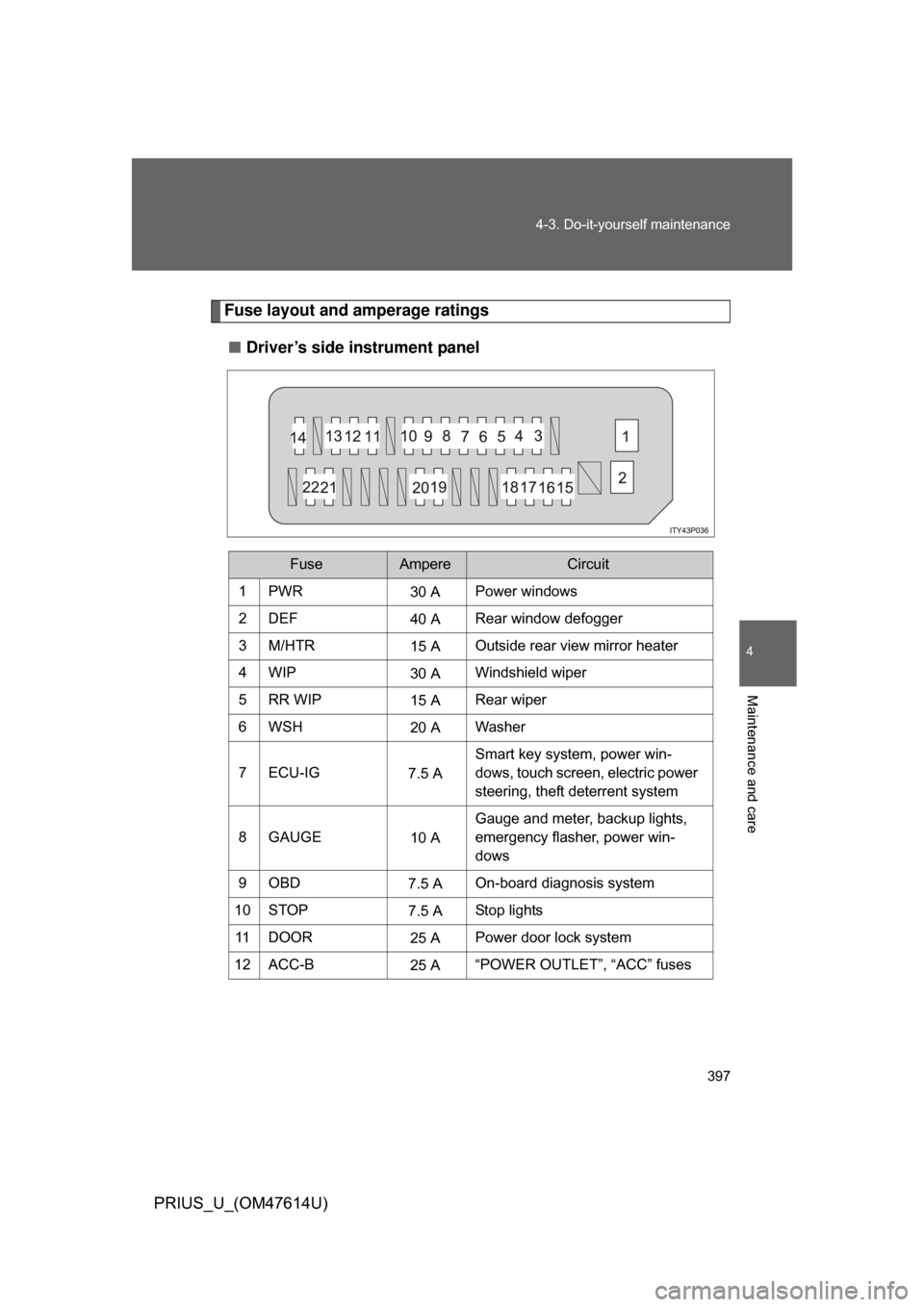
Fuse layout and amperage ratings
■ Driver’s side instrument panel
FuseAmpereCircuit
1PWR30 APower windows
2DEF 40 ARear window defogger
3M/HTR 15 AOutside rear view mirror heater
4WIP 30 AWindshield wiper
5RR WIP 15 ARear wiper
6WSH 20 AWasher
7 ECU-IG 7.5 ASmart key system, power win-
dows, touch screen, electric power
steering, theft deterrent system
8GAUGE 10 AGauge and meter, backup lights,
emergency flasher, power win-
dows
9OBD 7.5 AOn-board diagnosis system
10 STOP 7.5 AStop lights
11 D O O R 25 APower door lock system
12 ACC-B 25 A“POWER OUTLET”, “ACC” fuses
Page 413 of 508
5
When trouble arises
413
5-1. Essential information
PRIUS_U_(OM47614U)
If your vehicle needs to be towed
Before towingThe following may indicate a problem with your transmission. Contact
your Toyota dealer before towing.
● The hybrid system is operating, but the vehicle will not move.
● The vehicle makes an abnormal sound.
Emergency towing
If a tow truck is not available, in an emergency your vehicle may be
temporarily towed using a cable or chain secured to the emergency
towing eyelet. This should only attempted on hard, surfaced roads for
short distances below 18 mph (30km/h).
A driver must be in the vehicle to steer and operate the brakes. The
vehicle’s wheels, drive train, axles, steering and brakes must be in
good condition.
If towing is necessary, we recommend having your vehicle towed by
your Toyota dealer or a commerci al towing service, using a lift-type
truck or a flat bed truck.
Use a safety chain system for all to wing, and abide by all state/pro-
vincial and local laws.
If towing from the front, the vehicle ’s rear wheel and axles must be in
good condition. ( P. 417)
If they are damaged, use a towing dolly or flat bed truck.
Page 414 of 508
414 5-1. Essential information
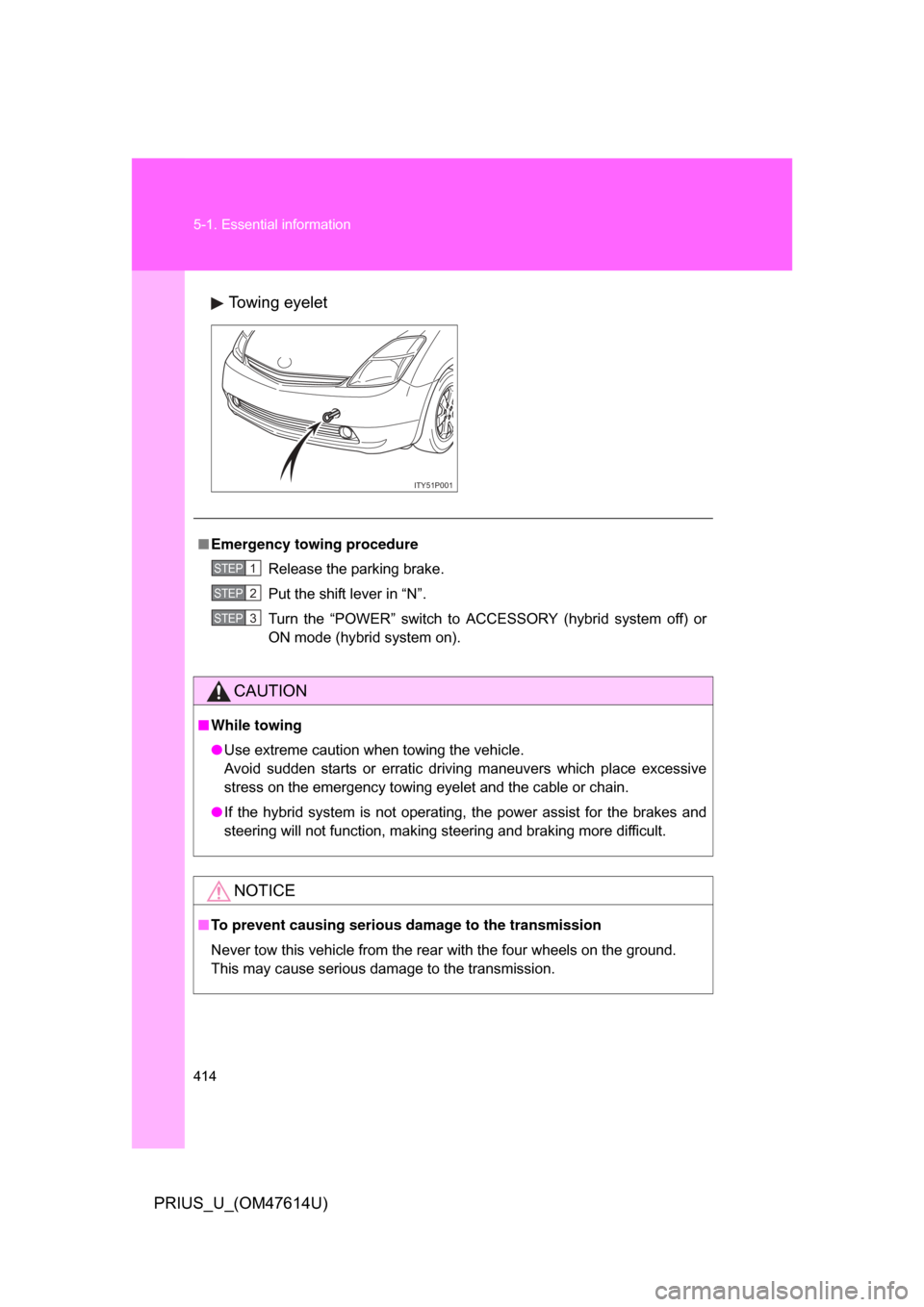
PRIUS_U_(OM47614U)Towing eyelet
ITY51P001
■
Emergency towing procedure
Release the parking brake.
Put the shift lever in “N”.
Turn the “POWER” switch to ACCESSORY (hybrid system off) or
ON mode (hybrid system on).
CAUTION
■While towing
● Use extreme caution when towing the vehicle.
Avoid sudden starts or erratic driving maneuvers which place excessive
stress on the emergency towing eyelet and the cable or chain.
● If the hybrid system is not operating, the power assist for the brakes and
steering will not function, making steering and braking more difficult.
NOTICE
■To prevent causing serious dama ge to the transmission
Never tow this vehicle from the rear with the four wheels on the ground.
This may cause serious damage to the transmission.
STEP1
STEP2
STEP3
Page 418 of 508

418 5-1. Essential information
PRIUS_U_(OM47614U)
NOTICE
■To prevent causing serious damage to the transmission
Never tow this vehicle from the rear with the front wheels on the ground.
■ To prevent damaging the vehicle
● Do not tow the vehicle with the “POWER” switch OFF.
The steering lock mechanism is not strong enough to hold the front wheel
straight.
● When raising the vehicle, ensure adequate ground clearance for towing at
the opposite end of the raised vehicle. Without adequate clearance, the
vehicle could be damaged while being towed.
Page 425 of 508
5
When trouble arises
425
5-2. Steps to take in an emergency
PRIUS_U_(OM47614U)
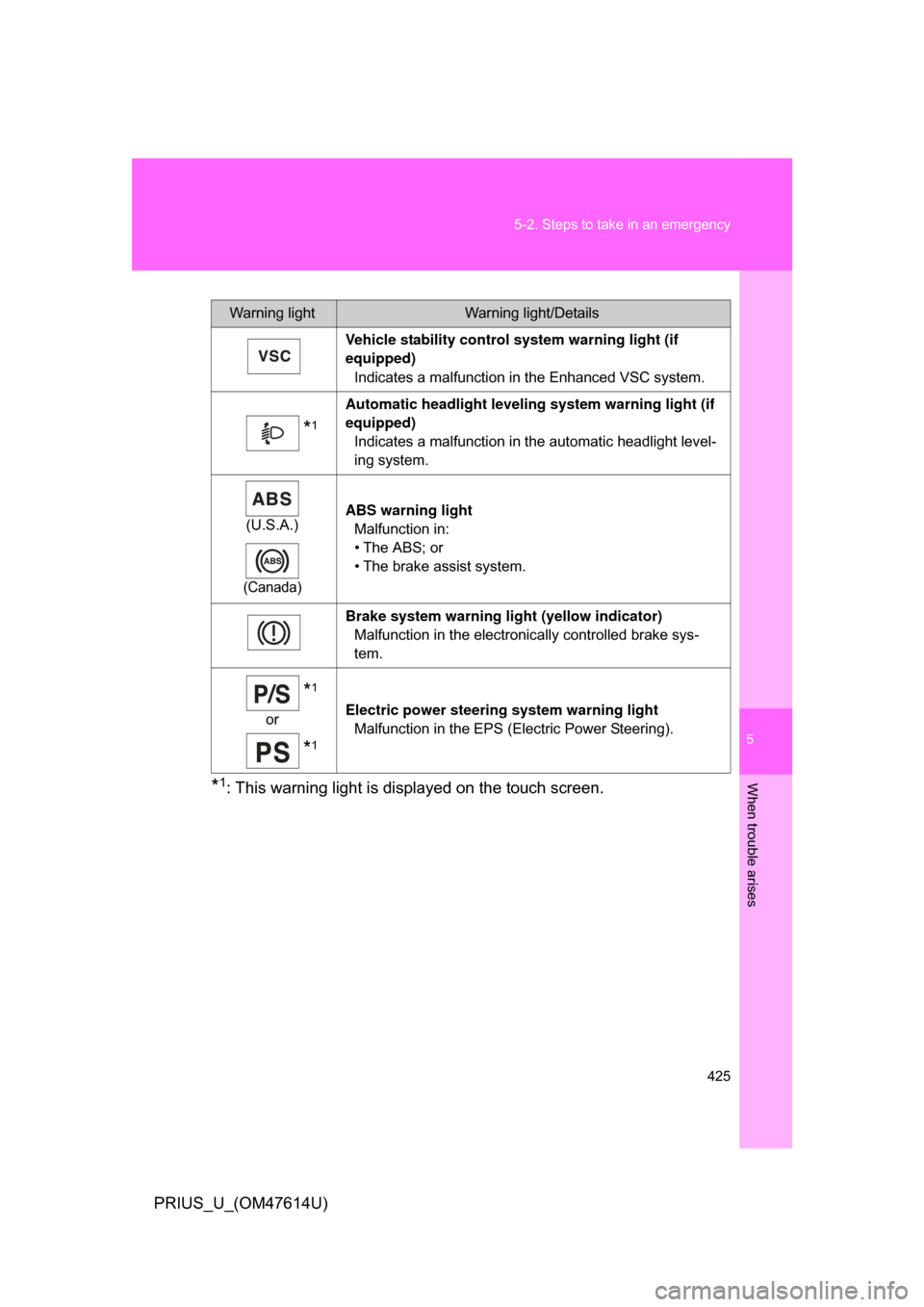
*1: This warning light is di
splayed on the touch screen.
Warning lightWarning light/Details
Vehicle stability control system warning light (if
equipped)
Indicates a malfunction in the Enhanced VSC system.
*1
Automatic headlight leveling system warning light (if
equipped) Indicates a malfunction in the automatic headlight level-
ing system.
(U.S.A.)
(Canada)
ABS warning lightMalfunction in:
• The ABS; or
• The brake assist system.
Brake system warning light (yellow indicator) Malfunction in the electronically controlled brake sys-
tem.
*1
or
*1
Electric power steering system warning lightMalfunction in the EPS (Electric Power Steering).
Page 430 of 508

430 5-2. Steps to take in an emergency
PRIUS_U_(OM47614U)
■If the malfunction indicator lamp comes on while driving
First check the following:
● Is your vehicle low on gas?
If it is, refuel the vehicle immediately.
● Is the fuel tank cap loose?
If it is, tighten it securely.
The light will go off after taking several driving trips.
If the light does not go off even after several trips, contact your Toyota dealer
as soon as possible.
■ Power steering warning light
When the voltage is low or drops, the power steering warning light may
come on.
■ SRS warning light
This warning light system monitors the following:
● The airbag sensor assembly
● Front airbag sensors
● The curtain shield airbag sensors
● The side and curtain shield airbag sensor assemblies
● The driver’s seat position sensor
● Driver’s seat belt buckle switch
● The front passenger occupant classification ECU
● The pressure sensor
● The belt tension sensor
● “AIR BAG ON” and “AIR BA G OFF” indicator lights
● Front passenger’s seat belt buckle switch
● The inflators
● The warning light
● The interconnecting wiring and power sources
Page 433 of 508
5
When trouble arises
433
5-2. Steps to take in an emergency
PRIUS_U_(OM47614U)
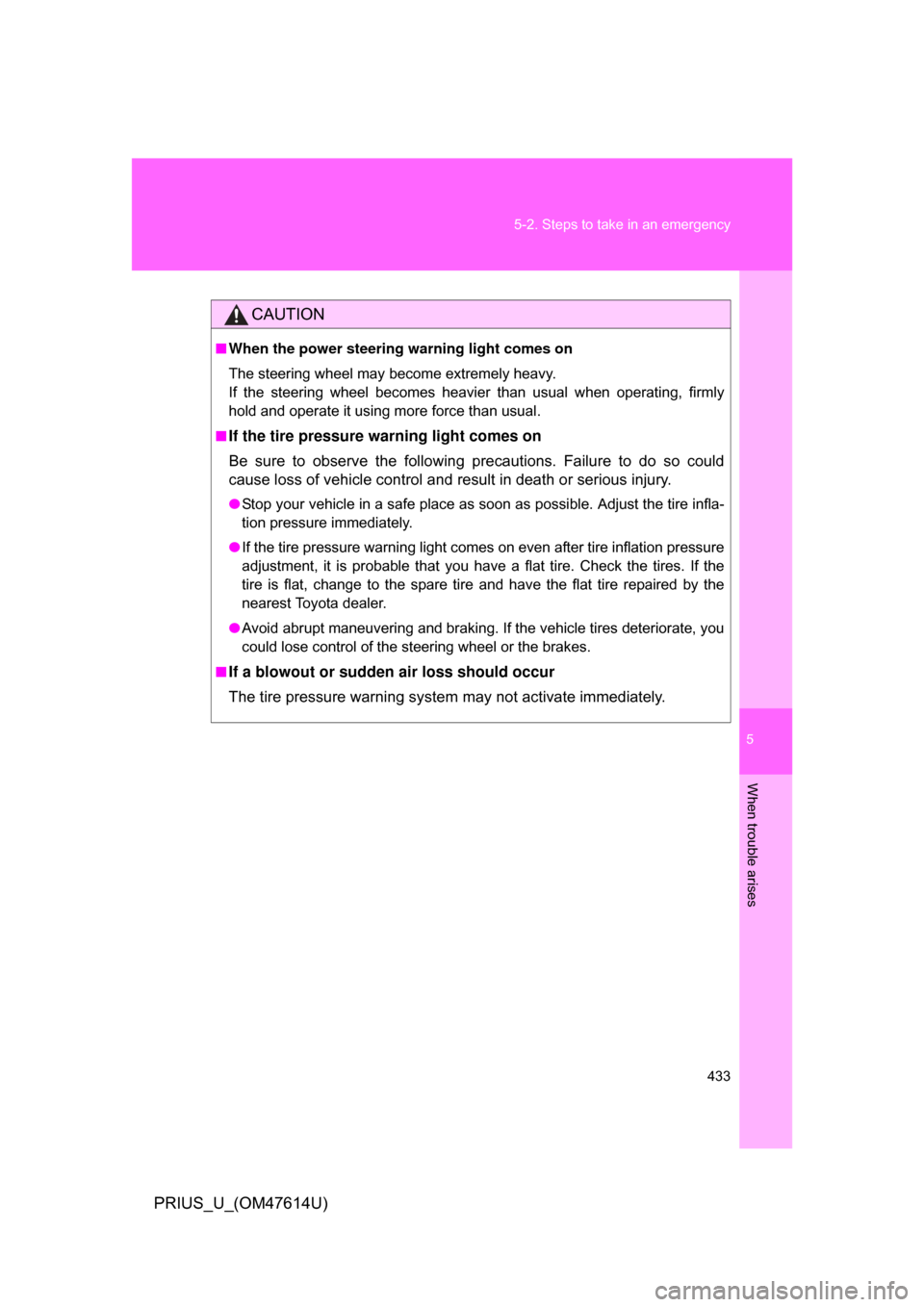
CAUTION
■
When the power steering warning light comes on
The steering wheel may become extremely heavy.
If the steering wheel becomes heavier than usual when operating, firmly
hold and operate it using more force than usual.
■
If the tire pressure warning light comes on
Be sure to observe the following precautions. Failure to do so could
cause loss of vehicle control and result in death or serious injury.
● Stop your vehicle in a safe place as soon as possible. Adjust the tire infla-
tion pressure immediately.
● If the tire pressure warning light comes on even after tire inflation pressure
adjustment, it is probable that you have a flat tire. Check the tires. If the
tire is flat, change to the spare tire and have the flat tire repaired by the
nearest Toyota dealer.
● Avoid abrupt maneuvering and braking. If the vehicle tires deteriorate, you
could lose control of the steering wheel or the brakes.
■
If a blowout or sudden air loss should occur
The tire pressure warning syste m may not activate immediately.
Page 468 of 508
468 6-1. Specifications
PRIUS_U_(OM47614U)
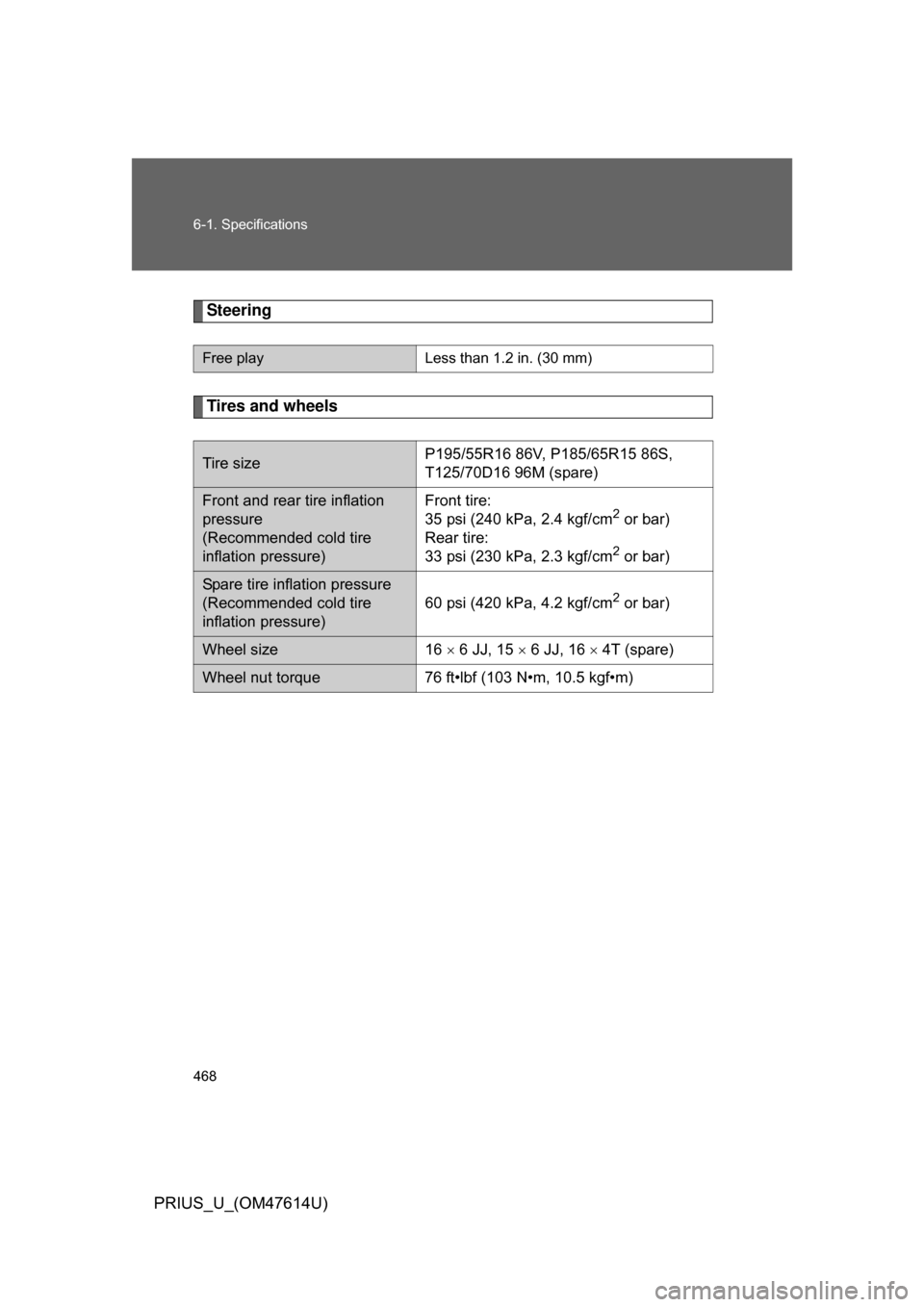
Steering
Tires and wheels
Free playLess than 1.2 in. (30 mm)
Tire sizeP195/55R16 86V, P185/65R15 86S,
T125/70D16 96M (spare)
Front and rear tire inflation
pressure
(Recommended cold tire
inflation pressure)Front tire:
35 psi (240 kPa, 2.4 kgf/cm2 or bar)
Rear tire:
33 psi (230 kPa, 2.3 kgf/cm
2 or bar)
Spare tire inflation pressure
(Recommended cold tire
inflation pressure) 60 psi (420 kPa, 4.2 kgf/cm2 or bar)
Wheel size
16 6 JJ, 15 6 JJ, 16 4T (spare)
Wheel nut torque 76 ft•lbf (103 N•m, 10.5 kgf•m)
Page 479 of 508

479
6-1. Specifications
6
Vehicle specifications
PRIUS_U_(OM47614U)
Warning: The temperature grades for this tire are established for a
tire that is properly inflated and not overloaded.
Excessive speed, underinflation, or
excessive loading, either sepa-
rately or in combination, can caus e heat buildup and possible tire fail-
ure.
Glossary of tire terminology
Tire related termMeaning
Cold tire inflation
pressure Tire pressure when the vehicle has been
parked for three hours or more, or has not
been driven more than 1 mile or 1.5 km under
that condition
Maximum inflation
pressure The maximum cold inflated
pressure to which a
tire may be inflated, s hown on the sidewall of
the tire
Recommended
inflation pressure Cold tire inflation pressure recommended by a
manufacturer.
Accessory weight The combined weight (in excess of those stan-
dard items which may be replaced) of trans-
mission, power steering, power brakes, power
windows, power seats, radio and heater, to the
extent that these items
are available as factory-
installed equipment (whether installed or not)
Curb weight The weight of a motor vehicle with standard
equipment, including the maximum capacity of
fuel, oil and coolant, and if so equipped, air
conditioning and additional weight optional
engine
Maximum loaded
vehicle weight The sum of:
(a) Curb weight
(b) Accessory weight
(c) Vehicle capacity weight
(d) Production options weight
Normal occupant
weight 150 lb. (68 kg) times the number of occupants
specified in the second column of Table 1
* that
follows