Light system TOYOTA PRIUS 2009 2.G Manual Online
[x] Cancel search | Manufacturer: TOYOTA, Model Year: 2009, Model line: PRIUS, Model: TOYOTA PRIUS 2009 2.GPages: 508, PDF Size: 6.84 MB
Page 434 of 508

434 5-2. Steps to take in an emergency
PRIUS_U_(OM47614U)
CAUTION
■Maintenance of the tires
Each tire, including the spare (if provided), should be checked monthly
when cold and inflated to the inflation pressure recommended by the
vehicle manufacturer on the vehicle placard or tire inflation pressure
label (tire and load information label). (If your vehicle has tires of a differ-
ent size than the size indicated on the vehicle placard or tire inflation
pressure label [tire and load information label], you should determine the
proper tire inflation pr essure for those tires.)
As an added safety feature, your vehicle has been equipped with a tire
pressure monitoring system (TPMS-ti re pressure warning system) that
illuminates a low tire pressure telltal e (tire pressure warning light) when
one or more of your tires is significantly under-inflated. Accordingly,
when the low tire pressu re telltale (tire pressure warning light) illumi-
nates, you should stop and check your tires as soon as possible, and
inflate them to the proper pressure. Driving on a significantly under-
inflated tire causes the tire to overheat and can lead to tire failure.
Under-inflation also reduces fuel effi ciency and tire tread life, and may
affect the vehicle’s handling and stopping ability.
Please note that the TPMS (tire pressure warning system) is not a sub-
stitute for proper tire main tenance, and it is the driver’s responsibility to
maintain correct tire pressure, even if under-inflation has not reached the
level to trigger illu mination of the TPMS low tire pressure telltale (tire
pressure warning light).
Page 435 of 508
5
When trouble arises
435
5-2. Steps to take in an emergency
PRIUS_U_(OM47614U)
CAUTION
Your vehicle has also been equipped with a TPMS (tire pressure warning
system) malfunction indicator to indi
cate when the system is not operat-
ing properly. The TPMS (tire pressure warning system) malfunction indi-
cator is combined with the low tire pressure telltale (tire pressure
warning light). When the system det ects a malfunction, the telltale will
flash for approximately one minute an d then remain continuously illumi-
nated. This sequence will continue upon subsequent vehicle start-ups as
long as the malfunction exists. When the malfunction indi cator is illumi-
nated, the system may not be able to detect or signal low tire pressure
as intended.
TPMS (tire pressure warning system) malfunctions may occur for a vari-
ety of reasons, including the installati on of replacement or alternate tires
or wheels on the vehicle that prevent the TPMS (tire pressure warning
system) from functioning properly. Always check the TPMS (tire pres-
sure warning system) malfunction te lltale after replacing one or more
tires or wheels on your vehicle to ensure that the replacement or alter-
nate tires and wheels allow the TPMS (tire pressure warning system) to
continue to function properly.
NOTICE
■Precaution when installing a different tire
When a tire of a different specification or maker is installed, the tire pres-
sure warning system may not operate properly.
Page 446 of 508
446
5-2. Steps to take in an emergency
PRIUS_U_(OM47614U)
If the hybrid system will not start
If the hybrid system will not start even though correct starting proce-
dures are being followed (
P. 132), consider each of the following
points.
■ The hybrid system will not start even when the starter motor
operates normally.
One of the following may be the cause of the problem.
●The electronic key battery may be discharged. ( P. 448)
● The hybrid system may be flooded.
Try to restart the hybrid system once more following correct
starting procedures. (P. 132)
● There may be a malfunction in the immobilizer system.
( P. 8 2 )
■ The interior lights and headlight s are dim, or the horn does
not sound or sounds at a low volume
One of the following may be the cause of the problem.
● The 12 volt battery may be discharged. ( P. 449)
● The 12 volt battery terminal c onnections may be loose or cor-
roded.
■ The interior lights and headlights do not turn on, or the horn
does not sound
One of the following may be the cause of the problem.
●One or both of the 12 volt battery terminals may be discon-
nected.
● The 12 volt battery may be discharged. ( P. 449)
Contact your Toyota dealer if the problem cannot be repaired,
or if repair procedures are unknown.
Page 451 of 508
5
When trouble arises
451
5-2. Steps to take in an emergency
PRIUS_U_(OM47614U)
■
Starting the hybrid system when the battery is discharged
The hybrid system cannot be started by push-starting.
■ Avoiding a discharged 12 volt battery
● Turn off the headlights and the audio system while the hybrid system is
turned off.
● Turn off any unnecessary electrical components when the vehicle is run-
ning at a low speed for an extended period, such as in heavy traffic, etc.
Start the engine of the second vehicle. Increase the engine
speed slightly and maintain at that level for approximately
five minutes to recharge the 12 volt battery of your vehicle.
Open and close any of the doors with the “POWER” switch
OFF.
Maintain the engine speed on the second vehicle and turn
the “POWER” switch to the ON mode, then start the vehi-
cle’s hybrid system.
Make sure the “READY” light comes on. If the “READY”
light will not come on and the hybrid system will not start
after you recharge the battery, do the following procedure.
Turn the hybrid system off. Open and close the driver’s
door. Then push the “POWER” switch briefly and firmly. If
the light does not come on, contact your Toyota dealer.
Once the vehicle’s hybrid syst em has started, remove the
jumper cables in the exact reverse order in which they were
connected.
Once the hybrid system starts, have the vehicle checked at your
Toyota dealer as soon as possible.STEP4
STEP5
STEP6
STEP7
STEP8
Page 452 of 508
452 5-2. Steps to take in an emergency
PRIUS_U_(OM47614U)
■When the 12 volt battery is removed or discharged
The following systems must be initialized.
● Power windows (
P. 76)
● The hybrid system may not start. ( P. 446)
CAUTION
■Avoiding 12 volt battery fires or explosions
Observe the following precautions to prevent accidentally igniting the flam-
mable gas that may be emitted from the 12 volt battery.
● Make sure the jumper cable is connected to the correct terminal and that it
is not unintentionally in contact with any part other than the intended termi-
nal.
● Do not allow the jumper cables to come into contact with the “+” and “-” ter-
minals.
● Do not allow open flame or use matc hes, cigarette lighters or smoke near
the 12 volt battery.
■ 12 volt battery precautions
The 12 volt battery contains poisonous and corrosive acidic electrolyte, while
related parts contain lead and lead compounds. Observe the following pre-
cautions when handling the 12 volt battery:
● When working with the 12 volt battery, always wear safety glasses and
take care not to allow any battery fluids (acid) to come into contact with
skin, clothing or the vehicle body.
● Do not lean over the 12 volt battery.
● In the event that battery fluid comes into contact with the skin or eyes,
immediately wash the affected area with water and seek medical attention.
Place a wet sponge or cloth over the affected area until medical attention
can be received.
● Always wash your hands after handling the battery support, terminals, and
other battery-related parts.
● Do not allow children near the 12 volt battery.
Page 454 of 508
454
5-2. Steps to take in an emergency
PRIUS_U_(OM47614U)
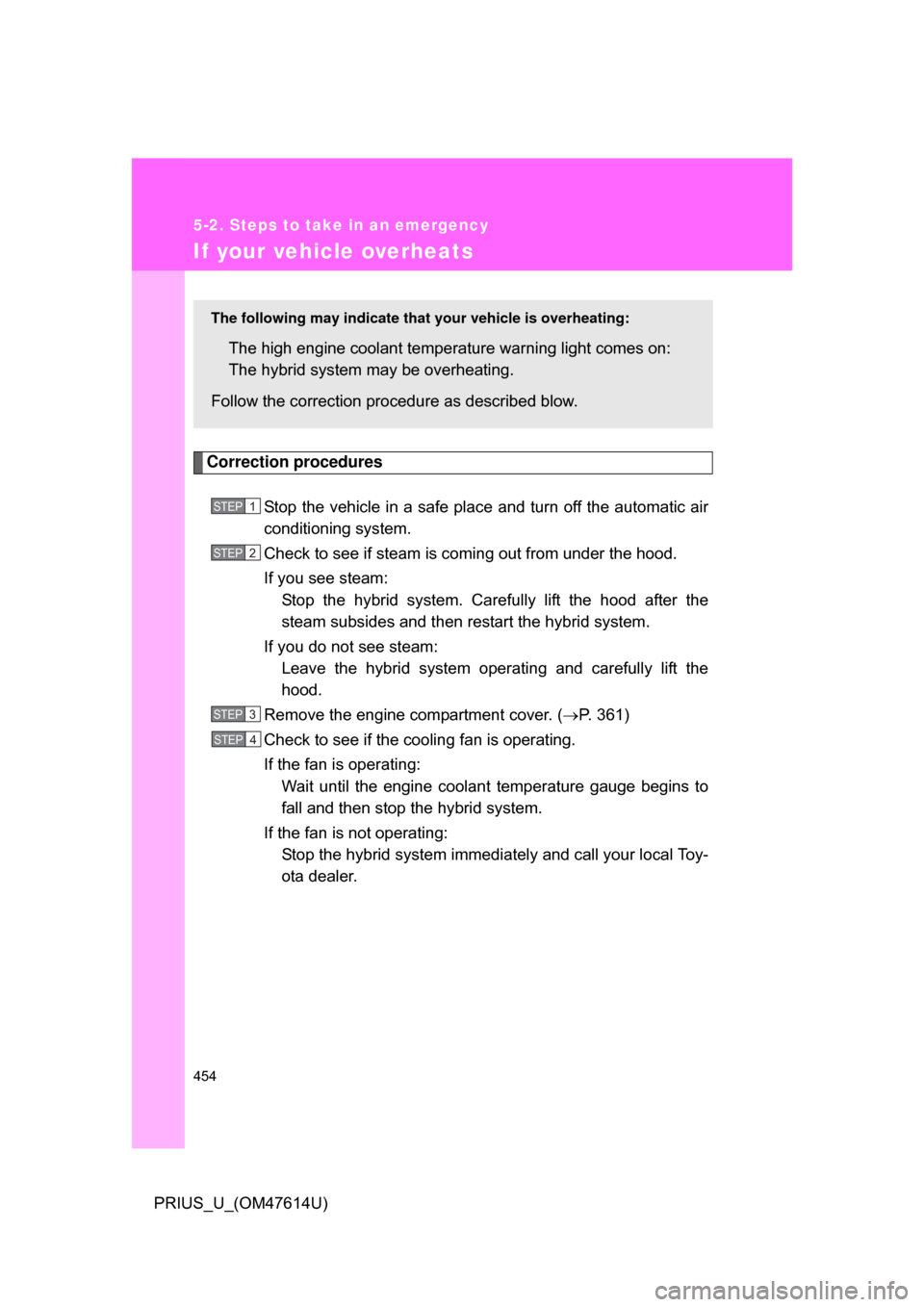
If your vehicle overheats
Correction proceduresStop the vehicle in a safe place and turn off the automatic air
conditioning system.
Check to see if steam is coming out from under the hood.
If you see steam: Stop the hybrid system. Carefully lift the hood after the
steam subsides and then restart the hybrid system.
If you do not see steam: Leave the hybrid system operating and carefully lift the
hood.
Remove the engine compartment cover. ( P. 361)
Check to see if the cooling fan is operating.
If the fan is operating: Wait until the engine coolant temperature gauge begins to
fall and then stop the hybrid system.
If the fan is not operating: Stop the hybrid system immediately and call your local Toy-
ota dealer.
The following may indicate that your vehicle is overheating:
The high engine coolant temperature warning light comes on:
The hybrid system may be overheating.
Follow the correction procedure as described blow.
STEP1
STEP2
STEP3
STEP4
Page 455 of 508
5
When trouble arises
455
5-2. Steps to take in an emergency
PRIUS_U_(OM47614U)
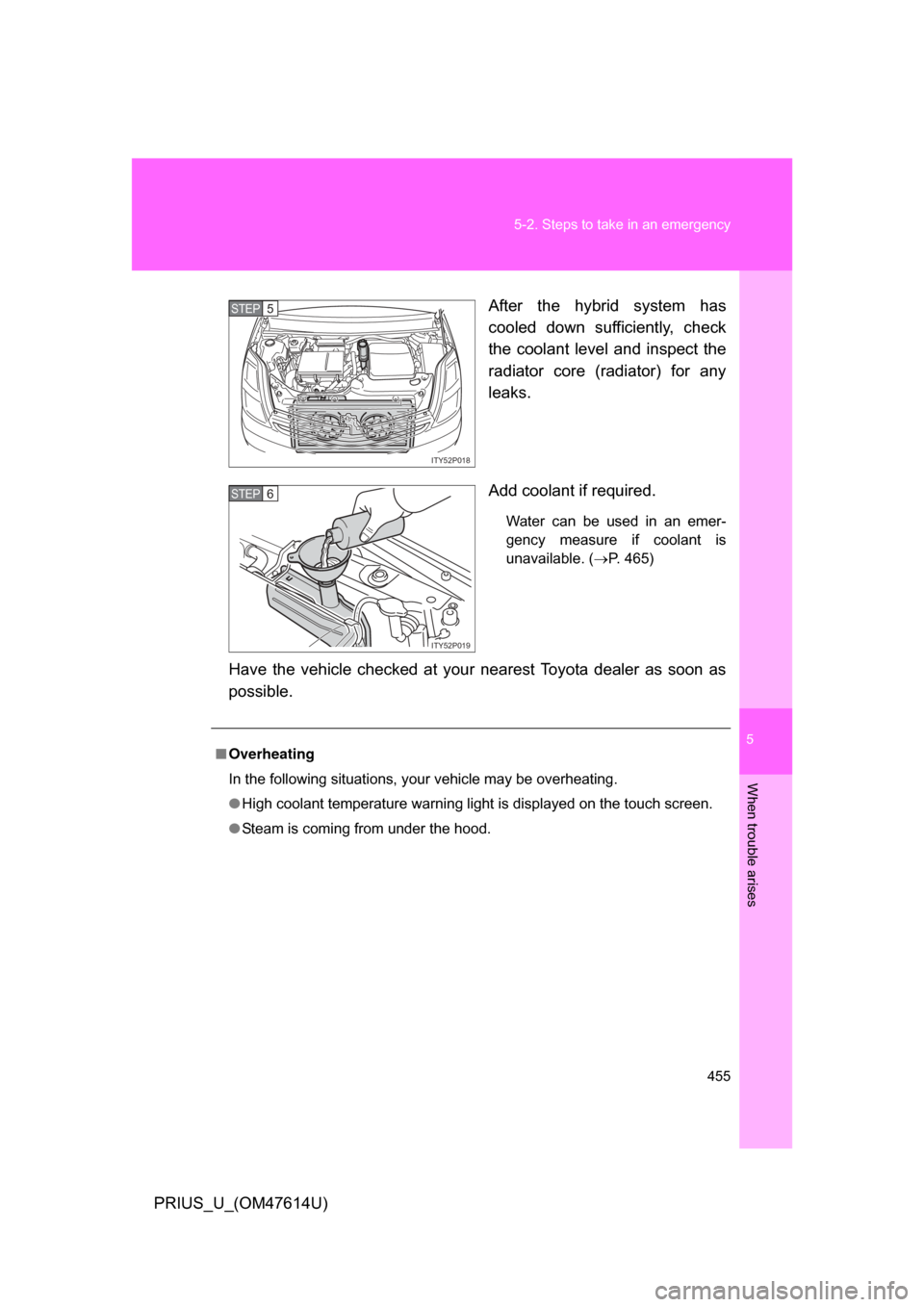
After the hybrid system has
cooled down sufficiently, check
the coolant level and inspect the
radiator core (radiator) for any
leaks.
Add coolant if required.
Water can be used in an emer-
gency measure if coolant is
unavailable. (
P. 465)
Have the vehicle checked at your nearest Toyota dealer as soon as
possible.
ITY52P018
STEP5
ITY52P019
STEP6
■Overheating
In the following situations, your vehicle may be overheating.
● High coolant temperature warning light is displayed on the touch screen.
● Steam is coming from under the hood.
Page 466 of 508
466 6-1. Specifications
PRIUS_U_(OM47614U)
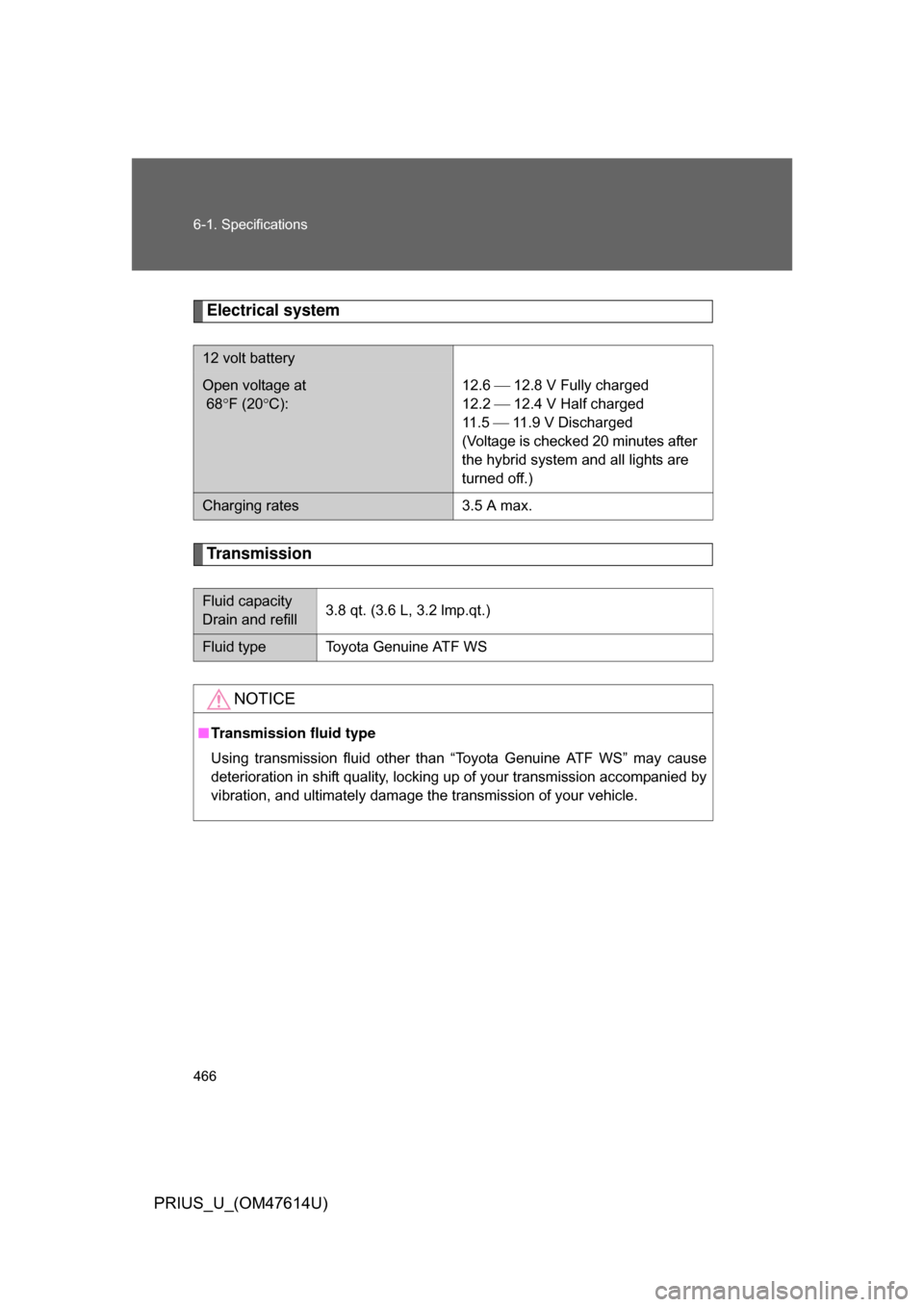
Electrical system
Transmission
12 volt battery
Open voltage at
68F (20 C): 12.6
12.8 V Fully charged
12.2 12.4 V Half charged
11 . 5 11.9 V Discharged
(Voltage is checked 20 minutes after
the hybrid system and all lights are
turned off.)
Charging rates 3.5 A max.
Fluid capacity
Drain and refill3.8 qt. (3.6 L, 3.2 lmp.qt.)
Fluid type Toyota Genuine ATF WS
NOTICE
■Transmission fluid type
Using transmission fluid other than “Toyota Genuine ATF WS” may cause
deterioration in shift quality, locking up of your transmission accompanied by
vibration, and ultimately damage the transmission of your vehicle.
Page 470 of 508
470
6-1. Specifications
PRIUS_U_(OM47614U)
Fuel infor mation
■Fuel tank opening fo r unleaded gasoline
To help prevent incorrect fueling, your Toyota has a fuel tank opening that
only accommodates the special nozzle on unleaded fuel pumps.
■ If your engine knocks
● Consult your Toyota dealer.
● You may occasionally notice light knocking for a short time while acceler-
ating or driving uphill. This is normal and there is no need for concern.
■ Gasoline quality
In very few cases, driveability problems may be caused by the brand of gas-
oline you are using. If driveability problems persist, try changing the brand of
gasoline. If this does not correct the problem, consult your Toyota dealer.
■ Gasoline quality standards
● Automotive manufacturers in the US, Europe and Japan have developed
a specification for fuel quality called World-Wide Fuel Charter (WWFC)
that is expected to be applied worldwide.
● The WWFC consists of four categories that are based on required emis-
sion levels. In the US, category 4 has been adopted.
● The WWFC improves air quality by lowering emissions in vehicle fleets,
and customer satisfaction through better performance.
■ Toyota recommends the use of gaso line containing detergent additives
● Toyota recommends the use of gasoline that contains detergent additives
to avoid build-up of engine deposits.
● All gasoline sold in the US contains detergent additives to clean and/or
keep clean intake systems.
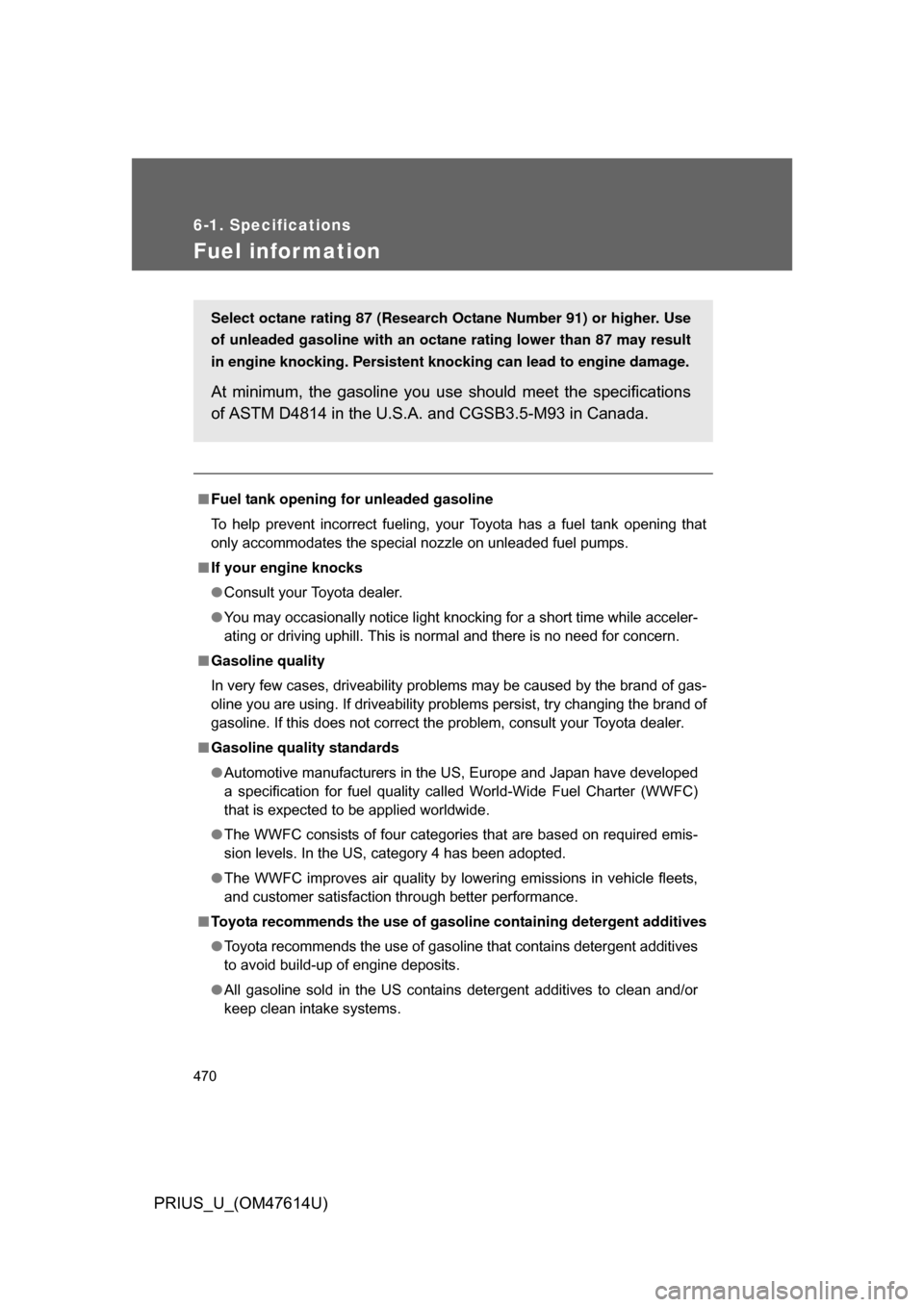
Select octane rating 87 (Research Octane Number 91) or higher. Use
of unleaded gasoline with an octane rating lower than 87 may result
in engine knocking. Persistent kno cking can lead to engine damage.
At minimum, the gasoline you use should meet the specifications
of ASTM D4814 in the U.S.A. and CGSB3.5-M93 in Canada.
Page 487 of 508
487
6-2. Customization
6
Vehicle specifications
PRIUS_U_(OM47614U)
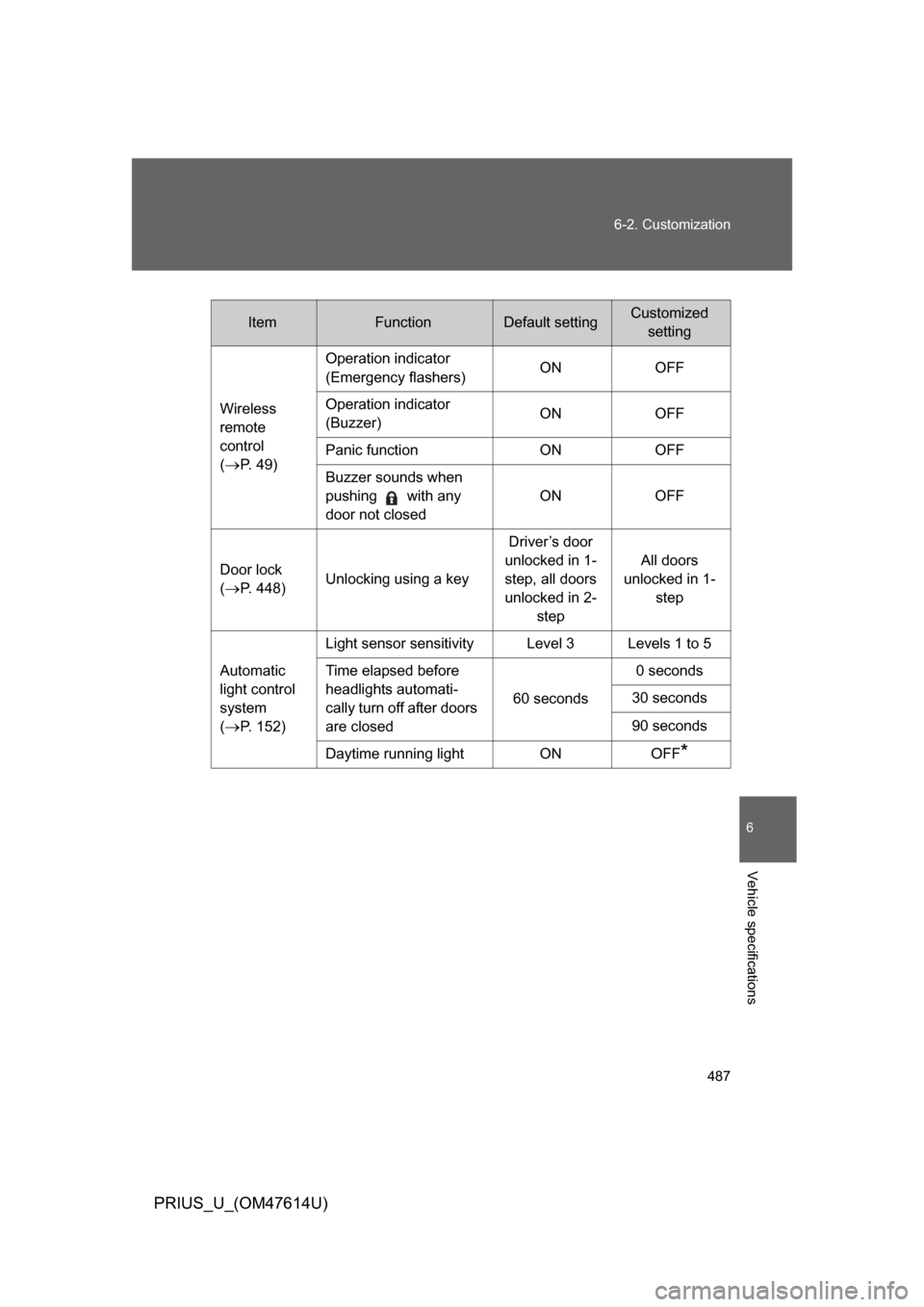
ItemFunctionDefault settingCustomized
setting
Wireless
remote
control
(
P. 4 9 ) Operation indicator
(Emergency flashers)
ON OFF
Operation indicator
(Buzzer) ON OFF
Panic function ON OFF
Buzzer sounds when
pushing with any
door not closed ON OFF
Door lock
(
P. 448) Unlocking using a key Driver’s door
unlocked in 1-
step, all doors
unlocked in 2- step All doors
unlocked in 1- step
Automatic
light control
system
(
P. 152) Light sensor sensitivity Level 3 Levels 1 to 5
Time elapsed before
headlights automati-
cally turn off after doors
are closed
60 seconds0 seconds
30 seconds
90 seconds
Daytime running light ONOFF
*