warning light TOYOTA PRIUS 2012 3.G User Guide
[x] Cancel search | Manufacturer: TOYOTA, Model Year: 2012, Model line: PRIUS, Model: TOYOTA PRIUS 2012 3.GPages: 636, PDF Size: 11.02 MB
Page 156 of 636

156 1-8. Safety information
■Unoccupied
■ There is a malfunction in the system
Indicator/
warning light “AIR BAG ON” and “AIR BAG OFF”
indicator lightsNot illuminated
SRS warning light Off
Front passenger’s seat belt reminder light
Devices Front passenger airbag
Deactivated
Side airbag on the front passenger seat Activated
Curtain shield airbag in the front passen-
ger side
Front passenger’s seat belt pretensioner Deactivated
Indicator/
warning light “AIR BAG ON” and “AIR BAG OFF”
indicator lights “AIR BAG
OFF”
SRS warning light On
Front passenger’s seat belt reminder light Off
Devices Front passenger airbag
Deactivated
Side airbag on the front passenger seat
Activated
Curtain shield airbag in the front passen-
ger side
Front passenger’s seat belt pretensioner
Page 159 of 636

159
1-8. Safety information
1
Before driving
CAUTION
■
Front passenger occupant cl assification system precautions
● Do not recline the front passenger seatback so far that it touches a rear
seat. This may cause the “AIR BAG OFF” indicator light to be illuminated,
which indicates that the passenger’s airbags will not deploy in the event of
a severe accident. If the seatback touches the rear seat, return the seat-
back to a position where it does not touch the rear seat. Keep the front\
passenger seatback as upright as possible when the vehicle is moving.
Reclining the seatback excessively may lessen the effectiveness of the
seat belt system.
● If an adult sits in the front passenger seat, the “AIR BAG ON” indicator
light is illuminated. If the “AIR BAG OFF” indicator is illuminated, ask the
passenger to sit up straight, well back in the seat, feet on the floor, and
with the seat belt worn correctly. If the “AIR BAG OFF” indicator still
remains illuminated, either ask the passenger to move to the rear seat, or
if that is not possible, move the front passenger seat fully rearward.
● When it is unavoidable to install a forward-facing child restraint system on
the front passenger seat, install the child restraint system on the front pas-
senger seat in the proper order. ( P. 165)
● Do not modify or remove the front seats.
● Do not kick the front passenger seat or subject it to severe impact. Other-
wise, the SRS warning light may come on to indicate a malfunction of the
detection system. In this case, contact your Toyota dealer immediately.
● Child restraint systems installed on the rear seat should not contact the
front seatbacks.
● Do not use a seat accessory, such as a cushion and seat cover, that cov-
ers the seat cushion surface.
● Do not modify or replace the upholstery of the front seat.
Page 179 of 636
When driving2
179
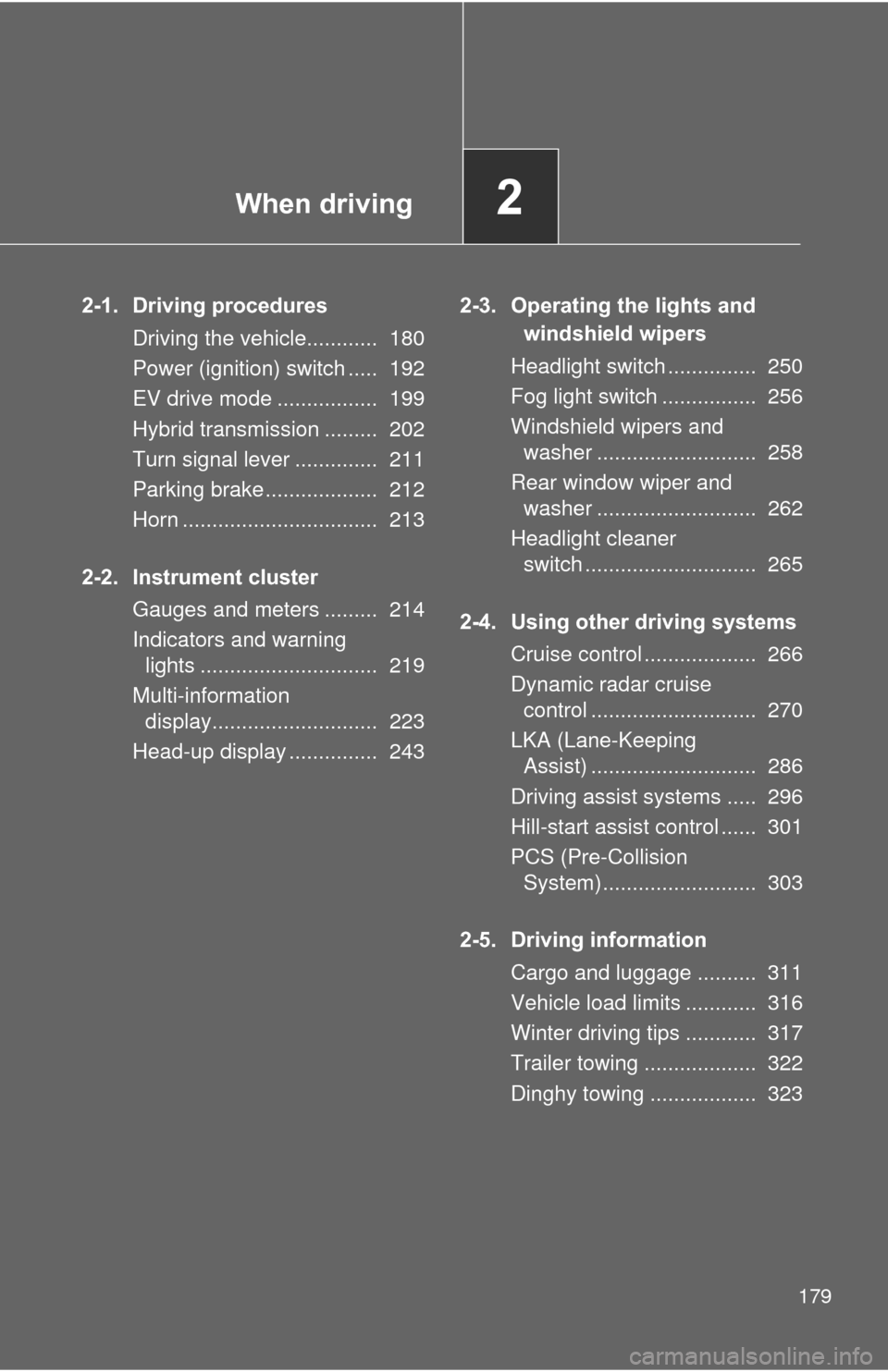
2-1. Driving proceduresDriving the vehicle............ 180
Power (ignition) switch ..... 192
EV drive mode ................. 199
Hybrid transmission ......... 202
Turn signal lever .............. 211
Parking brake ................... 212
Horn ................................. 213
2-2. Instrument cluster Gauges and meters ......... 214
Indicators and warning lights .............................. 219
Multi-information display............................ 223
Head-up display ............... 243 2-3. Operating the lights and
windshield wipers
Headlight switch ............... 250
Fog light switch ................ 256
Windshield wipers and washer ........................... 258
Rear window wiper and washer ........................... 262
Headlight cleaner switch ............................. 265
2-4. Using other driving systems Cruise control ................... 266
Dynamic radar cruise control ............................ 270
LKA (Lane-Keeping Assist) ............................ 286
Driving assist systems ..... 296
Hill-start assist control ...... 301
PCS (Pre-Collision System).......................... 303
2-5. Driving information Cargo and luggage .......... 311
Vehicle load limits ............ 316
Winter driving tips ............ 317
Trailer towing ................... 322
Dinghy towing .................. 323
Page 189 of 636
189
2-1. Driving procedures
2
When driving
CAUTION
■
When taking a nap in the vehicle
Always turn the hybrid system off. Otherwise, if you accidentally move the
shift lever or depress the accelerator pedal, this could cause an accident or
fire due to hybrid system overheating. Additionally, if the vehicle is parked in
a poorly ventilated area, exhaust gases may collect and enter the vehicle,
leading to death or a serious health hazard.
■ When braking
●When the brakes are wet, drive more cautiously.
Braking distance increases when the brakes are wet, and this may cause
one side of the vehicle to brake differently than the other side. Also, the
parking brake may not securely hold the vehicle.
● If the electronically controlled assist function does not operate, do not fol-
low other vehicles closely and avoid downhill or sharp turns that require
braking.
In this case, braking is still possible, but the brake pedal should be
depressed more firmly than usual. Also, the braking distance will increase.
● The brake system consists of 2 individual hydraulic systems; if one of the
systems fails, the others will still operate. In this case, the brake pedal
should be depressed more firmly than usual and the braking distance will
increase. If this happens, do not continue to drive the vehicle. If the brake
system warning light (red indicator) comes on while driving, immediately
stop the vehicle in a safe place and contact your Toyota dealer.
Page 218 of 636
218 2-2. Instrument cluster
CAUTION
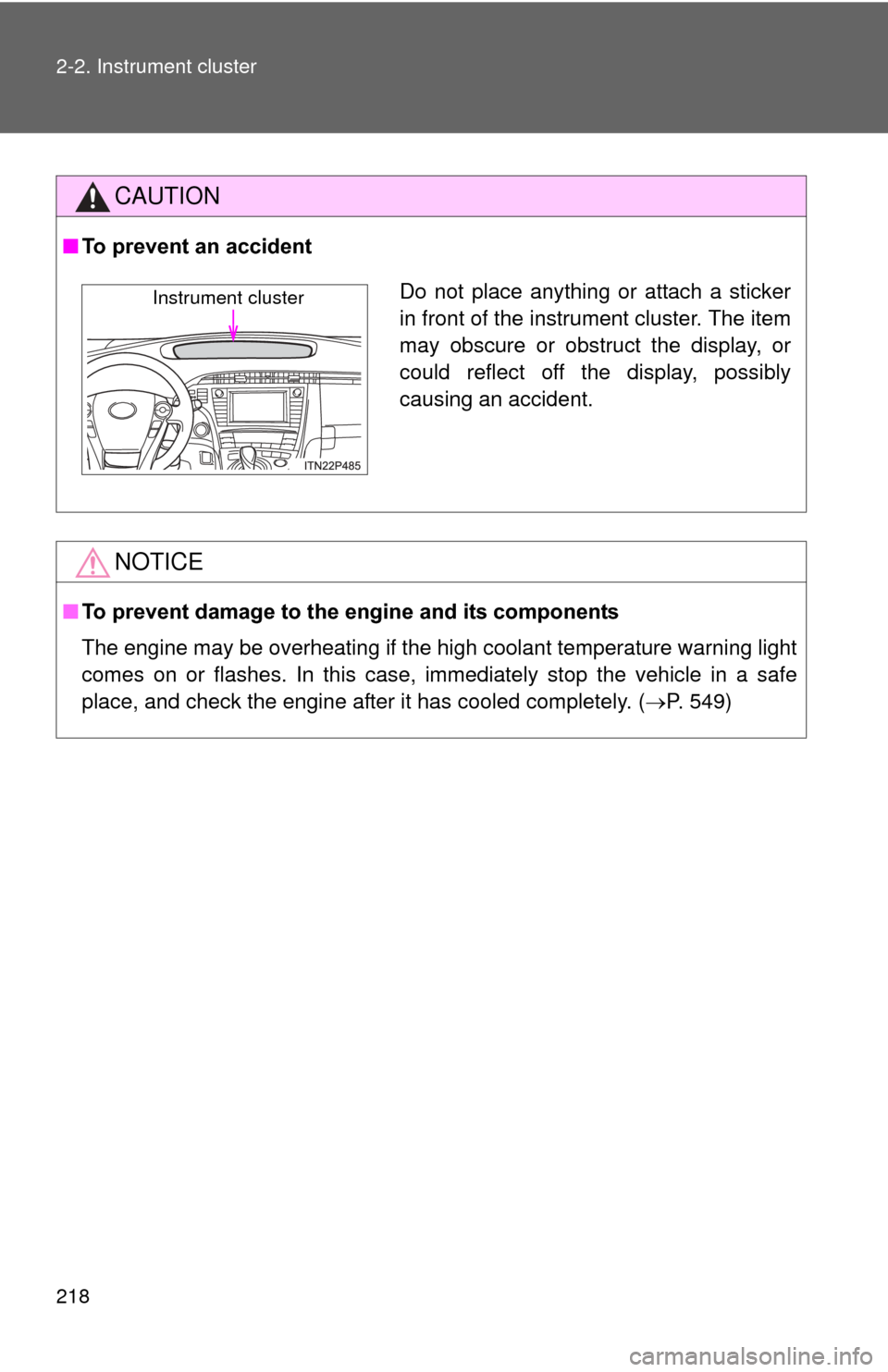
■To prevent an accident
NOTICE
■To prevent damage to the engine and its components
The engine may be overheating if the high coolant temperature warning light
comes on or flashes. In this case, immediately stop the vehicle in a safe
place, and check the engine after it has cooled completely. ( P. 549)
Do not place anything or attach a sticker
in front of the instrument cluster. The item
may obscure or obstruct the display, or
could reflect off the display, possibly
causing an accident.Instrument cluster
Page 219 of 636
219
2-2. Instrument cluster
2
When driving
Indicators and warning lights
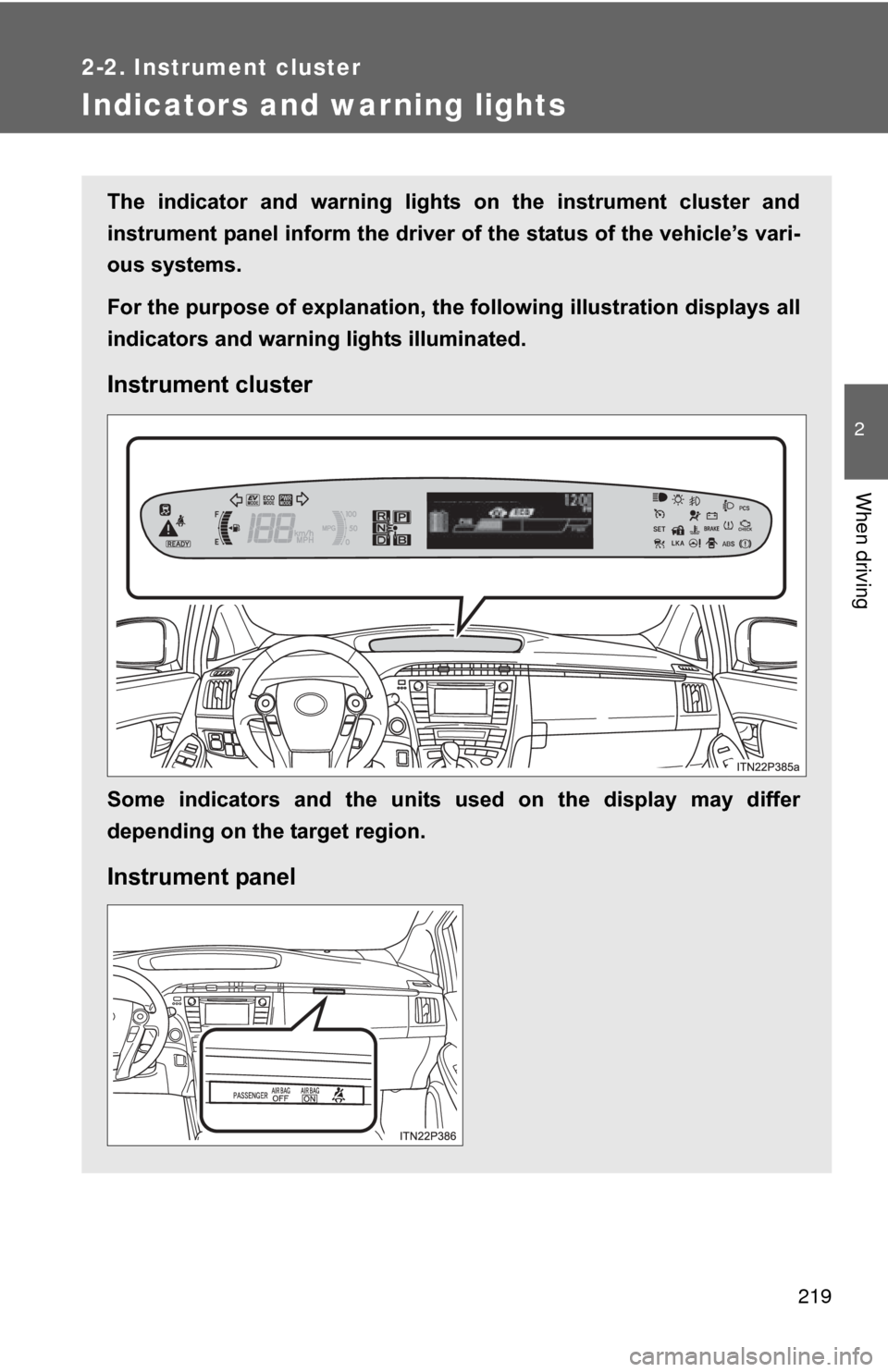
The indicator and warning lights on the instrument cluster and
instrument panel inform the driver of the status of the vehicle’s vari-
ous systems.
For the purpose of explanation, the following illustration displays all
indicators and warning lights illuminated.
Instrument cluster
Some indicators and the units used on the display may differ
depending on the target region.
Instrument panel
Page 221 of 636
221
2-2. Instrument cluster
2
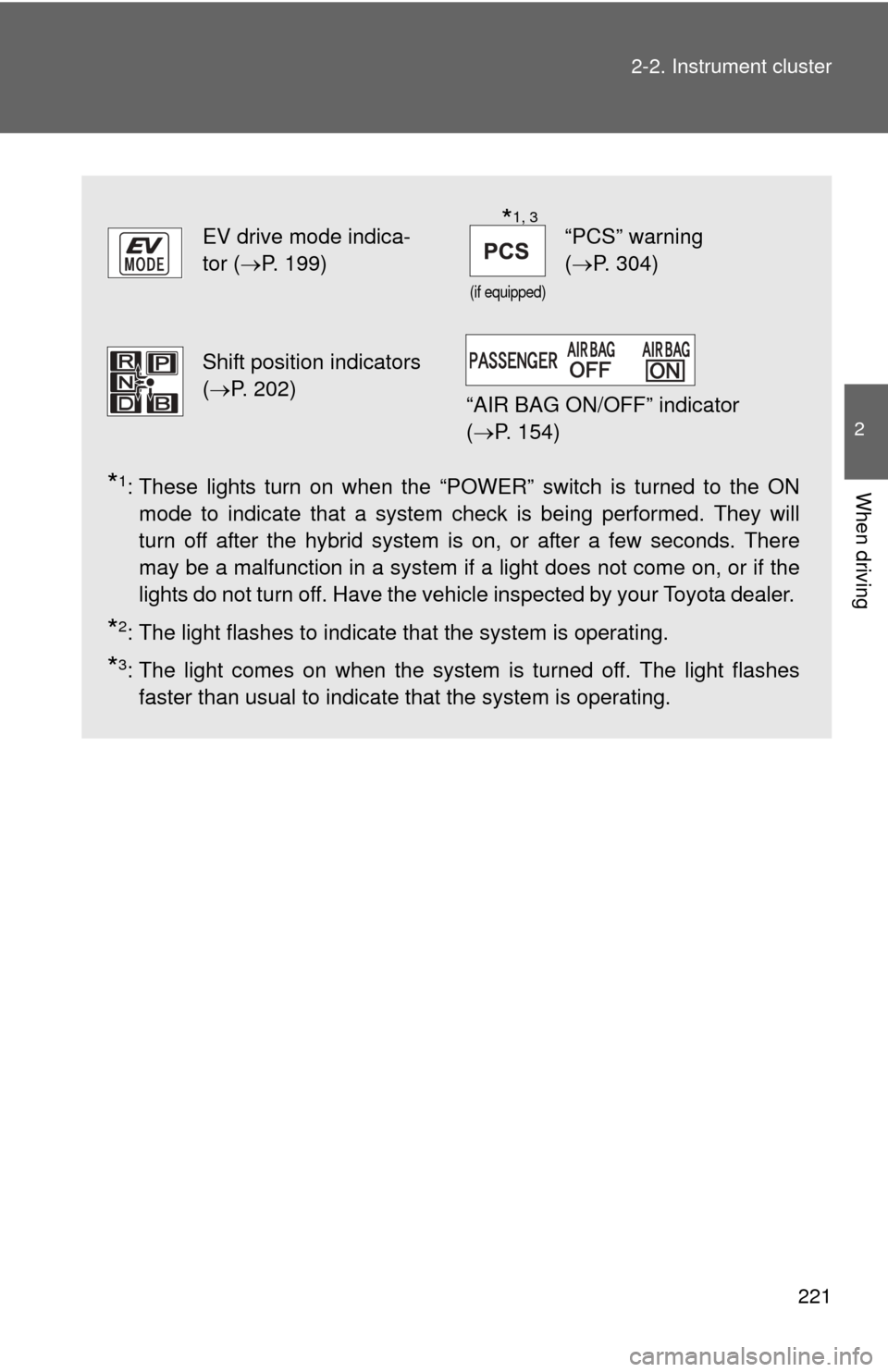
When driving*1: These lights turn on when the “POWER” switch is turned to the ON
mode to indicate that a system check is being performed. They will
turn off after the hybrid system is on, or after a few seconds. There
may be a malfunction in a system if a light does not come on, or if the
lights do not turn off. Have the vehicle inspected by your Toyota dealer.
*2: The light flashes to indicate that the system is operating.
*3: The light comes on when the system is turned off. The light flashes
faster than usual to indicate that the system is operating.
EV drive mode indica-
tor ( P. 199)
(if equipped)
“PCS” warning
(P. 304)
Shift position indicators
(P. 202)
“AIR BAG ON/OFF” indicator
( P. 154)
*1, 3
Page 222 of 636
222 2-2. Instrument cluster
CAUTION
■If a safety system warning light does not come on
Should a safety system light such as the ABS and SRS airbag warning light
not come on when you start the hybrid system, this could mean that these
systems are not available to help protect you in an accident, which could
result in death or serious injury. Have the vehicle inspected by your Toyota
dealer immediately if this occurs.
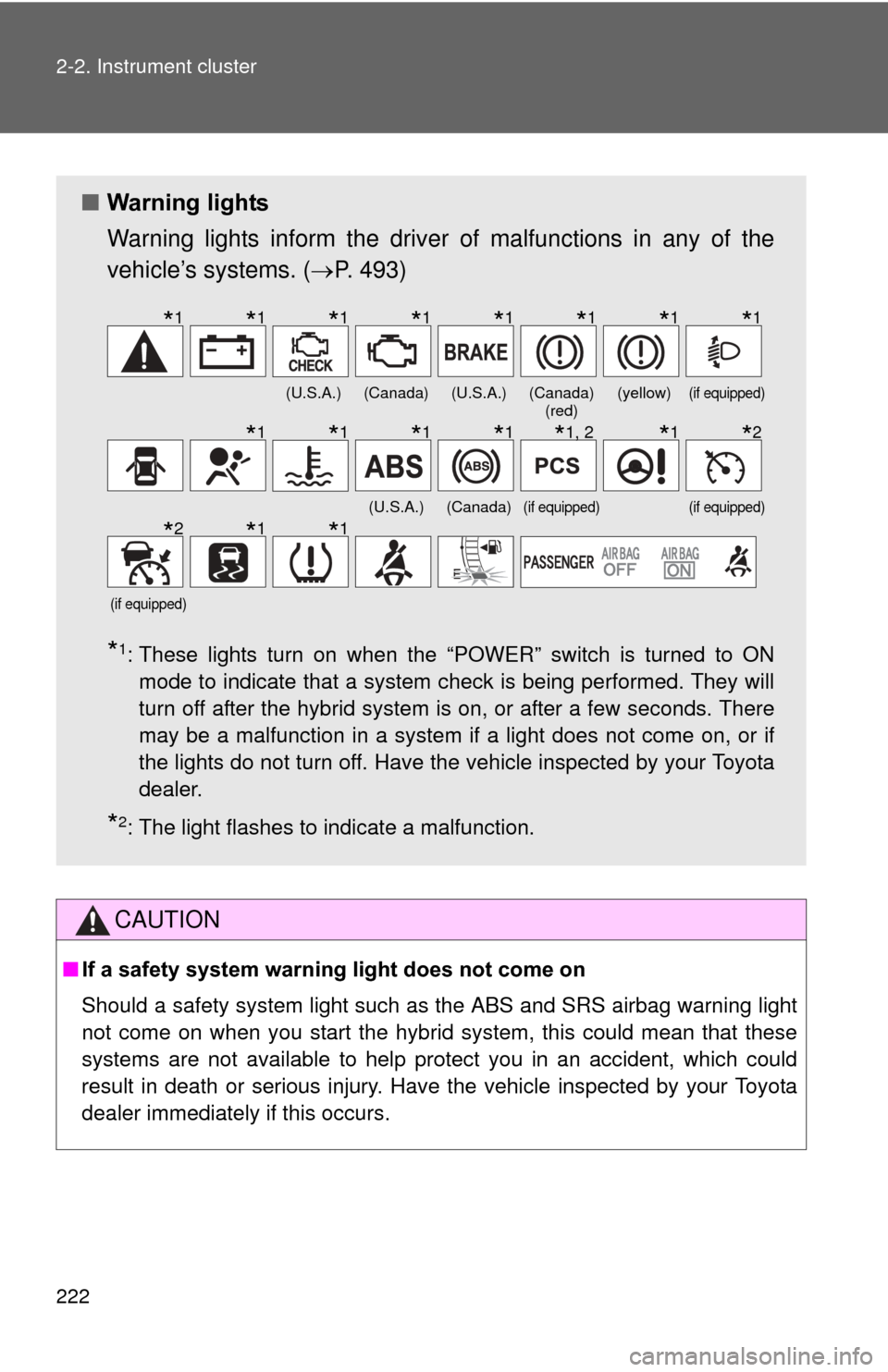
■ Warning lights
Warning lights inform the driver of malfunctions in any of the
vehicle’s systems. ( P. 493)
*1: These lights turn on when the “POWER” switch is turned to ON
mode to indicate that a system check is being performed. They will
turn off after the hybrid system is on, or after a few seconds. There
may be a malfunction in a system if a light does not come on, or if
the lights do not turn off. Have the vehicle inspected by your Toyota
dealer.
*2: The light flashes to indicate a malfunction.
(U.S.A.)(Canada)(U.S.A.)(Canada) (red)(yellow)(if equipped)
(U.S.A.)(Canada)(if equipped)(if equipped)
(if equipped)
*1*1*1*1*1*1*1*1
*1*1*1*1*1, 2*1*2
*2*1*1
Page 281 of 636

281
2-4. Using other
driving systems
2
When driving
■Warning lights, messages and buzze rs for dynamic radar cruise con-
trol
Warning lights, warning messages and buzzers are used to indicate a sys-
tem malfunction or to inform the driver of the need for caution while driving.
■ Certification
For vehicles sold in the U.S.A.
FCC ID: HYQDNMWR004
This device complies with part 15 of the FCC Rules. Operation is subject to
the following two conditions: (1) This device may not cause harmful interfer-
ence, and (2) this device must accept any interference received, including
interference that may cause undesired operation.
FCC WARNING
Changes or modifications not expressly approved by the party responsible
for compliance could void the user’s authority to operate the equipment.
Radiofrequency radiation exposure Information:
This equipment complies with FCC radiation exposure limits set forth for an
uncontrolled environment.
This equipment should be installed and operated with minimum distance of
20 cm between the radiator (antenna) and your body.
This transmitter must not be co-located or operating in conjunction with any
other antenna or transmitter.
For vehicles sold in Canada
Operation is subject to the following two conditions: (1) this device may not
cause interference, and (2) this device must accept any interference, includ-
ing interference that may cause undesired operation of the device.
Page 286 of 636
286
2-4. Using other driving systems
LKA (Lane-Keeping Assist)
: If equipped
While driving on a freeway or motor highway that has lane markings,
this system recognizes the lanes using a camera as a sensor to
assist the driver with staying in the lane. The LKA system has two
functions.
■ Lane departure warning function
If the system judges that the vehicle may deviate from its lane, it
alerts the driver using rapid be eping, indications on the multi-
information display, and a sensory warning
* given via the steer-
ing wheel.
*: A slight steering torque is applied for a short period of time in
the direction of the center of the lane.
■ Lane keeping assist function
This function will be active when the vehicle-to-vehicle distance
control mode of the cruise control ( P. 270) is set with vehicle
speed above approx. 50 mph (approx. 75 km/h) and while the
lane departure warning function is active. When the lane keep-
ing assist function is active , a slight steering torque will be
applied, to help the driver mainta in the vehicle inside the lane.