ECU TOYOTA PRIUS 2012 3.G Workshop Manual
[x] Cancel search | Manufacturer: TOYOTA, Model Year: 2012, Model line: PRIUS, Model: TOYOTA PRIUS 2012 3.GPages: 636, PDF Size: 11.02 MB
Page 490 of 636

490 5-1. Essential information
CAUTION
■Caution while towing
●Use extreme caution when towing the vehicle.
Avoid sudden starts or erratic driving maneuvers which place excessive
stress on the emergency towing eyelets and the cables or chains. Always
be cautious of the surroundings and other vehicles while towing.
● Do not turn the “POWER” switch off.
This may lead to an accident as the front wheels will be locked by the
parking lock.
● If the hybrid system is off, the power assist for the brakes and steering will
not function, making steering and braking more difficult.
■ Installing towing eyelets to the vehicle
Make sure that towing eyelets are installed securely.
If not securely installed, towing eyelets may come loose during towing. This
may lead to accidents that cause serious injury or even death.
Page 500 of 636

500 5-2. Steps to take in an emergency
*1: Open door warning buzzer:The open door warning buzzer sounds to alert one or more of the doors is
not fully closed (with the vehicle having reached a speed of 3 mph [5 km/h]).
*2: Seat belt warning buzzer:
The driver’s and front passenger’s seat belts reminder sounds to alert the
driver and front passenger that his or her seat belt is not fastened. The
buzzer sounds intermittently for 10 seconds after the vehicle has reached a
speed of at least 12 mph (20 km/h). Then, if the seat belt is still unfastened,
the buzzer will sound in a different tone for 20 more seconds.
■ SRS warning light
This warning light system monitors the airbag sensor assembly, front impact
sensors, side impact sensors (front), si de impact sensors (rear), driver’s seat
position sensor, driver’s seat belt buckle switch, front passenger occupant
classification system (ECU and sensors), “AIR BAG ON” indicator light, “AIR
BAG OFF” indicator light, front passenger’s seat belt buckle switch, seat belt
pretensioner assemblies, airbags, interconnecting wiring and power
sources. ( P. 140)
■ Front passenger occupant classifi cation system (ECU and sensors),
seat belt reminder and warning buzzer
● If luggage is placed on the front passenger seat, the front passenger
occupant classification system (ECU and sensors) may cause the warn-
ing light to flash and the warning buzzer to sound even if a passenger is
not sitting in the seat.
● If a cushion is placed on the seat, the front passenger occupant classifi-
cation system (ECU and sensors) may not detect a passenger, and the
warning light may not operate properly.
Page 501 of 636

5
When trouble arises
501
5-2. Steps to take in an emergency
■
Electric power steering system warning light
When the 12-volt battery charge becomes insufficient or the voltage tempo-
rarily drops, the electric power steering system warning light may come on.
■ If the malfunction indicator lamp comes on while driving
First check the following:
● Is the fuel tank cap loose?
If it is, tighten it securely.
The malfunction indicator lamp will go off after several driving trips.
If the malfunction indicator lamp does not go off even after several trips, con-
tact your Toyota dealer as soon as possible.
■
When the tire pressure warning light comes on
Check the tire inflation pressure and adjust to the appropriate level.
Pushing the tire pressure warning re set switch will not turn off the tire
pressure warning light.
■The tire pressure warning light may come on due to natural causes
The tire pressure warning light may come on due to natural causes such
as natural air leaks and tire inflat ion pressure changes caused by tem-
perature. In this case, adjusting the tire inflation pressure will turn off the
warning light (after a few minutes).
■When a tire is replaced with a spare tire
The compact spare tire is not equipped with a tire pressure warning
valve and transmitter. If a tire goes flat, the tire pressure warning light will
not turn off even though the flat tire has been replaced with the spare
tire. Replace the spare tire with the re paired tire and adjust the tire infla-
tion pressure. The tire pressure wa rning light will go off after a few min-
utes.
Page 509 of 636
5
When trouble arises
509
5-2. Steps to take in an emergency
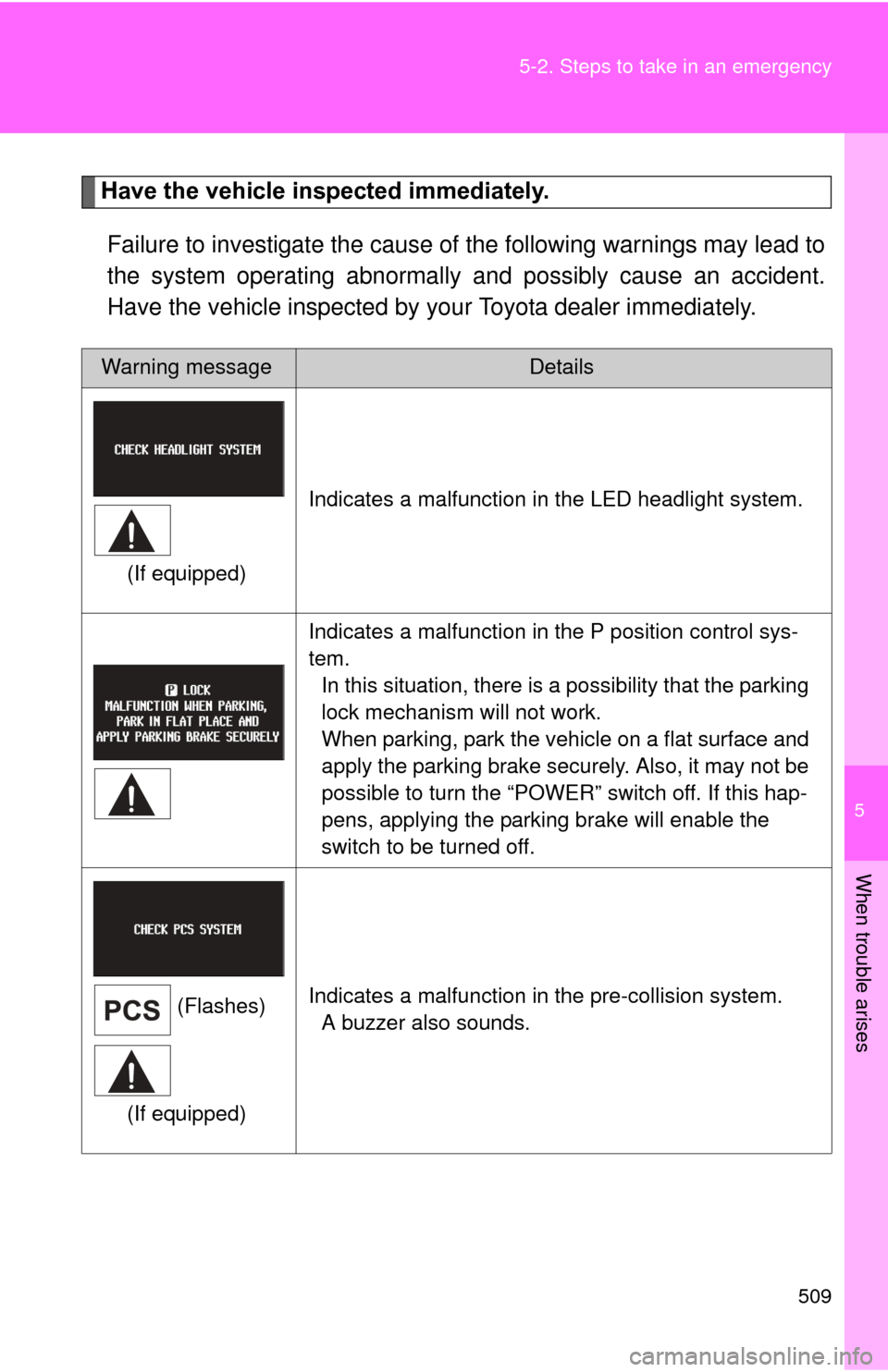
Have the vehicle inspected immediately.
Failure to investigate the cause of the following warnings may lead to
the system operating abnormally and possibly cause an accident.
Have the vehicle inspected by your Toyota dealer immediately.
Warning messageDetails
(If equipped) Indicates a malfunction in the LED headlight system.
Indicates a malfunction in the P position control sys-
tem.
In this situation, there is a possibility that the parking
lock mechanism will not work.
When parking, park the vehicle on a flat surface and
apply the parking brake securely. Also, it may not be
possible to turn the “POWER” switch off. If this hap-
pens, applying the parking brake will enable the
switch to be turned off.
(Flashes)
(If equipped) Indicates a malfunction in the pre-collision system.
A buzzer also sounds.
Page 525 of 636
5
When trouble arises
525
5-2. Steps to take in an emergency
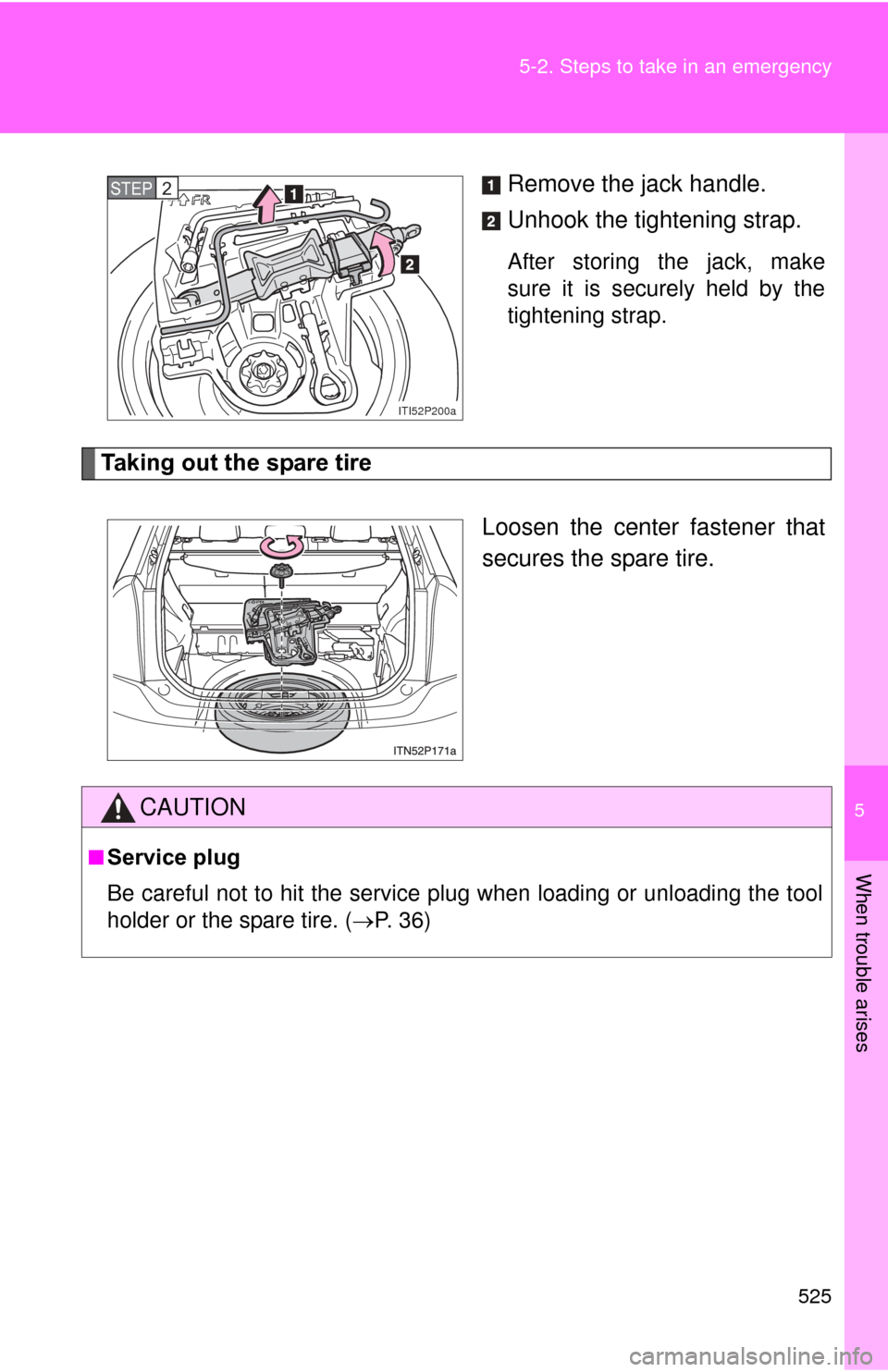
Remove the jack handle.
Unhook the tightening strap.
After storing the jack, make
sure it is securely held by the
tightening strap.
Taking out the spare tire
Loosen the center fastener that
secures the spare tire.
ITI52P200a
STEP 2
CAUTION
■Service plug
Be careful not to hit the service plug when loading or unloading the tool
holder or the spare tire. (P. 3 6 )
Page 532 of 636
532 5-2. Steps to take in an emergency
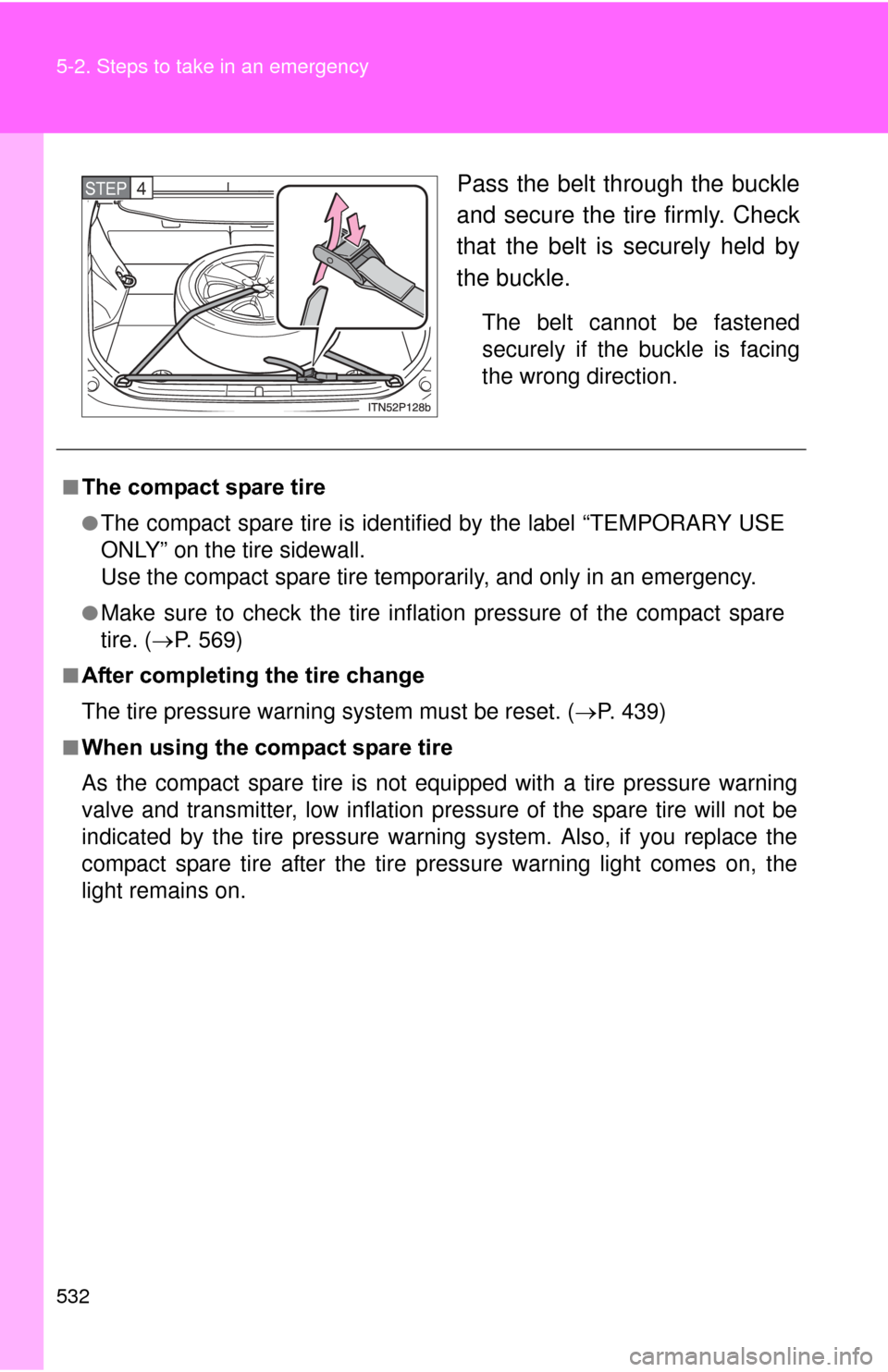
Pass the belt through the buckle
and secure the tire firmly. Check
that the belt is securely held by
the buckle.
The belt cannot be fastened
securely if the buckle is facing
the wrong direction.
STEP 4
■The compact spare tire
●The compact spare tire is identified by the label “TEMPORARY USE
ONLY” on the tire sidewall.
Use the compact spare tire temporarily, and only in an emergency.
●Make sure to check the tire inflation pressu re of the compact spare
tire. ( P. 569)
■After completing the tire change
The tire pressure warnin g system must be reset. ( P. 439)
■When using the compact spare tire
As the compact spare tire is not equipped with a tire pressure warning
valve and transmitter, low inflation pressure of the spare tire will not be
indicated by the tire pressure warn ing system. Also, if you replace the
compact spare tire after the tire pressure warning light comes on, the
light remains on.
Page 535 of 636

5
When trouble arises
535
5-2. Steps to take in an emergency
CAUTION
■Using the tire jack
Improper use of the tire jack may cause the vehicle to suddenly fall off
the jack, leading to death or serious injury.
Observe the following precautions:
●Do not use the tire jack for any pu
rpose other than replacing tires or
installing and removing tire chains.
●Only use the tire jack that comes wi th this vehicle for replacing a flat
tire.
Do not use it on other vehicles, and do not use other tire jacks for
replacing tires on this vehicle.
●Always check that the tire jack is securely set to the jack point.
●Do not put any part of your body under the vehicle while it is supported
by the jack.
●Do not start or run the hybrid system while your vehicle is supported by
the jack.
●Do not raise the vehicle while someone is inside.
●When raising the vehicle, do not put an object on or under the jack.
●Do not raise the vehicle to a hei ght greater than that required to
replace the tire.
●Use a jack stand if it is necessary to get under the vehicle.
Take particular care when lowering the vehicle to ensure that no one
working on or near the vehicle may be injured.
Page 536 of 636

536 5-2. Steps to take in an emergency
CAUTION
■Replacing a flat tire
●Do not touch the disc wheels or the area around the brakes immedi-
ately after the vehicle has been driven.
After the vehicle has been driven the disc wheels and the area around
the brakes will be extremely hot. Touching these areas with hands, feet
or other body parts while changing a tire, etc. may result in burns.
●Failure to follow these precautions could cause the wheel nuts to
loosen and the tire to fall off, resulting in death or serious injury.
• Have the wheel nuts tightened with a torque wrench to 76 ft•lbf (103
N•m, 10.5 kgf•m) as soon as possible after changing wheels.
• When installing a tire, only use wheel nuts that have been specifically designed for that wheel.
• If there are any cracks or deformations in the bolt screws, nut threads or bolt holes of the wheel, have the vehicle inspected by your Toyota
dealer.
• When installing the wheel nuts, be sure to install the wheel nuts with the tapered end facing inward. ( P. 452)
■
After using the tools and jack
Before driving, make sure all the tools and jack are securely in place in
their storage location to reduce the po ssibility of personal injury during a
collision or sudden braking.
■When stowing the flat tire
●Make sure the rear seatbacks are in their original position.
●Secure it using a tire tie-down belt. Otherwise, the flat tire may fly out
in case of sudden braking or an a ccident, resulting in death or serious
injury.
Page 556 of 636
556
5-2. Steps to take in an emergency
If your vehicle has to be stopped in an emergency
Only in an emergency, such as if it becomes impossible to stop the
vehicle in the normal way, stop the vehicle using the following pro-
cedure:
Steadily step on the brake pedal with both feet and firmly
depress it.
Do not pump the brake pedal repeatedly as this will increase the
effort required to slow the vehicle.
Shift the shift position to N.
If the shift position is shifted to N After slowing down, stop the vehi cle in a safe place by the
road.
Stop the hybrid system.
If the shift position cannot be shifted to N Keep depressing the brake pedal with both feet to reduce
vehicle speed as much as possible.
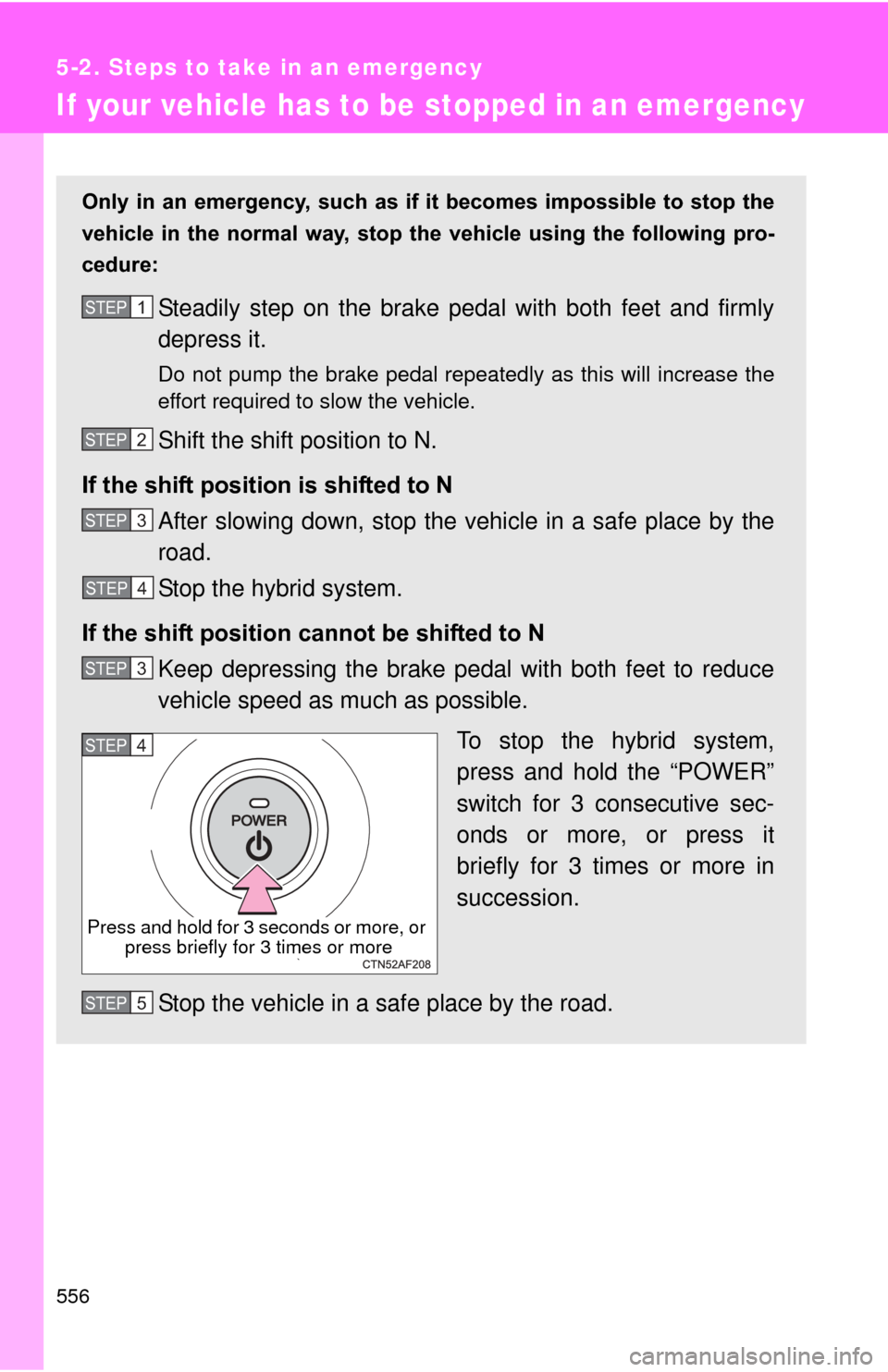
To stop the hybrid system,
press and hold the “POWER”
switch for 3 consecutive sec-
onds or more, or press it
briefly for 3 times or more in
succession.
Stop the vehicle in a safe place by the road.
STEP 1
STEP 2
STEP 3
STEP 4
STEP 3
STEP 4
Press and hold for 3 seconds or more, or press briefly for 3 times or more
STEP 5
Page 589 of 636
589
6-1. Specifications
6
Vehicle specifications
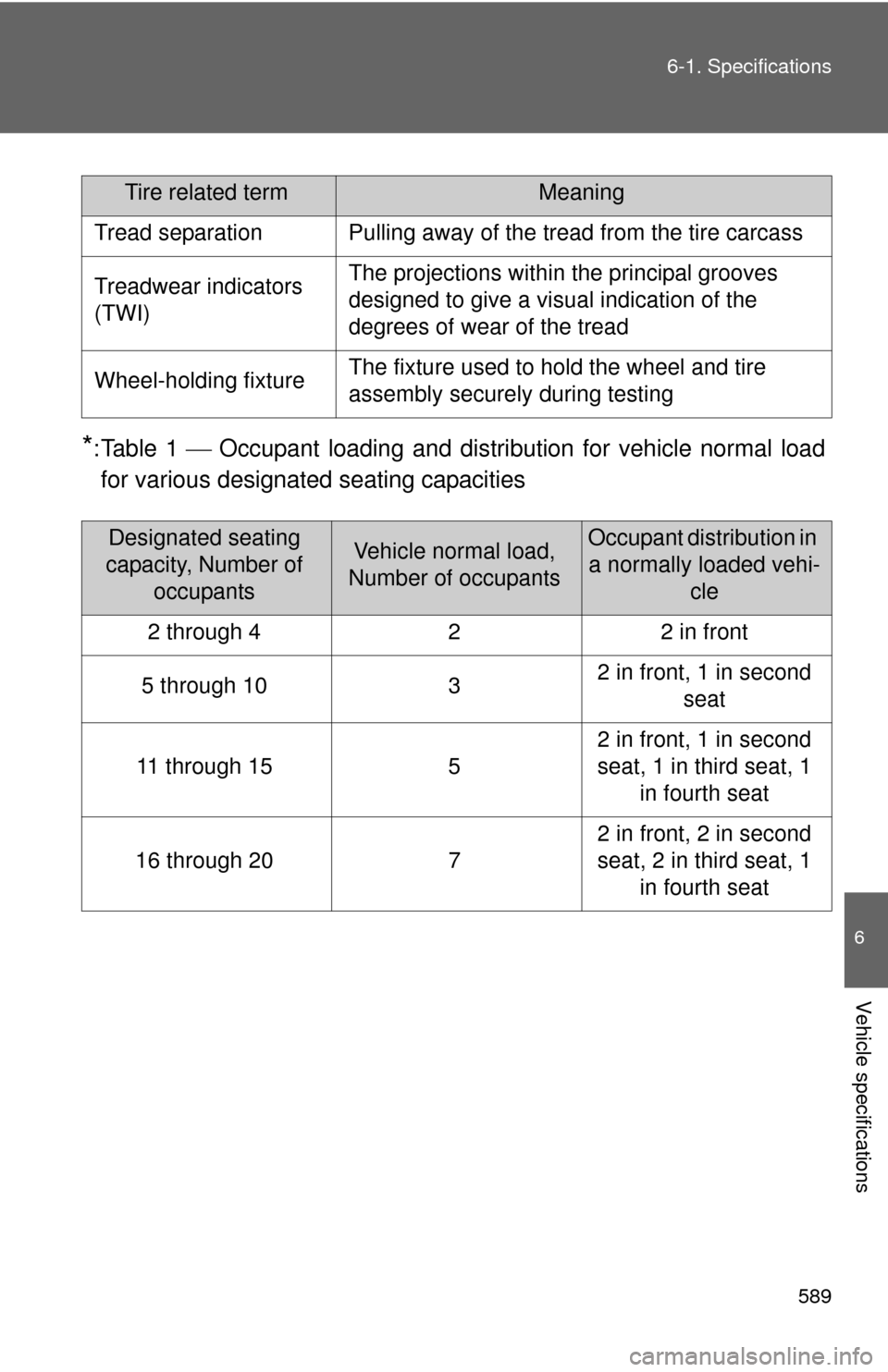
*: Table 1
Occupant loading and distri bution for vehicle normal load
for various designated seating capacities
Tire related termMeaning
Tread separation Pulling away of the tread from the tire carcass
Treadwear indicators
(TWI) The projections within the principal grooves
designed to give a visual indication of the
degrees of wear of the tread
Wheel-holding fixture The fixture used to hold the wheel and tire
assembly securely
during testing
Designated seating
capacity, Number of occupantsVehicle normal load,
Number of occupantsOccupant distribution in a normally loaded vehi- cle
2 through 4 2 2 in front
5 through 10 3 2 in front, 1 in second
seat
11 through 15 5 2 in front, 1 in second
seat, 1 in third seat, 1
in fourth seat
16 through 20 7 2 in front, 2 in second
seat, 2 in third seat, 1
in fourth seat