lock TOYOTA PRIUS 2012 3.G Workshop Manual
[x] Cancel search | Manufacturer: TOYOTA, Model Year: 2012, Model line: PRIUS, Model: TOYOTA PRIUS 2012 3.GPages: 636, PDF Size: 11.02 MB
Page 106 of 636
106 1-4. Adjustable components (seats, mirrors, steering wheel)
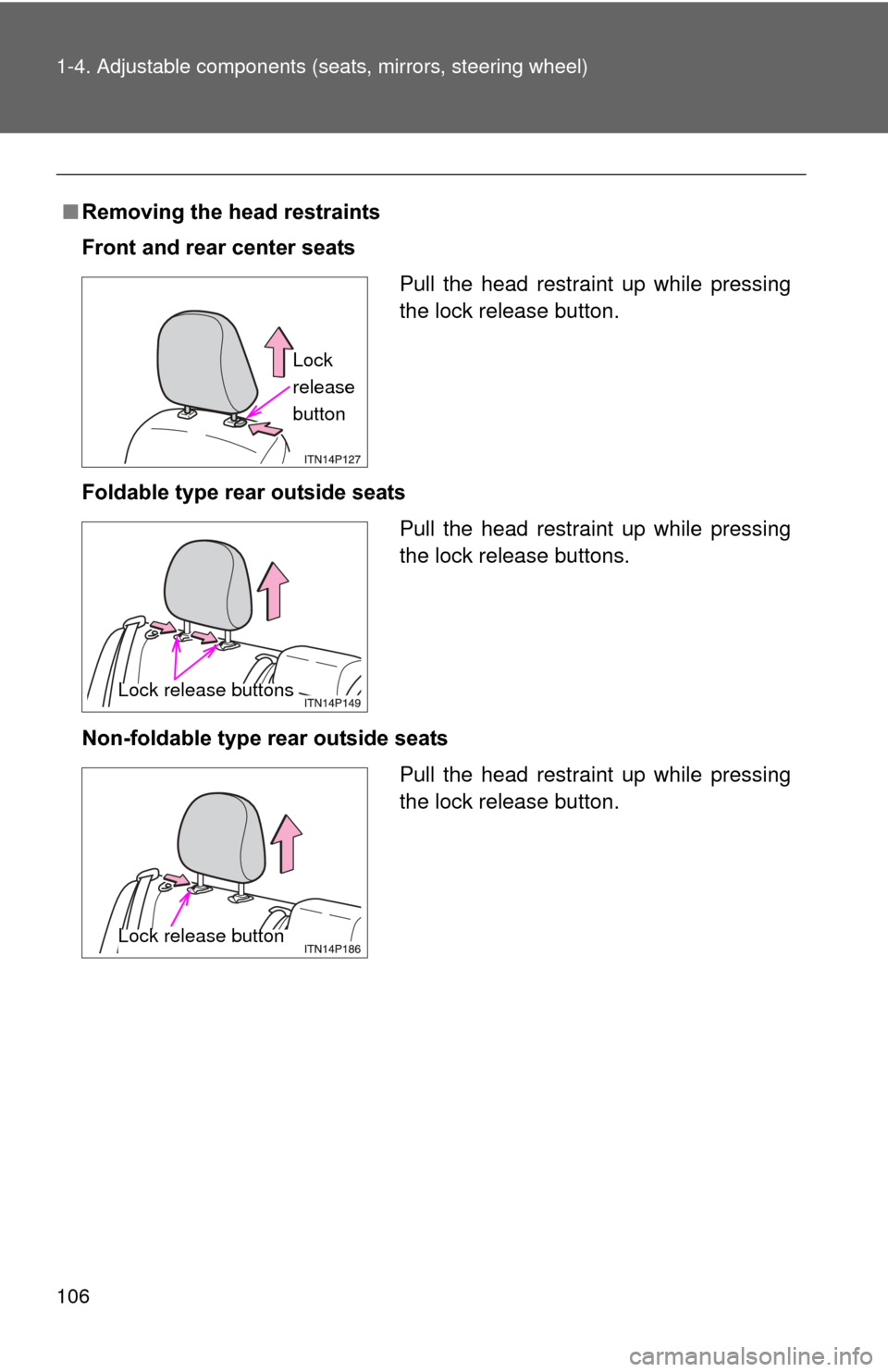
■Removing the head restraints
Front and rear center seats
Foldable type rear outside seats
Non-foldable type rear outside seats
Pull the head restraint up while pressing
the lock release button.
Lock
release
button
Pull the head restraint up while pressing
the lock release buttons.
Lock release buttons
Pull the head restraint up while pressing
the lock release button.
Lock release button
Page 107 of 636
107
1-4. Adjustable components (s
eats, mirrors, steering wheel)
1
Before driving
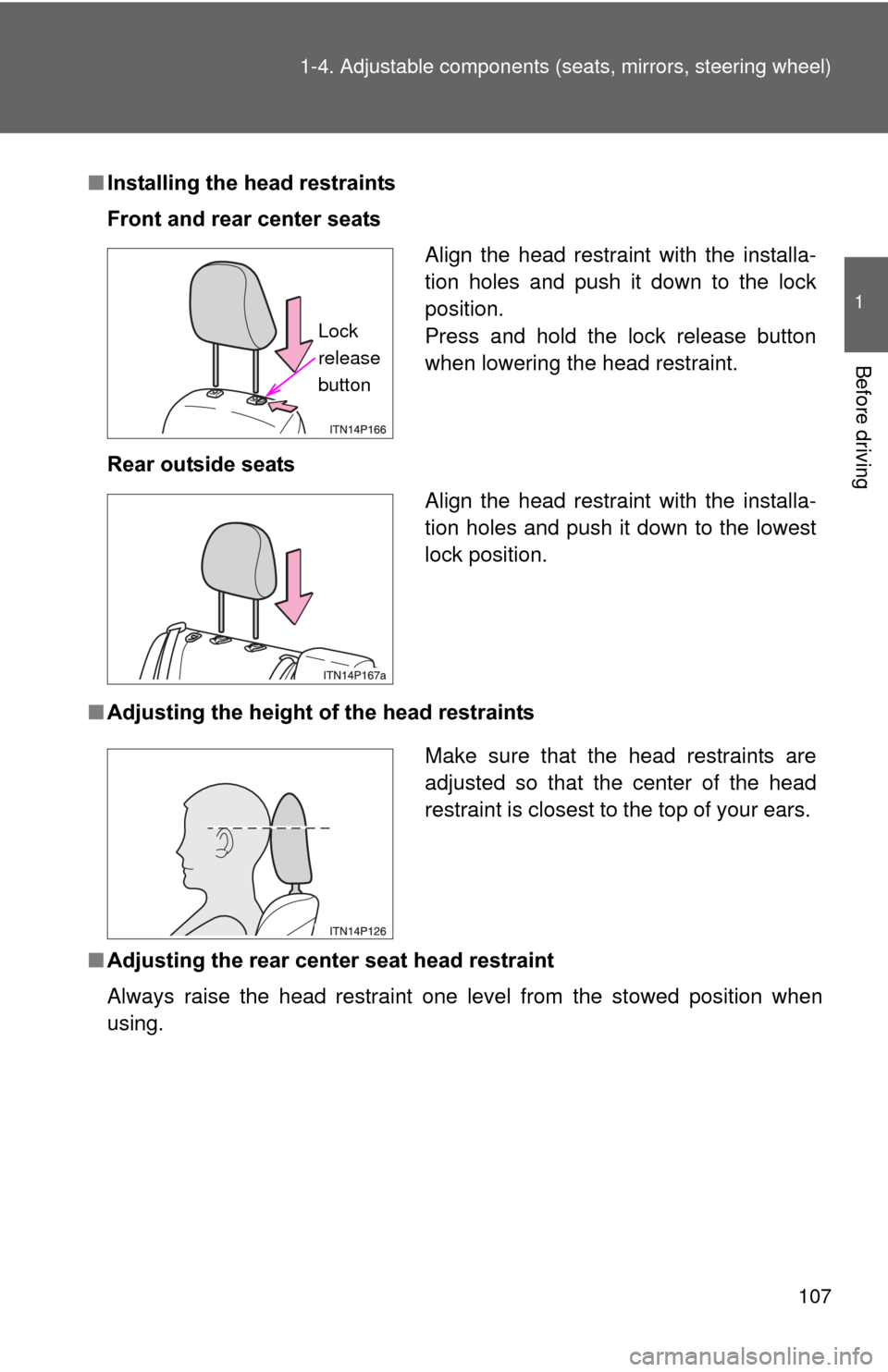
■Installing the head restraints
Front and rear center seats
Rear outside seats
■ Adjusting the height of the head restraints
■ Adjusting the rear cent er seat head restraint
Always raise the head restraint one level from the stowed position when
using.
Align the head restraint with the installa-
tion holes and push it down to the lock
position.
Press and hold the lock release button
when lowering the head restraint.
Lock
release
button
Align the head restraint with the installa-
tion holes and push it down to the lowest
lock position.
Make sure that the head restraints are
adjusted so that the center of the head
restraint is closest to the top of your ears.
Page 108 of 636
108 1-4. Adjustable components (seats, mirrors, steering wheel)
CAUTION
■Head restraint precautions
Observe the following precautions regarding the head restraints. Failure to
do so may result in death or serious injury.
●Use the head restraints designed for each respective seat.
● Adjust the head restraints to the correct position at all times.
● After adjusting the head restraints, push down on them and make sure
they are locked in position.
● Do not drive with the head restraints removed.
Page 111 of 636

111
1-4. Adjustable components (s
eats, mirrors, steering wheel)
1
Before driving
Pre-collision seat belts (front seats of vehicles with pre-collision
system)
If the system determine s that a collision is unavoidable, the front seat
belts will retract before the collision. ( P. 303)
■Emergency locking retractor (ELR)
The retractor will lock the belt during a sudden stop or on impact. It may also
lock if you lean forward too quickly. A slow, easy motion will allow the belt to
extend so that you can move around fully.
■ Automatic locking retractor (ALR)
When a passenger’s shoulder belt is completely extended and then
retracted even slightly, the belt is locked in that position and cannot be
extended. This feature is used to hold the child restraint system (CRS) firmly.
To free the belt again, fully retract the belt and then pull the belt out once
more. ( P. 165)
■ Child seat belt usage
The seat belts of your vehicle were principally designed for persons of adult
size.
●Use a child restraint system appropriate for the child, until the child
becomes large enough to properly wear the vehicle’s seat belt. ( P. 160)
● When the child becomes large enough to properly wear the vehicle’s
seat belt, follow the instructions on P. 109 regarding seat belt usage.
■ Replacing the belt after the pretensioner has been activated
If the vehicle is involved in multiple collisions, the pretensioner will activate
for the first collision, but will not activate for the second or subsequent colli-
sions.
Page 115 of 636
115
1-4. Adjustable components (s
eats, mirrors, steering wheel)
1
Before driving
CAUTION
■Seat belt damage and wear
●Do not damage the seat belts by allowing the belt, plate, or buckle to be
jammed in the door.
● Inspect the seat belt system periodically. Check for cuts, fraying, and loose
parts. Do not use a damaged seat belt until it is replaced. Damaged seat
belts cannot protect an occupant from death or serious injury.
● Ensure that the belt and plate are locked and the belt is not twisted.
If the seat belt does not function correctly, immediately contact your Toyota
dealer.
● Replace the seat assembly, including the belts, if your vehicle has been
involved in a serious accident, even if there’s no obvious damage.
● Do not attempt to install, remove, modify, disassemble or dispose of the
seat belts. Have any necessary repairs carried out by your Toyota dealer.
Inappropriate handling of the pretensioner may prevent it from operating
properly, resulting in death or serious injury.
Page 117 of 636
117
1
1-4. Adjustable components (seats, mirrors, steering wheel)
Before driving
Steering wheel
CAUTION
■Caution while driving
Do not adjust the steering wheel while driving.
Doing so may cause the driver to mishandle the vehicle and cause an acci-
dent, resulting in death or serious injury.
■ After adjusting the steering wheel
Make sure that the steering wheel is securely locked.
Otherwise, the steering wheel may move suddenly, possibly causing an
accident, and resulting in death or serious injury.
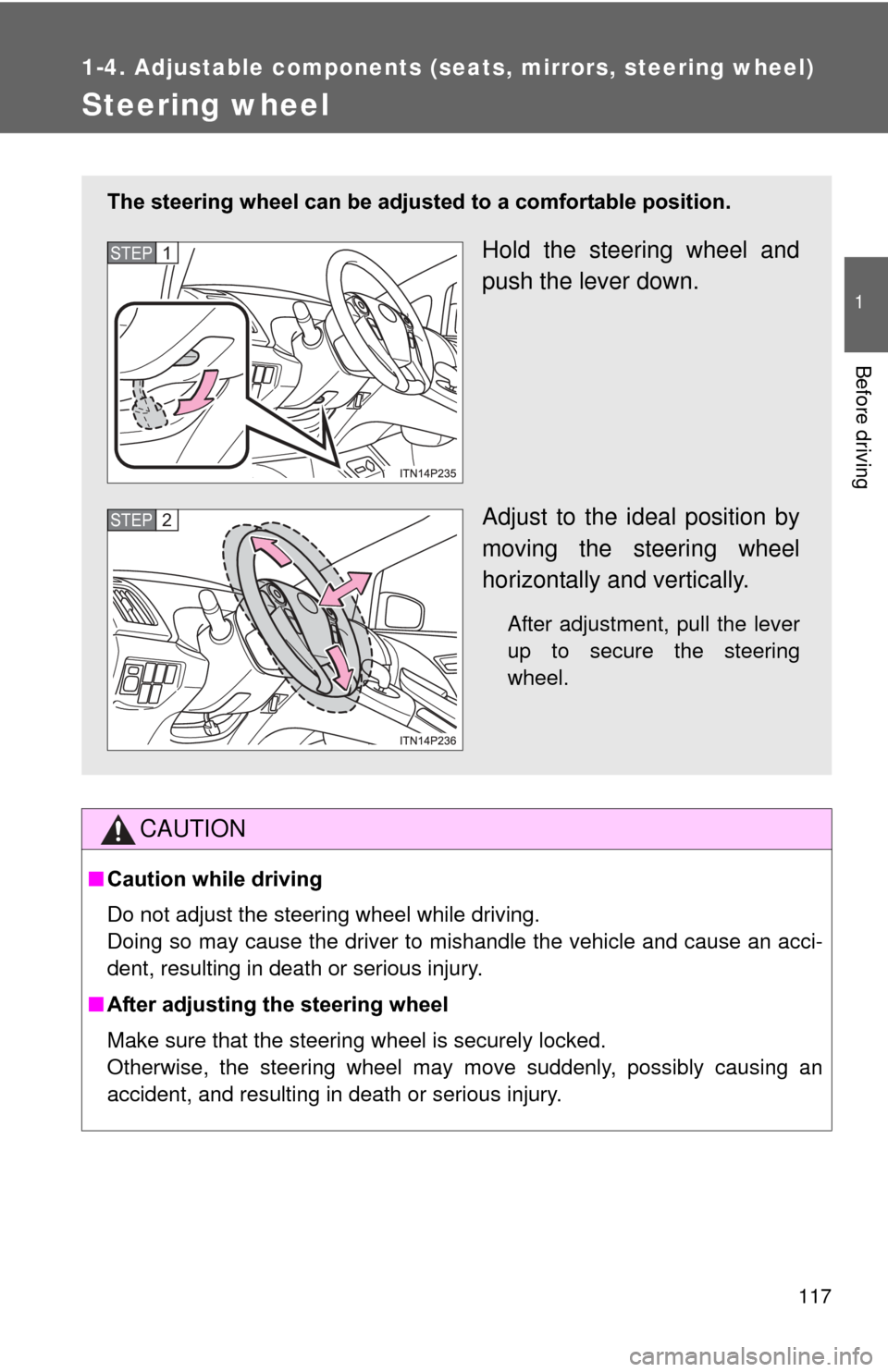
The steering wheel can be adjust ed to a comfortable position.
Hold the steering wheel and
push the lever down.
Adjust to the ideal position by
moving the steering wheel
horizontally and vertically.
After adjustment, pull the lever
up to secure the steering
wheel.
STEP 1
STEP 2
Page 123 of 636
123
1
Before driving
1-5. Opening and closing the windows and moon roof
Power windows
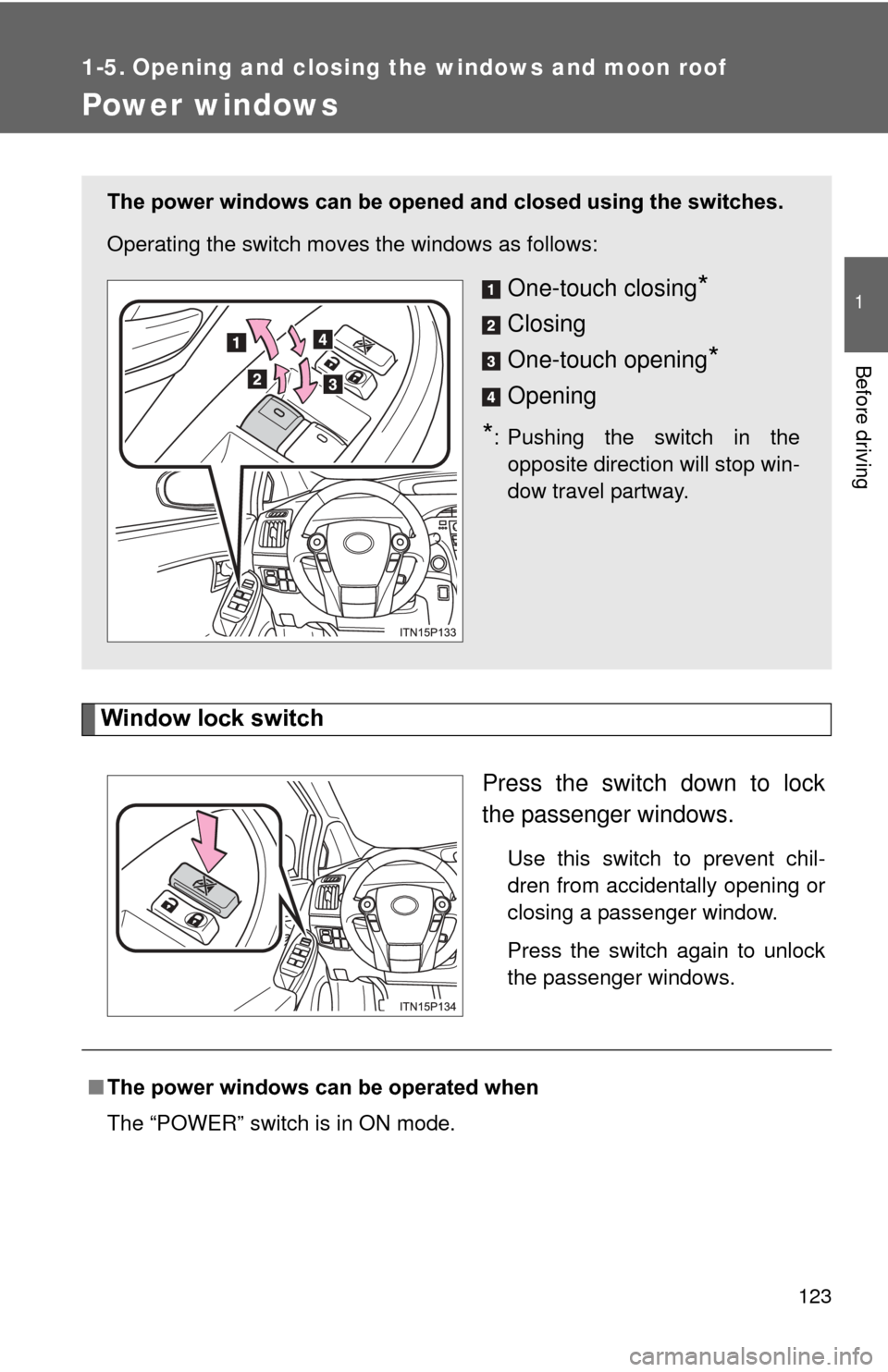
Window lock switchPress the switch down to lock
the passenger windows.
Use this switch to prevent chil-
dren from accidentally opening or
closing a passenger window.
Press the switch again to unlock
the passenger windows.
The power windows can be opened and closed using the switches.
Operating the switch moves the windows as follows:
One-touch closing*
Closing
One-touch opening
*
Opening
*: Pushing the switch in the opposite direction will stop win-
dow travel partway.
■ The power windows can be operated when
The “POWER” switch is in ON mode.
Page 138 of 636
138
1-8. Safety information
Correct driving posture
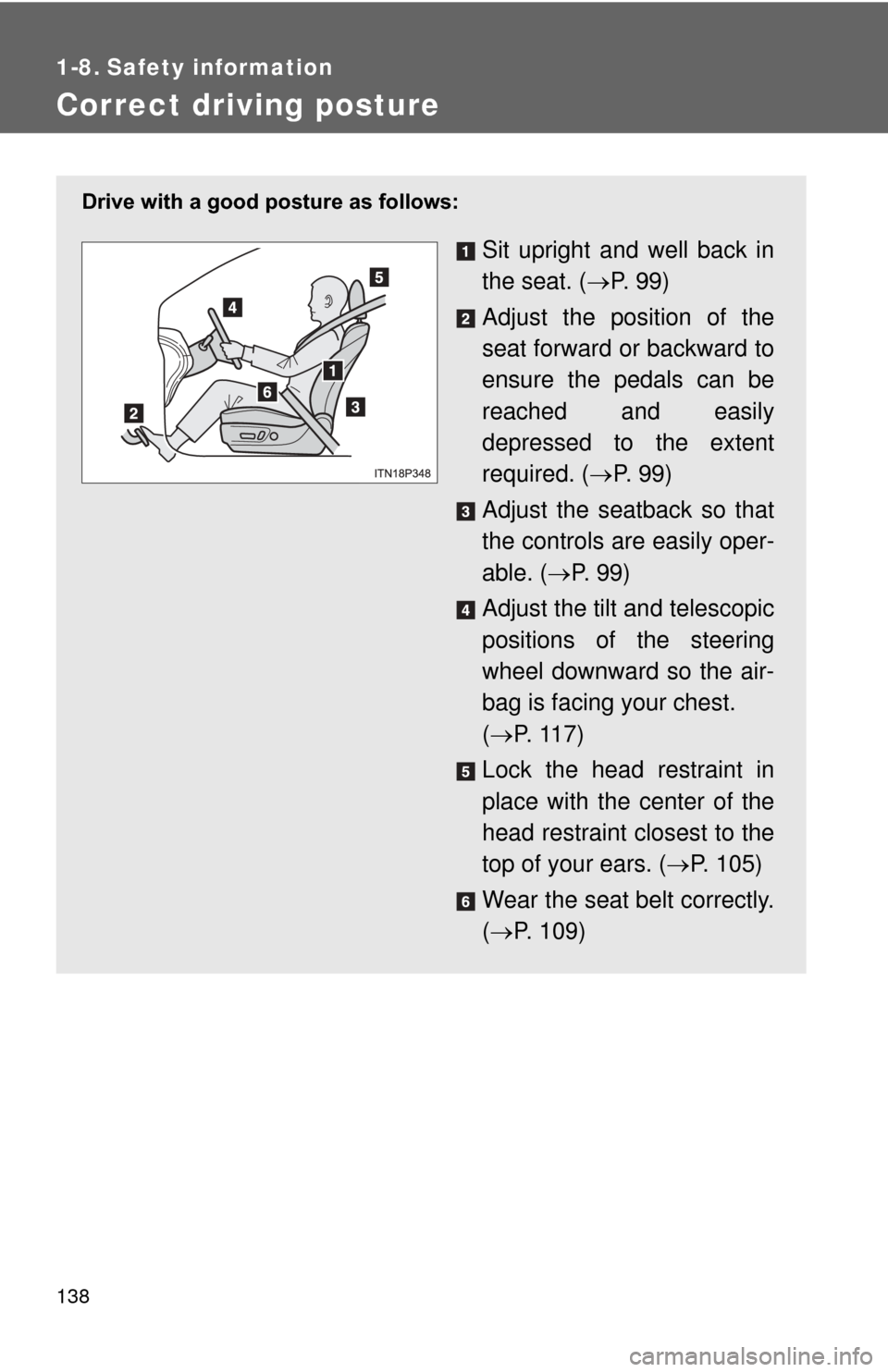
Drive with a good posture as follows:
Sit upright and well back in
the seat. (P. 9 9 )
Adjust the position of the
seat forward or backward to
ensure the pedals can be
reached and easily
depressed to the extent
required. ( P. 99)
Adjust the seatback so that
the controls are easily oper-
able. ( P. 99)
Adjust the tilt and telescopic
positions of the steering
wheel downward so the air-
bag is facing your chest.
( P. 1 1 7 )
Lock the head restraint in
place with the center of the
head restraint closest to the
top of your ears. ( P. 105)
Wear the seat belt correctly.
( P. 109)
Page 139 of 636
139
1-8. Safety information
1
Before driving
CAUTION
■
While driving
●Do not adjust the position of the driver’s seat.
Doing so could cause the driver to lose control of the vehicle.
● Do not place a cushion between the driver or passenger and the seatback.
A cushion may prevent correct posture from being achieved, and reduce
the effectiveness of the seat belt and head restraint, increasing the risk of
death or serious injury to the driver or passenger.
● Do not place anything under the front seats.
Objects placed under the front seats may become jammed in the seat
tracks and stop the seat from locking in place. This may lead to an acci-
dent, resulting in death or serious injury. The adjustment mechanism may
also be damaged.
■ Adjusting the seat position
●Take care when adjusting the seat position to ensure that other passen-
gers are not injured by the moving seat.
● Do not put your hands under the seat or near the moving parts to avoid
injury.
Fingers or hands may become jammed in the seat mechanism.
Page 165 of 636
165
1
1-8. Safety information
Before driving
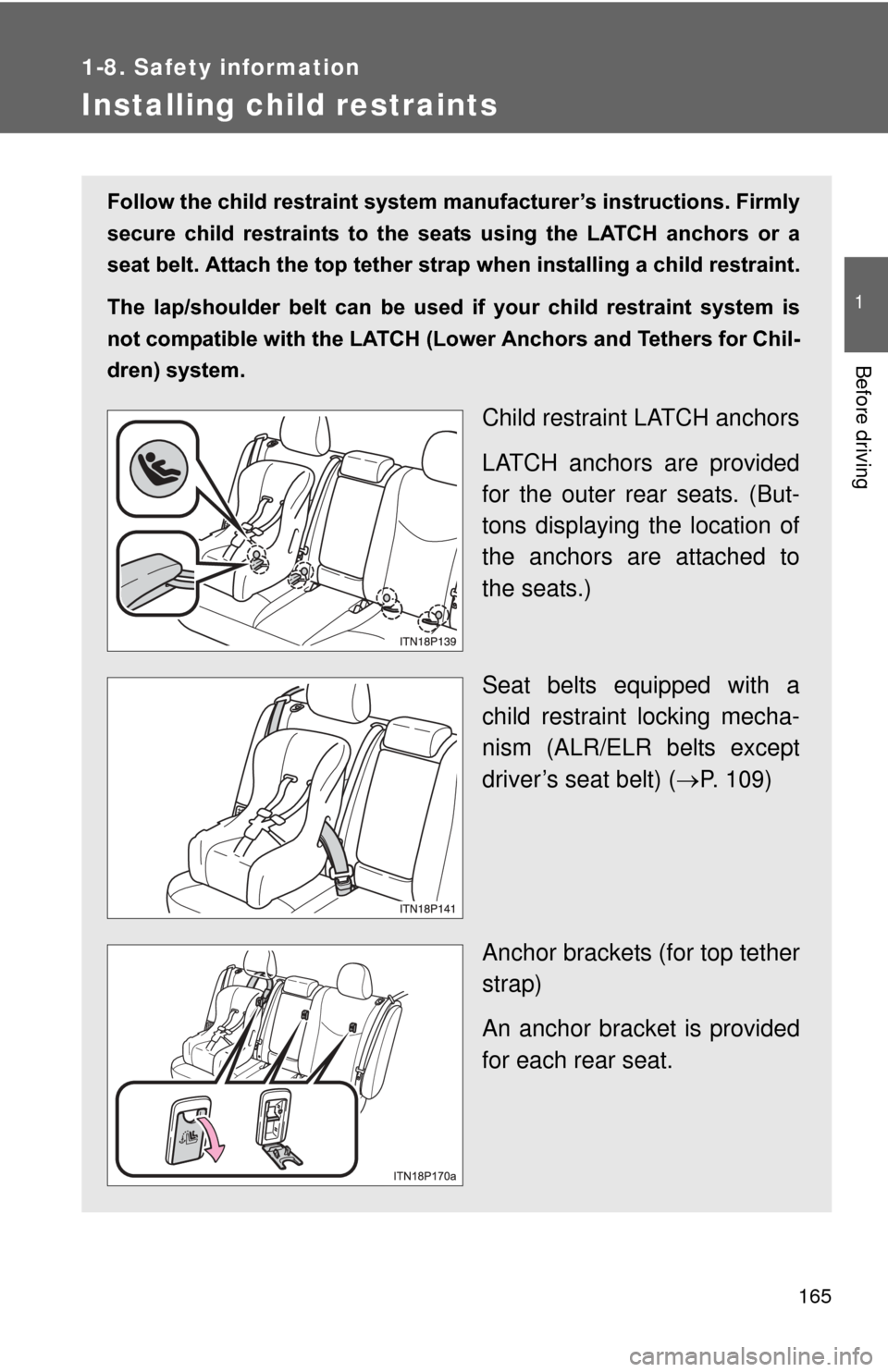
Installing child restraints
Follow the child restraint system manufacturer’s instructions. Firmly
secure child restraints to the seat s using the LATCH anchors or a
seat belt. Attach the top tether stra p when installing a child restraint.
The lap/shoulder belt can be used if your child restraint system is
not compatible with the LATCH (Low er Anchors and Tethers for Chil-
dren) system.
Child restraint LATCH anchors
LATCH anchors are provided
for the outer rear seats. (But-
tons displaying the location of
the anchors are attached to
the seats.)
Seat belts equipped with a
child restraint locking mecha-
nism (ALR/ELR belts except
driver’s seat belt) ( P. 109)
Anchor brackets (for top tether
strap)
An anchor bracket is provided
for each rear seat.