MOUNT TOYOTA PRIUS 2016 4.G Service Manual
[x] Cancel search | Manufacturer: TOYOTA, Model Year: 2016, Model line: PRIUS, Model: TOYOTA PRIUS 2016 4.GPages: 800, PDF Size: 16.69 MB
Page 557 of 800
PRIUS_OM_OM47A29U_(U)
5576-4. Using the other interior features
6
Interior features
■Programming a rolling code system (for U.S.A. owners)
If your device is rolling code equipped, follow the steps under the
heading “Programming HomeLink
®” before proceeding with the
steps listed below.
Locate the training button on the ceiling mounted garage door
opener motor. The exact location and color of the button may
vary by brand of garage door opener motor.
Refer to the operation manual supplied with the garage door opener for
the location of the training button.
Press the training button.
Following this step, you have 30 seconds in which to initiate step 3
below.
Press and hold the vehicle’s programmed HomeLink® button for
2 seconds and release it. Repeat this step once again. The
garage door may open.
If the garage door opens, the programming process is complete. If the
door does not open, press and hold the button a third time, and release
after 2 seconds. This third press and release will complete the program-
ming process by opening the garage door.
The ceiling mounted garage door opener motor should now recognize
the HomeLink
® signal and operate the garage door.
Repeat the steps above to program another rolling code system
for any of the remaining HomeLink® buttons.
1
2
3
4
Page 582 of 800
582
PRIUS_OM_OM47A29U_(U)
7-2. Maintenance
Vehicle interior
ItemsCheck points
Accelerator pedal• The accelerator pedal should move smoothly(without uneven pedal effort or catching).
Hybrid transmission
“Park” mechanism• When parked on a slope and the shift positionis in P, is the vehicle securely stopped?
Brake pedal
• Does the brake pedal move smoothly?
• Does the brake pedal have appropriate clear-
ance from the floor? ( P. 733)
• Does the brake pedal have the correct amount of free play? ( P. 733)
Brakes
• The vehicle should not pull to one side when
the brakes are applied.
• The brakes should work effectively.
• The brake pedal should not feel spongy.
• The brake pedal should not get too close to the floor when the brakes are applied.
Head restraints• Do the head restraints move smoothly andlock securely?
Indicators/buzzers• Do the indicators and buzzers function prop-erly?
Lights• Do all the lights come on?
Parking brake
• Does the parking brake pedal movesmoothly?
• When parked on a slope and the parking brake is on, is the vehicle securely stopped?
Seat belts• Do the seat belts operate smoothly?
• The seat belts should not be damaged.
Seats• Do the seat controls operate properly?
Steering wheel
• Does the steering wheel rotate smoothly?
• Does the steering wheel have the correctamount of free play?
• There should not be any strange sounds com- ing from the steering wheel.
Page 593 of 800
PRIUS_OM_OM47A29U_(U)
5937-3. Do-it-yourself maintenance
7
Maintenance and care
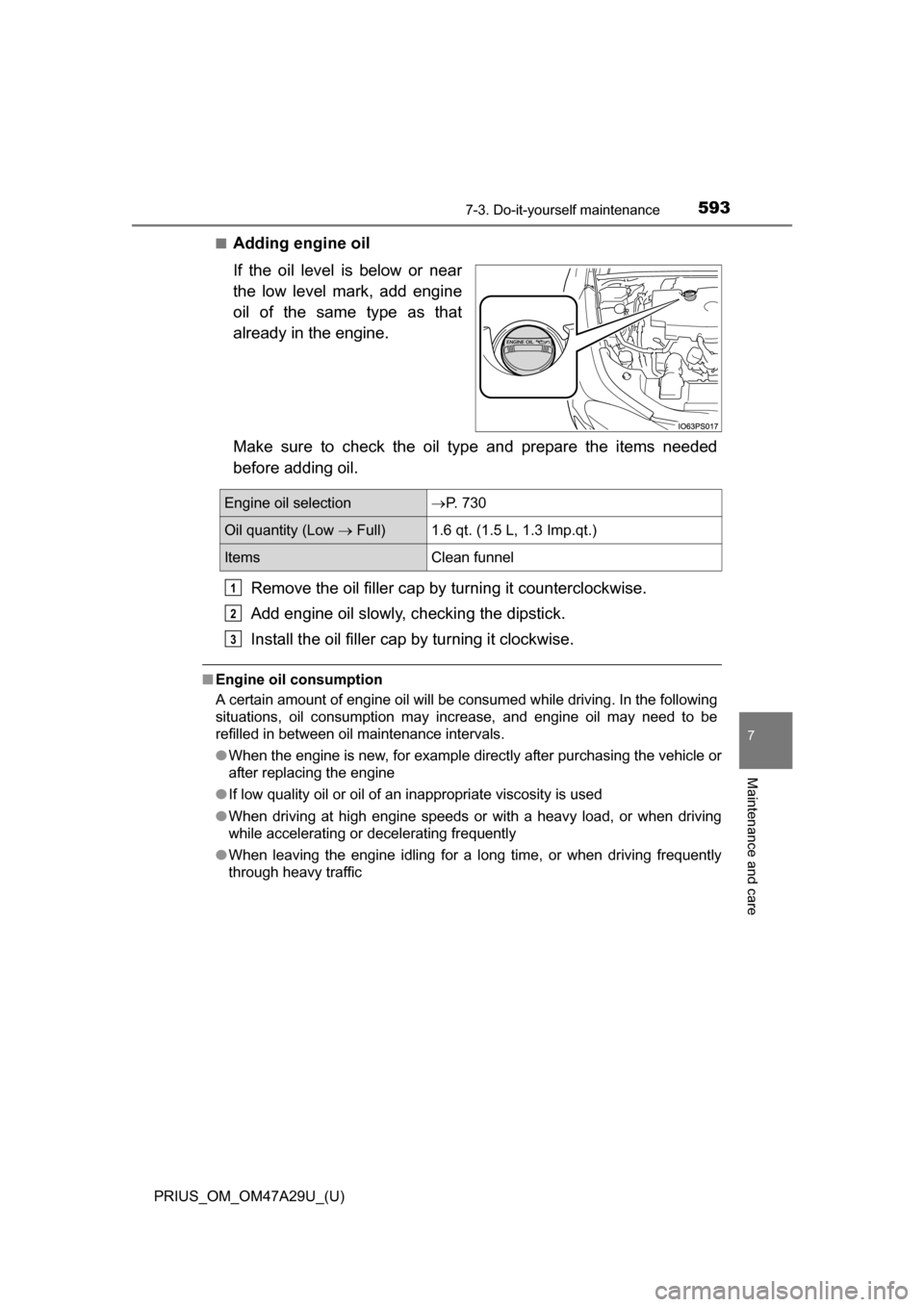
■Adding engine oil
If the oil level is below or near
the low level mark, add engine
oil of the same type as that
already in the engine.
Make sure to check the oil type and prepare the items needed
before adding oil.Remove the oil filler cap by turning it counterclockwise.
Add engine oil slowly, checking the dipstick.
Install the oil filler cap by turning it clockwise.
■ Engine oil consumption
A certain amount of engine oil will be consumed while driving. In the following
situations, oil consumption may increase, and engine oil may need to be
refilled in between oil maintenance intervals.
●When the engine is new, for example directly after purchasing the vehicle or
after replacing the engine
● If low quality oil or oil of an inappropriate viscosity is used
● When driving at high engine speeds or with a heavy load, or when driving
while accelerating or decelerating frequently
● When leaving the engine idling for a long time, or when driving frequently
through heavy traffic
Engine oil selectionP. 730
Oil quantity (Low Full)1.6 qt. (1.5 L, 1.3 Imp.qt.)
ItemsClean funnel
1
2
3
Page 626 of 800
626
PRIUS_OM_OM47A29U_(U)
7-3. Do-it-yourself maintenance
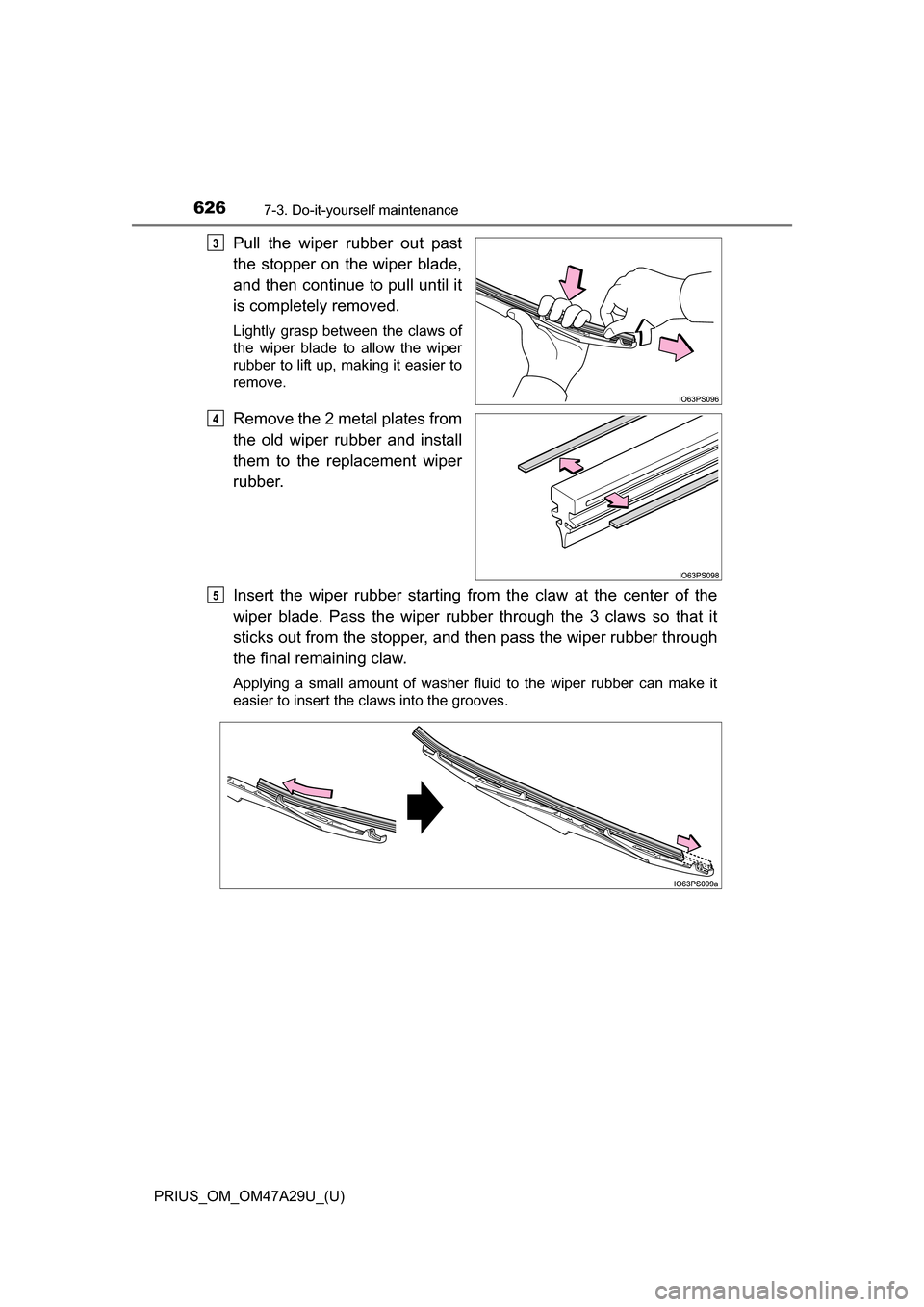
Pull the wiper rubber out past
the stopper on the wiper blade,
and then continue to pull until it
is completely removed.
Lightly grasp between the claws of
the wiper blade to allow the wiper
rubber to lift up, making it easier to
remove.
Remove the 2 metal plates from
the old wiper rubber and install
them to the replacement wiper
rubber.
Insert the wiper rubber starting from the claw at the center of the
wiper blade. Pass the wiper rubber through the 3 claws so that it
sticks out from the stopper, and then pass the wiper rubber through
the final remaining claw.
Applying a small amount of washer fluid to the wiper rubber can make it
easier to insert the claws into the grooves.
3
4
5
Page 642 of 800
642
PRIUS_OM_OM47A29U_(U)
7-3. Do-it-yourself maintenance
■Replacing the following bulbs
If any of the lights listed below has burnt out, have it replaced by
your Toyota dealer.
● Headlights and daytime running lights
● Front side marker lights
● Parking lights (LED type: if equipped)
● Fog lights
● Rear side marker/tail lights
● Stop lights
● High mounted stoplight
● License plate lights
■LED lights
The lights other than the parking lights (bulb type: if equipped), front turn sig-
nal lights, rear turn signal lights and back-up lights each consist of a number
of LEDs. If any of the LEDs burn out, take your vehicle to your Toyota dealer
to have the light replaced.
■ Condensation build-up on the inside of the lens
Temporary condensation build-up on the inside of the headlight lens does not
indicate a malfunction. Contact your Toyota dealer for more information in the
following situations:
●Large drops of water have built up on the inside of the lens.
● Water has built up inside the headlight.
■ When replacing light bulbs
P. 633
Page 682 of 800
6828-2. Steps to take in an emergency
PRIUS_OM_OM47A29U_(U)
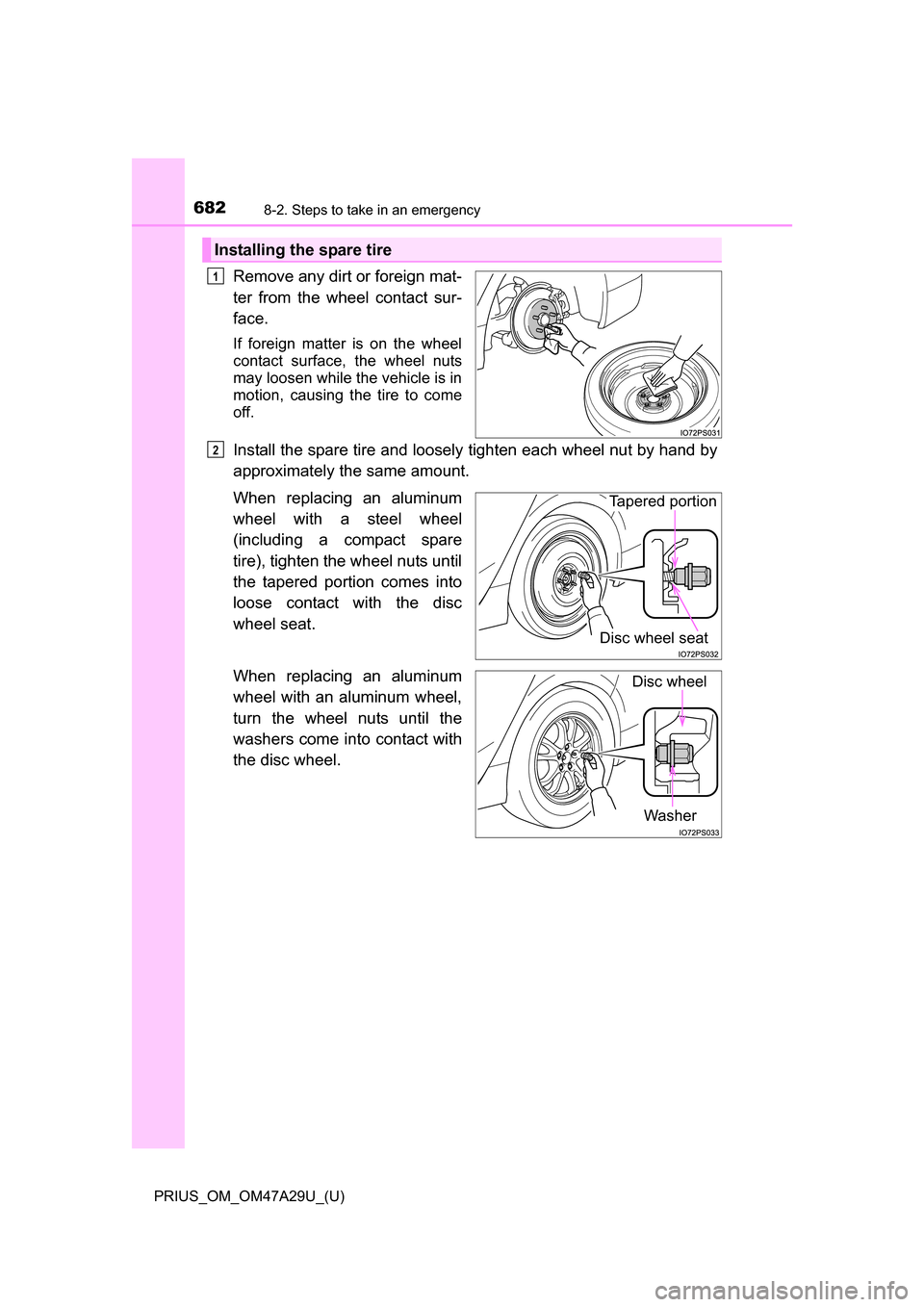
Remove any dirt or foreign mat-
ter from the wheel contact sur-
face.
If foreign matter is on the wheel
contact surface, the wheel nuts
may loosen while the vehicle is in
motion, causing the tire to come
off.
Install the spare tire and loosely tighten each wheel nut by hand by
approximately the same amount.
When replacing an aluminum
wheel with a steel wheel
(including a compact spare
tire), tighten the wheel nuts until
the tapered portion comes into
loose contact with the disc
wheel seat.
When replacing an aluminum
wheel with an aluminum wheel,
turn the wheel nuts until the
washers come into contact with
the disc wheel.
Installing the spare tire
1
2
Tapered portion
Disc wheel seat
Washer
Disc wheel
Page 717 of 800
717
PRIUS_OM_OM47A29U_(U)
8
When trouble arises
8-2. Steps to take in an emergency
If your vehicle overheats
■If the high coolant temperature warning light comes on or
flashes
Stop the vehicle in a safe place and turn off the air conditioning
system, and then stop the hybrid system.
If you see steam:
Carefully lift the hood after the steam subsides.
If you do not see steam:
Carefully lift the hood.
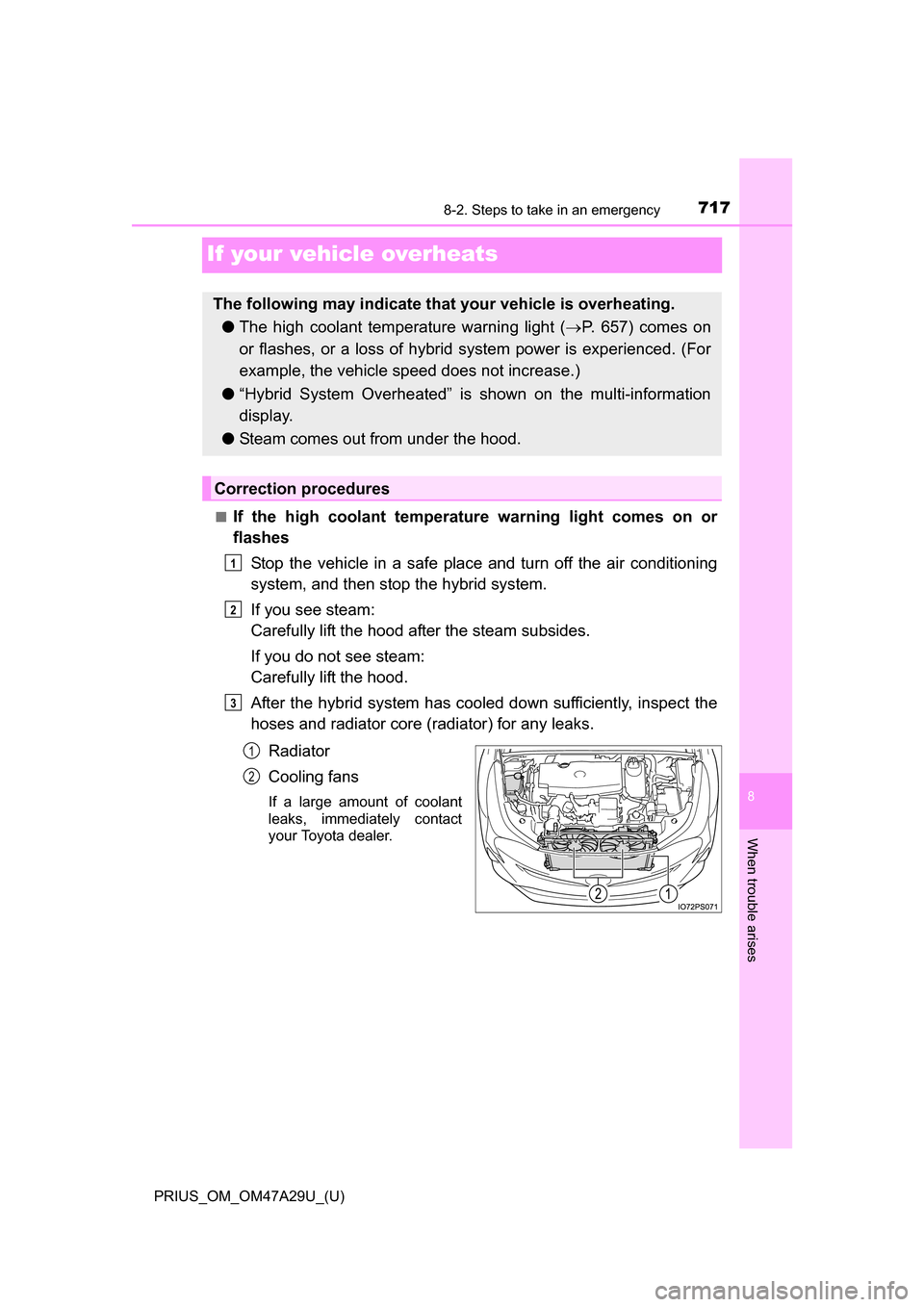
After the hybrid system has cooled down sufficiently, inspect the
hoses and radiator core (radiator) for any leaks.
Radiator
Cooling fans
If a large amount of coolant
leaks, immediately contact
your Toyota dealer.
The following may indicate that your vehicle is overheating.
● The high coolant temperature warning light ( P. 657) comes on
or flashes, or a loss of hybrid system power is experienced. (For
example, the vehicle s peed does not increase.)
● “Hybrid System Overhe ated” is shown on the multi-information
display.
● Steam comes out from under the hood.
Correction procedures
1
2
3
1
2
Page 719 of 800
7198-2. Steps to take in an emergency
PRIUS_OM_OM47A29U_(U)
8
When trouble arises
■If “Hybrid System Overheated” is shown on the multi-informa-
tion displayStop the vehicle in a safe place.
Stop the hybrid system and carefully lift the hood.
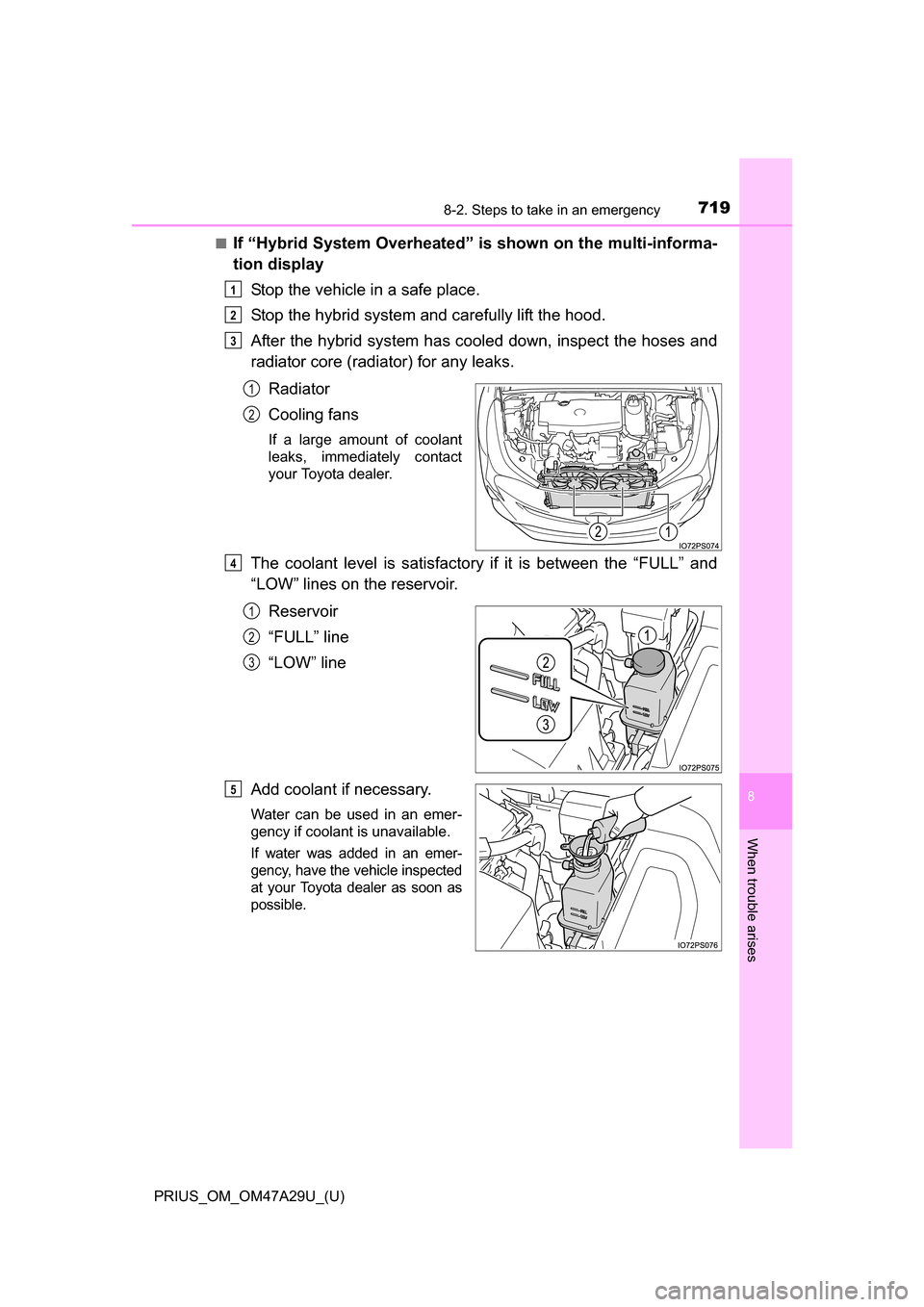
After the hybrid system has cooled down, inspect the hoses and
radiator core (radiator) for any leaks.
Radiator
Cooling fans
If a large amount of coolant
leaks, immediately contact
your Toyota dealer.
The coolant level is satisfactory if it is between the “FULL” and
“LOW” lines on the reservoir.
Reservoir
“FULL” line
“LOW” line
Add coolant if necessary.
Water can be used in an emer-
gency if coolant is unavailable.
If water was added in an emer-
gency, have the vehicle inspected
at your Toyota dealer as soon as
possible.
1
2
3
1
2
4
1
2
3
5
Page 749 of 800
PRIUS_OM_OM47A29U_(U)
7499-1. Specifications
9
Vehicle specifications
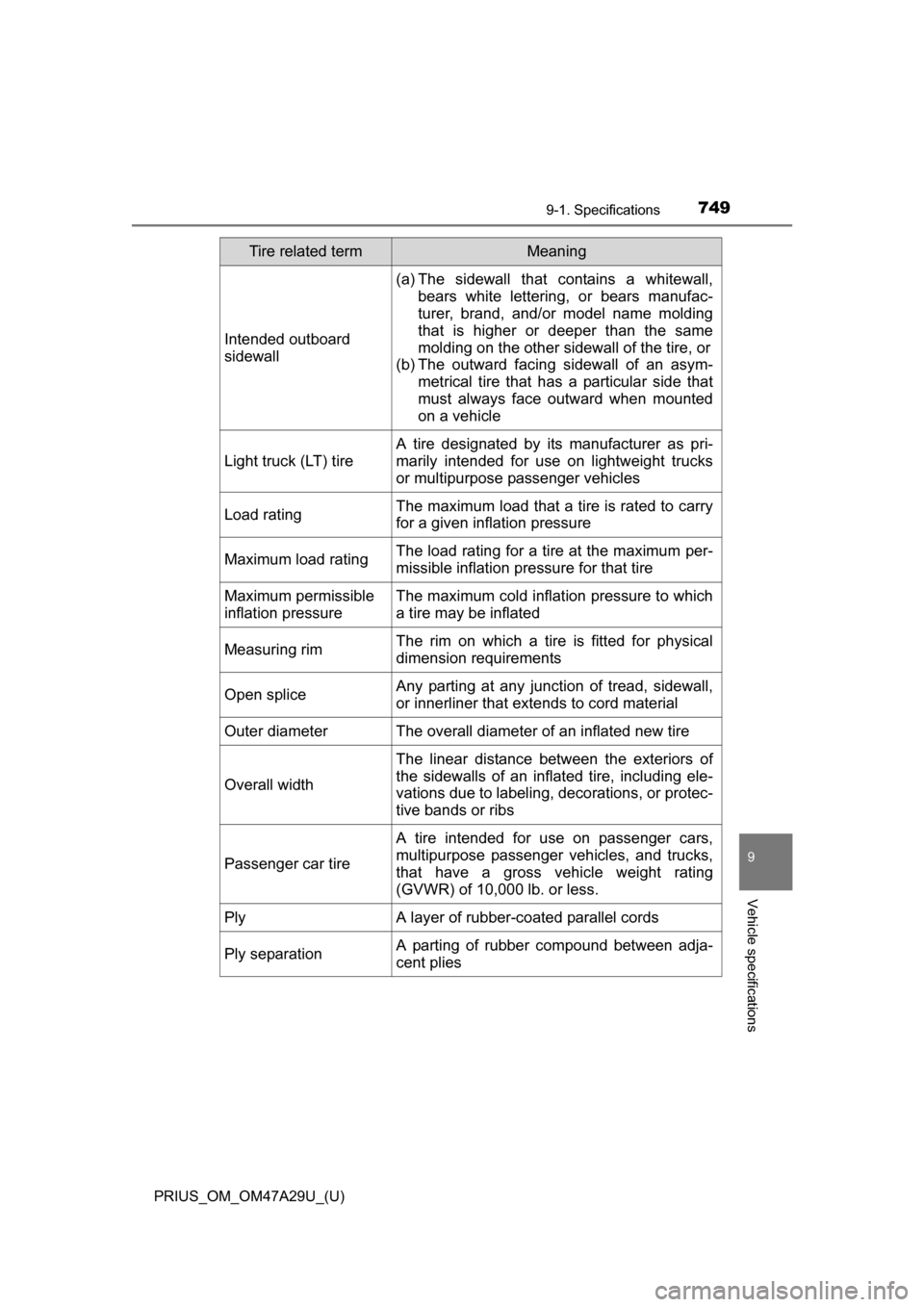
Intended outboard
sidewall
(a) The sidewall that contains a whitewall,bears white lettering, or bears manufac-
turer, brand, and/or model name molding
that is higher or deeper than the same
molding on the other sidewall of the tire, or
(b) The outward facing sidewall of an asym-
metrical tire that has a particular side that
must always face outward when mounted
on a vehicle
Light truck (LT) tire
A tire designated by its manufacturer as pri-
marily intended for use on lightweight trucks
or multipurpose passenger vehicles
Load ratingThe maximum load that a tire is rated to carry
for a given inflation pressure
Maximum load ratingThe load rating for a tire at the maximum per-
missible inflation pressure for that tire
Maximum permissible
inflation pressureThe maximum cold inflat ion pressure to which
a tire may be inflated
Measuring rimThe rim on which a tire is fitted for physical
dimension requirements
Open spliceAny parting at any junction of tread, sidewall,
or innerliner that extends to cord material
Outer diameterThe overall diameter of an inflated new tire
Overall width
The linear distance between the exteriors of
the sidewalls of an inflated tire, including ele-
vations due to labeling, decorations, or protec-
tive bands or ribs
Passenger car tire
A tire intended for use on passenger cars,
multipurpose passenger vehicles, and trucks,
that have a gross vehicle weight rating
(GVWR) of 10,000 lb. or less.
PlyA layer of rubber-coated parallel cords
Ply separationA parting of rubber compound between adja-
cent plies
Tire related termMeaning
Page 750 of 800
750
PRIUS_OM_OM47A29U_(U)
9-1. Specifications
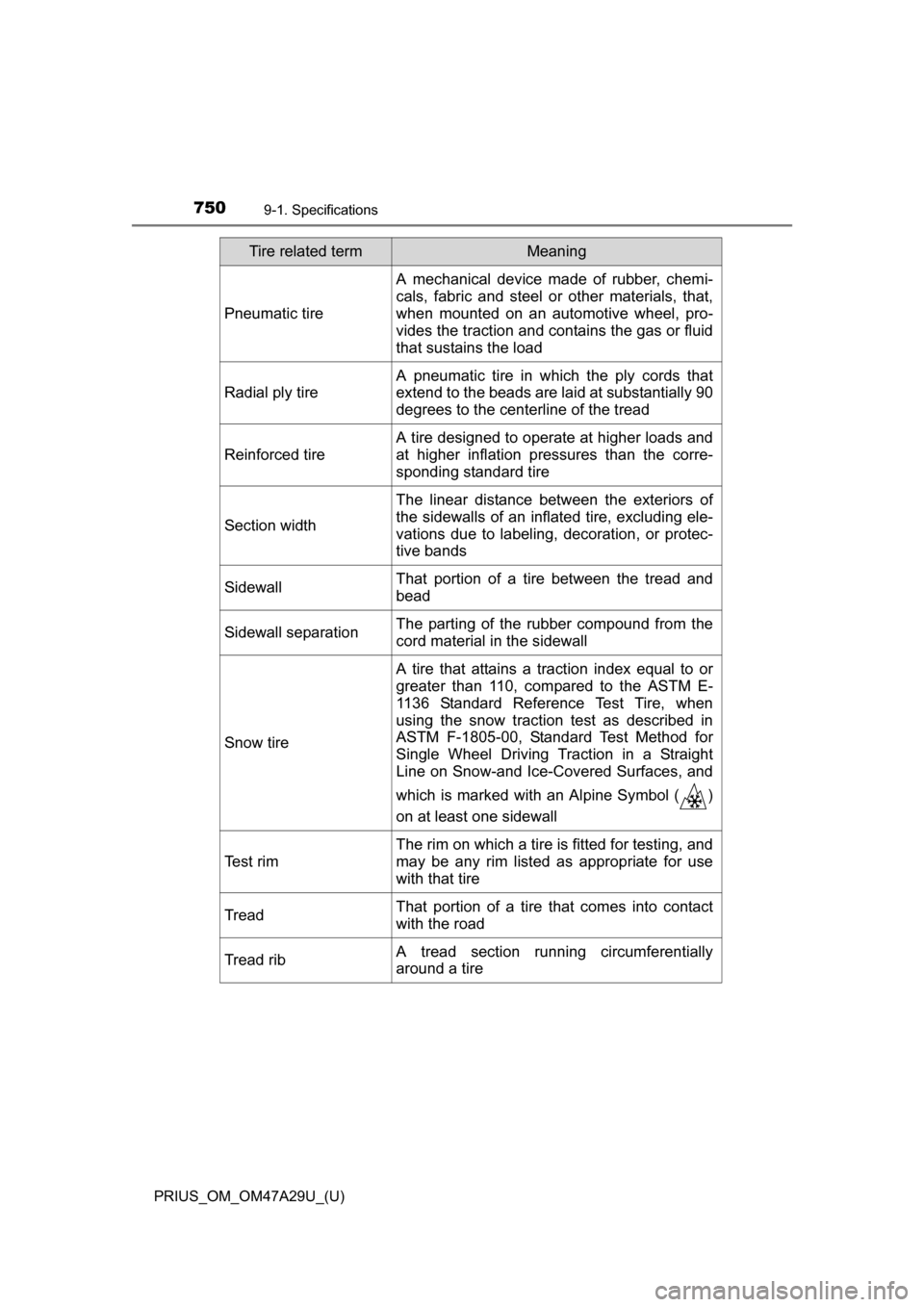
Pneumatic tire
A mechanical device made of rubber, chemi-
cals, fabric and steel or other materials, that,
when mounted on an automotive wheel, pro-
vides the traction and contains the gas or fluid
that sustains the load
Radial ply tire
A pneumatic tire in which the ply cords that
extend to the beads are laid at substantially 90
degrees to the centerline of the tread
Reinforced tire
A tire designed to operate at higher loads and
at higher inflation pressures than the corre-
sponding standard tire
Section width
The linear distance between the exteriors of
the sidewalls of an inflated tire, excluding ele-
vations due to labeling, decoration, or protec-
tive bands
SidewallThat portion of a tire between the tread and
bead
Sidewall separationThe parting of the rubber compound from the
cord material in the sidewall
Snow tire
A tire that attains a traction index equal to or
greater than 110, compared to the ASTM E-
1136 Standard Reference Test Tire, when
using the snow traction test as described in
ASTM F-1805-00, Standard Test Method for
Single Wheel Driving Traction in a Straight
Line on Snow-and Ice-Covered Surfaces, and
which is marked with an Alpine Symbol ( )
on at least one sidewall
Test rim
The rim on which a tire is fitted for testing, and
may be any rim listed as appropriate for use
with that tire
TreadThat portion of a tire that comes into contact
with the road
Tread ribA tread section running circumferentially
around a tire
Tire related termMeaning