ECO mode TOYOTA PRIUS 2022 Repair Manual
[x] Cancel search | Manufacturer: TOYOTA, Model Year: 2022, Model line: PRIUS, Model: TOYOTA PRIUS 2022Pages: 744, PDF Size: 14.35 MB
Page 535 of 744

PRIUS_OM_OM47F01U_(U)
5356-3. Do-it-yourself maintenance
6
Maintenance and care
■When initialization of the tire pressure warning system has fai led
Initialization can be completed in a few minutes. However, in the following
cases, the settings have not been record ed and the system will not oper-
ate properly. If repeated attempts to record tire inflation pre ssure settings
are unsuccessful, have the vehicle inspected by your Toyota dealer.
●When operating the initializatio n of the system, the tire pressure warning
light does not flash 3 times an d the setting message does not a ppear on
the multi-information display.
●After driving for a certain period of time since the initializa tion has been
completed, the warning light comes on after blinking for 1 minute.
WARNING
■When inspecting or replacing tires
Observe the following precaut ions to prevent accidents.
Failure to do so may cause damage to parts of the drive train as well as
dangerous handling characteristics, which may lead to an accide nt
resulting in death o r serious injury.
●Do not mix tires of different ma kes, models or tread patterns.
Also, do not mix tires of remarkably different treadwear.
●Do not use tire sizes other th an those recommended by Toyota.
●Do not mix differently constructed tires (radial, bias-belted o r bias-ply
tires).
●Do not mix summer, all season and snow tires.
●Do not use tires that have been used on another vehicle.
Do not use tires if you do not kn ow how they were used previously.
■When initializing the tire pressure warning system
Do not initialize the tire press ure warning system without firs t adjusting
the tire inflation pressure to t he specified level. Otherwise, the tire pres-
sure warning light may not come on even if the tire inflation p ressure is
low, or it may come on when the tire inflation pressure is actu ally nor-
mal.
Page 593 of 744

5937-2. Steps to take in an emergency
PRIUS_OM_OM47F01U_(U)
7
When trouble arises
*1: Brake system warning buzzer:When there is a possible problem that could affect braking perf ormance,
the warning light will come on and a warning buzzer will sound.
*2: Low engine oil pressure warning buzzer: A buzzer also sounds continuously for approximately 30 seconds at maxi-
mum in addition to the low engine oil pressure warning light when the
“READY” indicator is illuminated.
*3: Open door warning buzzer:
The open door warning buzzer sounds to alert one or more of the doors is
not fully closed (with the vehicle having reached a speed of 3 mph [5 km/h]).
*4: Driver’s seat belt warning buzzer:
The driver’s seat belt warning buzzer sounds to alert the drive r that his or
her seat belt is not fastened. Once the power switch is turned to ON mode,
the buzzer sounds. If the seat belt is still unfastened, the bu zzer sounds
intermittently for a certain period of time after the vehicle r eaches a certain
speed.
Front passenger’s seat belt warning buzzer:
The front passenger’s seat belt warning buzzer sounds to alert the front
passenger that his or her seat belt is not fastened. If the sea t belt is unfas-
tened, the buzzer sounds intermittently for a certain period of time after the
vehicle reaches a certain speed.
*5: Rear passengers’ seat belt warning buzzer: The rear passengers’ seat belt warning buzzer sounds to alert t he rear
passenger that his or her seat belt is not fastened. If the sea t belt is unfas-
tened, the buzzer sounds intermittently for a certain period of time, after
the seat belt is fastened and unfastened and the vehicle reache s a certain
speed.
*6: This symbol is displayed on the multi-information display.
Page 642 of 744

6427-2. Steps to take in an emergency
PRIUS_OM_OM47F01U_(U)
One of the following may be the cause of the problem:
● The 12-volt battery may be discharged. ( P. 646)
● One or both of the 12-volt battery terminals may be disconnecte d.
( P. 520)
Contact your Toyota dealer if the problem cannot be repaired, o r if repair
procedures are unknown.
When the hybrid system does not start, the following steps can be
used as an interim measure to sta rt the hybrid system if the power
switch is functioning normally.
Do not use this starting procedur e except in cases of emergency.
Set the parking brake.
Turn the power switch to ACCESSORY mode.
Press and hold the power switch for about 15 seconds while
depressing the brake pedal firmly.
Even if the hybrid system can be started using the above steps, the
system may be malfunctioning. Hav e the vehicle inspected by your
Toyota dealer.
The interior lights and headlights do not turn on, or the horn
does not sound.
Emergency start function
1
2
3
Page 645 of 744

6457-2. Steps to take in an emergency
PRIUS_OM_OM47F01U_(U)
7
When trouble arises
■Stopping the hybrid system
Set the parking brake, shift the shift position to P and press the power switch
as you normally do when stopping the hybrid system.
■ Replacing the key battery
As the above procedure is a temporary measure, it is recommended that the
electronic key battery be replaced immediately when the battery is depleted.
(P. 555)
■ Changing power switch modes
Release the brake pedal and press the power switch in step above. The
hybrid system does not start and modes will be changed each time the switch
is pressed. ( P. 241)
■ When the electronic key does not work properly
●Make sure that the smart key system has not been deactivated in the cus-
tomization setting. If it is off, turn the function on.
(Customizable features: P. 686)
● Check if battery-saving mode is set. If it is set, cancel the f unction.
( P. 194)
WARNING
■ When using the mechanical key and operating the power windows or
moon roof (if equipped)
Operate the power window or moon roof after checking to make su re that
there is no possibility of any passenger having any of their body parts
caught in the window or moon roof.
Also, do not allow children to operate the mechanical key. It is possible for
children and other passengers to get caught in the power window or moon
roof.
3
Page 647 of 744
6477-2. Steps to take in an emergency
PRIUS_OM_OM47F01U_(U)
7
When trouble arises
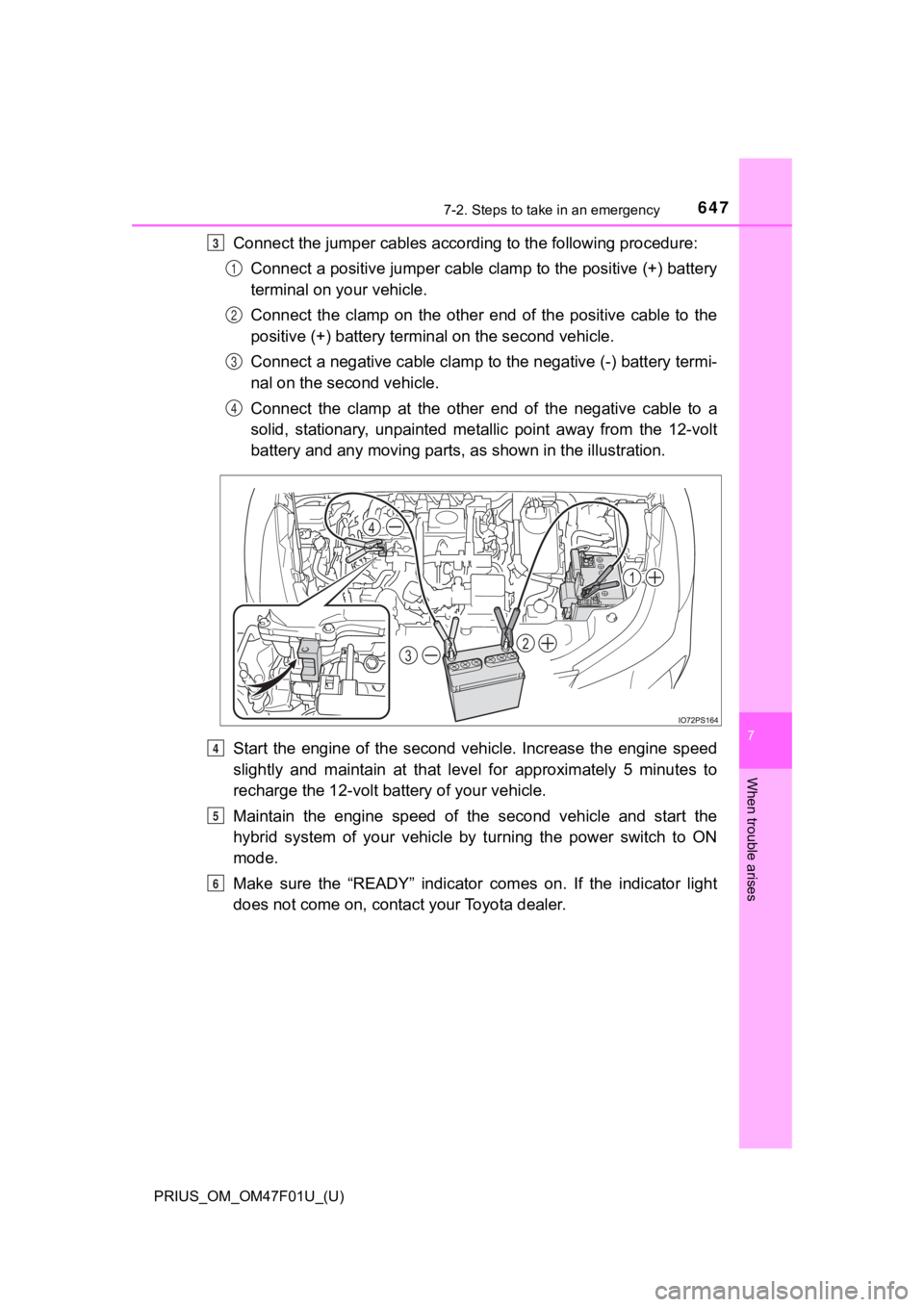
Connect the jumper cables according to the following procedure:Connect a positive jumper cable clamp to the positive (+) batte ry
terminal on your vehicle.
Connect the clamp on the other end of the positive cable to the
positive (+) battery termi nal on the second vehicle.
Connect a negative cable clamp to the negative (-) battery term i-
nal on the s econd vehicle.
Connect the clamp at the other e nd of the negative cable to a
solid, stationary, unpainted metallic point away from the 12-vo lt
battery and any movin g parts, as shown in the illustration.
Start the engine of the second v ehicle. Increase the engine speed
slightly and maintain at that lev el for approximately 5 minutes to
recharge the 12-volt battery of your vehicle.
Maintain the engine speed of the second vehicle and start the
hybrid system of your vehicle by turning the power switch to ON
mode.
Make sure the “READY” indicator comes on. If the indicator ligh t
does not come on, contac t your Toyota dealer.3
1
2
3
4
32
4
1
4
5
6
Page 649 of 744

6497-2. Steps to take in an emergency
PRIUS_OM_OM47F01U_(U)
7
When trouble arises
■When recharging or replacing the 12-volt battery
●In some cases, it may not be possible to unlock the doors using the smart
key system when the 12-volt battery is discharged. Use the wire less remote
control or the mechanical key to lock or unlock the doors.
● The hybrid system may not start on the first attempt after the 12-volt battery
has recharged but will start normally after the second attempt. This is not a
malfunction.
● The power switch mode is memorized by the vehicle. When the 12- volt bat-
tery is reconnected, the system will return to the mode it was in before the
12-volt battery was discharged. Before disconnecting the 12-volt battery,
turn the power switch off.
If you are unsure what mode the power switch was in before the 12-volt bat-
tery discharged, be especially careful when reconnecting the 12 -volt battery.
● If the 12-volt battery discharges while the shift position is in P, it may not be
possible to shift the shift position to other positions. In thi s case, the vehicle
cannot be towed without lifting both front wheels because the f ront wheels
will be locked. ( P. 580)
■ When replacing the 12-volt battery
●Use a 12-volt battery that conforms to European regulations.
● Use a 12-volt battery that the case size is same as the previou s one (LN1),
20 hour rate capacity (20HR) is equivalent (45Ah) or greater, and perfor-
mance rating (CCA) is equivalent (295A) or greater.
• If the sizes differ, the 12-volt battery cannot be properly se cured.
• If the 20 hour rate capacity is low, even if the time period w here the vehi-
cle is not used is a short time, the 12-volt battery may discharge and the
hybrid system may not be able to start.
● For details, consult your Toyota dealer.
Page 668 of 744
668
PRIUS_OM_OM47F01U_(U)
8-1. Specifications
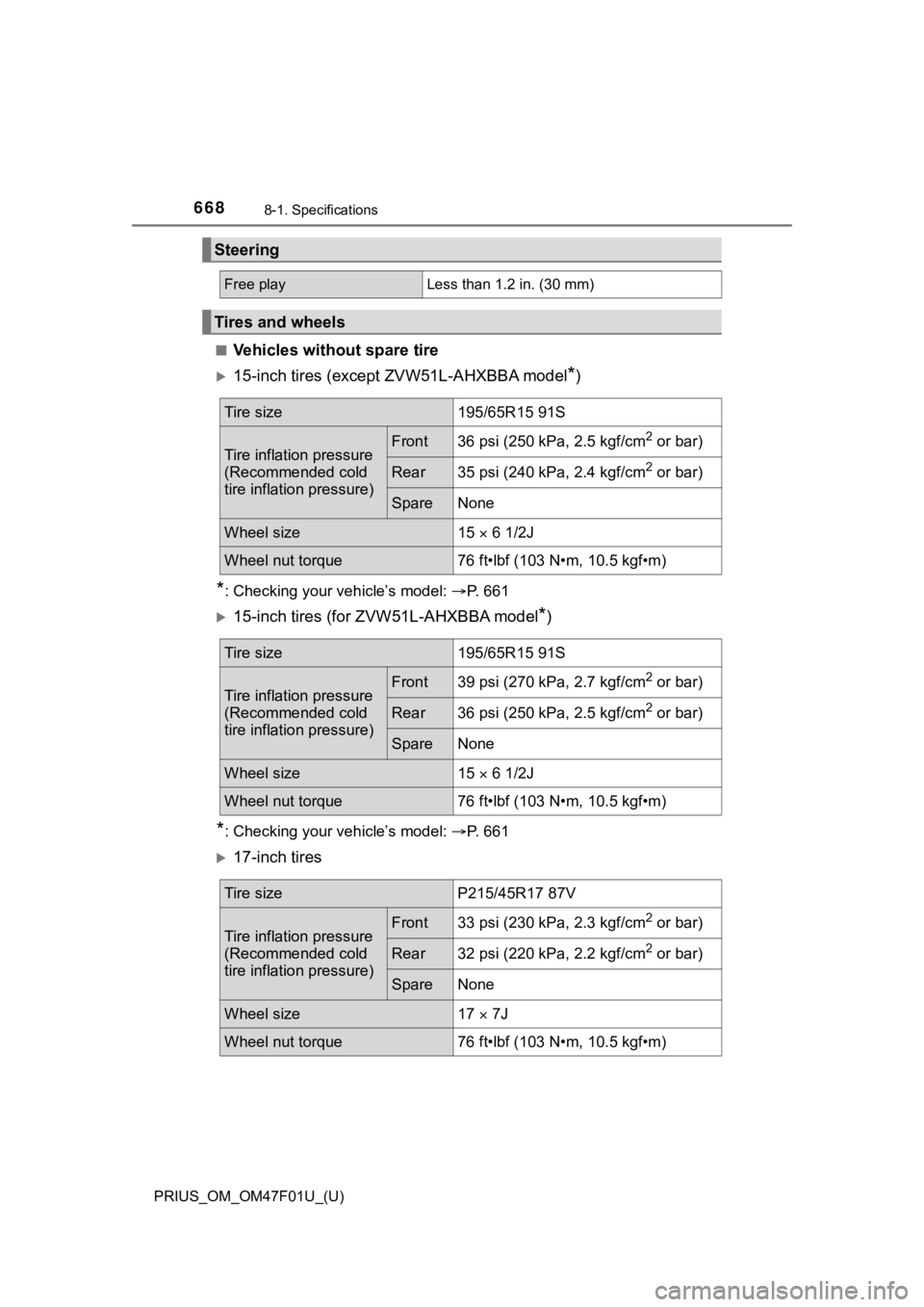
■Vehicles without spare tire
15-inch tires (except ZVW51L-AHXBBA model*)
*: Checking your vehicle’s model: P. 6 6 1
15-inch tires (for ZVW51L-AHXBBA model*)
*: Checking your vehicle’s model: P. 6 6 1
17-inch tires
Steering
Free playLess than 1.2 in. (30 mm)
Tires and wheels
Tire size195/65R15 91S
Tire inflation pressure
(Recommended cold
tire inflation pressure)Front36 psi (250 kPa, 2.5 kgf/cm2 or bar)
Rear35 psi (240 kPa, 2.4 kgf/cm2 or bar)
SpareNone
Wheel size15 6 1/2J
Wheel nut torque76 ft•lbf (103 N•m, 10.5 kgf•m)
Tire size195/65R15 91S
Tire inflation pressure
(Recommended cold
tire inflation pressure)Front39 psi (270 kPa, 2.7 kgf/cm2 or bar)
Rear36 psi (250 kPa, 2.5 kgf/cm2 or bar)
SpareNone
Wheel size15 6 1/2J
Wheel nut torque76 ft•lbf (103 N•m, 10.5 kgf•m)
Tire sizeP215/45R17 87V
Tire inflation pressure
(Recommended cold
tire inflation pressure)Front33 psi (230 kPa, 2.3 kgf/cm2 or bar)
Rear32 psi (220 kPa, 2.2 kgf/cm2 or bar)
SpareNone
Wheel size17 7J
Wheel nut torque76 ft•lbf (103 N•m, 10.5 kgf•m)
Page 683 of 744
PRIUS_OM_OM47F01U_(U)
6838-1. Specifications
8
Vehicle specifications
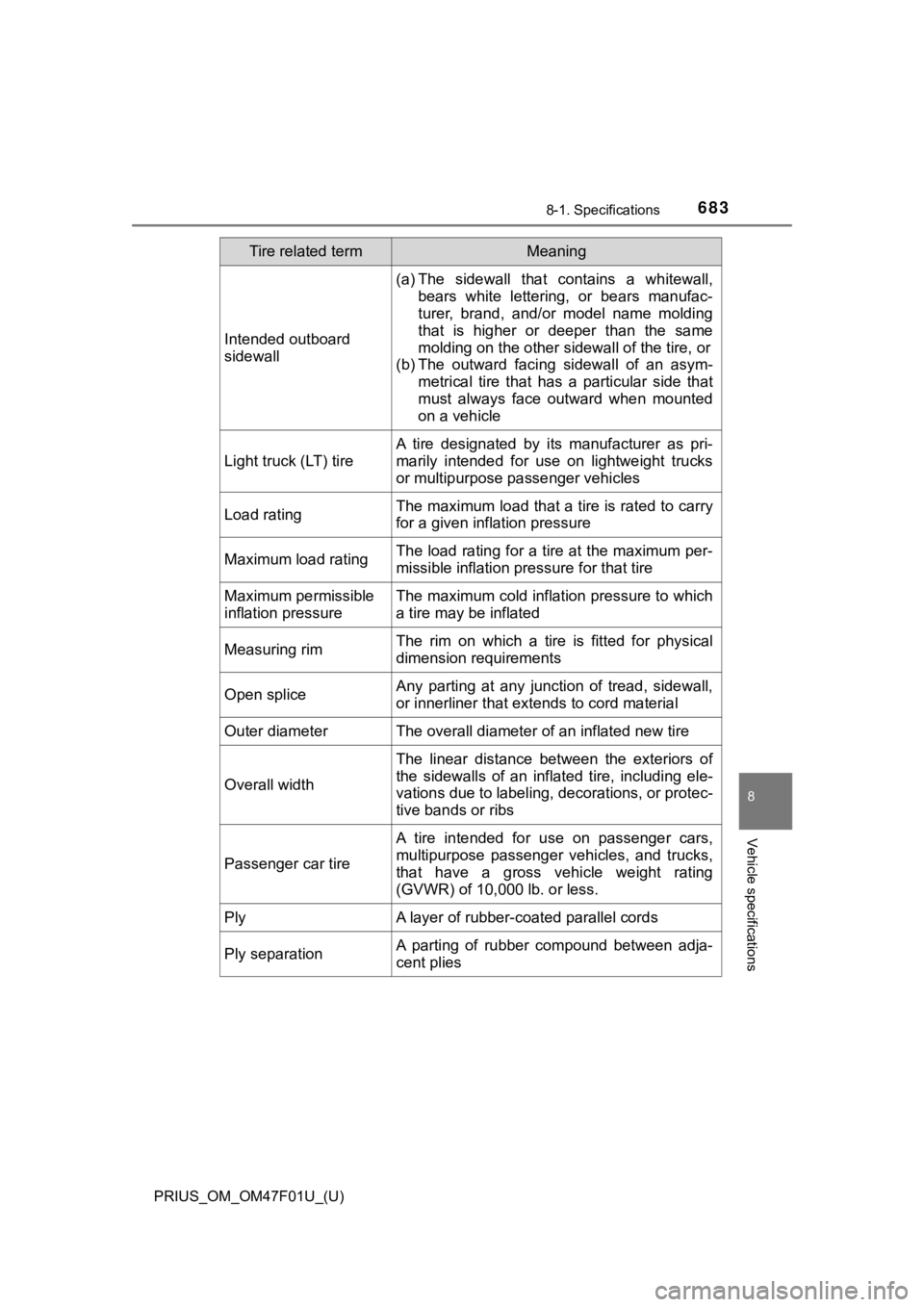
Intended outboard
sidewall
(a) The sidewall that contains a whitewall,bears white lettering, or bears manufac-
turer, brand, and/or model name molding
that is higher or deeper than the same
molding on the other sidewall of the tire, or
(b) The outward facing sidewall of an asym-
metrical tire that has a particular side that
must always face outward when mounted
on a vehicle
Light truck (LT) tire
A tire designated by its manufacturer as pri-
marily intended for use on lightweight trucks
or multipurpose passenger vehicles
Load ratingThe maximum load that a tire is rated to carry
for a given inflation pressure
Maximum load ratingThe load rating for a tire at the maximum per-
missible inflation pressure for that tire
Maximum permissible
inflation pressureThe maximum cold inflation pressure to which
a tire may be inflated
Measuring rimThe rim on which a tire is fitted for physical
dimension requirements
Open spliceAny parting at any junction of tread, sidewall,
or innerliner that extends to cord material
Outer diameterThe overall diameter of an inflated new tire
Overall width
The linear distance between the exteriors of
the sidewalls of an inflated tire, including ele-
vations due to labeling, decorations, or protec-
tive bands or ribs
Passenger car tire
A tire intended for use on passenger cars,
multipurpose passenger vehicles, and trucks,
that have a gross vehicle weight rating
(GVWR) of 10,000 lb. or less.
PlyA layer of rubber-coated parallel cords
Ply separationA parting of rubber compound between adja-
cent plies
Tire related termMeaning
Page 720 of 744

720Alphabetical index
PRIUS_OM_OM47F01U_(U)
Alphabetical index
A/C .................................... 430, 440Air conditioning eco
mode .......................... 433, 443
Air conditioning filter ............. 543
Automatic air conditioning system .... 430, 440
Eco score (A/C score)........... 148
Front seat concentrated airflow mode
(S-FLOW) ................... 432, 442
ABS (Anti-lock Brake
System) .................................. 415 Function ................................ 415
Warning light ......................... 589
ACA (Active Cornering Assist) ................................... 415
Active Cornering Assist
(ACA) ...................................... 415
AHB (Automatic High Beam) ..................................... 262
Adaptive Front-lighting System (AFS) ......................... 259
AFS (Adaptive Front-lighting
System) .................................. 259
Air conditioning filter .............. 543
Air conditioning system ............................ 430, 440
Air conditioning eco mode .......................... 433, 443
Air conditioning filter ............. 543
Automatic air
conditioning system .... 430, 440
Eco score (A/C score)........... 148
Front seat concentrated
airflow mode
(S-FLOW) ................... 432, 442
Air intake vent ............................ 90 Cleaning................................ 546 Airbags ....................................... 35
Airbag operating conditions .... 43
Airbag precaut ions for your
child ...................................... 38
Airbag warning light .............. 589
Correct driving posture ........... 28
Curtain shield airbag operating conditions ............. 44
Curtain shield airbag precautions........................... 41
Front passenger occupant
classification syst em ............ 49
General airbag precautions .... 38
Locations of airbags ............... 35
Modification and disposal of airbags ................................. 42
Side airbag operating
conditions ............................. 44
Side airbag precautions .......... 40
Side and curtain shield airbags operating
conditions ............................. 44
Side and curtain shield
airbags precautions .............. 41
SRS airbag instructions for Canadian owners ............... 704
SRS airbags ........................... 35
Anchor brackets ........................ 72
Antenna Smart key system ................. 192
A
Page 721 of 744
721Alphabetical index
PRIUS_OM_OM47F01U_(U)
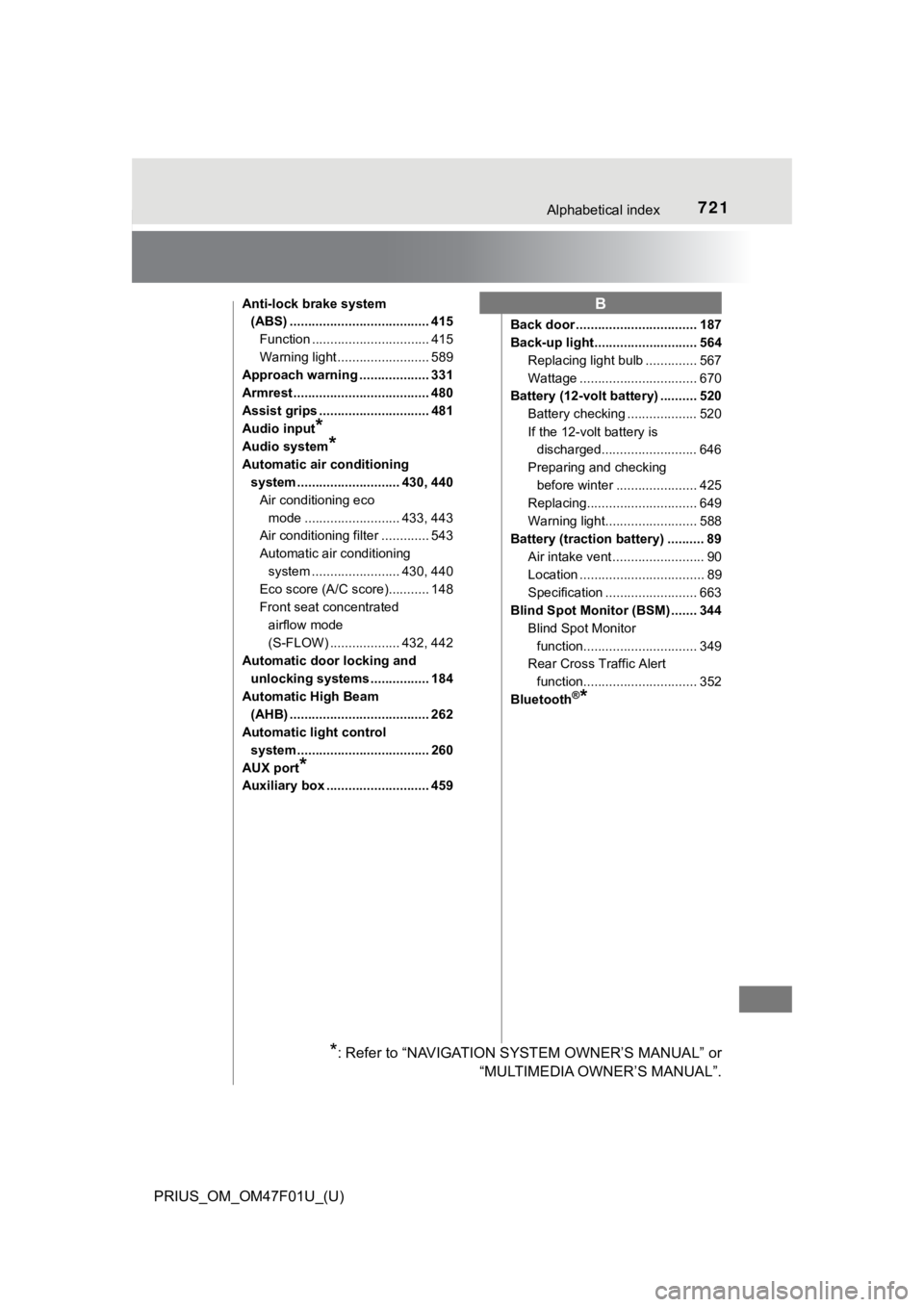
Anti-lock brake system (ABS) ...................................... 415
Function ................................ 415
Warning light ......................... 589
Approach warning ................... 331
Armrest ..................................... 480
Assist grips .............................. 481
Audio input
*
Audio system*
Automatic air conditioning system ............................ 430, 440
Air conditioning eco mode .......................... 433, 443
Air conditioning filter ............. 543
Automatic air conditioning
system ....... ................. 430, 440
Eco score (A/C score)........... 148
Front seat concentrated
airflow mode
(S-FLOW) ................... 432, 442
Automatic door locking and unlocking systems ................ 184
Automatic High Beam
(AHB) ...................................... 262
Automatic light control system .................................... 260
AUX port
*
Auxiliary box ............................ 459 Back door ................................. 187
Back-up light............................ 564
Replacing light bulb .............. 567
Wattage ................................ 670
Battery (12-volt battery) .......... 520
Battery checking ................... 520
If the 12-volt battery is discharged.......................... 646
Preparing and checking before winter ...................... 425
Replacing.............................. 649
Warning light......................... 588
Battery (traction battery) .......... 89 Air intake vent ......................... 90
Location .................................. 89
Specification ......................... 663
Blind Spot Monitor (BSM) ....... 344
Blind Spot Monitor function............................... 349
Rear Cross Traffic Alert
function............................... 352
Bluetooth
®*
B
*: Refer to “NAVIGATION SYSTEM OWNER’S MANUAL” or “MULTIMEDIA OWNER’S MANUAL”.