wheel TOYOTA PRIUS C 2020 Owner's Manual
[x] Cancel search | Manufacturer: TOYOTA, Model Year: 2020, Model line: PRIUS C, Model: TOYOTA PRIUS C 2020Pages: 600, PDF Size: 12.02 MB
Page 180 of 600

1804-1. Before driving
PRIUS c_U
NOTICE
■Avoiding damage to vehicle parts
● Do not turn the steering wheel fully in either direction and ho ld it there for
an extended period of time.
Doing so may damage the power steering motor.
● When driving over bumps in the road, drive as slowly as possibl e to avoid
damaging the wheels, underside of the vehicle, etc.
■ If you get a flat tire while driving
A flat or damaged tire may cause the following situations. Hold the steering
wheel firmly and gradually depress the brake pedal to slow down the vehi-
cle.
● It may be difficult to control your vehicle.
● The vehicle will make abnormal sounds or vibrations.
● The vehicle will lean abnormally.
Information on what to do in case of a flat tire ( P. 505)
■ When encountering flooded roads
Do not drive on a road that has flooded after heavy rain etc. D oing so may
cause the following serious damage to the vehicle:
● Engine stalling
● Short in electrical components
● Engine damage caused by water immersion
In the event that you drive on a flooded road and the vehicle i s flooded, be
sure to have your Toyota dealer check the following:
● Brake function
● Changes in quantity and quality of oil and fluid used for the e ngine, hybrid
transmission, etc.
● Lubricant condition for the bearings and suspension joints (whe re possi-
ble), and the function of all joints, bearings, etc.
Page 186 of 600
1864-1. Before driving
PRIUS c_U
Trailer towing
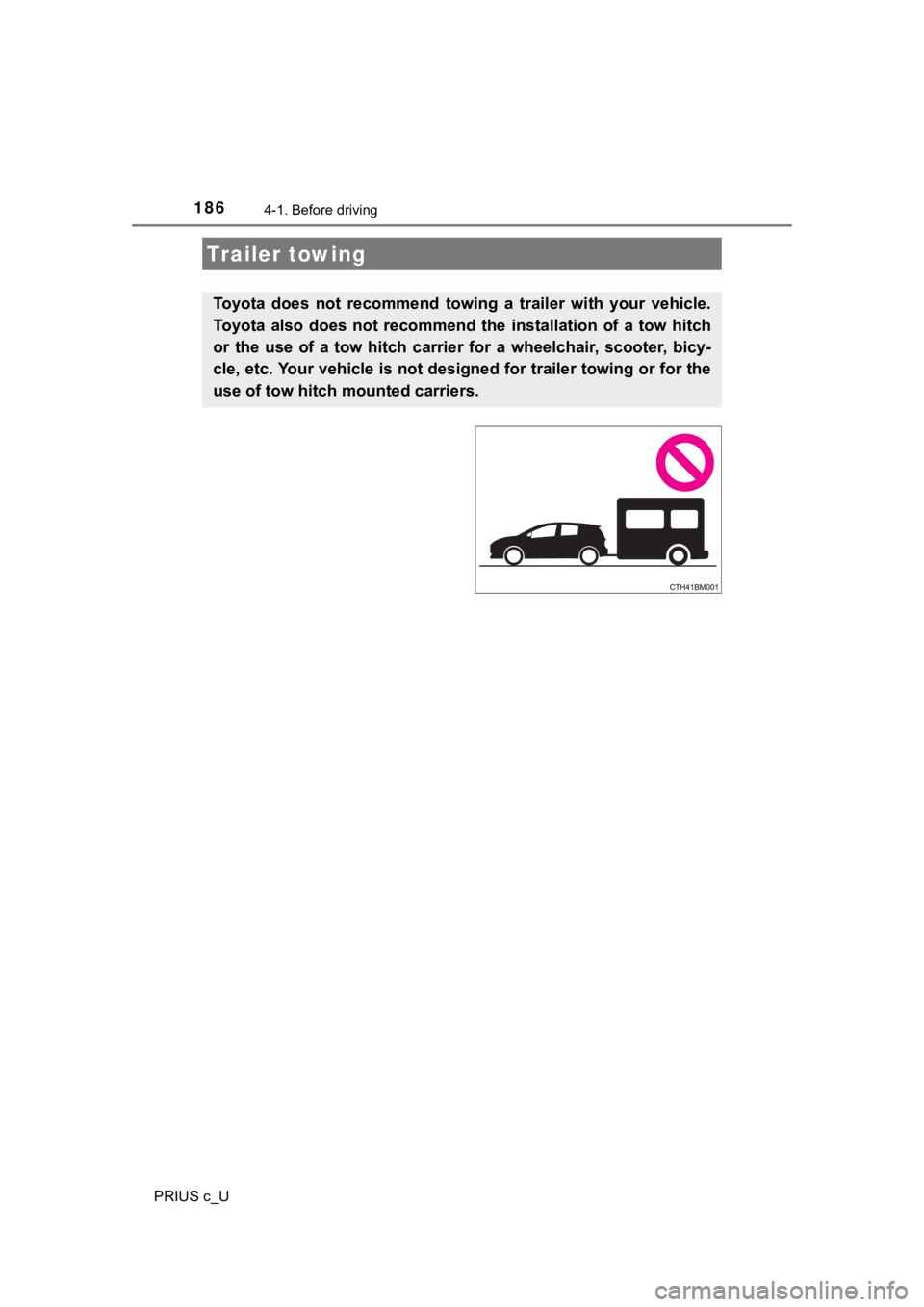
Toyota does not recommend towing a trailer with your vehicle.
Toyota also does not recommend the installation of a tow hitch
or the use of a tow hitch carrier for a wheelchair, scooter, bi cy-
cle, etc. Your vehicle is not des igned for trailer towing or for the
use of tow hitch mounted carriers.
Page 187 of 600
1874-1. Before driving
4
Driving
PRIUS c_U
Dinghy towing
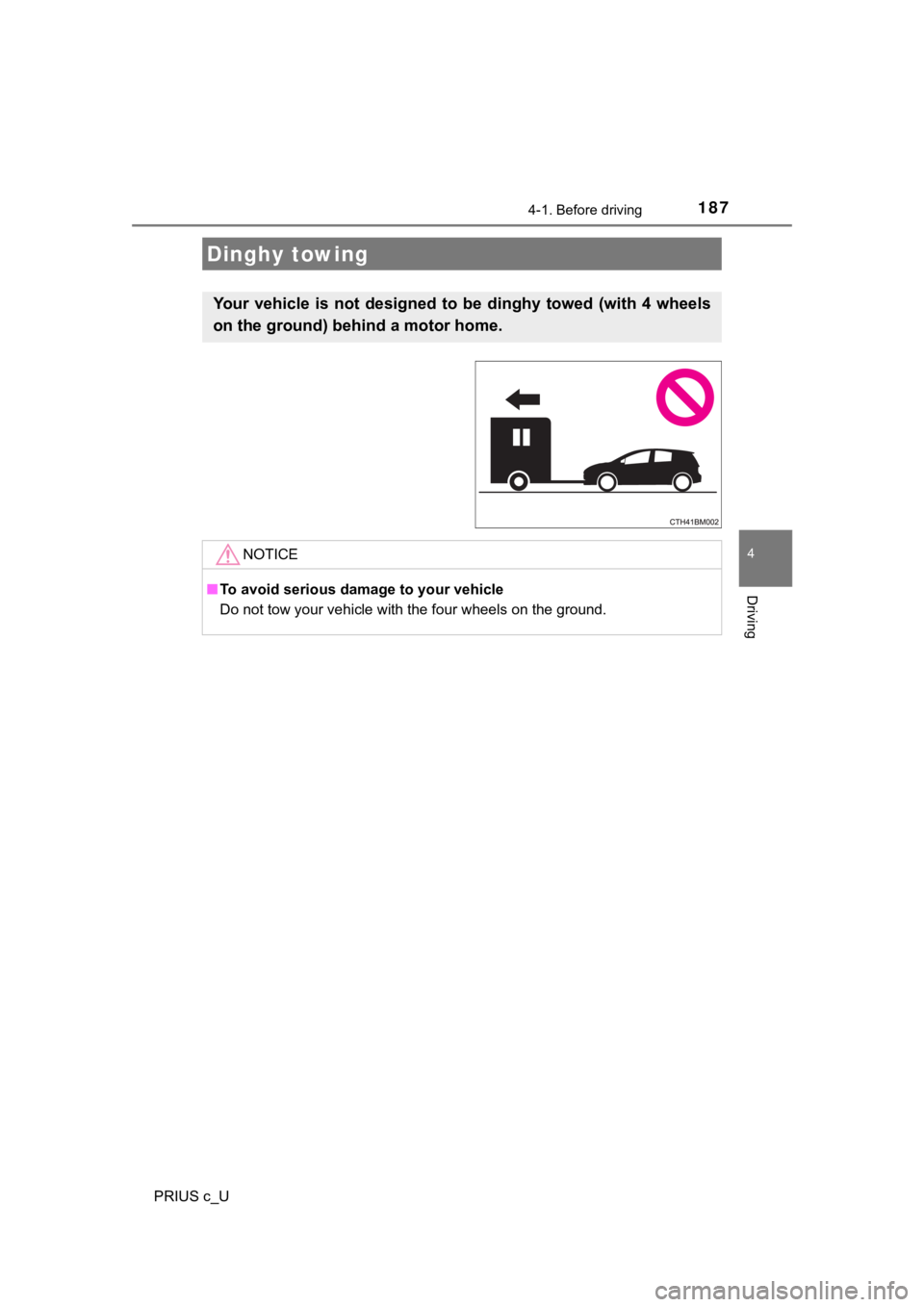
Your vehicle is not designed to be dinghy towed (with 4 wheels
on the ground) behind a motor home.
NOTICE
■To avoid serious damage to your vehicle
Do not tow your vehicle with the four wheels on the ground.
Page 189 of 600
1894-2. Driving procedures
4
Driving
PRIUS c_U
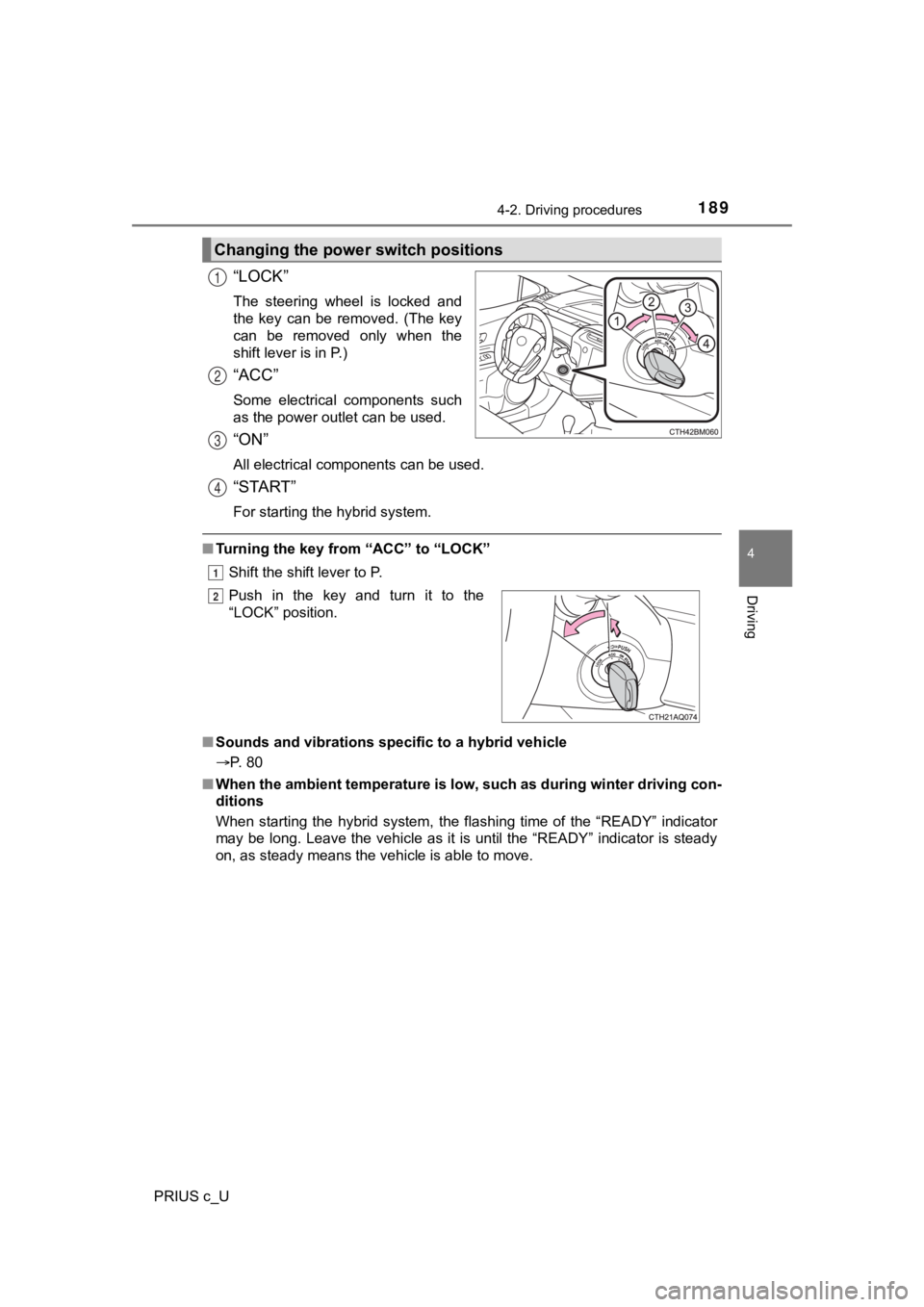
“LOCK”
The steering wheel is locked and
the key can be removed. (The key
can be removed only when the
shift lever is in P.)
“ACC”
Some electrical components such
as the power outlet can be used.
“ON”
All electrical components can be used.
“START”
For starting the hybrid system.
■Turning the key from “ACC” to “LOCK”
Shift the shift lever to P.
■ Sounds and vibrations sp ecific to a hybrid vehicle
P. 80
■ When the ambient temperature is low, such as during winter driv ing con-
ditions
When starting the hybrid system, the flashing time of the “READ Y” indicator
may be long. Leave the vehicle as it is until the “READY” indic ator is steady
on, as steady means the vehicle is able to move.
Changing the power switch positions
1
2
3
4
1
Push in the key and turn it to the
“LOCK” position.2
Page 190 of 600
1904-2. Driving procedures
PRIUS c_U■
If the hybrid system does not start (vehicles with immobilizer system)
The immobilizer system may not have been deactivated. ( P. 88)
Contact your Toyota dealer.
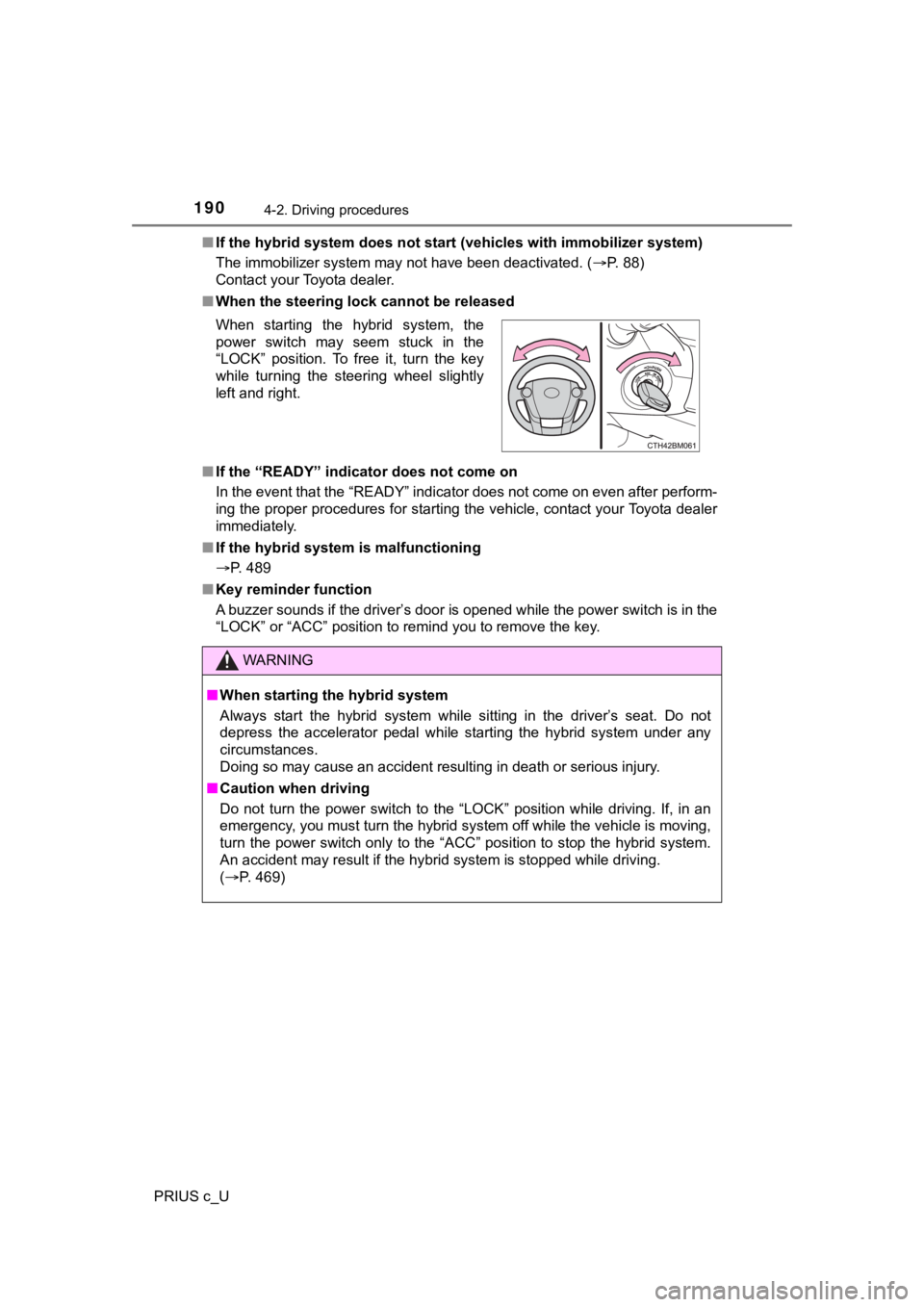
■ When the steering lock cannot be released
■ If the “READY” indicator does not come on
In the event that the “READY” indicator does not come on even a fter perform-
ing the proper procedures for starting the vehicle, contact you r Toyota dealer
immediately.
■ If the hybrid system is malfunctioning
P. 489
■ Key reminder function
A buzzer sounds if the driver’s door is opened while the power switch is in the
“LOCK” or “ACC” position to remind you to remove the key. When starting the hybrid system, the
power switch may seem stuck in the
“LOCK” position. To free it, turn the key
while turning the steering wheel slightly
left and right.
WARNING
■ When starting the hybrid system
Always start the hybrid system while sitting in the driver’s se at. Do not
depress the accelerator pedal while starting the hybrid system under any
circumstances.
Doing so may cause an accident resulting in death or serious in jury.
■ Caution when driving
Do not turn the power switch to the “LOCK” position while drivi ng. If, in an
emergency, you must turn the hybrid system off while the vehicle is moving,
turn the power switch only to the “ACC” position to stop the hy brid system.
An accident may result if the hybrid system is stopped while dr iving.
( P. 469)
Page 195 of 600
1954-2. Driving procedures
4
Driving
PRIUS c_U■
Notes for the entry function
P. 144
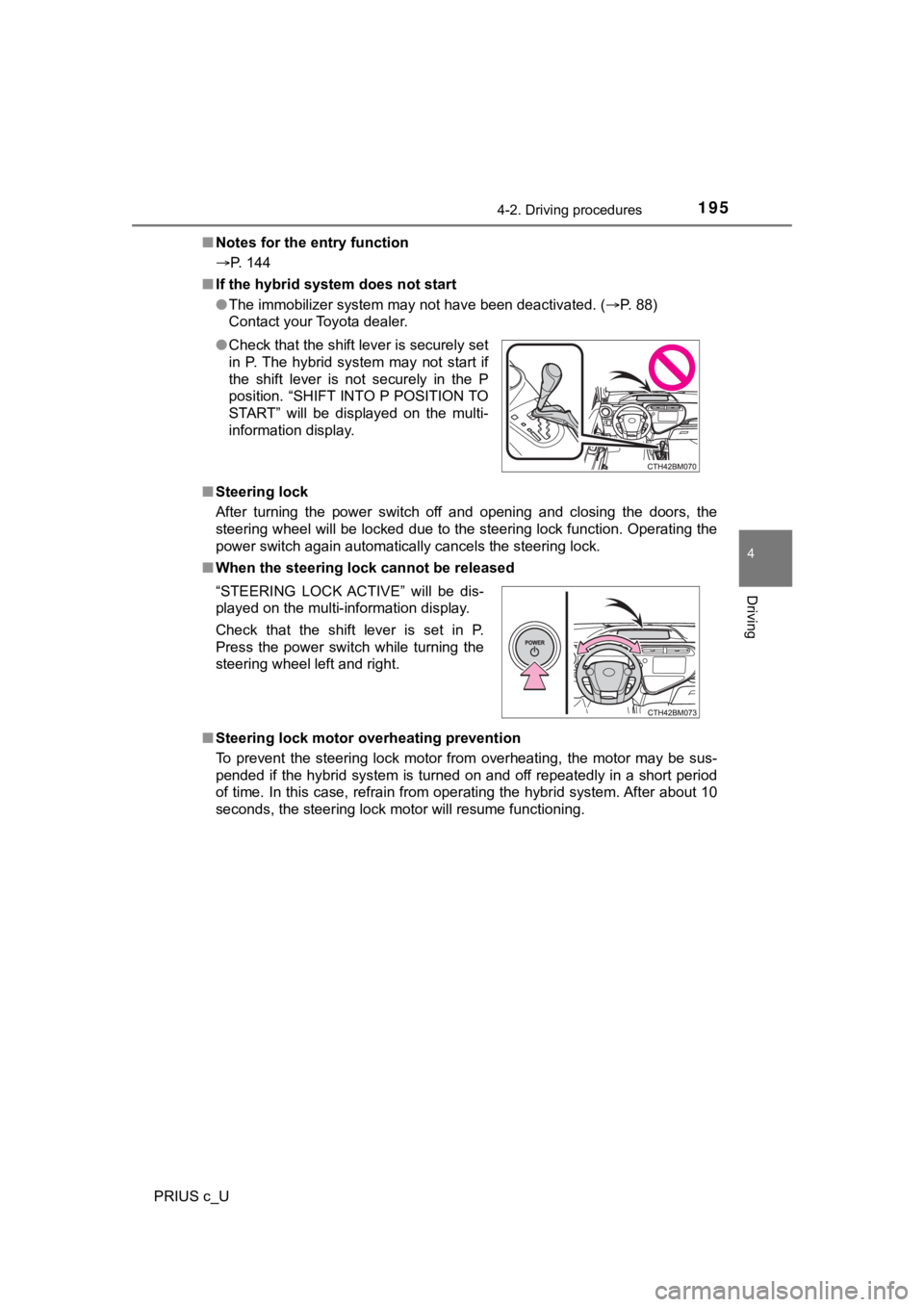
■ If the hybrid system does not start
●The immobilizer system may not have been deactivated. ( P. 88)
Contact your Toyota dealer.
■ Steering lock
After turning the power switch off and opening and closing the doors, the
steering wheel will be locked due to the steering lock function. Operating the
power switch again automatically cancels the steering lock.
■ When the steering lock cannot be released
■ Steering lock motor overheating prevention
To prevent the steering lock motor from overheating, the motor may be sus-
pended if the hybrid system is turned on and off repeatedly in a short period
of time. In this case, refrain from operating the hybrid system . After about 10
seconds, the steering lock motor will resume functioning. ● Check that the shift lever is securely set
in P. The hybrid system may not start if
the shift lever is not securely in the P
position. “SHIFT INTO P POSITION TO
START” will be displayed on the multi-
information display.
“STEERING LOCK ACTIVE” will be dis-
played on the multi-information display.
Check that the shift lever is set in P.
Press the power switch while turning the
steering wheel left and right.
Page 232 of 600

2324-5. Toyota Safety Sense C
PRIUS c_U■
Pre-collision braking
If the system determines that the
possibility of a frontal collision is
extremely high, a buzzer will sound and the brakes are automati -
cally applied to help avoid the collision or reduce the impact of the
collision.
WARNING
■ Limitations of the pre-collision system
● The driver is solely responsible for safe driving. Always drive safely, taking
care to observe your surroundings.
Do not use the pre-collision system instead of normal braking o perations
under any circumstances. This system will not prevent collision s or lessen
collision damage or injury in every situation. Do not overly re ly on this sys-
tem. Failure to do so may lead to an accident, resulting in dea th or serious
injury.
● Although this system is designed to help avoid a collision or h elp reduce
the impact of the collision, its effectiveness may change according to vari-
ous conditions, therefore the system may not always be able to achieve
the same level of performance.
Read the following conditions carefully. Do not overly rely on this system
and always drive carefully.
• Conditions under which the system may operate even if there is no pos-
sibility of a collision: P. 236
• Conditions under which the system may not operate properly: P. 238
● Do not attempt to test the operation of the pre-collision syste m yourself
Depending on the objects used for testing (dummies, cardboard o bjects
imitating detectable objects, etc.), the system may not operate properly,
possibly leading to an accident.
■ Pre-collision braking
● When the pre-collision braking function is operating, a large a mount of
braking force will be applied.
● If the vehicle is stopped by the operation of the pre-collision braking func-
tion, the pre-collision braking function operation will be canceled after
approximately 2 seconds. Depress the brake pedal as necessary.
● The pre-collision braking function may not operate if certain o perations are
performed by the driver. If the accelerator pedal is being depressed
strongly or the steering wheel is being turned, the system may determine
that the driver is taking evasive action and possibly prevent t he pre-colli-
sion braking function from operating.
● In some situations, while the pre-collision braking function is operating,
operation of the function may be canceled if the accelerator pedal is
depressed strongly or the steering wheel is turned and the syst em deter-
mines that the driver is taking evasive action.
Page 236 of 600
2364-5. Toyota Safety Sense C
PRIUS c_U■
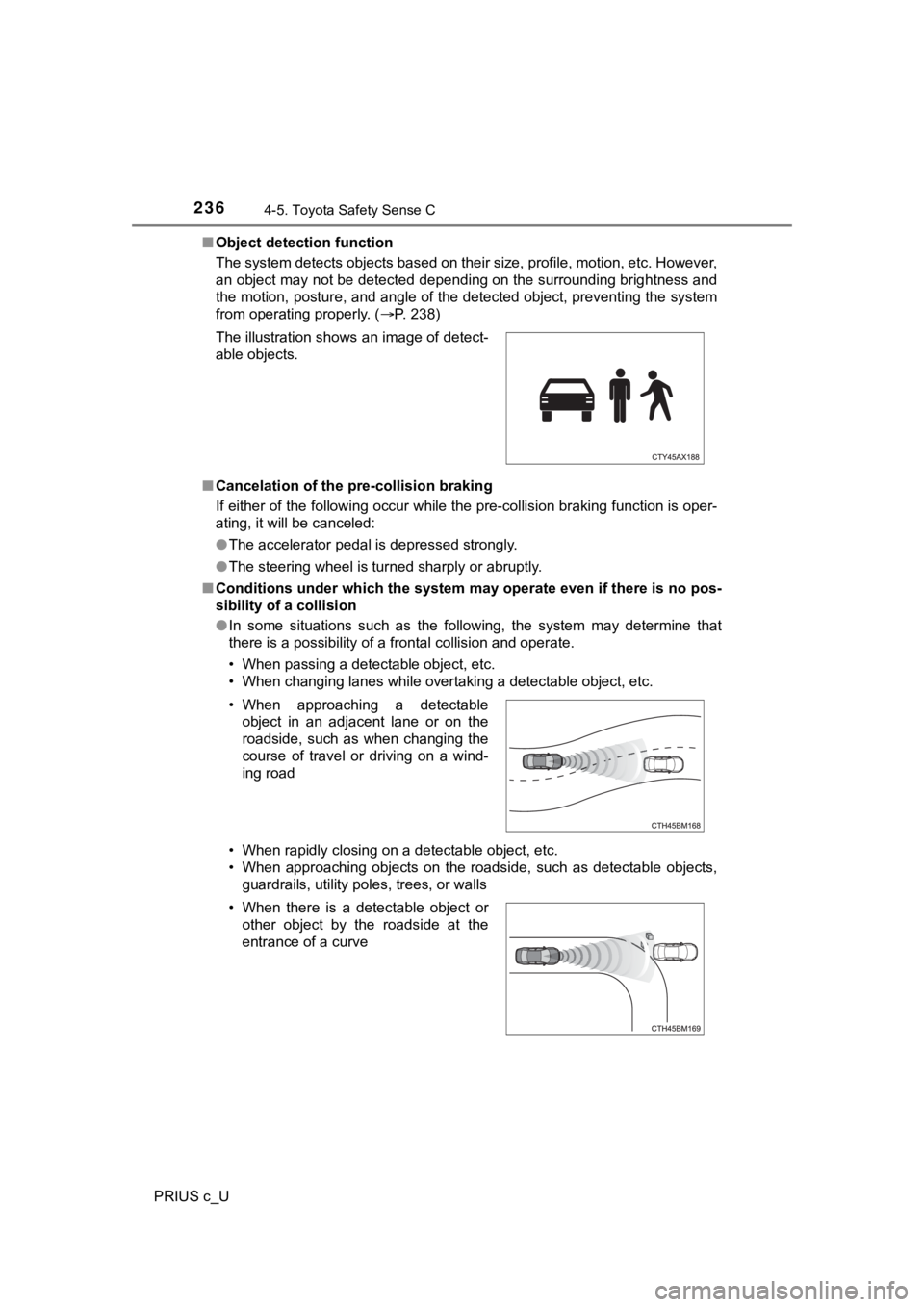
Object detection function
The system detects objects based on their size, profile, motion, etc. However,
an object may not be detected depending on the surrounding brig htness and
the motion, posture, and angle of the detected object, preventing the system
from operating properly. (P. 238)
■ Cancelation of the pre-collision braking
If either of the following occur while the pre-collision brakin g function is oper-
ating, it will be canceled:
● The accelerator pedal is depressed strongly.
● The steering wheel is turned sharply or abruptly.
■ Conditions under which the system may operate even if there is no pos-
sibility of a collision
● In some situations such as the following, the system may determ ine that
there is a possibility of a frontal collision and operate.
• When passing a detectable object, etc.
• When changing lanes while overtaking a detectable object, etc.
• When rapidly closing on a detectable object, etc.
• When approaching objects on the roadside, such as detectable o bjects,
guardrails, utility poles, trees, or walls
The illustration shows an image of detect-
able objects.
• When approaching a detectableobject in an adjacent lane or on the
roadside, such as when changing the
course of travel or driving on a wind-
ing road
• When there is a detectable object or other object by the roadside at the
entrance of a curve
Page 239 of 600
2394-5. Toyota Safety Sense C
4
Driving
PRIUS c_U• When a detectable object appears to be nearly the same color o
r bright-
ness as its surroundings
• If a detectable object cuts or suddenly emerges in front of your vehicle
• When the front of your vehicle is hit by water, snow, dust, et c.
• When a very bright light ahead, such as the sun or the headlig hts of
oncoming traffic, shines directly into the front camera sensor
• When approaching the side or front of a vehicle ahead
• If a vehicle ahead is a bicycle or motorcycle
• If a vehicle ahead is narrow, such as a personal mobility vehi cle
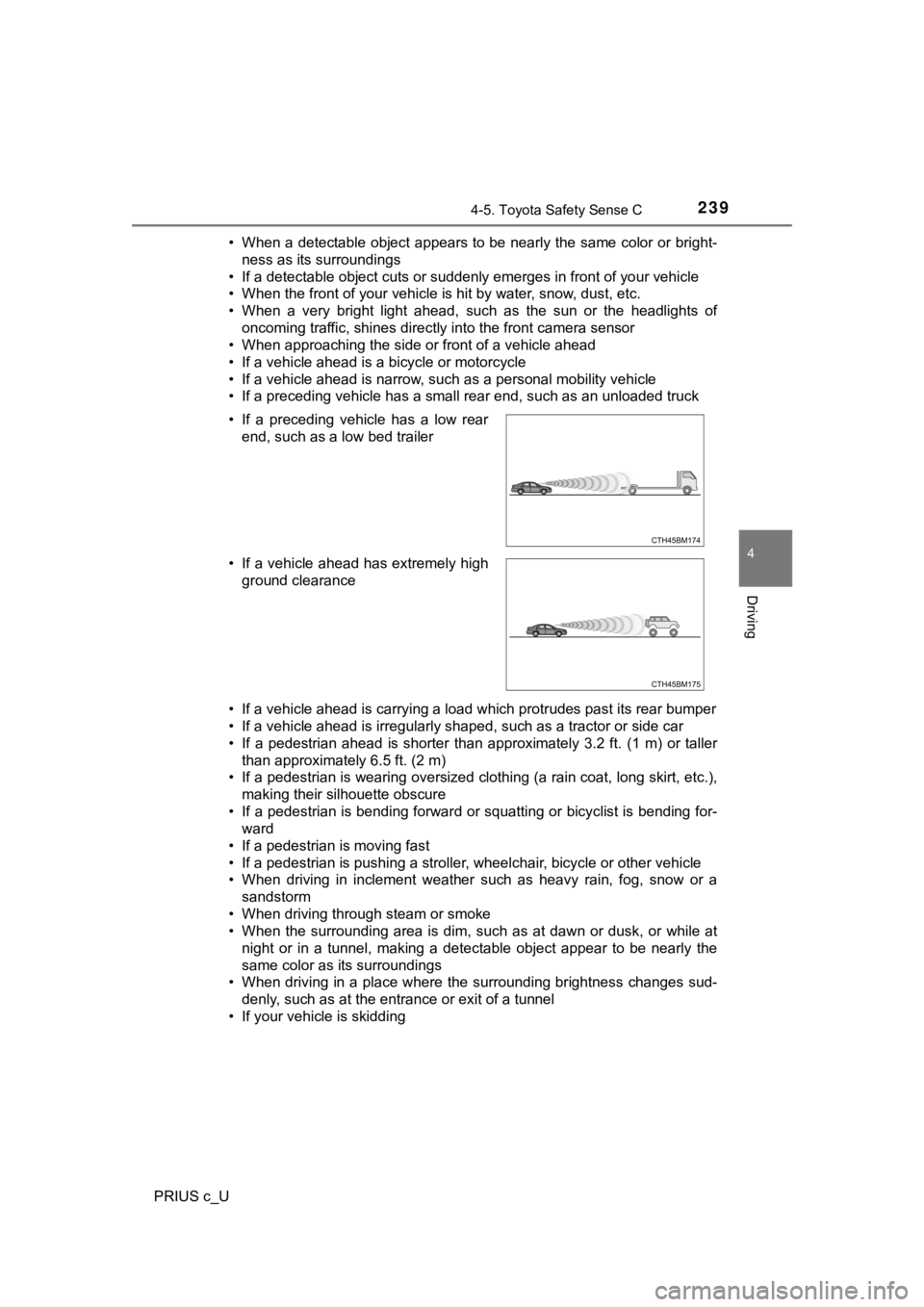
• If a preceding vehicle has a small rear end, such as an unload ed truck
• If a vehicle ahead is carrying a load which protrudes past its rear bumper
• If a vehicle ahead is irregularly shaped, such as a tractor or side car
• If a pedestrian ahead is shorter than approximately 3.2 ft. (1 m) or taller
than approximately 6.5 ft. (2 m)
• If a pedestrian is wearing oversized clothing (a rain coat, lo ng skirt, etc.),
making their silhouette obscure
• If a pedestrian is bending forward or squatting or bicyclist i s bending for-
ward
• If a pedestrian is moving fast
• If a pedestrian is pushing a stroller, wheelchair, bicycle or other vehicle
• When driving in inclement weather such as heavy rain, fog, snow or a sandstorm
• When driving through steam or smoke
• When the surrounding area is dim, such as at dawn or dusk, or while at
night or in a tunnel, making a detectable object appear to be n early the
same color as its surroundings
• When driving in a place where the surrounding brightness changes sud- denly, such as at the entrance or exit of a tunnel
• If your vehicle is skidding • If a preceding vehicle has a low rear end, such as a low bed trailer
• If a vehicle ahead has extremely high ground clearance
Page 240 of 600

2404-5. Toyota Safety Sense C
PRIUS c_U• If the wheels are misaligned
• If a wiper blade is blocking the camera sensor
• The vehicle is being driven at extremely high speeds
• When driving on a hill
• When there is a laser reflecting object (manhole cover, reflec
tive plate,
etc.), steps, or a protrusion in front of your vehicle
• If the radar sensor or camera sensor is misaligned
● In some situations such as the following, sufficient braking fo rce may not be
obtained, preventing the system from performing properly:
• If the braking functions cannot operate to their full extent, such as when
the brake parts are extremely cold, extremely hot, or wet
• If the vehicle is not properly maintained (brakes or tires are excessively
worn, improper tire inflation pressure, etc.)
• When the vehicle is being driven on a gravel road or other sli ppery sur-
face
■ If VSC is disabled
●If VSC is disabled ( P. 267), the pre-collision brake assist and pre-collision
braking functions are also disabled.
● The PCS warning light will turn on and “VSC TURNED OFF PRE-COLL I-
SION BRAKE SYSTEM UNAVAILABLE” will be displayed on the multi-i nfor-
mation display. • If the front of the vehicle is raised or
lowered