parking sensors TOYOTA PRIUS PRIME 2018 Owners Manual (in English)
[x] Cancel search | Manufacturer: TOYOTA, Model Year: 2018, Model line: PRIUS PRIME, Model: TOYOTA PRIUS PRIME 2018Pages: 788, PDF Size: 14.67 MB
Page 417 of 788
PRIUS PRIME_OM_OM47C17U_(U)
4175-5. Using the driving support systems
5
Driving
■Conditions under which the Rear C ross Traffic Alert function will not
detect a vehicle
The Rear Cross Traffic Alert function is not designed to detect the following
types of vehicles and/or objects:
● Vehicles approaching from directly behind
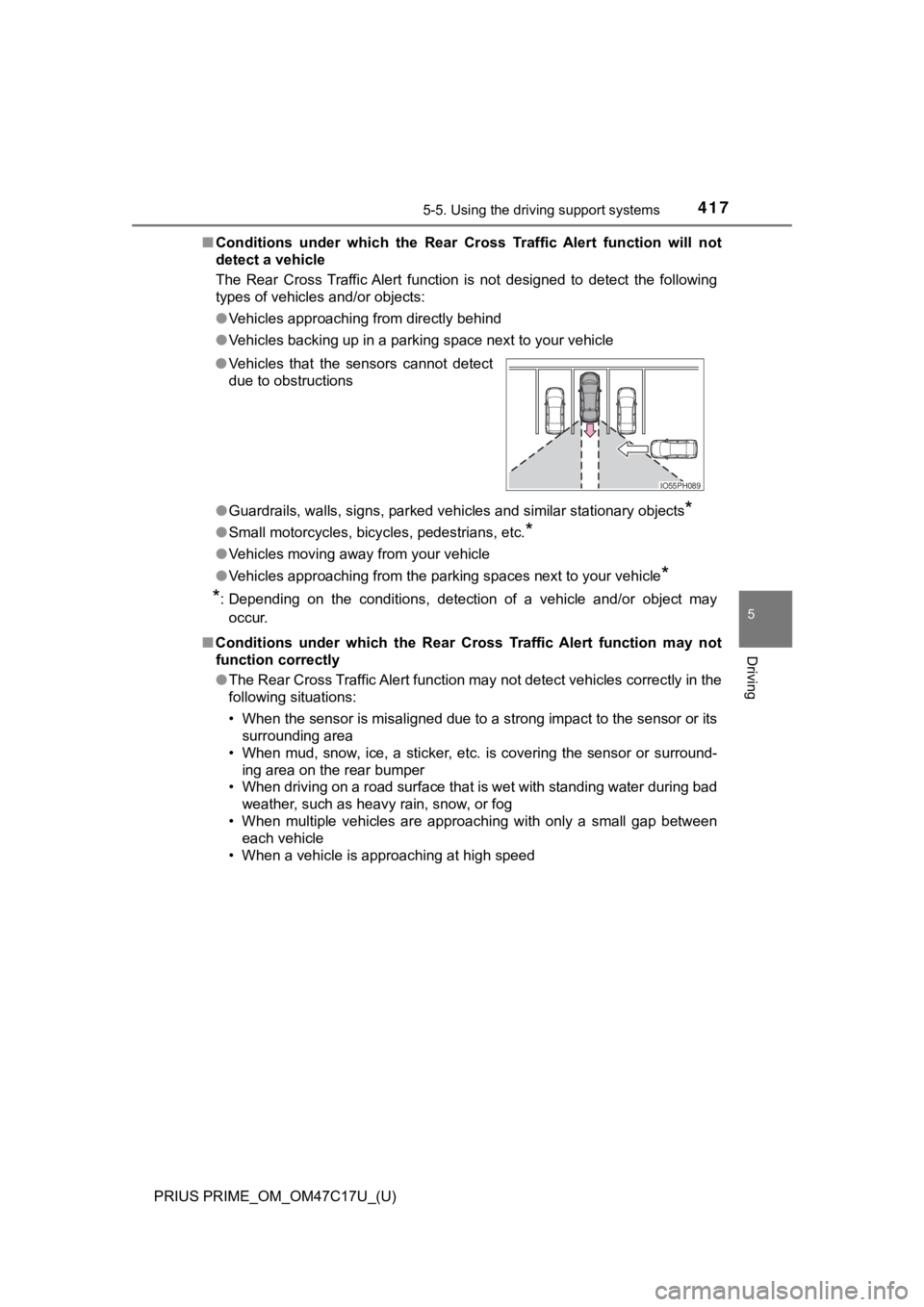
● Vehicles backing up in a parking space next to your vehicle
● Guardrails, walls, signs, parked vehicles and similar stationar y objects
*
●Small motorcycles, bicycles, pedestrians, etc.*
●Vehicles moving away from your vehicle
● Vehicles approaching from the parking spaces next to your vehic le
*
*
: Depending on the conditions, detection of a vehicle and/or obj ect may
occur.
■ Conditions under which the Rear C ross Traffic Alert function may not
function correctly
● The Rear Cross Traffic Alert function may not detect vehicles c orrectly in the
following situations:
• When the sensor is misaligned due to a strong impact to the se nsor or its
surrounding area
• When mud, snow, ice, a sticker, etc. is covering the sensor or surround-
ing area on the rear bumper
• When driving on a road surface that is wet with standing water during bad
weather, such as heavy rain, snow, or fog
• When multiple vehicles are approaching with only a small gap b etween
each vehicle
• When a vehicle is approaching at high speed
●
Vehicles that the sensors cannot detect
due to obstructions
IO55PH089
Page 418 of 788
418
PRIUS PRIME_OM_OM47C17U_(U)
5-5. Using the driving support systems
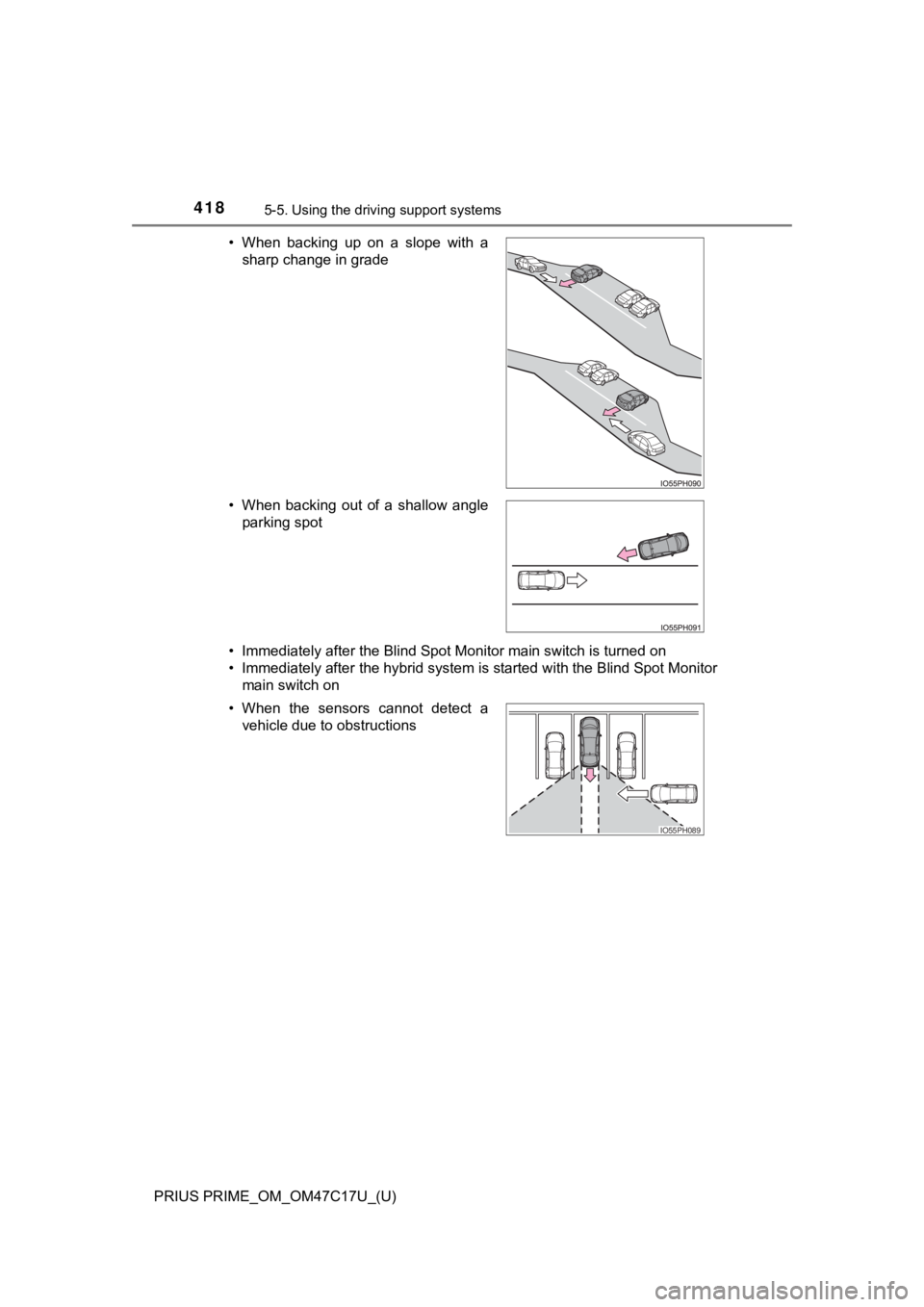
• Immediately after the Blind Spot Monitor main switch is turned on
• Immediately after the hybrid system is started with the Blind Spot Monitor
main switch on
• When backing up on a slope with a
sharp change in grade
• When backing out of a shallow angle parking spot
• When the sensors cannot detect a vehicle due to obstructions
IO55PH089
Page 420 of 788
420
PRIUS PRIME_OM_OM47C17U_(U)
5-5. Using the driving support systems
Intuitive parking assist
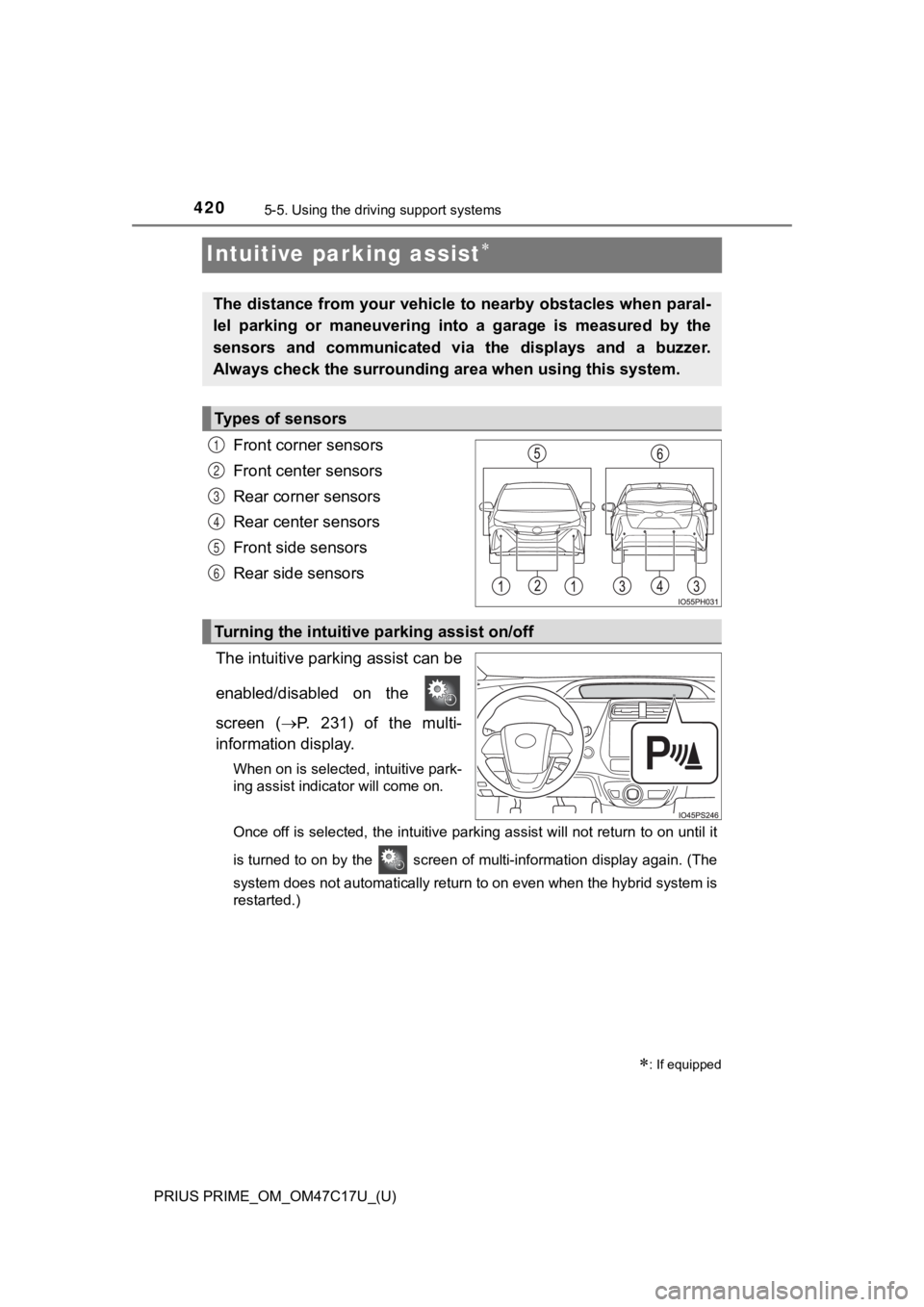
Front corner sensors
Front center sensors
Rear corner sensors
Rear center sensors
Front side sensors
Rear side sensors
The intuitive parking assist can be
enabled/disabled on the
screen ( P. 231) of the multi-
information display.
When on is selected, intuitive park-
ing assist indicator will come on.
Once off is selected, the intuitive parking assist will not return to on until it
is turned to on by the screen of multi-information display again. (The
system does not automatically return to on even when the hybrid system is
restarted.)
: If equipped
The distance from your vehicle to nearby obstacles when paral-
lel parking or maneuvering into a garage is measured by the
sensors and communicated via the displays and a buzzer.
Always check the surrounding ar ea when using this system.
Types of sensors
1
2
3
4
5
6
Turning the intuitive parking assist on/off
Page 424 of 788
424
PRIUS PRIME_OM_OM47C17U_(U)
5-5. Using the driving support systems
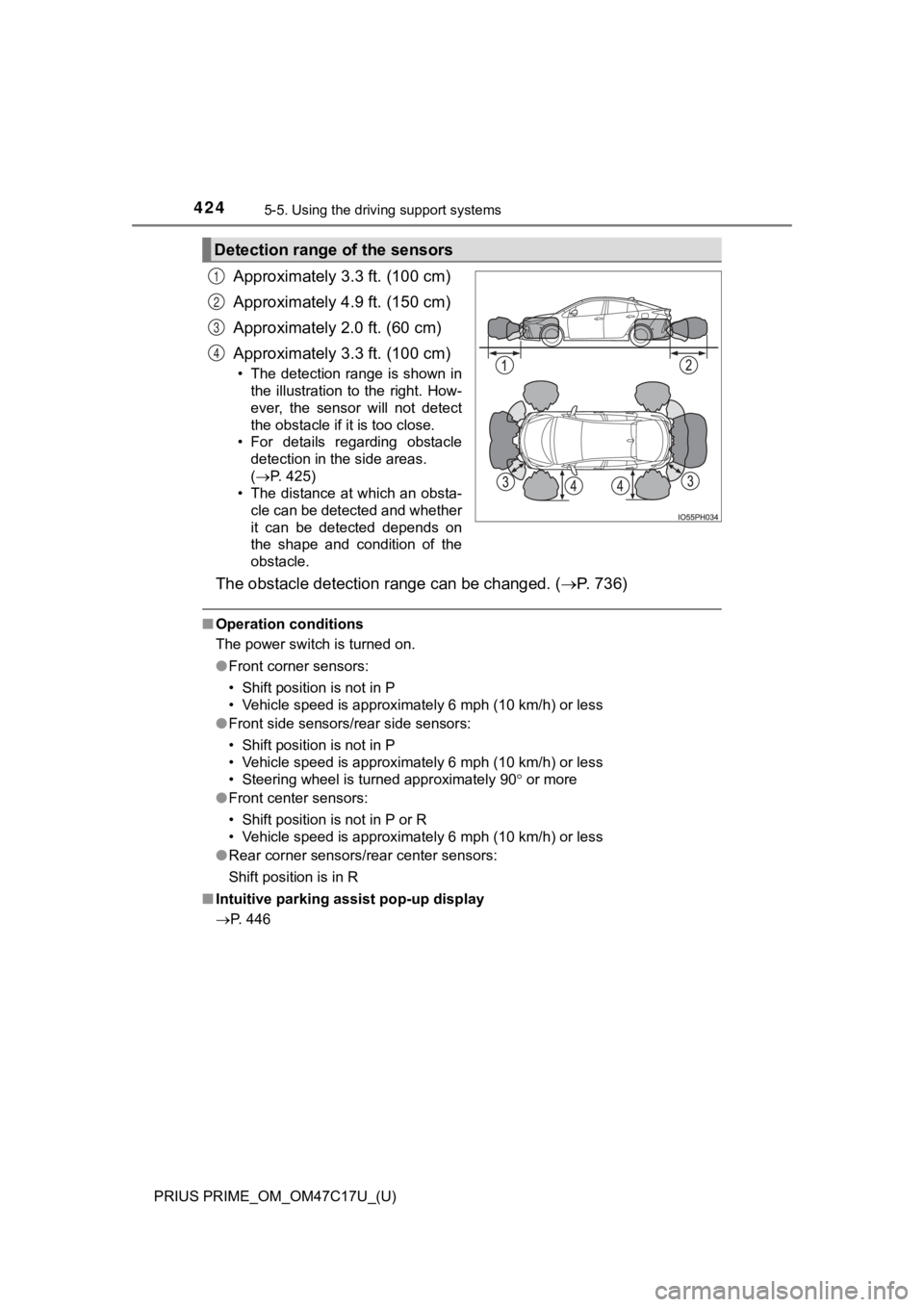
Approximately 3.3 ft. (100 cm)
Approximately 4.9 ft. (150 cm)
Approximately 2.0 ft. (60 cm)
Approximately 3.3 ft. (100 cm)
• The detection range is shown in
the illustration to the right. How-
ever, the sensor will not detect
the obstacle if it is too close.
• For details regarding obstacle detection in the side areas.
(P. 425)
• The distance at which an obsta- cle can be detected and whether
it can be detected depends on
the shape and condition of the
obstacle.
The obstacle detecti on range can be changed. ( P. 7 3 6 )
■Operation conditions
The power switch is turned on.
●Front corner sensors:
• Shift position is not in P
• Vehicle speed is approximately 6 mph (10 km/h) or less
● Front side sensors/rear side sensors:
• Shift position is not in P
• Vehicle speed is approximately 6 mph (10 km/h) or less
• Steering wheel is turned approximately 90 or more
● Front center sensors:
• Shift position is not in P or R
• Vehicle speed is approximately 6 mph (10 km/h) or less
● Rear corner sensors/rear center sensors:
Shift position is in R
■ Intuitive parking assist pop-up display
P. 446
Detection range of the sensors
1
2
3
4
Page 426 of 788

426
PRIUS PRIME_OM_OM47C17U_(U)
5-5. Using the driving support systems
■If “Clean Parking Assist Sensor” is displayed on the multi-information
display
A sensor may be dirty or covered with snow or ice. In such case s, if it is
removed from the sensor, the system should return to normal.
Also, due to the sensor being frozen at low temperatures, a mal function dis-
play may appear or an obstacle may not be detected. If the sens or thaws out,
the system should return to normal.
■ If “Parking Assist Malfunction” is displayed on the multi-information dis-
play
Depending on the malfunction of the sensor, the device may not be working
normally. Have the vehicle inspected by your Toyota dealer.
■ Certification (Canada only)
This ISM device complies with Canadian ICES-001.
■ Customization
Setting of buzzer volume can be changed.
(Customizable features: P. 736)
WARNING
■When using intuitive parking assist
Observe the following precautions to avoid an unexpected accident.
● Do not exceed the speed limit of 6 mph (10 km/h).
● The sensors’ detection areas and reaction times are limited. When moving
forward or reversing, check the areas surrounding the vehicle ( especially
the sides of the vehicle) for safety, and drive slowly, using t he brake to
control the vehicle’s speed.
● Do not install accessories within the sensors’ detection areas.
Page 427 of 788
PRIUS PRIME_OM_OM47C17U_(U)
4275-5. Using the driving support systems
5
Driving
WARNING
■Sensors
Certain vehicle conditions and the surrounding environment may affect the
ability of the sensor to correctly detect obstacles. Particular instances where
this may occur are listed below.
● There is dirt, snow or ice on the sensor. (Wiping the sensors w ill resolve
this problem.)
● The sensor is frozen. (Thawing the area will resolve this probl em.)
In especially cold weather, if a sensor is frozen, the screen m ay show an
abnormal display, or obstacles may not be detected.
● The sensor is covered in any way.
● In harsh sunlight or intense cold weather
● On an extremely bumpy road, on an incline, on gravel, or on gra ss
● The vicinity of the vehicle is noisy due to vehicle horns, moto rcycle
engines, air brakes of large vehicles, or other loud noises pro ducing ultra-
sonic waves.
● The sensor is splashed with water or drenched with heavy rain.
● The sensor is drenched with water on a flooded road.
● The vehicle is leaning considerably to one side.
● The vehicle is equipped with a fender pole or wireless antenna.
● The vehicle is approaching a tall or curved curb.
● The detection range is reduced due to an object such as a sign.
● The area directly under the bumpers is not detected.
● If obstacles draw too close to the sensor.
● The bumper or sensor receives a strong impact.
● A non-genuine Toyota suspension (lowered suspension etc.) is in stalled.
● There is another vehicle equipped with parking assist sensors i n the vicin-
ity.
● Towing eyelets are installed.
● A backlit license plate is installed.
In addition to the examples above, depending on the shape and c ondition of
obstacles, detection may not be possible, or the detection rang e may be
shortened.
Page 428 of 788

428
PRIUS PRIME_OM_OM47C17U_(U)
5-5. Using the driving support systems
WARNING
■Side sensors
In the following situations, the intuitive parking assist may n ot operate nor-
mally and may result in an unexpected accident. Drive carefully .
● Obstacles may not be detected in the side areas until the vehic le is driven
for a short time and a scan of the side areas is completed. ( P. 425)
● Even after the scan of the side areas is completed, obstacles s uch as
other vehicles, people or animals that approach from the sides cannot be
detected.
● Even after the scan of the side areas is completed, obstacles may not be
detected depending on the surrounding situation of the vehicle.
At that time, the side sensor operation displays ( P. 421) temporary turn
off.
■ Obstacles which may not be properly detected
● The shape of the obstacle may prevent the sensor from detecting it. Pay
particular attention to the following obstacles:
• Wires, fences, ropes, etc.
• Cotton, snow and other materials that absorb sound waves
• Sharply-angled objects
• Low obstacles
• Tall obstacles with upper sections projecting outwards in the direction of
your vehicle
• People may not be detected if they are wearing certain types of cloth- ing.
• Moving objects such as people or animals
Page 430 of 788
430
PRIUS PRIME_OM_OM47C17U_(U)
5-5. Using the driving support systems
Intelligent Clearance Sonar
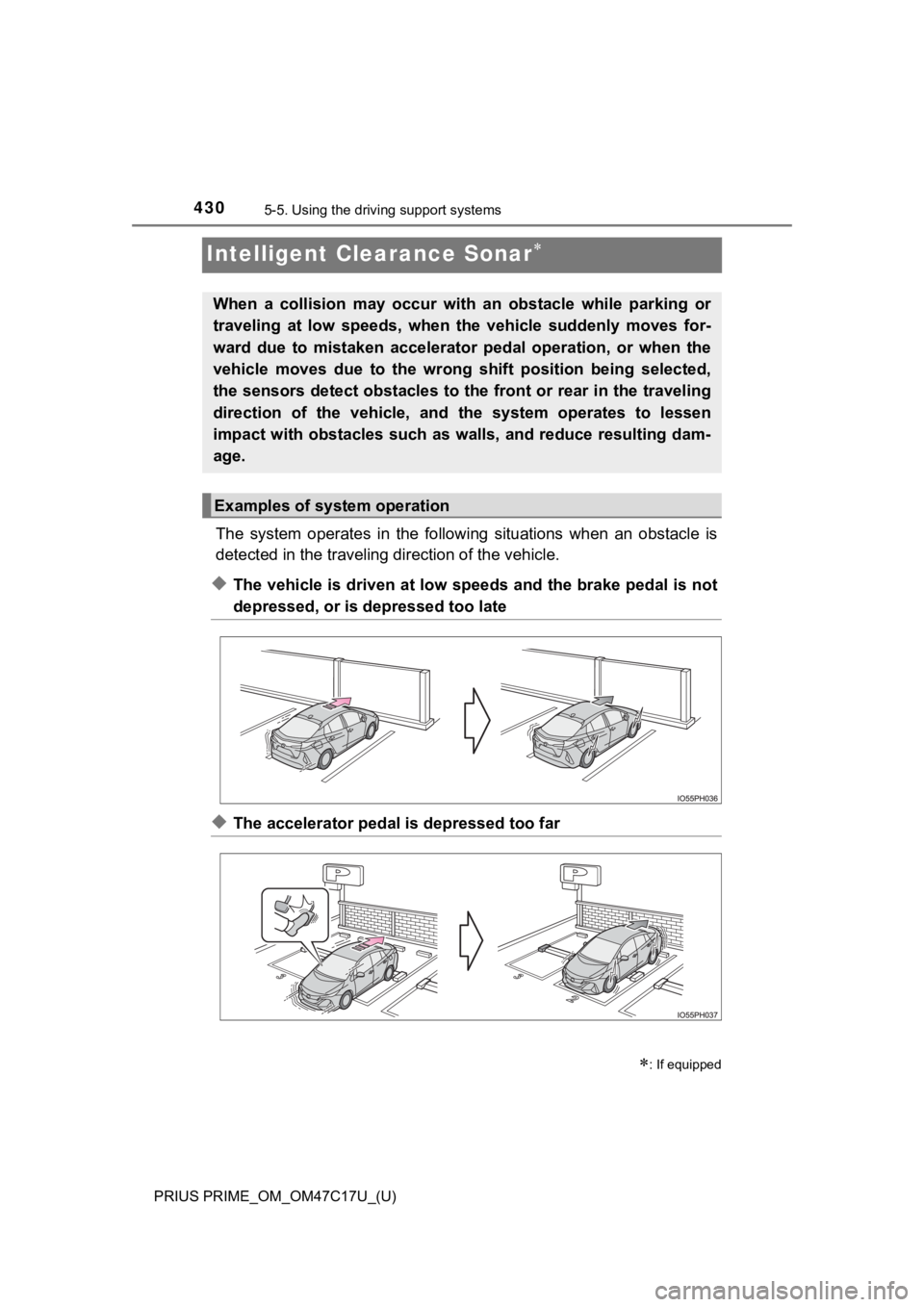
The system operates in the follo wing situations when an obstacle is
detected in the traveling d irection of the vehicle.
◆The vehicle is driven at low speeds and the brake pedal is not
depressed, or is depressed too late
◆The accelerator pedal is depressed too far
: If equipped
When a collision may occur with an obstacle while parking or
traveling at low speeds, when the vehicle suddenly moves for-
ward due to mistaken accelerator pedal operation, or when the
vehicle moves due to the wrong shift position being selected,
the sensors detect obstacles to the front or rear in the travel ing
direction of the vehicle, and the system operates to lessen
impact with obstacles such as walls, and reduce resulting dam-
age.
Examples of system operation
Page 436 of 788

436
PRIUS PRIME_OM_OM47C17U_(U)
5-5. Using the driving support systems
■Sensor detection range
The detection range of the Intelligent Clearance Sonar function differs from
the detection range of the intuitive parking assist ( P. 424).
Therefore, even if the intuitive parking assist detects an obst acle and pro-
vides a warning, the Intelligent Clearance Sonar may not start operating.
■ System operation
When the vehicle is stopped by system operation, the Intelligen t Clearance
Sonar function stops and the ICS OFF indicator illuminates.
■ System recovery
When the Intelligent Clearance Sonar function is stopped by sys tem opera-
tion and you would like to resume operation, either turn the In telligent Clear-
ance Sonar on again ( P. 431), or turn the power switch off and then back
on. Furthermore, when the vehicle moves with an obstacle no lon ger in the
traveling direction of the vehicle, or when the traveling direc tion of the vehicle
changes (such as when switching from moving forward to backing up, and
vice versa), system operation automatically resumes.
■ Obstacles not detected by the sensors
The following obstacles may not be detected by the sensors.
●Objects such as people, cloth and snow, that are difficult for sonic waves to
reflect off of. (In particular, people may also not be detected depending on
the type of clothing they are wearing.)
● Objects not perpendicular with the ground, objects not at a rig ht angle to the
traveling direction of the vehicle, uneven objects or waving objects
● Low objects
● Thin objects such as wires, fences, ropes and signposts
● Objects that are extremely close to the bumper
■ Intuitive parking assist buzzer
Regardless of whether the intuitive parking assist is on or off ( P. 420), if the
Intelligent Clearance Sonar function is not stopped ( P. 431), when the front
or rear sensors detect an obstacle and brake control is perform ed, the intui-
tive parking assist buzzer also sounds and a notification of th e approximate
distance to the obstacle is provided.
Page 437 of 788
PRIUS PRIME_OM_OM47C17U_(U)
4375-5. Using the driving support systems
5
Driving
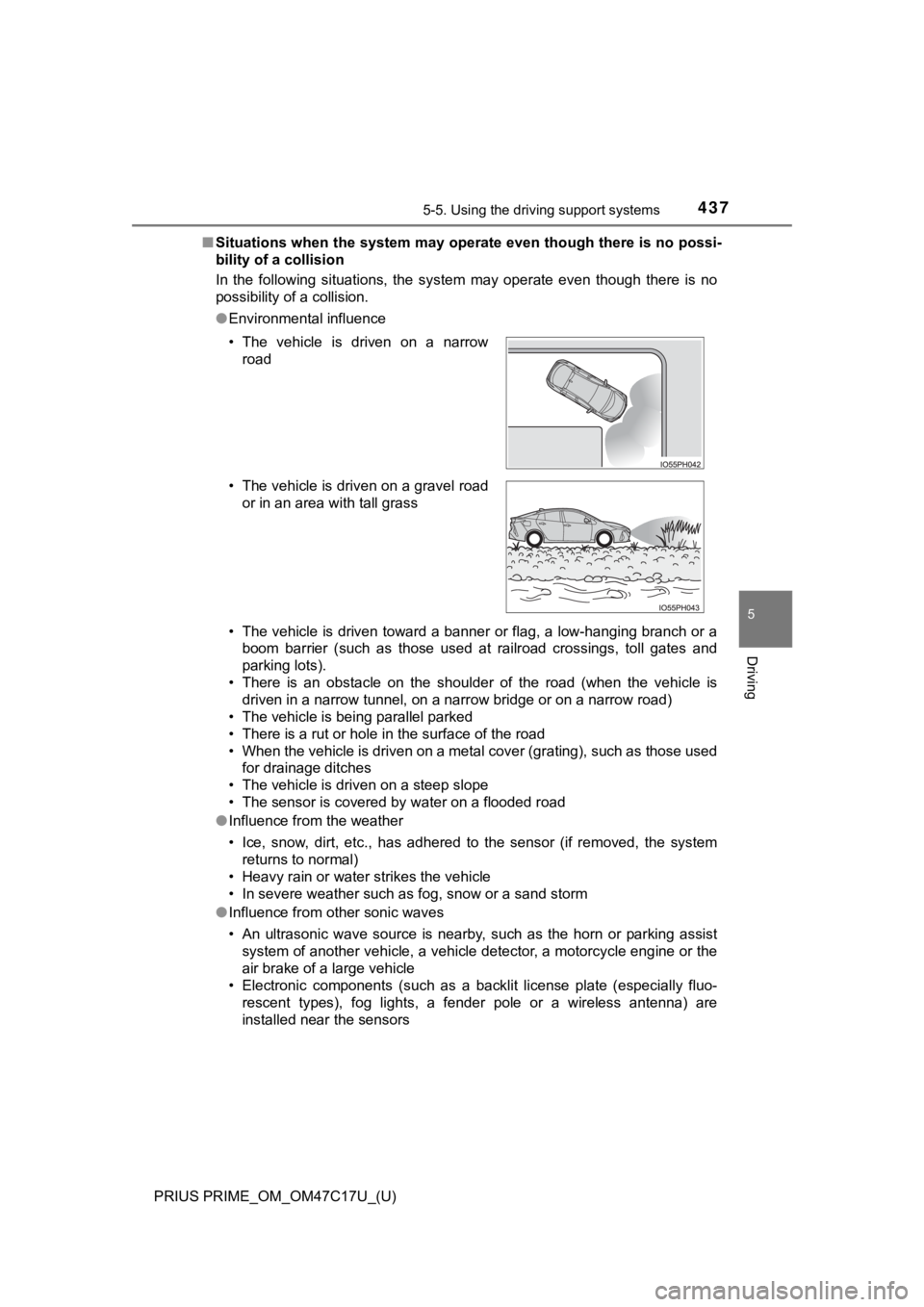
■Situations when the system may operate even though there is no possi-
bility of a collision
In the following situations, the system may operate even though there is no
possibility of a collision.
● Environmental influence
• The vehicle is driven toward a banner or flag, a low-hanging branch or a
boom barrier (such as those used at railroad crossings, toll gates and
parking lots).
• There is an obstacle on the shoulder of the road (when the veh icle is
driven in a narrow tunnel, on a narrow bridge or on a narrow road)
• The vehicle is being parallel parked
• There is a rut or hole in the surface of the road
• When the vehicle is driven on a metal cover (grating), such as those used
for drainage ditches
• The vehicle is driven on a steep slope
• The sensor is covered by water on a flooded road
● Influence from the weather
• Ice, snow, dirt, etc., has adhered to the sensor (if removed, the system
returns to normal)
• Heavy rain or water strikes the vehicle
• In severe weather such as fog, snow or a sand storm
● Influence from other sonic waves
• An ultrasonic wave source is nearby, such as the horn or parki ng assist
system of another vehicle, a vehicle detector, a motorcycle eng ine or the
air brake of a large vehicle
• Electronic components (such as a backlit license plate (especi ally fluo-
rescent types), fog lights, a fender pole or a wireless antenna ) are
installed near the sensors
• The vehicle is driven on a narrow
road
• The vehicle is driven on a gravel road or in an area with tall grass