fuel TOYOTA PRIUS PRIME 2019 Owners Manual (in English)
[x] Cancel search | Manufacturer: TOYOTA, Model Year: 2019, Model line: PRIUS PRIME, Model: TOYOTA PRIUS PRIME 2019Pages: 792, PDF Size: 17.18 MB
Page 3 of 792

3
1
9 8
7
6 4 3
2
PRIUS PRIME_OM_OM47D13U_(U)
10
5
4-1. Key informationKeys .................................. 270
4-2. Opening, closing and locking the doors
Side doors ......................... 275
Back door .......................... 281
Smart key system.............. 286
4-3. Adjusting the seats Front seats ........................ 295
Rear seats ......................... 297
Head restraints .................. 299
4-4. Adjusting the steering wheel and mirrors
Steering wheel .................. 302
Inside rear view mirror....... 304
Outside rear view mirrors ............................. 306
4-5. Opening and closing the windows
Power windows ................. 308 5-1. Before driving
Driving the vehicle ............. 314
Cargo and luggage ............ 326
Vehicle load limits .............. 329
Trailer towing ..................... 330
Dinghy towing .................... 331
5-2. Driving procedures Power (ignition) switch....... 332
Hybrid transmission ........... 338
Turn signal lever ................ 344
Parking brake .................... 345
5-3. Operating the lights and wipers
Headlight switch ................ 346
Automatic High Beam ........ 351
Fog light switch .................. 356
Windshield wipers and washer ............................. 358
5-4. Refueling Opening the fuel tank cap................................... 364
4Operation of each
component5Driving
Page 6 of 792

TABLE OF CONTENTS6
PRIUS PRIME_OM_OM47D13U_(U)8-1. Essential information
Emergency flashers .......... 650
If your vehicle has to be stopped in an
emergency ...................... 651
If the vehicle is trapped in rising water .................. 652
8-2. Steps to take in an emergency
If your vehicle needs to be towed ......................... 653
If you think something is wrong .............................. 659
If a warning light turns on or a warning buzzer
sounds ............................ 660
If a warning message is displayed ......................... 670
If you have a flat tire .......... 678
If the hybrid system will not start ........................... 695
If the electronic key does not operate properly ........ 697
If the 12-volt battery is discharged ...................... 701
If your vehicle overheats ... 707
If the vehicle becomes stuck................................ 712 9-1. Specifications
Maintenance data (fuel, oil level, etc.) .......... 716
Fuel information ................. 725
Tire information.................. 728
9-2. Customization Customizable features ....... 739
9-3. Initialization Items to initialize ................ 750
Reporting safety defects for U.S. owners ........................ 752
Seat belt instructions for Canadian owners
(in French)................................ 753
SRS airbag instructions for Canadian owners
(in French)................................ 755
Headlight aim instructions for Canadian owners
(in French)................................ 764
8When trouble arises9Vehicle specifications
10For owners
Page 8 of 792
8
PRIUS PRIME_OM_OM47D13U_(U)
For your infor mation
Please note that this manual applies to all models and explains all equipment,
including options. Therefore, you may find some explanations fo r equipment
not installed on your vehicle.
All specifications provided in this manual are current at the t ime of printing.
However, because of the Toyota policy of continual product improvement, we
reserve the right to make changes at any time without notice.
Depending on specifications, the vehicle shown in the illustrat ions may differ
from your vehicle in terms of equipment.
Approximately five hours after the hybrid system is turned off, you may hear
sound coming from under the vehicle for several minutes. This i s the sound of
a fuel evaporation leakage check and, it does not indicate a ma lfunction.
A wide variety of non-genuine spare parts and accessories for T oyota vehi-
cles are currently available in the market. You should know tha t Toyota does
not warrant these products and is not responsible for their per formance,
repair, or replacement, or for any damage they may cause to, or adverse
effect they may have on, your Toyota vehicle.
This vehicle should not be modified with non-genuine Toyota pro ducts. Modi-
fication with non-genuine Toyota products could affect its perf ormance, safety
or durability, and may even violate governmental regulations. In addition,
damage or performance problems resulting from the modification may not be
covered under warranty.
Main Owner’s Manual
Noise from under vehicle after turning off the hybrid system
Accessories, spare parts and m odification of your Toyota
Page 9 of 792

PRIUS PRIME_OM_OM47D13U_(U)
9
The installation of a mobile two-way radio system in your vehicle could affect
electronic systems such as:
● Hybrid system
● Multiport fuel injection system/sequential multiport fuel injection system
● Toyota Safety Sense P
● Anti-lock brake system
● SRS airbag system
● Seat belt pretensioner system
Be sure to check with your Toyota dealer for precautionary meas ures or spe-
cial instructions regarding instal lation of a mobile two-way radio system.
High voltage parts and cables on the hybrid vehicles emit appro ximately the
same amount of electromagnetic waves as the conventional gasoli ne pow-
ered vehicles or home electronic appliances despite of their el ectromagnetic
shielding.
Unwanted noise may occur in the reception of the mobile two-way radio.
Installation of a mobile two-way radio system
Page 17 of 792
17Pictorial index
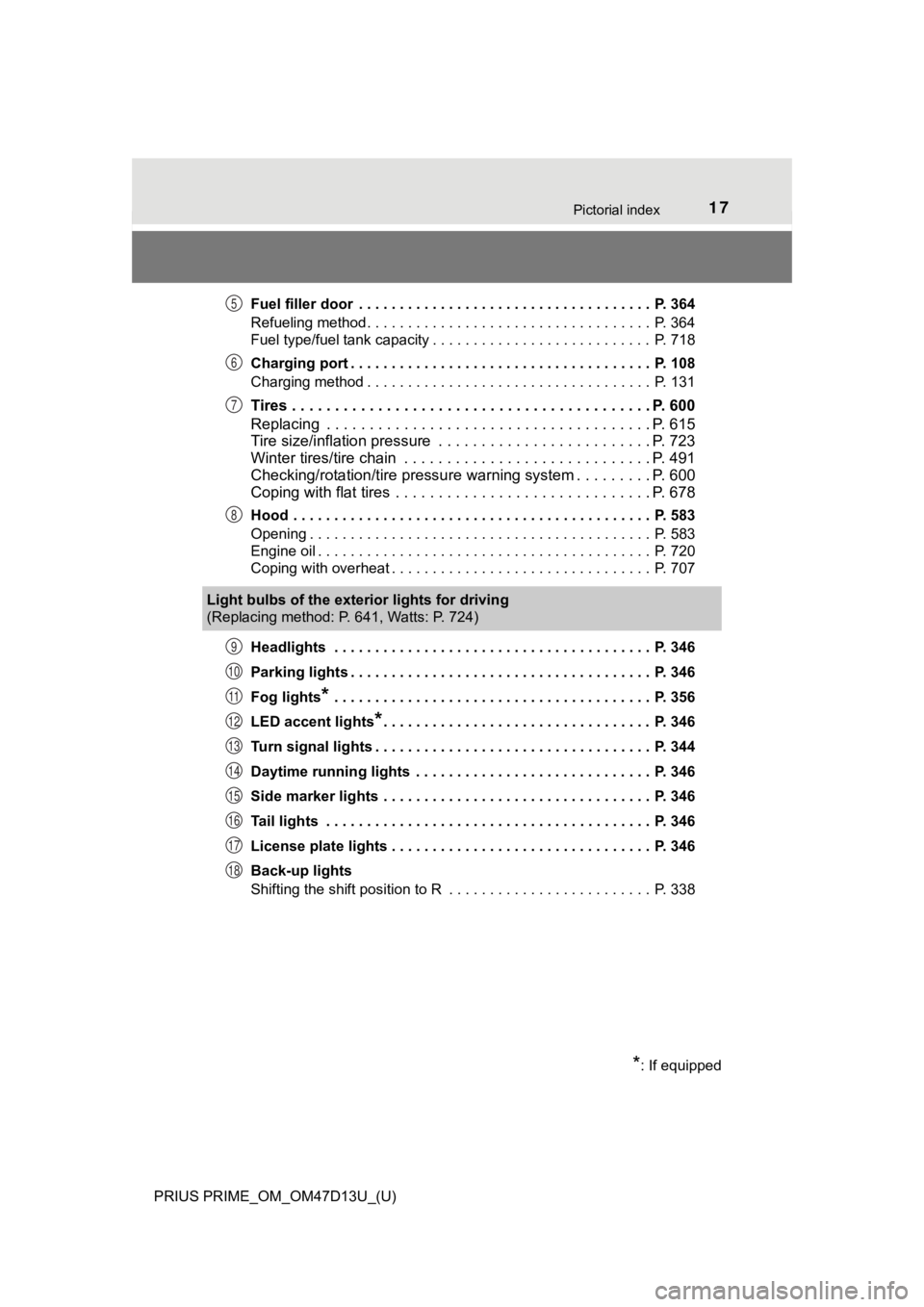
PRIUS PRIME_OM_OM47D13U_(U)Fuel filler door . . . . . . . . . . . . . . . . . . . . . . . . . . . . . . . . . . . . P. 364
Refueling method . . . . . . . . . . . . . . . . . . . . . . . . . . . . . . . . . . . P. 364
Fuel type/fuel tank capacity . . . . . . . . . . . . . . . . . . . . . . . . . . . P. 718
Charging port . . . . . . . . . . . . . . . . . . . . . . . . . . . . . . . . . . . . . P. 108
Charging method . . . . . . . . . . . . . . . . . . . . . . . . . . . . . . . . . . . P. 131
Tires . . . . . . . . . . . . . . . . . . . . . . . . . . . . .
. . . . . . . . . . . . . P. 600
Replacing . . . . . . . . . . . . . . . . . . . . . . . . . . . . . . . . . . . . . . P. 615
Tire size/inflation pressure . . . . . . . . . . . . . . . . . . . . . . . . . P. 723
Winter tires/tire chain . . . . . . . . . . . . . . . . . . . . . . . . . . . . . P. 491
Checking/rotation/tire pressur e warning system . . . . . . . . .P. 600
Coping with flat tires . . . . . . . . . . . . . . . . . . . . . . . . . . . . . . P. 678
Hood . . . . . . . . . . . . . . . . . . . . . . . . . . . . . . . . . . . . . . . . . . . . P. 583
Opening . . . . . . . . . . . . . . . . . . . . . . . . . . . . . . . . . . . . . . . . . . P. 583
Engine oil . . . . . . . . . . . . . . . . . . . . . . . . . . . . . . . . . . . . . . . . . P. 720
Coping with overheat . . . . . . . . . . . . . . . . . . . . . . . . . . . . . . . . P. 707
Headlights . . . . . . . . . . . . . . . . . . . . . . . . . . . . . . . . . . . . . . . P. 346
Parking lights . . . . . . . . . . . . . . . . . . . . . . . . . . . . . . . . . . . . . P. 346
Fog lights
* . . . . . . . . . . . . . . . . . . . . . . . . . . . . . . . . . . . . . . . P. 356
LED accent lights
*. . . . . . . . . . . . . . . . . . . . . . . . . . . . . . . . . P. 346
Turn signal lights . . . . . . . . . . . . . . . . . . . . . . . . . . . . . . . . . . P. 344
Daytime running lights . . . . . . . . . . . . . . . . . . . . . . . . . . . . . P. 346
Side marker lights . . . . . . . . . . . . . . . . . . . . . . . . . . . . . . . . . P. 346
Tail lights . . . . . . . . . . . . . . . . . . . . . . . . . . . . . . . . . . . . . . . . P. 346
License plate lights . . . . . . . . . . . . . . . . . . . . . . . . . . . . . . . . P. 346
Back-up lights
Shifting the shift position to R . . . . . . . . . . . . . . . . . . . . . . . . . P. 338
5
6
7
8
Light bulbs of the exterior lights for driving
(Replacing method: P. 641, Watts: P. 724)
*: If equipped
9
10
11
12
13
14
15
16
17
18
Page 19 of 792

19Pictorial index
PRIUS PRIME_OM_OM47D13U_(U)Multi-information display . . . . . . . . . . . . . . . . . . . . . . . . . . . P. 213
Display . . . . . . . . . . . . . . . . . . . . . . . . . . . . . . . . . . . . . . . . . . . P. 213
Energy monitor . . . . . . . . . . . . . . . . . . . . . . . . . . . . . . . . . . . . P. 216
When the warning messages are displayed . . . . . . . . . . . . . . P. 670
Parking brake . . . . . . . . . . . . . . . . . . . . . . . . . . . . . . . . . . . . . P. 345
Applying/releasing . . . . . . . . . . . . . . . . . . . . . . . . . . . . . . . . . . P. 345
Precautions against winter season . . . . . . . . . . . . . . . . . . . . . P. 491
Warning buzzer . . . . . . . . . . . . . . . . . . . . . . . .
. . . . . . . . . . . . P. 345
Turn signal lever . . . . . . . . . . . . . . . . . . . . . . . . . . . . . . . . . . P. 344
Headlight switch . . . . . . . . . . . . . . . . . . . . . . . . . . . . . . . . . . P. 346
Headlights/parking lights/tail lights/
daytime running lights . . . . . . . . . . . . . . . . . . . . . . . . . . . . . . . P. 346
Fog lights
*1 . . . . . . . . . . . . . . . . . . . . . . . . . . . . . . . . . . . . . . . P. 356
Windshield wipers and washer switch . . . . . . . . . . . . . . . . P. 358
Usage . . . . . . . . . . . . . . . . . . . . . . . . . . . . . . . . . . . . . . . . . . . P. 358
Adding washer fluid . . . . . . . . . . . . . . . . . . . . . . . . . . . . . . . . . P. 598
Emergency flasher switch . . . . . . . . . . . . . . . . . . . . . . . . . . P. 650
Fuel filler door opener . . . . . . . . . . . . . . . . . . . . . . . . . . . . . . P. 366
Hood lock release lever. . . . . . . . . . . . . . . . . . . . . . . . . . . . . P. 583
Tilt and telescopic steering lock release lever . . . . . . . . . . P. 302
Air conditioning system . . . . . . . . . . . . . . . . . . . . . . . . P. 496, 507
Usage . . . . . . . . . . . . . . . . . . . . . . . . . . . . . . . . . . . . . . . P. 496, 508
Rear window defogger . . . . . . . . . . . . . . . . . . . . . . . . . . . P. 500, 511
Audio system
*2
*1: If equipped
*2: Refer to “NAVIGATION S YSTEM OWNER’S MANUAL”.
5
6
7
8
9
10
11
12
13
14
Page 44 of 792

441-1. For safe use
PRIUS PRIME_OM_OM47D13U_(U)
■If the SRS airbags deploy (inflate)
●Slight abrasions, burns, bruising etc., may be sustained from S RS airbags,
due to the extremely high speed deployment (inflation) by hot g ases.
● A loud noise and white powder will be emitted.
● Parts of the airbag module (steering wheel hub, airbag cover an d inflator) as
well as the front seats, parts of the front and rear pillars, and roof side rails,
may be hot for several minutes. The airbag itself may also be h ot.
● The windshield may crack.
● The hybrid system will be stopped and fuel supply to the engine will be
stopped. ( P. 97)
● For Safety Connect subscribers, if any of the following situations occur, the
system is designed to send an emergency call to the response center, noti-
fying them of the vehicle’s location (without needing to push t he “SOS” but-
ton) and an agent will attempt to speak with the occupants to a scertain the
level of emergency and assistance required. If the occupants are unable to
communicate, the agent automatically treats the call as an emer gency and
helps to dispatch the necessary emergency services. ( P. 75)
• An SRS airbag is deployed.
• A seat belt pretensioner is activated.
• The vehicle is involved in a severe rear-end collision.
■ SRS airbag deployment condi tions (SRS front airbags)
● The SRS front airbags will deploy in the event of an impact tha t exceeds the
set threshold level (the level of force corresponding to an app roximately 12 -
18 mph [20 - 30 km/h] frontal collision with a fixed wall that does not move or
deform).
However, this threshold velocity will be considerably higher in the following
situations:
• If the vehicle strikes an object, such as a parked vehicle or sign pole,
which can move or deform on impact
• If the vehicle is involved in an underride collision, such as a collision in
which the front of the vehicle “underrides”, or goes under, the bed of a
truck
● Depending on the type of collision, it is possible that only th e seat belt pre-
tensioners and seat cushion airbag will activate.
● The SRS front airbags for the front passenger will not activate if there is no
passenger sitting in the front passenger seat. However, the SRS front air-
bags for the front passenger may deploy if luggage is put in the seat, even if
the seat is unoccupied.
● The SRS seat cushion airbag on the front passenger seat will not operate if
the occupant is not wearing a seat belt.
Page 79 of 792

791-3. Emergency assistance
PRIUS PRIME_OM_OM47D13U_(U)
1
For safety and security
■Enhanced Roadside Assistance
Enhanced Roadside Assistance adds GPS data to the already
included warranty-based Toyota roadside service.
Subscribers can press the “SOS” button to reach a Safety Connec t
response-center agent, who can he lp with a wide range of needs,
such as: towing, flat tire, fuel delivery, etc. For a description of the
Roadside Assistance services an d their limitations, please see the
Safety Connect Terms and Conditions, which are available at
Toyota.com in the United States, Toyotapr.com in Puerto Rico an d
Toyota.ca in Canada.
Important! Read this informatio n before using Safety Connect.
■Exposure to radio frequency signals
The Safety Connect system installed in your vehicle is a low-po wer
radio transmitter and receiver. I t receives and also sends out radio
frequency (RF) signals.
In August 1996, the Federal Communications Commission (FCC)
adopted RF exposure guidelines with safety levels for mobile wi re-
less phones. Those guidelines are consistent with the safety stan-
dards previously set by the following U.S. and international
standards bodies.
● ANSI (American National Stand ards Institute) C95.1 [1992]
● NCRP (National Council on Radi ation Protection and Measure-
ment) Report 86 [1986]
● ICNIRP (International Commission on Non-Ionizing Radiation
Protection) [1996]
Those standards were based on comprehensive and periodic eval-
uations of the relevant scienti fic literature. Over 120 scientists, engi-
neers, and physicians from unive rsities, and government health
agencies and industries reviewed the available body of research to
develop the ANSI Standard (C95.1).
The design of Safety Connect complies with the FCC guidelines i n
addition to those standards.
Safety information for Safety Connect
Page 87 of 792

PRIUS PRIME_OM_OM47D13U_(U)
872-1. Plug-in hybrid system
2
Plug-in hybrid system
Hybrid battery (traction battery) charge mode ( P. 89)
Electricity generated in the gas oline engine can be charged in the
hybrid battery (traction battery) by switching to the hybrid battery
(traction battery) charge mode wh en electricity needed for EV driv-
ing is not remaining.
*
● The system may not be able to switch to the hybrid battery (tra c-
tion battery) charge mode due to the state of the plug-in hybri d
system. ( P. 8 9 )
● Charging time differs depending on the driving state of the vehi-
cle when driving in hybrid batte ry (traction battery) charge mode.
When in the hybrid battery (traction battery) charge mode, the hybrid
battery charge mode indicator illuminates.
*: When in the hybrid battery (traction battery) charge mode, the hybrid
battery can be charged while driving. However, the gasoline eng ine runs
to charge the battery and fuel consumption becomes higher compa red
with driving in HV mode.
4
Page 90 of 792

90
PRIUS PRIME_OM_OM47D13U_(U)
2-1. Plug-in hybrid system
■When in EV/EV auto mode
In EV/EV auto mode, EV driving (driving using only the electric
motor)
* is possible. However, depending on the situation, EV driv-
ing may be canceled and both gaso line engine and electric motor
are used ( P. 93). Also, if a little electricity is remaining in the
hybrid battery (traction battery), HV mode is automatically sel ected.
To drive in EV/EV auto mode l ong, observe the followings.
● Avoid sudden acceleration and sudden deceleration, and be sure
to drive smoothly.
If you repeatedly accelerate, the hybrid battery (traction batt ery)
charge will deplete quickly. Also , EV driving may be canceled by
rapid acceleration or vehicle speed.
● Restrain your speed as much as possible. The distance that can
be driven in EV/EV auto mode will reduce considerably at high
speeds.
*: The EV driving range can be checked using the multi-informatio n dis-
play etc. ( P. 207, 223, 230, 247)
■
When in HV mode
The vehicle can be used in the same way as a standard hybrid
vehicle.
In HV mode, controls are primarily carried out as follows in ac cor-
dance with the dr iving conditions.
● The gasoline engine stops
* when the vehicle is stopped.
● During start off, the electric motor (traction motor) drives the vehi-
cle.
● During normal driving, the gasoline engine and electric motor
(traction motor) are controlled effectively, and the vehicle is
driven with optimum fuel efficiency. Also, when necessary, the
electric motor (traction motor) operates as an electrical gener ator
to charge the hybrid battery (traction battery).
● When the accelerator pedal is depressed heavily, drive force
from both the gasoline engine and the electric motor (traction
motor) is used to accelerate.
*: When the hybrid battery (traction battery) requires charging or the
engine is warming up, etc., the gasoline engine will not automa tically
stop. ( P. 93)
Control when driving in each mode