lights TOYOTA PRIUS PRIME 2019 Owners Manual (in English)
[x] Cancel search | Manufacturer: TOYOTA, Model Year: 2019, Model line: PRIUS PRIME, Model: TOYOTA PRIUS PRIME 2019Pages: 68, PDF Size: 3.34 MB
Page 3 of 68
1
OVERVIEW
ELECTRIC VEHICLE SYSTEM
FEATURES & OPERATIONS
TOYOTA SAFETY SENSE
SAFETY &
EMERGENCY FEATURES
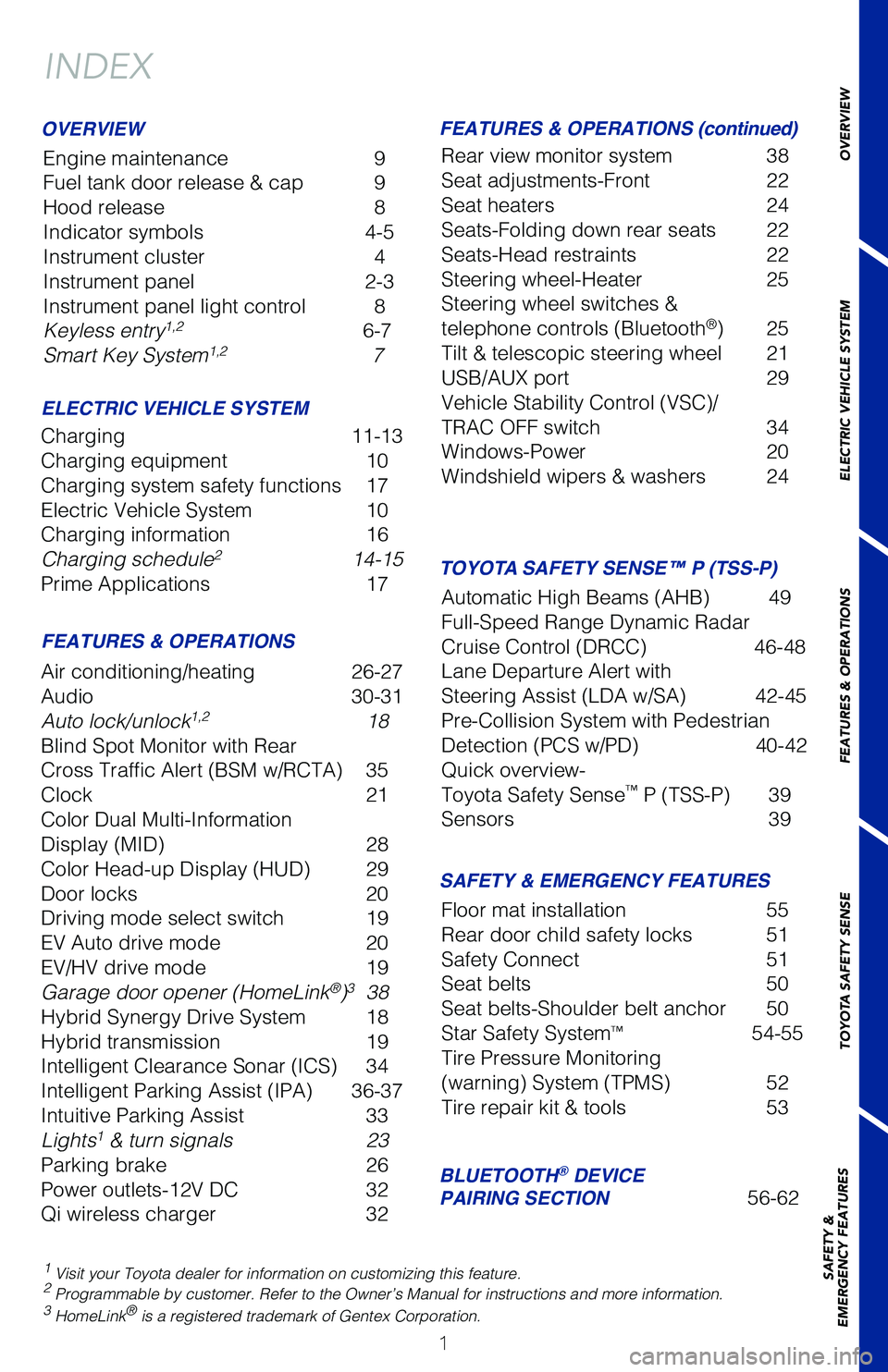
INDEX
Engine maintenance
9
Fuel tank door release & cap 9
Hood release 8
Indicator symbols 4-5
Instrument cluster 4
Instrument panel 2-3
Instrument panel light control 8
Keyless entry
1,2 6-7
Smart Key System1,2 7
1 Visit your Toyota dealer for information on customizing this feature.2 Programmable by customer. Refer to the Owner’s Manual for instructio\
ns and more information.3 HomeLink® is a registered trademark of Gentex Corporation.
OVERVIEW
ELECTRIC VEHICLE SYSTEM FEATURES & OPERATIONS (continued)
FEATURES & OPERATIONS SAFETY & EMERGENCY FEATURES
Charging 11-13
Charging equipment 10
Charging system safety functions 17
Electric Vehicle System 10
Charging information 16
Charging schedule
2 14-15
Prime Applications 17
Air conditioning/heating 26-27
Audio 30-31
Auto lock/unlock
1,2 18
Blind Spot Monitor with Rear
Cross Traffic Alert (BSM w/RCTA) 35
Clock 21
Color Dual Multi-Information
Display (MID) 28
Color Head-up Display (HUD) 29
Door locks 20
Driving mode select switch 19
EV Auto drive mode 20
EV/HV drive mode 19
Garage door opener (HomeLink
®)3 38
Hybrid Synergy Drive System 18
Hybrid transmission 19
Intelligent Clearance Sonar (ICS) 34
Intelligent Parking Assist (IPA) 36-37
Intuitive Parking Assist 33
Lights
1 & turn signals 23
Parking brake 26
Power outlets-12V DC 32
Qi wireless charger 32Rear view monitor system 38
Seat adjustments-Front
22
Seat heaters 24
Seats-Folding down rear seats 22
Seats-Head restraints 22
Steering wheel-Heater 25
Steering wheel switches &
telephone controls (Bluetooth
®) 25
Tilt & telescopic steering wheel 21
USB/AUX port 29
Vehicle Stability Control (VSC)/
TRAC OFF switch 34
Windows-Power 20
Windshield wipers & washers 24
Floor mat installation 55
Rear door child safety locks 51
Safety Connect 51
Seat belts 50
Seat belts-Shoulder belt anchor 50
Star Safety System
™ 54-55
Tire Pressure Monitoring
(warning) System (TPMS) 52
Tire repair kit & tools 53
BLUETOOTH® DEVICE
PAIRING SECTION 56-62
TOYOTA SAFETY SENSE™ P (TSS-P)
Automatic High Beams (AHB) 49
Full-Speed Range Dynamic Radar
Cruise Control (DRCC) 46-48
Lane Departure Alert with
Steering Assist (LDA w/SA) 42-45
Pre-Collision System with Pedestrian
Detection (PCS w/PD) 40-42
Quick overview-
Toyota Safety Sense
™ P (TSS-P) 39
Sensors 39
Page 13 of 68
 11
The Prius Prime may be charged immediately, or scheduled to charge at a \
specific time. Before charging, it is recommended that:
• Parking brake is securely set
• All lights are turned off
â€")
11
The Prius Prime may be charged immediately, or scheduled to charge at a \
specific time. Before charging, it is recommended that:
• Parking brake is securely set
• All lights are turned off
• The POWER switch is OFF
Refer to “Things to Know Before Charging,” in the Owner’s Manua\
l before
attempting to charge the hybrid battery.
Step 1 Plug the charge cable into the outlet of the external power source.
NOTE: Hanging the CCID on a hook is recommended to reduce the strain on
the outlet and charge cable plug.
OVERVIEW
ELECTRIC VEHICLE SYSTEM
FEATURES & OPERATIONS
TOYOTA SAFETY SENSE
SAFETY &
EMERGENCY FEATURES
START CHARGING
- Make sure to hold the body of the plug and insert it
firmly into the outlet.
- Check that the power indicator of the CCID (Charging Circuit Interrupting Device) is illuminated.
- Check the status of the automatic system check that runs before charging to detect electrical leakage. If a
malfunction is detected, an error warning indicator
flashes.
- The surface of the CCID may become hot, but this does not indicate a malfunction.
Step 2 Press the charge port lid to open and the charging inlet light will ill\
uminate.
NOTE: For vehicles with smart lid & connector locking system, unlock doors
first.
For more information or to change settings for the smart lid and chargin\
g connector
function, refer to the Owner’s Manual.
Charging inlet light
Charging
Page 25 of 68
23
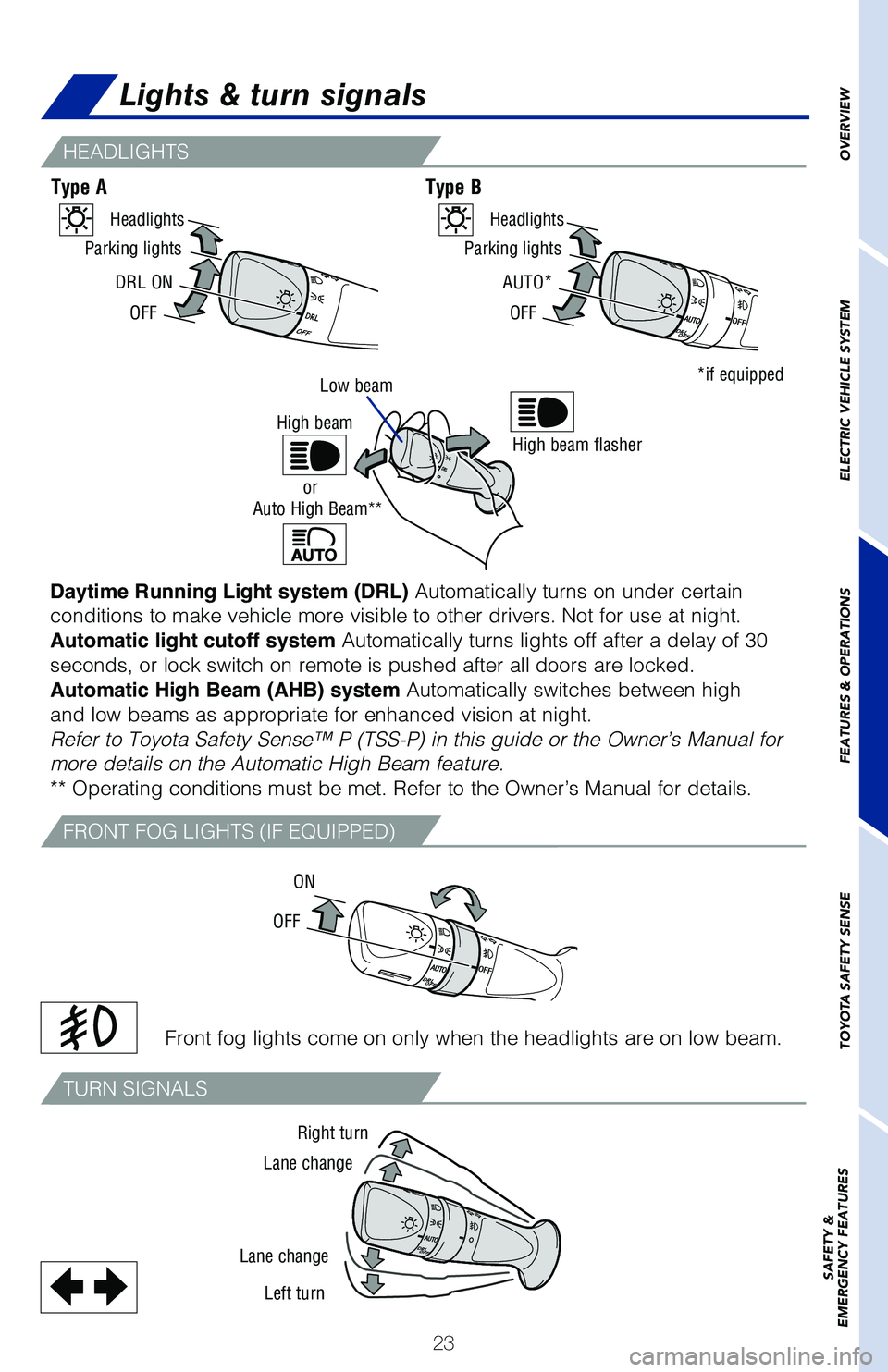
Lights & turn signals
Front fog lights come on only when the headlights are on low beam.
Type AType B
HEADLIGHTS
FRONT FOG LIGHTS (IF EQUIPPED)
TURN SIGNALS
DRL ON
OFF
Parking lights
HeadlightsAUTO*
OFF
Parking lights
Headlights
*if equipped
OFF ON
Right turn
Lane change
Lane change Left turn
OVERVIEW
ELECTRIC VEHICLE SYSTEM
FEATURES & OPERATIONS
TOYOTA SAFETY SENSE
SAFETY &
EMERGENCY FEATURES
Low beam
Daytime Running Light system (DRL) Automatically turns on under certain
conditions to make vehicle more visible to other drivers. Not for use at\
night.
Automatic light cutoff system Automatically turns lights off after a delay of 30
seconds, or lock switch on remote is pushed after all doors are locked.
Automatic High Beam (AHB) system Automatically switches between high
and low beams as appropriate for enhanced vision at night.
Refer to Toyota Safety Sense™ P (TSS-P) in this guide or the Owner’\
s Manual for
more details on the Automatic High Beam feature.
** Operating conditions must be met. Refer to the Owner’s Manual for \
details.
High beam flasherHigh beam
Auto High Beam**or
Page 41 of 68
 39
Quick overview-Toyota Safety Sense™ P (TSS-P)
Sensors
TSS-P combines an in-vehicle camera mounted in front of the inside rear \
view mirror
and a millimeter-wave radar mounted in the front grill")
39
Quick overview-Toyota Safety Sense™ P (TSS-P)
Sensors
TSS-P combines an in-vehicle camera mounted in front of the inside rear \
view mirror
and a millimeter-wave radar mounted in the front grill. These sensors su\
pport the
driver assist systems.
Camera sensor
Radar sensor
TOYOTA SAFETY SENSE™
Toyota Safety Sense™ P (TSS-P) is a set of active safety technologies designed
to help mitigate or prevent collisions across a wide range of traffic si\
tuations, in
certain conditions. TSS-P is designed to help support the driver’s aw\
areness,
decision making and vehicle operation contributing to a safe driving exp\
erience.
Refer to the Owner’s Manual for operation, setting adjustments, limitations and
more details to understand these functions and complete safety precautions. For
more information, please go to http://www.toyota.com/safety-sense
Lane Departure Alert with Steering Assist (LDA w/SA)
LDA w/SA is designed to provide notification when the system detects
an unintended lane departure.
The Steering Assist function is designed to provide small corrective
steering inputs to the steering wheel for a short period of time to help\
keep the vehicle in its lane.
Automatic High Beams (AHB)
AHB is designed to detect the headlights of oncoming vehicles and the
tail lights of preceding vehicles and switch between high beams and
low beams as appropriate.
Pre-Collision System with Pedestrian Detection (PCS w/PD)
PCS w/PD is designed to provide alert, mitigation, and/or avoidance
support in certain conditions, when the system detects a potential
collision with a preceding vehicle is likely to occur.
The advanced millimeter-wave radar sensor system is designed to
work with the camera sensor to help recognize a preceding pedestrian,
and provide an alert, mitigation and/or avoidance support in certain
conditions.
Full-Speed Range Dynamic Radar Cruise Control (DRCC)
DRCC is designed to help maintain a pre-set distance to a preceding
vehicle when the preceding vehicle is traveling at a lower speed.
OVERVIEW
ELECTRIC VEHICLE SYSTEM
FEATURES & OPERATIONS
TOYOTA SAFETY SENSE
SAFETY &
EMERGENCY FEATURES
Page 49 of 68
47
OVERVIEW
ELECTRIC VEHICLE SYSTEM
FEATURES & OPERATIONS
TOYOTA SAFETY SENSE
SAFETY &
EMERGENCY FEATURES
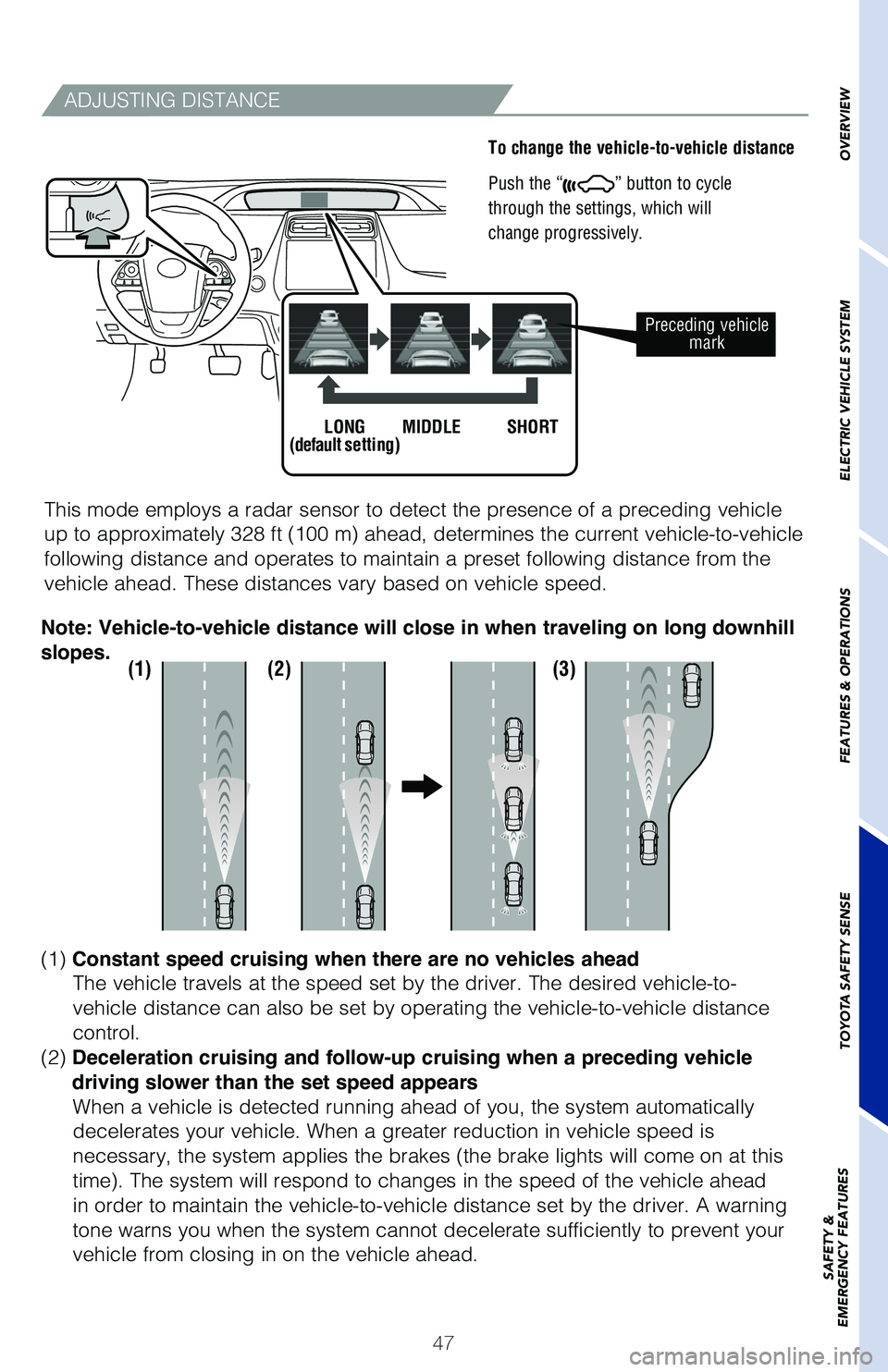
ADJUSTING DISTANCE
To change the vehicle-to-vehicle distance
Push the “
” button to cycle
through the settings, which will
change progressively.
This mode employs a radar sensor to detect the presence of a preceding v\
ehicle
up to approximately 328 ft (100 m) ahead, determines the current vehicle-to-vehicle
following distance and operates to maintain a preset following distance \
from the
vehicle ahead. These distances vary based on vehicle speed.
Preceding vehicle mark
LONG
(default setting) MIDDLE SHORT
(1) (2) (3)
(1) Constant speed cruising when there are no vehicles ahead
The vehicle travels at the speed set by the driver. The desired vehicle-\
to-
vehicle distance can also be set by operating the vehicle-to-vehicle dis\
tance
control.
(2) Deceleration cruising and follow-up cruising when a preceding vehicle
driving slower than the set speed appears When a vehicle is detected running ahead of you, the system automaticall\
y
decelerates your vehicle. When a greater reduction in vehicle speed is
necessary, the system applies the brakes (the brake lights will come on at this
time). The system will respond to changes in the speed of the vehicle ahead
in order to maintain the vehicle-to-vehicle distance set by the driver. \
A warning
tone warns you when the system cannot decelerate sufficiently to prevent\
your
vehicle from closing in on the vehicle ahead.
Note: Vehicle-to-vehicle distance will close in when traveling on long downhill
slopes.
Page 51 of 68
 49
OVERVIEW
ELECTRIC VEHICLE SYSTEM
FEATURES & OPERATIONS
TOYOTA SAFETY SENSE
SAFETY &
EMERGENCY FEATURES
AHB is a safety system designed to help drivers see more of what’s ah\
ead at
nighttime a")
49
OVERVIEW
ELECTRIC VEHICLE SYSTEM
FEATURES & OPERATIONS
TOYOTA SAFETY SENSE
SAFETY &
EMERGENCY FEATURES
AHB is a safety system designed to help drivers see more of what’s ah\
ead at
nighttime and reduce glare for oncoming drivers. When enabled, AHB uses \
an
in-vehicle camera to help detect the headlights of oncoming vehicles and\
tail lights
of preceding vehicles, then automatically switches between high and low \
beams
as appropriate to provide the most light possible and enhance forward vi\
sibility.
By using high beams more frequently, the system may allow earlier detect\
ion of
pedestrians and obstacles.
Refer to the Toyota Owner’s Manual for additional information on AHB \
operation,
settings adjustments, limitations, and precautions before attempting to \
use it.
Automatic High Beams (AHB)
Note: The AHB function only operates at night.
(1) With the engine switch in IGNITION ON mode and headlight switch turned to
“AUTO” or “
” position, push lever away from you.
(2) Depress the Automatic High Beam “
” switch.
The AHB indicator will come on when the headlights are turned on automat\
ically
to indicate that the system is active.
Note: Pull the lever back toward you to turn the AHB system off. The AHB
indicator will turn off and the high beam indicator “
” turns on.
When all of these conditions are met, high beams will be automatically t\
urned on
(after approximately 1 second): • Vehicle speed is above approximately 21 mph (34 km/h.)
• The area ahead of the vehicle is dark.
• There are no oncoming or preceding vehicles with headlights or tail\
lights turned on.
• There are few street lights on the road ahead.
If any of these conditions occur, the system is designed to automaticall\
y turn off
high beams: • Vehicle speed drops below approximately 17 mph (27 km/h.)
• The area ahead of the vehicle is not dark.
• Oncoming or preceding vehicles have headlights or tail lightsturned on.
• There are many streetlights on the road ahead.
ACTIVATING THE AHB SYSTEM
CONDITIONS WHERE AHB WILL TURN ON/OFF AUTOMATICALLY