stop start TOYOTA PRIUS PRIME 2019 Owners Manual (in English)
[x] Cancel search | Manufacturer: TOYOTA, Model Year: 2019, Model line: PRIUS PRIME, Model: TOYOTA PRIUS PRIME 2019Pages: 68, PDF Size: 3.34 MB
Page 19 of 68
17
OVERVIEW
ELECTRIC VEHICLE SYSTEM
FEATURES & OPERATIONS
TOYOTA SAFETY SENSE
SAFETY &
EMERGENCY FEATURES
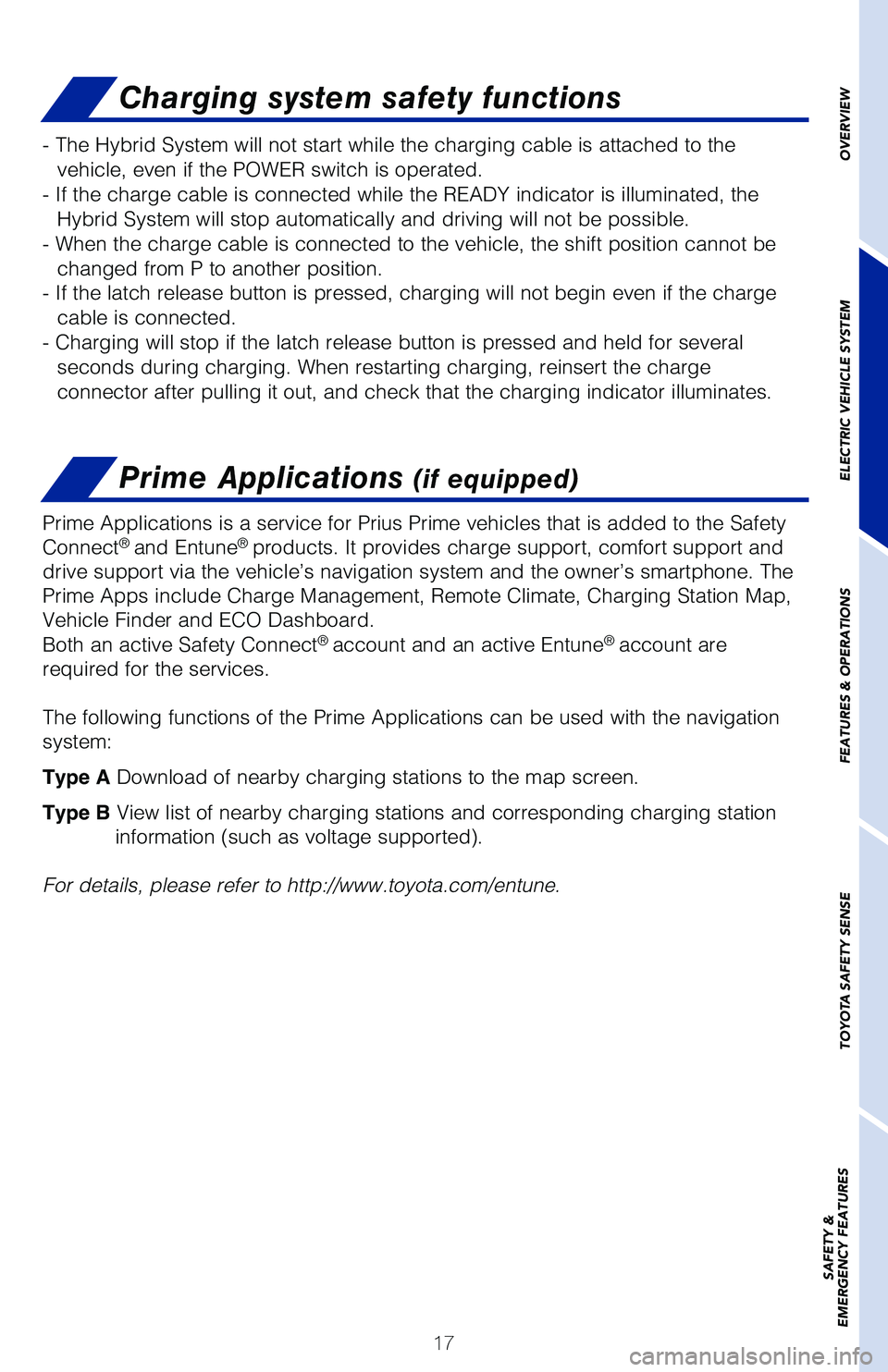
Charging system safety functions
Prime Applications (if equipped)
- The Hybrid System will not start while the charging cable is attached \
to the
vehicle, even if the POWER switch is operated.
- If the charge cable is connected while the READY indicator is illuminated, the Hybrid System will stop automatically and driving will not be possible.
- When the charge cable is connected to the vehicle, the shift position \
cannot be changed from P to another position.
- If the latch release button is pressed, charging will not begin even i\
f the charge cable is connected.
- Charging will stop if the latch release button is pressed and held for\
several seconds during charging. When restarting charging, reinsert the charge
connector after pulling it out, and check that the charging indicator il\
luminates.
Prime Applications is a service for Prius Prime vehicles that is added t\
o the Safety
Connect® and Entune® products. It provides charge support, comfort support and
drive support via the vehicle’s navigation system and the owner’s \
smartphone. The
Prime Apps include Charge Management, Remote Climate, Charging Station M\
ap,
Vehicle Finder and ECO Dashboard.
Both an active Safety Connect
® account and an active Entune® account are
required for the services.
The following functions of the Prime Applications can be used with the n\
avigation
system:
Type A Download of nearby charging stations to the map screen.
Type B View list of nearby charging stations and corresponding charging statio\
n information (such as voltage supported).
For details, please refer to http://www.toyota.com/entune.
Page 20 of 68
 18
Hybrid Synergy Drive System
FEATURES & OPERATIONS
The Hybrid Synergy Drive System utilizes a computer-controlled gasoline \
engine
and electric motor to provide the most efficient combination of p")
18
Hybrid Synergy Drive System
FEATURES & OPERATIONS
The Hybrid Synergy Drive System utilizes a computer-controlled gasoline \
engine
and electric motor to provide the most efficient combination of power fo\
r the
vehicle. To conserve energy, when the brakes are applied the braking for\
ce
generates electricity which is then sent to the traction battery. In add\
ition, the
engine shuts off when the vehicle is stopped. The benefits are better fu\
el economy,
reduced vehicle emissions and improved performance.
NOTE: Fuel consumption and energy information of the Hybrid System are shown on the Multi-Information Display.
-Ensure tire pressures are maintained at levels specified in the Owner’\
s Manual.
-When possible, link trips to reduce engine cold starts.
-Avoid driving at speeds that are higher than necessary, especially on t\
he highway.
-When possible, avoid sudden stops to maximize regenerative braking ener\
gy.
-Minimize use of the air conditioning.
TIPS FOR IMPROVED FUEL ECONOMY
STARTING YOUR VEHICLE
Auto lock/unlock
Automatic door locks can be programmed to operate in different modes, or\
turned
OFF.
Shift position linked door locking/unlocking function
-Doors lock when shifting from Park.
-Doors unlock when shifting into Park.
Speed linked door locking function
-Doors lock when the vehicle speed is approximately 12 mph or higher.
Driver’s door linked door unlocking function
-Doors unlock when the “POWER” switch is set to OFF and driver’\
s door is opened within approximately 45 seconds.
Refer to the Owner’s Manual for more details.
Push
(1) Put the shift lever in “P.”
(2) Depress the brake pedal, and “”
will be displayed on the Multi-Information
Display.
(3) Press the “POWER” switch briefly and
firmly.
(4) The “READY” light will blink. After
a few seconds, when the light remains
steady and a beep sounds, you may
begin driving.
Page 21 of 68
 19
Hybrid transmission
Driving mode select switch
*
The engine brake is the equivalent of downshifting. Shift to “B” w\
hen engine
braking is desired (i.e. downhill driving, coasting to a stop,")
19
Hybrid transmission
Driving mode select switch
*
The engine brake is the equivalent of downshifting. Shift to “B” w\
hen engine
braking is desired (i.e. downhill driving, coasting to a stop, etc.)
Park button
Reverse
Neutral
Drive
Engine brake*
Normal - Suitable for normal
driving.
Power mode - Use when a
higher level of response is
desired, such as when driving
in mountainous regions.
ECO drive mode -
Helps achieve lower fuel
consumption during trips that
involve frequent accelerating
and braking.
Refer to the Owner’s Manual for more details.
EV Mode allows the electric motor (traction motor), powered by the hybrid battery
(traction battery), to be used to drive the vehicle under certain driving conditions.
EV Mode is the default Mode upon starting the vehicle if the battery has\
sufficient
charge. You can use the EV/HV button at any time to toggle between EV Mode and
hybrid mode.
Refer to the Owner’s Manual for more details.
EV/HV drive mode
OVERVIEW
ELECTRIC VEHICLE SYSTEM
FEATURES & OPERATIONS
TOYOTA SAFETY SENSE
SAFETY &
EMERGENCY FEATURES
Page 39 of 68
37
OVERVIEW
ELECTRIC VEHICLE SYSTEM
FEATURES & OPERATIONS
TOYOTA SAFETY SENSE
SAFETY &
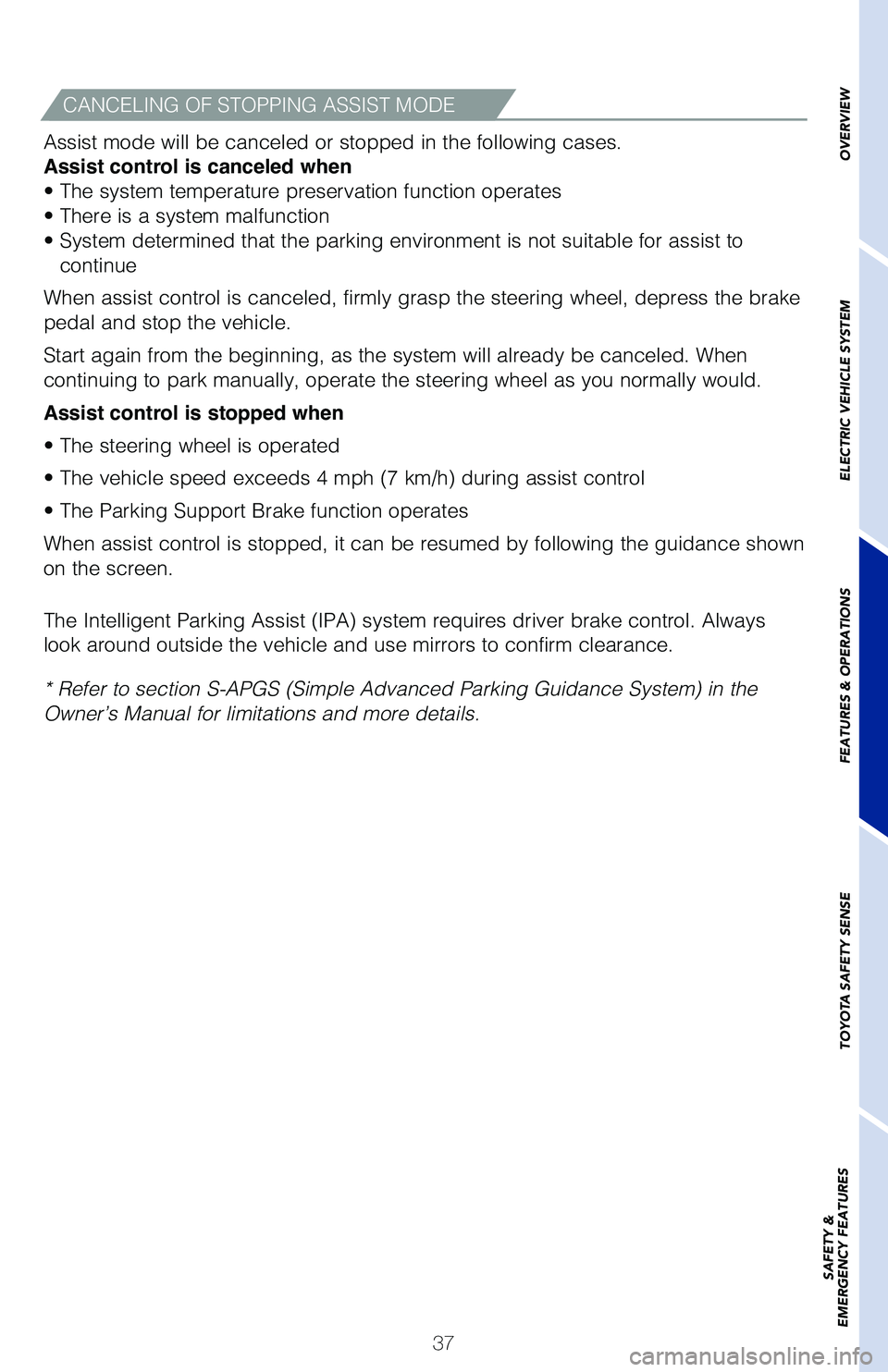
EMERGENCY FEATURESAssist mode will be canceled or stopped in the following cases.
Assist control is canceled when
• The system temperature preservation function operates
• There is a system malfunction
• System determined that the parking environment is not suitable for \
assist to
continue
When assist control is canceled, firmly grasp the steering wheel, depres\
s the brake
pedal and stop the vehicle.
Start again from the beginning, as the system will already be canceled. \
When
continuing to park manually, operate the steering wheel as you normally \
would.
Assist control is stopped when
• The steering wheel is operated
• The vehicle speed exceeds 4 mph (7 km/h) during assist control
• The Parking Support Brake function operates
When assist control is stopped, it can be resumed by following the guida\
nce shown
on the screen.
The Intelligent Parking Assist (IPA) system requires driver brake control. Always
look around outside the vehicle and use mirrors to confirm clearance.
* Refer to section S-APGS (Simple Advanced Parking Guidance System) in\
the
Owner’s Manual for limitations and more details.
CANCELING OF STOPPING ASSIST MODE
Page 56 of 68
 54
SAFETY & EMERGENCY FEATURES
Star Safety System™
ANTI-LOCK BRAKE SYSTEM (ABS)
Toyota’s ABS sensors detect which wheels are locking up and limits wh\
eel lockup
by “pulsing” each wheel’s b")
54
SAFETY & EMERGENCY FEATURES
Star Safety System™
ANTI-LOCK BRAKE SYSTEM (ABS)
Toyota’s ABS sensors detect which wheels are locking up and limits wh\
eel lockup
by “pulsing” each wheel’s brakes independently. Pulsing release\
s brake pressure
repeatedly for fractions of a second. This helps the tires attain the tr\
action that
current road conditions will allow, helping you to stay in directional c\
ontrol.
BRAKE ASSIST (BA)
Brake Assist is designed to detect sudden or “panic” braking, and \
then add braking
pressure to help decrease the vehicle’s stopping distance. When there\
’s only a split
second to react, Brake Assist can add additional brake pressure more qui\
ckly than
just the driver alone can.
ENHANCED VEHICLE STABILITY CONTROL (VSC)
Enhanced Vehicle Stability Control provides cooperative control of the A\
BS, TRAC,
VSC and EPS.
Enhanced VSC helps to maintain directional stability when loss of tracti\
on occurs
during a turn.
ELECTRONIC BRAKE FORCE DISTRIBUTION (EBD)
Toyota’s ABS technology has Electronic Brake-force Distribution (EBD) to help
maintain control and balance when braking. EBD responds to sudden stops \
by
redistributing brake force to enhance the braking effectiveness of all f\
our wheels. Your vehicle comes standard with the Star Safety System
TM, which combines Anti-
lock Braking System (ABS), Brake Assist (BA), Electronic Brake-force Distribution
(EBD), Smart Stop Technology (SST), Traction Control (TRAC) and Vehicle Stability
Control (VSC).
Refer to the Owner’s Manual for more details and important information on limitations
to these systems.
SMART STOP TECHNOLOGY (SST)
Smart Stop Technology automatically reduces engine power when the accele\
rator
and brake pedals are pressed simultaneously under certain conditions.
SST engages when the accelerator is depressed first and the brakes are a\
pplied
firmly for longer than one-half second at speeds greater than five miles\
per hour.
SST doesn’t engage if the brake pedal is depressed before the acceler\
ator pedal,
allowing vehicles to start on a steep hill and safely accelerate without\
rolling
backward.