engine TOYOTA PRIUS PRIME 2021 Owners Manual (in English)
[x] Cancel search | Manufacturer: TOYOTA, Model Year: 2021, Model line: PRIUS PRIME, Model: TOYOTA PRIUS PRIME 2021Pages: 808, PDF Size: 74.05 MB
Page 5 of 808

5
1
9 8
7
6 4 3
2
PRIUS PRIME_OM_OM47D71U_(U)
10
5
6-4. Using the other interior
features
Other interior features ....... 553
• Sun visors ..................... 553
• Vanity mirrors................ 553
• Power outlets ................ 554
• USB charging ports....... 555
• Wireless charger ........... 557
• Armrest ......................... 566
• Coat hooks.................... 566
• Assist grips ................... 567
Garage door opener .......... 5687-1. Maintenance and care
Cleaning and protecting
the vehicle exterior .......... 576
Cleaning and protecting
the vehicle interior ........... 581
7-2. Maintenance
Maintenance
requirements ................... 587
General maintenance ........ 590
Emission inspection and
maintenance (I/M)
programs ......................... 593
7-3. Do-it-yourself maintenance
Do-it-yourself service
precautions ...................... 594
Hood .................................. 597
Positioning a floor jack....... 599
Engine compartment ......... 600
Tires................................... 614
Tire inflation pressure ........ 623
Wheels............................... 626
Replacing the tire............... 629
Air conditioning filter .......... 640
Wiper insert
replacement..................... 644
Electronic key battery ........ 647
Checking and replacing
fuses ................................ 650
Headlight aim..................... 653
Light bulbs ......................... 655
7Maintenance and care
Page 10 of 808

10
PRIUS PRIME_OM_OM47D71U_(U)The vehicle is equipped with sophisticated computers that will record certain
data, such as:
• Engine speed/Electric motor speed (traction motor speed)
• Accelerator status
• Brake status
• Vehicle speed
• Operation status of the driving assist systems
• Images from the cameras
Your vehicle is equipped with cameras. Contact your Toyota dealer for the
location of recording cameras.
• Hybrid battery (traction battery) status
The recorded data varies according to the vehicle grade level and options
with which it is equipped.
These computers do not record conversations or sounds, and only record
<004c00500044004a0048005600030052005800570056004c0047004800030052004900030057004b0048000300590048004b004c0046004f00480003004c0051000300460048005500570044004c005100030056004c0057005800440057004c0052005100
560011[
●Data Transmission
Your vehicle may transmit the data recorded in these computers to Toyota
without notification to you.
●Data usage
Toyota may use the data recorded in this computer to diagnose malfunc-
tions, conduct research and development, and improve quality.
Toyota will not disclose the recorded data to a third party except:
• With the consent of the vehicle owner or with the consent of the lessee if
the vehicle is leased
• In response to an official request by the police, a court of law or a govern-
ment agency
• For use by Toyota in a lawsuit
• For research purposes where the data is not tied to a specific vehicle or
vehicle owner
●Recorded image information can be erased by your Toyota dealer.
The image recording function can be disabled. However, if the function is
disabled, data from when the system operates will not be available.
●To learn more about the vehicle data collected, used and shared by Toy-
ota, please visit www.toyota.com/privacyvts/
.
If your Toyota has Safety Connect and if you have subscribed to those ser-
vices, please refer to the Safety Connect Telematics Subscription Service
Agreement for information on data collected and its usage.
●To learn more about the vehicle data collected, used and shared by Toy-
ota, please visit www.toyota.com/privacyvts/
.
Vehicle data recording
Usage of data collected through Safety Connect (U.S.mainland
only)
Page 17 of 808

17Pictorial index
PRIUS PRIME_OM_OM47D71U_(U)Fuel filler door . . . . . . . . . . . . . . . . . . . . . . . . . . . . . . . . . . . . P. 371
Refueling method . . . . . . . . . . . . . . . . . . . . . . . . . . . . . . . . . . . P. 371
Fuel type/fuel tank capacity . . . . . . . . . . . . . . . . . . . . . . . . . . . P. 732
Charging port . . . . . . . . . . . . . . . . . . . . . . . . . . . . . . . . . . . . . P. 110
Charging method . . . . . . . . . . . . . . . . . . . . . . . . . . . . . . . . . . . P. 134
Tires . . . . . . . . . . . . . . . . . . . . . . . . . . . . . . . . . . . . . . . . . . P. 614
Replacing . . . . . . . . . . . . . . . . . . . . . . . . . . . . . . . . . . . . . . P. 629
Tire size/inflation pressure . . . . . . . . . . . . . . . . . . . . . . . . . P. 737
Winter tires/tire chain . . . . . . . . . . . . . . . . . . . . . . . . . . . . . P. 507
Checking/rotation/tire pressure warning system . . . . . . . . .P. 614
Coping with flat tires . . . . . . . . . . . . . . . . . . . . . . . . . . . . . . P. 692
Hood . . . . . . . . . . . . . . . . . . . . . . . . . . . . . . . . . . . . . . . . . . . . P. 597
Opening . . . . . . . . . . . . . . . . . . . . . . . . . . . . . . . . . . . . . . . . . . P. 597
Engine oil . . . . . . . . . . . . . . . . . . . . . . . . . . . . . . . . . . . . . . . . . P. 734
Coping with overheat . . . . . . . . . . . . . . . . . . . . . . . . . . . . . . . . P. 721
Headlights . . . . . . . . . . . . . . . . . . . . . . . . . . . . . . . . . . . . . . . P. 353
Parking lights . . . . . . . . . . . . . . . . . . . . . . . . . . . . . . . . . . . . . P. 353
Fog lights
* . . . . . . . . . . . . . . . . . . . . . . . . . . . . . . . . . . . . . . . P. 363
LED accent lights
*. . . . . . . . . . . . . . . . . . . . . . . . . . . . . . . . . P. 353
Turn signal lights . . . . . . . . . . . . . . . . . . . . . . . . . . . . . . . . . . P. 351
Daytime running lights . . . . . . . . . . . . . . . . . . . . . . . . . . . . . P. 353
Side marker lights . . . . . . . . . . . . . . . . . . . . . . . . . . . . . . . . . P. 353
Tail lights . . . . . . . . . . . . . . . . . . . . . . . . . . . . . . . . . . . . . . . . P. 353
License plate lights . . . . . . . . . . . . . . . . . . . . . . . . . . . . . . . . P. 353
Back-up lights
Shifting the shift position to R . . . . . . . . . . . . . . . . . . . . . . . . . P. 345
5
6
7
8
Light bulbs of the exterior lights for driving
(Replacing method: P. 655, Watts: P. 738)
*: If equipped
9
10
11
12
13
14
15
16
17
18
Page 44 of 808

441-1. For safe use
PRIUS PRIME_OM_OM47D71U_(U)
■If the SRS airbags deploy (inflate)
●Slight abrasions, burns, bruising etc., may be sustained from SRS airbags,
due to the extremely high speed deployment (inflation) by hot gases.
●A loud noise and white powder will be emitted.
●Parts of the airbag module (steering wheel hub, airbag cover and inflator) as
well as the front seats, parts of the front and rear pillars, and roof side rails,
may be hot for several minutes. The airbag itself may also be hot.
●The windshield may crack.
●The hybrid system will be stopped and fuel supply to the engine will be
stopped. (P. 99)
●The emergency flashers will turn on automatically. (P. 664)
●For Safety Connect subscribers, if any of the following situations occur, the
system is designed to send an emergency call to the response center, noti-
fying them of the vehicle’s location (without needing to push the “SOS” but-
ton) and an agent will attempt to speak with the occupants to ascertain the
level of emergency and assistance required. If the occupants are unable to
communicate, the agent automatically treats the call as an emergency and
<004b0048004f0053005600030057005200030047004c00560053004400570046004b00030057004b0048000300510048004600480056005600440055005c00030048005000480055004a004800510046005c00030056004800550059004c00460048005600
110003000b[P. 76)
• An SRS airbag is deployed.
• A seat belt pretensioner is activated.
• The vehicle is involved in a severe rear-end collision.
■SRS airbag deployment conditions (SRS front airbags)
●The SRS front airbags will deploy in the event of an impact that exceeds the
set threshold level (the level of force corresponding to an approximately 12 -
18 mph [20 - 30 km/h] frontal collision with a fixed wall that does not move or
deform).
However, this threshold velocity will be considerably higher in the following
situations:
• If the vehicle strikes an object, such as a parked vehicle or sign pole,
which can move or deform on impact
• If the vehicle is involved in an underride collision, such as a collision in
which the front of the vehicle “underrides”, or goes under, the bed of a
truck
●Depending on the type of collision, it is possible that only the seat belt pre-
tensioners and seat cushion airbag will activate.
●The SRS front airbags for the front passenger will not activate if there is no
passenger sitting in the front passenger seat. However, the SRS front air-
bags for the front passenger may deploy if luggage is put in the seat, even if
the seat is unoccupied.
●The SRS seat cushion airbag on the front passenger seat will not operate if
the occupant is not wearing a seat belt.
Page 86 of 808
86
PRIUS PRIME_OM_OM47D71U_(U)
2-1. Plug-in hybrid system
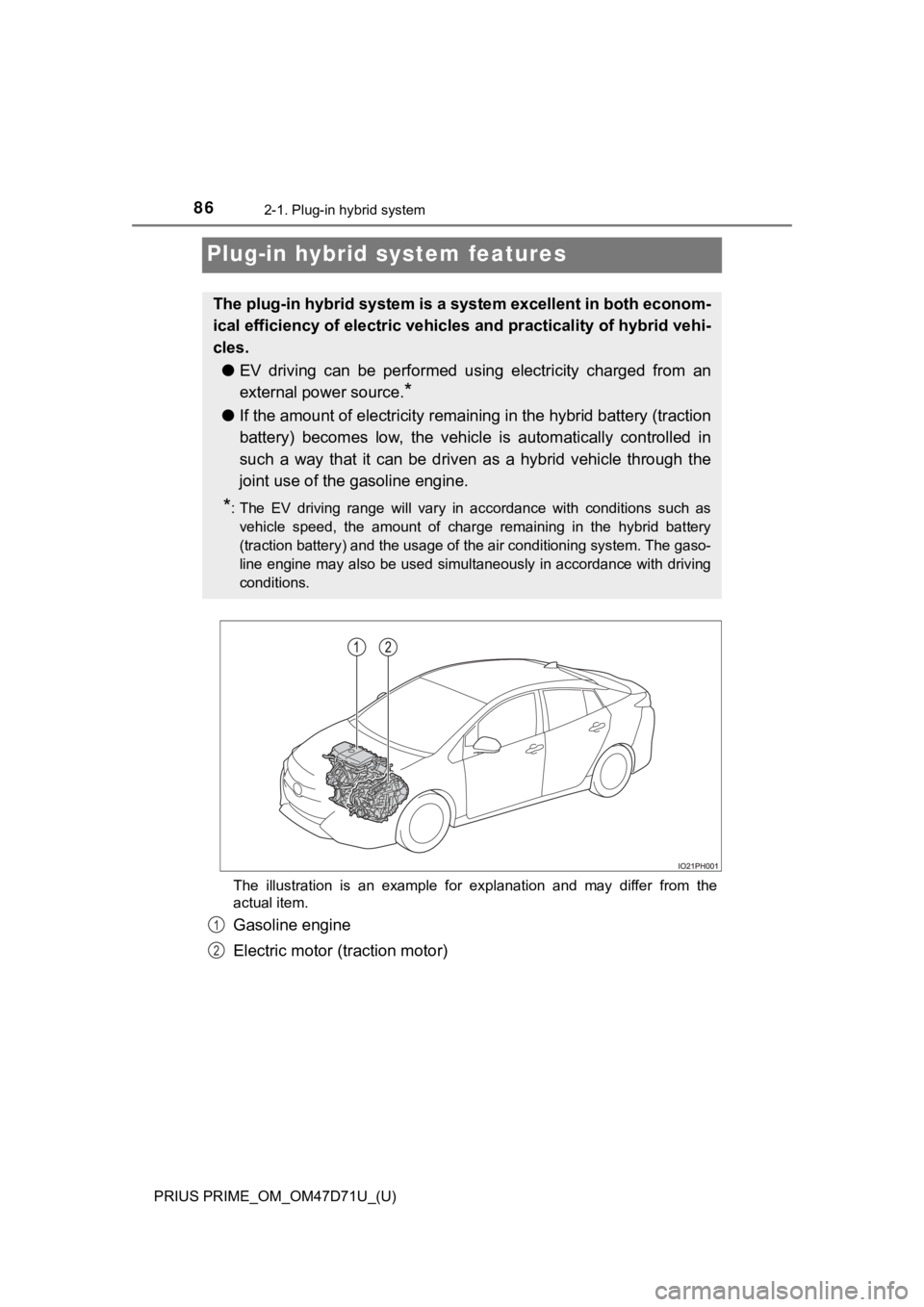
Plug-in hybrid system features
The illustration is an example for explanation and may differ from the
actual item.
Gasoline engine
Electric motor (traction motor)
The plug-in hybrid system is a system excellent in both econom-
ical efficiency of electric vehicles and practicality of hybrid vehi-
cles.
●EV driving can be performed using electricity charged from an
external power source.
*
●If the amount of electricity remaining in the hybrid battery (traction
battery) becomes low, the vehicle is automatically controlled in
such a way that it can be driven as a hybrid vehicle through the
joint use of the gasoline engine.
*: The EV driving range will vary in accordance with conditions such as
vehicle speed, the amount of charge remaining in the hybrid battery
(traction battery) and the usage of the air conditioning system. The gaso-
line engine may also be used simultaneously in accordance with driving
conditions.
1
2
Page 87 of 808
PRIUS PRIME_OM_OM47D71U_(U)
872-1. Plug-in hybrid system
2
Plug-in hybrid system
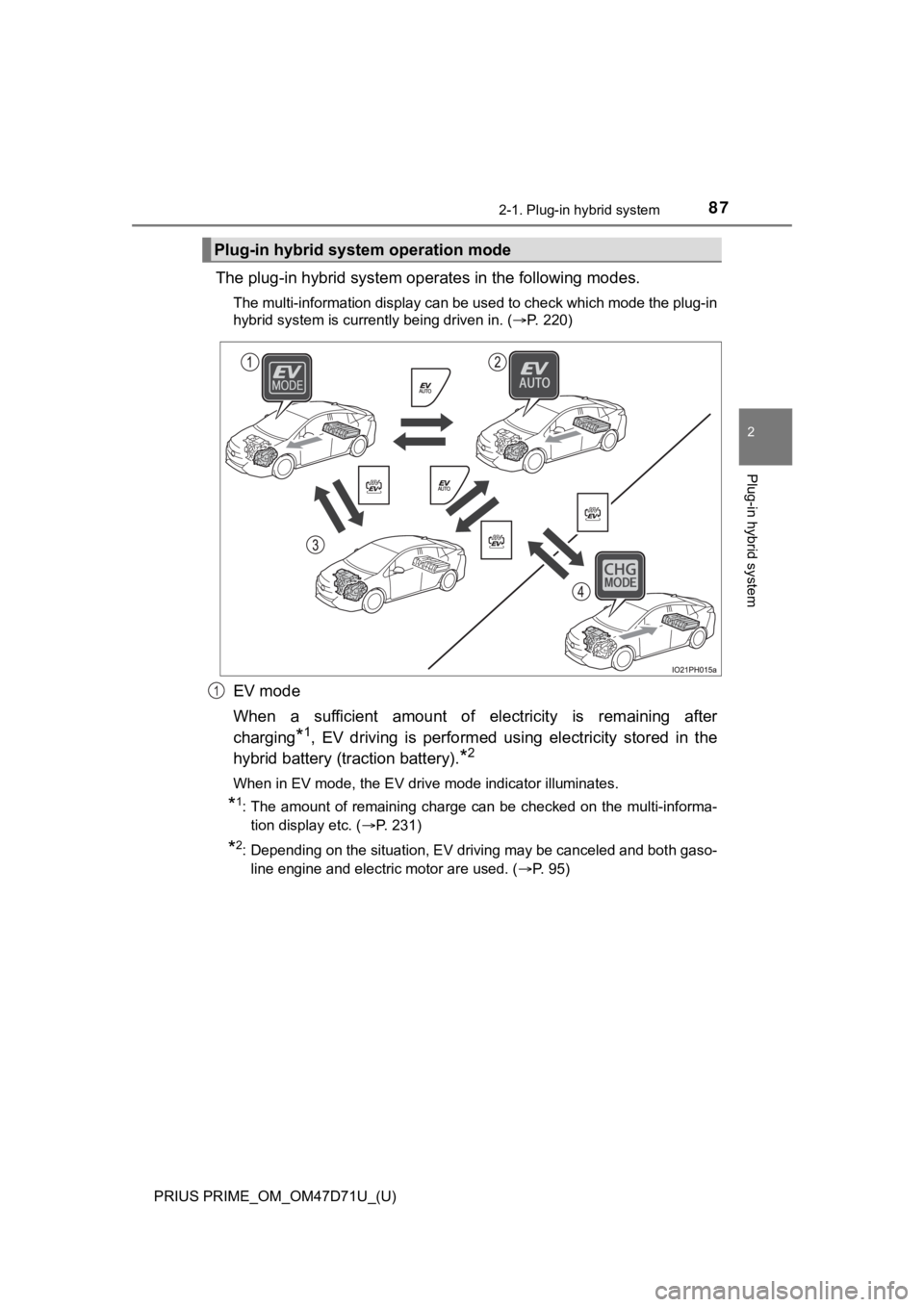
The plug-in hybrid system operates in the following modes.
The multi-information display can be used to check which mode the plug-in
hybrid system is currently being driven in. (P. 220)
EV mode
When a sufficient amount of electricity is remaining after
charging
*1, EV driving is performed using electricity stored in the
hybrid battery (traction battery).
*2
When in EV mode, the EV drive mode indicator illuminates.
*1: The amount of remaining charge can be checked on the multi-informa-
tion display etc. (P. 231)
*2: Depending on the situation, EV driving may be canceled and both gaso-
line engine and electric motor are used. (P. 95)
Plug-in hybrid system operation mode
1
Page 88 of 808

88
PRIUS PRIME_OM_OM47D71U_(U)
2-1. Plug-in hybrid system
EV auto mode (P. 9 0 )
When a sufficient amount of electricity for EV driving is remaining in
the hybrid battery (traction battery) after charging
*, the operation
mode can be switched to EV auto mode.
Switching to EV auto mode make powerful driving possible by using
both the gasoline engine and electric motor in a driving condition
that requires large driving force, such as when passing a vehicle on
a highway or driving on a steep slope.
When in EV auto mode, the EV auto mode indicator illuminates.
*: The amount of remaining charge can be checked on the multi-informa-
tion display etc. (P. 231)
HV mode
When in HV mode, the vehicle is driven using both the gasoline
engine and electric motor (traction motor). (P. 9 2 )
●If electricity needed for EV driving in EV mode or EV auto mode
is not remaining, the operation mode will be automatically
switched to HV mode.
●The operation mode can be switched to HV mode at any timing
by operating the switch to keep electricity for EV driving etc.
*
(P. 90). Switching to HV mode when driving on a highway or
when driving uphill is recommended in order to conserve battery
power.
When in HV mode, the EV drive mode indicator and EV auto mode indi-
cator turn off.
*: The EV driving range may reduce even after switching to HV mode.
2
3
Page 89 of 808

PRIUS PRIME_OM_OM47D71U_(U)
892-1. Plug-in hybrid system
2
Plug-in hybrid system
Hybrid battery (traction battery) charge mode (P. 91)
Electricity generated in the gasoline engine can be charged in the
hybrid battery (traction battery) by switching to the hybrid battery
(traction battery) charge mode when electricity needed for EV driv-
ing is not remaining.
*
●The system may not be able to switch to the hybrid battery (trac-
tion battery) charge mode due to the state of the plug-in hybrid
system. (P. 9 1 )
●Charging time differs depending on the driving state of the vehi-
cle when driving in hybrid battery (traction battery) charge mode.
When in the hybrid battery (traction battery) charge mode, the hybrid
battery charge mode indicator illuminates.
*: When in the hybrid battery (traction battery) charge mode, the hybrid
battery can be charged while driving. However, the gasoline engine runs
to charge the battery and fuel consumption becomes higher compared
with driving in HV mode.
4
Page 91 of 808
PRIUS PRIME_OM_OM47D71U_(U)
912-1. Plug-in hybrid system
2
Plug-in hybrid system
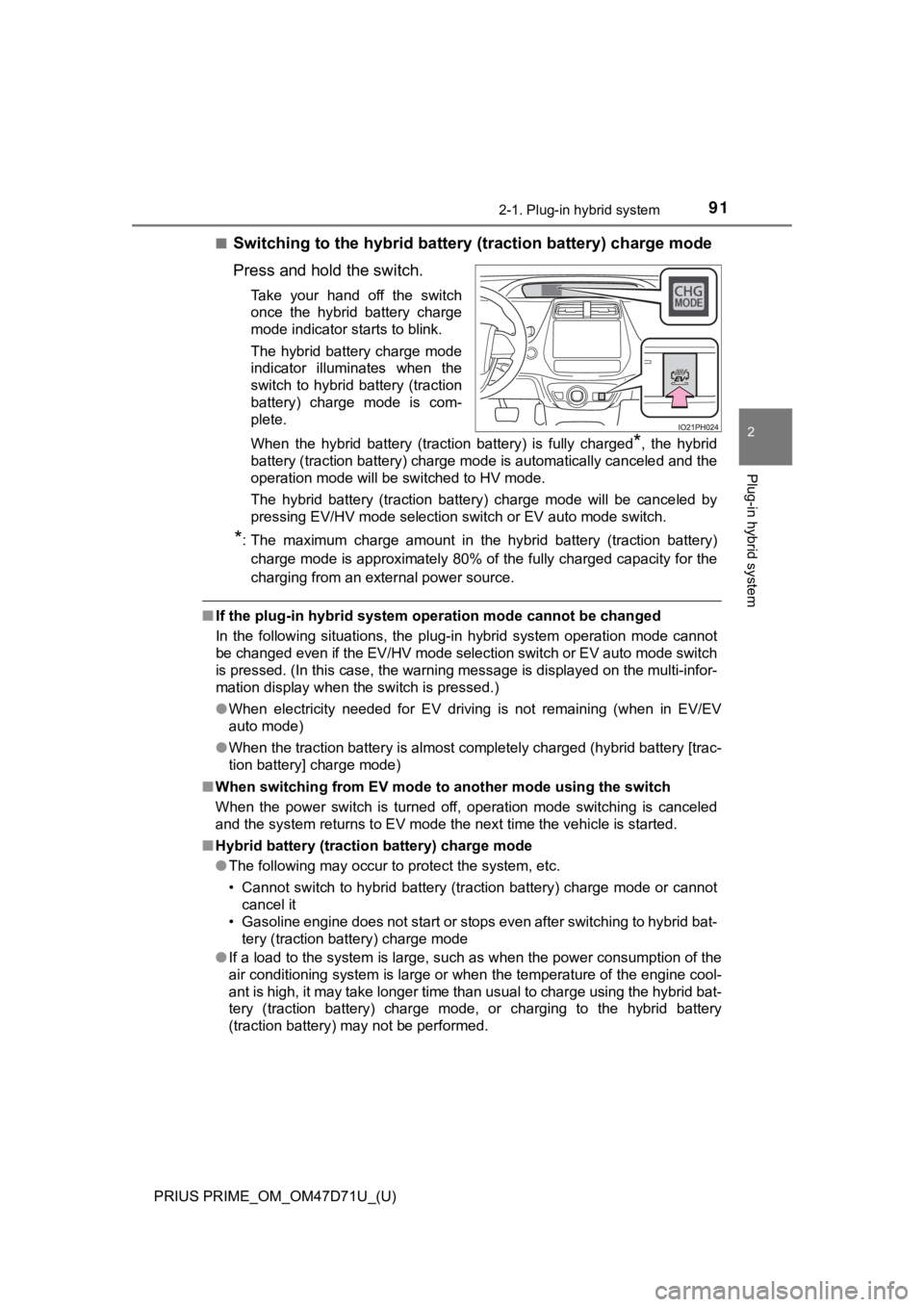
■Switching to the hybrid battery (traction battery) charge mode
Press and hold the switch.
Take your hand off the switch
once the hybrid battery charge
mode indicator starts to blink.
The hybrid battery charge mode
indicator illuminates when the
switch to hybrid battery (traction
battery) charge mode is com-
plete.
When the hybrid battery (traction battery) is fully charged
*, the hybrid
battery (traction battery) charge mode is automatically canceled and the
operation mode will be switched to HV mode.
The hybrid battery (traction battery) charge mode will be canceled by
pressing EV/HV mode selection switch or EV auto mode switch.
*: The maximum charge amount in the hybrid battery (traction battery)
charge mode is approximately 80% of the fully charged capacity for the
charging from an external power source.
■If the plug-in hybrid system operation mode cannot be changed
In the following situations, the plug-in hybrid system operation mode cannot
be changed even if the EV/HV mode selection switch or EV auto mode switch
is pressed. (In this case, the warning message is displayed on the multi-infor-
mation display when the switch is pressed.)
●When electricity needed for EV driving is not remaining (when in EV/EV
auto mode)
●When the traction battery is almost completely charged (hybrid battery [trac-
tion battery] charge mode)
■When switching from EV mode to another mode using the switch
When the power switch is turned off, operation mode switching is canceled
and the system returns to EV mode the next time the vehicle is started.
■Hybrid battery (traction battery) charge mode
●The following may occur to protect the system, etc.
• Cannot switch to hybrid battery (traction battery) charge mode or cannot
cancel it
• Gasoline engine does not start or stops even after switching to hybrid bat-
tery (traction battery) charge mode
●If a load to the system is large, such as when the power consumption of the
air conditioning system is large or when the temperature of the engine cool-
ant is high, it may take longer time than usual to charge using the hybrid bat-
tery (traction battery) charge mode, or charging to the hybrid battery
(traction battery) may not be performed.
Page 92 of 808

92
PRIUS PRIME_OM_OM47D71U_(U)
2-1. Plug-in hybrid system
■When in EV/EV auto mode
In EV/EV auto mode, EV driving (driving using only the electric
motor)
* is possible. However, depending on the situation, EV driv-
ing may be canceled and both gasoline engine and electric motor
are used (P. 95). Also, if a little electricity is remaining in the
hybrid battery (traction battery), HV mode is automatically selected.
To drive in EV/EV auto mode long, observe the followings.
●Avoid sudden acceleration and sudden deceleration, and be sure
to drive smoothly.
If you repeatedly accelerate, the hybrid battery (traction battery)
charge will deplete quickly. Also, EV driving may be canceled by
rapid acceleration or vehicle speed.
●Restrain your speed as much as possible. The distance that can
be driven in EV/EV auto mode will reduce considerably at high
speeds.
*: The EV driving range can be checked using the multi-information dis-
play etc. (P. 214, 230, 237, 254)
■
When in HV mode
The vehicle can be used in the same way as a standard hybrid
vehicle.
In HV mode, controls are primarily carried out as follows in accor-
dance with the driving conditions.
●The gasoline engine stops
* when the vehicle is stopped.
●During start off, the electric motor (traction motor) drives the vehi-
cle.
●During normal driving, the gasoline engine and electric motor
(traction motor) are controlled effectively, and the vehicle is
driven with optimum fuel efficiency. Also, when necessary, the
electric motor (traction motor) operates as an electrical generator
to charge the hybrid battery (traction battery).
●When the accelerator pedal is depressed heavily, drive force
from both the gasoline engine and the electric motor (traction
motor) is used to accelerate.
*: When the hybrid battery (traction battery) requires charging or the
engine is warming up, etc., the gasoline engine will not automatically
stop. (P. 95)
Control when driving in each mode