torque TOYOTA PRIUS PRIME 2023 Owners Manual
[x] Cancel search | Manufacturer: TOYOTA, Model Year: 2023, Model line: PRIUS PRIME, Model: TOYOTA PRIUS PRIME 2023Pages: 680, PDF Size: 14.97 MB
Page 88 of 680
882-1. Plug-in hybrid system
Primarily using EV mode and
AUTO EV/HV mode when driv-
ing in cities and using HV mode
when driving on highways (or
freeways) can help conserve
fuel and electricity. (P.74)
When using Eco drive mode, the
torque corresponding to the
accelerator pedal depression
amount can be generated more
smoothly than it is in normal
conditions. In addition, the oper-
ation of the air conditioning sys-
tem (heating/cooling) will be
minimized, improving fuel and
electricity economy. ( P.422)
Eco-friendly driving is possible
by keeping the Hybrid System
Indicator within Eco area.
( P.158) Shift the shift position to D when
stopped at a traffic light, or driv-
ing in heavy traffic etc. Shift the
shift position to P when parking.
When using the N, there is no
positive effect on fuel consump-
tion. In the N, the gasoline
engine operates but electricity
cannot be generated. Also,
when using the air conditioning
system, etc., the hybrid battery
(traction battery) power is con-
sumed.
Drive your vehicle smoothly.
Avoid abrupt acceleration and
deceleration. Gradual accel-
eration and deceleration will
make more effective use of
the electric motor (traction
motor) without having to use
gasoline engine power.
Avoid repeated acceleration.
Repeated acceleration con-
sumes hybrid battery (trac-
tion battery) po wer, resulting
in poor fuel consumption. Bat-
tery power can be restored by
driving with the accelerator
pedal slightly released.
Make sure to operate the brakes
Plug-in Hybrid Elec-
tric Vehicle driving
tips
For economical and ecolog-
ical driving, pay attention to
the following points:
Using EV mode, AUTO
EV/HV mode and HV
mode effectively
Using Eco drive mode
Use of Hybrid System
Indicator
Changing the shift posi-
tion
Accelerator pedal/brake
pedal operation
When braking
Page 91 of 680
912-1. Plug-in hybrid system
2
Plug-in hybrid system
automatically records the elec-
tricity consumption when being
charged and uses the electricity
consumption for estimating the
EV driving range. Therefore, the
EV driving range displayed
when the hybrid battery (traction
battery) is fully charged may dif-
fer from the previous EV driving
range depending on how the
vehicle was driven.
The EV driving range may
change significantly with each
charging until the electricity con-
sumption based on the recorded
value is stable (for approxi-
mately the first month or two).
However, this does not indicate
a malfunction.
When the air conditioning sys-
tem is turned on, the EV driving
range (with using the air condi-
tioning system) is estimated
based on the past air condition-
ing electricity consumption
amount considering that the
electricity consumption may
become higher.
The distance that EV driving is
possible varies significantly
depending on how the vehicle is
driven, road conditions, the
weather, the outside tempera-
ture, usage conditions of electri-
cal components and the number of occupants.
The distance that EV driving is
possible can be extended if the
following is performed:
■When starting off, depress
the accelerator pedal
smoothly to accelerate
As a guide, accelerate up to
approximately 12mph (20 km/h)
in the first 5 seconds.
Electrical and fuel efficiency can
be improved just by using the
ECO Accelerator Guidance dis-
played on the multi-information
display and taking care to start
off gently. ( P.163)
When the driving mode is set to
Eco drive mode, depressing the
accelerator pedal generates
smooth torque that makes it easier
to operate the accelerator gently.
At the same time, the air condition-
ing control is switched to eco air
conditioning mode ( P.437) to
reduce the strength of the air condi-
tioning operation.
■Maintain sufficient vehicle-
to-vehicle distance and do
not accelerate or decelerate
unnecessarily
Try to maintain a fixed speed
while driving. Driving at a short
vehicle-to-vehicle distance will
result in repeating wasteful
acceleration and deceleration,
which will worsen the electrical
and fuel efficiency.
Tips for extending the EV
driving range
Page 530 of 680
5307-3. Do-it-yourself maintenance
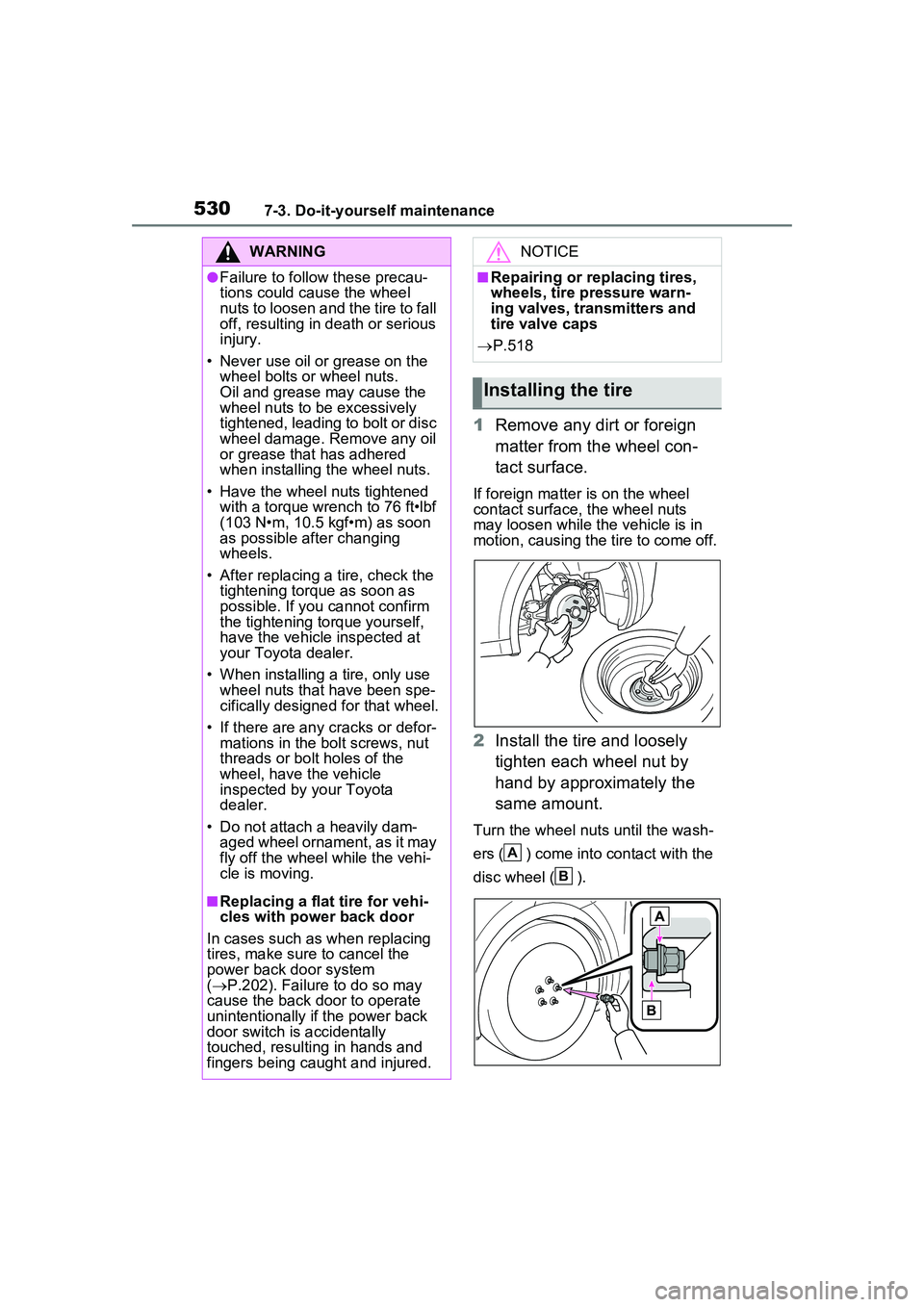
1Remove any dirt or foreign
matter from the wheel con-
tact surface.
If foreign matter is on the wheel
contact surface, the wheel nuts
may loosen while th e vehicle is in
motion, causing the tire to come off.
2 Install the tire and loosely
tighten each wheel nut by
hand by approximately the
same amount.
Turn the wheel nuts until the wash-
ers ( ) come into contact with the
disc wheel ( ).
WARNING
●Failure to follow these precau-
tions could cause the wheel
nuts to loosen and the tire to fall
off, resulting in death or serious
injury.
• Never use oil or grease on the wheel bolts or wheel nuts.
Oil and grease may cause the
wheel nuts to be excessively
tightened, leading to bolt or disc
wheel damage. Remove any oil
or grease that has adhered
when installing the wheel nuts.
• Have the wheel nuts tightened with a torque wrench to 76 ft•lbf
(103 N•m, 10.5 kgf•m) as soon
as possible after changing
wheels.
• After replacing a tire, check the tightening torque as soon as
possible. If you cannot confirm
the tightening torque yourself,
have the vehicle inspected at
your Toyota dealer.
• When installing a tire, only use wheel nuts that have been spe-
cifically designed for that wheel.
• If there are any cracks or defor- mations in the bolt screws, nut
threads or bolt holes of the
wheel, have the vehicle
inspected by your Toyota
dealer.
• Do not attach a heavily dam- aged wheel ornament, as it may
fly off the wheel while the vehi-
cle is moving.
■Replacing a flat tire for vehi-
cles with power back door
In cases such as when replacing
tires, make sure to cancel the
power back door system
( P.202). Failure to do so may
cause the back door to operate
unintentionally if the power back
door switch is accidentally
touched, resulting in hands and
fingers being caught and injured.
NOTICE
■Repairing or replacing tires,
wheels, tire pressure warn-
ing valves, transmitters and
tire valve caps
P.518
Installing the tire
A
B
Page 531 of 680
5317-3. Do-it-yourself maintenance
7
Maintenance and care
Washer
Disc wheel
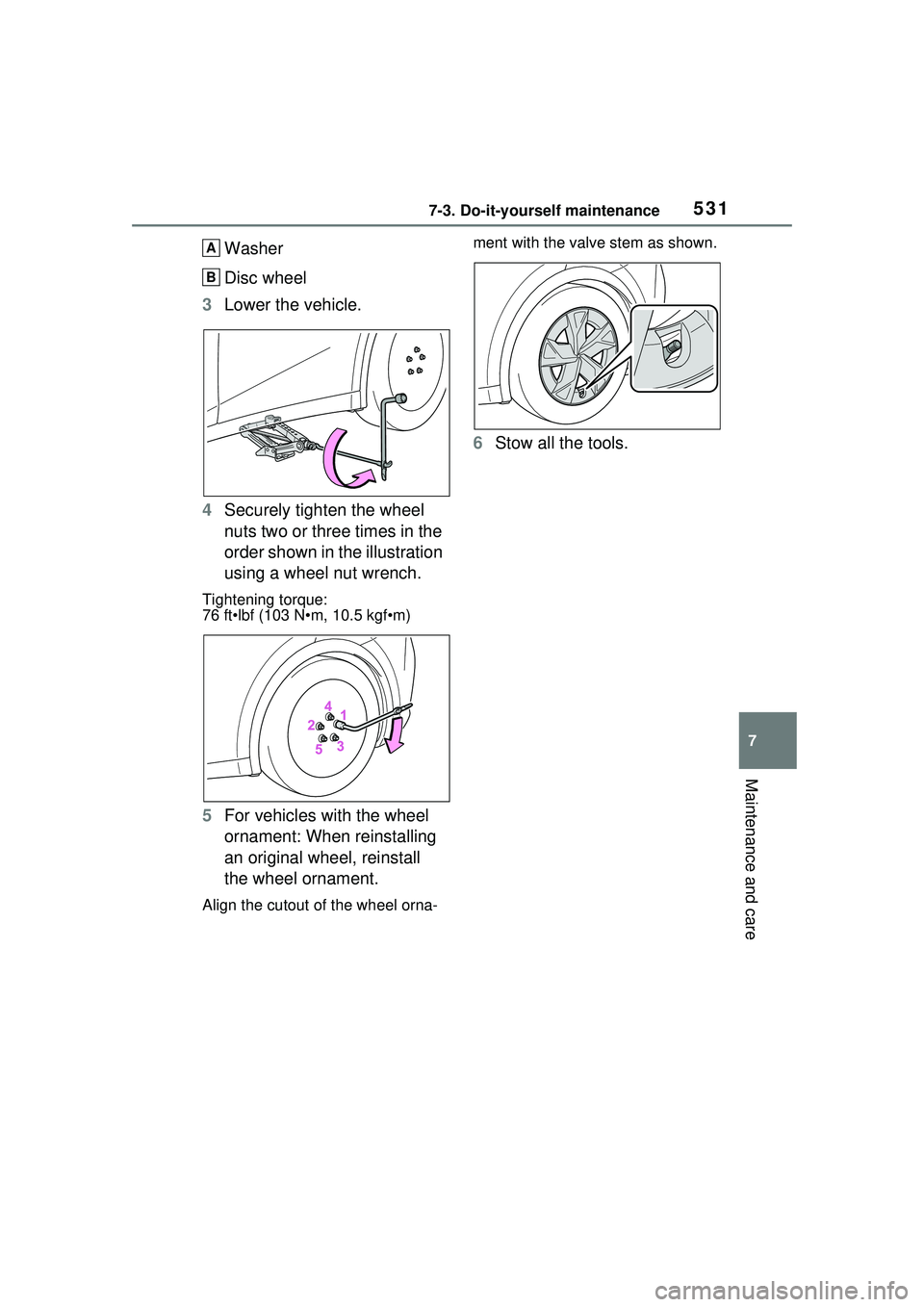
3 Lower the vehicle.
4 Securely tighten the wheel
nuts two or three times in the
order shown in the illustration
using a wheel nut wrench.
Tightening torque:
76 ft•lbf (103 N•m, 10.5 kgf•m)
5For vehicles with the wheel
ornament: When reinstalling
an original wheel, reinstall
the wheel ornament.
Align the cutout of the wheel orna- ment with the valve stem as shown.
6
Stow all the tools.
A
B
Page 602 of 680
6029-1. Specifications
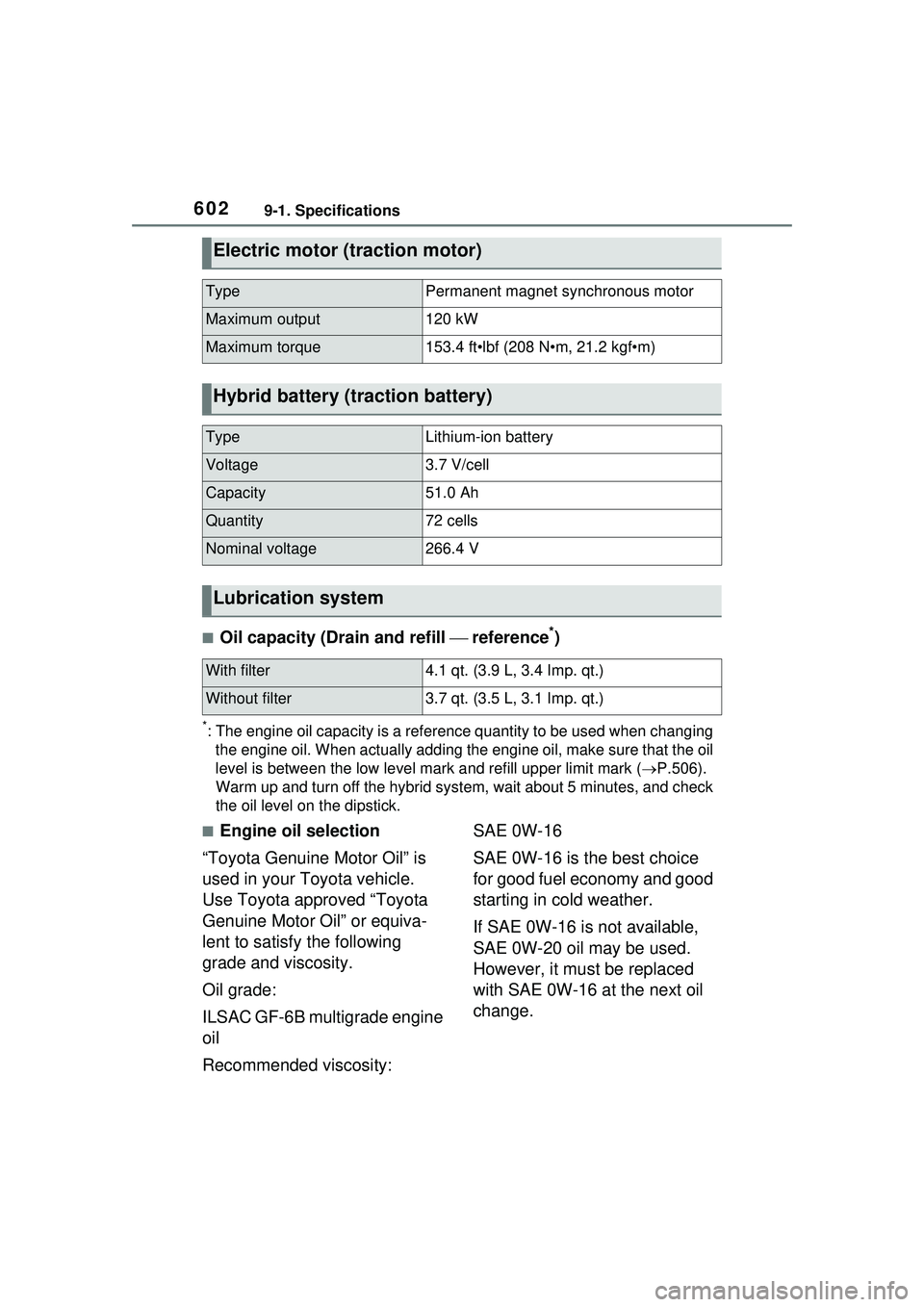
■Oil capacity (Drain and refill reference*)
*: The engine oil capacity is a reference quantity to be used when changing
the engine oil. When actually adding the engine oil, make sure that the oil
level is between the low level ma rk and refill upper limit mark (P.506).
Warm up and turn off the hybrid syst em, wait about 5 minutes, and check
the oil level on the dipstick.
■Engine oil selection
“Toyota Genuine Motor Oil” is
used in your Toyota vehicle.
Use Toyota approved “Toyota
Genuine Motor Oil” or equiva-
lent to satisfy the following
grade and viscosity.
Oil grade:
ILSAC GF-6B multigrade engine
oil
Recommended viscosity: SAE 0W-16
SAE 0W-16 is the best choice
for good fuel economy and good
starting in cold weather.
If SAE 0W-16 is not available,
SAE 0W-20 oil may be used.
However, it must be replaced
with SAE 0W-16 at the next oil
change.
Electric motor (traction motor)
TypePermanent magnet synchronous motor
Maximum output120 kW
Maximum torque153.4 ft•lbf (208 N•m, 21.2 kgf•m)
Hybrid battery (traction battery)
TypeLithium-ion battery
Voltage3.7 V/cell
Capacity51.0 Ah
Quantity72 cells
Nominal voltage266.4 V
Lubrication system
With filter4.1 qt. (3.9 L, 3.4 Imp. qt.)
Without filter3.7 qt. (3.5 L, 3.1 Imp. qt.)
Page 605 of 680

6059-1. Specifications
9
Vehicle specifications
*1: Minimum pedal clearance when depressed with a force of 67.4 lbf (300 N, 30.6 kgf) while the hybr id system is operating.
When performing the brake pedal inspection, also be sure to check that the
brake system warning light is not illuminated when the hybrid system is
operating. (If the brake system warning light is illuminated, refer to P.555.)
*2: Make sure to confirm that the brake system warning light (yellow) does
not illuminate. (If the br ake system warning light illuminates, refer to
P.555.)
Vehicles with 17-inch tires
Brake pad wear limit
Front
0.06 in. (1.5 mm)
Rear
0.08 in. (2.0 mm)
Parking brake indicator*2
When pushing the parking brake switch for
1 to 2 seconds: turns off
When pulling the parking brake switch for
1 to 2 seconds: comes on
Fluid typeFMVSS No.116 DOT 3 or SAE J1703
FMVSS No.116 DOT 4 or SAE J1704
Steering
Free playLess than 1.2 in. (30 mm)
Tires and wheels
Tire size195/60R17 90H
Tire inflation pressure (Recom-
mended cold tire inflation pres-
sure)
Front:
36 psi (250 kPa, 2.5 kgf/cm
2 or bar)
Rear:
35 psi (240 kPa, 2.4 kgf/cm
2 or bar)
Spare:
None
Wheel size17 6 1/2J
Wheel nut torque76 ft•lbf (103 N•m, 10.5 kgf•m)
Page 606 of 680
6069-1. Specifications
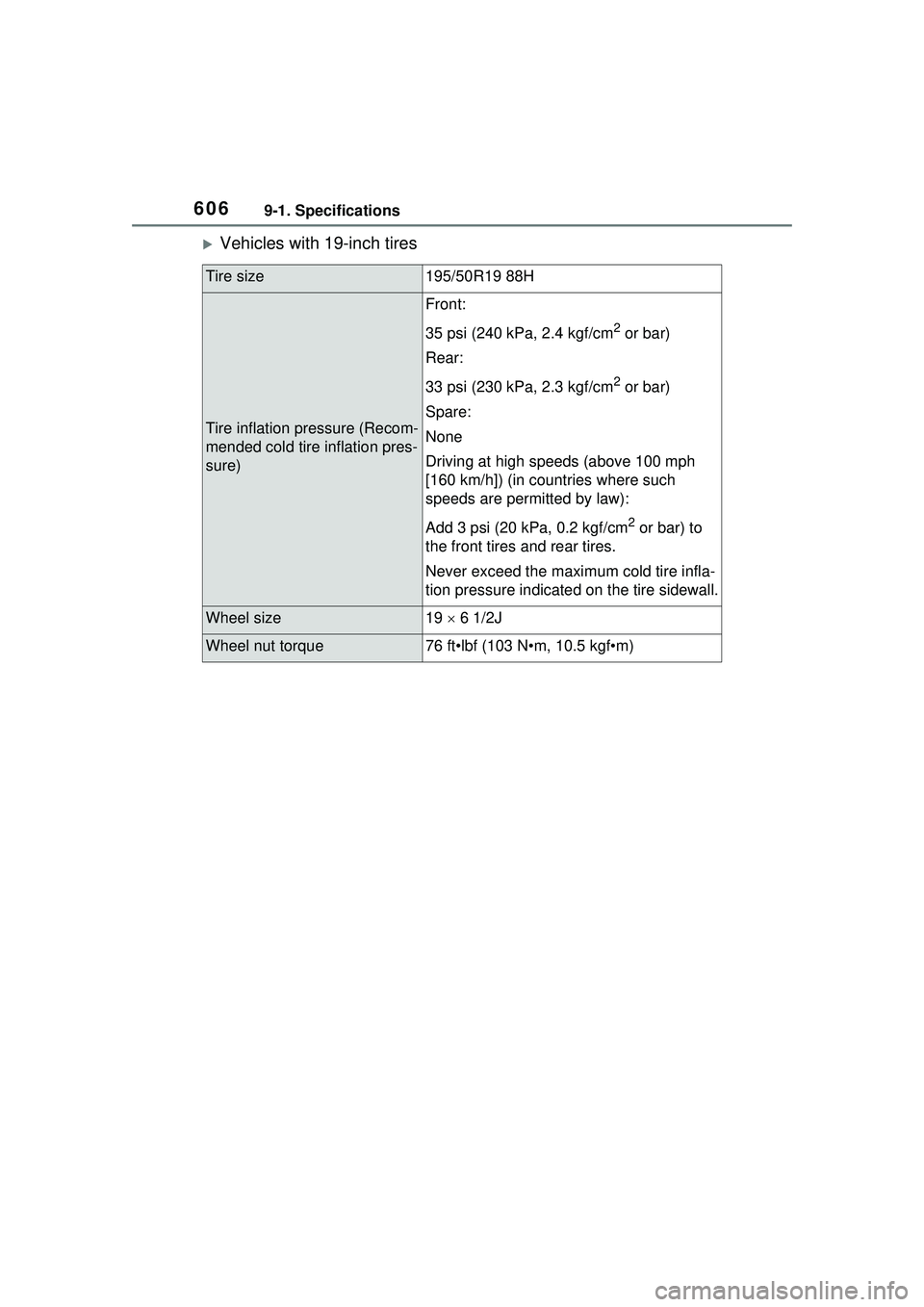
Vehicles with 19-inch tires
Tire size195/50R19 88H
Tire inflation pressure (Recom-
mended cold tire inflation pres-
sure)
Front:
35 psi (240 kPa, 2.4 kgf/cm
2 or bar)
Rear:
33 psi (230 kPa, 2.3 kgf/cm
2 or bar)
Spare:
None
Driving at high speeds (above 100 mph
[160 km/h]) (in countries where such
speeds are permitted by law):
Add 3 psi (20 kPa, 0.2 kgf/cm
2 or bar) to
the front tires and rear tires.
Never exceed the maximum cold tire infla-
tion pressure indicated on the tire sidewall.
Wheel size19 6 1/2J
Wheel nut torque76 ft•lbf (103 N•m, 10.5 kgf•m)