transmission TOYOTA PRIUS PRIME 2023 Owners Manual
[x] Cancel search | Manufacturer: TOYOTA, Model Year: 2023, Model line: PRIUS PRIME, Model: TOYOTA PRIUS PRIME 2023Pages: 680, PDF Size: 14.97 MB
Page 3 of 680
3TABLE OF CONTENTS
1
2
3
4
5
6
7
8
9
10
Back door ......................191
Smart key system ......... 203
4-3. Adjusting the seats Front seats .................... 209
Rear seats..................... 210
Head restraints.............. 212
4-4. Adjusting the steering wheel and mirrors
Steering wheel .............. 215
Inside rear view mirror .. 216
Digital Rear-view Mirror 217
Outside rear view mirrors .................................... 225
4-5. Opening, closing the win- dows
Power windows ............. 227
4-6. Favorite settings Driving position memory 230
My Settings ................... 234
5-1. Before driving Driving the vehicle......... 239
Cargo and luggage ....... 246
Vehicle load limits ......... 249
Trailer towing ................ 250
Dinghy towing ............... 250
5-2. Driving procedures Power (ignition) switch .. 251
Transmission................. 256
Turn signal lever ........... 262
Parking brake ................ 263
Brake Hold .................... 2665-3. Operating the lights and
wipers
Headlight switch ............ 269
AHB (Automatic High Beam) .................................... 272
Windshield wipers and washer ......................... 275
5-4. Refueling Opening the fuel tank cap.................................... 279
5-5. Using the driving support systems
Toyota Safety Sense 3.0/Traffic Jam Assist soft-
ware update................. 282
Toyota Safety Sense 3.0 284
Driver monitor ................ 292
PCS (Pre-Collision System) .................................... 293
LTA (Lane Tracing Assist) .................................... 305
LCA (Lane Change Assist) .................................... 310
LDA (Lane Departure Alert) .................................... 313
PDA (Proactive driving assist) .......................... 320
FCTA (Front Cross Traffic Alert) ............................ 326
RSA (Road Sign Assist) 329
Dynamic radar cruise control .................................... 331
Cruise control ................ 342
Emerge
ncy Driving Stop
System ........................ 345
Traffic Jam Assist .......... 348
BSM (Blind Spot Monitor) .................................... 354
5Driving
Page 80 of 680
802-1. Plug-in hybrid system
●Motor sounds may be heard from
the engine compartment.
●Sounds may be heard from the
hybrid battery (traction battery)
when the hybrid system starts or
stops.
●Relay operating sounds such as a
snap or soft clank will be emitted
from the hybrid battery (traction
battery), under the rear seats or
under the floor, when the hybrid
system is started or stopped.
●Sounds from the hybrid system
may be heard when the back door
is open.
●Sounds may be heard from the
transmission when the gasoline
engine starts or stops, when driv-
ing at low speeds, or during idling.
●Engine sounds may be heard
when accelerating sharply.
●Sounds may be heard due to
regenerative braking when the
brake pedal is depressed or as
the accelerator pedal is released.
●Vibration may be felt when the
gasoline engine starts or stops.
●Sounds may be heard from near
the hybrid battery (traction battery)
in accordance with the operation
of the air conditioning system or
battery cooler. ( P.109)
■Maintenance, repair, recycling,
and disposal
Contact your Toyota dealer regard-
ing maintenance, repair, recycling
and disposal. Do not dispose of the
vehicle yourself.
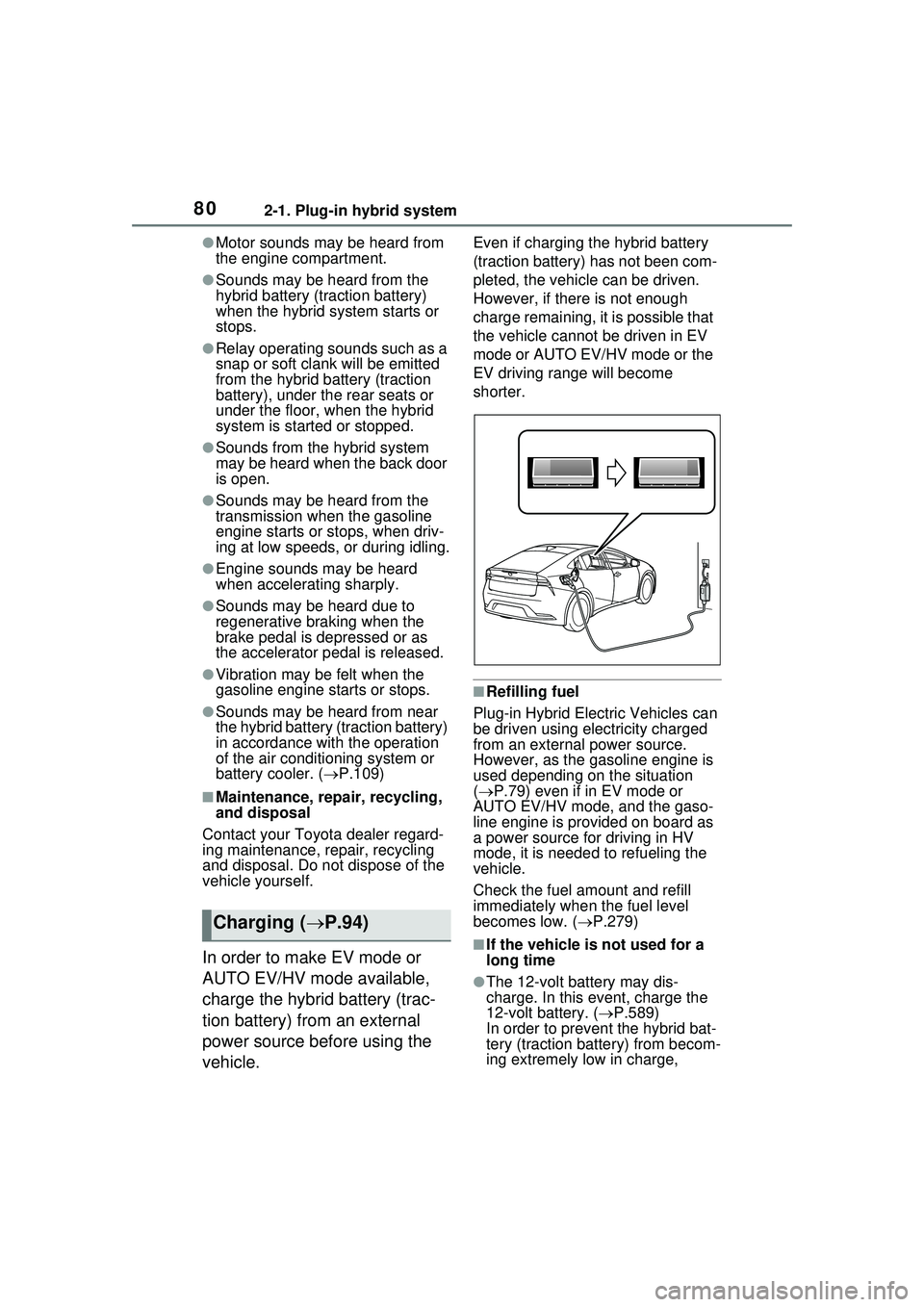
In order to make EV mode or
AUTO EV/HV mode available,
charge the hybrid battery (trac-
tion battery) from an external
power source before using the
vehicle.
Even if charging the hybrid battery
(traction battery) has not been com-
pleted, the vehicle can be driven.
However, if there is not enough
charge remaining, it is possible that
the vehicle cannot be driven in EV
mode or AUTO EV/HV mode or the
EV driving range will become
shorter.
■Refilling fuel
Plug-in Hybrid Electric Vehicles can
be driven using electricity charged
from an external power source.
However, as the gasoline engine is
used depending on the situation
( P.79) even if in EV mode or
AUTO EV/HV mode, and the gaso-
line engine is provided on board as
a power source for driving in HV
mode, it is needed to refueling the
vehicle.
Check the fuel amount and refill
immediately when the fuel level
becomes low. ( P.279)
■If the vehicle is not used for a
long time
●The 12-volt battery may dis-
charge. In this event, charge the
12-volt battery. ( P.589)
In order to prevent the hybrid bat-
tery (traction batt ery) from becom-
ing extremely low in charge,
Charging ( P.94)
Page 237 of 680
237
5
5
Driving
Driving
5-1. Before drivingDriving the vehicle....... 239
Cargo and luggage ..... 246
Vehicle load limits ....... 249
Trailer towing .............. 250
Dinghy towing ............. 250
5-2. Driving procedures Power (ignition) switch 251
Transmission............... 256
Turn signal lever ......... 262
Parking brake .............. 263
Brake Hold .................. 266
5-3. Operating the lights and wipers
Headlight switch .......... 269
AHB (Automatic High Beam)........................ 272
Windshield wipers and washer....................... 275
5-4. Refueling Opening the fuel tank cap.................................. 279
5-5. Using the driving support systems
Toyota Safety Sense 3.0/Traffic Jam Assist soft-
ware update .............. 282
Toyota Safety Sense 3.0 .................................. 284
Driver monitor ............. 292PCS (Pre-Collision System)
.................................. 293
LTA (Lane Tracing Assist) .................................. 305
LCA (Lane Change Assist) .................................. 310
LDA (Lane Departure Alert) .................................. 313
PDA (Proactive driving assist) ........................ 320
FCTA (Front Cross Traffic Alert) .......................... 326
RSA (Road Sign Assist) .................................. 329
Dynamic radar cruise con- trol ............................. 331
Cruise control .............. 342
Emergency Driving Stop System ...................... 345
Traffic Jam Assist ........ 348
BSM (Blind Spot Monitor) .................................. 354
Safe Exit Assist ........... 359
Intuitive parking assist . 363
RCTA (Rear Cross Traffic Alert) function ............ 373
RCD (Rear Camera Detec- tion) function .............. 378
PKSB (Parking Support Brake) ........................ 382
Page 242 of 680
2425-1. Before driving
WARNING
●Do not drive across a river or
through other bodies of water.
This may cause electric/elec-
tronic components to short cir-
cuit, damage the hybrid system
or cause other serious damage
to the vehicle.
●Do not drive in excess of the
speed limit. Even if the legal
speed limit permits it, do not
drive over 85 mph (140 km/h)
unless your vehicle has high-
speed capability tires. Driving
over 85 mph (140 km/h) may
result in tire failure, loss of con-
trol and possible injury. Be sure
to consult a tire dealer to deter-
mine whether the tires on your
vehicle are high-speed capabil-
ity tires or not before driving at
such speeds.
■When driving on slippery
road surfaces
●Sudden braking, acceleration
and steering may cause tire
slippage and reduce your ability
to control the vehicle.
●Sudden acceleration, engine
braking due to shifting, or
changes in engine speed could
cause the vehicle to skid, result-
ing in an accident.
●After driving through a puddle,
lightly depress the brake pedal
to make sure that the brakes
are functioning properly. Wet
brake pads may prevent the
brakes from functioning prop-
erly. If the brakes on only one
side are wet and not functioning
properly, steering control may
be affected.
■When shifting the shift posi-
tion
●Do not let the vehicle roll back-
ward while a fo rward driving
position is selected, or roll for-
ward while the shift position is in
R.
Doing so may result in an acci-
dent or damage to the vehicle.
●Do not shift the shift position to
P while the vehicle is moving.
Doing so can damage the trans-
mission and may result in a loss
of vehicle control.
●Do not shift the shift position to
R while the vehicle is moving
forward. Doing so can damage
the transmission and may result
in a loss of vehicle control.
●Do not shift the shift position to
a driving position while the vehi-
cle is moving backward. Doing
so can damage the transmis-
sion and may result in a loss of
vehicle control.
●Changing the shift position to N
while the vehicle is moving will
disengage the hybrid system.
Regenerative braking is not
available with the hybrid system
disengaged.
●Do not shift the shift position
with the accelerator pedal
depressed. Changing the shift
position to any positions other
than P or N may lead to unex-
pected rapid acceleration of the
vehicle that may cause an acci-
dent and result in death or seri-
ous injury.
After changing the shift position,
make sure to confirm the cur-
rent shift position displayed on
the shift position indicator inside
the meter.
Page 245 of 680
2455-1. Before driving
5
Driving
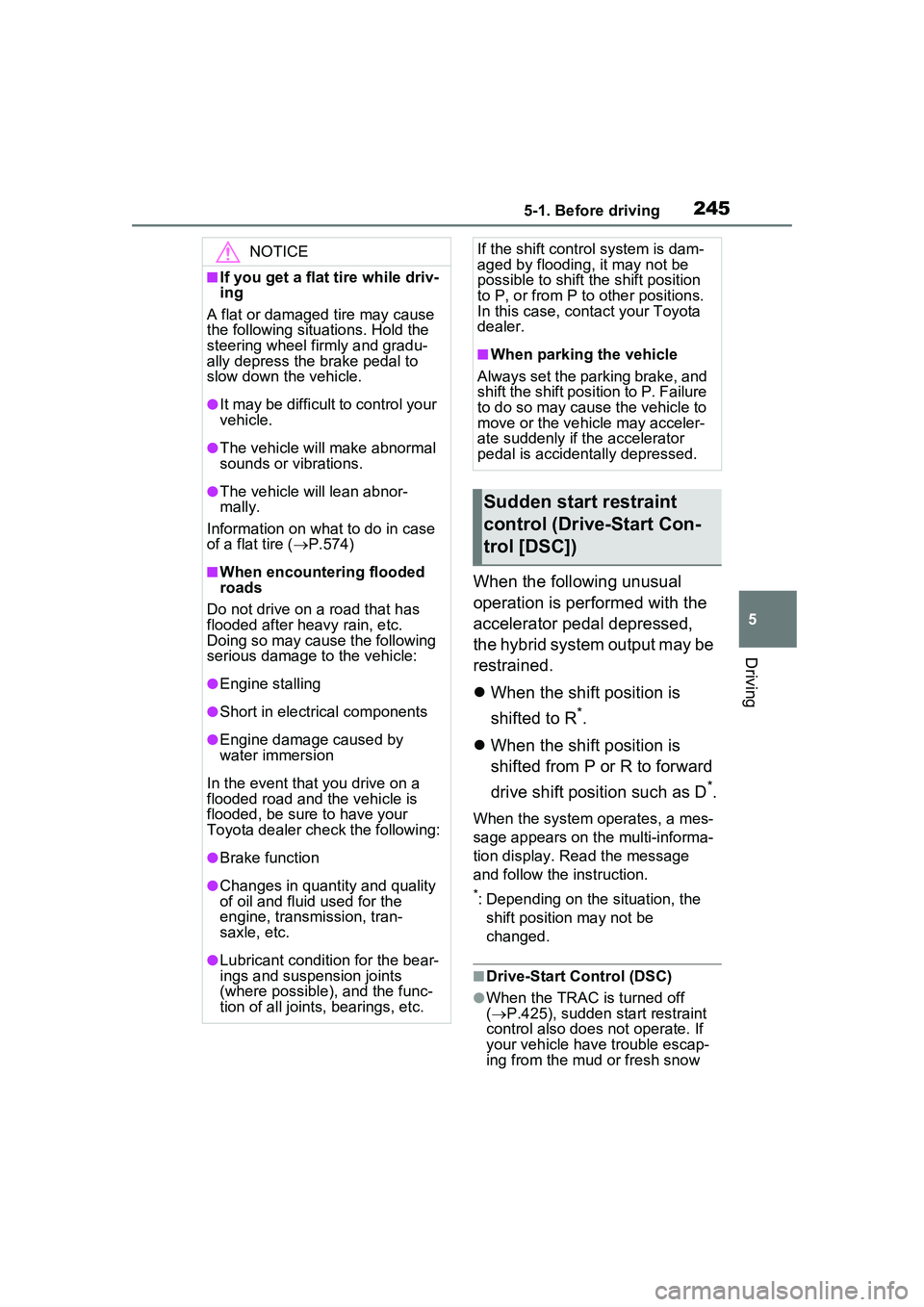
When the following unusual
operation is performed with the
accelerator pedal depressed,
the hybrid system output may be
restrained.
When the shift position is
shifted to R
*.
When the shift position is
shifted from P or R to forward
drive shift position such as D
*.
When the system operates, a mes-
sage appears on the multi-informa-
tion display. Read the message
and follow the instruction.
*: Depending on the situation, the
shift position may not be
changed.
■Drive-Start Control (DSC)
●When the TRAC is turned off
( P.425), sudden start restraint
control also does not operate. If
your vehicle have trouble escap-
ing from the mud or fresh snow
NOTICE
■If you get a flat tire while driv-
ing
A flat or damaged tire may cause
the following situations. Hold the
steering wheel firmly and gradu-
ally depress the brake pedal to
slow down the vehicle.
●It may be difficult to control your
vehicle.
●The vehicle will make abnormal
sounds or vibrations.
●The vehicle will lean abnor-
mally.
Information on what to do in case
of a flat tire ( P.574)
■When encountering flooded
roads
Do not drive on a road that has
flooded after heavy rain, etc.
Doing so may cause the following
serious damage to the vehicle:
●Engine stalling
●Short in electrical components
●Engine damage caused by
water immersion
In the event that you drive on a
flooded road and the vehicle is
flooded, be sure to have your
Toyota dealer check the following:
●Brake function
●Changes in quantity and quality
of oil and fluid used for the
engine, transmission, tran-
saxle, etc.
●Lubricant condition for the bear-
ings and suspension joints
(where possible), and the func-
tion of all joints, bearings, etc.
If the shift control system is dam-
aged by flooding, it may not be
possible to shift the shift position
to P, or from P to other positions.
In this case, contact your Toyota
dealer.
■When parking the vehicle
Always set the parking brake, and
shift the shift position to P. Failure
to do so may cause the vehicle to
move or the vehicle may acceler-
ate suddenly if the accelerator
pedal is accidentally depressed.
Sudden start restraint
control (Drive-Start Con-
trol [DSC])
Page 256 of 680
2565-2. Driving procedures
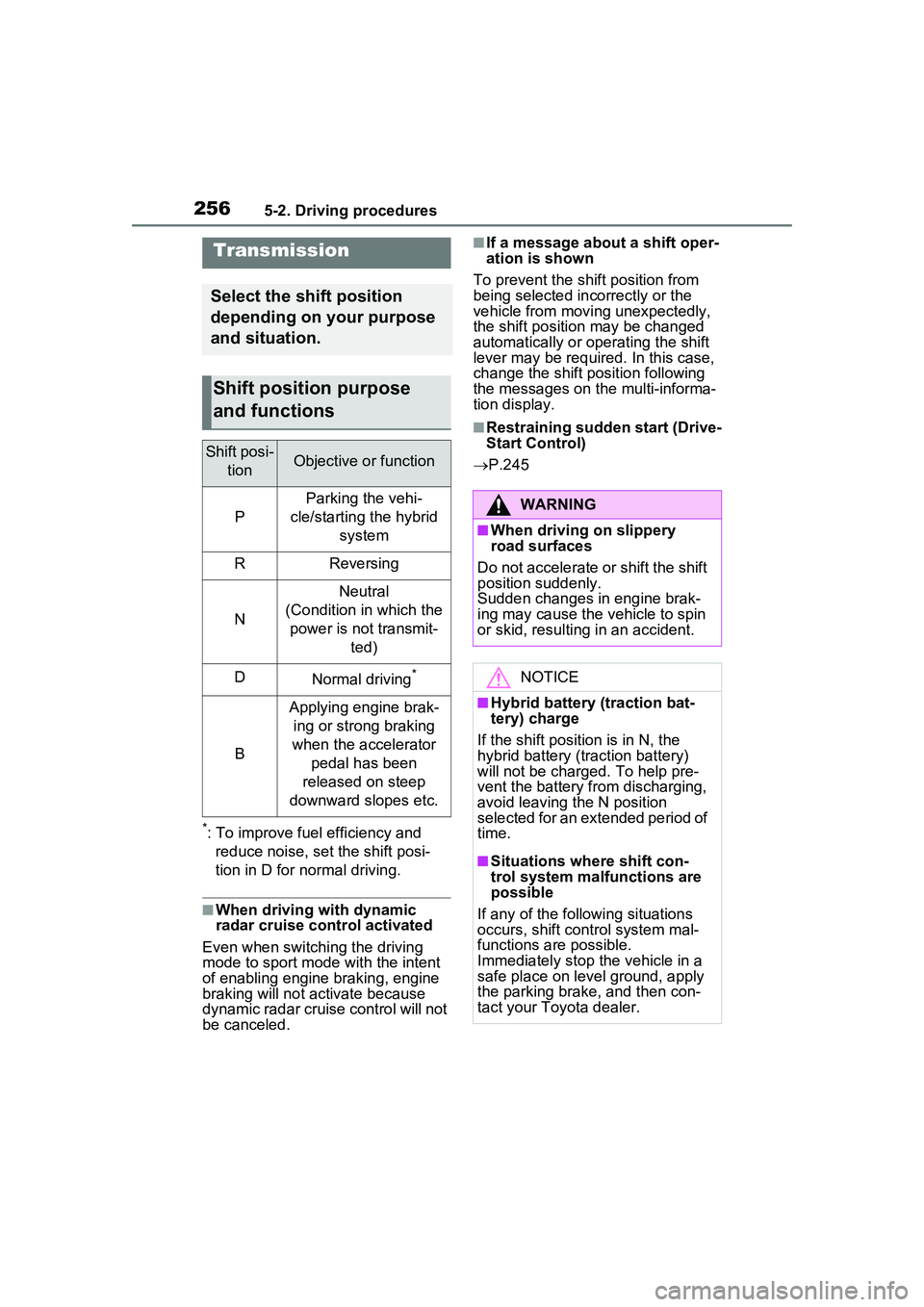
*: To improve fuel efficiency and reduce noise, set the shift posi-
tion in D for normal driving.
■When driving with dynamic
radar cruise control activated
Even when switching the driving
mode to sport mode with the intent
of enabling engine braking, engine
braking will not activate because
dynamic radar cruise control will not
be canceled.
■If a message about a shift oper-
ation is shown
To prevent the shift position from
being selected incorrectly or the
vehicle from moving unexpectedly,
the shift position may be changed
automatically or operating the shift
lever may be required . In this case,
change the shift position following
the messages on the multi-informa-
tion display.
■Restraining sudden start (Drive-
Start Control)
P.245
Transmission
Select the shift position
depending on your purpose
and situation.
Shift position purpose
and functions
Shift posi-
tionObjective or function
P
Parking the vehi-
cle/starting the hybrid system
RReversing
N
Neutral
(Condition in which the power is not transmit- ted)
DNormal driving*
B
Applying engine brak-ing or strong braking
when the accelerator pedal has been
released on steep
downward slopes etc.
WARNING
■When driving on slippery
road surfaces
Do not accelerate or shift the shift
position suddenly.
Sudden changes in engine brak-
ing may cause the vehicle to spin
or skid, resulting in an accident.
NOTICE
■Hybrid battery (traction bat-
tery) charge
If the shift position is in N, the
hybrid battery (traction battery)
will not be charged. To help pre-
vent the battery from discharging,
avoid leaving the N position
selected for an extended period of
time.
■Situations where shift con-
trol system malfunctions are
possible
If any of the following situations
occurs, shift control system mal-
functions are possible.
Immediately stop the vehicle in a
safe place on level ground, apply
the parking brake, and then con-
tact your Toyota dealer.
Page 550 of 680
5508-2. Steps to take in an emergency
8-2.Steps to take in an emergency
In the following situations, it is
not possible to be towed by
another vehicle using cables or
chains, as the front wheels may
be locked due to the parking
lock. Contact your Toyota dealer
or commercial towing service.
There is a malfunction in the
shift control system.
( P.253)
There is a malfunction in the
immobilizer system. ( P.70)
There is a malfunction in the
smart key system. ( P.587)
The 12-volt battery is dis-
charged. ( P.589) The following may indicate a
problem with your transmission.
Contact your Toyota dealer or
commercial towing service
before towing.
The hybrid system warning
message is shown on the
multi-information display and
the vehicle does not move.
The vehicle makes an abnor-
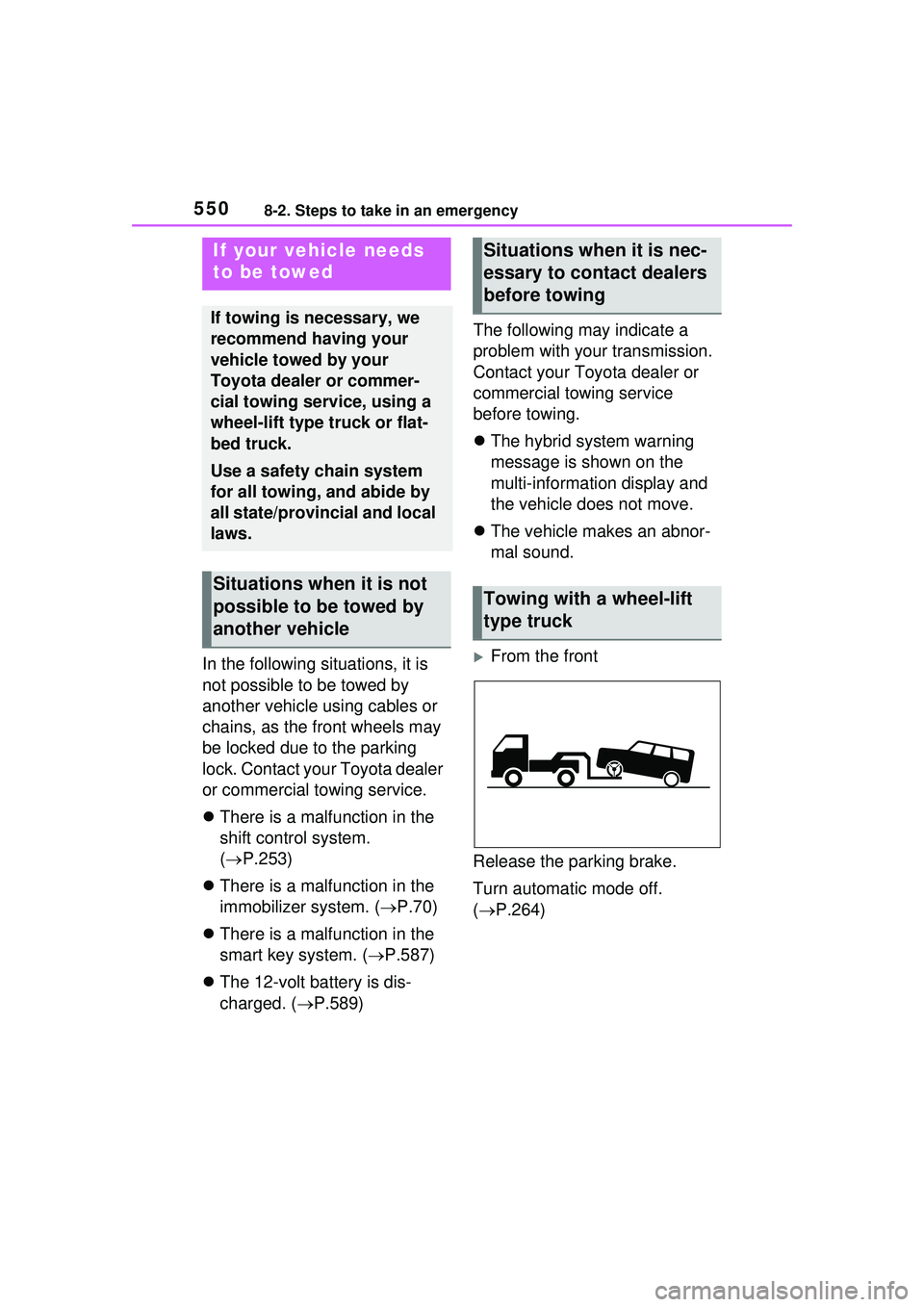
mal sound.From the front
Release the parking brake.
Turn automatic mode off.
( P.264)
If your vehicle needs
to be towed
If towing is necessary, we
recommend having your
vehicle towed by your
Toyota dealer or commer-
cial towing service, using a
wheel-lift type truck or flat-
bed truck.
Use a safety chain system
for all towing, and abide by
all state/provincial and local
laws.
Situations when it is not
possible to be towed by
another vehicle
Situations when it is nec-
essary to contact dealers
before towing
Towing with a wheel-lift
type truck
Page 604 of 680

6049-1. Specifications
*: The fluid capacity is the quantity of reference.If replacement is necessary, contact your Toyota dealer.
Ignition system (spark plug)
MakeDENSO FC16HR-Q8
Gap0.031 in. (0.8 mm)
NOTICE
■Iridium-tipped spark plugs
Use only iridium-tipped spark plugs. Do not adjust the spark plug gap.
Electrical system (12-volt Battery)
Open voltage at 68°F (20°C):
12.0 V or higher
(Turn the power switch to OFF and turn on
the high beam headlights for 30 seconds.)
If the voltage is lower than the standard
value, charge the battery.
Charging rates (Slow charge)5 A max.
Hybrid transmission
Fluid capacity*3.9 qt. (3.7 L, 3.2 Imp. qt.)
Fluid typeToyota Genuine e-Transaxle fluid TE
NOTICE
■Hybrid transmission fluid type
Using transmission fluid other than the above type may cause abnormal
noise or vibration, or ultimately da mage the transmission of your vehicle.
Brakes
Pedal clearance*15.2 in. (132 mm) Min.
Pedal free play0.04 0.24 in. (1.0 6.0 mm)
Page 613 of 680
6139-1. Specifications
9
Vehicle specifications
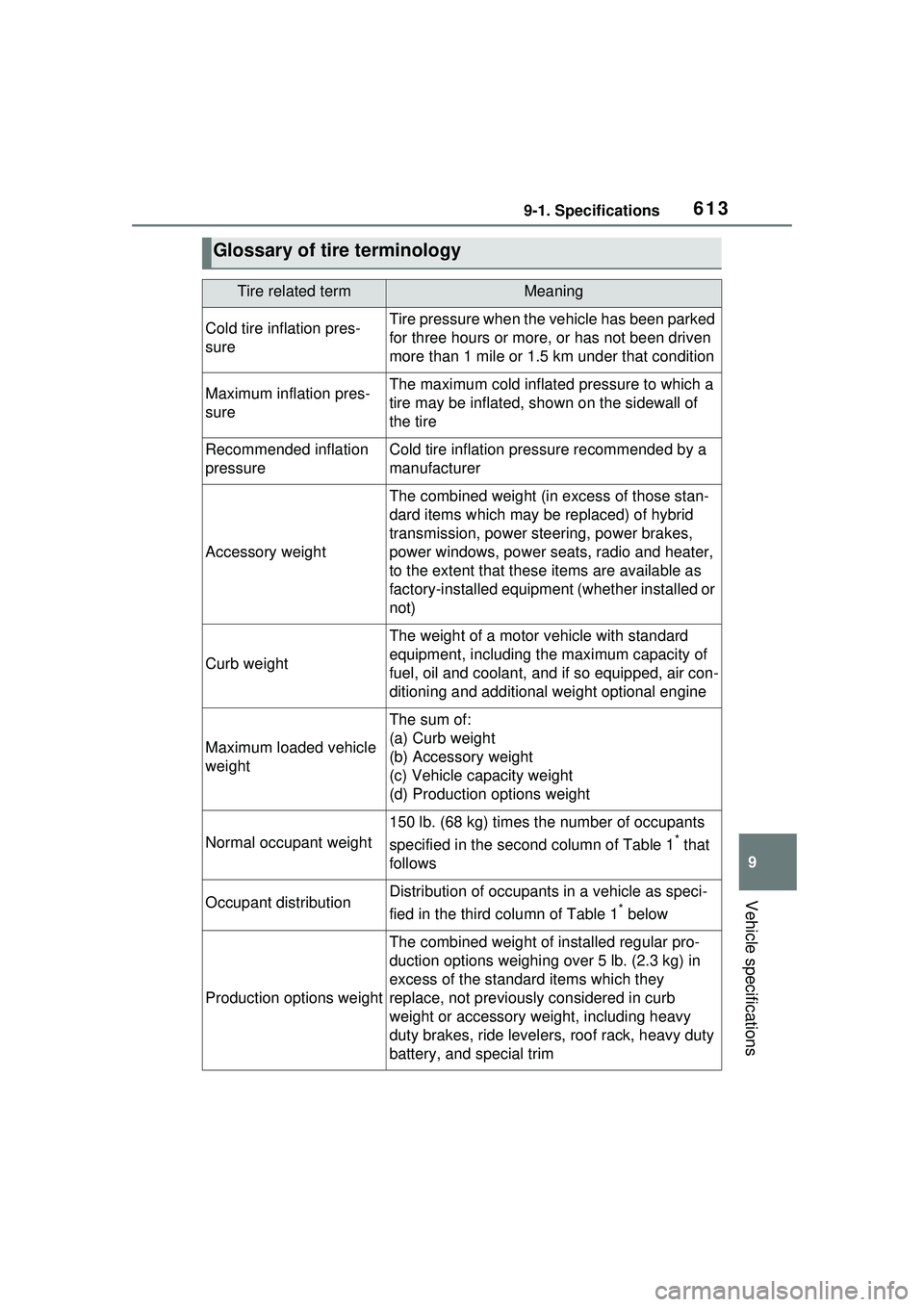
Glossary of tire terminology
Tire related termMeaning
Cold tire inflation pres-
sureTire pressure when the vehicle has been parked
for three hours or more, or has not been driven
more than 1 mile or 1.5 km under that condition
Maximum inflation pres-
sureThe maximum cold inflated pressure to which a
tire may be inflated, shown on the sidewall of
the tire
Recommended inflation
pressureCold tire inflation pressure recommended by a
manufacturer
Accessory weight
The combined weight (in excess of those stan-
dard items which may be replaced) of hybrid
transmission, power steering, power brakes,
power windows, power seat s, radio and heater,
to the extent that these items are available as
factory-installed equipment (whether installed or
not)
Curb weight
The weight of a motor vehicle with standard
equipment, including the maximum capacity of
fuel, oil and coolant, and if so equipped, air con-
ditioning and additional weight optional engine
Maximum loaded vehicle
weight
The sum of:
(a) Curb weight
(b) Accessory weight
(c) Vehicle capacity weight
(d) Production options weight
Normal occupant weight
150 lb. (68 kg) times the number of occupants
specified in the second column of Table 1
* that
follows
Occupant distributionDistribution of occupants in a vehicle as speci-
fied in the third column of Table 1
* below
Production options weight
The combined weight of installed regular pro-
duction options weighing over 5 lb. (2.3 kg) in
excess of the standard items which they
replace, not previously considered in curb
weight or accessory weight, including heavy
duty brakes, ride levelers, roof rack, heavy duty
battery, and special trim
Page 654 of 680
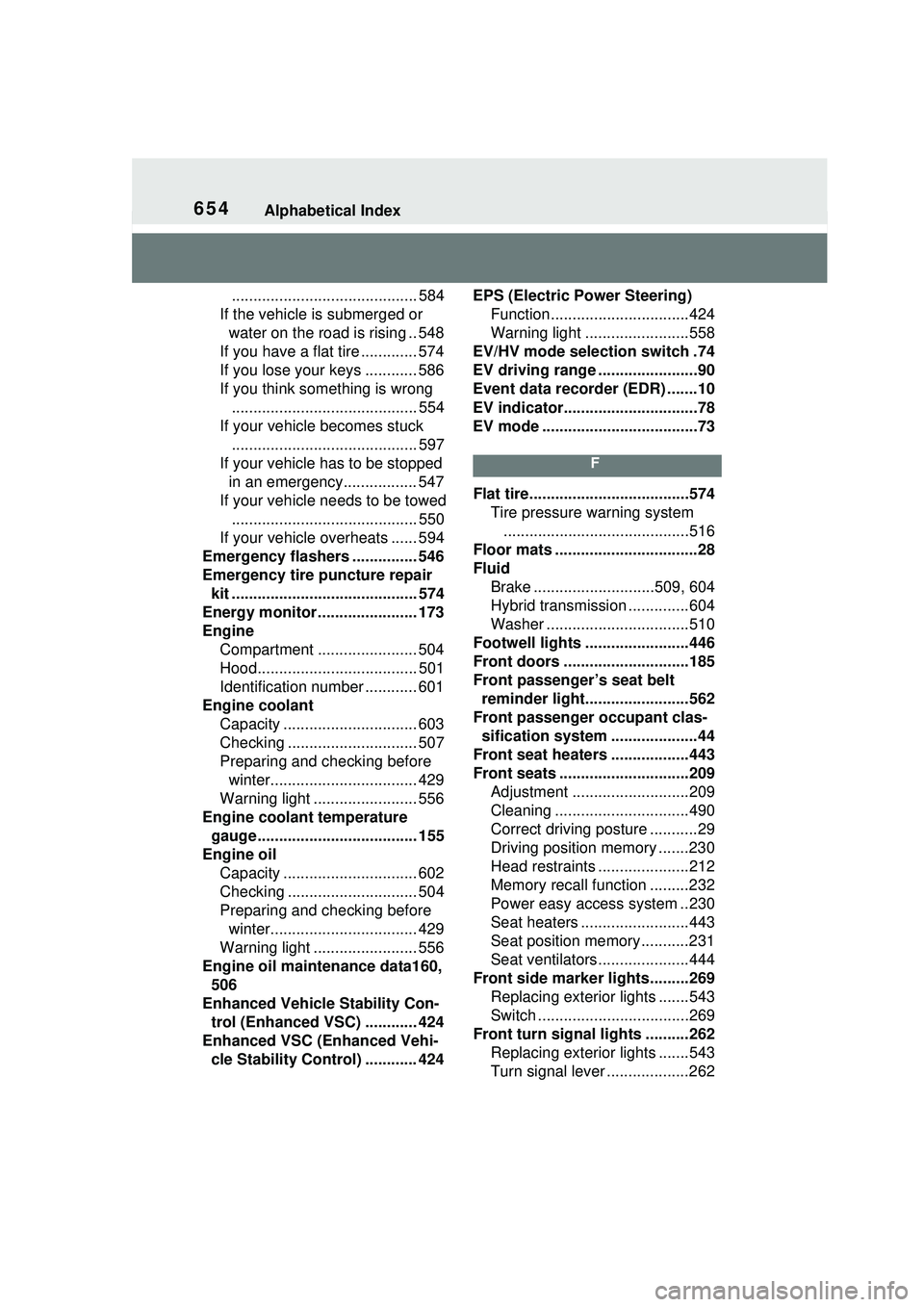
654Alphabetical Index
........................................... 584
If the vehicle is submerged or water on the road is rising .. 548
If you have a flat tire ............. 574
If you lose your keys ............ 586
If you think something is wrong ........................................... 554
If your vehicle becomes stuck ........................................... 597
If your vehicle has to be stopped in an emergency................. 547
If your vehicle needs to be towed ........................................... 550
If your vehicle overheats ...... 594
Emergency flashers ............... 546
Emergency tire puncture repair kit ........................................... 574
Energy monitor ....................... 173
Engine Compartment ....................... 504
Hood..................................... 501
Identification number ............ 601
Engine coolant Capacity ............................... 603
Checking .............................. 507
Preparing and checking before winter.................................. 429
Warning light ........................ 556
Engine coolant temperature gauge..................................... 155
Engine oil Capacity ............................... 602
Checking .............................. 504
Preparing and checking before winter.................................. 429
Warning light ........................ 556
Engine oil maintenance data160, 506
Enhanced Vehicle Stability Con- trol (Enhanced VSC) ............ 424
Enhanced VSC (Enhanced Vehi- cle Stability Control) ............ 424 EPS (Electric Power Steering)
Function................................424
Warning light ........................558
EV/HV mode selection switch .74
EV driving range .......................90
Event data recorder (EDR) .......10
EV indicator...............................78
EV mode ....................................73
F
Flat tire.....................................574 Tire pressure warning system...........................................516
Floor mats .................................28
Fluid Brake ............................509, 604
Hybrid transmission ..............604
Washer .................................510
Footwell lights ........................446
Front doors .............................185
Front passenger’s seat belt reminder light........................562
Front passenger occupant clas- sification system ....................44
Front seat heaters ..................443
Front seats ..............................209 Adjustment ...........................209
Cleaning ...............................490
Correct driving posture ...........29
Driving position memory .......230
Head restraints .....................212
Memory recall function .........232
Power easy access system ..230
Seat heaters .........................443
Seat position memory...........231
Seat ventilators.....................444
Front side marker lights.........269 Replacing exterior lights .......543
Switch ...................................269
Front turn signal lights ..........262 Replacing exterior lights .......543
Turn signal lever ...................262