service TOYOTA PROACE 2017 Owner's Manual
[x] Cancel search | Manufacturer: TOYOTA, Model Year: 2017, Model line: PROACE, Model: TOYOTA PROACE 2017Pages: 516, PDF Size: 91.65 MB
Page 101 of 516
101
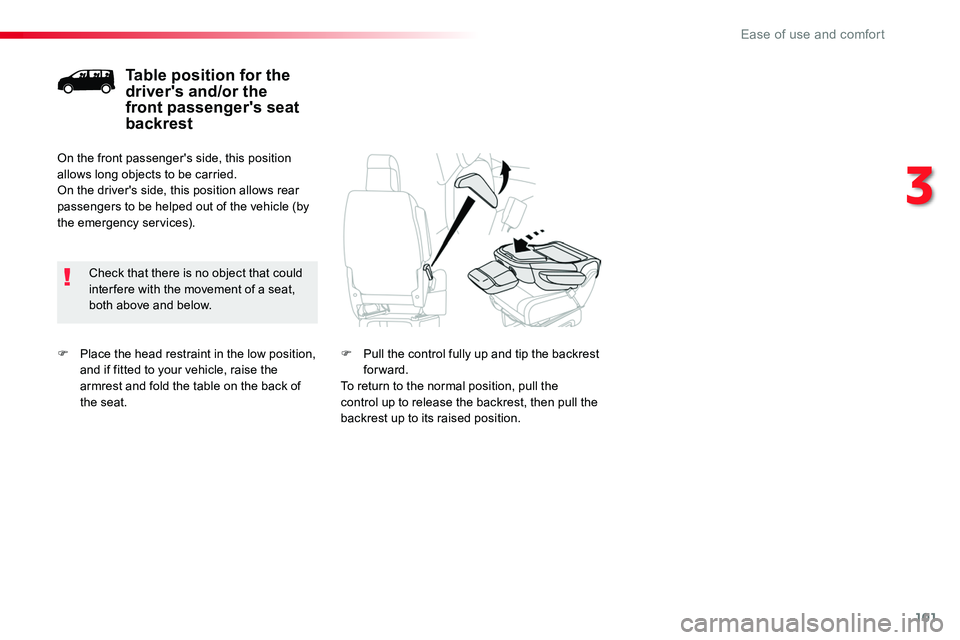
F Place the head restraint in the low position, and if fitted to your vehicle, raise the armrest and fold the table on the back of the seat.
Table position for the driver's and/or the front passenger's seat backrest
Check that there is no object that could inter fere with the movement of a seat, both above and below.
On the front passenger's side, this position allows long objects to be carried.On the driver's side, this position allows rear passengers to be helped out of the vehicle (by the emergency services).
F Pull the control fully up and tip the backrest forward.To return to the normal position, pull the control up to release the backrest, then pull the backrest up to its raised position.
3
Ease of use and comfort
Page 160 of 516
160
Automatic operation of
hazard warning lamps
Hazard warning lamps
When braking in an emergency, depending on the rate of deceleration, as well as when the ABS regulation is invoked or in the event of an impact, the hazard warning lamps come on automatically.They switch off automatically the first time you accelerate.F You can also switch them off by pressing the button.
Visual warning with all of the direction indicators flashing to alert other road users to a vehicle breakdown, towing or accident.
ER A - GLONASS
emergency call
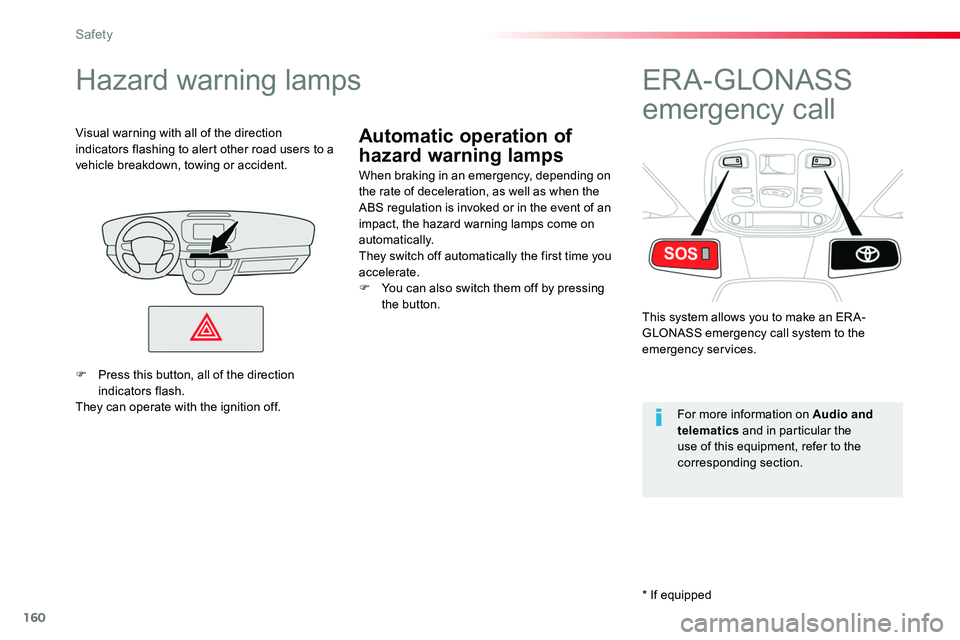
This system allows you to make an ER A-GLONASS emergency call system to the emergency services.
For more information on Audio and telematics and in particular the use of this equipment, refer to the corresponding section.
F Press this button, all of the direction indicators flash.They can operate with the ignition off.
* If equipped
Safety
Page 244 of 516
244
The Autonomous emergency braking system does not operate:- if the front bumper is damaged,- if the system has been triggered in the last 10 seconds,- if the electronic stability control system has a fault.
Limits of operation
It is recommended that the system be deactivated in the vehicle configuration menu in the following cases:- if the windscreen has impact damage close to the detection camera,- when towing a trailer or caravan,- when a load on the roof rack extends beyond the windscreen (for example: long objects),- when the vehicle is being towed, with the engine running,- when a "space-saver" type spare wheel is fitted (if your vehicle has one),- when on a rolling road for a service in a workshop,- when in an automatic car wash,- if the brake lamps are not working.
Following an impact, the system is automatically disabled; contact an authorized Toyota dealer or repairer, or another duly qualified and equipped professional to have the system checked.
Forward collision warning
Depending on the degree of risk of collision detected by the system and the alert threshold chosen, different levels of alert can be triggered and displayed in the instrument panel or the head-up display.
This level of alert is based on the inter-vehicle time between your vehicle and the vehicle ahead.
Level 1: visual alert only, warning you that the vehicle ahead is very close.A message on your vigilance is displayed as you close on the vehicle ahead.
This information also appears in the head-up display.For more information on the Head-up display, refer to the corresponding section.
Driving
Page 245 of 516
245
This level of alert is based on the time before collision. It takes account of the vehicle dynamics, the speed of your vehicle and the
one in front, the environmental conditions, the operation of the vehicle (cornering, pedals pressed, etc.) to trigger the alert at the best moment.
Level 2: visual and audible alert, warning you that a collision is imminent.A message indicating that you should brake is displayed.
Where the speed of your vehicle is too high approaching another vehicle, the first level of alert may not be displayed: the level 2 alert may be displayed di r e c t l y.Furthermore, the level 1 alert is never displayed with the "Close" threshold.Poor weather conditions (very heavy rain, accumulation of snow in front of the radar and the camera) may hinder the operation of the system, with the display of an operating fault message. The system remains out of service until the message disappears.
Programming the alert thresholds
The thresholds for triggering an alert determine how you wish to be warned of the presence of a vehicle moving or stationary ahead of you, or a pedestrian in your traffic lane.You can select one of three thresholds:- "Distant", to be warned early (cautious driving).- "Normal".- "Close", to be warned later.
In the vehicle settings menu, activate/deactivate "Collision risk alert and automatic braking".
With the touch screen
With the audio system
In the "Personalisation-configuration" menu, activate/deactivate "Auto. emergency braking".Then modify the alert threshold.
Then modify the alert threshold.Press on "Confirm" to save the change.
6
Driving
Page 264 of 516
264
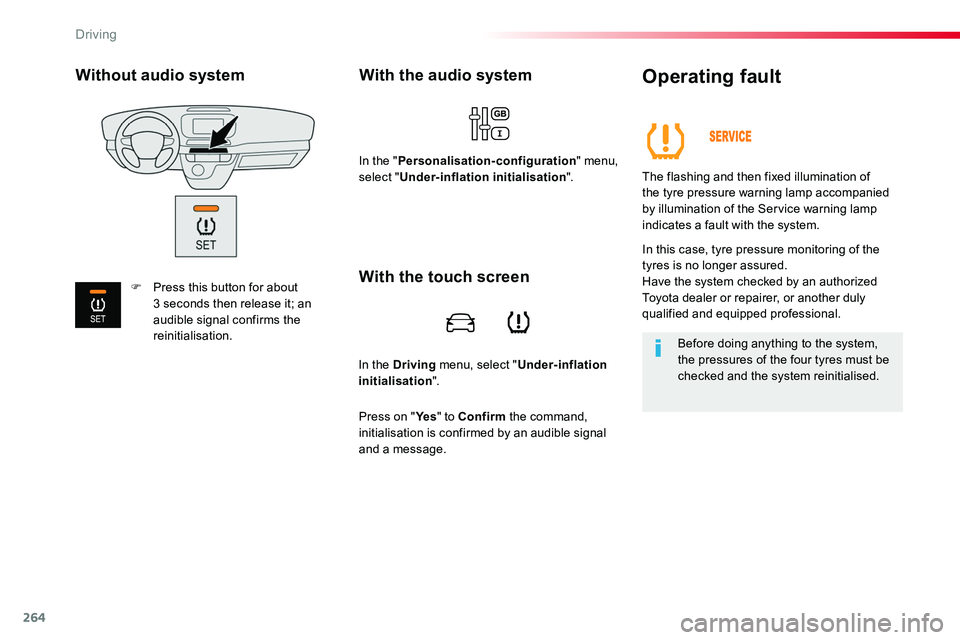
In the Driving menu, select "Under-inflation initialisation".
With the audio system
In the "Personalisation-configuration" menu, select "Under-inflation initialisation".
Operating fault
The flashing and then fixed illumination of the tyre pressure warning lamp accompanied by illumination of the Service warning lamp
indicates a fault with the system.
In this case, tyre pressure monitoring of the tyres is no longer assured.Have the system checked by an authorized Toyota dealer or repairer, or another duly qualified and equipped professional.
Before doing anything to the system, the pressures of the four tyres must be checked and the system reinitialised.
With the touch screen
Press on "Ye s" to Confirm the command, initialisation is confirmed by an audible signal and a message.
Without audio system
F Press this button for about 3 seconds then release it; an audible signal confirms the reinitialisation.
Driving
Page 272 of 516
272
By visiting a Toyota dealer, you can also obtain products for cleaning and maintenance (exterior and interior) - including ecological products in the Toyota range, topping-up products (screenwash...), touch-up pens and paint aerosols for the exact colour of your vehicle, refills (cartridge for the temporary puncture repair kit...), ...
"Multimedia"
Smartphone support, table support or semi-integral navigation support, range of audio systems and portable navigation systems, driving recorder, Bluetooth hands-free kit, DVD player, multimedia support, driving aids, vehicle tracking system, ...
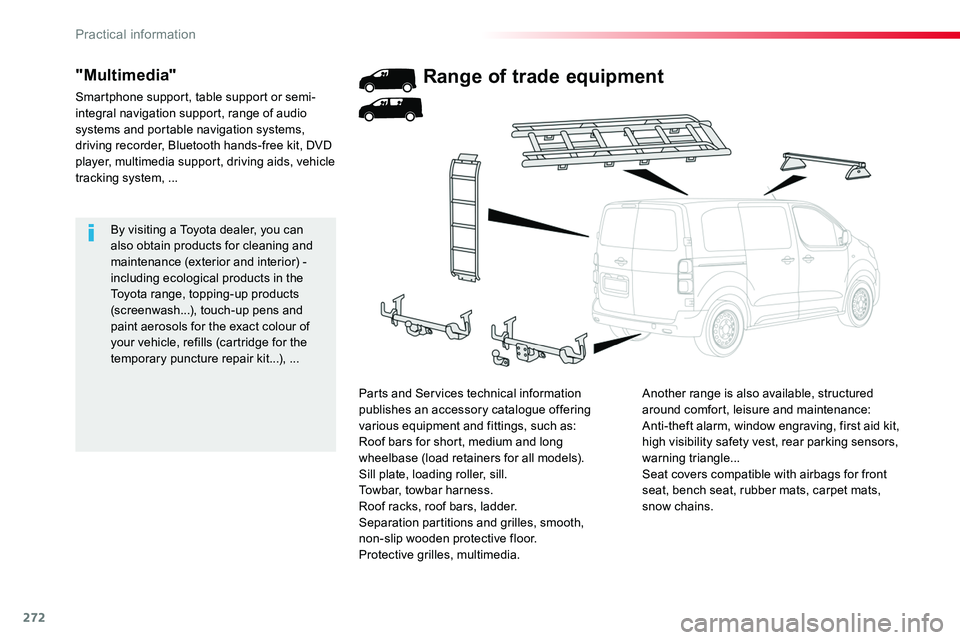
Range of trade equipment
Another range is also available, structured around comfort, leisure and maintenance:Anti-theft alarm, window engraving, first aid kit, high visibility safety vest, rear parking sensors, warning triangle...Seat covers compatible with airbags for front seat, bench seat, rubber mats, carpet mats, snow chains.
Parts and Services technical information publishes an accessory catalogue offering various equipment and fittings, such as:Roof bars for short, medium and long wheelbase (load retainers for all models).Sill plate, loading roller, sill.Towbar, towbar harness.Roof racks, roof bars, ladder.Separation partitions and grilles, smooth,
non-slip wooden protective floor.Protective grilles, multimedia.
Practical information
Page 278 of 516
278
Checking levels
Take care when working under the bonnet, as certain areas of the engine may be extremely hot (risk of burns) and the cooling fan could start at any time (even with the ignition off).
Engine oil level
The check is carried out either when the ignition is switched on using the oil level indicator in the instrument panel for vehicles so equipped, or using the dipstick.
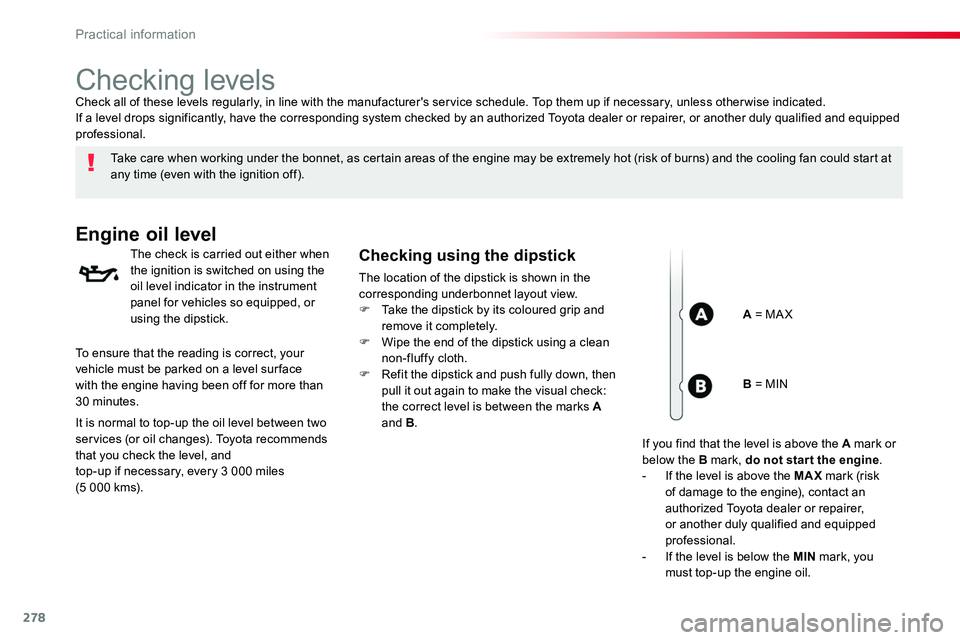
Checking using the dipstick
The location of the dipstick is shown in the corresponding underbonnet layout view.F Take the dipstick by its coloured grip and remove it completely.F Wipe the end of the dipstick using a clean non-fluffy cloth.F Refit the dipstick and push fully down, then pull it out again to make the visual check: the correct level is between the marks A and B.
Check all of these levels regularly, in line with the manufacturer's service schedule. Top them up if necessary, unless other wise indicated.If a level drops significantly, have the corresponding system checked by an authorized Toyota dealer or repairer, or another duly qualified and equipped professional.
A = MA X
To ensure that the reading is correct, your vehicle must be parked on a level sur face with the engine having been off for more than 30 minutes.
It is normal to top-up the oil level between two services (or oil changes). Toyota recommends that you check the level, and top-up if necessary, every 3 000 miles (5 000 kms).
B = MIN
If you find that the level is above the A mark or below the B mark, do not star t the engine.- If the level is above the MAX mark (risk of damage to the engine), contact an authorized Toyota dealer or repairer, or another duly qualified and equipped professional.- If the level is below the MIN mark, you must top-up the engine oil.
Practical information
Page 279 of 516
279
Oil grade
Before topping-up the oil or changing the oil, check that the oil is the correct grade for your engine and conforms to the manufacturer's recommendations.
Topping-up the engine oil level
The location of the oil filler cap is shown in the corresponding underbonnet layout view.F Unscrew the oil filler cap to reveal the filler aperture.F Add oil in small quantities, avoiding any spills on engine components (risk of fire).F Wait a few minutes before checking the level again using the dipstick.F Add more oil if necessary.F After checking the level, carefully refit the oil filler cap and the dipstick in its tube.
After topping-up the oil, the check when switching on the ignition with the oil level indicator in the instrument panel is not valid during the 30 minutes after topping-up.
Engine oil change
Refer to the manufacturer's service schedule for details of the interval for this operation.In order to maintain the reliability of the engine and emission control system, never use additives in the engine oil.
The brake fluid level should be close to the "MA X" mark. If it is not, check the brake pad wear.
Brake fluid level
Changing the fluid
Refer to the manufacturer's service schedule for details of the interval for this operation.
Fluid specification
The brake fluid must conform to the manufacturer's recommendations.
Coolant level
The coolant level should be close to the "MA X" mark but should never exceed it.
In addition, as the cooling system is pressurised, wait at least one hour after switching off the engine before carrying out any work.To avoid any risk of scalding, unscrew the cap by two turns to allow the pressure to drop. When the pressure has dropped, remove the cap and top up the level.
The cooling fan may star t after switching
off the engine: take care with ar ticles and clothing that might be caught by the fan blades.
When the engine is warm, the temperature of the coolant is regulated by the fan.
Check the coolant level regularly, according to the use made of your vehicle (every 3 000 miles or 5 000 kms / 3 months); if necessary, top-up using coolant recommended by the manufacturer.Topping-up the coolant between services is normal.
Power steering
fluid level
The power steering fluid level should be close to the "MA X" mark. With the engine cold, unscrew the cap to check the level.
7
Practical information
Page 280 of 516
280
Changing the coolant
The coolant does not have to be replaced at routine services.
Fluid specification
The coolant must conform to the manufacturer's recommendations.
The check and top-up must be done with the engine cold.A low coolant level presents the risk of serious damage to your engine.
If the ambient temperature is high, it
is recommended that the engine be allowed to idle for 1 to 2 minutes after the vehicle comes to a stop, to facilitate its cooling.
Avoid prolonged contact of used oil or fluids with the skin.Most of these fluids are harmful to health or indeed very corrosive.
Do not discard used oil or fluids into sewers or onto the ground.Take used oil to an authorized Toyota dealer or repairer, or another duly qualified and equipped professional (France) or to an authorised waste disposal site.
Used products
To p p i n g - u p
This additive must be topped-up by an authorized Toyota dealer or repairer, or another duly qualified and equipped professional without delay.
Diesel additive level
(Diesel engine with
particle filter)
A low additive level is indicated by illumination of this warning lamp, accompanied by an audible warning and a message in the instrument panel screen.
Fluid specification
For optimum cleaning and to avoid freezing, this fluid must not be topped up with or replaced with plain water.
Screenwash and headlamp
wash fluid
In the case of vehicles fitted with headlamp washers, the low fluid level is indicated by an audible signal and a message in the instrument panel screen.Top up the reservoir when you next stop the vehicle.
In wintry conditions, the use of an ethyl alcohol or methanol base fluid is recommended.
Practical information
Page 281 of 516
281
Checks
12 V battery
The battery does not require any maintenance.However, check regularly that the terminals are correctly tightened (versions without quick release terminals) and that the connections are clean.
Refer to the manufacturer's service schedule for details of the replacement intervals for these components.
Air filter and passenger compartment filter
Replace the oil filter each time the engine oil is changed.Refer to the manufacturer's service schedule for details of the replacement interval for this component.
Oil filter
Diesel Particle Filter (DPF)
The start of saturation of the particle filter is indicated by the temporary illumination of this warning lamp accompanied by a message in the multifunction screen.
As soon as the traffic conditions permit, regenerate the filter by driving at a speed of at least 40 mph (60 km/h) until the warning lamp goes off.If the warning lamp stays on, this indicates a low additive level.For more information on Checking levels, refer to the corresponding section.
On a new vehicle, the first particle filter regeneration operations may be accompanied by a "burning" smell, which is per fectly normal.Following prolonged operation of the
vehicle at very low speed or at idle, you may, in exceptional circumstances, notice the emission of water vapour at the exhaust on acceleration. This does not affect the behaviour of the vehicle or the environment.
Unless otherwise indicated, check these components in accordance with the manufacturer's service schedule and according to your engine.Other wise, have them checked by an authorized Toyota dealer or repairer, or another duly qualified and equipped professional.
For more information and the precautions to take before starting work on the 12 V batter y, refer to the corresponding section.
Depending on the environment (e.g. dusty atmosphere) and the use of the vehicle (e.g. city driving), replace them twice as often if necessar y.A clogged passenger compartment filter may have an adverse effect on the per formance of the air conditioning system and generate undesirable odours.
Versions equipped with Stop & Start are fitted with a 12 V lead-acid battery of specific technology and specification.Its replacement should be carried out only by an authorized Toyota dealer or repairer, or another duly qualified and equipped professional.
7
Practical information