engine TOYOTA PROACE CITY EV 2021 Owners Manual
[x] Cancel search | Manufacturer: TOYOTA, Model Year: 2021, Model line: PROACE CITY EV, Model: TOYOTA PROACE CITY EV 2021Pages: 320, PDF Size: 75.81 MB
Page 238 of 320
238
Starting using another
battery
If the vehicle's battery is flat, the engine can be started using a backup battery (either external or from another vehicle) and jump leads or using a battery booster.
WARNI NG
Never start the engine by connecting a battery charger.Never use a 24 V or higher battery booster.Check beforehand that the backup battery has a nominal voltage of 12 V and a capacity at least equal to that of the discharged battery.The two vehicles must not be in contact with each other.Switch off all electricity-consuming equipment on both vehicles (audio system, wipers, lighting, etc.).Make sure that the jump leads are well away from the engine’s moving parts (fan, belt, etc.).Do not disconnect the (+) terminal while the engine is running.
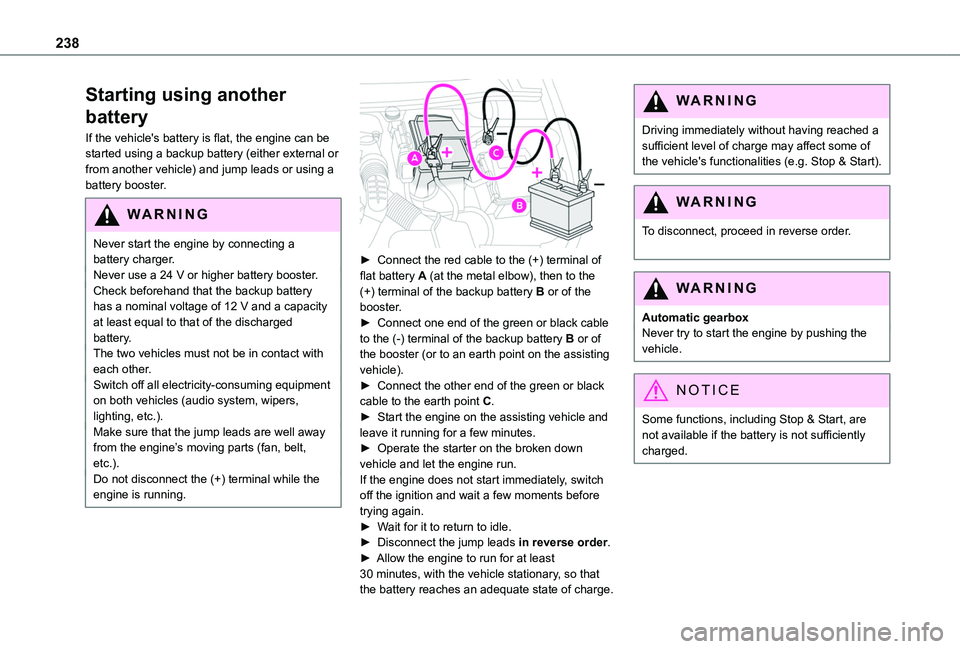
► Connect the red cable to the (+) terminal of flat battery A (at the metal elbow), then to the (+) terminal of the backup battery B or of the booster.► Connect one end of the green or black cable to the (-) terminal of the backup battery B or of the booster (or to an earth point on the assisting vehicle).► Connect the other end of the green or black cable to the earth point C.► Start the engine on the assisting vehicle and leave it running for a few minutes.► Operate the starter on the broken down vehicle and let the engine run.If the engine does not start immediately, switch off the ignition and wait a few moments before trying again.► Wait for it to return to idle.► Disconnect the jump leads in reverse order.► Allow the engine to run for at least 30 minutes, with the vehicle stationary, so that the battery reaches an adequate state of charge.
WARNI NG
Driving immediately without having reached a sufficient level of charge may affect some of the vehicle's functionalities (e.g. Stop & Start).
WARNI NG
To disconnect, proceed in reverse order.
WARNI NG
Automatic gearboxNever try to start the engine by pushing the vehicle.
NOTIC E
Some functions, including Stop & Start, are not available if the battery is not sufficiently charged.
Page 240 of 320
240
Disconnecting/reconnecting
the battery
In order to maintain an adequate state of charge for starting the engine, we recommend disconnecting the battery if the vehicle is to be unused for an extended period.Before disconnecting the battery:► Close all openings (doors, boot, windows, roof).► Switch off all electricity-consuming devices (audio system, wipers, lamps, etc.).► Switch off the ignition and wait for 4 minutes.After accessing the battery, it is only necessary to disconnect the (+) terminal.
Quick-release terminal clamp
Disconnecting the (+) terminal
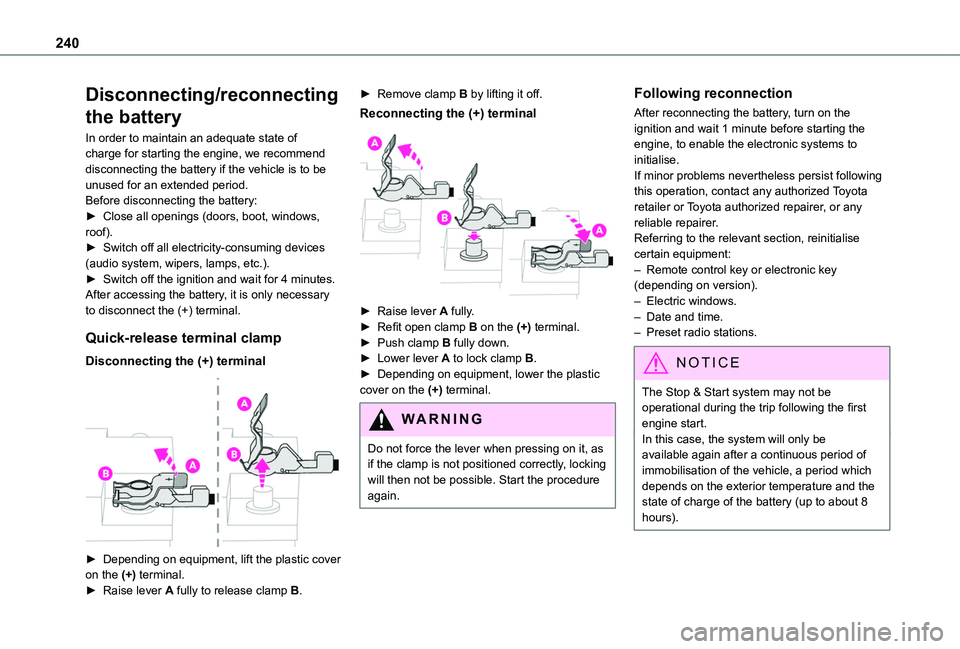
► Depending on equipment, lift the plastic cover on the (+) terminal.► Raise lever A fully to release clamp B.
► Remove clamp B by lifting it off.
Reconnecting the (+) terminal
► Raise lever A fully.► Refit open clamp B on the (+) terminal.► Push clamp B fully down.► Lower lever A to lock clamp B.► Depending on equipment, lower the plastic cover on the (+) terminal.
WARNI NG
Do not force the lever when pressing on it, as if the clamp is not positioned correctly, locking will then not be possible. Start the procedure again.
Following reconnection
After reconnecting the battery, turn on the ignition and wait 1 minute before starting the engine, to enable the electronic systems to initialise.If minor problems nevertheless persist following this operation, contact any authorized Toyota retailer or Toyota authorized repairer, or any reliable repairer.Referring to the relevant section, reinitialise certain equipment:– Remote control key or electronic key (depending on version).– Electric windows.– Date and time.– Preset radio stations.
NOTIC E
The Stop & Start system may not be operational during the trip following the first engine start.In this case, the system will only be
available again after a continuous period of immobilisation of the vehicle, a period which depends on the exterior temperature and the state of charge of the battery (up to about 8 hours).
Page 241 of 320
241
In the event of a breakdown
8
Towing
Procedure for having your vehicle towed or for towing another vehicle using the towing eye.
NOTIC E
General recommendationsObserve the legislation in force in the country where you are driving.Ensure that the weight of the towing vehicle is higher than that of the towed vehicle.The driver must remain at the wheel of the towed vehicle and must have a valid driving licence.When towing a vehicle with all four wheels on the ground, always use an approved towbar; ropes and straps are prohibited.
The towing vehicle must move off gently.When the vehicle is towed with its engine off, there is no longer braking and steering assistance.
WARNI NG
A professional recovery service must be called if:– broken down on a motorway or main road;
– not possible to put the gearbox into neutral, unlock the steering, or release the parking brake;– not possible to tow a vehicle with an automatic gearbox, with the engine running;– towing with only two wheels on the ground;– four-wheel drive vehicle;– no approved towbar available.
WARNI NG
Before towing the vehicle, it is essential to put the vehicle in free-wheeling mode.For more information on Free-wheeling, refer to the corresponding section.
NOTIC E
Electric motorAn electric vehicle cannot under any circumstances be used to tow another vehicle.However, it may be used, for example, to exit a rut.
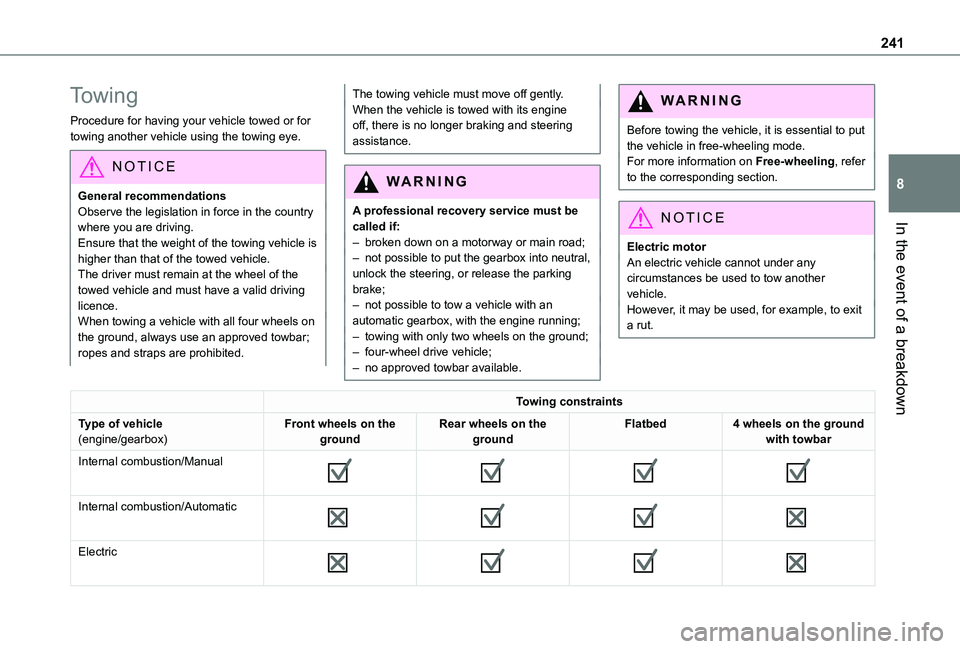
Towing constraints
Type of vehicle(engine/gearbox)Front wheels on the groundRear wheels on the groundFlatbed4 wheels on the ground with towbar
Internal combustion/Manual
Internal combustion/Automatic
Electric
Page 242 of 320
242
NOTIC E
In case of battery or electric parking brake failure, it is essential to call a professional using flatbed recovery vehicles (excluding manual gearbox).
Accessing the eye
NOTIC E
For more information on the Tool kit, refer to the corresponding section.
WARNI NG
With a manual gearbox, move the gear lever into neutral.With an automatic gearbox, place the gear selector into position N.Failure to adhere to this instruction may lead to damage to braking system components and the lack of braking assistance on restarting the engine.
Towing your vehicle
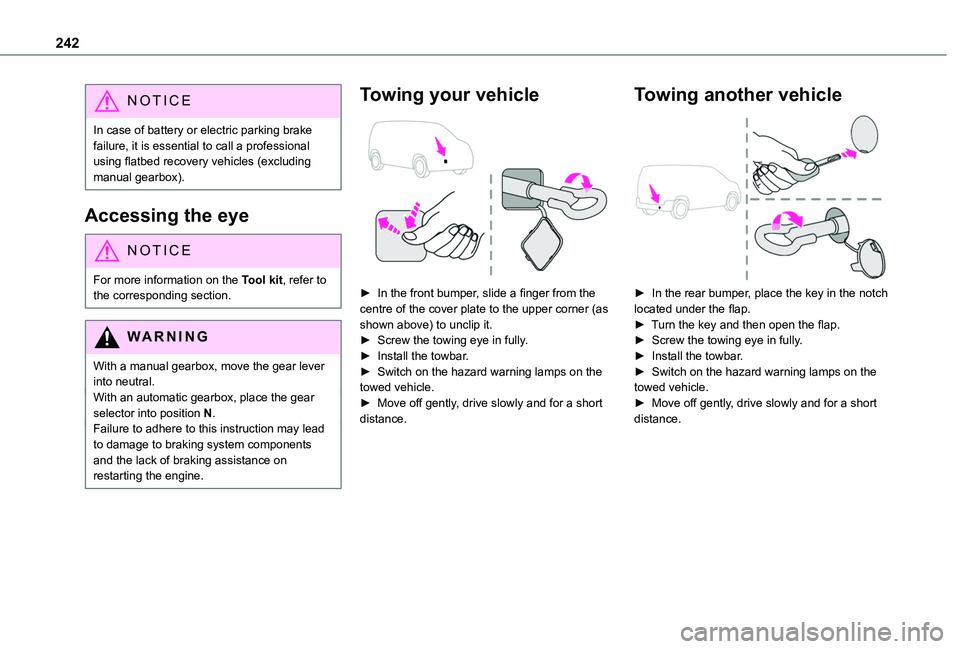
► In the front bumper, slide a finger from the centre of the cover plate to the upper corner (as shown above) to unclip it.► Screw the towing eye in fully.► Install the towbar.► Switch on the hazard warning lamps on the towed vehicle.► Move off gently, drive slowly and for a short distance.
Towing another vehicle
► In the rear bumper, place the key in the notch located under the flap.► Turn the key and then open the flap.► Screw the towing eye in fully.► Install the towbar.► Switch on the hazard warning lamps on the towed vehicle.► Move off gently, drive slowly and for a short distance.
Page 243 of 320
243
Technical data
9
Dimensions (mm)
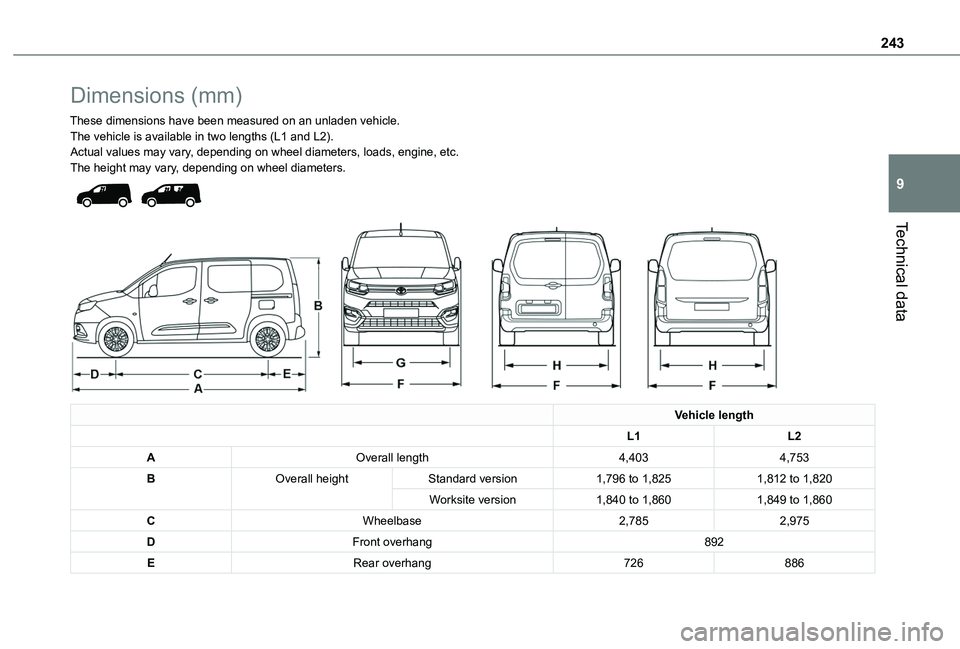
These dimensions have been measured on an unladen vehicle.The vehicle is available in two lengths (L1 and L2).Actual values may vary, depending on wheel diameters, loads, engine, etc.The height may vary, depending on wheel diameters.
Vehicle length
L1L2
AOverall length4,4034,753
BOverall heightStandard version1,796 to 1,8251,812 to 1,820
Worksite version1,840 to 1,8601,849 to 1,860
CWheelbase2,7852,975
DFront overhang892
ERear overhang726886
Page 248 of 320
248
Engine technical data and
towed loads
Engines
The engine characteristics are given in the vehicle's registration document, as well as in sales brochures.Only the values available at the time of publication are presented in the tables.Contact any authorized Toyota retailer or Toyota authorized repairer, or any reliable repairer to obtain missing values.
NOTIC E
The maximum power corresponds to the value type-approved on a test bed, under conditions defined by European legislation (Directive 1999/99/EC).
For more information, contact a any authorized Toyota retailer or Toyota authorized repairer, or any reliable repairer.
Weights and towed loads
The weights and towed loads relating to the vehicle are indicated on the registration document, as well as in sales brochures.These values are also indicated on the manufacturer's plate or label.For more information, contact a any authorized Toyota retailer or Toyota authorized repairer, or any reliable repairer.The GTW (Gross Train Weight) and towed load values indicated are valid up to a maximum altitude of 1,000 metres. The towed load value must be reduced by 10% for each additional 1,000 metres of altitude.The maximum authorised nose weight corresponds to the weight permitted on the towball.
WARNI NG
When exterior temperatures are high, the vehicle performance may be limited in order to protect the engine. When the exterior temperature is higher than 37°C, reduce the towed weight.
WARNI NG
Towing even with a lightly loaded vehicle can adversely affect its road holding.Braking distances are increased when towing a trailer.When using a vehicle to tow, never exceed a speed of 62 mph (100 km/h) (observe the local legislation in force).
NOTIC E
If the exterior temperature is high, it is recommended that the engine is allowed to idle for 1 to 2 minutes after the vehicle comes to a stop, to facilitate its cooling.
Page 249 of 320
249
Technical data
9
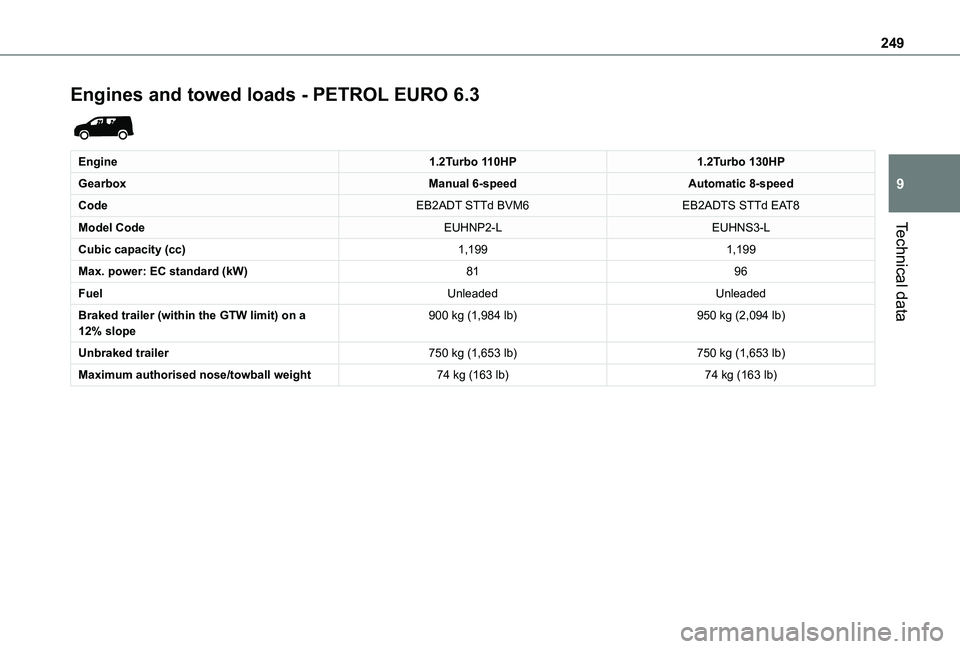
Engines and towed loads - PETROL EURO 6.3
Engine1.2Turbo 110HP1.2Turbo 130HP
GearboxManual 6-speedAutomatic 8-speed
CodeEB2ADT STTd BVM6EB2ADTS STTd EAT8
Model CodeEUHNP2-LEUHNS3-L
Cubic capacity (cc)1,1991,199
Max. power: EC standard (kW)8196
FuelUnleadedUnleaded
Braked trailer (within the GTW limit) on a 12% slope900 kg (1,984 lb)950 kg (2,094 lb)
Unbraked trailer750 kg (1,653 lb)750 kg (1,653 lb)
Maximum authorised nose/towball weight74 kg (163 lb)74 kg (163 lb)
Page 250 of 320
250
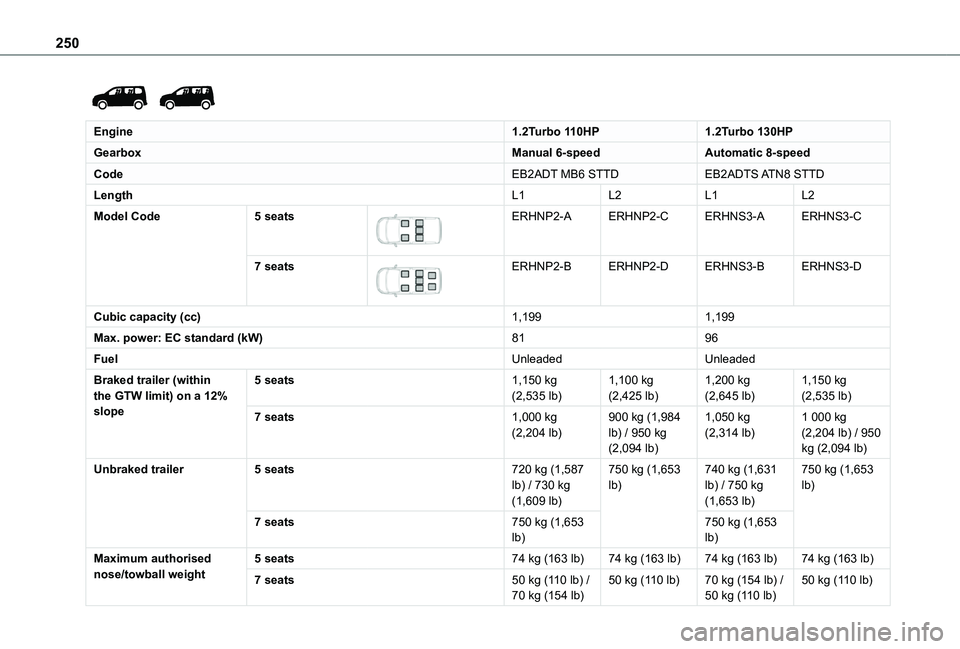
Engine1.2Turbo 110HP1.2Turbo 130HP
GearboxManual 6-speedAutomatic 8-speed
CodeEB2ADT MB6 STTDEB2ADTS ATN8 STTD
LengthL1L2L1L2
Model Code5 seats
ERHNP2-AERHNP2-CERHNS3-AERHNS3-C
7 seats
ERHNP2-BERHNP2-DERHNS3-BERHNS3-D
Cubic capacity (cc)1,1991,199
Max. power: EC standard (kW)8196
FuelUnleadedUnleaded
Braked trailer (within the GTW limit) on a 12% slope
5 seats1,150 kg (2,535 lb)1,100 kg (2,425 lb)1,200 kg (2,645 lb)1,150 kg (2,535 lb)
7 seats1,000 kg (2,204 lb)900 kg (1,984 lb) / 950 kg
(2,094 lb)
1,050 kg (2,314 lb)1 000 kg (2,204 lb) / 950
kg (2,094 lb)
Unbraked trailer5 seats720 kg (1,587 lb) / 730 kg (1,609 lb)
750 kg (1,653 lb)740 kg (1,631 lb) / 750 kg (1,653 lb)
750 kg (1,653 lb)
7 seats750 kg (1,653 lb)750 kg (1,653 lb)
Maximum authorised nose/towball weight5 seats74 kg (163 lb)74 kg (163 lb)74 kg (163 lb)74 kg (163 lb)
7 seats50 kg (110 lb) /
70 kg (154 lb)
50 kg (110 lb)70 kg (154 lb) /
50 kg (110 lb)
50 kg (110 lb)
Page 251 of 320
251
Technical data
9
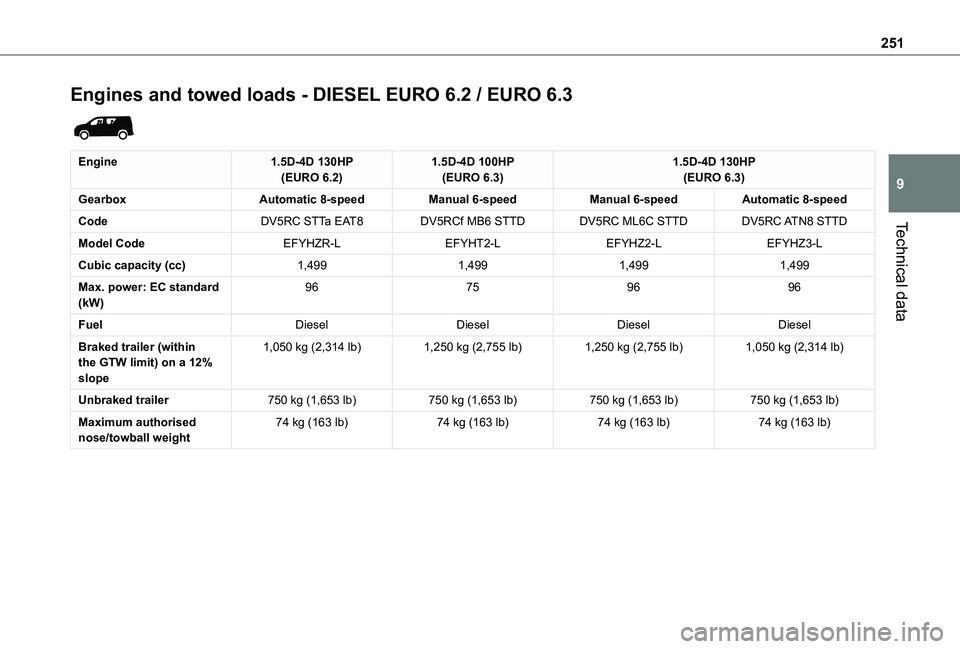
Engines and towed loads - DIESEL EURO 6.2 / EURO 6.3
Engine1.5D-4D 130HP(EURO 6.2)1.5D-4D 100HP(EURO 6.3)1.5D-4D 130HP(EURO 6.3)
GearboxAutomatic 8-speedManual 6-speedManual 6-speedAutomatic 8-speed
CodeDV5RC STTa EAT8DV5RCf MB6 STTDDV5RC ML6C STTDDV5RC ATN8 STTD
Model CodeEFYHZR-LEFYHT2-LEFYHZ2-LEFYHZ3-L
Cubic capacity (cc)1,4991,4991,4991,499
Max. power: EC standard (kW)96759696
FuelDieselDieselDieselDiesel
Braked trailer (within the GTW limit) on a 12% slope
1,050 kg (2,314 lb)1,250 kg (2,755 lb)1,250 kg (2,755 lb)1,050 kg (2,314 lb)
Unbraked trailer 750 kg (1,653 lb)750 kg (1,653 lb)750 kg (1,653 lb)750 kg (1,653 lb)
Maximum authorised nose/towball weight 74 kg (163 lb)74 kg (163 lb)74 kg (163 lb)74 kg (163 lb)
Page 252 of 320
252
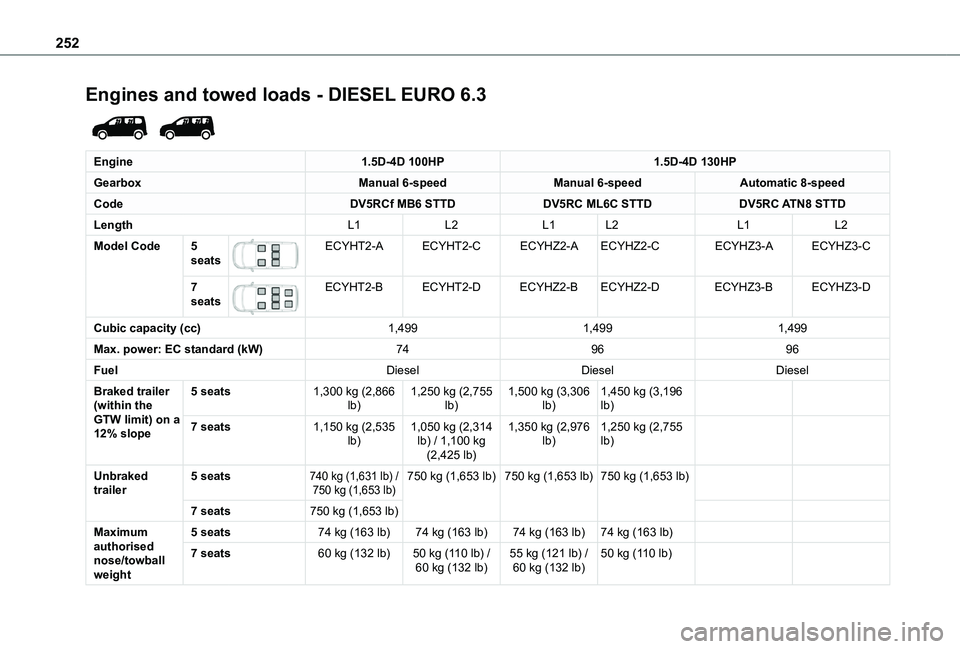
Engines and towed loads - DIESEL EURO 6.3
Engine1.5D-4D 100HP1.5D-4D 130HP
GearboxManual 6-speedManual 6-speedAutomatic 8-speed
CodeDV5RCf MB6 STTDDV5RC ML6C STTDDV5RC ATN8 STTD
LengthL1L2L1L2L1L2
Model Code5 seats
ECYHT2-AECYHT2-CECYHZ2-AECYHZ2-CECYHZ3-AECYHZ3-C
7 seats
ECYHT2-BECYHT2-DECYHZ2-BECYHZ2-DECYHZ3-BECYHZ3-D
Cubic capacity (cc)1,4991,4991,499
Max. power: EC standard (kW)749696
FuelDieselDieselDiesel
Braked trailer (within the GTW limit) on a 12% slope
5 seats1,300 kg (2,866 lb)1,250 kg (2,755 lb)1,500 kg (3,306 lb)1,450 kg (3,196 lb)
7 seats1,150 kg (2,535 lb)1,050 kg (2,314 lb) / 1,100 kg (2,425 lb)
1,350 kg (2,976 lb)1,250 kg (2,755 lb)
Unbraked trailer5 seats740 kg (1,631 lb) / 750 kg (1,653 lb)750 kg (1,653 lb)750 kg (1,653 lb)750 kg (1,653 lb)
7 seats750 kg (1,653 lb)
Maximum authorised nose/towball weight
5 seats74 kg (163 lb)74 kg (163 lb)74 kg (163 lb)74 kg (163 lb)
7 seats60 kg (132 lb)50 kg (110 lb) / 60 kg (132 lb)55 kg (121 lb) / 60 kg (132 lb)50 kg (110 lb)