wheel TOYOTA PROACE VERSO 2017 Workshop Manual
[x] Cancel search | Manufacturer: TOYOTA, Model Year: 2017, Model line: PROACE VERSO, Model: TOYOTA PROACE VERSO 2017Pages: 504, PDF Size: 81.64 MB
Page 292 of 504
292
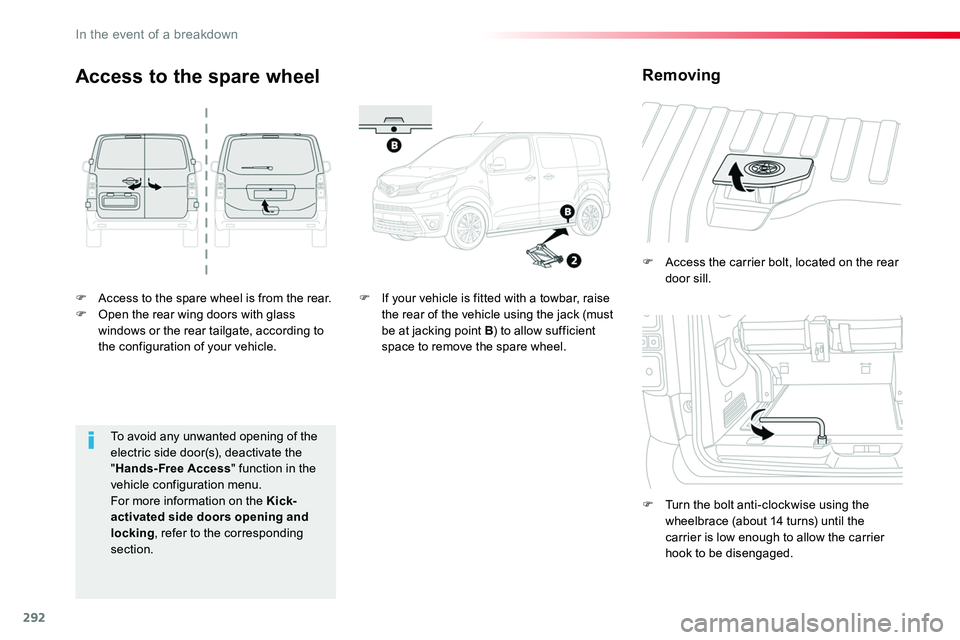
F Access to the spare wheel is from the rear.F Open the rear wing doors with glass windows or the rear tailgate, according to the configuration of your vehicle.
F Access the carrier bolt, located on the rear door sill.
F Turn the bolt anti-clockwise using the wheelbrace (about 14 turns) until the carrier is low enough to allow the carrier hook to be disengaged.
Access to the spare wheel
F If your vehicle is fitted with a towbar, raise the rear of the vehicle using the jack (must be at jacking point B) to allow sufficient space to remove the spare wheel.
Removing
To avoid any unwanted opening of the electric side door(s), deactivate the "Hands-Free Access" function in the vehicle configuration menu.For more information on the Kick-activated side doors opening and
locking, refer to the corresponding section.
In the event of a breakdown
Page 293 of 504
293
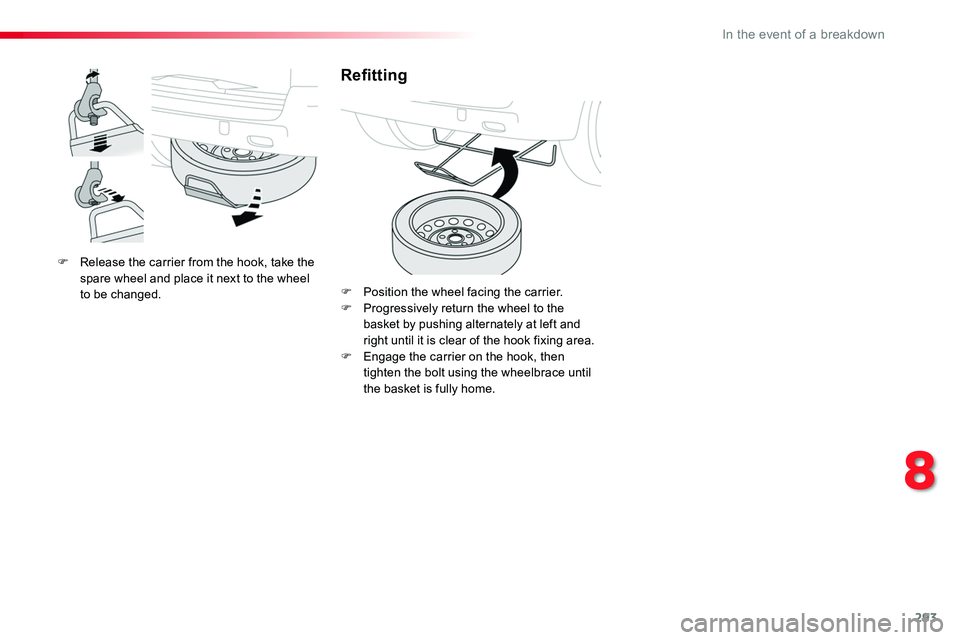
F Release the carrier from the hook, take the spare wheel and place it next to the wheel to be changed.
Refitting
F Position the wheel facing the carrier.F Progressively return the wheel to the basket by pushing alternately at left and right until it is clear of the hook fixing area.F Engage the carrier on the hook, then tighten the bolt using the wheelbrace until the basket is fully home.
8
In the event of a breakdown
Page 294 of 504
294
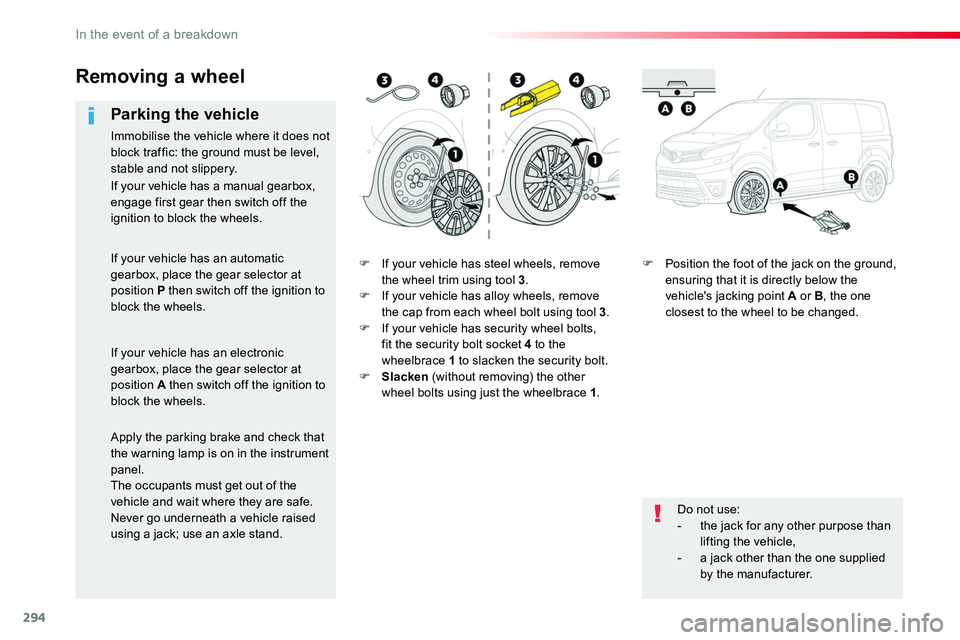
F If your vehicle has steel wheels, remove the wheel trim using tool 3.F If your vehicle has alloy wheels, remove the cap from each wheel bolt using tool 3.F If your vehicle has security wheel bolts, fit the security bolt socket 4 to the wheelbrace 1 to slacken the security bolt.F Slacken (without removing) the other wheel bolts using just the wheelbrace 1.
F Position the foot of the jack on the ground, ensuring that it is directly below the vehicle's jacking point A or B, the one closest to the wheel to be changed.
Removing a wheel
Parking the vehicle
Immobilise the vehicle where it does not block traffic: the ground must be level, stable and not slippery.
Do not use:- the jack for any other purpose than lifting the vehicle,- a jack other than the one supplied by the manufacturer.
If your vehicle has a manual gearbox, engage first gear then switch off the ignition to block the wheels.
If your vehicle has an automatic gearbox, place the gear selector at position P then switch off the ignition to block the wheels.
If your vehicle has an electronic gearbox, place the gear selector at position A then switch off the ignition to block the wheels.
Apply the parking brake and check that the warning lamp is on in the instrument panel.The occupants must get out of the vehicle and wait where they are safe.Never go underneath a vehicle raised using a jack; use an axle stand.
In the event of a breakdown
Page 295 of 504
295
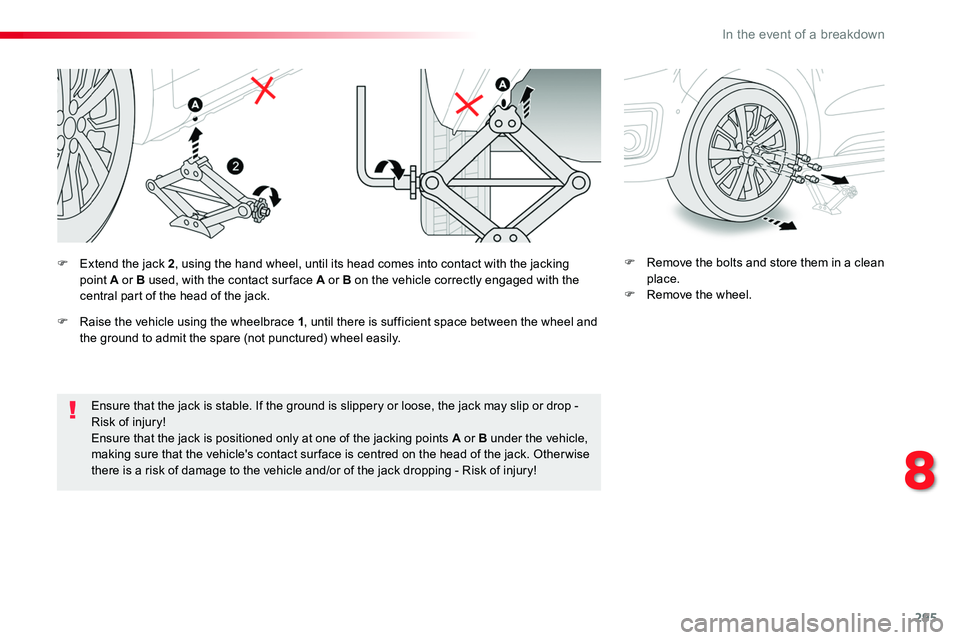
Ensure that the jack is stable. If the ground is slippery or loose, the jack may slip or drop - Risk of injury!
Ensure that the jack is positioned only at one of the jacking points A or B under the vehicle, making sure that the vehicle's contact sur face is centred on the head of the jack. Other wise there is a risk of damage to the vehicle and/or of the jack dropping - Risk of injury!
F Remove the bolts and store them in a clean place.F Remove the wheel.
F Extend the jack 2, using the hand wheel, until its head comes into contact with the jacking point A or B used, with the contact sur face A or B on the vehicle correctly engaged with the central part of the head of the jack.
F Raise the vehicle using the wheelbrace 1, until there is sufficient space between the wheel and the ground to admit the spare (not punctured) wheel easily.
8
In the event of a breakdown
Page 296 of 504
296
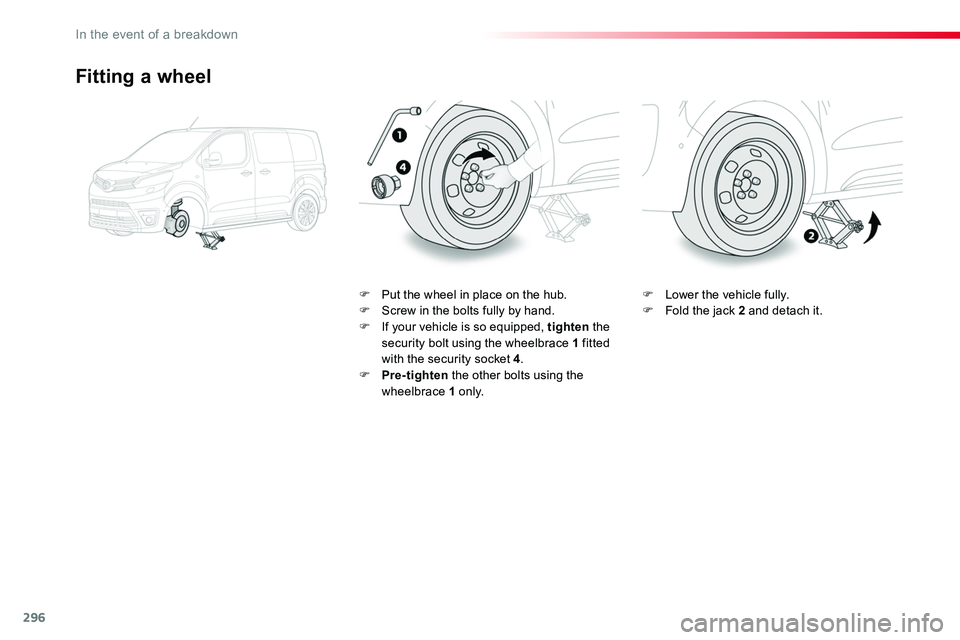
Fitting a wheel
F Put the wheel in place on the hub.F Screw in the bolts fully by hand.F If your vehicle is so equipped, tighten the security bolt using the wheelbrace 1 fitted with the security socket 4.F Pre-tighten the other bolts using the wheelbrace 1 o n l y.
F Lower the vehicle fully.F Fold the jack 2 and detach it.
In the event of a breakdown
Page 297 of 504
297
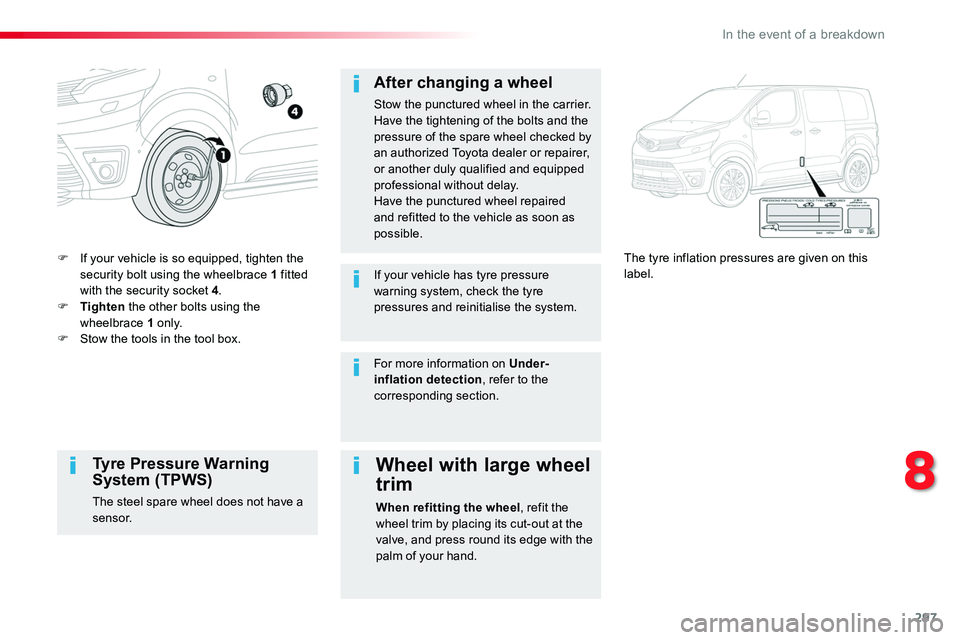
F If your vehicle is so equipped, tighten the security bolt using the wheelbrace 1 fitted with the security socket 4.F Tighten the other bolts using the wheelbrace 1 o n l y.F Stow the tools in the tool box.
The tyre inflation pressures are given on this label.
After changing a wheel
Stow the punctured wheel in the carrier.Have the tightening of the bolts and the pressure of the spare wheel checked by an authorized Toyota dealer or repairer, or another duly qualified and equipped professional without delay.Have the punctured wheel repaired and refitted to the vehicle as soon as possible.
If your vehicle has tyre pressure warning system, check the tyre pressures and reinitialise the system.
Tyre Pressure Warning System (TPWS)
The steel spare wheel does not have a sensor.
Wheel with large wheel
trim
When refitting the wheel, refit the wheel trim by placing its cut-out at the valve, and press round its edge with the palm of your hand.
For more information on Under-inflation detection, refer to the corresponding section.
8
In the event of a breakdown
Page 321 of 504
321
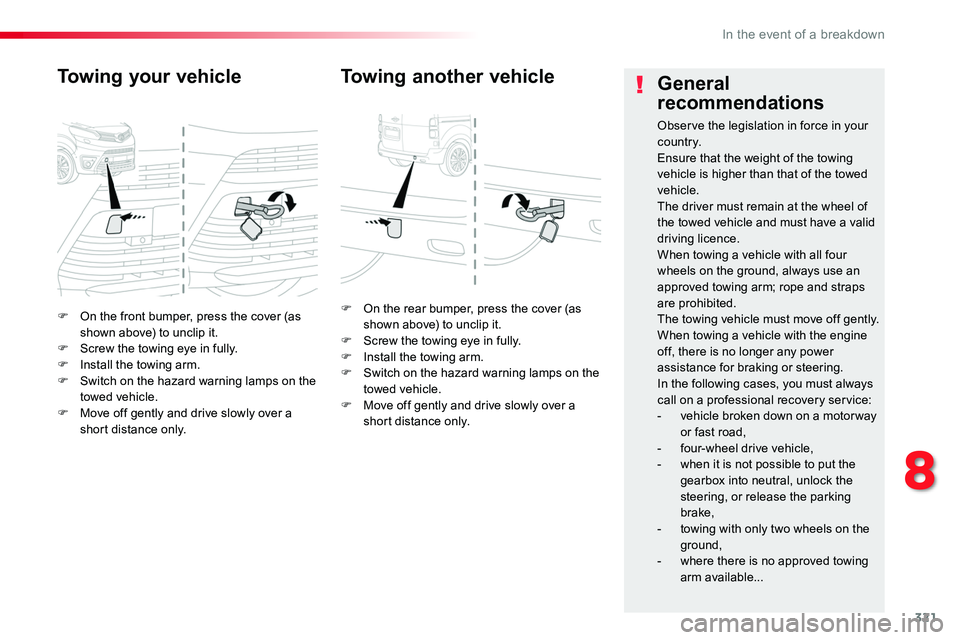
F On the front bumper, press the cover (as shown above) to unclip it.F Screw the towing eye in fully.F Install the towing arm.F Switch on the hazard warning lamps on the towed vehicle.F Move off gently and drive slowly over a short distance only.
Towing your vehicle
F On the rear bumper, press the cover (as shown above) to unclip it.F Screw the towing eye in fully.F Install the towing arm.F Switch on the hazard warning lamps on the towed vehicle.F Move off gently and drive slowly over a short distance only.
Towing another vehicleGeneral
recommendations
Observe the legislation in force in your c o unt r y.Ensure that the weight of the towing vehicle is higher than that of the towed vehicle.The driver must remain at the wheel of the towed vehicle and must have a valid driving licence.When towing a vehicle with all four wheels on the ground, always use an approved towing arm; rope and straps are prohibited.The towing vehicle must move off gently.When towing a vehicle with the engine off, there is no longer any power assistance for braking or steering.In the following cases, you must always call on a professional recovery service:- vehicle broken down on a motor way or fast road,- four-wheel drive vehicle,- when it is not possible to put the gearbox into neutral, unlock the
steering, or release the parking brake,- towing with only two wheels on the
ground,- where there is no approved towing arm available...
8
In the event of a breakdown
Page 327 of 504
327
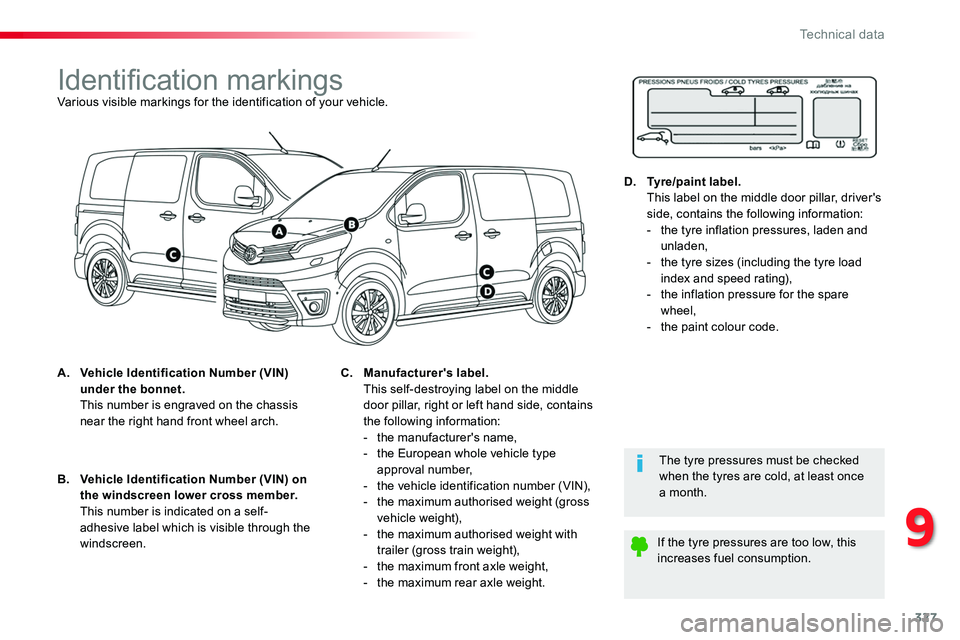
Identification markingsVarious visible markings for the identification of your vehicle.
A. Vehicle Identification Number (VIN) under the bonnet. This number is engraved on the chassis near the right hand front wheel arch.
The tyre pressures must be checked when the tyres are cold, at least once a month.
If the tyre pressures are too low, this increases fuel consumption.
B. Vehicle Identification Number (VIN) on the windscreen lower cross member. This number is indicated on a self-adhesive label which is visible through the
windscreen.
C. Manufacturer's label. This self-destroying label on the middle door pillar, right or left hand side, contains the following information:
- the manufacturer's name,- the European whole vehicle type approval number,- the vehicle identification number (VIN),- the maximum authorised weight (gross vehicle weight),- the maximum authorised weight with trailer (gross train weight),- the maximum front axle weight,- the maximum rear axle weight.
D. Tyre/paint label. This label on the middle door pillar, driver's side, contains the following information:- the tyre inflation pressures, laden and unladen,- the tyre sizes (including the tyre load index and speed rating),- the inflation pressure for the spare wheel,- the paint colour code.
9
Technical data
Page 337 of 504
337
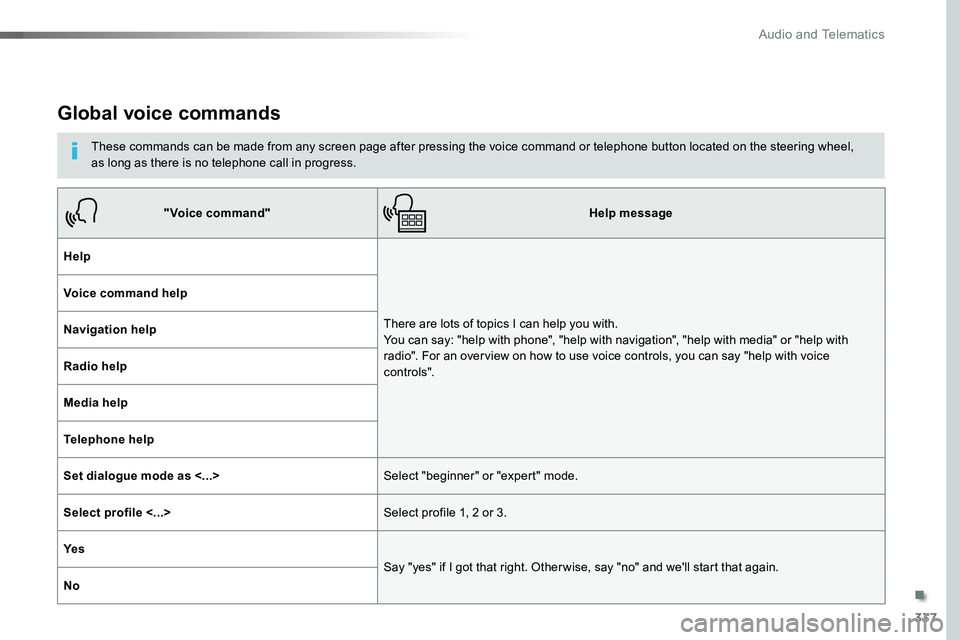
Global voice commands
These commands can be made from any screen page after pressing the voice command or telephone button located on the steering wheel, as long as there is no telephone call in progress.
"Voice command"Help message
Help
There are lots of topics I can help you with. You can say: "help with phone", "help with navigation", "help with media" or "help with radio". For an overview on how to use voice controls, you can say "help with voice c ont ro ls".
Voice command help
Navigation help
Radio help
Media help
Telephone help
Set dialogue mode as <...>Select "beginner" or "expert" mode.
Select profile <...>Select profile 1, 2 or 3.
Ye s
Say "yes" if I got that right. Other wise, say "no" and we'll start that again.
No
.
Audio and Telematics
Page 338 of 504
338
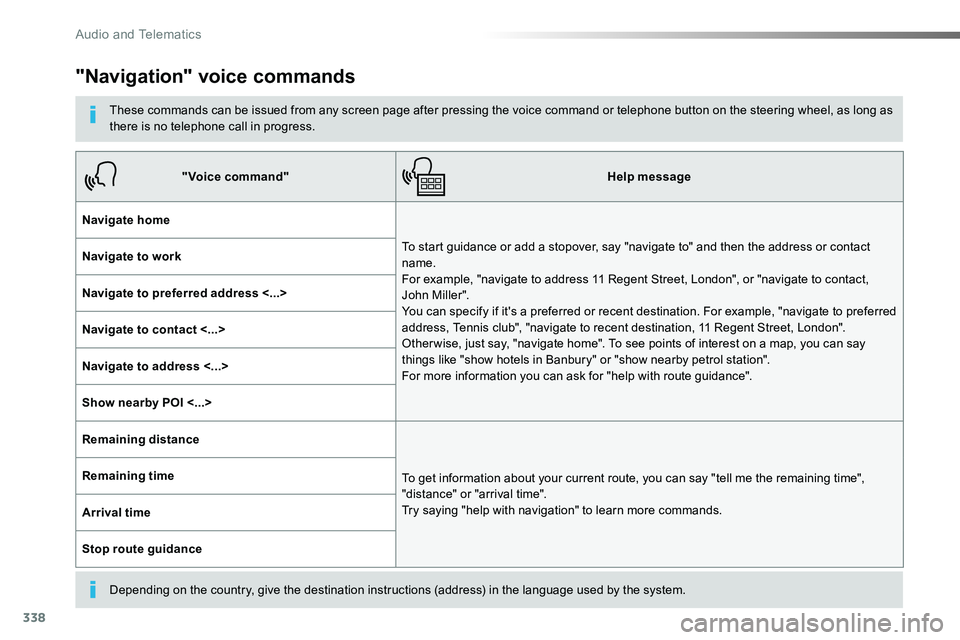
"Navigation" voice commands
These commands can be issued from any screen page after pressing the voice command or telephone button on the steering wheel, as long as there is no telephone call in progress.
Depending on the country, give the destination instructions (address) in the language used by the system.
"Voice command"Help message
Navigate home
To start guidance or add a stopover, say "navigate to" and then the address or contact name. For example, "navigate to address 11 Regent Street, London", or "navigate to contact, John Miller". You can specify if it's a preferred or recent destination. For example, "navigate to preferred address, Tennis club", "navigate to recent destination, 11 Regent Street, London". Other wise, just say, "navigate home". To see points of interest on a map, you can say things like "show hotels in Banbury" or "show nearby petrol station". For more information you can ask for "help with route guidance".
Navigate to work
Navigate to preferred address <...>
Navigate to contact <...>
Navigate to address <...>
Show nearby POI <...>
Remaining distance
To get information about your current route, you can say "tell me the remaining time", "distance" or "arrival time". Try saying "help with navigation" to learn more commands.
Remaining time
Arrival time
Stop route guidance
Audio and Telematics