fog TOYOTA PROACE VERSO 2018 User Guide
[x] Cancel search | Manufacturer: TOYOTA, Model Year: 2018, Model line: PROACE VERSO, Model: TOYOTA PROACE VERSO 2018Pages: 504, PDF Size: 80.57 MB
Page 238 of 504
238
In the event of a fault with the adaptive cruise control, you are alerted by an audible signal and display of the message message "Driving aid functions fault".Have the system checked by an authorized Toyota dealer or repairer, or another duly qualified and equipped professional.
Operating faultThe adaptive cruise control operates by day and at night, in fog or moderate rainfall.
When the cruise control is working, take care if making a maintained press on one of the cruise control programmed speed modification buttons: this can lead to a very quick change in the speed of your vehicle.Do not use the adaptive cruise control on slippery sur faces or in heavy traffic.
When descending a steep hill, the cruise control may not be able to prevent the vehicle from exceeding the programmed speed.When ascending a steep hill or when towing, it might not be possible to achieve or maintain the programmed speed.
The use of mats not approved by Toyota may inter fere with the operation of the adaptive cruise control.To avoid any risk of jamming the pedals:- ensure that mats are secured c o r r e c t l y,- never fit one mat on top of another.It is recommended that you always keep
your feet close to the pedals.
If the difference between the programmed speed setting and the speed of the vehicle in front is too great, the speed cannot be adjusted: the cruise control is automatically deactivated.
The system does not act on the braking system, but works only with engine braking.The regulation range is limited: there will no longer be any adjustment of speed if the difference between the programmed speed setting and the speed of the vehicle in front becomes too high.
The adaptive cruise control cannot in any circumstances replace the observation of speed limits, nor the need for the vigilance on the part of the driver.
Driving
Page 243 of 504
243
Deactivation / Activation of
the alert and the braking
By default, the function is automatically activated at every engine start.The deactivation or activation of the function is done in the vehicle configuration menu.
With the audio system
In the "Personalisation-configuration" menu, activate/deactivate "Auto. emergency braking".
Autonomous emergency braking system with Pedestrian Detection
If the driver does not brake sufficiently to avoid an accident, this system will complete the braking.This emergency braking system will not act if you press the brake pedal.
With the touch screen
In the vehicle settings menu, activate/deactivate "Collision risk alert and automatic
braking".
In the event of a fault, you are alerted by the illumination of this warning lamp, accompanied by an audible signal and a message.Contact an authorized Toyota dealer or repairer, or another duly qualified and equipped professional.
Operating fault
There may be inter ference in the operation of the camera or it not work at all in the following situations:- poor visibility (inadequate street lighting, falling snow or rain, fog, ...),- dazzle (headlamps of an approaching vehicle on the other side of the road, low sun, reflection on a wet road, leaving a tunnel, alternating between light and shade, ...),- the area in front of the windscreen: dirty, misty, frosty, snow-covered,
damaged or covered by a sticker.The operation of the radar, located in the front bumper, may be disturbed in certain weather conditions: with accumulations of snow, ice, mud, ...
6
Driving
Page 246 of 504
246
Operating faultWith the touch screen
In the Driving menu, activate/deactivate "Lane departure warning".
Contact an authorized Toyota dealer or repairer, or another duly qualified and equipped professional.
The indicator lamp in this button flashes.
The button flashes and a fault appears.
Depending on your vehicle's equipment:
The detection may be impeded:- if the markings on the ground are worn and do not contrast well with the road sur face,- if the windscreen is dirty,- in certain severe weather conditions: fog, heavy rain, snow, shade, bright sunlight and direct exposure to the sun (low sun,
leaving a tunnel, ...).or
Driving
Page 248 of 504
248
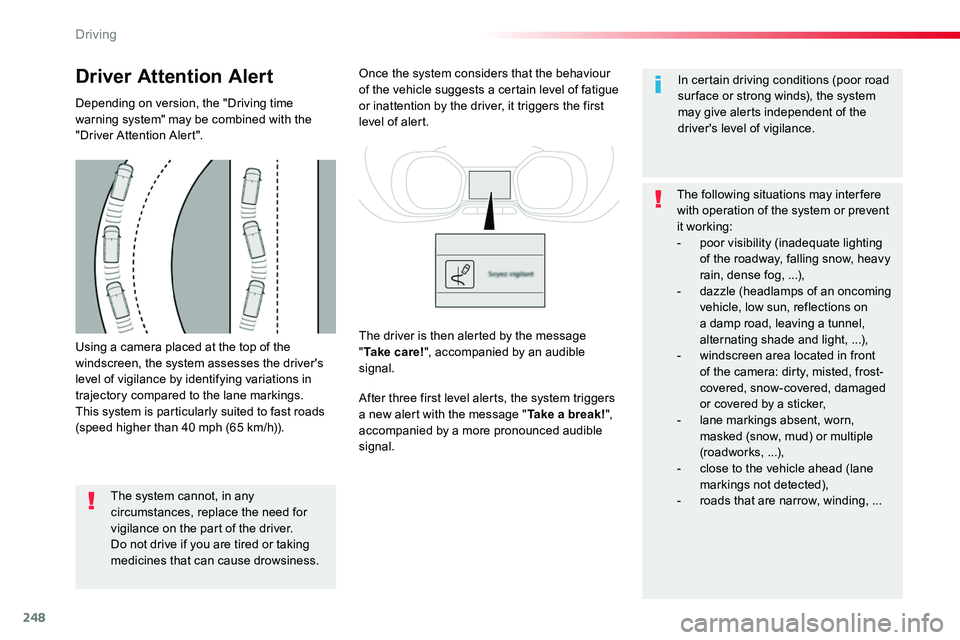
Using a camera placed at the top of the windscreen, the system assesses the driver's level of vigilance by identifying variations in trajectory compared to the lane markings.This system is particularly suited to fast roads (speed higher than 40 mph (65 km/h)).
Driver Attention Alert
Depending on version, the "Driving time warning system" may be combined with the "Driver Attention Alert".
The system cannot, in any circumstances, replace the need for vigilance on the part of the driver.Do not drive if you are tired or taking medicines that can cause drowsiness.
Once the system considers that the behaviour of the vehicle suggests a certain level of fatigue or inattention by the driver, it triggers the first level of alert.
After three first level alerts, the system triggers a new alert with the message "Take a break!", accompanied by a more pronounced audible signal.
In certain driving conditions (poor road sur face or strong winds), the system may give alerts independent of the driver's level of vigilance.
The following situations may inter fere with operation of the system or prevent
it working:- poor visibility (inadequate lighting of the roadway, falling snow, heavy rain, dense fog, ...),- dazzle (headlamps of an oncoming vehicle, low sun, reflections on a damp road, leaving a tunnel, alternating shade and light, ...),- windscreen area located in front of the camera: dirty, misted, frost-covered, snow-covered, damaged or covered by a sticker,- lane markings absent, worn, masked (snow, mud) or multiple (roadworks, ...),- close to the vehicle ahead (lane markings not detected),- roads that are narrow, winding, ...
The driver is then alerted by the message "Ta k e c a r e !", accompanied by an audible signal.
Driving
Page 251 of 504
251
Operating fault
Have it checked by an authorized Toyota dealer or repairer, or another duly qualified and equipped professional.
The system may suffer temporary interference in certain weather conditions (rain, hail...).In particular, driving on a wet sur face or moving from a dry area to a wet area can cause false alerts (for example, the presence of a fog of water droplets in the blind spot angle is interpreted as a vehicle).In bad or wintry weather, ensure that the sensors are not covered by mud, ice or snow.Take care not to cover the warning zone in the door mirrors or the detection zones on the front and rear bumpers with adhesive labels or other objects; they may hamper the correct operation of the system.
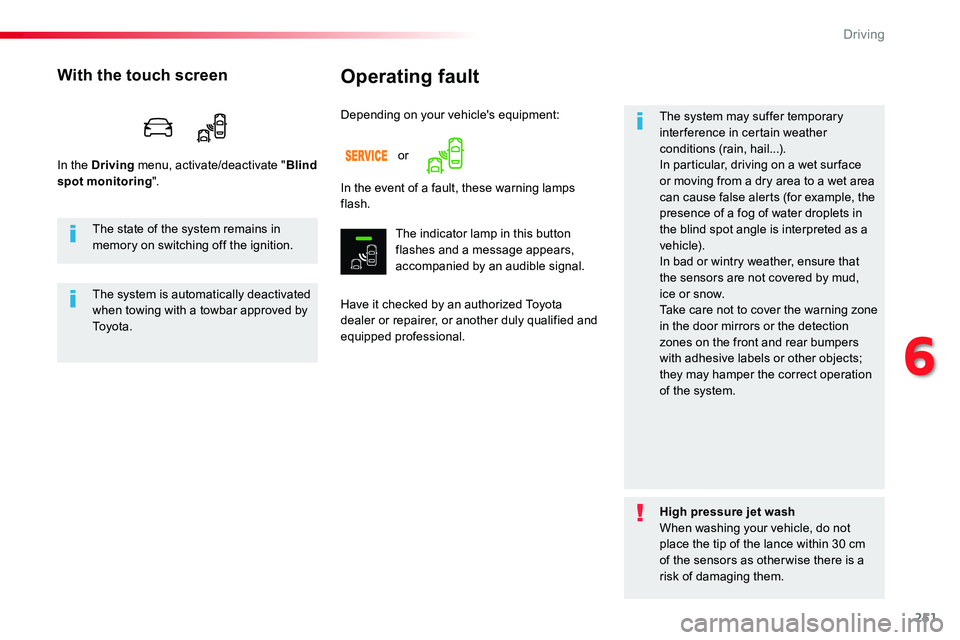
Depending on your vehicle's equipment:
With the touch screen
In the Driving menu, activate/deactivate "Blind spot monitoring".In the event of a fault, these warning lamps flash.
The indicator lamp in this button flashes and a message appears, accompanied by an audible signal.
The state of the system remains in memory on switching off the ignition.
The system is automatically deactivated when towing with a towbar approved by To y o t a .
High pressure jet washWhen washing your vehicle, do not place the tip of the lance within 30 cm of the sensors as otherwise there is a risk of damaging them.
or
6
Driving
Page 267 of 504
267
Accessories
A wide range of accessories and genuine parts is available from the Toyota dealer network.These accessories and parts are all suitable for your vehicle and benefit from Toyota's recommendation and warranty.
"Comfort"
Door deflectors, cigarette lighter, boot dividers, coat hanger fixed to head restraint, front and rear parking sensors, styling mudflaps, boot management system, ...
"Transport solutions"
Boot liners, roof bars, bicycle carrier on roof bars, ski carrier, roof box, towbar harness, ...Tow bar, which must be fitted by an authorized Toyota dealer or repairer, or another duly qualified and equipped professional.
"Styling"
Wheel trims, wheel caps, door sills, gear lever knobs, ...
"Security and safety"
Anti-theft alarm, window engraving, wheel security bolts, child seats, breathalyzer, first aid kit, warning triangle, high visibility jacket, stolen
vehicle tracking system, fleet management unit, snow chains, tyre snow socks, front foglamps kit, ...
"Protection"
Mats*, seat covers compatible with lateral airbags, mud flaps, side protection rubbing strips, bumper protectors, loading area protection (on wood or plastic), rear sill finishers, rear mat, ...
The fitting of electrical equipment or accessories which are not recommended by Toyota may result in a failure of your vehicle's electronic system and excessive electrical consumption.Contact a Toyota dealer for information on the range of recommended equipment and accessories.
Installation of radio communication transmitters
Before installing any after-market radio communication transmitter, you can contact a Toyota dealer for the specification of transmitters which can be fitted (frequency, maximum power, aerial position, specific installation requirements), in line with the Vehicle Electromagnetic Compatibility Directive (2004/104/EC).
Depending on the legislation in force in the country, certain safety equipment may be compulsory: high visibility safety vests, warning triangles, breathalyzers, spare bulbs, spare fuses,
fire extinguisher, first aid kit, mud flaps at the rear of the vehicle.* To avoid any risk of jamming of the pedals:- ensure that the mat is positioned and secured correctly,- never fit one mat on top of another.
7
Practical information
Page 299 of 504
299
Front lamps
Xenon headlamps
For more information on Changing a bulb and in particular the types of bulb, refer to the corresponding section.
Halogen headlamps
For more information on Changing a bulb and in particular the types of bulb, refer to the corresponding section.
For H7 type bulbs with lugs... take care
to observe their correct installation so as to ensure the best lighting performance.
Front fog lamps
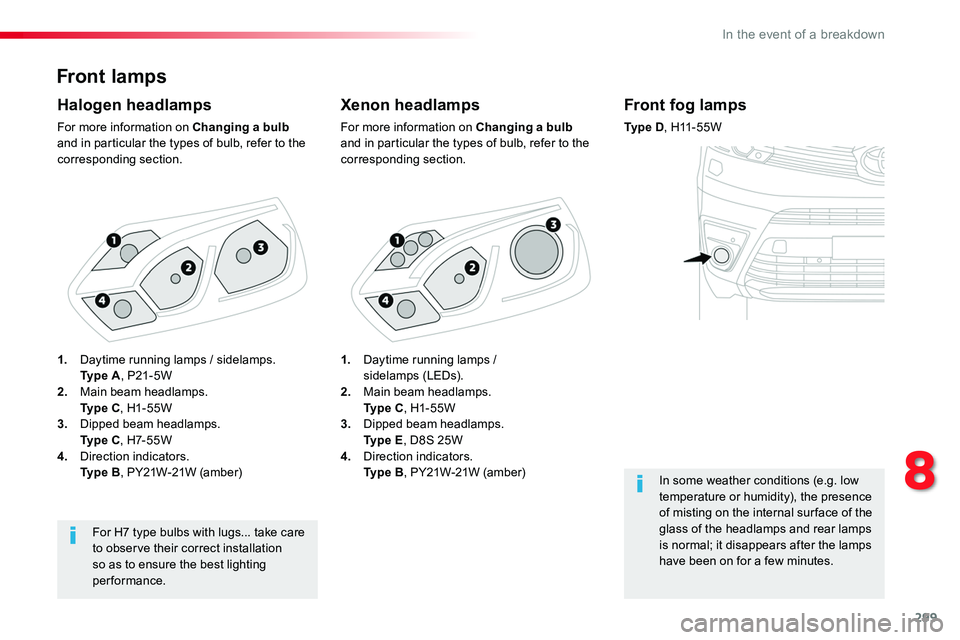
Ty p e D, H11-55W
In some weather conditions (e.g. low temperature or humidity), the presence of misting on the internal sur face of the glass of the headlamps and rear lamps is normal; it disappears after the lamps have been on for a few minutes.
1. Daytime running lamps / sidelamps (LEDs).2. Main beam headlamps. Ty p e C, H1-55W3. Dipped beam headlamps. Ty p e E, D8S 25W4. Direction indicators. Ty p e B, PY21W-21W (amber)
1. Daytime running lamps / sidelamps. Ty p e A, P21-5W 2. Main beam headlamps. Ty p e C, H1-55W3. Dipped beam headlamps. Ty p e C, H7-55W4. Direction indicators. Ty p e B, PY21W-21W (amber)
8
In the event of a breakdown
Page 304 of 504
304
Front foglamps
Ty p e C, H11-55W
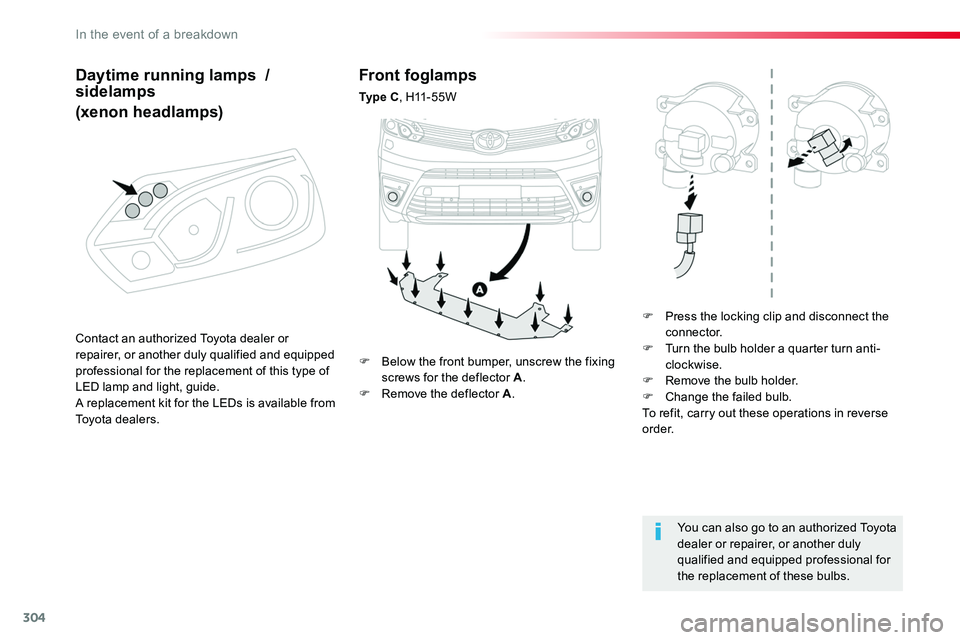
F Press the locking clip and disconnect the connector.F Turn the bulb holder a quarter turn anti-clockwise.F Remove the bulb holder.F Change the failed bulb.To refit, carry out these operations in reverse o r d e r.
You can also go to an authorized Toyota dealer or repairer, or another duly qualified and equipped professional for the replacement of these bulbs.
F Below the front bumper, unscrew the fixing screws for the deflector A.F Remove the deflector A.
Contact an authorized Toyota dealer or repairer, or another duly qualified and equipped professional for the replacement of this type of LED lamp and light, guide.A replacement kit for the LEDs is available from Toyota dealers.
Daytime running lamps / sidelamps
(xenon headlamps)
In the event of a breakdown
Page 305 of 504
305
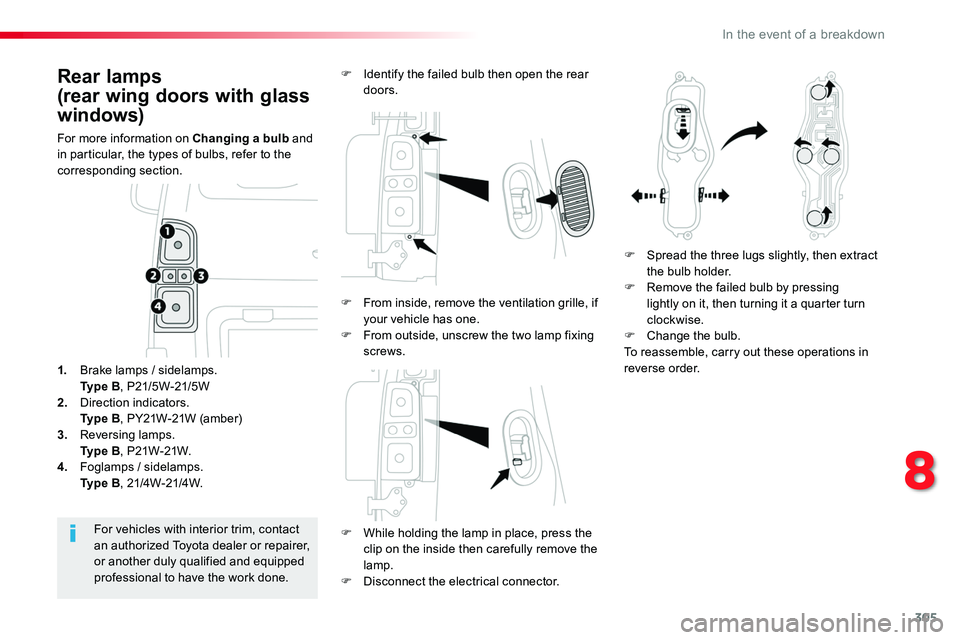
Rear lamps
(rear wing doors with glass
windows)
For more information on Changing a bulb and in particular, the types of bulbs, refer to the corresponding section.
F While holding the lamp in place, press the clip on the inside then carefully remove the lamp.F Disconnect the electrical connector.
For vehicles with interior trim, contact an authorized Toyota dealer or repairer, or another duly qualified and equipped professional to have the work done.
1. Brake lamps / sidelamps. Ty p e B, P21/5W-21/5W2. Direction indicators. Ty p e B, PY21W-21W (amber)3. Reversing lamps. Ty p e B, P21W-21W.4. Foglamps / sidelamps. Ty p e B, 21/4W-21/4W.
F Identify the failed bulb then open the rear doors.
F Spread the three lugs slightly, then extract the bulb holder.F Remove the failed bulb by pressing lightly on it, then turning it a quarter turn clockwise.F Change the bulb.To reassemble, carry out these operations in reverse order.
F From inside, remove the ventilation grille, if your vehicle has one.F From outside, unscrew the two lamp fixing screws.
8
In the event of a breakdown
Page 308 of 504
308
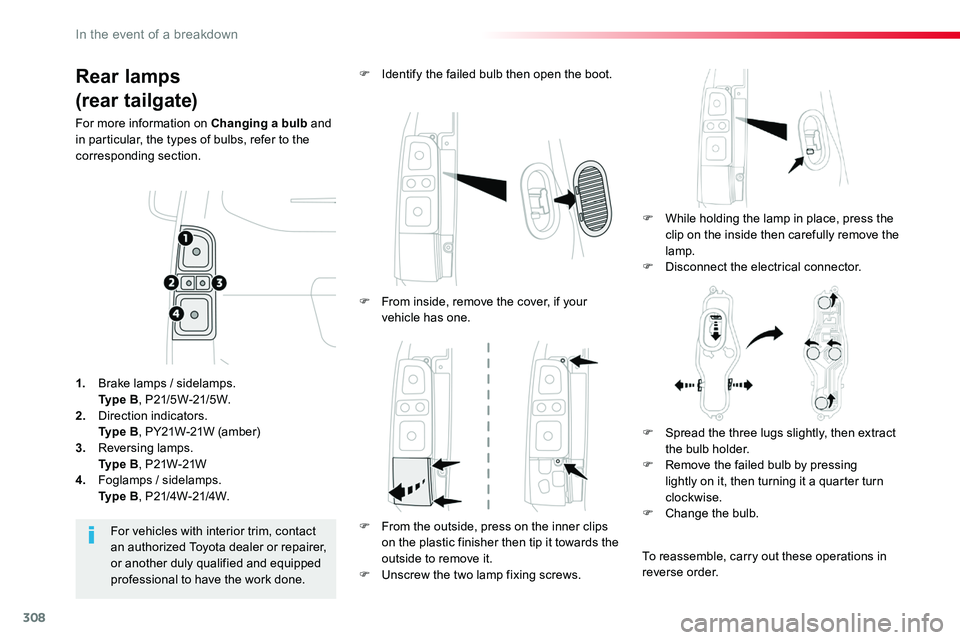
Rear lamps
(rear tailgate)
For more information on Changing a bulb and in particular, the types of bulbs, refer to the corresponding section.
F While holding the lamp in place, press the clip on the inside then carefully remove the lamp.F Disconnect the electrical connector.
F Identify the failed bulb then open the boot.
For vehicles with interior trim, contact an authorized Toyota dealer or repairer, or another duly qualified and equipped professional to have the work done.
1. Brake lamps / sidelamps. Ty p e B, P21/5W-21/5W.2. Direction indicators. Ty p e B, PY21W-21W (amber)3. Reversing lamps. Ty p e B, P21W-21W4. Foglamps / sidelamps. Ty p e B, P21/4W-21/4W.
F From inside, remove the cover, if your vehicle has one.
F From the outside, press on the inner clips on the plastic finisher then tip it towards the outside to remove it.F Unscrew the two lamp fixing screws.
F Spread the three lugs slightly, then extract the bulb holder.F Remove the failed bulb by pressing lightly on it, then turning it a quarter turn clockwise.F Change the bulb.
To reassemble, carry out these operations in reverse order.
In the event of a breakdown