ESP TOYOTA PROACE VERSO 2020 Workshop Manual
[x] Cancel search | Manufacturer: TOYOTA, Model Year: 2020, Model line: PROACE VERSO, Model: TOYOTA PROACE VERSO 2020Pages: 418, PDF Size: 39.32 MB
Page 163 of 418
163
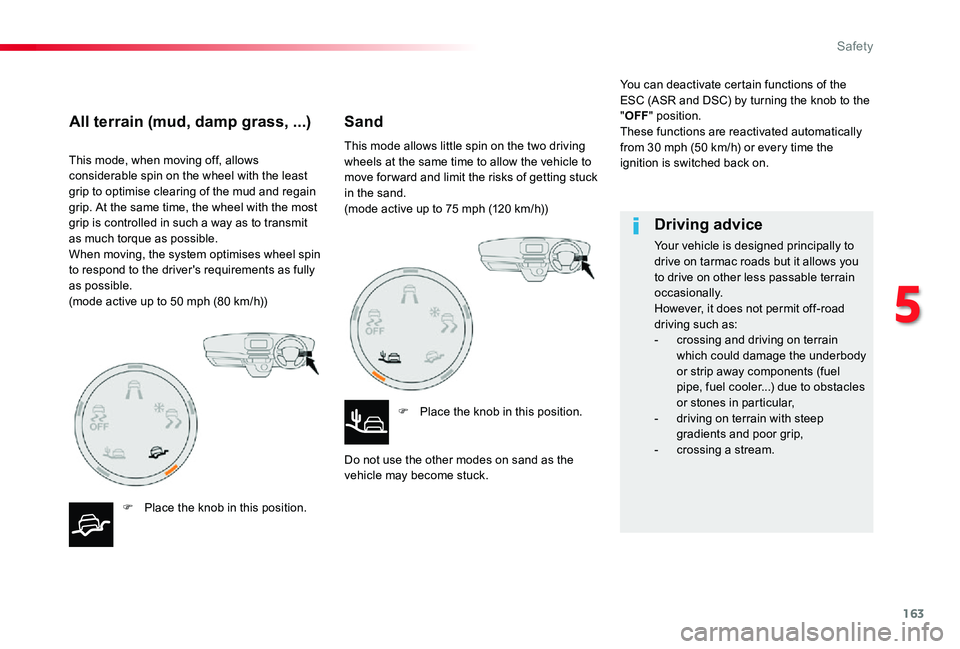
This mode, when moving off, allows considerable spin on the wheel with the least grip to optimise clearing of the mud and regain grip. At the same time, the wheel with the most grip is controlled in such a way as to transmit as much torque as possible.When moving, the system optimises wheel spin to respond to the driver's requirements as fully as possible.(mode active up to 50 mph (80 km/h))
F Place the knob in this position.
This mode allows little spin on the two driving wheels at the same time to allow the vehicle to move for ward and limit the risks of getting stuck in the sand.(mode active up to 75 mph (120 km/h))
F Place the knob in this position.
Do not use the other modes on sand as the vehicle may become stuck.
You can deactivate certain functions of the ESC (ASR and DSC) by turning the knob to the "OFF" position.These functions are reactivated automatically from 30 mph (50 km/h) or every time the ignition is switched back on.
All terrain (mud, damp grass, ...)Sand
Driving advice
Your vehicle is designed principally to drive on tarmac roads but it allows you to drive on other less passable terrain occasionally.However, it does not permit off-road driving such as:- crossing and driving on terrain which could damage the underbody or strip away components (fuel pipe, fuel cooler...) due to obstacles or stones in particular,- driving on terrain with steep gradients and poor grip,- crossing a stream.
5
Safety
Page 166 of 418
166
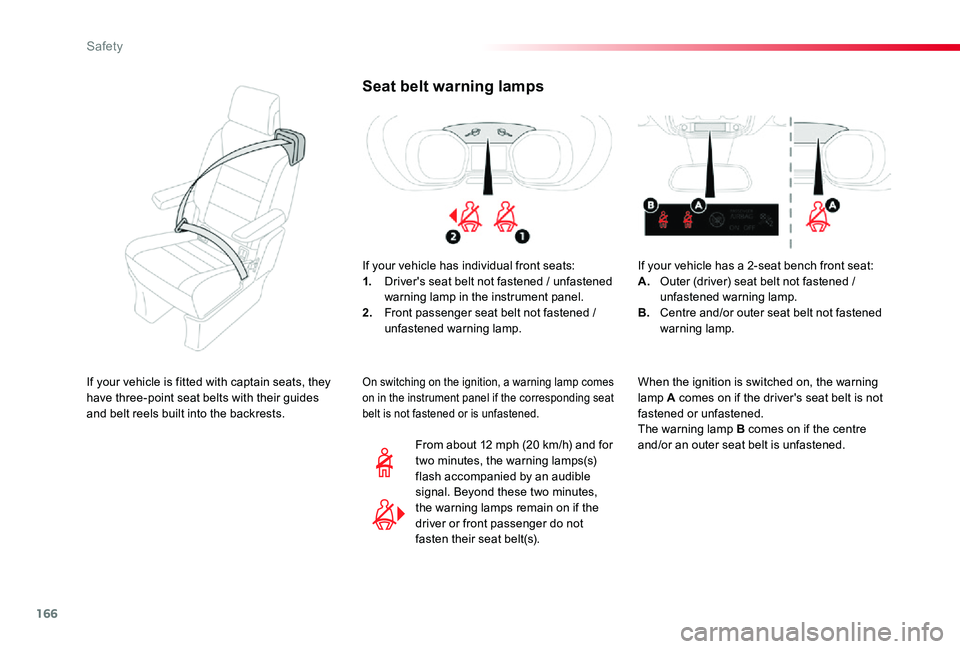
Seat belt warning lamps
If your vehicle has individual front seats:1. Driver's seat belt not fastened / unfastened warning lamp in the instrument panel.2. Front passenger seat belt not fastened / unfastened warning lamp.
From about 12 mph (20 km/h) and for two minutes, the warning lamps(s) flash accompanied by an audible signal. Beyond these two minutes, the warning lamps remain on if the driver or front passenger do not fasten their seat belt(s).
On switching on the ignition, a warning lamp comes on in the instrument panel if the corresponding seat belt is not fastened or is unfastened.
If your vehicle has a 2-seat bench front seat:A. Outer (driver) seat belt not fastened / unfastened warning lamp.B. Centre and/or outer seat belt not fastened warning lamp.
When the ignition is switched on, the warning lamp A comes on if the driver's seat belt is not fastened or unfastened.The warning lamp B comes on if the centre and/or an outer seat belt is unfastened.
If your vehicle is fitted with captain seats, they have three-point seat belts with their guides and belt reels built into the backrests.
Safety
Page 167 of 418
167
Advice
In the event of an impact
Depending on the nature and seriousness of the impact, the pretensioning device may be deployed before and independently of the airbags. Deployment of the pretensioners is accompanied by a slight discharge of harmless smoke and a noise, due to the activation of the pyrotechnic cartridge incorporated in the system.In all cases, the airbag warning lamp comes on.Following an impact, have the seat belts system checked, and if necessary replaced, by an authorized Toyota dealer or repairer, or another duly qualified and equipped professional.
In order to be effective, a seat belt must:- be tightened as close to the body as possible,- be pulled in front of you with a smooth movement, checking that it does not twist,- be used to restrain only one person,- not bear any trace of cuts or fraying,- not be converted or modified to avoid affecting its performance.In accordance with current safety regulations, for all repairs on your vehicle's seat belts, go to a qualified workshop with the skills and equipment needed, which a Toyota dealer is able to provide.Have your seat belts checked regularly by an authorized Toyota dealer or repairer, or another duly qualified and equipped professional, particularly if the straps show signs of damage.Clean the seat belt straps with soapy water or a textile cleaning product, sold by Toyota dealers.After folding or moving a seat or rear bench seat, ensure that the seat belt is positioned and reeled in correctly.
Recommendations for children
Use a suitable child seat if the passenger is less than 12 years old or shorter than one and a half metres.Never use the same seat belt to secure more than one person.Never allow a child to travel on your lap.For more information on Child seats, refer to the corresponding section.
The driver must ensure that passengers use the seat belts correctly and that they are all fastened before setting off.Wherever you are seated in the vehicle, always fasten your seat belt, even for short journeys.Do not interchange the seat belt buckles as they will not fulfill their role fully.The seat belts are fitted with an inertia reel permitting automatic adjustment of the length of the strap to your size. The seat belt is stowed automatically when not in use.Before and after use, ensure that the seat belt is reeled in correctly.The lower part of the strap must be positioned as low as possible on the pelvis.The upper part must be positioned in the hollow of the shoulder.The inertia reels are fitted with an automatic locking device which comes into operation in the event of a collision, emergency braking or if the vehicle rolls over. You can release the device by pulling the strap firmly and then releasing it so that it reels in slightly.
5
Safety
Page 170 of 418
170
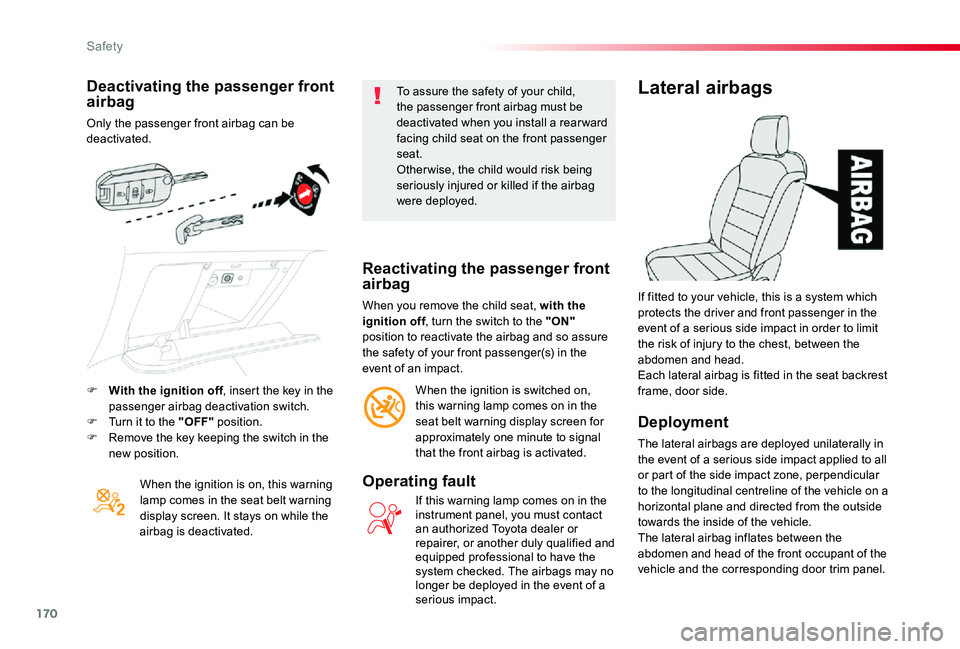
Deactivating the passenger front airbag
Only the passenger front airbag can be deactivated.
When the ignition is on, this warning lamp comes in the seat belt warning display screen. It stays on while the airbag is deactivated.
To assure the safety of your child, the passenger front airbag must be deactivated when you install a rear ward facing child seat on the front passenger seat.Other wise, the child would risk being seriously injured or killed if the airbag were deployed.
Reactivating the passenger front airbag
When you remove the child seat, with the ignition off, turn the switch to the "ON" position to reactivate the airbag and so assure the safety of your front passenger(s) in the event of an impact.
When the ignition is switched on, this warning lamp comes on in the seat belt warning display screen for approximately one minute to signal that the front airbag is activated.
Operating fault
If this warning lamp comes on in the instrument panel, you must contact an authorized Toyota dealer or repairer, or another duly qualified and equipped professional to have the system checked. The airbags may no longer be deployed in the event of a serious impact.
Lateral airbags
Deployment
The lateral airbags are deployed unilaterally in
the event of a serious side impact applied to all or part of the side impact zone, perpendicular to the longitudinal centreline of the vehicle on a horizontal plane and directed from the outside towards the inside of the vehicle.The lateral airbag inflates between the abdomen and head of the front occupant of the vehicle and the corresponding door trim panel.
If fitted to your vehicle, this is a system which protects the driver and front passenger in the event of a serious side impact in order to limit the risk of injury to the chest, between the abdomen and head.Each lateral airbag is fitted in the seat backrest frame, door side.F With the ignition off, insert the key in the passenger airbag deactivation switch.F Turn it to the "OFF" position.F Remove the key keeping the switch in the
new position.
Safety
Page 172 of 418
172
Sit in a normal upright position.Wear a correctly adjusted seat belt.Do not leave anything between the occupants and the airbags (a child, pet, object...), nor fix or attach anything close to
the inflation trajectory of the airbags; this could cause injuries during their deployment.Never modify the original definition of your vehicle, particularly in the area directly around the airbags.After an accident or if the vehicle has been stolen or broken into, have the airbag systems checked.All work on the airbag system must be carried out by an authorized Toyota dealer or repairer, or another duly qualified and equipped professional.Even if all of the precautions mentioned are obser ved, a risk of injury or of minor burns to the head, chest or arms when an airbag is deployed cannot be ruled out.
Lateral airbags
Use only approved covers on the seats, compatible with the deployment the lateral airbags. For information on the range of seat covers suitable for your vehicle, you can contact an authorized Toyota dealer or repairer, or another duly qualified and equipped professional.For more information on Accessories, refer to the corresponding section.Do not fix or attach anything to the seat backs (clothing...). This could cause injury to the chest or arms if the lateral airbag is deployed.Do not sit with the upper part of the body any nearer to the door than necessary.
The bag inflates almost instantly (within a few milliseconds) then deflates within the same time discharging the hot gas via openings provided for this purpose.
Front airbags
Do not drive holding the steering wheel by its spokes or resting your hands on the centre part of the wheel.Passengers must not place their feet on the dashboard.Do not smoke as deployment of the airbags can cause burns or the risk of injury from a cigarette or pipe.Never remove or pierce the steering wheel or hit it violently.Do not fit or attach anything to the steering wheel or dashboard, this could cause injuries with deployment of the airbags.
Advice
For the airbags to be fully effective, observe the safety recommendations below:
Curtain airbags
Do not fix or attach anything to the roof. This could cause injury to the head if the curtain airbag is deployed.If fitted on your vehicle, do not remove the grab handles installed on the roof, they play a part in securing the curtain airbags.
Safety
Page 176 of 418
176
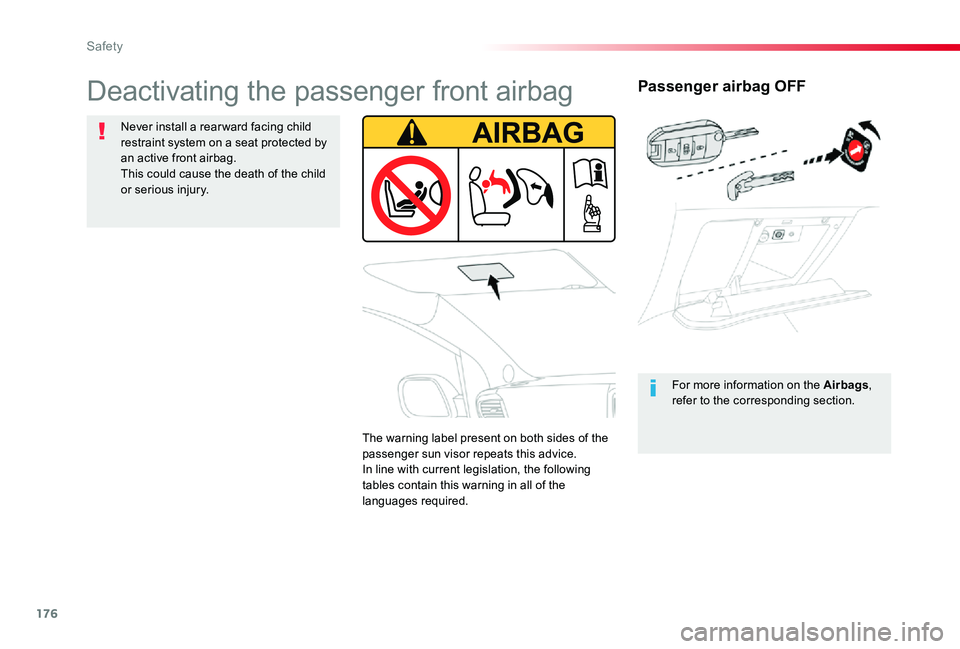
Passenger airbag OFF
For more information on the Airbags, refer to the corresponding section.
Deactivating the passenger front airbag
Never install a rear ward facing child restraint system on a seat protected by an active front airbag.This could cause the death of the child or serious injury.
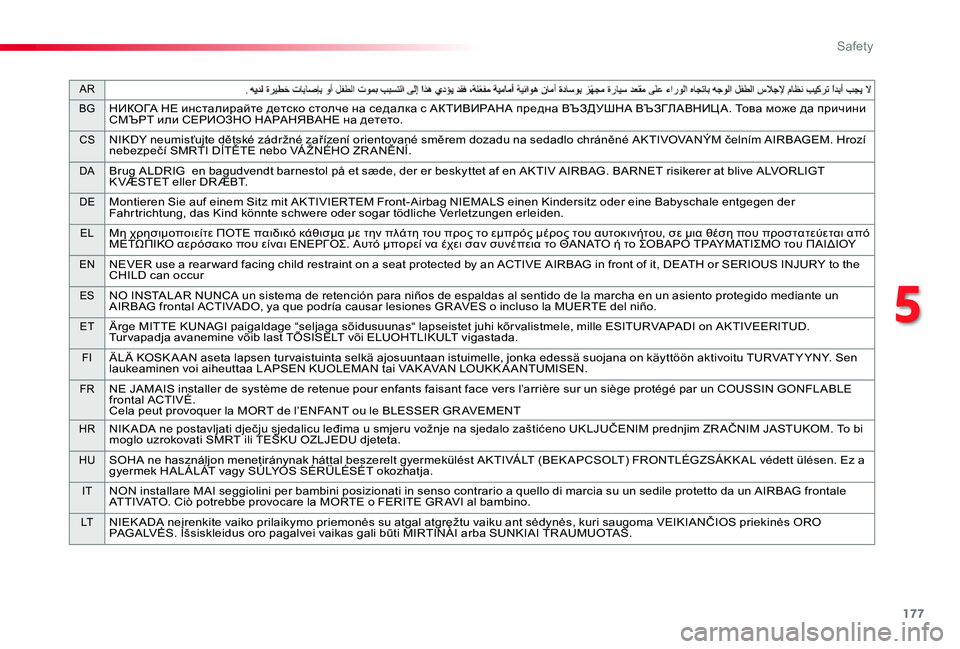
The warning label present on both sides of the passenger sun visor repeats this advice.In line with current legislation, the following tables contain this warning in all of the languages required.
Safety
Page 177 of 418
177
AR
BGНИКОГА НЕ инсталирайте детско столче на седалка с АК ТИВИРАНА предна ВЪЗДУШНА ВЪЗГЛАВНИЦ А. Това може да причини СМЪРТ или СЕРИОЗНО НАРАНЯВАНЕ на детето.
CSNIKDY neumisťujte dětské zádržné zařízení orientované směrem dozadu na sedadlo chráněné AKTIVOVANÝM čelním AIRBAGEM. Hrozí nebezpečí SMRTI DÍTĚTE nebo VÁ ŽNÉHO ZR ANĚNÍ.
DABrug ALDRIG en bagudvendt barnestol på et sæde, der er beskyttet af en AKTIV AIRBAG. BARNET risikerer at blive ALVORLIGT K VÆSTET eller DR ÆBT.
DEMontieren Sie auf einem Sitz mit AKTIVIERTEM Front-Airbag NIEMALS einen Kindersitz oder eine Babyschale entgegen der Fahr trichtung, das Kind könnte schwere oder sogar tödliche Verletzungen erleiden.
ELΜη χρησιμοποιείτε ΠΟΤΕ παιδικό κάθισμα με την πλάτη του προς το εμπρός μέρος του αυτοκινήτου, σε μια θέση που προστατεύεται από ΜΕΤΩΠΙΚΟ αερόσακο που είναι ΕΝΕΡΓΟΣ. Αυτό μπορεί να έχει σαν συνέπεια το ΘΑΝΑΤΟ ή το ΣΟΒΑΡΟ ΤΡΑΥΜΑΤΙΣΜΟ του ΠΑΙΔΙΟΥ
ENNEVER use a rear ward facing child restraint on a seat protected by an ACTIVE AIRBAG in front of it, DEATH or SERIOUS INJURY to the CHILD can occur
ESNO INSTAL AR NUNCA un sistema de retención para niños de espaldas al sentido de la marcha en un asiento protegido mediante un AIRBAG frontal ACTIVADO, ya que podría causar lesiones GR AVES o incluso la MUERTE del niño.
ETÄrge MITTE KUNAGI paigaldage “seljaga sõidusuunas“ lapseistet juhi kõr valistmele, mille ESITURVAPADI on AKTIVEERITUD. Tur vapadja avanemine võib last TÕSISELT või ELUOHTLIKULT vigastada.
FIÄL Ä KOSK A AN aseta lapsen tur vaistuinta selkä ajosuuntaan istuimelle, jonka edessä suojana on käyttöön aktivoitu TURVAT Y YNY. Sen laukeaminen voi aiheuttaa L APSEN KUOLEMAN tai VAK AVAN LOUKK A ANTUMISEN.
FRNE JAMAIS installer de système de retenue pour enfants faisant face vers l’arrière sur un siège protégé par un COUSSIN GONFL ABLE frontal ACTIVÉ.Cela peut provoquer la MORT de l’ENFANT ou le BLESSER GR AVEMENT
HRNIK ADA ne postavljati dječju sjedalicu leđima u smjeru vožnje na sjedalo zaštićeno UKLJUČENIM prednjim ZR AČNIM JASTUKOM. To bi moglo uzrokovati SMRT ili TEŠKU OZLJEDU djeteta.
HUSOHA ne használjon menetiránynak háttal beszerelt gyermekülést AKTIVÁLT (BEK APCSOLT) FRONTLÉGZSÁKK AL védett ülésen. Ez a gyermek HAL ÁL ÁT vagy SÚLYOS SÉRÜLÉSÉT okozhatja.
ITNON installare MAI seggiolini per bambini posizionati in senso contrario a quello di marcia su un sedile protetto da un AIRBAG frontale ATTIVATO. Ciò potrebbe provocare la MORTE o FERITE GR AVI al bambino.
LTNIEK ADA neįrenkite vaiko prilaikymo priemonės su atgal atgręžtu vaiku ant sėdynės, kuri saugoma VEIKIANČIOS priekinės ORO PAGALVĖS. Išsiskleidus oro pagalvei vaikas gali būti MIRTINAI arba SUNKIAI TR AUMUOTAS.
5
Safety
Page 188 of 418
188
IUF Seat suitable for the installation of an Isofix Universal seat, For ward facing secured using the upper strap.IL- SU Seat suitable for the installation of an Isofix Semi-Universal seat either:- rear ward facing fitted with an upper strap or a support leg,- for ward facing fitted with a support leg,- an cot fitted with an upper strap or a support leg.
X Seat not suitable for the installation of a child seat of the weight group indicated.
Remove and stow the head restraint before fitting a child seat with a backrest to a passenger seat.Refit the head restraint when the child seat is removed.
For more information on the ISOFIX mountings and in particular the upper strap, refer to the corresponding section.
Safety
Page 194 of 418
194
When towing
Distribution of loads
F Distribute the load in the trailer so that the heaviest items are as close as possible to the axle and the nose weight approaches the maximum permitted without exceeding it.Air density decreases with altitude, thus reducing engine per formance. Above 1 000 metres, the maximum towed load must be reduced by 10 % for every 1 000 metres of altitude.
Side wind
F Take into account the increased sensitivity to side wind.
Cooling
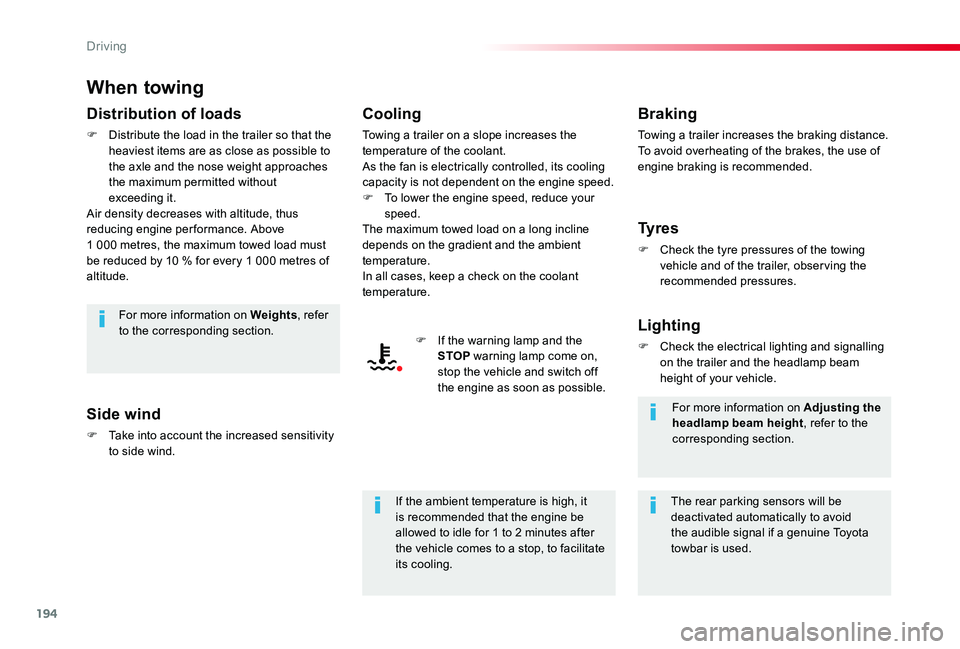
Towing a trailer on a slope increases the temperature of the coolant.As the fan is electrically controlled, its cooling capacity is not dependent on the engine speed.F To lower the engine speed, reduce your speed.The maximum towed load on a long incline depends on the gradient and the ambient temperature.In all cases, keep a check on the coolant temperature.
F If the warning lamp and the STOP warning lamp come on, stop the vehicle and switch off the engine as soon as possible.
Braking
Towing a trailer increases the braking distance.To avoid overheating of the brakes, the use of engine braking is recommended.
Ty r e s
F Check the tyre pressures of the towing vehicle and of the trailer, obser ving the recommended pressures.
Lighting
F Check the electrical lighting and signalling on the trailer and the headlamp beam height of your vehicle.
For more information on Weights, refer to the corresponding section.
The rear parking sensors will be deactivated automatically to avoid the audible signal if a genuine Toyota towbar is used.
If the ambient temperature is high, it is recommended that the engine be allowed to idle for 1 to 2 minutes after the vehicle comes to a stop, to facilitate its cooling.
For more information on Adjusting the headlamp beam height, refer to the corresponding section.
Driving
Page 206 of 418
206
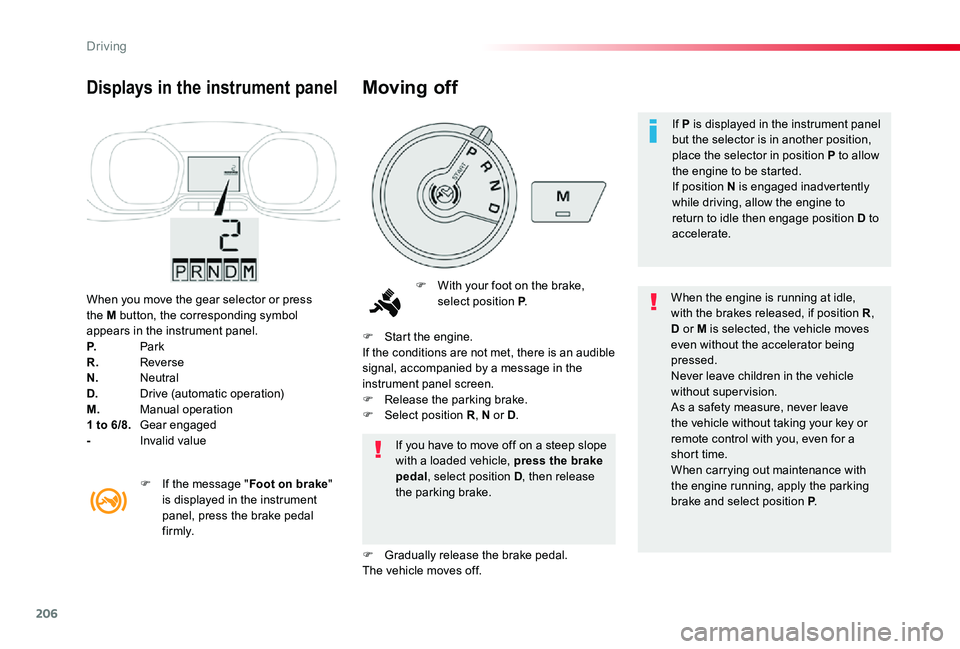
When you move the gear selector or press the M button, the corresponding symbol appears in the instrument panel.P. ParkR. ReverseN. NeutralD. Drive (automatic operation)M. Manual operation1 to 6/8. Gear engaged- Invalid value
Displays in the instrument panel
F With your foot on the brake, select position P.When the engine is running at idle, with the brakes released, if position R, D or M is selected, the vehicle moves even without the accelerator being pressed.Never leave children in the vehicle without supervision.As a safety measure, never leave the vehicle without taking your key or remote control with you, even for a
short time.When carrying out maintenance with the engine running, apply the parking brake and select position P.
If you have to move off on a steep slope with a loaded vehicle, press the brake pedal, select position D, then release the parking brake.
F Start the engine.If the conditions are not met, there is an audible signal, accompanied by a message in the instrument panel screen.F Release the parking brake.F Select position R, N or D.
F Gradually release the brake pedal.The vehicle moves off.
F If the message "Foot on brake" is displayed in the instrument panel, press the brake pedal f i r m l y.
Moving off
If P is displayed in the instrument panel but the selector is in another position, place the selector in position P to allow the engine to be started.If position N is engaged inadvertently while driving, allow the engine to return to idle then engage position D to accelerate.
Driving