ESP TOYOTA PROACE VERSO 2020 Service Manual
[x] Cancel search | Manufacturer: TOYOTA, Model Year: 2020, Model line: PROACE VERSO, Model: TOYOTA PROACE VERSO 2020Pages: 418, PDF Size: 39.32 MB
Page 131 of 418
131
Front demist - defrost
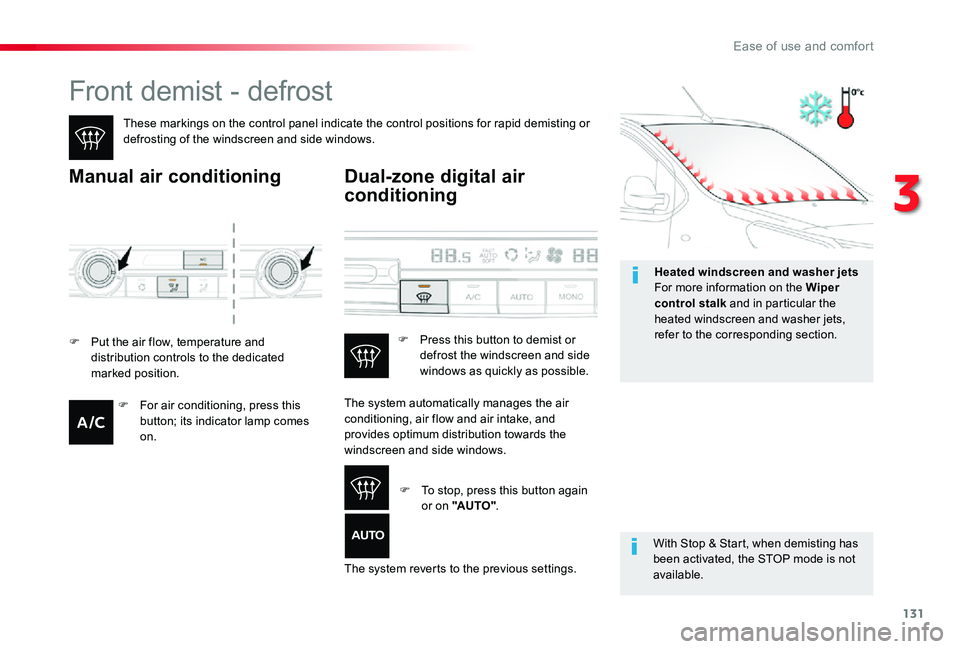
These markings on the control panel indicate the control positions for rapid demisting or defrosting of the windscreen and side windows.
Manual air conditioning
With Stop & Start, when demisting has been activated, the STOP mode is not available.
Dual-zone digital air
conditioning
F Put the air flow, temperature and distribution controls to the dedicated marked position.
The system automatically manages the air conditioning, air flow and air intake, and provides optimum distribution towards the windscreen and side windows.
The system reverts to the previous settings.
F Press this button to demist or defrost the windscreen and side windows as quickly as possible.
F To stop, press this button again or on "AUTO".
F For air conditioning, press this button; its indicator lamp comes on.
Heated windscreen and washer jetsFor more information on the Wiper control stalk and in particular the heated windscreen and washer jets, refer to the corresponding section.
3
Ease of use and comfort
Page 134 of 418
134
In order for these systems to be fully effective, follow the operation and maintenance guidelines below:F To obtain an even air distribution, take care not to obstruct the exterior air intake grilles located at the base of the windscreen, the nozzles, the vents and the air outlets, as well as the air extractor located at the rear.F Do not cover the sunshine sensor, located at the top of the windscreen; this is used for regulation of the air conditioning system.F Operate the air conditioning system for at least 5 to 10 minutes, once or twice a month
to keep it in per fect working order.F Ensure that the passenger compartment filter is in good condition and have the filter elements replaced regularly. We recommend the use of a combined passenger compartment filter. Thanks to its special active additive, it contributes to the purification of the air breathed by the occupants and the cleanliness of the passenger compartment (reduction of allergic symptoms, bad odours and greasy deposits).F To ensure correct operation of the air conditioning system, you are also advised to have it checked regularly as recommended in the maintenance and warranty guide.F If the system does not produce cold air, switch it off and contact an authorized Toyota dealer or repairer, or another duly qualified and equipped professional.
Recommendations for heating, ventilation and air conditioning
If after an extended stop in sunshine, the interior temperature is very high, first ventilate the passenger compartment for a few moments.Put the air flow control at a setting high enough to quickly change the air in the passenger compartment.The air conditioning system does not contain chlorine and does not present any danger to the ozone layer.
The condensation created by the air conditioning results in a discharge of water under the vehicle which is per fectly normal.
When towing the maximum load on a steep gradient in high temperatures, switching off the air conditioning increases the available engine power and so improves the towing ability.
Stop & Start
The heating and air conditioning systems only work when the engine is running.To maintain a comfortable temperature in the passenger compartment, you can temporarily deactivate the Stop & Start system.For more information on Stop & Star t, refer to the corresponding section.
Air vents
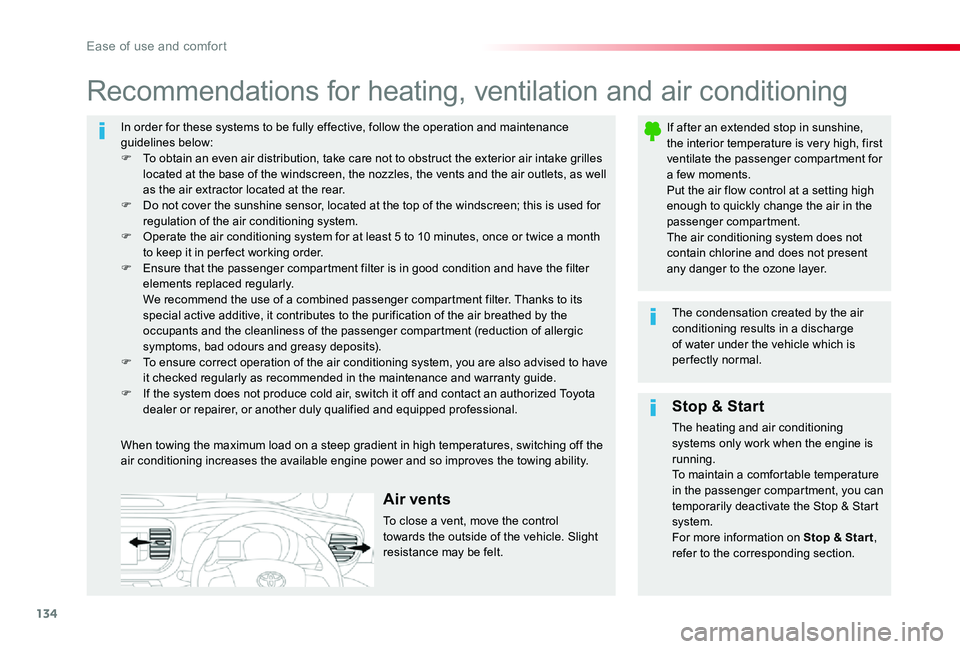
To close a vent, move the control towards the outside of the vehicle. Slight resistance may be felt.
Ease of use and comfort
Page 140 of 418
140
Individual reading lamp
Rear
Courtesy lampsAutomatic operation
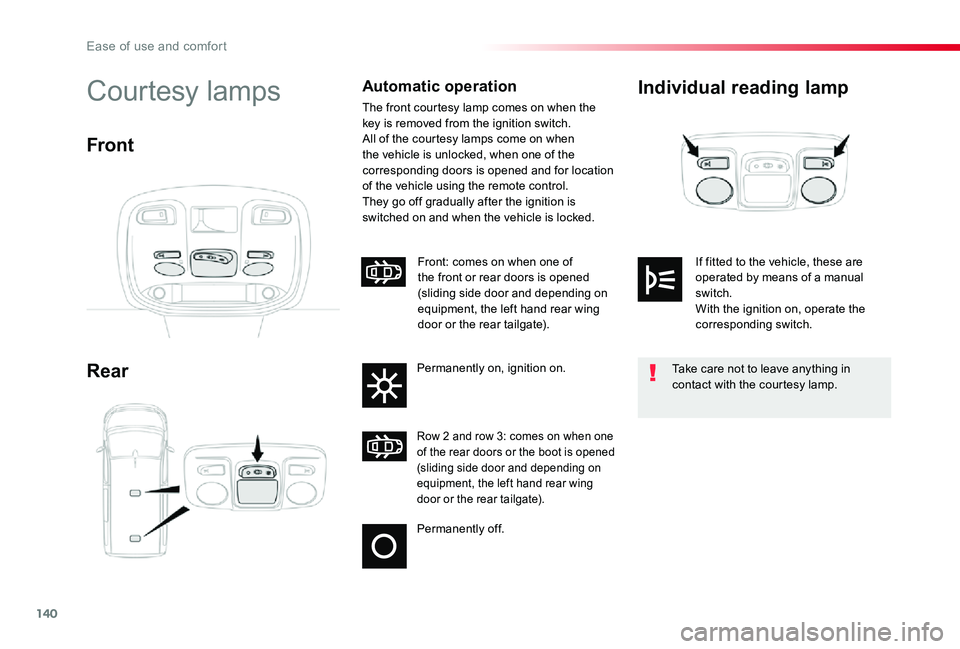
The front courtesy lamp comes on when the key is removed from the ignition switch.All of the courtesy lamps come on when the vehicle is unlocked, when one of the corresponding doors is opened and for location of the vehicle using the remote control.They go off gradually after the ignition is switched on and when the vehicle is locked.
Front
Permanently off.
Row 2 and row 3: comes on when one of the rear doors or the boot is opened (sliding side door and depending on equipment, the left hand rear wing door or the rear tailgate).
Front: comes on when one of the front or rear doors is opened (sliding side door and depending on equipment, the left hand rear wing door or the rear tailgate).
Permanently on, ignition on.Take care not to leave anything in contact with the courtesy lamp.
If fitted to the vehicle, these are operated by means of a manual switch.With the ignition on, operate the corresponding switch.
Ease of use and comfort
Page 141 of 418
141
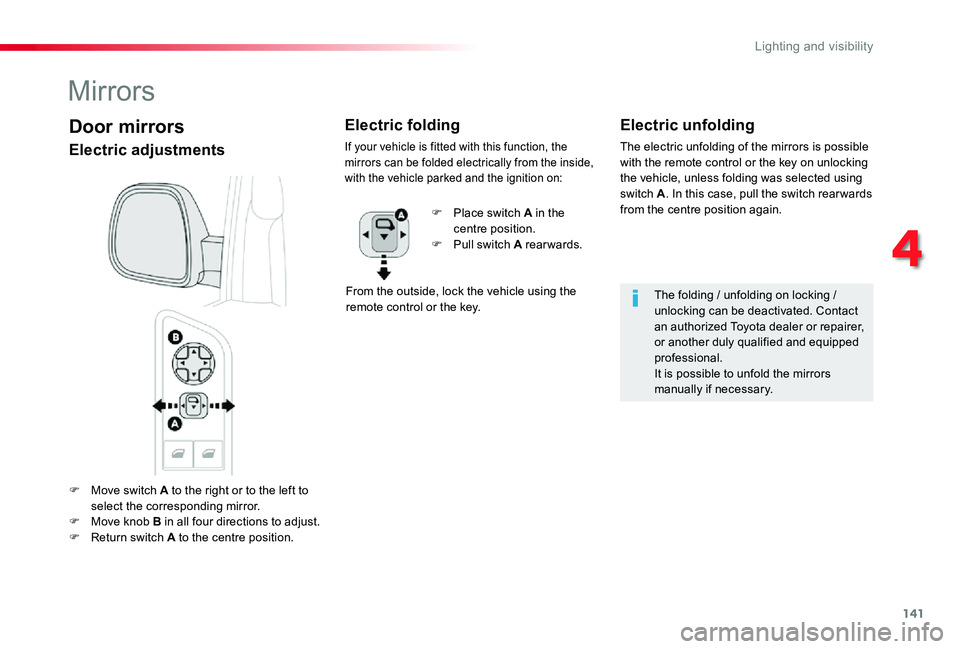
F Move switch A to the right or to the left to select the corresponding mirror.F Move knob B in all four directions to adjust.F Return switch A to the centre position.
Electric unfolding
The electric unfolding of the mirrors is possible with the remote control or the key on unlocking the vehicle, unless folding was selected using switch A. In this case, pull the switch rear wards from the centre position again.
Mirrors
Electric adjustments
Electric folding
If your vehicle is fitted with this function, the mirrors can be folded electrically from the inside, with the vehicle parked and the ignition on:
F Place switch A in the centre position.
F Pull switch A rearwards.
From the outside, lock the vehicle using the remote control or the key.The folding / unfolding on locking / unlocking can be deactivated. Contact an authorized Toyota dealer or repairer, or another duly qualified and equipped professional.It is possible to unfold the mirrors manually if necessary.
Door mirrors
4
Lighting and visibility
Page 142 of 418
142
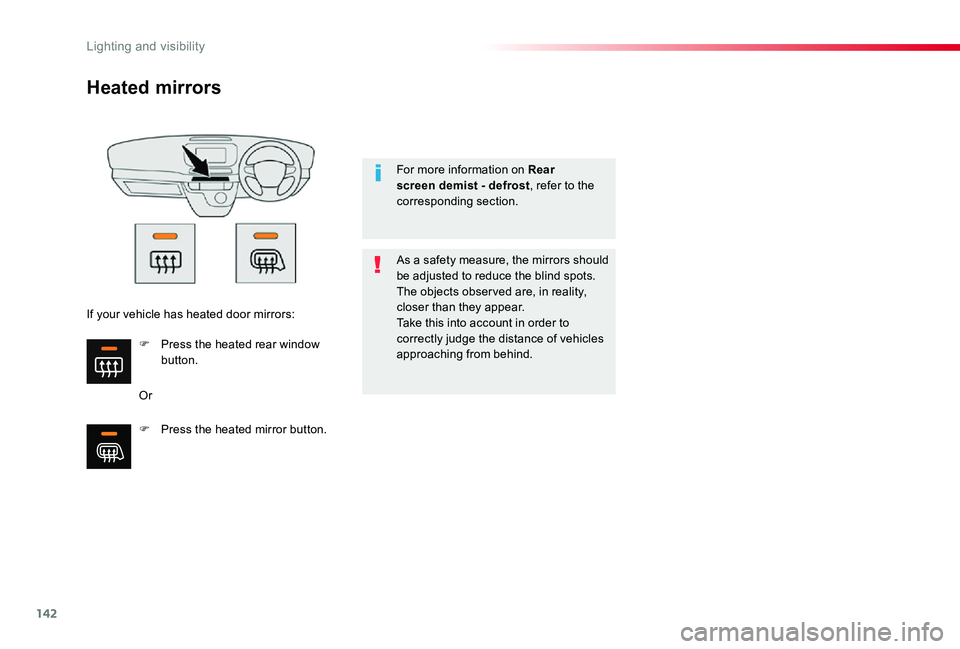
Heated mirrors
Or
As a safety measure, the mirrors should be adjusted to reduce the blind spots.The objects obser ved are, in reality, closer than they appear.Take this into account in order to correctly judge the distance of vehicles approaching from behind.
For more information on Rear screen demist - defrost, refer to the corresponding section.
F Press the heated rear window button.
F Press the heated mirror button.
If your vehicle has heated door mirrors:
Lighting and visibility
Page 144 of 418
144
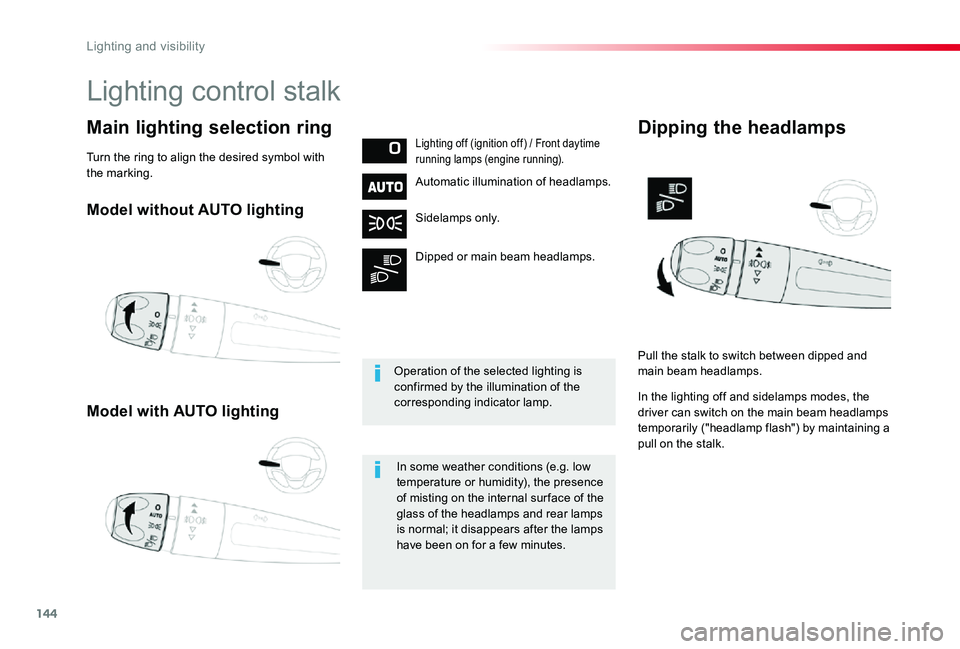
Model without AUTO lighting
Model with AUTO lighting
Main lighting selection ringLighting off (ignition off) / Front daytime running lamps (engine running).
Automatic illumination of headlamps.
Sidelamps only.
Dipped or main beam headlamps.
Dipping the headlamps
In the lighting off and sidelamps modes, the driver can switch on the main beam headlamps temporarily ("headlamp flash") by maintaining a pull on the stalk.
Operation of the selected lighting is confirmed by the illumination of the corresponding indicator lamp.
Pull the stalk to switch between dipped and main beam headlamps.
Lighting control stalk
In some weather conditions (e.g. low temperature or humidity), the presence of misting on the internal sur face of the glass of the headlamps and rear lamps is normal; it disappears after the lamps
have been on for a few minutes.
Turn the ring to align the desired symbol with the marking.
Lighting and visibility
Page 146 of 418
146
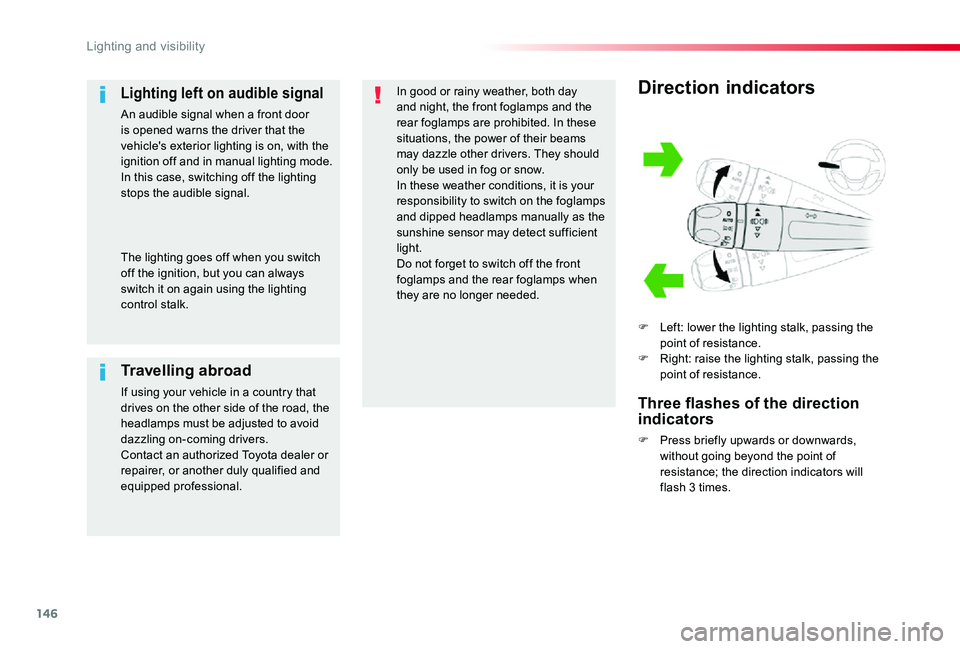
Direction indicators
F Left: lower the lighting stalk, passing the point of resistance.F Right: raise the lighting stalk, passing the point of resistance.
Three flashes of the direction indicators
F Press briefly upwards or downwards,
without going beyond the point of resistance; the direction indicators will flash 3 times.
In good or rainy weather, both day and night, the front foglamps and the rear foglamps are prohibited. In these situations, the power of their beams may dazzle other drivers. They should only be used in fog or snow.In these weather conditions, it is your responsibility to switch on the foglamps and dipped headlamps manually as the sunshine sensor may detect sufficient light.Do not forget to switch off the front foglamps and the rear foglamps when they are no longer needed.
Lighting left on audible signal
An audible signal when a front door is opened warns the driver that the vehicle's exterior lighting is on, with the ignition off and in manual lighting mode.In this case, switching off the lighting stops the audible signal.
Travelling abroad
If using your vehicle in a country that drives on the other side of the road, the headlamps must be adjusted to avoid dazzling on-coming drivers.
Contact an authorized Toyota dealer or repairer, or another duly qualified and equipped professional.
The lighting goes off when you switch off the ignition, but you can always switch it on again using the lighting control stalk.
Lighting and visibility
Page 150 of 418
150
ProgrammingCornering lighting
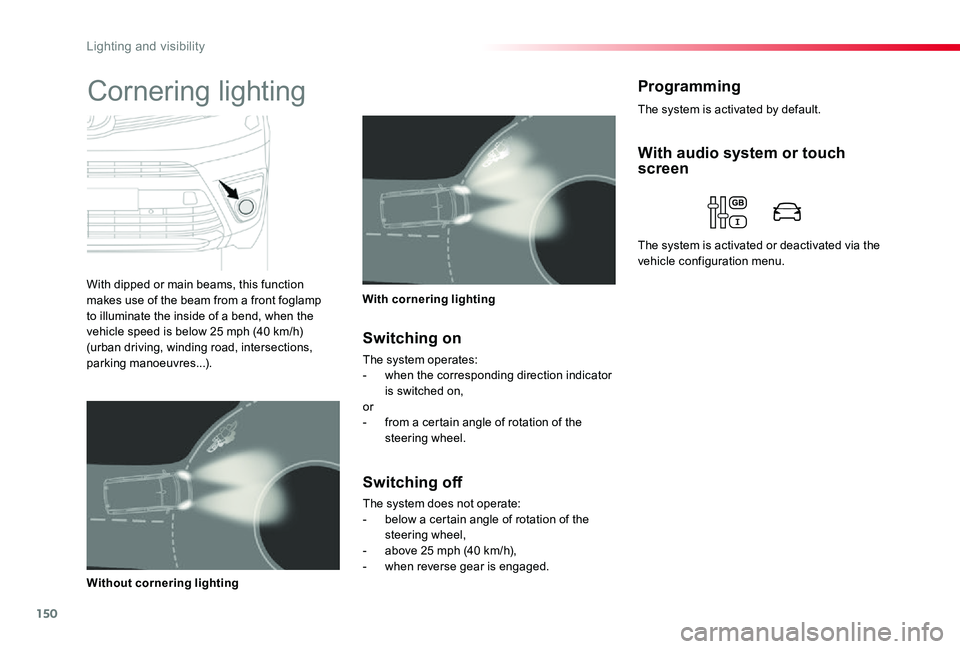
With dipped or main beams, this function makes use of the beam from a front foglamp to illuminate the inside of a bend, when the vehicle speed is below 25 mph (40 km/h) (urban driving, winding road, intersections, parking manoeuvres...).
With cornering lighting
Without cornering lighting
Switching on
The system operates:- when the corresponding direction indicator is switched on,or- from a certain angle of rotation of the steering wheel.
Switching off
The system does not operate:- below a certain angle of rotation of the steering wheel,- above 25 mph (40 km/h),- when reverse gear is engaged.
With audio system or touch screen
The system is activated or deactivated via the vehicle configuration menu.
The system is activated by default.
Lighting and visibility
Page 151 of 418
151
Automatic headlamp dipping
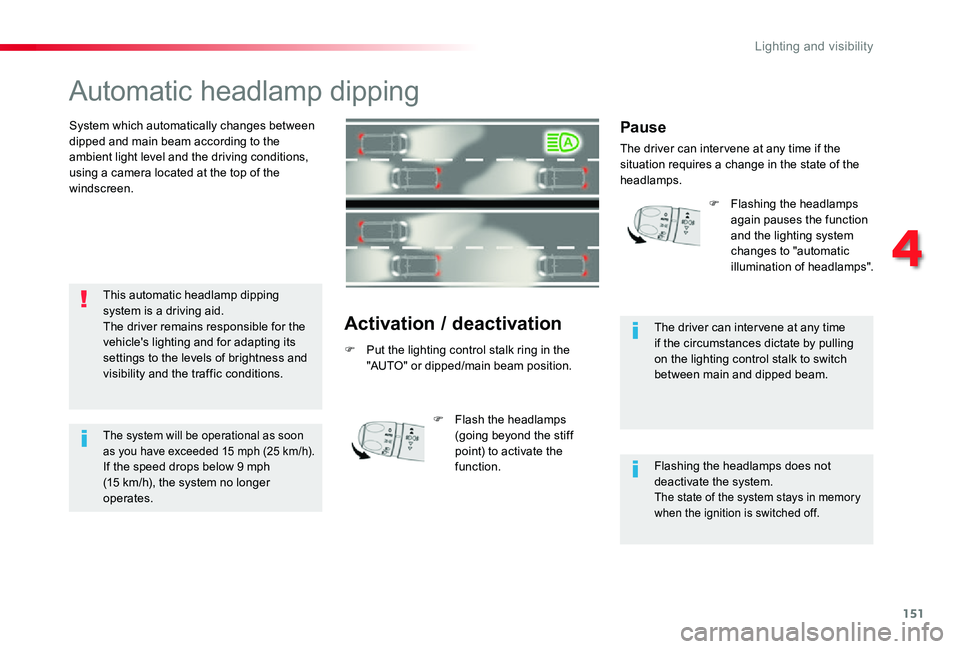
System which automatically changes between dipped and main beam according to the ambient light level and the driving conditions, using a camera located at the top of the windscreen.
Activation / deactivation
F Put the lighting control stalk ring in the "AUTO" or dipped/main beam position.
This automatic headlamp dipping system is a driving aid.The driver remains responsible for the vehicle's lighting and for adapting its settings to the levels of brightness and visibility and the traffic conditions.
The system will be operational as soon
as you have exceeded 15 mph (25 km/h).If the speed drops below 9 mph (15 km/h), the system no longer operates.
F Flash the headlamps (going beyond the stiff point) to activate the function.
F Flashing the headlamps again pauses the function and the lighting system
changes to "automatic illumination of headlamps".
Pause
The driver can inter vene at any time if the situation requires a change in the state of the headlamps.
The driver can inter vene at any time if the circumstances dictate by pulling on the lighting control stalk to switch between main and dipped beam.
Flashing the headlamps does not deactivate the system.The state of the system stays in memory when the ignition is switched off.
4
Lighting and visibility
Page 158 of 418
158
Automatic operation of
hazard warning lamps
Hazard warning lamps
When braking in an emergency, depending on the rate of deceleration, as well as when the ABS regulation is invoked or in the event of an impact, the hazard warning lamps come on
automatically.They switch off automatically the first time you accelerate.F You can also switch them off by pressing the button.
Visual warning with all of the direction indicators flashing to alert other road users to a vehicle breakdown, towing or accident.
ER A - GLONASS
emergency call system*
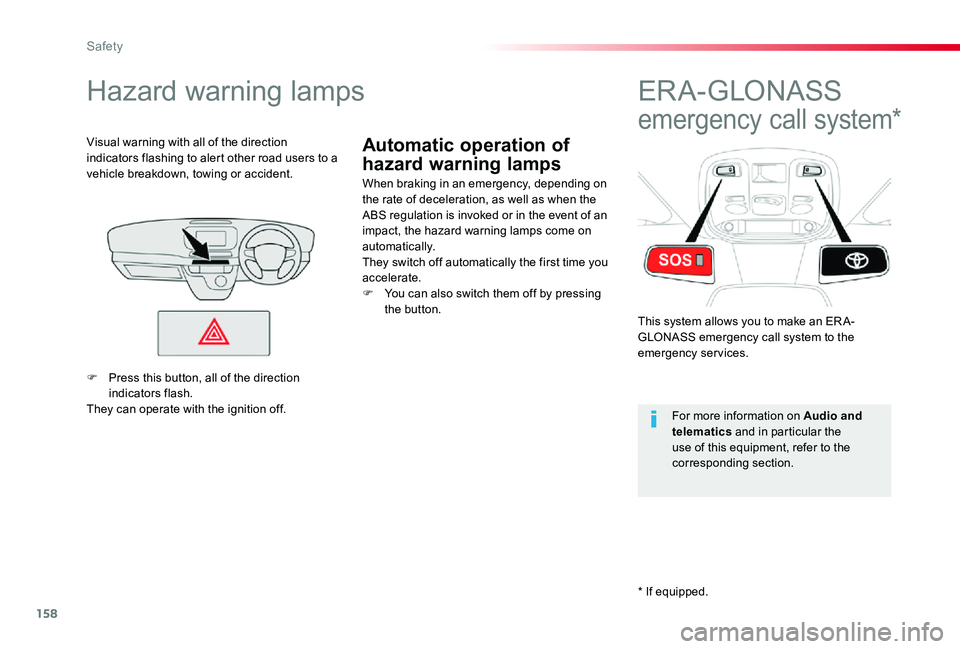
This system allows you to make an ER A-GLONASS emergency call system to the emergency services.
For more information on Audio and telematics and in particular the
use of this equipment, refer to the corresponding section.
F Press this button, all of the direction indicators flash.They can operate with the ignition off.
* If equipped.
Safety