ECU TOYOTA PROACE VERSO EV 2021 Owner's Manual
[x] Cancel search | Manufacturer: TOYOTA, Model Year: 2021, Model line: PROACE VERSO EV, Model: TOYOTA PROACE VERSO EV 2021Pages: 360, PDF Size: 68.91 MB
Page 128 of 360

128
Locations for child seats secured using the seat belt
In accordance with European regulations, the table indicates the options\
for installing child seats secured using a seat belt and universally ap\
proved (a) according to the weight of the child and the seating position in the veh\
icle.
Weight of the child/indicative age
SeatsUnder 13 kg (28 lb)(groups 0 (b) and 0+)Up to about 1 year old
From 9 to 18 kg (from 20 to 39 lb)(group 1)From about 1 to 3 years old
From 15 to 25 kg (from 34 to 56 lb)(group 2)From about 3 to 6 years old
From 22 to 36 kg (from 49 to 79 lb)(group 3)From about 6 to 10 years old
Cab/Row 1 (c) (f)
Individual seat, passenger seatU
Bench seat, outer seatU
Bench seat, centre seatX
Row 2 (d) (Fixed bench seat)
Rear seatsU
Page 131 of 360
131
Safety
5
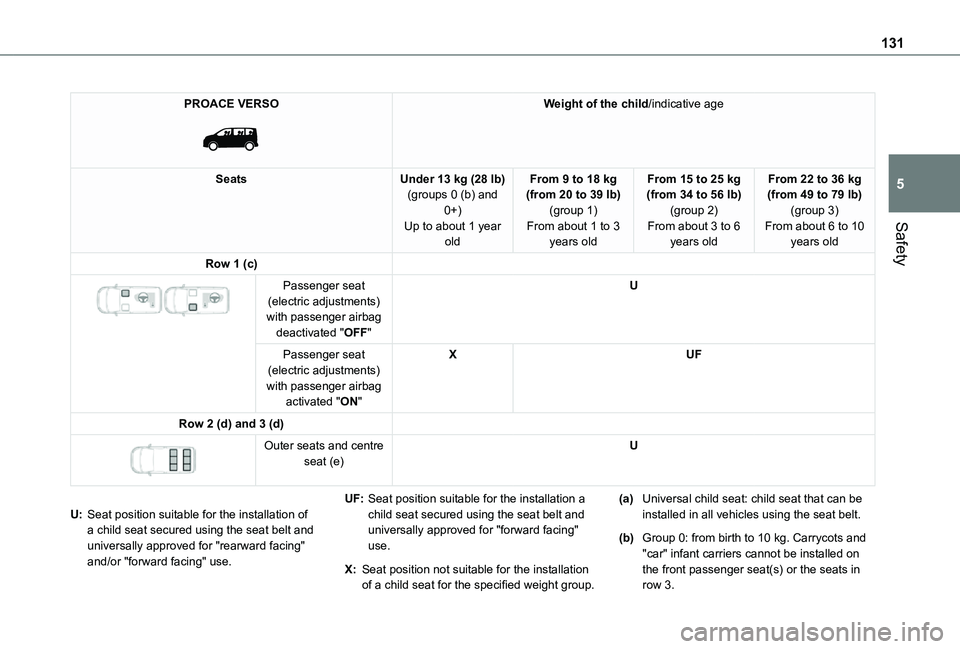
PROACE VERSO
Weight of the child/indicative age
SeatsUnder 13 kg (28 lb)(groups 0 (b) and 0+)Up to about 1 year old
From 9 to 18 kg (from 20 to 39 lb)(group 1)From about 1 to 3 years old
From 15 to 25 kg (from 34 to 56 lb)(group 2)From about 3 to 6 years old
From 22 to 36 kg (from 49 to 79 lb)(group 3)From about 6 to 10 years old
Row 1 (c)
Passenger seat (electric adjustments) with passenger airbag deactivated "OFF"
U
Passenger seat (electric adjustments) with passenger airbag activated "ON"
XUF
Row 2 (d) and 3 (d)
Outer seats and centre seat (e)U
U:Seat position suitable for the installation of a child seat secured using the seat belt and
universally approved for "rearward facing" and/or "forward facing" use.
UF:Seat position suitable for the installation a child seat secured using the seat belt and universally approved for "forward facing"
use.
X:Seat position not suitable for the installation of a child seat for the specified weight group.
(a)Universal child seat: child seat that can be installed in all vehicles using the seat belt.
(b)Group 0: from birth to 10 kg. Carrycots and "car" infant carriers cannot be installed on the front passenger seat(s) or the seats in row 3.
Page 132 of 360
132
(c)Refer to the current legislation in the country in which you are driving before placing a child in this seat position.
(d)To install a "rearward facing" or "forward facing" child seat on a rear seat, move the seats in front of it forward, then straighten their backrests to allow sufficient room for the child seat and the child's legs.
(e)The seat can be installed centrally in the vehicle; it then prevents the use of the outer seats.
(f)When a "rearward facing" child seat is installed on the front passenger seat, the front passenger airbag must be deactivated. Otherwise, the child risks being severely injured or killed if the airbag is deployed.
"ISOFIX" mountings and
i-Size
PROACE VERSO
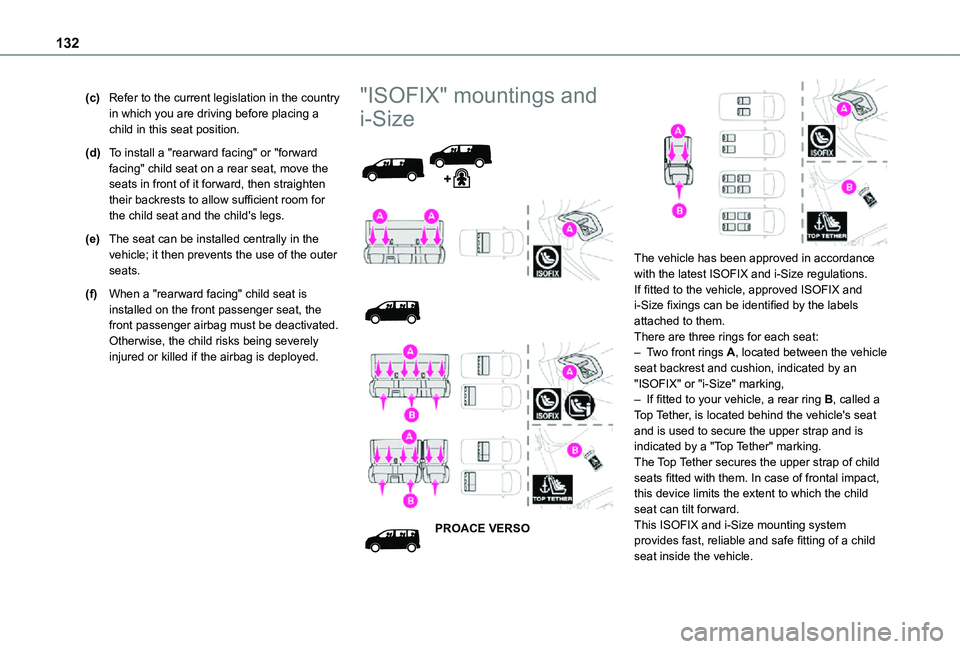
The vehicle has been approved in accordance with the latest ISOFIX and i-Size regulations.If fitted to the vehicle, approved ISOFIX and i-Size fixings can be identified by the labels attached to them.There are three rings for each seat:– Two front rings A, located between the vehicle seat backrest and cushion, indicated by an "ISOFIX" or "i-Size" marking,– If fitted to your vehicle, a rear ring B, called a Top Tether, is located behind the vehicle's seat and is used to secure the upper strap and is indicated by a "Top Tether" marking.The Top Tether secures the upper strap of child seats fitted with them. In case of frontal impact, this device limits the extent to which the child seat can tilt forward.This ISOFIX and i-Size mounting system provides fast, reliable and safe fitting of a child
seat inside the vehicle.
Page 133 of 360
133
Safety
5
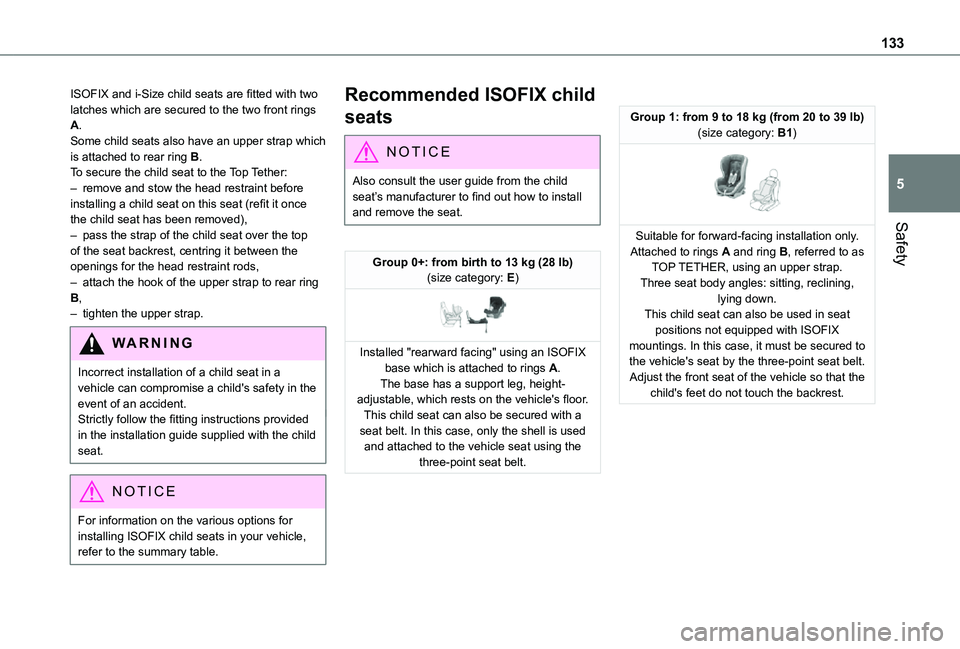
ISOFIX and i-Size child seats are fitted with two latches which are secured to the two front rings A.Some child seats also have an upper strap which is attached to rear ring B.To secure the child seat to the Top Tether:– remove and stow the head restraint before installing a child seat on this seat (refit it once the child seat has been removed),– pass the strap of the child seat over the top of the seat backrest, centring it between the openings for the head restraint rods,– attach the hook of the upper strap to rear ring B,– tighten the upper strap.
WARNI NG
Incorrect installation of a child seat in a vehicle can compromise a child's safety in the event of an accident.Strictly follow the fitting instructions provided in the installation guide supplied with the child seat.
NOTIC E
For information on the various options for installing ISOFIX child seats in your vehicle,
refer to the summary table.
Recommended ISOFIX child
seats
NOTIC E
Also consult the user guide from the child seat’s manufacturer to find out how to install and remove the seat.
Group 0+: from birth to 13 kg (28 lb)(size category: E)
Installed "rearward facing" using an ISOFIX base which is attached to rings A.The base has a support leg, height-adjustable, which rests on the vehicle's floor.This child seat can also be secured with a seat belt. In this case, only the shell is used and attached to the vehicle seat using the three-point seat belt.
Group 1: from 9 to 18 kg (from 20 to 39 lb)(size category: B1)
Suitable for forward-facing installation only.Attached to rings A and ring B, referred to as TOP TETHER, using an upper strap.Three seat body angles: sitting, reclining, lying down.This child seat can also be used in seat positions not equipped with ISOFIX mountings. In this case, it must be secured to the vehicle's seat by the three-point seat belt. Adjust the front seat of the vehicle so that the child's feet do not touch the backrest.
Page 142 of 360
142
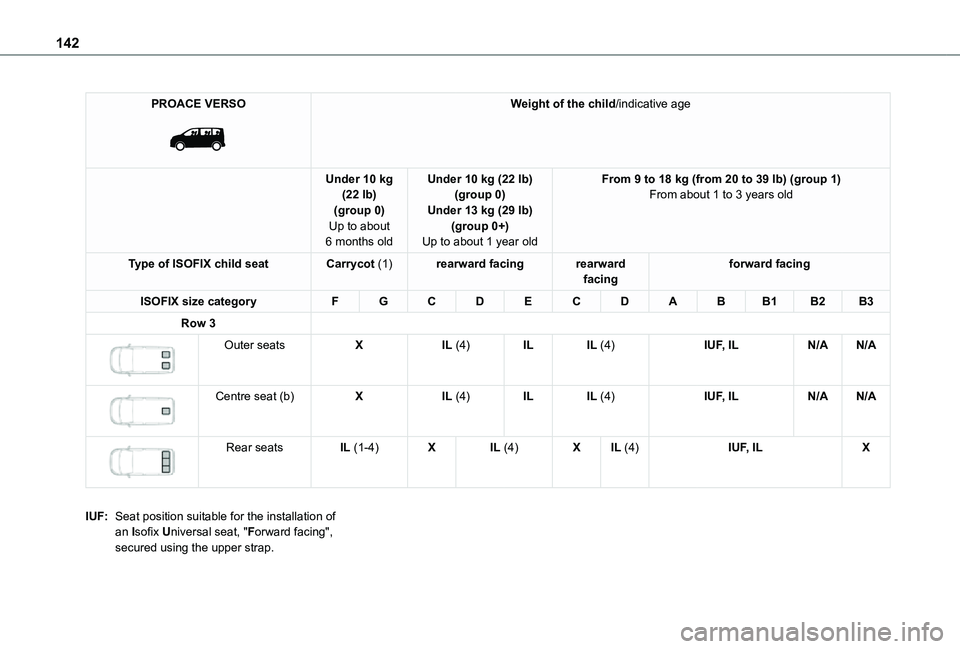
PROACE VERSO
Weight of the child/indicative age
Under 10 kg (22 lb)(group 0)Up to about 6 months old
Under 10 kg (22 lb)(group 0)Under 13 kg (29 lb)(group 0+)Up to about 1 year old
From 9 to 18 kg (from 20 to 39 lb) (group 1)From about 1 to 3 years old
Type of ISOFIX child seatCarrycot (1)rearward facingrearward facingforward facing
ISOFIX size categoryFGCDECDABB1B2B3
Row 3
Outer seatsXIL (4)ILIL (4)IUF, ILN/AN/A
Centre seat (b)XIL (4)ILIL (4)IUF, ILN/AN/A
Rear seatsIL (1-4)XIL (4)XIL (4)IUF, ILX
IUF:Seat position suitable for the installation of an Isofix Universal seat, "Forward facing", secured using the upper strap.
Page 143 of 360
143
Safety
5
IL:Seat position suitable for the installation of an Isofix Semi-UniversaL seat which is either:– "rearward facing" fitted with an upper strap or a support leg,– "forward facing" fitted with a support leg,– a carrycot fitted with an upper strap or a support leg.
X:Seat position not suitable for the installation
of an ISOFIX child seat or carrycot for the specified weight group.
N/A:Not applicable
(a)Refer to the current legislation in the country in which you are driving before placing a child in this seat position.
(b)The seat can be installed centrally in the vehicle; it then prevents the use of the outer seats.
NOTIC E
For information on securing the upper strap using the ISOFIX mountings, refer to the corresponding section.
(1)Installing a carrycot on this seat may prevent the use of one or more of the other seats in this row.
(2)Installation possible only behind the driver's seat.
(3)Installation possible only behind the driver's seat with individual passenger seat.
(4)The seat in row 2 must be adjusted so that there is no contact between the child in row 3 and the seat immediately in front.
(5)The front seat must be adjusted so that there is no contact between the child in row 2 and the seat immediately in front.
(6)The front seat must be adjusted so that there is no contact between the child in row 2 and the seat immediately in front (with the front seat adjusted to 2 notches ahead of the centre of the slide).
Page 154 of 360
154
On starting, the instrument panel lights up and the power indicator needle performs one sweep then moves to the "neutral" position. The steering column automatically unlocks (you may hear a sound and feel the steering wheel move).
Switching off
► If using a conventional or remote control key, turn the key fully to position 1 (Stop).► If using Smart Entry & Start, press the "START/STOP" button.Before exiting the vehicle, check that:– The drive selector is in mode P.– The READY indicator lamp is off.
NOTIC E
The drive selector moves automatically to mode P when the motor is switched off or when the driver's door is opened.
NOTIC E
If the driver's door is opened while the required conditions for stopping are not satisfied, an audible signal is emitted, accompanied by the display of a warning message.
Special case with Smart
Entry & Start
Switching on the ignition without
starting the engine
With the Smart Entry & Start system’s electronic key inside the vehicle, pressing the "START/STOP" button, with no action on the pedals, allows the ignition to be switched on.► Pressing this button again switches off the ignition and allows the vehicle to be locked.
Back-up starting
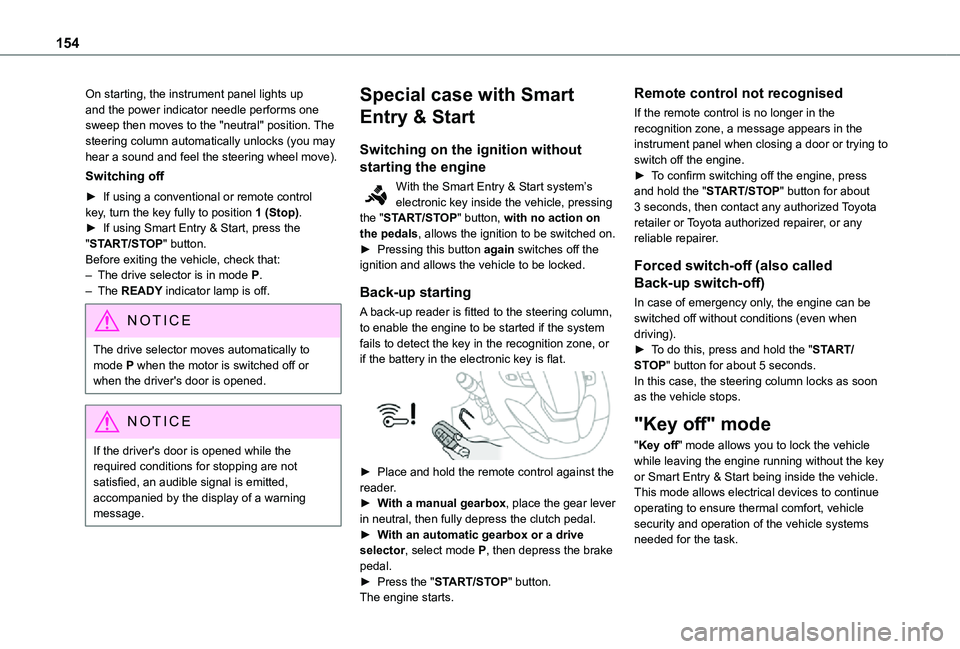
A back-up reader is fitted to the steering column, to enable the engine to be started if the system fails to detect the key in the recognition zone, or if the battery in the electronic key is flat.
► Place and hold the remote control against the reader.► With a manual gearbox, place the gear lever in neutral, then fully depress the clutch pedal.► With an automatic gearbox or a drive selector, select mode P, then depress the brake pedal.► Press the "START/STOP" button.The engine starts.
Remote control not recognised
If the remote control is no longer in the recognition zone, a message appears in the instrument panel when closing a door or trying to switch off the engine.► To confirm switching off the engine, press and hold the "START/STOP" button for about 3 seconds, then contact any authorized Toyota retailer or Toyota authorized repairer, or any reliable repairer.
Forced switch-off (also called
Back-up switch-off)
In case of emergency only, the engine can be switched off without conditions (even when driving).► To do this, press and hold the "START/STOP" button for about 5 seconds.In this case, the steering column locks as soon as the vehicle stops.
"Key off" mode
"Key off" mode allows you to lock the vehicle while leaving the engine running without the key or Smart Entry & Start being inside the vehicle.This mode allows electrical devices to continue operating to ensure thermal comfort, vehicle security and operation of the vehicle systems needed for the task.
Page 162 of 360
162
WARNI NG
When the engine is running at idle with the brakes released, if position R, D or M is selected, the vehicle moves even without the accelerator being pressed.Never leave children inside the vehicle unsupervised.As a safety measure, never leave the vehicle without taking your key or remote control with you, even for a short time.When carrying out maintenance with the engine running, apply the parking brake and select position P.
WARNI NG
With an automatic gearbox, never try to start the engine by pushing the vehicle.
Automatic operation
► Select position D for automatic changing of the gears.The gearbox then operates in auto-adaptive mode, without any intervention on the part of the driver. It continuously selects the most suitable gear according to the driving style, the road profile and the load in the vehicle.For maximum acceleration without touching the selector, press the accelerator fully down (kick-down).
The gearbox changes down automatically or holds the gear selected until the maximum engine speed is reached.When braking, the gearbox changes down automatically to provide effective engine braking.If the accelerator pedal is sharply released, the gearbox will not shift to a higher gear for safety reasons.
WARNI NG
Never select position N while the vehicle is moving.Never select positions P or R unless the vehicle is completely stationary.
Temporary manual control
of gear changes
You can temporarily assume control of gear changing using the "+" et "-” steering-mounted controls. The gear change request will be executed if the engine speed permits. This function allows you to anticipate certain situations, such as overtaking another vehicle or approaching a bend in the road. After a few seconds with no inputs via the control paddles, the gearbox reverts to automatic operation.
Creeping (moving without
using the accelerator)
This function facilitates manoeuvring of the vehicle at low speed (when parking, in traffic jams, etc.).When the engine is at idle, with the parking brake released and gear position D, M or R selected, the vehicle begins to creep forward as soon as you take your foot off the brake pedal (even without pressing the accelerator).
WARNI NG
As a safety precaution, never leave the vehicle with the engine running and the doors closed.
Manual operation
► With the selector in position D, press button M to enable 6- or 8-speed sequential gear changing.The indicator lamp for the button comes on.► Operate the "+" or "-" steering mounted controls. M appears and the engaged gears are shown in succession on the instrument panel.► You can revert to automatic operation at any time by pressing button M again.The indicator lamp for the button goes off.
Page 171 of 360
171
Driving
6
NOTIC E
Other camerasThe images from the camera(s) displayed on the touch screen or on the instrument panel may be distorted by the relief.In the presence of areas in shade, or in conditions of bright sunlight or inadequate lighting, the image may be darkened and with lower contrast.Obstacles may appear further away than they actually are.
WARNI NG
SensorsThe operation of the sensors as well as the associated functions may be disturbed by sound interference such as that emitted by noisy vehicles and machinery (e.g. lorries, pneumatic drills), by the accumulation of snow or dead leaves on the road or in the event of damaged bumpers and mirrors.When reverse gear is engaged, an audible signal (long beep) indicates that the sensors may be dirty.A front or rear impact to the vehicle can upset the sensors’ settings, which is not always detected by the system: distance measurements may be distorted.The sensors do not systematically detect obstacles that are too low (pavements, studs) or too thin (trees, posts, wire fences).Certain obstacles located in the sensors’ blind spots may not be detected or may no longer be detected during the manoeuvre.
Certain materials (fabrics) absorb sound waves: pedestrians may not be detected.
NOTIC E
MaintenanceClean the bumpers and door mirrors and the field of vision of the cameras regularly.When washing your vehicle at high pressure, direct the spray from at least 30 cm away from the radar, sensors and cameras.
WARNI NG
MatsThe use of mats not approved by TOYOTA may interfere with the operation of the speed limiter or cruise control.To avoid any risk of jamming the pedals:– Ensure that the mat is secured correctly.– Never fit one mat on top of another.
NOTIC E
Units of speed
Ensure that the units of speed displayed on the instrument panel (km/h or mph) are those for the country you are driving in.If this is not the case, when the vehicle is stationary, set the display to the required units of speed so that it complies with what is authorised locally.In case of doubt, contact any authorized Toyota retailer or Toyota authorized repairer,
or any reliable repairer.
Page 213 of 360
213
Practical information
7
Roof bars / Roof rack
WARNI NG
As a safety measure and to avoid damaging the roof, it is essential to use the roof bars and racks approved for your vehicle.Observe the instructions on fitting and use contained in the guide supplied with the roof bars and racks.
WARNI NG
RecommendationsDistribute the load uniformly, taking care to avoid overloading one of the sides.Arrange the heaviest part of the load as close as possible to the roof.Secure the load firmly.Drive gently: the vehicle will be more susceptible to the effects of side winds and its stability may be affected.
Remove the roof bars once they are no longer needed.
WARNI NG
As this value may change, please verify the maximum load quoted in the guide supplied with the roof bars.If the height exceeds 40 cm, adapt the speed of the vehicle to the profile of the road to avoid damaging the roof bars and the fixings on the vehicle.Be sure to refer to national legislation in order to comply with the regulations for transporting objects that are longer than the vehicle.
Roof bars
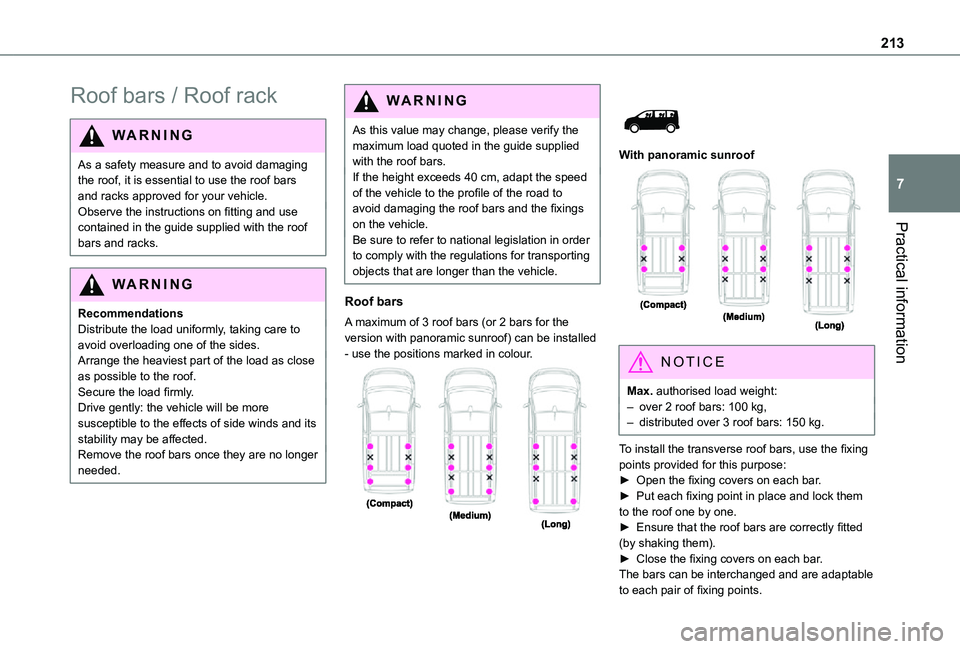
A maximum of 3 roof bars (or 2 bars for the version with panoramic sunroof) can be installed - use the positions marked in colour.
With panoramic sunroof
NOTIC E
Max. authorised load weight:– over 2 roof bars: 100 kg,– distributed over 3 roof bars: 150 kg.
To install the transverse roof bars, use the fixing points provided for this purpose:► Open the fixing covers on each bar.► Put each fixing point in place and lock them to the roof one by one.► Ensure that the roof bars are correctly fitted (by shaking them).► Close the fixing covers on each bar.The bars can be interchanged and are adaptable to each pair of fixing points.