engine TOYOTA RAV4 1996 Service Repair Manual
[x] Cancel search | Manufacturer: TOYOTA, Model Year: 1996, Model line: RAV4, Model: TOYOTA RAV4 1996Pages: 1632, PDF Size: 41.64 MB
Page 1094 of 1632
1999-2000 STEERING
Power Rack & Pinion - Trucks
DESCRIPTION & OPERATION
System consists of a rack and pinion assembly, hydraulic power steering pump, hoses and control valves. On
some models an air control valve is used to increase idle speed when power steering pump is under load.
LUBRICATION
FLUID TYPE
Use Dexron-II or Dexron-III ATF fluid.
FLUID LEVEL CHECK
When fluid is at normal operating temperature, fluid level should be between HOT marks on fluid reservoir.
When fluid is cold, fluid level should be between COLD marks on fluid reservoir. Add as necessary.
HYDRAULIC SYSTEM BLEEDING
1. With engine off, check fluid level in power steering pump reservoir. See FLUID LEVEL CHECK
.
Raise and support vehicle. Turn wheels fully in both directions. Lower vehicle. Start engine and run at
idle.
2. Turn wheels fully to lock in one direction. Hold for a few seconds. Turn wheels fully to opposite lock.
Hold for a few seconds. Repeat process several times.
3. Check fluid. If there is no evidence of excess bubbles or foaming, bleeding is complete. If not, repeat
process until no bubbling is evident. Adjust fluid level as necessary.
ADJUSTMENTS
POWER STEERING PUMP BELT
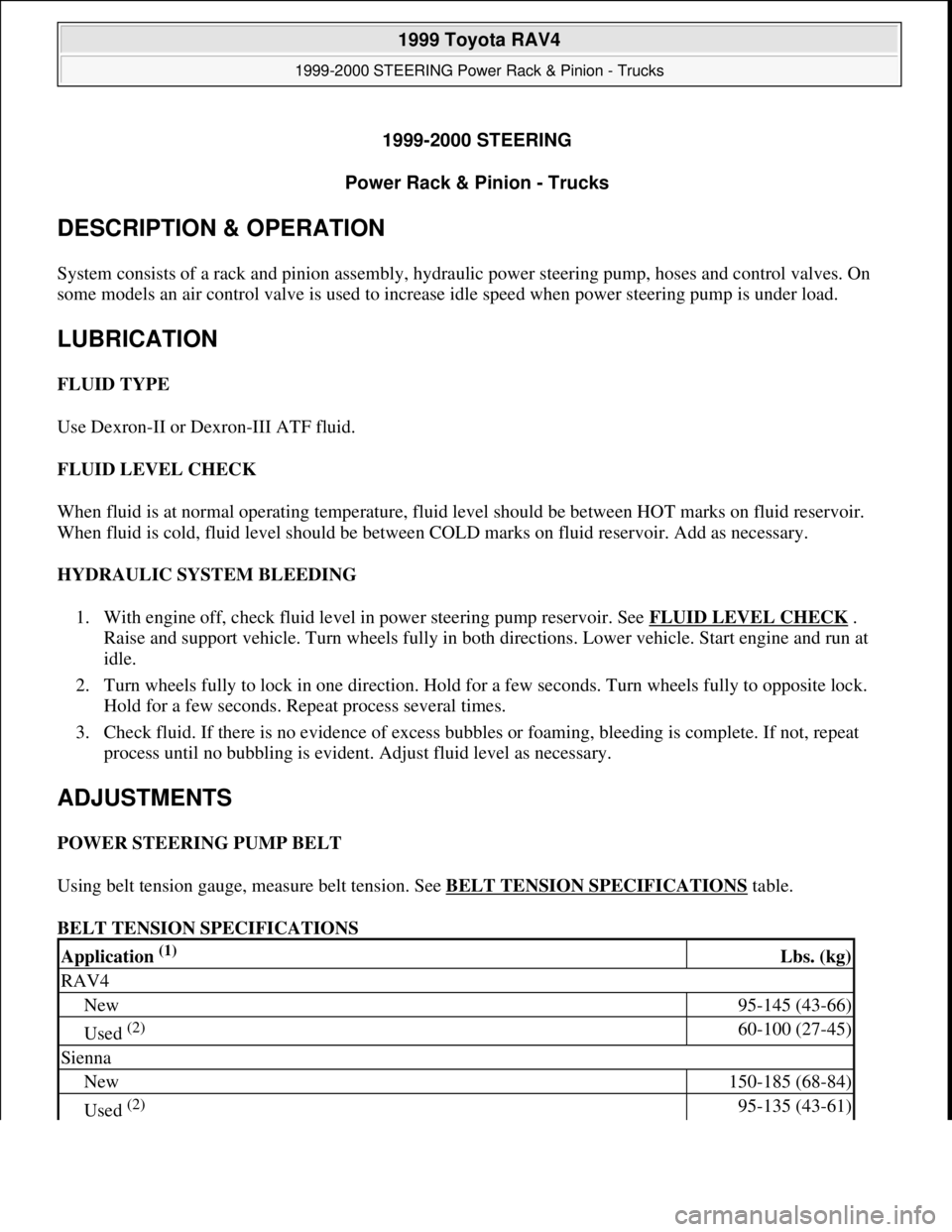
Using belt tension gauge, measure belt tension. See BELT TENSION SPECIFICATIONS
table.
BELT TENSION SPECIFICATIONS
Application (1) Lbs. (kg)
RAV4
New95-145 (43-66)
Used (2) 60-100 (27-45)
Sienna
New150-185 (68-84)
Used (2) 95-135 (43-61)
1999 Toyota RAV4
1999-2000 STEERING Power Rack & Pinion - Trucks
1999 Toyota RAV4
1999-2000 STEERING Power Rack & Pinion - Trucks
Microsoft
Sunday, November 22, 2009 10:35:46 AMPage 1 © 2005 Mitchell Repair Information Company, LLC.
Microsoft
Sunday, November 22, 2009 10:35:50 AMPage 1 © 2005 Mitchell Repair Information Company, LLC.
Page 1095 of 1632
SYSTEMS TESTS
AIR CONTROL VALVE
Land Cruiser, RAV4, Tacoma & 4Runner
Start and fully warm up engine. Ensure A/C is off. With engine at idle, turn steering wheel to full LOCK
position until test is complete. Ensure engine RPM decreases when air control valve vacuum hose is pinched
shut. When hose is released, engine RPM should increase to normal. If system fails this test, check vacuum
hose, connections, and air control valve.
HYDRAULIC SYSTEM PRESSURE TEST
Pressure Test
1. Connect pressure to power steering pump high pressure line. Connect pressure gauge according to
manufacturer's instructions. Bleed air from hydraulic system. Check power steering fluid level. With
engine at idle, close pressure gauge valve for 2-3 seconds. DO NOT keep valve closed for more than 10
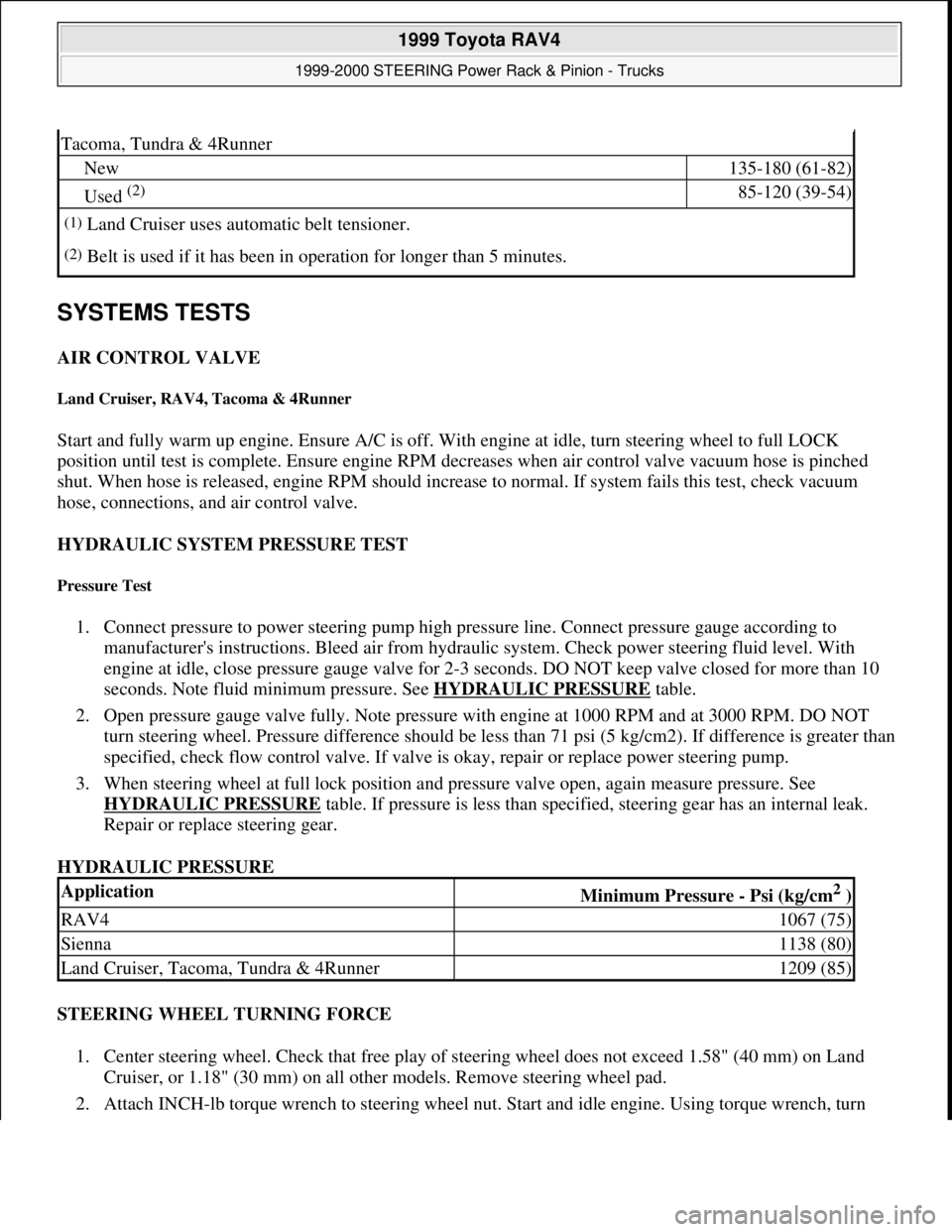
seconds. Note fluid minimum pressure. See HYDRAULIC PRESSURE
table.
2. Open pressure gauge valve fully. Note pressure with engine at 1000 RPM and at 3000 RPM. DO NOT
turn steering wheel. Pressure difference should be less than 71 psi (5 kg/cm2). If difference is greater than
specified, check flow control valve. If valve is okay, repair or replace power steering pump.
3. When steering wheel at full lock position and pressure valve open, again measure pressure. See
HYDRAULIC PRESSURE
table. If pressure is less than specified, steering gear has an internal leak.
Repair or replace steering gear.
HYDRAULIC PRESSURE
STEERING WHEEL TURNING FORCE
1. Center steering wheel. Check that free play of steering wheel does not exceed 1.58" (40 mm) on Land
Cruiser, or 1.18" (30 mm) on all other models. Remove steering wheel pad.
2. Attach INCH-lb torque wrench to steerin
g wheel nut. Start and idle engine. Using torque wrench, turn
Tacoma, Tundra & 4Runner
New135-180 (61-82)
Used (2) 85-120 (39-54)
(1)Land Cruiser uses automatic belt tensioner.
(2)Belt is used if it has been in operation for longer than 5 minutes.
ApplicationMinimum Pressure - Psi (kg/cm2 )
RAV41067 (75)
Sienna1138 (80)
Land Cruiser, Tacoma, Tundra & 4Runner1209 (85)
1999 Toyota RAV4
1999-2000 STEERING Power Rack & Pinion - Trucks
Microsoft
Sunday, November 22, 2009 10:35:46 AMPage 2 © 2005 Mitchell Repair Information Company, LLC.
Page 1096 of 1632
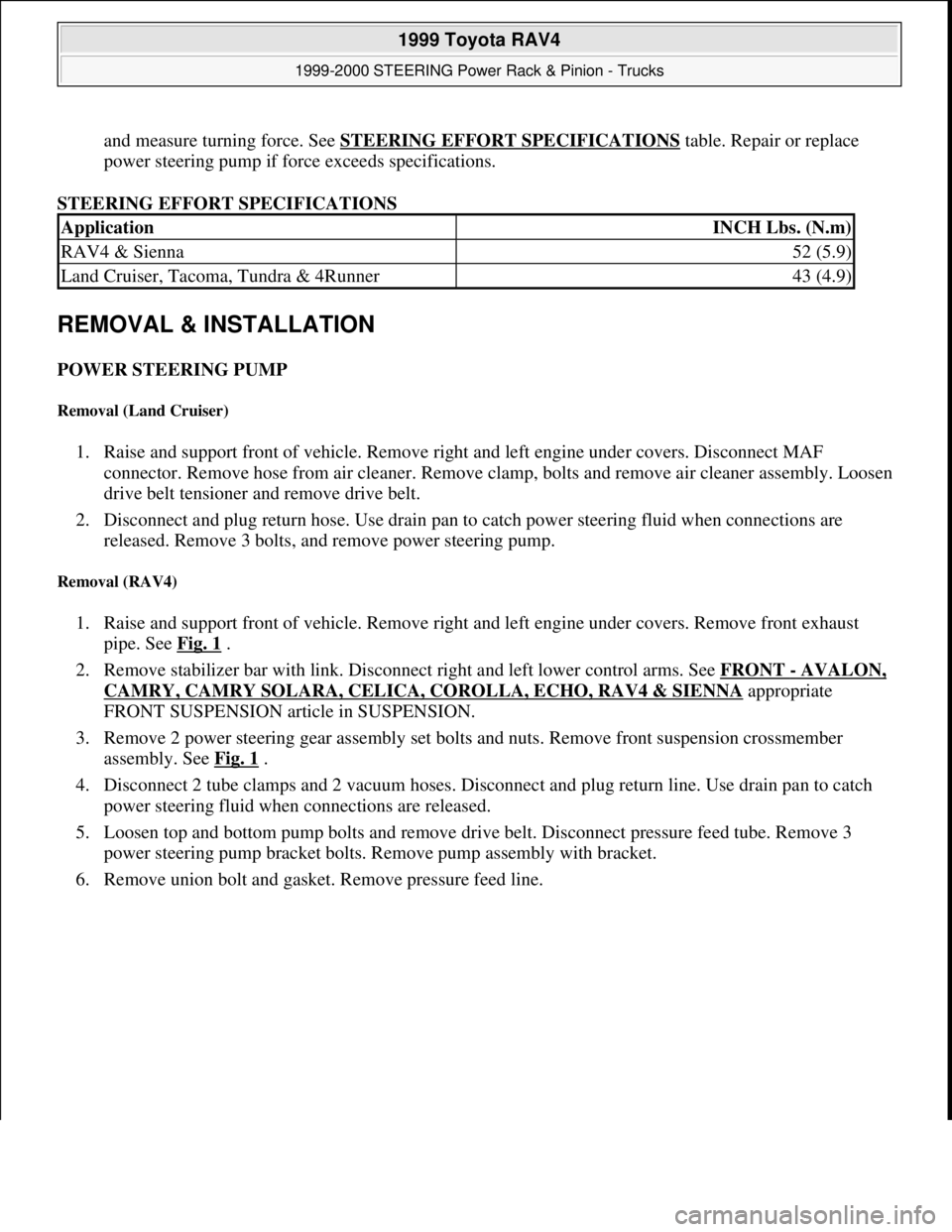
and measure turning force. See STEERING EFFORT SPECIFICATIONS table. Repair or replace
power steering pump if force exceeds specifications.
STEERING EFFORT SPECIFICATIONS
REMOVAL & INSTALLATION
POWER STEERING PUMP
Removal (Land Cruiser)
1. Raise and support front of vehicle. Remove right and left engine under covers. Disconnect MAF
connector. Remove hose from air cleaner. Remove clamp, bolts and remove air cleaner assembly. Loosen
drive belt tensioner and remove drive belt.
2. Disconnect and plug return hose. Use drain pan to catch power steering fluid when connections are
released. Remove 3 bolts, and remove power steering pump.
Removal (RAV4)
1. Raise and support front of vehicle. Remove right and left engine under covers. Remove front exhaust
pipe. See Fig. 1
.
2. Remove stabilizer bar with link. Disconnect right and left lower control arms. See FRONT
- AVALON,
CAMRY, CAMRY SOLARA, CELICA, COROLLA, ECHO, RAV4 & SIENNA appropriate
FRONT SUSPENSION article in SUSPENSION.
3. Remove 2 power steering gear assembly set bolts and nuts. Remove front suspension crossmember
assembly. See Fig. 1
.
4. Disconnect 2 tube clamps and 2 vacuum hoses. Disconnect and plug return line. Use drain pan to catch
power steering fluid when connections are released.
5. Loosen top and bottom pump bolts and remove drive belt. Disconnect pressure feed tube. Remove 3
power steering pump bracket bolts. Remove pump assembly with bracket.
6. Remove union bolt and
gasket. Remove pressure feed line.
ApplicationINCH Lbs. (N.m)
RAV4 & Sienna52 (5.9)
Land Cruiser, Tacoma, Tundra & 4Runner43 (4.9)
1999 Toyota RAV4
1999-2000 STEERING Power Rack & Pinion - Trucks
Microsoft
Sunday, November 22, 2009 10:35:46 AMPage 3 © 2005 Mitchell Repair Information Company, LLC.
Page 1099 of 1632
1. Remove air cleaner assembly. Disconnect and plug return hose. Use drain pan to catch power steering
fluid when connections are released.
2. Disconnect oil pressure switch connector. Remove oil pressure switch from pressure feed line. Remove
union bolt and gaskets. Disconnect pressure feed line from pump.
3. Loosen power steering pump adjusting bolts. Remove drive belt. Remove power steering pump mounting
bolts. Remove power steering pump.
Removal (Tundra)
1. Disconnect MAF connector. Remove hose from air cleaner. Remove clamp, bolts and remove air cleaner
assembly. On V8 engines, loosen drive belt tensioner and remove drive belt. On all models, disconnect
and plug return hose. Use drain pan to catch power steering fluid when connections are released.
2. On V6 models, disconnect oil pressure switch connector and remove oil pressure switch. On V8, remove
vacuum hoses. On all models, disconnect pressure feed line from pump. On V6 models, remove drive
belt. On all models, loosen power steering pump adjusting bolts. Remove power steering pump mounting
bolts. Remove power steering pump.
Installation (All Models)
To install, reverse removal procedure. Fill and bleed system. See HYDRAULIC SYSTEM BLEEDINGunder
LUBRICATION.
POWER RACK & PINION
Removal (Land Cruiser)
1. Place front wheels in straight-ahead position. Remove steering wheel and pad. Remove right and left
engine under covers. Disconnect both tie rod ends. See FRONT
- LAND CRUISER article in
SUSPENSION.
2. Drain engine oil. Remove oil filter assembly. Disconnect lower steering column shaft from steering gear.
Disconnect pressure and return lines from steering gear. Remove line clamps. Place matchmarks on tie
rod end and rack end. Remove both tie rods.
3. Remove power rack and pinion assembly mounting bolts and nuts. Remove rack and pinion assembly.
Installation
1. To install, reverse removal procedure, except install power feed and return line clamps to rack and pinion
assembly first.
2. After installation, place front wheels in straight-ahead position. Center steering wheel spiral cable, then
install steering wheel and pad. Check front wheel alignment.
Removal (RAV4)
1. Place front wheels in straight-ahead position. Remove steering wheel and pad.
2. Remove right and left engine under covers. Disconnect both tie rod ends. See FRONT
- AVALON,
CAMRY, CAMRY SOLARA, CELICA, COROLLA, ECHO, RAV4 & SIENNA article in
1999 Toyota RAV4
1999-2000 STEERING Power Rack & Pinion - Trucks
Microsoft
Sunday, November 22, 2009 10:35:46 AMPage 6 © 2005 Mitchell Repair Information Company, LLC.
Page 1100 of 1632
SUSPENSION. Remove front exhaust pipe. Remove stabilizer bar with link.
3. Disconnect lower steering column shaft from steering gear. Disconnect pressure and return lines from
steering gear. Remove line clamps.
4. Disconnect right and left lower control arms. See FRONT
- AVALON, CAMRY, CAMRY SOLARA,
CELICA, COROLLA, ECHO, RAV4 & SIENNA article in SUSPENSION.
5. Remove power rack and pinion assembly mounting bolts and nuts. Securely suspend rack and pinion
assembly.
6. Remove front suspension crossmember. See Fig. 1
. Remove power rack and pinion assembly.
Installation
1. To install, reverse removal procedure, except install power feed and return line clamps to rack and pinion
assembly first.
2. After installation, place front wheels in straight-ahead position. Center steering wheel spiral cable, then
install steering wheel and pad. Check front wheel alignment.
Removal (Sienna)
1. Place front wheels in straight-ahead position. Remove steering wheel and pad. Disconnect both tie rod
ends. See FRONT
- AVALON, CAMRY, CAMRY SOLARA, CELICA, COROLLA, ECHO, RAV4
& SIENNA article in SUSPENSION.
2. Disconnect lower steering column shaft from steering gear. Remove nut holding tube clamp on rack
housing. Disconnect pressure and return lines from steering gear.
3. Disconnect, but DO NOT remove, stabilizer bar. See FRONT
- AVALON, CAMRY, CAMRY
SOLARA, CELICA, COROLLA, ECHO, RAV4 & SIENNA article in SUSPENSION.
4. Remove power rack and pinion assembly mounting bolts and nuts. Lift stabilizer bar to remove bolts.
Remove power rack and pinion assembly.
Installation
To install, reverse removal procedure, installing assembly from left side of vehicle. After installation, place
front wheels in straight-ahead position. Center steering wheel spiral cable, then install steering wheel and pad.
Check front wheel alignment.
Removal (Tacoma)
1. Place front wheels in straight-ahead position. Remove steering wheel and pad. On 4WD models, remove
engine under cover. Disconnect both tie rod ends.
2. Disconnect lower steering column shaft from steering gear. Disconnect pressure and return lines from
steering gear.
3. Remove power rack and pinion assembly mounting bolts and nuts. Remove power rack and pinion
assembly.
Installation
1999 Toyota RAV4
1999-2000 STEERING Power Rack & Pinion - Trucks
Microsoft
Sunday, November 22, 2009 10:35:46 AMPage 7 © 2005 Mitchell Repair Information Company, LLC.
Page 1101 of 1632
To install, reverse removal procedure. After installation, place front wheels in straight-ahead position. Center
steering wheel spiral cable, then install steering wheel and pad. Check front wheel alignment.
Removal (Tundra)
1. Place front wheels in straight-ahead position. Remove steering wheel and pad. Disconnect both tie rod
ends. Disconnect lower steering column shaft from steering gear. Remove clamp plate bolt and remove
clamp plate.
2. Disconnect pressure and return lines from steering gear. Remove power rack and pinion assembly
mounting bolts and nuts. Remove power rack and pinion assembly.
Installation
To install, reverse removal procedure. After installation, place front wheels in straight-ahead position. Center
steering wheel spiral cable, then install steering wheel and pad. Check front wheel alignment.
Removal (4Runner)
1. Place front wheels in straight-ahead position. Remove steering wheel and pad. Remove engine under
cover.
2. Remove stabilizer bar. Disconnect both tie rod ends. Disconnect lower steering column shaft from
steering gear. Disconnect pressure and return lines from steering gear.
3. Remove power rack and pinion assembly mounting bolts and nuts. Remove power rack and pinion
assembly.
Installation
To install, reverse removal procedure. After installation, place front wheels in straight-ahead position. Center
steering wheel spiral cable, then install steering wheel and pad. Check front wheel alignment.
OVERHAUL
POWER STEERING PUMP
Disassembly (RAV4)
1. Mount pump assembly in soft-jaw vise. Ensure pump rotates smoothly. Using a torque wrench, check
pump rotating torque. Rotating torque should be 2.4 INCH lbs. (.3 N.m) or less. Remove front bracket
and pump bracket.
2. While holding pulley, remove pulley nut. Remove pulley and Woodruff key from pump shaft. Remove air
control valve. See Fig. 3
. Remove pressure feed No. 2 tube.
3. Remove union bolt and "O" ring from suction (return) port. Remove "O" ring from pressure port. Remove
flow control valve and spring. See Fig. 3
.
4. Remove flow control valve seat snap ring. Install a 6 x 1 x 50 mm bolt about 2-3 threads into seat. Pull
sprin
g seat from housing. Remove "O" ring.
1999 Toyota RAV4
1999-2000 STEERING Power Rack & Pinion - Trucks
Microsoft
Sunday, November 22, 2009 10:35:46 AMPage 8 © 2005 Mitchell Repair Information Company, LLC.
Page 1156 of 1632
1999-2000 STARTING & CHARGING SYSTEMS
Starters
DESCRIPTION & OPERATION
All models use Nippondenso 4-brush, solenoid-actuated, reduction gear type starters, equipped with over-
running clutches. The brush holder assembly retains 4 brushes and springs in the starter housing.
Reduction gear type starters contain an integral solenoid attached to drive housing, a reduction idler gear and
bearing installed into starter housing, and a clutch drive assembly. The clutch drive assembly is mounted to
starter housing and is driven by the reduction idler gear from armature shaft. The brush holder assembly retains
4 brushes and 4 springs in the end cover of field frame housing.
All models use a starter relay to energize starter. Manual transmission vehicles use a clutch start switch and
automatic transmission vehicles use a park/neutral switch to energize starter relay. On models with theft
deterrent system, theft deterrent system ECU provides ground for starter relay.
Tacoma, Tundra and 4Runner models with 4WD and M/T use an optional clutch start cancel switch. When this
switch is turned on, it will allow engine to be started without depressing clutch pedal when transmission is in
Neutral. This allows vehicle to be driven out of difficult situations by cranking the engine with the clutch
engaged.
TROUBLE SHOOTING
1. If a no-start condition exists and battery is known to be good, connect test light or voltmeter between
starter solenoid terminal No. 50 and ground. See Fig. 8
or Fig. 9 .
2. Turn ignition switch to START position. If test light or voltmeter does not indicate voltage, check main
fusible links and large ampere main fuses in engine compartment relay box. If fusible links and fuses are
okay, see IGNITION SWITCH CONTINUITY TEST
and/or STARTER RELAY TEST under ON-
VEHICLE TESTING.
ON-VEHICLE TESTING
CLUTCH START SWITCH TEST
Switch is located above clutch pedal on bracket. Disconnect wirin
g harness connector from switch. Connect NOTE: This article also applies to Lexus LX470. For Lexus LX470, refer to Land
Cruiser, unless otherwise indicated.
NOTE: See TROUBLE SHOOTING article in GENERAL INFORMATION.
NOTE: Before testing, ensure battery is fully charged, battery cables and terminal ends
are tight and clean, and engine grounds are secure.
1999 Toyota RAV4
1999-2000 STARTING & CHARGING SYSTEMS Starters
1999 Toyota RAV4
1999-2000 STARTING & CHARGING SYSTEMS Starters
Microsoft
Sunday, November 22, 2009 10:19:17 AMPage 1 © 2005 Mitchell Repair Information Company, LLC.
Microsoft
Sunday, November 22, 2009 10:19:23 AMPage 1 © 2005 Mitchell Repair Information Company, LLC.
Page 1163 of 1632
1. Locate and remove starter relay. Starter relay is marked "ST". See STARTER RELAY LOCATION
table. Using ohmmeter, verify continuity exists between relay terminals No. 3 and 4. See STEP 1. See
Fig. 6
. Continuity should not exist between terminals No. 1 and 2. If continuity is not as specified,
replace relay.
2. Check relay operation by applying battery voltage to terminals No. 3 and 4. See STEP 2. See Fig. 6
.
Continuity should now exist between terminals No. 1 and 2. If relay does not test as indicated, replace
relay.
All Others
1. Locate and remove starter relay. Starter relay is marked "ST". See STARTER RELAY LOCATION
table. Using ohmmeter, verify continuity between relay terminals No. 1 and 2. See Fig. 7
. Continuity
should not exist between terminals No. 3 and 5. If continuity is not as specified, replace relay.
2. Check relay operation by applying battery voltage through terminals No. 1 and 2. See Fig. 7
. Continuity
should now exist between terminals No. 3 and 5. If relay does not test as indicated, replace relay.
STARTER RELAY LOCATION
ApplicationLocation
Avalon & CorollaIn Engine Compartment Junction Block
Camry, Camry Solara & SiennaIn Engine Compartment Junction Block No. 2
CelicaIn Engine Compartment Junction/Relay Block No. 2
Land CruiserIn Engine Compartment Junction Block
RAV4, Tundra & 4RunnerIn Engine Compartment Relay Block
TacomaIn Engine Compartment Relay Block No. 2
1999 Toyota RAV4
1999-2000 STARTING & CHARGING SYSTEMS Starters
Microsoft
Sunday, November 22, 2009 10:19:18 AMPage 8 © 2005 Mitchell Repair Information Company, LLC.
Page 1168 of 1632
1.Pull-In Coil Test
Disconnect field coil lead from terminal "C". Connect jumper wires from negative battery terminal to
terminal "C" and to starter housing. When wire is connected from positive battery terminal to terminal
No. 50, clutch pinion gear should extend fully. See Fig. 10
or Fig. 13 . If clutch pinion gear does not
move, replace solenoid. If clutch pinion gear does move, go to next test.
2.Hold-In Coil Test
With battery connected as in previous test and clutch pinion gear still extended, disconnect jumper wire
from starter terminal "C". See Fig. 11
or Fig. 14 . Clutch pinion gear should remain extended. If clutch
pinion gear does not remain extended, replace solenoid. If clutch pinion gear does remain extended, go to
next test.
3.Drive Pinion Return Test
Disconnect jumper wire from negative battery terminal to starter housing. See Fig. 12
or Fig. 15 . Pinion
gear should now retract. If it does not retract, replace solenoid.
STARTER COMPONENT INSPECTION
Armature Coil
1. Using ohmmeter, check for continuity between armature coil core and insulation between commutator
segments. If continuity is present, replace armature. Check armature for shorts using a growler. Replace
armature as necessary.
2. Check for continuity between segments of commutator. If continuity is not present between any segment,
replace armature.
Brushes & Springs
1. Check brush length. If length is less than specification, replace brushes. See STARTER
SPECIFICATIONS . If brushes are okay, go to next step.
2. Check brush holders, springs, spring clip and insulation between positive and negative holders. Verify no
continuity exists between positive and negative brush holders. Repair or replace components as needed.
Clutch Assembly & Gears
1. Inspect teeth on pinion gear, idler gear and clutch assembly for wear or damage. If damaged, replace gear
or clutch assembly and inspect flywheel ring gear for wear or damage.
2. Inspect clutch pinion gear by rotating pinion gear. Depending on engine, pinion gear will rotate freely in
one direction and lock when rotated in opposite direction. On Avalon, Camry, Camry Solara, Celica,
RAV4 and Sienna, clutch pinion
gear will lock when rotated in a clockwise direction. On all other CAUTION: DO NOT engage starter solenoid for more than 5 seconds during testing,
or damage to coil winding will result.
1999 Toyota RAV4
1999-2000 STARTING & CHARGING SYSTEMS Starters
Microsoft
Sunday, November 22, 2009 10:19:18 AMPage 13 © 2005 Mitchell Repair Information Company, LLC.
Page 1175 of 1632
assembly. If equipped with cruise control, remove cruise control actuator cable from clamps.
2. On California models, remove air hose for idle-up from air cleaner hose. On all models, disconnect 4
clamps, and disconnect air cleaner cap from air cleaner case. Loosen hose clamp, and disconnect air
cleaner hose from throttle body.
3. Remove air cleaner cap and air cleaner hose assembly. Remove air filter. Disconnect 2 engine wires from
clamps on air cleaner case. Remove 3 bolts and air cleaner case. Remove battery. If equipped with cruise
control, disconnect cruise control actuator connector.
4. Remove 3 bolts, and disconnect actuator from body bracket. On all models, disconnect starter connector.
Remove nut, and disconnect starter cable. Remove 2 bolts, and disconnect oxygen sensor connector and
engine wire brackets from starter. Remove starter. To install, reverse removal procedure. Tighten starter
bolts to specification. See TORQUE SPECIFICATIONS
.
Removal & Installation (Corolla)
1. Disconnect negative battery cable and then positive cable. Remove battery and tray. Remove engine
coolant reservoir. Remove engine splash shield from underneath right side of compartment.
2. Remove starter terminal/wire cover and remove starter wires. Remove starter bolts and starter. Note
starter mounting bolt locations (bolts are different lengths). To install, reverse removal procedure. Tighten
starter bolts to specification. See TORQUE SPECIFICATIONS
.
Removal & Installation (Land Cruiser & Tundra V8)
1. Starter is located underneath intake manifold. See Fig. 16 . Disconnect negative battery cable. Remove
cover from top of engine. Remove air cleaner intake hose. Disconnect accelerator cable. Remove intake
manifold. See CYLINDER HEAD & MANIFOLDS
in 4.7L article in ENGINES.
2. Remove starter wires and remove starter. To install, reverse removal procedure. Tighten starter bolts to
specification. See TORQUE SPECIFICATIONS
.
1999 Toyota RAV4
1999-2000 STARTING & CHARGING SYSTEMS Starters
Microsoft
Sunday, November 22, 2009 10:19:18 AMPage 20 © 2005 Mitchell Repair Information Company, LLC.