Coolant Temperature Sensor TOYOTA RAV4 1996 Service Repair Manual
[x] Cancel search | Manufacturer: TOYOTA, Model Year: 1996, Model line: RAV4, Model: TOYOTA RAV4 1996Pages: 1632, PDF Size: 41.64 MB
Page 161 of 1632
clutch.
Vehicle Does Not Move In Reverse ("R")
Check 1-2 shift valve, 2-3 shift valve, 2nd coast brake, front planetary gear, rear planetary gear, direct clutch,
OD direct clutch and 1st and reverse brake.
No 1-2 &/Or 2-3 Upshift
Check Throttle Position (TP) sensor circuit, No. 1 and No. 2 shift solenoid circuit, Vehicle Speed Sensor (VSS)
circuit, Electronic Control Transmission Electronic Control Module (ECT ECM), 1-2 shift valve, 2-3 shift
valve, 2nd brake, direct clutch and No. 1 one-way clutch.
No 3-O/D Upshift
Check OD switch and OD OFF indicator switch circuit, OD cancel signal circuit, No. 1 and No. 2 shift solenoid
circuit, VSS, Engine Coolant Temperature (ECT) circuit, ECT ECM, 3-4 shift valve and OD brake.
No O/D-3 Downshift
Check No. 1 and No. 2 shift solenoid valve, VSS circuit, OD cancel signal circuit, ECT ECM and 3-4 shift
valve.
No 3-2 &/Or 2-1 Downshift
Check No. 1 and No. 2 shift solenoid valve, VSS circuit, TP sensor circuit, ECT ECM, 2-3 shift valve, 1-2 shift
valve and 2nd coast brake.
No Torque Converter Lock-Up
Check shift solenoid valve SL circuit, TP sensor circuit, VSS circuit, OD cancel circuit, brakelight circuit, ECT
circuit, ECT ECM, lock-up relay valve and torque converter clutch.
Torque Converter Lock-Up Will Not Release
Check shift solenoid valve SL circuit, TP sensor circuit, brakelight circuit, ECT ECM circuit, lock-up relay
valve and torque converter clutch.
Shift Speeds Too High Or Too Low
Check TP sensor circuit, VSS circuit, shift solenoid valve SL circuit, OD cancel signal circuit, pattern select
switch circuit and ECT ECM.
Harsh Engagement Neutral To Reverse
Check direct clutch accumulator, direct clutch, throttle valve and 1st and reverse brake.
Harsh Engagement Neutral To Drive
1998 Toyota Avalon XLS
1997-99 AUTOMATIC TRANSMISSIONS Toyota A-540E, A-540H & A-541E Overhaul
Helpmelearn
November-03-08 10:28:16 AMPage 7 © 2005 Mitchell Repair Information Company, LLC.
Page 471 of 1632
1999-2000 ENGINE COOLING
Electric Cooling Fans
IDENTIFICATION
ELECTRIC COOLING FAN IDENTIFICATION
DESCRIPTION & OPERATION
Land Cruiser, Tacoma, Tundra and 4Runner use a belt-driven cooling fan attached to the water pump. All other
models use 2 electric cooling fans located directly behind the radiator. Fans are controlled via Engine Coolant
Temperature (ECT) switches/sensors, and turn on when engine coolant temperature is above 208°F (98°C) on
Avalon, Camry with 3.0L, Camry Solara with 3.0L and Sienna. On Camry with 2.2L, Camry Solara with 2.2L,
Celica, Corolla, ECHO, MR2 and RAV4, ECT turns cooling fans on above 199°F (93°C). On Avalon, Camry
with 3.0L, Camry Solara with 3.0L and Sienna, fans will turn off when engine coolant temperature falls below
190°F (88°C). On Camry with 2.2L, Camry Solara with 2.2L, Celica, Corolla and RAV4, fans will turn off
below 181°F (83°C).
SYSTEM TESTS
ELECTRIC COOLING FAN
Avalon (1999), Camry 3.0L, Camry Solara 3.0L & Sienna
1. With engine coolant temperature below 190°F (88°C), turn ignition switch to ON position (engine off).
Ensure fans stop.
2. If fan do not stop, test cooling fan relay and ECT switch. See COOLING FAN RELAYS
and ECT
SWITCH . Check for loose or broken connector or wiring between relay and ECT switch. Repair as
necessary.
3. Disconnect No. 1 ECT switch connector. See ECT SWITCH LOCATIONS
table. With ignition still in
ON position, ensure cooling fan turns on. If not, check fuses, engine main relay, cooling fan relay and
cooling fan motor. Check for short between cooling fan relay and ECT switch.
4. Start engine and raise temperature above 208°F (98°C). Ensure cooling fan turns. If not, replace No. 1
ECT switch.
5. Stop engine and disconnect cooling fan 2-pin connector. With battery connected to ammeter (positive
battery terminal to positive ammeter terminal and negative battery and negative ammeter terminals to
each connector pin), test amperage readings. See Fig. 1
. If readings are not as specified, replace cooling
fan. See COOLING FAN AMPERAGE READINGS
table. Reconnect fan connector.
Avalon (2000)
ApplicationCooling Fan Location
All Models
Condenser Cooling FanPassenger's Side, Rear Of Radiator
Radiator Cooling FanDriver's Side, Rear Of Radiator
1999 Toyota RAV4
1999-2000 ENGINE COOLING Electric Cooling Fans
1999 Toyota RAV4
1999-2000 ENGINE COOLING Electric Cooling Fans
Microsoft
Sunday, November 22, 2009 10:21:41 AMPage 1 © 2005 Mitchell Repair Information Company, LLC.
Microsoft
Sunday, November 22, 2009 10:21:45 AMPage 1 © 2005 Mitchell Repair Information Company, LLC.
Page 474 of 1632
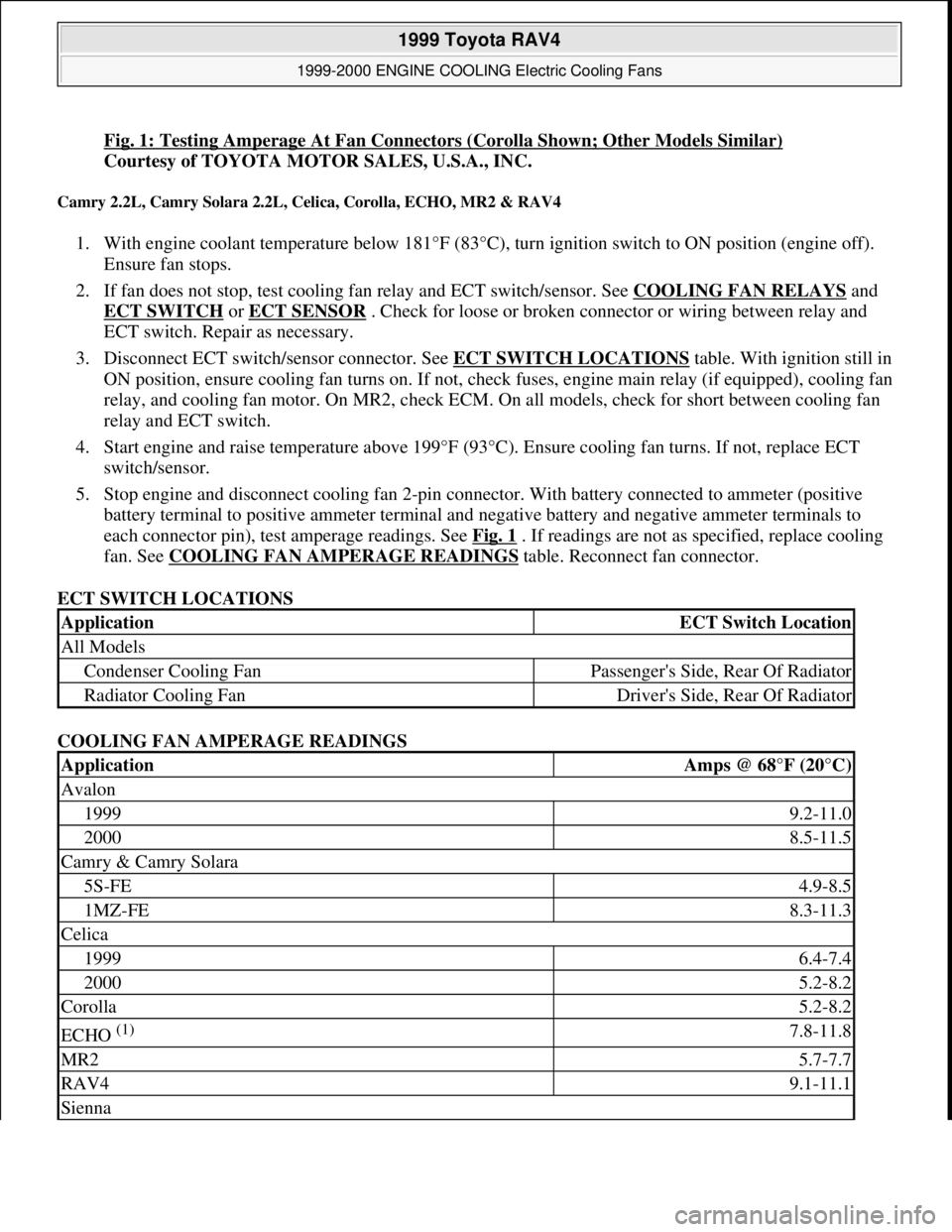
Fig. 1: Testing Amperage At Fan Connectors (Corolla Shown; Other Models Similar)
Courtesy of TOYOTA MOTOR SALES, U.S.A., INC.
Camry 2.2L, Camry Solara 2.2L, Celica, Corolla, ECHO, MR2 & RAV4
1. With engine coolant temperature below 181°F (83°C), turn ignition switch to ON position (engine off).
Ensure fan stops.
2. If fan does not stop, test cooling fan relay and ECT switch/sensor. See COOLING FAN RELAYS
and
ECT SWITCH
or ECT SENSOR . Check for loose or broken connector or wiring between relay and
ECT switch. Repair as necessary.
3. Disconnect ECT switch/sensor connector. See ECT SWITCH LOCATIONS
table. With ignition still in
ON position, ensure cooling fan turns on. If not, check fuses, engine main relay (if equipped), cooling fan
relay, and cooling fan motor. On MR2, check ECM. On all models, check for short between cooling fan
relay and ECT switch.
4. Start engine and raise temperature above 199°F (93°C). Ensure cooling fan turns. If not, replace ECT
switch/sensor.
5. Stop engine and disconnect cooling fan 2-pin connector. With battery connected to ammeter (positive
battery terminal to positive ammeter terminal and negative battery and negative ammeter terminals to
each connector pin), test amperage readings. See Fig. 1
. If readings are not as specified, replace cooling
fan. See COOLING FAN AMPERAGE READINGS
table. Reconnect fan connector.
ECT SWITCH LOCATIONS
COOLING FAN AMPERAGE READINGS
ApplicationECT Switch Location
All Models
Condenser Cooling FanPassenger's Side, Rear Of Radiator
Radiator Cooling FanDriver's Side, Rear Of Radiator
ApplicationAmps @ 68°F (20°C)
Avalon
19999.2-11.0
20008.5-11.5
Camry & Camry Solara
5S-FE4.9-8.5
1MZ-FE8.3-11.3
Celica
19996.4-7.4
20005.2-8.2
Corolla5.2-8.2
ECHO (1) 7.8-11.8
MR25.7-7.7
RAV49.1-11.1
Sienna
1999 Toyota RAV4
1999-2000 ENGINE COOLING Electric Cooling Fans
Microsoft
Sunday, November 22, 2009 10:21:41 AMPage 4 © 2005 Mitchell Repair Information Company, LLC.
Page 492 of 1632
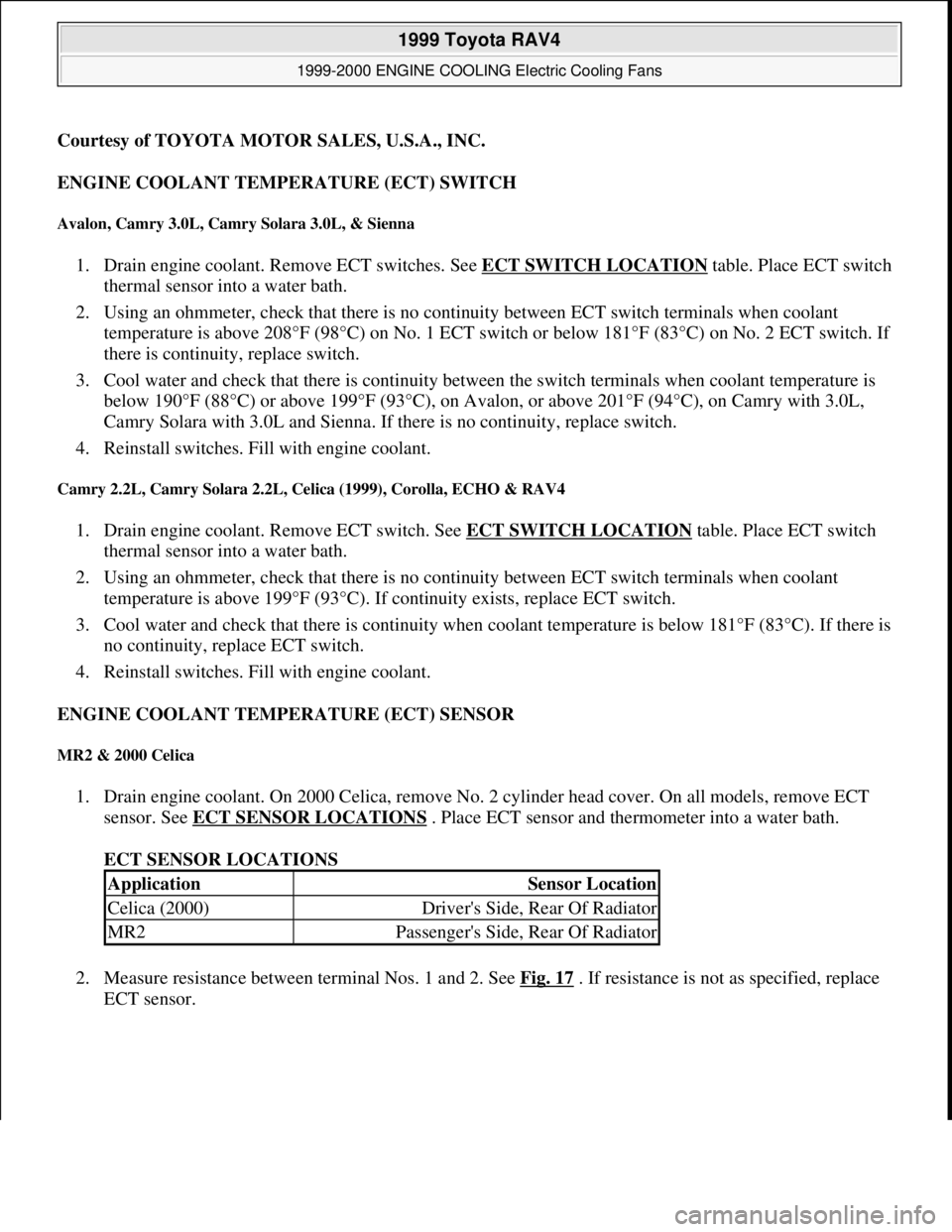
Courtesy of TOYOTA MOTOR SALES, U.S.A., INC.
ENGINE COOLANT TEMPERATURE (ECT) SWITCH
Avalon, Camry 3.0L, Camry Solara 3.0L, & Sienna
1. Drain engine coolant. Remove ECT switches. See ECT SWITCH LOCATION table. Place ECT switch
thermal sensor into a water bath.
2. Using an ohmmeter, check that there is no continuity between ECT switch terminals when coolant
temperature is above 208°F (98°C) on No. 1 ECT switch or below 181°F (83°C) on No. 2 ECT switch. If
there is continuity, replace switch.
3. Cool water and check that there is continuity between the switch terminals when coolant temperature is
below 190°F (88°C) or above 199°F (93°C), on Avalon, or above 201°F (94°C), on Camry with 3.0L,
Camry Solara with 3.0L and Sienna. If there is no continuity, replace switch.
4. Reinstall switches. Fill with engine coolant.
Camry 2.2L, Camry Solara 2.2L, Celica (1999), Corolla, ECHO & RAV4
1. Drain engine coolant. Remove ECT switch. See ECT SWITCH LOCATION table. Place ECT switch
thermal sensor into a water bath.
2. Using an ohmmeter, check that there is no continuity between ECT switch terminals when coolant
temperature is above 199°F (93°C). If continuity exists, replace ECT switch.
3. Cool water and check that there is continuity when coolant temperature is below 181°F (83°C). If there is
no continuity, replace ECT switch.
4. Reinstall switches. Fill with engine coolant.
ENGINE COOLANT TEMPERATURE (ECT) SENSOR
MR2 & 2000 Celica
1. Drain engine coolant. On 2000 Celica, remove No. 2 cylinder head cover. On all models, remove ECT
sensor. See ECT SENSOR LOCATIONS
. Place ECT sensor and thermometer into a water bath.
ECT SENSOR LOCATIONS
2. Measure resistance between terminal Nos. 1 and 2. See Fig. 17
. If resistance is not as specified, replace
ECT sensor.
ApplicationSensor Location
Celica (2000)Driver's Side, Rear Of Radiator
MR2Passenger's Side, Rear Of Radiator
1999 Toyota RAV4
1999-2000 ENGINE COOLING Electric Cooling Fans
Microsoft
Sunday, November 22, 2009 10:21:41 AMPage 22 © 2005 Mitchell Repair Information Company, LLC.
Page 676 of 1632
SOLENOIDS & SOLENOID VALVES
SOLENOIDS & SOLENOID VALVES
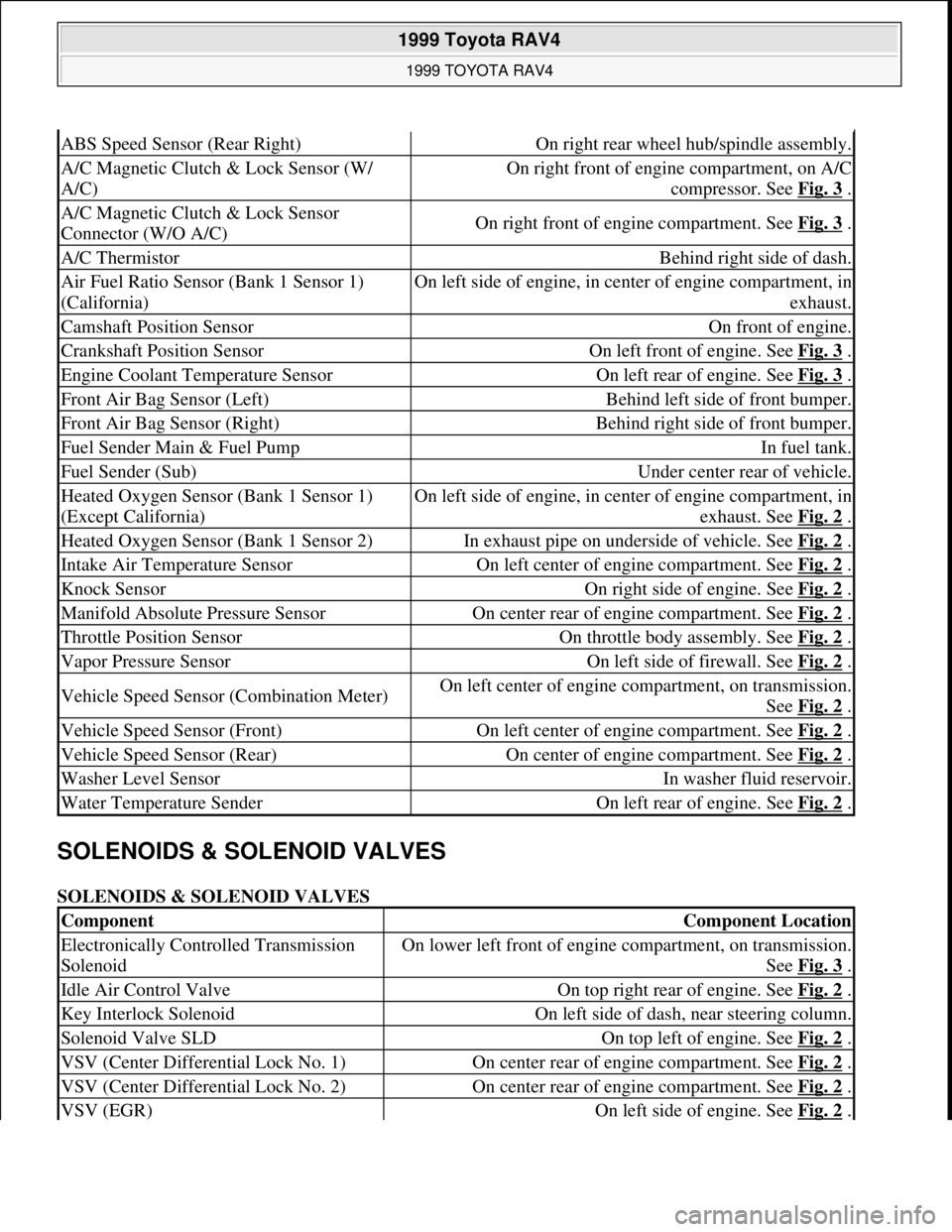
ABS Speed Sensor (Rear Right)On right rear wheel hub/spindle assembly.
A/C Magnetic Clutch & Lock Sensor (W/
A/C)On right front of engine compartment, on A/C
compressor. See Fig. 3
.
A/C Magnetic Clutch & Lock Sensor
Connector (W/O A/C)On right front of engine compartment. See Fig. 3 .
A/C ThermistorBehind right side of dash.
Air Fuel Ratio Sensor (Bank 1 Sensor 1)
(California)On left side of engine, in center of engine compartment, in
exhaust.
Camshaft Position SensorOn front of engine.
Crankshaft Position SensorOn left front of engine. See Fig. 3 .
Engine Coolant Temperature SensorOn left rear of engine. See Fig. 3 .
Front Air Bag Sensor (Left)Behind left side of front bumper.
Front Air Bag Sensor (Right)Behind right side of front bumper.
Fuel Sender Main & Fuel PumpIn fuel tank.
Fuel Sender (Sub)Under center rear of vehicle.
Heated Oxygen Sensor (Bank 1 Sensor 1)
(Except California)On left side of engine, in center of engine compartment, in
exhaust. See Fig. 2
.
Heated Oxygen Sensor (Bank 1 Sensor 2)In exhaust pipe on underside of vehicle. See Fig. 2 .
Intake Air Temperature SensorOn left center of engine compartment. See Fig. 2 .
Knock SensorOn right side of engine. See Fig. 2 .
Manifold Absolute Pressure SensorOn center rear of engine compartment. See Fig. 2 .
Throttle Position SensorOn throttle body assembly. See Fig. 2 .
Vapor Pressure SensorOn left side of firewall. See Fig. 2 .
Vehicle Speed Sensor (Combination Meter)On left center of engine compartment, on transmission.
See Fig. 2
.
Vehicle Speed Sensor (Front)On left center of engine compartment. See Fig. 2 .
Vehicle Speed Sensor (Rear)On center of engine compartment. See Fig. 2 .
Washer Level SensorIn washer fluid reservoir.
Water Temperature SenderOn left rear of engine. See Fig. 2 .
ComponentComponent Location
Electronically Controlled Transmission
SolenoidOn lower left front of engine compartment, on transmission.
See Fig. 3
.
Idle Air Control ValveOn top right rear of engine. See Fig. 2 .
Key Interlock SolenoidOn left side of dash, near steering column.
Solenoid Valve SLDOn top left of engine. See Fig. 2 .
VSV (Center Differential Lock No. 1)On center rear of engine compartment. See Fig. 2 .
VSV (Center Differential Lock No. 2)On center rear of engine compartment. See Fig. 2 .
VSV (EGR)On left side of engine. See Fig. 2 .
1999 Toyota RAV4
1999 TOYOTA RAV4
Microsoft
Sunday, November 22, 2009 10:17:32 AMPage 3 © 2005 Mitchell Repair Information Company, LLC.
Page 894 of 1632
2. Turn ignition switch to ON position. Test light should be on and temperature gauge should slowly move
to HOT. If gauge functions as specified, replace sending unit. If gauge does not function as specified,
perform TEMPERATURE GAUGE RESISTANCE TEST
.
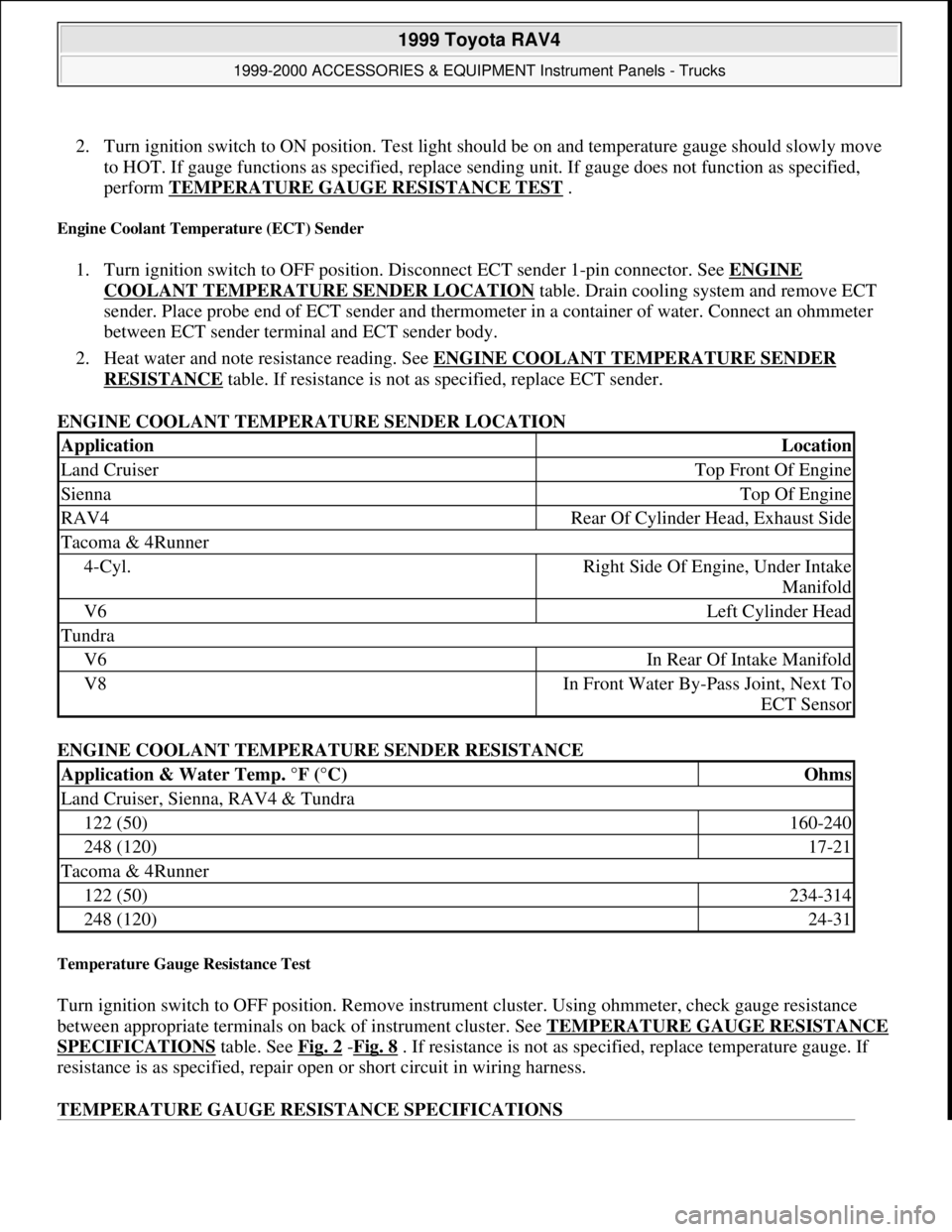
Engine Coolant Temperature (ECT) Sender
1. Turn ignition switch to OFF position. Disconnect ECT sender 1-pin connector. See ENGINE
COOLANT TEMPERATURE SENDER LOCATION table. Drain cooling system and remove ECT
sender. Place probe end of ECT sender and thermometer in a container of water. Connect an ohmmeter
between ECT sender terminal and ECT sender body.
2. Heat water and note resistance reading. See ENGINE COOLANT TEMPERATURE SENDER
RESISTANCE table. If resistance is not as specified, replace ECT sender.
ENGINE COOLANT TEMPERATURE SENDER LOCATION
ENGINE COOLANT TEMPERATURE SENDER RESISTANCE
Temperature Gauge Resistance Test
Turn ignition switch to OFF position. Remove instrument cluster. Using ohmmeter, check gauge resistance
between appropriate terminals on back of instrument cluster. See TEMPERATURE GAUGE RESISTANCE
SPECIFICATIONS table. See Fig. 2 -Fig. 8 . If resistance is not as specified, replace temperature gauge. If
resistance is as specified, repair open or short circuit in wiring harness.
TEMPERATURE GAUGE RESISTANCE SPECIFICATIONS
ApplicationLocation
Land CruiserTop Front Of Engine
SiennaTop Of Engine
RAV4Rear Of Cylinder Head, Exhaust Side
Tacoma & 4Runner
4-Cyl.Right Side Of Engine, Under Intake
Manifold
V6Left Cylinder Head
Tundra
V6In Rear Of Intake Manifold
V8In Front Water By-Pass Joint, Next To
ECT Sensor
Application & Water Temp. °F (°C)Ohms
Land Cruiser, Sienna, RAV4 & Tundra
122 (50)160-240
248 (120)17-21
Tacoma & 4Runner
122 (50)234-314
248 (120)24-31
1999 Toyota RAV4
1999-2000 ACCESSORIES & EQUIPMENT Instrument Panels - Trucks
Microsoft
Sunday, November 22, 2009 10:54:09 AMPage 4 © 2005 Mitchell Repair Information Company, LLC.
Page 1177 of 1632
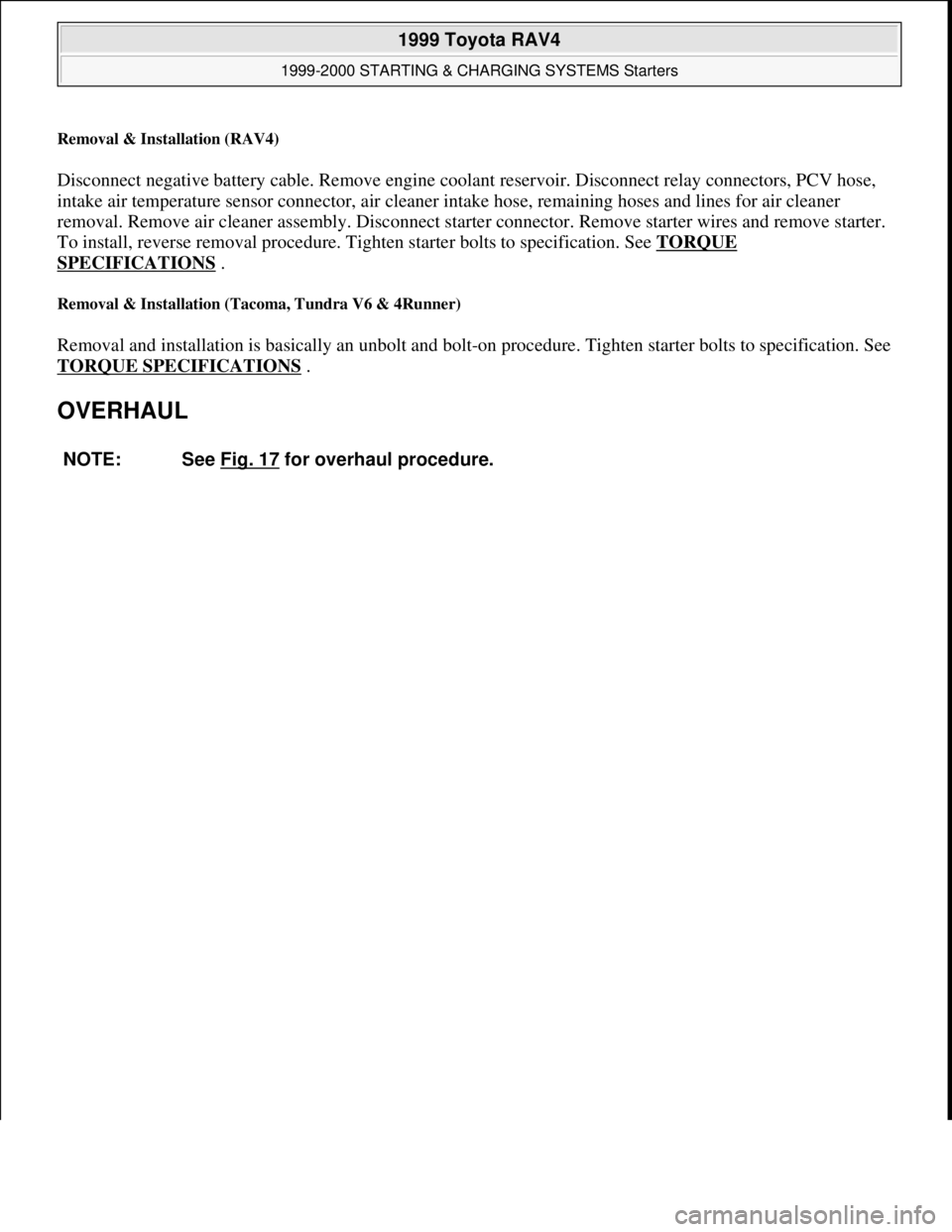
Removal & Installation (RAV4)
Disconnect negative battery cable. Remove engine coolant reservoir. Disconnect relay connectors, PCV hose,
intake air temperature sensor connector, air cleaner intake hose, remaining hoses and lines for air cleaner
removal. Remove air cleaner assembly. Disconnect starter connector. Remove starter wires and remove starter.
To install, reverse removal procedure. Tighten starter bolts to specification. See TORQUE
SPECIFICATIONS .
Removal & Installation (Tacoma, Tundra V6 & 4Runner)
Removal and installation is basically an unbolt and bolt-on procedure. Tighten starter bolts to specification. See
TORQUE SPECIFICATIONS
.
OVERHAUL
NOTE: See Fig. 17 for overhaul procedure.
1999 Toyota RAV4
1999-2000 STARTING & CHARGING SYSTEMS Starters
Microsoft
Sunday, November 22, 2009 10:19:18 AMPage 22 © 2005 Mitchell Repair Information Company, LLC.