cooling TOYOTA RAV4 1996 Service Repair Manual
[x] Cancel search | Manufacturer: TOYOTA, Model Year: 1996, Model line: RAV4, Model: TOYOTA RAV4 1996Pages: 1632, PDF Size: 41.64 MB
Page 126 of 1632
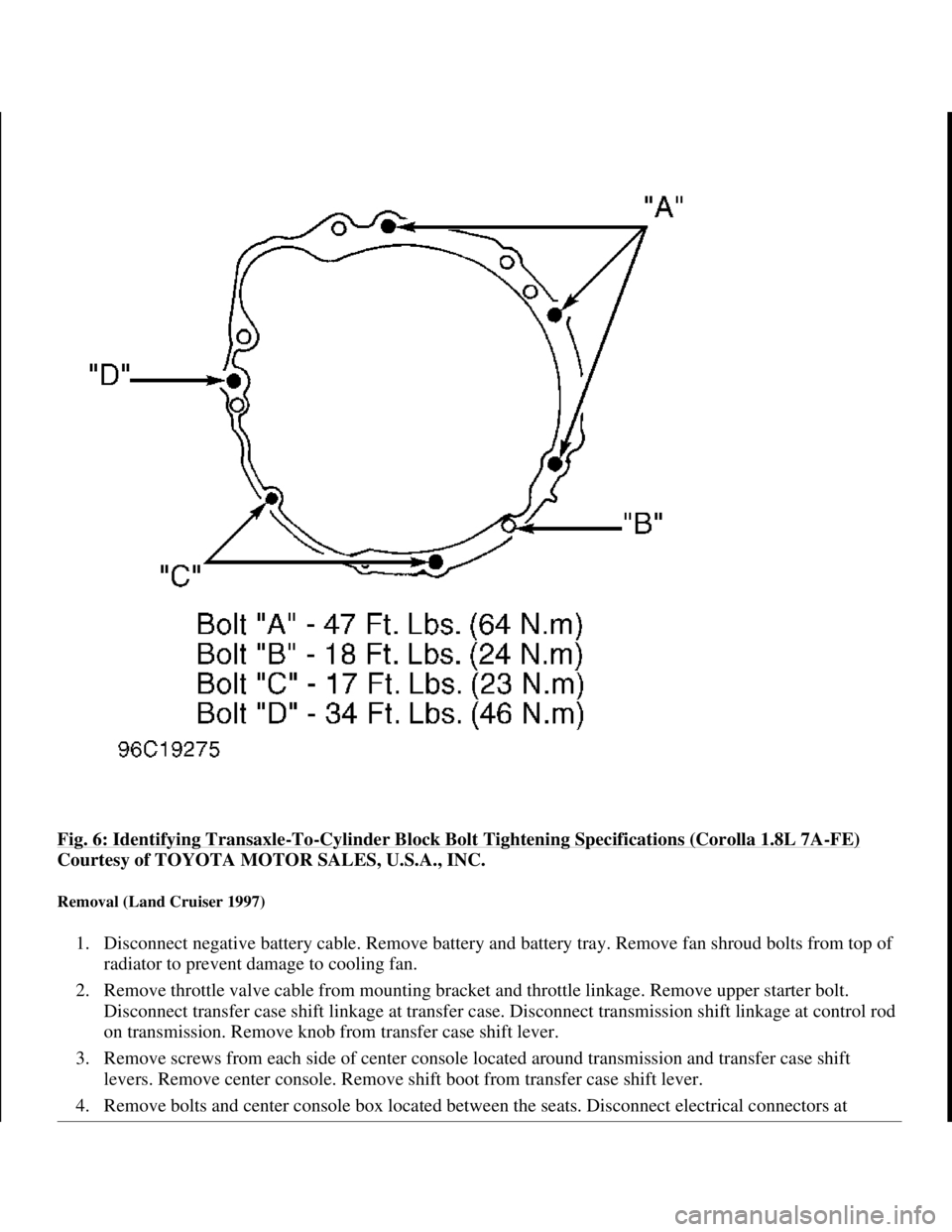
Fig. 6: Identifying Transaxle-To-Cylinder Block Bolt Tightening Specifications (Corolla 1.8L 7A-FE)
Courtesy of TOYOTA MOTOR SALES, U.S.A., INC.
Removal (Land Cruiser 1997)
1. Disconnect negative battery cable. Remove battery and battery tray. Remove fan shroud bolts from top of
radiator to prevent damage to cooling fan.
2. Remove throttle valve cable from mounting bracket and throttle linkage. Remove upper starter bolt.
Disconnect transfer case shift linkage at transfer case. Disconnect transmission shift linkage at control rod
on transmission. Remove knob from transfer case shift lever.
3. Remove screws from each side of center console located around transmission and transfer case shift
levers. Remove center console. Remove shift boot from transfer case shift lever.
4. Remove bolts and center console box located between the seats. Disconnect electrical connectors at
1998 Toyota Avalon XLS
TRANSMISSION SERVICING - A/T 1997-98 TRANSMISSION SERVICING Toyota - Transmission Removal &
Installation
Helpmelearn
November-03-08 10:30:28 AMPage 14 © 2005 Mitchell Repair Information Company, LLC.
Page 127 of 1632
transmission shift lever assembly for removal of transmission shift lever assembly.
5. Remove bolts and transmission shift lever assembly from top of transmission. Remove bolts, transfer case
shift lever assembly and cushions. Cushions are located between transfer case shift lever assembly and
the transfer case.
6. Raise and support vehicle. Disconnect necessary electrical connectors and hoses for transmission and
transfer case removal. Place reference marks on drive shaft flanges for reassembly reference. Remove
bolts and all drive shafts.
7. Remove transmission oil dipstick, dipstick tube and "O" ring. Loosen oil cooler lines at side of
transmission. Remove stabilizer bar-to-frame mounting bracket bolts at each end of stabilizer bar.
Remove lower engine cover.
8. Remove plug on front of transmission for access to torque converter bolts. Remove torque converter
bolts. Remove support brackets and front exhaust pipe with front catalytic converter and gasket. Front
exhaust pipe fits between exhaust manifolds and rear catalytic converter and exhaust pipe.
9. Remove starter. Support transmission with transmission jack. Remove transmission crossmember located
below the transmission. Lower rear of transmission. Separate wiring harness from transmission and
transfer case.
10. Remove oil cooler line mounting bolts from torque converter housing. Disconnect oil cooler lines from
side of transmission. Remove transmission-to-cylinder block bolts. Lower transmission with transfer case
from vehicle.
Installation
1. Before installing transmission, use dial indicator to check drive plate runout. Drive plate runout should be
checked right next to the starter ring gear on the drive plate. Replace drive plate if runout
exceeds .0079" (.200 mm).
2. Install torque converter on transmission. To ensure torque converter is fully seated, torque converter
depth should be checked. Using straightedge and caliper, measure torque converter depth from torque
converter bolt lug on torque converter to the surface on transmission. See Fig. 1
.
3. Torque converter depth should be more than .618" (15.70 mm). If torque converter depth is less than
specified, check for improperly seated torque converter.
4. To install, reverse removal procedure. Tighten all bolts/nuts to specification. See TORQUE
SPECIFICATIONS . When installing torque converter bolts, apply Loctite to torque converter bolt
threads before installing. Ensure the Gray torque converter bolt is installed first before installing the
remaining torque converter bolts.
5. Use NEW gaskets and NEW nuts when installing front exhaust pipe. Adjust all cables, shift linkages and
fill with ATF. See appropriate TRANSMISSION SERVICING article.
Removal (Land Cruiser 1998)
1. Disconnect negative battery cable. Remove battery and battery tray. Remove serpentine belt, fan and fan CAUTION: When lowering rear of transmission, use care not to damage cooling
fan, brake booster and brake line.
1998 Toyota Avalon XLS
TRANSMISSION SERVICING - A/T 1997-98 TRANSMISSION SERVICING Toyota - Transmission Removal &
Installation
Helpmelearn
November-03-08 10:30:28 AMPage 15 © 2005 Mitchell Repair Information Company, LLC.
Page 128 of 1632
clutch, fan shroud and radiator. Remove transmission dipstick. Remove dipstick tube upper bolt.
Disconnect 2 bleeder hoses.
2. Remove knob from transfer case shift lever. Remove upper console panel. Remove 4 boots to transfer
shift lever boot and remove shift lever boot. Raise and support vehicle. Remove 2 lower engine covers.
Remove exhaust pipes as necessary. Place reference marks on drive shaft flanges for reassembly
reference. Remove bolts and all drive shafts.
3. Remove dipstick tube lower bolt. Remove dipstick tube and "O" ring. Remove nut and plate washer, and
disconnect transmission shift control rod. Remove clip, plate washer and collar, and disconnect transfer
shift lever rod assembly. Disconnect all necessary electrical connectors for transmission and transfer case
removal. Remove 2 bolts and cover from front of transmission for access to torque converter bolts.
Remove torque converter bolts. Remove oil cooler pipe union nuts and pipe bracket bolt from
transmission.
4. Support transmission with transmission jack. Remove 8 bolts and 2 nuts from crossmember and remove
crossmember. Lower rear of transmission. Remove transmission wire clamp bolt. Remove 10
transmission-to-cylinder block bolts. Lower transmission with transfer case from vehicle.
Installation
1. Before installing transmission, use dial indicator to check drive plate runout. Drive plate runout should be
checked right next to the starter ring gear on the drive plate. Replace drive plate if runout
exceeds .0079" (.200 mm).
2. Install torque converter on transmission. To ensure torque converter is fully seated, torque converter
depth should be checked. Using straightedge and caliper, measure torque converter depth from torque
converter bolt lug on torque converter to the surface on transmission. See Fig. 1
.
3. Torque converter depth should be more than .673" (17.10 mm). If torque converter depth is less than
specified, check for improperly seated torque converter.
4. To install, reverse removal procedure. Tighten all bolts/nuts to specification. See TORQUE
SPECIFICATIONS When installing torque converter bolts, apply Loctite to torque converter bolt
threads before installing. Ensure the Green torque converter bolt is installed first before installing the
remaining torque converter bolts.
5. Install NEW "O" ring on dipstick tube. Use NEW gaskets and NEW nuts when installing front exhaust
pipe. Fill cooling system and check for leaks. Adjust shift linkages and fill with ATF. See appropriate
TRANSMISSION SERVICING article.
Removal (Paseo)
1. Disconnect negative battery cable. Remove transaxle oil dipstick. Disconnect throttle valve cable from
throttle body. Remove air cleaner assembly along with air intake duct to air cleaner.
2. Remove upper bolt from starter. Remove the 2 upper transaxle-to-cylinder block bolts located at top of
transaxle. Raise and support vehicle. Remove lower engine covers.
3. Support engine with hoist. Remove front wheels. Drain transaxle fluid. Remove axle shafts from
transaxle. See FWD AXLE SHAFTS article in DRIVE AXLES.
4. Disconnect necessary electrical connectors, ground cables, speedometer cable, control cables and oil
cooler lines for transaxle removal. Remove the 2 vertical bottom bolts from front (radiator side) transaxle
mount.
1998 Toyota Avalon XLS
TRANSMISSION SERVICING - A/T 1997-98 TRANSMISSION SERVICING Toyota - Transmission Removal &
Installation
Helpmelearn
November-03-08 10:30:28 AMPage 16 © 2005 Mitchell Repair Information Company, LLC.
Page 471 of 1632
1999-2000 ENGINE COOLING
Electric Cooling Fans
IDENTIFICATION
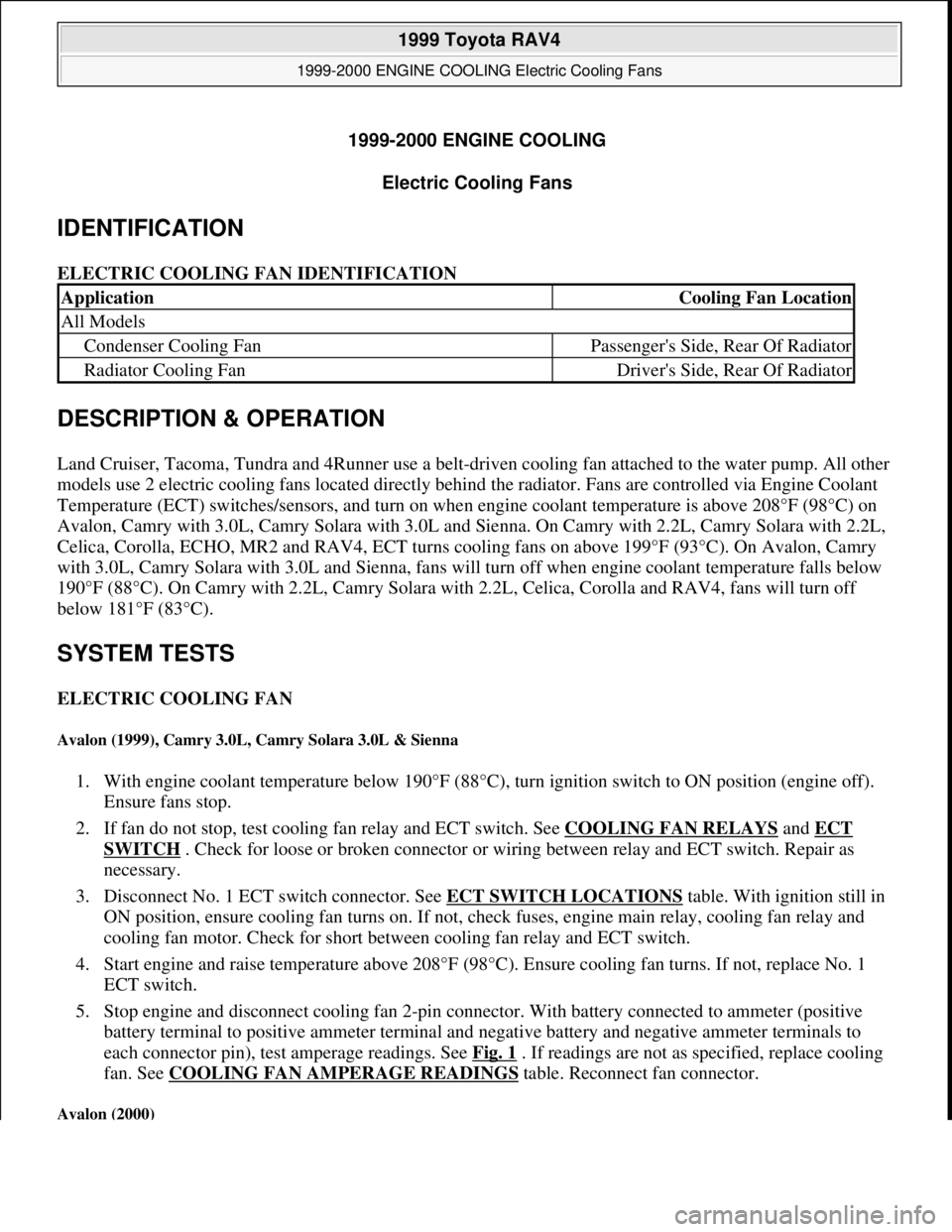
ELECTRIC COOLING FAN IDENTIFICATION
DESCRIPTION & OPERATION
Land Cruiser, Tacoma, Tundra and 4Runner use a belt-driven cooling fan attached to the water pump. All other
models use 2 electric cooling fans located directly behind the radiator. Fans are controlled via Engine Coolant
Temperature (ECT) switches/sensors, and turn on when engine coolant temperature is above 208°F (98°C) on
Avalon, Camry with 3.0L, Camry Solara with 3.0L and Sienna. On Camry with 2.2L, Camry Solara with 2.2L,
Celica, Corolla, ECHO, MR2 and RAV4, ECT turns cooling fans on above 199°F (93°C). On Avalon, Camry
with 3.0L, Camry Solara with 3.0L and Sienna, fans will turn off when engine coolant temperature falls below
190°F (88°C). On Camry with 2.2L, Camry Solara with 2.2L, Celica, Corolla and RAV4, fans will turn off
below 181°F (83°C).
SYSTEM TESTS
ELECTRIC COOLING FAN
Avalon (1999), Camry 3.0L, Camry Solara 3.0L & Sienna
1. With engine coolant temperature below 190°F (88°C), turn ignition switch to ON position (engine off).
Ensure fans stop.
2. If fan do not stop, test cooling fan relay and ECT switch. See COOLING FAN RELAYS
and ECT
SWITCH . Check for loose or broken connector or wiring between relay and ECT switch. Repair as
necessary.
3. Disconnect No. 1 ECT switch connector. See ECT SWITCH LOCATIONS
table. With ignition still in
ON position, ensure cooling fan turns on. If not, check fuses, engine main relay, cooling fan relay and
cooling fan motor. Check for short between cooling fan relay and ECT switch.
4. Start engine and raise temperature above 208°F (98°C). Ensure cooling fan turns. If not, replace No. 1
ECT switch.
5. Stop engine and disconnect cooling fan 2-pin connector. With battery connected to ammeter (positive
battery terminal to positive ammeter terminal and negative battery and negative ammeter terminals to
each connector pin), test amperage readings. See Fig. 1
. If readings are not as specified, replace cooling
fan. See COOLING FAN AMPERAGE READINGS
table. Reconnect fan connector.
Avalon (2000)
ApplicationCooling Fan Location
All Models
Condenser Cooling FanPassenger's Side, Rear Of Radiator
Radiator Cooling FanDriver's Side, Rear Of Radiator
1999 Toyota RAV4
1999-2000 ENGINE COOLING Electric Cooling Fans
1999 Toyota RAV4
1999-2000 ENGINE COOLING Electric Cooling Fans
Microsoft
Sunday, November 22, 2009 10:21:41 AMPage 1 © 2005 Mitchell Repair Information Company, LLC.
Microsoft
Sunday, November 22, 2009 10:21:45 AMPage 1 © 2005 Mitchell Repair Information Company, LLC.
Page 472 of 1632
1. With engine coolant temperature below 181°F (83°C), turn ignition switch to ON position (engine off).
Ensure fans stop.
2. If fans do not stop, test cooling fan relays and ECT switches. See COOLING FAN RELAYS
and ECT
SWITCH . Check for loose or broken connector or wiring between relay and ECT switch. Repair as
necessary.
3. Disconnect No. 1 ECT switch wire connector. Connect jumper wire to No. 1 ECT terminals. Ensure fan
rotates at high speed. If fan does not rotate, check No. 1 cooling fan relay and cooling fan. Reconnect No.
1 switch connector.
4. Disconnect No. 2 switch connector. Ground terminal on No. 2 ECT switch wire harness side connector.
Ensure No. 1 and No. 2 fans rotate at low speed. If fans do not rotate, check No. 2 cooling fan relay, No.
3 cooling fan relay and No. 2 cooling fan. Reconnect No. 2 ECT switch connector.
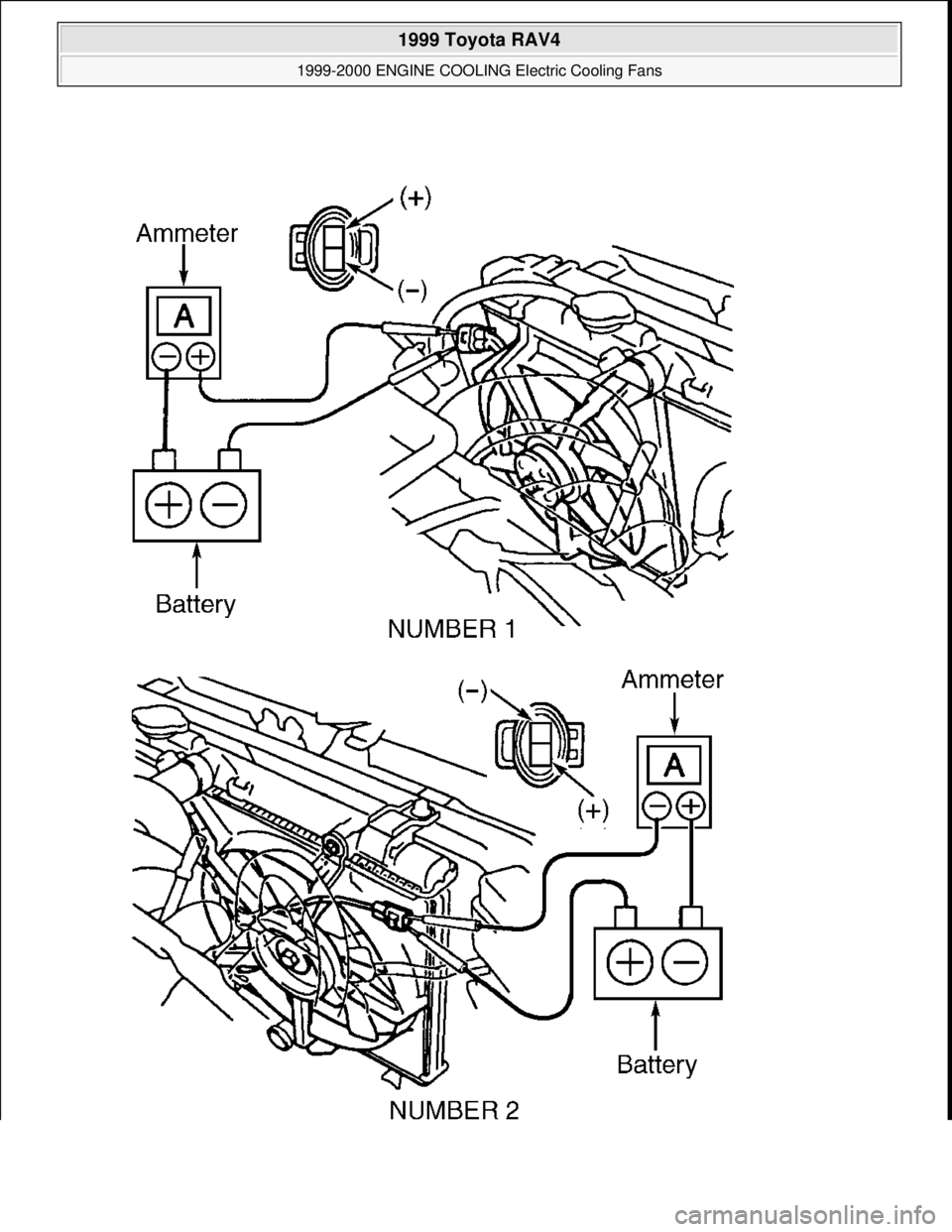
5. Inspect No. 1 and No. 2 cooling fans. Disconnect cooling fan connector. With battery connected to
ammeter (positive battery terminal to positive ammeter terminal and negative battery and negative
ammeter terminals to each connector pin), test amperage readings. See Fig. 1
. If readings are not as
specified, replace cooling fan. See COOLING FAN AMPERAGE READINGS
table. Reconnect fan
connector.
1999 Toyota RAV4
1999-2000 ENGINE COOLING Electric Cooling Fans
Microsoft
Sunday, November 22, 2009 10:21:41 AMPage 2 © 2005 Mitchell Repair Information Company, LLC.
Page 473 of 1632
1999 Toyota RAV4
1999-2000 ENGINE COOLING Electric Cooling Fans
Microsoft
Sunday, November 22, 2009 10:21:41 AMPage 3 © 2005 Mitchell Repair Information Company, LLC.
Page 474 of 1632
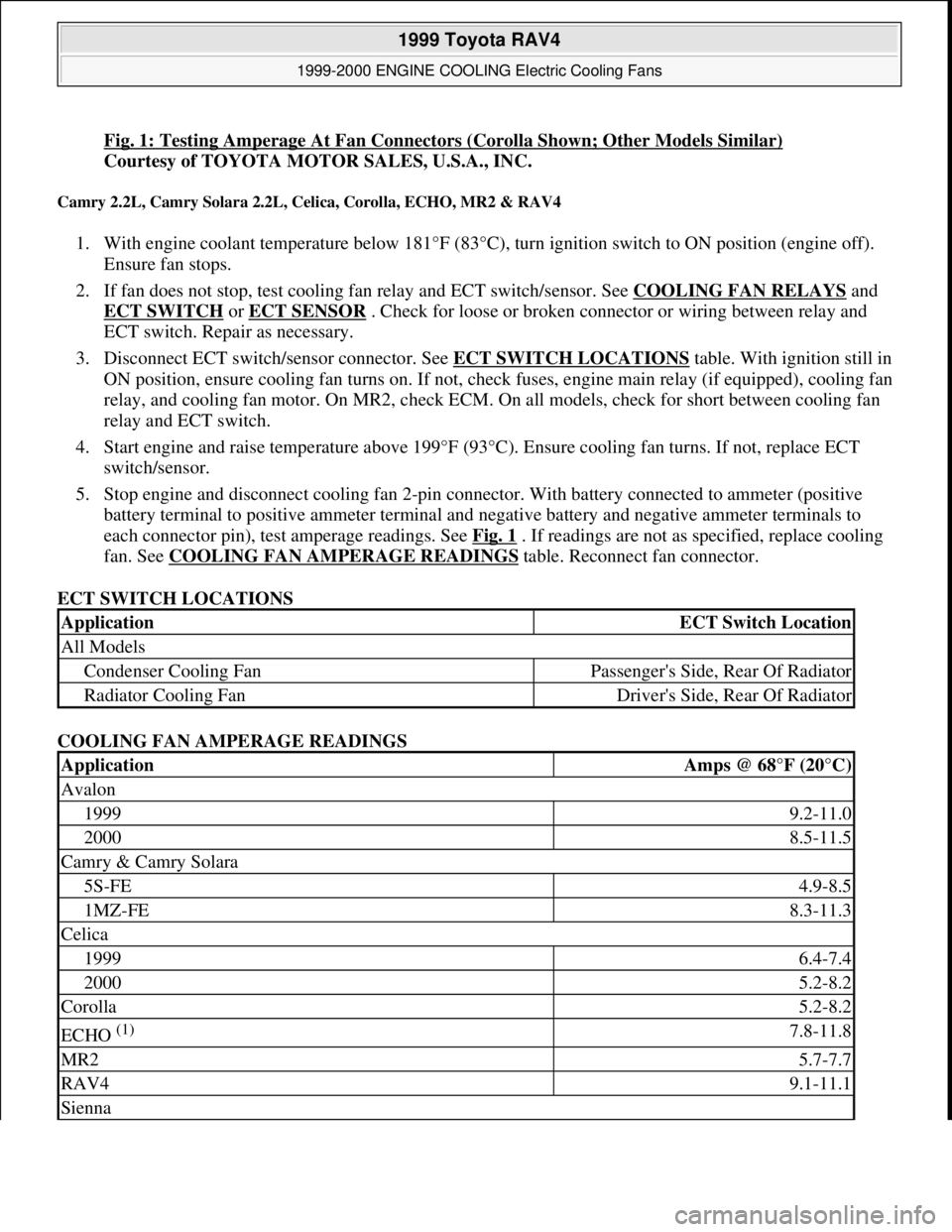
Fig. 1: Testing Amperage At Fan Connectors (Corolla Shown; Other Models Similar)
Courtesy of TOYOTA MOTOR SALES, U.S.A., INC.
Camry 2.2L, Camry Solara 2.2L, Celica, Corolla, ECHO, MR2 & RAV4
1. With engine coolant temperature below 181°F (83°C), turn ignition switch to ON position (engine off).
Ensure fan stops.
2. If fan does not stop, test cooling fan relay and ECT switch/sensor. See COOLING FAN RELAYS
and
ECT SWITCH
or ECT SENSOR . Check for loose or broken connector or wiring between relay and
ECT switch. Repair as necessary.
3. Disconnect ECT switch/sensor connector. See ECT SWITCH LOCATIONS
table. With ignition still in
ON position, ensure cooling fan turns on. If not, check fuses, engine main relay (if equipped), cooling fan
relay, and cooling fan motor. On MR2, check ECM. On all models, check for short between cooling fan
relay and ECT switch.
4. Start engine and raise temperature above 199°F (93°C). Ensure cooling fan turns. If not, replace ECT
switch/sensor.
5. Stop engine and disconnect cooling fan 2-pin connector. With battery connected to ammeter (positive
battery terminal to positive ammeter terminal and negative battery and negative ammeter terminals to
each connector pin), test amperage readings. See Fig. 1
. If readings are not as specified, replace cooling
fan. See COOLING FAN AMPERAGE READINGS
table. Reconnect fan connector.
ECT SWITCH LOCATIONS
COOLING FAN AMPERAGE READINGS
ApplicationECT Switch Location
All Models
Condenser Cooling FanPassenger's Side, Rear Of Radiator
Radiator Cooling FanDriver's Side, Rear Of Radiator
ApplicationAmps @ 68°F (20°C)
Avalon
19999.2-11.0
20008.5-11.5
Camry & Camry Solara
5S-FE4.9-8.5
1MZ-FE8.3-11.3
Celica
19996.4-7.4
20005.2-8.2
Corolla5.2-8.2
ECHO (1) 7.8-11.8
MR25.7-7.7
RAV49.1-11.1
Sienna
1999 Toyota RAV4
1999-2000 ENGINE COOLING Electric Cooling Fans
Microsoft
Sunday, November 22, 2009 10:21:41 AMPage 4 © 2005 Mitchell Repair Information Company, LLC.
Page 475 of 1632
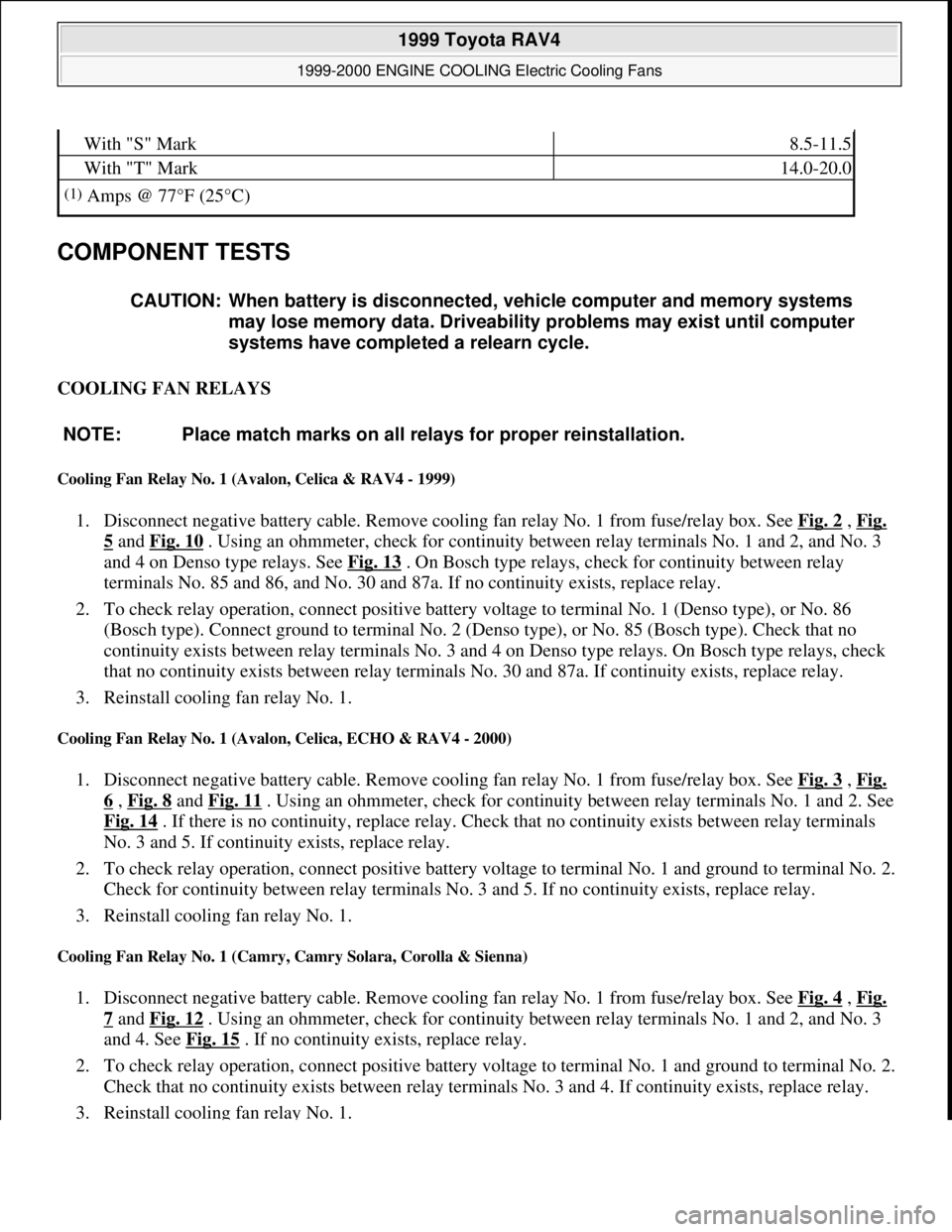
COMPONENT TESTS
COOLING FAN RELAYS
Cooling Fan Relay No. 1 (Avalon, Celica & RAV4 - 1999)
1. Disconnect negative battery cable. Remove cooling fan relay No. 1 from fuse/relay box. See Fig. 2 , Fig.
5 and Fig. 10 . Using an ohmmeter, check for continuity between relay terminals No. 1 and 2, and No. 3
and 4 on Denso type relays. See Fig. 13
. On Bosch type relays, check for continuity between relay
terminals No. 85 and 86, and No. 30 and 87a. If no continuity exists, replace relay.
2. To check relay operation, connect positive battery voltage to terminal No. 1 (Denso type), or No. 86
(Bosch type). Connect ground to terminal No. 2 (Denso type), or No. 85 (Bosch type). Check that no
continuity exists between relay terminals No. 3 and 4 on Denso type relays. On Bosch type relays, check
that no continuity exists between relay terminals No. 30 and 87a. If continuity exists, replace relay.
3. Reinstall cooling fan relay No. 1.
Cooling Fan Relay No. 1 (Avalon, Celica, ECHO & RAV4 - 2000)
1. Disconnect negative battery cable. Remove cooling fan relay No. 1 from fuse/relay box. See Fig. 3 , Fig.
6 , Fig. 8 and Fig. 11 . Using an ohmmeter, check for continuity between relay terminals No. 1 and 2. See
Fig. 14
. If there is no continuity, replace relay. Check that no continuity exists between relay terminals
No. 3 and 5. If continuity exists, replace relay.
2. To check relay operation, connect positive battery voltage to terminal No. 1 and ground to terminal No. 2.
Check for continuity between relay terminals No. 3 and 5. If no continuity exists, replace relay.
3. Reinstall cooling fan relay No. 1.
Cooling Fan Relay No. 1 (Camry, Camry Solara, Corolla & Sienna)
1. Disconnect negative battery cable. Remove cooling fan relay No. 1 from fuse/relay box. See Fig. 4 , Fig.
7 and Fig. 12 . Using an ohmmeter, check for continuity between relay terminals No. 1 and 2, and No. 3
and 4. See Fig. 15
. If no continuity exists, replace relay.
2. To check relay operation, connect positive battery voltage to terminal No. 1 and ground to terminal No. 2.
Check that no continuity exists between relay terminals No. 3 and 4. If continuity exists, replace relay.
3. Reinstall cooling fan relay No. 1.
With "S" Mark8.5-11.5
With "T" Mark14.0-20.0
(1)Amps @ 77°F (25°C)
CAUTION: When battery is disconnected, vehicle computer and memory systems
may lose memory data. Driveability problems may exist until computer
systems have completed a relearn cycle.
NOTE: Place match marks on all relays for proper reinstallation.
1999 Toyota RAV4
1999-2000 ENGINE COOLING Electric Cooling Fans
Microsoft
Sunday, November 22, 2009 10:21:41 AMPage 5 © 2005 Mitchell Repair Information Company, LLC.
Page 476 of 1632
Cooling Fan Relay No. 2 (Except Avalon)
1. Disconnect negative battery cable. Remove cooling fan relay No. 2 from fuse/relay box. See Fig. 4 -Fig.
12 . Using an ohmmeter, check for continuity between relay terminals No. 1 and 2, and No. 3 and 4. See
Fig. 13
-Fig. 15 . If no continuity exists, replace relay. Check that no continuity exists between relay
terminals No. 3 and 5. If continuity exists, replace relay.
2. To check relay operation, connect positive battery voltage to terminal No. 1 and ground to terminal No. 2.
Check that no continuity exists between relay terminals No. 3 and 4. If continuity exists, replace relay.
Check for continuity between relay terminals No. 3 and 5. If no continuity exists, replace relay.
3. Reinstall cooling fan relay No. 2.
Cooling Fan Relay No. 2 (Avalon)
1. Disconnect negative battery cable. Remove cooling fan relay No. 2 from fuse/relay box. See Fig. 2 and
Fig. 3
. Using an ohmmeter, check for continuity between relay terminals No. 1 and 2, and No. 3 and 4 on
Denso type relay. On Bosch type relay, check for continuity between relay terminals No. 85 and 86, and
No. 30 and 87a. See Fig. 13
and Fig. 14 . If there is no continuity, replace relay.
2. To check relay operation, connect positive battery voltage to terminal No. 1 (Denso type), or No. 85
(Bosch type). Connect ground to terminal No. 2 (Denso type), or No. 86 (Bosch type). Check that no
continuity exists between relay terminals No. 3 and 4 (Denso type), or No. 30 and 87a (Bosch type). If
continuity exists, replace relay. Check for continuity between relay terminals No. 3 and 5 (Denso), or No.
30 and 87 (Bosch). If no continuity exists, replace relay.
3. Reinstall cooling fan relay No. 2.
Cooling Fan Relay No. 3
1. Disconnect negative battery cable. Remove cooling fan relay No. 3 from fuse/relay box. See Fig. 2 - Fig.
12 . Using an ohmmeter, check for continuity between relay terminals No. 1 and 2 (Denso type), or No.
85 and 86 (Bosch type). See Fig. 13
- Fig. 15 . If no continuity exists, replace relay. Check that no
continuity exists between relay terminals No. 3 and 5 (Denso type), or No. 30 and 87 (Bosch type). If
continuity exists, replace relay.
2. To check relay operation, connect positive battery voltage to terminal No. 1 (Denso type), or No. 86
(Bosch type). Connect ground to terminal No. 2 (Denso type), or No. 85 (Bosch type). Check for
continuity between relay terminals No. 3 and 5 (Denso type), or No. 30 and 87 (Bosch type). If no
continuity exists, replace relay.
3. Reinstall cooling fan relay No. 3.
Engine Main Relay (Except 2000 Avalon, 2000 Celica, ECHO & MR2)
1. Disconnect negative battery cable. Remove engine main relay from fuse/relay box. See Fig. 2 -Fig. 12 .
Using an ohmmeter, check for continuity between relay terminals No. 3 and 5, and No. 2 and 4. See Fig.
16 . If no continuity exists, replace relay. Check that no continuity exists between relay terminals No. 1
and 2. If continuit
y exists, replace relay. NOTE: ECHO is not equipped with cooling fan relay No. 3.
1999 Toyota RAV4
1999-2000 ENGINE COOLING Electric Cooling Fans
Microsoft
Sunday, November 22, 2009 10:21:41 AMPage 6 © 2005 Mitchell Repair Information Company, LLC.
Page 477 of 1632
2. To check relay operation, connect positive battery voltage to terminal No. 3 and ground to terminal No. 5.
Check that no continuity exists between relay terminals No. 2 and 4. If continuity exists, replace relay.
Check for continuity between relay terminals No. 1 and 2. If no continuity exists, replace relay.
3. Reinstall en
gine main relay.
1999 Toyota RAV4
1999-2000 ENGINE COOLING Electric Cooling Fans
Microsoft
Sunday, November 22, 2009 10:21:41 AMPage 7 © 2005 Mitchell Repair Information Company, LLC.