fuses TOYOTA RAV4 1996 Service Repair Manual
[x] Cancel search | Manufacturer: TOYOTA, Model Year: 1996, Model line: RAV4, Model: TOYOTA RAV4 1996Pages: 1632, PDF Size: 41.64 MB
Page 2 of 1632
Fig. 1: Locating ABS Components
Courtesy of TOYOTA MOTOR SALES, U.S.A., INC.
OPERATION
Under normal driving conditions, ABS functions as a standard brake system. With detection of wheel lock-up,
short pedal pulsations occurring in rapid succession will be felt in brake pedal. Pedal pulsation will continue
until there is no longer a need for ABS function or until vehicle speed falls below 3 MPH. Maintaining a
constant force on the brake pedal provides shortest stopping distance.
BLEEDING BRAKE SYSTEM
MASTER CYLINDER
Ensure brake fluid reservoir is full. Disconnect brakelines from master cylinder. Have an assistant slowly
depress brake pedal and hold. Block off outlet ports on master cylinder with finger, then have assistant release
brake pedal. Repeat 3 or 4 times or until master cylinder is bled.
BRAKELINES
Install bleeder hose with container of clean brake fluid on wheel cylinder or caliper. Depress brake pedal several
times and hold, then loosen bleeder valve. Tighten bleeder valve when fluid flow stops, then release brake
pedal. Repeat until air bubbles are no longer present for each wheel.
TROUBLE SHOOTING
PRELIMINARY INSPECTION
Begin diagnosis with a basic visual inspection of brake fluid level, tire size and other mechanical brake system
components which may affect anti-lock operation. Check system sensors, wire harnesses and connectors for
proper installation, routing and connection. Ensure all system fuses are okay. Repair as necessary. NOTE: For more information on brake system, see DISC & DRUM
- FWD CARS article.
CAUTION: See ANTI-LOCK BRAKE SAFETY PRECAUTIONS article in GENERAL
INFORMATION.
CAUTION: Brake fluid will damage painted surfaces. If brake fluid contacts a painted
surface, wipe off immediately and clean with alcohol. Use only DOT 3
brake fluid from a sealed container. DO NOT mix brake fluid with any other
type.
NOTE: Bleed brakes from farthest wheel first to closest wheel.
1999 Toyota RAV4
1999-2000 BRAKES Anti-Lock - RAV4
Microsoft
Sunday, November 22, 2009 10:06:17 AMPage 2 © 2005 Mitchell Repair Information Company, LLC.
Page 17 of 1632
DTC Detecting Condition
Detection of the following condition may set DTC 41:
At vehicle speed of about 2 MPH or more, if voltage at ABS ECU terminal IG1 is less than 9.5 volts for
10 seconds or more, DTC 41 may set.
Diagnostic Procedure
1. Check charging system voltage. If voltage is 10-14 volts, system is okay. Go to next step. If voltage is not
10-14 volts, repair charging system. Ensure system fuses are okay.
2. Turn ignition off. Remove ABS ECU. Do not disconnect electrical connectors. Turn ignition switch to
ON position. Measure voltage between terminals IG1 and GND at ABS ECU harness connector. See Fig.
3 . If voltage is 10-14 volts, turn ignition off. Condition may be intermittent. Check ABS ECU connectors
for poor connection or damage. Repair as necessary. If connectors are okay, replace ABS ECU. If voltage
is not as specified, go to next step.
3. Measure resistance between ground and GND terminals at ABS ECU harness connector. See Fig. 3
. If
resistance is one ohm or less, go to next step. If resistance is more than one ohm, repair ground circuit
wiring. See WIRING DIAGRAMS
.
4. Remove ECU-IG fuse from instrument panel junction block. If fuse is blown, check for short circuit in all
wiring harnesses and components connected to ECU-IG fuse (ECM, A/C, cruise control, deceleration
sensor, combination meter, sun roof, shift lock, transmission pattern select switch). See WIRING
DIAGRAMS . Repair as necessary. If fuse is not blown, check for open circuit in wiring harness between
battery and ABS ECU. Repair as necessary.
DTC 43 & DTC 45: DECELERATION SENSOR MALFUNCTION (4WD MODELS ONLY)
DTC Detecting Conditions
Detection of the following conditions may set DTCs 43 or 45:
On 2-door models, if output voltage from deceleration sensor does not change for 16 consecutive times or
more when vehicle speed is decreased from 19 MPH to zero MPH, DTC 43 will set.
On 4-door models, after battery cables are connected, if input from deceleration sensor does not change at
one cycle (zero MPH to 19 MPH or more, then back to zero) for 16 consecutive times, DTC 43 will set.
When brake pedal is not depressed at vehicle speed of 3 MPH or more, and forward and backward force
(force of more than 0.4 "G") is detected for 30 seconds or more, DTC 43 will set.
On 2-door models, at vehicle speed of 19 MPH or more, if deceleration sensor output and vehicle
acceleration from wheel speed remains abnormally different for one minute or more, DTC 45 will set.
Diagnostic Procedure
1. Check deceleration sensor. See DECELERATION SENSOR CHECK under COMPONENT TESTS.
Replace sensor as necessary. If sensor is okay, go to next step.
2. Check for open or short circuit in wiring harness between deceleration sensor and ABS ECU. See
WIRING DIAGRAMS
. Repair as necessary. If wiring harness is okay, replace ABS ECU.
1999 Toyota RAV4
1999-2000 BRAKES Anti-Lock - RAV4
Microsoft
Sunday, November 22, 2009 10:06:17 AMPage 17 © 2005 Mitchell Repair Information Company, LLC.
Page 405 of 1632
Check all fuses, fusible links, ignition switch and appropriate relays (if equipped). Check generator output. See
NO
-LOAD TEST under ON-VEHICLE TESTING.
ON-VEHICLE TESTING
NO-LOAD TEST
1. Disconnect battery-to-generator terminal "B" wire. See Fig. 2
. Using an ammeter and voltmeter, connect
negative ammeter lead to disconnected generator terminal "B" wire end, and connect positive ammeter
lead to generator terminal "B".
2. Connect voltmeter positive lead to generator terminal "B" and negative lead to ground. See Fig. 2
. Start
engine and increase engine speed to 2000 RPM. Both meters should read within specification. See
GENERATOR REGULATED OUTPUT SPECIFICATIONS
table. If voltage is more than specified,
replace IC regulator. If voltage is less than specified, go to next step.
3. Locate small hole in back of generator. See Fig. 3
. It may be necessary to remove generator end cover to
access hole. Using a probe, ground generator terminal "F" (full field) to generator case. See Fig. 3
. If
voltage is more than specified range, replace IC regulator. If voltage is less than specified range, repair or
replace generator.
GENERATOR REGULATED OUTPUT SPECIFICATIONS
(1) NOTE: See TROUBLE SHOOTING article in GENERAL INFORMATION.
ApplicationAmpsVolts
Avalon10 Or Less13.2-14.8
Camry, Camry Solara & Corolla10 Or Less13.5-15.1
Celica & RAV4
With Temperature At 77°F (25°C)10 Or Less14.0-15.1
With Temperature At 239°F (115°C)10 Or Less13.5-14.3
Land Cruiser & Sienna10 Or Less13.2-14.8
Tacoma
With Temperature At 77°F (25°C)10 Or Less13.7-14.7
With Temperature At 239°F (115°C)10 Or Less13.2-14.0
Tundra
V610 Or Less13.2-14.8
V8
With Temperature At 77°F (25°C)10 Or Less13.7-14.7
With Temperature At 239°F (115°C)10 Or Less13.2-14.0
4Runner
With Temperature At 77°F (25°C)10 Or Less13.7-14.7
With Temperature At 239°F (115°C)10 Or Less13.2-14.0
(1)Specification given is with engine speed at 2000 RPM.
1999 Toyota RAV4
1999-2000 STARTING & CHARGING SYSTEMS Generators & Regulators
Microsoft
Sunday, November 22, 2009 10:13:07 AMPage 4 © 2005 Mitchell Repair Information Company, LLC.
Page 471 of 1632
1999-2000 ENGINE COOLING
Electric Cooling Fans
IDENTIFICATION
ELECTRIC COOLING FAN IDENTIFICATION
DESCRIPTION & OPERATION
Land Cruiser, Tacoma, Tundra and 4Runner use a belt-driven cooling fan attached to the water pump. All other
models use 2 electric cooling fans located directly behind the radiator. Fans are controlled via Engine Coolant
Temperature (ECT) switches/sensors, and turn on when engine coolant temperature is above 208°F (98°C) on
Avalon, Camry with 3.0L, Camry Solara with 3.0L and Sienna. On Camry with 2.2L, Camry Solara with 2.2L,
Celica, Corolla, ECHO, MR2 and RAV4, ECT turns cooling fans on above 199°F (93°C). On Avalon, Camry
with 3.0L, Camry Solara with 3.0L and Sienna, fans will turn off when engine coolant temperature falls below
190°F (88°C). On Camry with 2.2L, Camry Solara with 2.2L, Celica, Corolla and RAV4, fans will turn off
below 181°F (83°C).
SYSTEM TESTS
ELECTRIC COOLING FAN
Avalon (1999), Camry 3.0L, Camry Solara 3.0L & Sienna
1. With engine coolant temperature below 190°F (88°C), turn ignition switch to ON position (engine off).
Ensure fans stop.
2. If fan do not stop, test cooling fan relay and ECT switch. See COOLING FAN RELAYS
and ECT
SWITCH . Check for loose or broken connector or wiring between relay and ECT switch. Repair as
necessary.
3. Disconnect No. 1 ECT switch connector. See ECT SWITCH LOCATIONS
table. With ignition still in
ON position, ensure cooling fan turns on. If not, check fuses, engine main relay, cooling fan relay and
cooling fan motor. Check for short between cooling fan relay and ECT switch.
4. Start engine and raise temperature above 208°F (98°C). Ensure cooling fan turns. If not, replace No. 1
ECT switch.
5. Stop engine and disconnect cooling fan 2-pin connector. With battery connected to ammeter (positive
battery terminal to positive ammeter terminal and negative battery and negative ammeter terminals to
each connector pin), test amperage readings. See Fig. 1
. If readings are not as specified, replace cooling
fan. See COOLING FAN AMPERAGE READINGS
table. Reconnect fan connector.
Avalon (2000)
ApplicationCooling Fan Location
All Models
Condenser Cooling FanPassenger's Side, Rear Of Radiator
Radiator Cooling FanDriver's Side, Rear Of Radiator
1999 Toyota RAV4
1999-2000 ENGINE COOLING Electric Cooling Fans
1999 Toyota RAV4
1999-2000 ENGINE COOLING Electric Cooling Fans
Microsoft
Sunday, November 22, 2009 10:21:41 AMPage 1 © 2005 Mitchell Repair Information Company, LLC.
Microsoft
Sunday, November 22, 2009 10:21:45 AMPage 1 © 2005 Mitchell Repair Information Company, LLC.
Page 474 of 1632
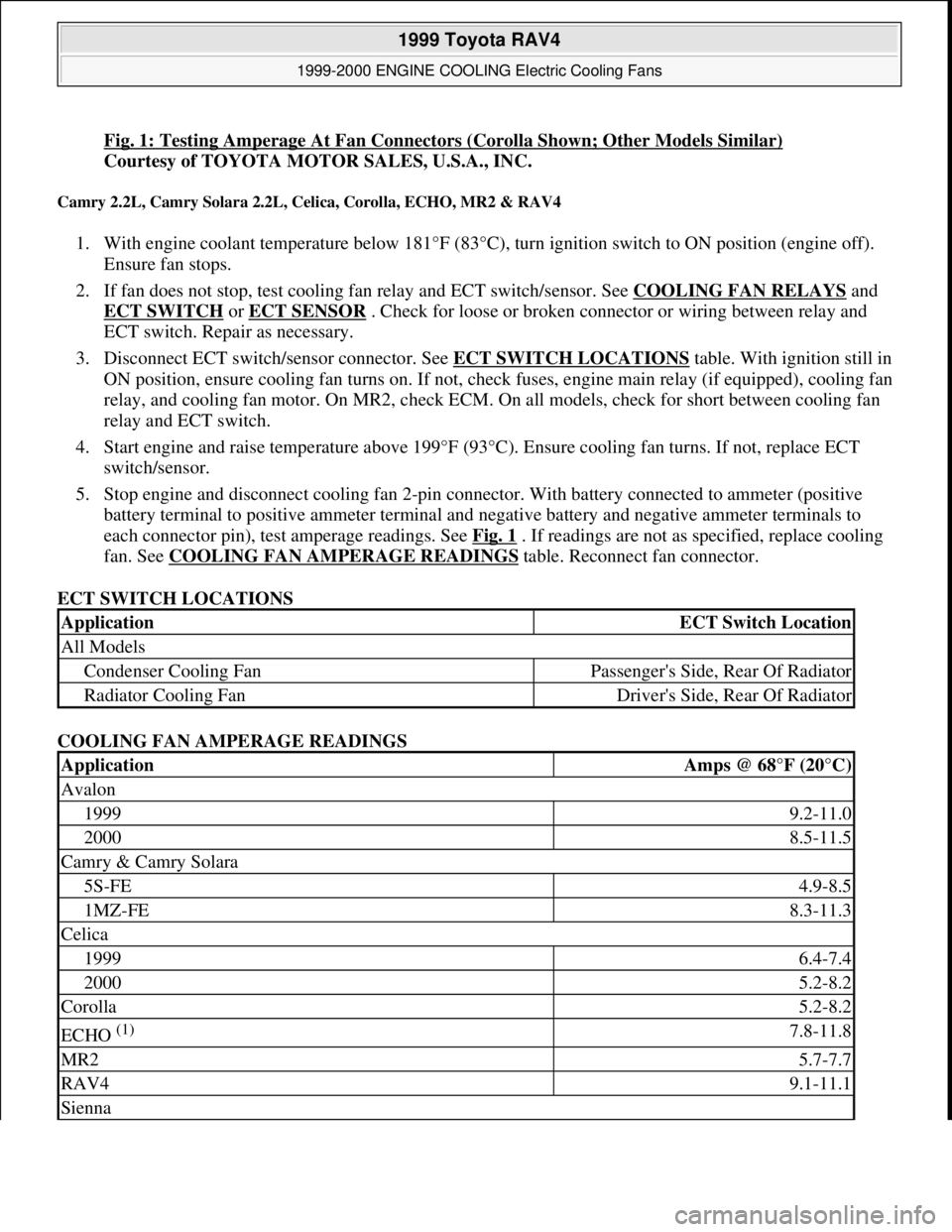
Fig. 1: Testing Amperage At Fan Connectors (Corolla Shown; Other Models Similar)
Courtesy of TOYOTA MOTOR SALES, U.S.A., INC.
Camry 2.2L, Camry Solara 2.2L, Celica, Corolla, ECHO, MR2 & RAV4
1. With engine coolant temperature below 181°F (83°C), turn ignition switch to ON position (engine off).
Ensure fan stops.
2. If fan does not stop, test cooling fan relay and ECT switch/sensor. See COOLING FAN RELAYS
and
ECT SWITCH
or ECT SENSOR . Check for loose or broken connector or wiring between relay and
ECT switch. Repair as necessary.
3. Disconnect ECT switch/sensor connector. See ECT SWITCH LOCATIONS
table. With ignition still in
ON position, ensure cooling fan turns on. If not, check fuses, engine main relay (if equipped), cooling fan
relay, and cooling fan motor. On MR2, check ECM. On all models, check for short between cooling fan
relay and ECT switch.
4. Start engine and raise temperature above 199°F (93°C). Ensure cooling fan turns. If not, replace ECT
switch/sensor.
5. Stop engine and disconnect cooling fan 2-pin connector. With battery connected to ammeter (positive
battery terminal to positive ammeter terminal and negative battery and negative ammeter terminals to
each connector pin), test amperage readings. See Fig. 1
. If readings are not as specified, replace cooling
fan. See COOLING FAN AMPERAGE READINGS
table. Reconnect fan connector.
ECT SWITCH LOCATIONS
COOLING FAN AMPERAGE READINGS
ApplicationECT Switch Location
All Models
Condenser Cooling FanPassenger's Side, Rear Of Radiator
Radiator Cooling FanDriver's Side, Rear Of Radiator
ApplicationAmps @ 68°F (20°C)
Avalon
19999.2-11.0
20008.5-11.5
Camry & Camry Solara
5S-FE4.9-8.5
1MZ-FE8.3-11.3
Celica
19996.4-7.4
20005.2-8.2
Corolla5.2-8.2
ECHO (1) 7.8-11.8
MR25.7-7.7
RAV49.1-11.1
Sienna
1999 Toyota RAV4
1999-2000 ENGINE COOLING Electric Cooling Fans
Microsoft
Sunday, November 22, 2009 10:21:41 AMPage 4 © 2005 Mitchell Repair Information Company, LLC.
Page 537 of 1632
FUNCTION TEST under TROUBLE SHOOTING. If clutch switch input signal is not as specified, go to
next step. If clutch switch input signal is as specified, no problem is indicated at this time. Fault may be
intermittent. If sent here from SYMPTOM DIAGNOSIS, perform next test listed.
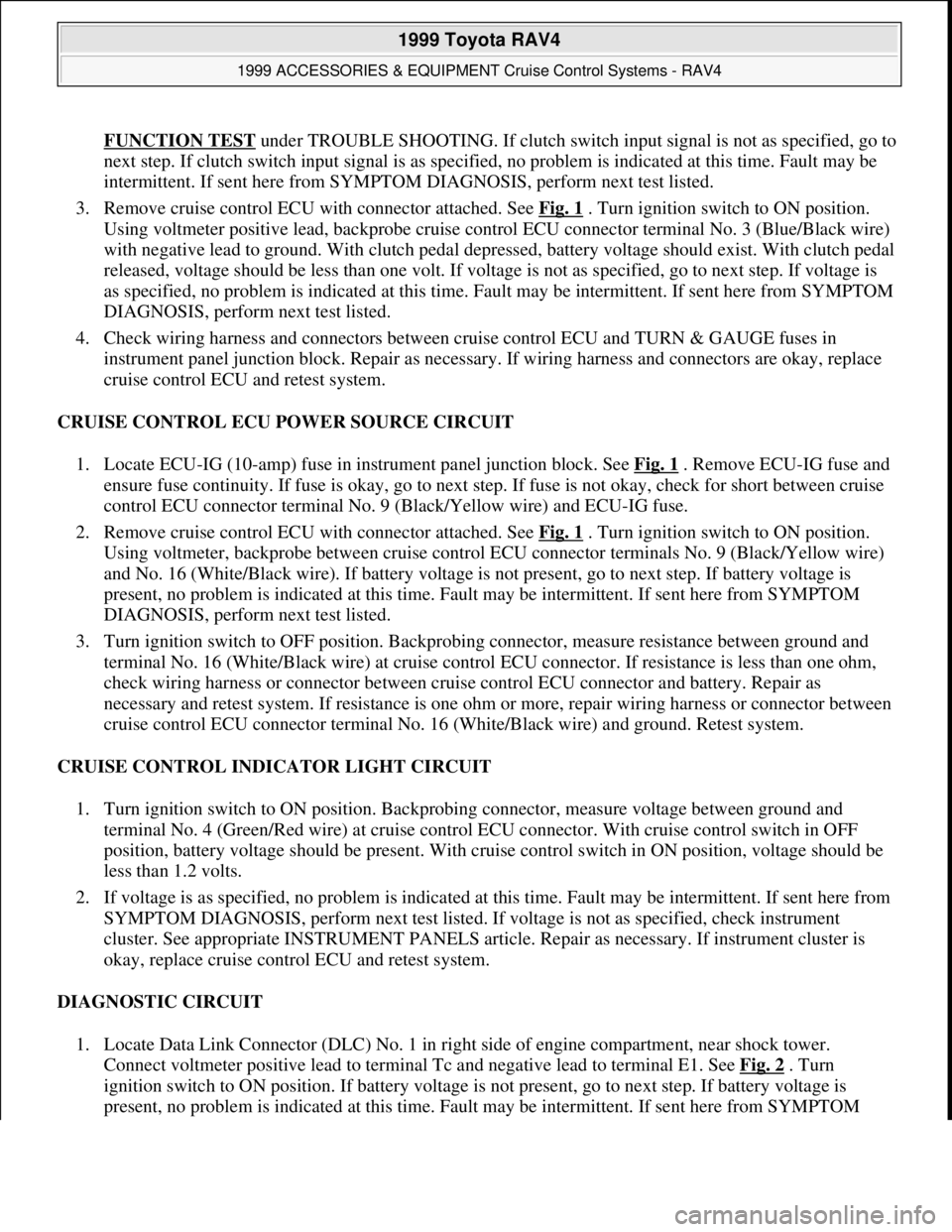
3. Remove cruise control ECU with connector attached. See Fig. 1
. Turn ignition switch to ON position.
Using voltmeter positive lead, backprobe cruise control ECU connector terminal No. 3 (Blue/Black wire)
with negative lead to ground. With clutch pedal depressed, battery voltage should exist. With clutch pedal
released, voltage should be less than one volt. If voltage is not as specified, go to next step. If voltage is
as specified, no problem is indicated at this time. Fault may be intermittent. If sent here from SYMPTOM
DIAGNOSIS, perform next test listed.
4. Check wiring harness and connectors between cruise control ECU and TURN & GAUGE fuses in
instrument panel junction block. Repair as necessary. If wiring harness and connectors are okay, replace
cruise control ECU and retest system.
CRUISE CONTROL ECU POWER SOURCE CIRCUIT
1. Locate ECU-IG (10-amp) fuse in instrument panel junction block. See Fig. 1
. Remove ECU-IG fuse and
ensure fuse continuity. If fuse is okay, go to next step. If fuse is not okay, check for short between cruise
control ECU connector terminal No. 9 (Black/Yellow wire) and ECU-IG fuse.
2. Remove cruise control ECU with connector attached. See Fig. 1
. Turn ignition switch to ON position.
Using voltmeter, backprobe between cruise control ECU connector terminals No. 9 (Black/Yellow wire)
and No. 16 (White/Black wire). If battery voltage is not present, go to next step. If battery voltage is
present, no problem is indicated at this time. Fault may be intermittent. If sent here from SYMPTOM
DIAGNOSIS, perform next test listed.
3. Turn ignition switch to OFF position. Backprobing connector, measure resistance between ground and
terminal No. 16 (White/Black wire) at cruise control ECU connector. If resistance is less than one ohm,
check wiring harness or connector between cruise control ECU connector and battery. Repair as
necessary and retest system. If resistance is one ohm or more, repair wiring harness or connector between
cruise control ECU connector terminal No. 16 (White/Black wire) and ground. Retest system.
CRUISE CONTROL INDICATOR LIGHT CIRCUIT
1. Turn ignition switch to ON position. Backprobing connector, measure voltage between ground and
terminal No. 4 (Green/Red wire) at cruise control ECU connector. With cruise control switch in OFF
position, battery voltage should be present. With cruise control switch in ON position, voltage should be
less than 1.2 volts.
2. If voltage is as specified, no problem is indicated at this time. Fault may be intermittent. If sent here from
SYMPTOM DIAGNOSIS, perform next test listed. If voltage is not as specified, check instrument
cluster. See appropriate INSTRUMENT PANELS article. Repair as necessary. If instrument cluster is
okay, replace cruise control ECU and retest system.
DIAGNOSTIC CIRCUIT
1. Locate Data Link Connector (DLC) No. 1 in right side of engine compartment, near shock tower.
Connect voltmeter positive lead to terminal Tc and negative lead to terminal E1. See Fig. 2
. Turn
ignition switch to ON position. If battery voltage is not present, go to next step. If battery voltage is
present, no problem is indicated at this time. Fault ma
y be intermittent. If sent here from SYMPTOM
1999 Toyota RAV4
1999 ACCESSORIES & EQUIPMENT Cruise Control Systems - RAV4
Microsoft
Sunday, November 22, 2009 10:52:01 AMPage 13 © 2005 Mitchell Repair Information Company, LLC.
Page 550 of 1632
Blown fuse or poor contact. Defogger switch defective. Poor connections. Broken wire. Relay defective.
INDICATOR LIGHT DOES NOT WORK
Bulb burned out. Open wire or poor connection.
REAR WINDOW DEFOGGER SYSTEM CHECK
1. Ensure all in-line fuses or circuit breakers are okay. Turn ignition and control switches to ON position.
Glass should feel warm after a few minutes.
2. If glass is not warm, use a test light or voltmeter to check for battery voltage at grid feed wire. If voltage
is not correct, check wiring harness, control switch and timer/relay.
SYSTEM TESTS
DEFOGGER SWITCH CIRCUIT
2000 Celica
1. Disconnect defogger switch 10-pin connector. Check continuity between ground and defogger switch
harness connector terminal No. 3 (White/Black wire). See Fig. 2
. If continuity exists, go to next step. If
continuity does not exist, repair ground circuit as necessary. See WIRING DIAGRAMS
.
2. Turn ignition on. Measure voltage between ground and defogger switch harness connector terminal No. 5
(Red/White wire). Battery voltage should exist. With ignition switch in LOCK or ACC position, no
voltage should exist. If voltage is as specified, go to next step. If voltage is not as specified, repair
appropriate circuit as necessary. See WIRING DIAGRAMS
.
3. Connect defogger switch harness connector. Turn ignition on. Measure voltage between ground and
defogger switch connector (backprobe) terminal No. 5 (Red/White wire). Battery voltage should exist.
Turn defogger switch to ON position. No voltage should exist. If voltage is not as specified, replace
defo
gger switch and retest system.
1999 Toyota RAV4
1999-2000 ACCESSORIES & EQUIPMENT Rear Window & Mirror Defoggers
Microsoft
Sunday, November 22, 2009 10:55:10 AMPage 2 © 2005 Mitchell Repair Information Company, LLC.
Page 841 of 1632
1999-2000 ELECTRICAL
Fuses & Circuit Breakers - RAV4
IDENTIFICATION
DRIVER SIDE J/B
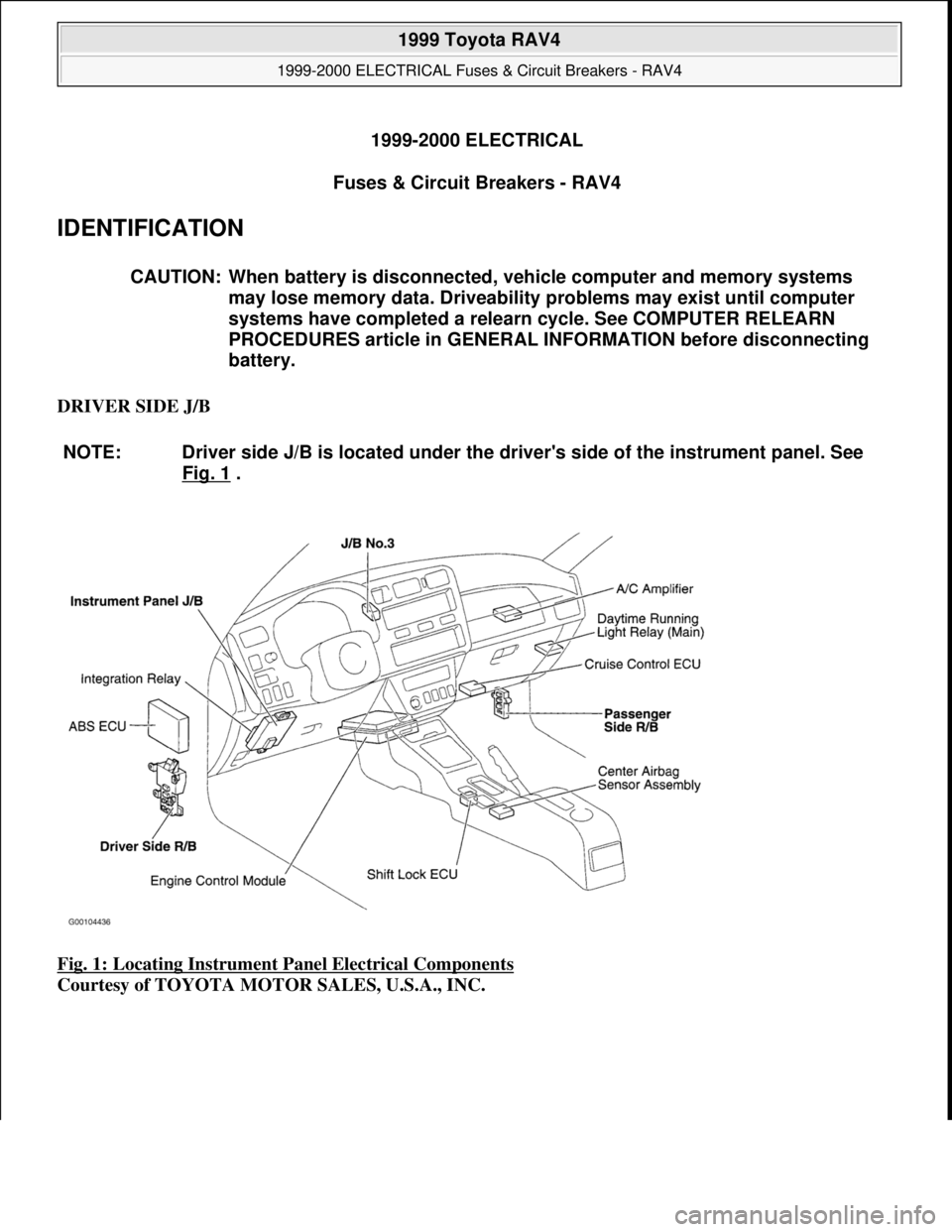
Fig. 1: Locating Instrument Panel Electrical Components
Courtesy of TOYOTA MOTOR SALES, U.S.A., INC. CAUTION: When battery is disconnected, vehicle computer and memory systems
may lose memory data. Driveability problems may exist until computer
systems have completed a relearn cycle. See COMPUTER RELEARN
PROCEDURES article in GENERAL INFORMATION before disconnecting
battery.
NOTE: Driver side J/B is located under the driver's side of the instrument panel. See
Fig. 1
.
1999 Toyota RAV4
1999-2000 ELECTRICAL Fuses & Circuit Breakers - RAV4
1999 Toyota RAV4
1999-2000 ELECTRICAL Fuses & Circuit Breakers - RAV4
Microsoft
Sunday, November 22, 2009 10:18:30 AMPage 1 © 2005 Mitchell Repair Information Company, LLC.
Microsoft
Sunday, November 22, 2009 10:18:36 AMPage 1 © 2005 Mitchell Repair Information Company, LLC.
Page 842 of 1632
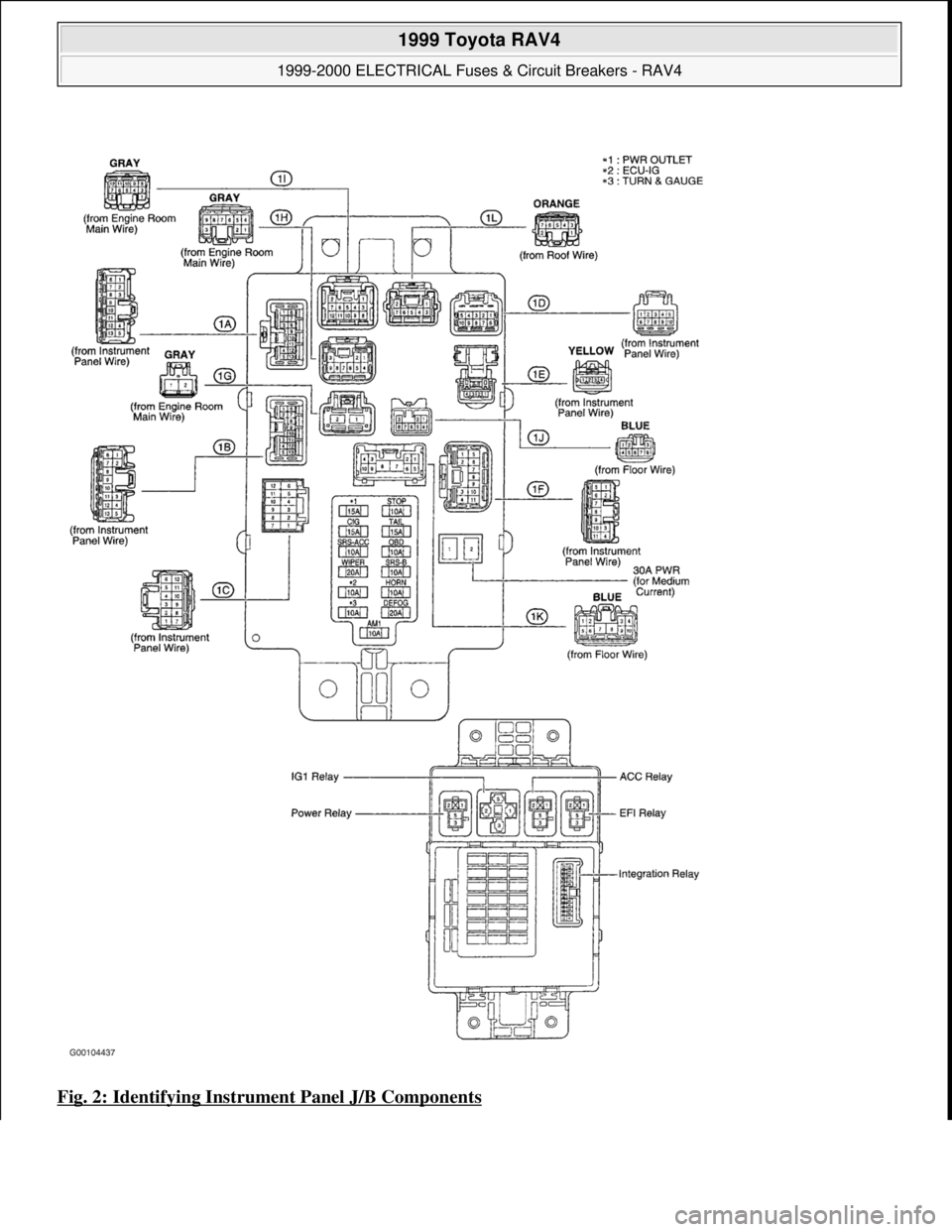
Fig. 2: Identifying Instrument Panel J/B Components
1999 Toyota RAV4
1999-2000 ELECTRICAL Fuses & Circuit Breakers - RAV4
Microsoft
Sunday, November 22, 2009 10:18:30 AMPage 2 © 2005 Mitchell Repair Information Company, LLC.
Page 843 of 1632
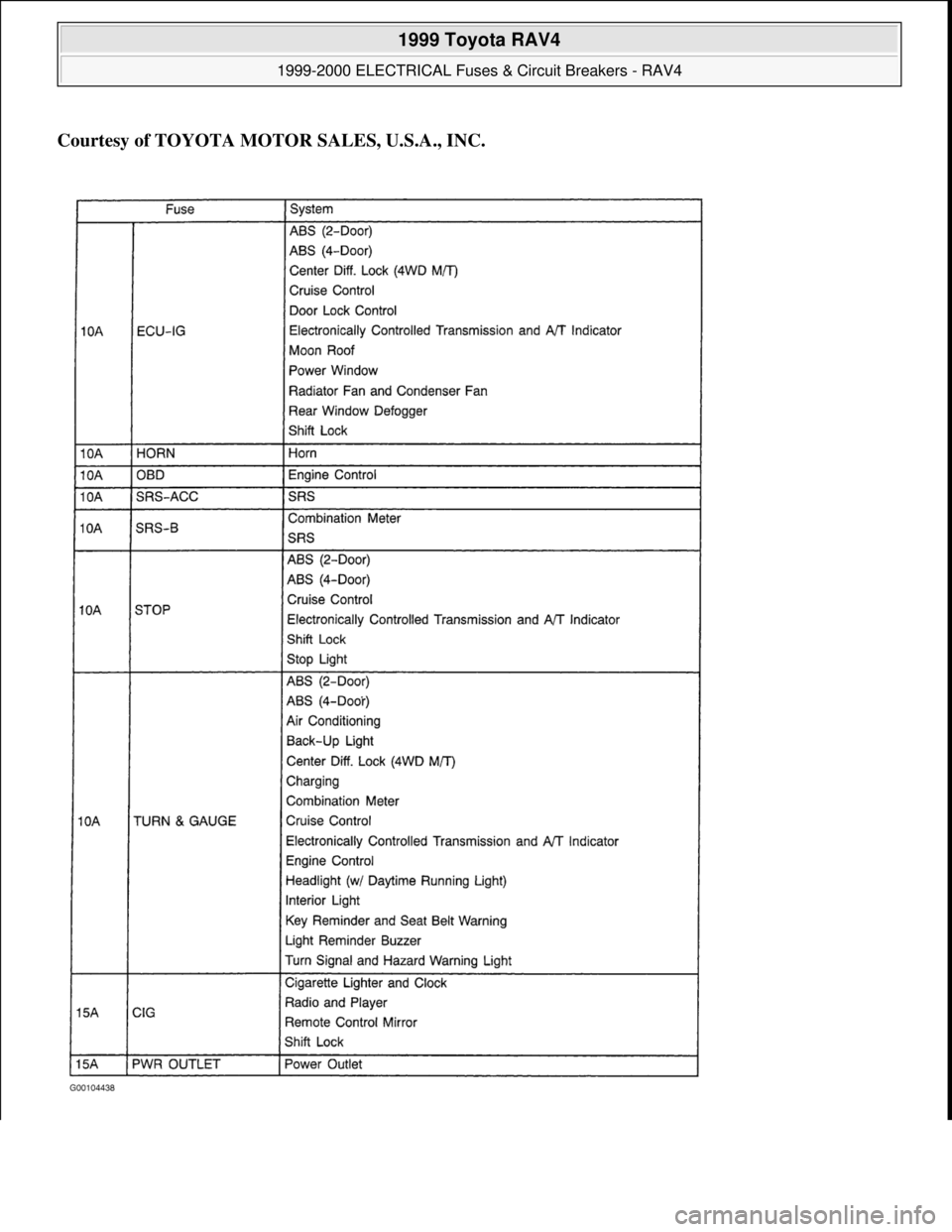
Courtesy of TOYOTA MOTOR SALES, U.S.A., INC.
1999 Toyota RAV4
1999-2000 ELECTRICAL Fuses & Circuit Breakers - RAV4
Microsoft
Sunday, November 22, 2009 10:18:30 AMPage 3 © 2005 Mitchell Repair Information Company, LLC.