wheel TOYOTA RAV4 1999 Workshop Manual
[x] Cancel search | Manufacturer: TOYOTA, Model Year: 1999, Model line: RAV4, Model: TOYOTA RAV4 1999Pages: 226, PDF Size: 3.89 MB
Page 218 of 226
'99 Rav4.U
218
Oil grade:
API grade SJ, ºEnergy- Conservingº or
ILSAC multigrade engine oil is recom-
mended.
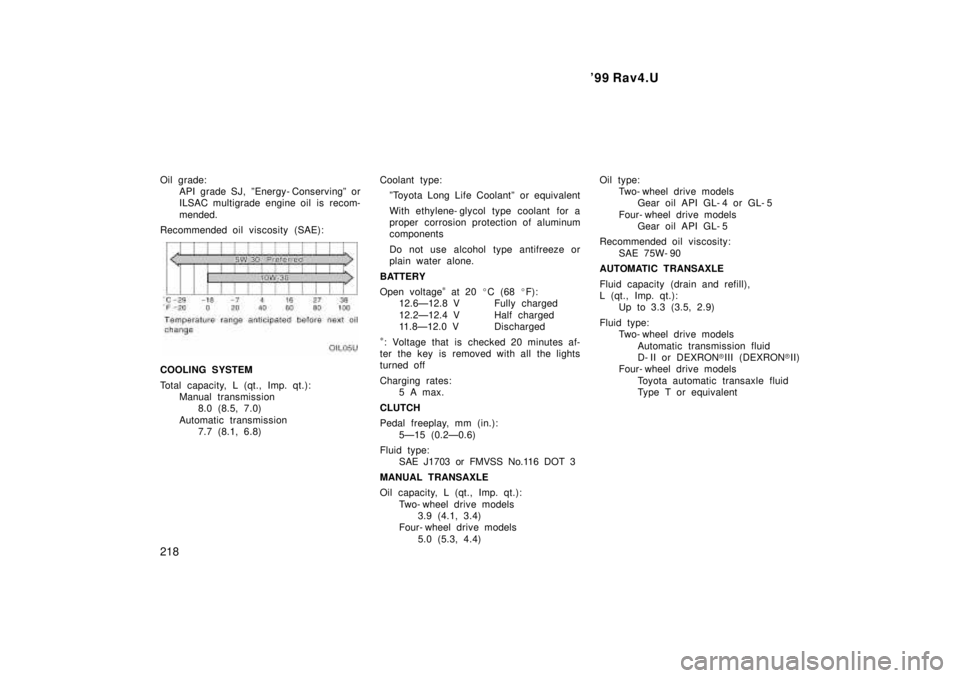
Recommended oil viscosity (SAE):
COOLING SYSTEM
Total capacity, L (qt., Imp. qt.): Manual transmission8.0 (8.5, 7.0)
Automatic transmission 7.7 (8.1, 6.8) Coolant type:
ºToyota Long Life Coolantº or equivalent
With ethylene- glycol type coolant for a
proper corrosion protection of aluminum
components
Do not use alcohol type antifreeze or
plain water alone.
BATTERY
Open voltage *
at 20 C (68 F):
12.6Ð12.8 V Fully charged
12.2Ð12.4 V Half charged
11.8Ð12.0 V Discharged
* : Voltage that is checked 20 minutes af-
ter the key is removed with all the lights
turned off
Charging rates:
5 A max.
CLUTCH
Pedal freeplay, mm (in.): 5Ð15 (0.2Ð0.6)
Fluid type: SAE J1703 or FMVSS No.116 DOT 3
MANUAL TRANSAXLE
Oil capacity, L (qt., Imp. qt.): Two- wheel drive models3.9 (4.1, 3.4)
Four- wheel drive models
5.0 (5.3, 4.4) Oil type:
Two- wheel drive models
Gear oil API GL- 4 or GL- 5
Four- wheel drive models Gear oil API GL- 5
Recommended oil viscosity: SAE 75W- 90
AUTOMATIC TRANSAXLE
Fluid capacity (drain and ref ill),
L (qt., Imp. qt.): Up to 3.3 (3.5, 2.9)
Fluid type: Two- wheel drive models
Automatic transmission fluid
D- II or DEXRON III (DEXRON II)
Four- wheel drive models
Toyota automatic transaxle fluid
Type T or equivalent
Page 219 of 226

'99 Rav4.U219
TRANSFER
(four- wheel drive models with an auto-
matic transaxle)
Oil capacity, L (qt., Imp. qt.):
0.7 (0.7, 0.6)
Oil type: Gear oil API GL- 5
Recommended oil viscosity: SAE 75W- 90
REAR DIFFERENTIAL
(four- wheel drive models)
Oil capacity, L (qt., Imp. qt.): 0.9 (1.0, 0.8)
Oil type: Hypoid gear oil API GL- 5
Recommended oil viscosity: Above -18 5C (0 5F)
SAE 90
Below -18 5C (0 5F)
SAE 80W or 80W- 90 BRAKES
Minimum pedal clearance when depressed
with the pressure of 490 N (50 kgf, 110
lbf) with the engine running, mm (in.):
75 (3.0)
Pedal freeplay, mm (in.): 1Ð6 (0.04Ð0.24)
Pad wear limit, mm (in.): 1.0 (0.04)
Lining wear limit, mm (in.): 1.0 (0.04)
Parking brake adjustment when pulled with
the force of 196 N (20 kgf, 44 lbf): 5Ð8 clicks
Fluid type: SAE J1703 or FMVSS No.116 DOT 3
STEERING
Wheel freeplay: Less than 30 mm (1.2 in.)
Power steering fluid type: Automatic transmission fluid DEXRON II or III
Page 220 of 226

'99 Rav4.U
220
Tires
Tire size and pressure:
Model
Tire size
Tire pressure
kPa (kgf/cm 2
or bar, psi)
Wheel sizeModelTire size
FrontRear
Wheel size
2- door hardtopand soft top
215/70R 16 99S180 (1.8, 26)180 (1.8, 26)16 6J
16 6.5JJ *
and soft- top235/60R 16 100H170 (1.7, 25)170 (1.7, 25)16
6.5JJ
4- door hardtop215/70R 16 99S190 (1.9, 28)180 (1.8, 26)16 6J
16 6.5JJ *
4 door hardto
235/60R 16 100H170 (1.7, 25)170 (1.7, 25)16
6.5JJ
Wheel nut torque, N ´m (kgf ´m, ft ´lbf):
103 (10.5, 76)
* : Vehicles with aluminum wheel
Page 226 of 226

'99 Rav4.U
226
Uniform tire quality grading
This information has been prepared in ac-
cordance with regulations issued by the
National Highway Traffic Safety Adminis-
tration of the U.S. Department of Trans-
portation. It provides the purchasers and/
or prospective purchasers of Toyota
vehicles with information on uniform tire
quality grading.
Your Toyota dealer will help answer any
questions you may have as you read this
information.
DOT quality gradesÐAll passenger ve-
hicle tires must conform to Federal
Safety Requirements in addition to
these grades. These quality grades are
molded on the sidewall.
TreadwearÐ
The treadwear grade is a
comparative rating based on the wear rate
of the tire when tested under controlled
conditions on a specified government test
course. For example, a tire graded 150
would wear one and a half (1- 1/2) times
as well on the government course as a
tire graded 100. The relative performance
of tires depends upon the actual condi-
tions of their use, however, and may de-
part significantly from the norm due to
variations in driving habits, service prac-
tices and differences in road characteris-
tics and climate. Traction AA, A, B, CÐ
The traction
grades, from highest to lowest, are AA, A,
B, and C, and they represent the tire's
ability to stop on wet pavement as mea-
sured under controlled conditions on spe-
cified government test surfaces of asphalt
and concrete. A tire marked C may have
poor traction performance.
Warning: The traction grade assigned to
this tire is based on braking (straight
ahead) traction tests and does not include
cornering (turning) traction.
Temperature A, B, CÐ The temperature
grades are A (the highest), B, and C,
representing the tire's resistance to the
generation of heat and its ab ility to dissi-
pate heat when tested under controlled
conditions on a specified indoor laboratory
test wheel. Sustained high temperature
can cause the material of the tire to de-
generate and reduce tire life, and exces-
sive temperature can lead to sudden tire
failure. The grade C corresponds to a lev-
el of performance which all passenger car
tires must meet under the Federal Motor
Vehicle Safety Standard No.109. Grades B
and A represent higher levels of perfor-
mance on the laboratory test wheel than
the minimum required by law. Warning: The temperature grades for this
tire are established for a tire that is prop-
erly inflated and not overloaded. Exces-
sive speed, underinflation, or excessive
loading, either separately or in combina-
tion, can cause heat buildup and possible
tire failure.